Happy Holi!

Happy Holi to all of my Indian readers!

And, of course, to everyone else, too!

Holi is the Hindu spring festival, and is celebrated primarily in the north of India, as well as in Nepal. It is not generally observed much in the south, since spring was confiscated ages ago and there they have seasons defined by being either wet or dry, or fairly hot as opposed to very hot.

I was in India for Holi in both 2004 and 2005. The first year, I was assured by everyone I met (both Indian and foreigner) that I would be wise to hide in my room for the duration of Holi, and so that was what I did. The following year, I decided that I would join in, come what may.

March 25th 2005. Holi; eve.

This year Holi coincides exactly with Easter, which seems odd but makes perfect sense, really. They are both spring festivals, and we’ve just passed the equinox. You wouldn’t have any idea that it’s Easter here, though. The whole thing started today, as all the shops started closing early from Midday, and a few children who couldn’t wait began stalking the streets like miniature ragged versions of Clint Eastwood. By nightfall, a fair amount of alcohol and bhang – cannabis in an edible form, a speciality of Holi – had been consumed and, despite being invited to the evening celebration by a couple of Indian friends, my friend and I decided to stay in the Guest House.
IMG

A huge bonfire had been built in the middle of the dried up river, and by 9pm a huge crowd had gathered on the bridge (being India, all male and predominantly young) with lighted firebrands and a goodly amount of noise. After a while the shouting began to resemble more and more the chanting at a football match, the bonfire was lit and people swarmed across the bridge swinging their torches round and around. At this point, we felt that our vantage point on the roof was perfectly adequate.

March 26th 2005. Holi; Day one.

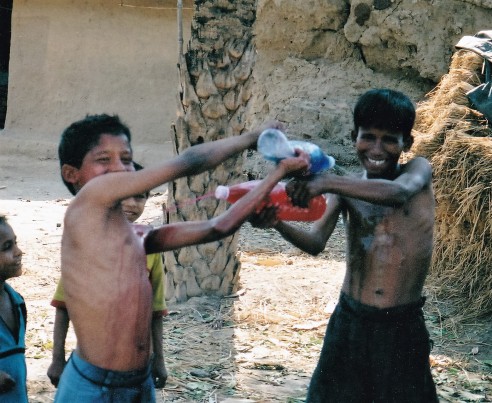
The following morning the fun really started. This is when there is license to soak everyone and everything in dye and gulal (powder): people, cars, rickshaws, passing dogs, whatever. The first few hours of the morning really are not a good time to be out, since this is when the mud and other unpleasantness’s (stones, dung) are quite often used as missiles We nipped down the road when the coast was clear for breakfast, then holed up until lunchtime back at the guesthouse. At lunchtime we returned to the same cafe, since very few were open and this is the nearest in any case. Soon a party of Indians arrived, some of whom we knew, who screeched to a halt in a car, came in loaded with beer and whisky, got the bhang out and very loudly invited us to join them. We made our excuses and left as soon as we could.

At this stage, I had already had a couple of hits from the kids (all of which seemed good-natured) and so I went over to the Foundation where I was working, where I had been invited to join in the festivities in the afternoon. As I approached the village, it became clear that I was not even going to reach the Foundation without much celebration (I guess that’s the best word). A few soakings from kids, then as soon as I plunged into the alleyway that led to the Foundation, A group of men emerged from a house, there was a fair amount of liquid dye squirted around, then handshakes and we swapped gulal markings (on each other’s foreheads, like cast marks) and I was presented with a piece of buttered toast soaked in milk for Holi – I had this last year, it’s actually rather nice! This activity then escalated until I reached the Foundation, where I walked into what felt like a carefully laid ambush, but was actually just the on-going hi jinks.

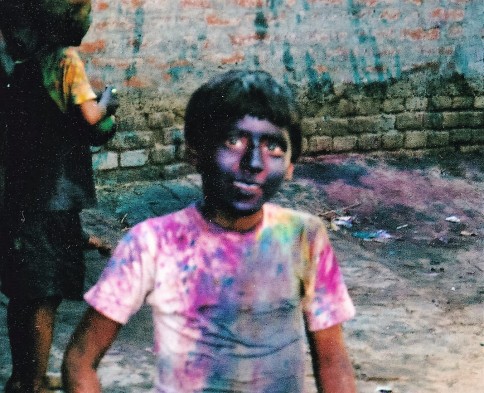
In no time at all, I was soaked from head to foot in dye and gulal. All the Foundation kids were there, plus the adults, and it also seemed as though half the village were charging in and out. Colours were flying in all directions, people rubbed handfuls of the stuff into each other’s faces and hair, handfuls of powder were dabbed on feet, on foreheads. We rubbed foreheads together, spreading the powder further and someone tipped a whole bucket of blue dye over me from behind. A man from the village, who was the father of one of the children in the school, swapped gulal marks with me and said ‘now I am your son.’ I probably should have replied ‘and I am your father’ but I just smiled and said that I was honoured. It seemed okay, because he beamed and gave me a great bear hug.
IMG_0001 (2)

After an hour or so of this, it begins to wind down and the kids are slowly introduced to soap at the pump. Eventually we return to the guest house and I spend an extremely long time in the shower trying to remove the worst of the dye. Most of it eventually comes out, but I suspect the turquoise will be on me when I return to England. Goodness, I’ve got dye in the parts that other beers can’t reach!

By then it is evening, and we decide to try the other cafe that is open, since the party still seems to be going full-pelt in our usual one. We go in and, whilst impressed at the variety and quantity of insect life that it is possible to fit into one small cafe, decide that perhaps it is not the place to eat. We return to the first cafe, where there is an equally impressive array of human detritus – stoned, drunk and asleep. We eat, we go.

March 27th 2005. Holi; day two. Easter Sunday. Whatever.

I go into town after breakfast, where there is a little desultory squirting going on (don’t titter), but mainly people (at least young males) seem to be gathering in groups. There is one on the Tibetan Market ground and one on the river bed by the bridge. I’m not sure of the significance, but it seems to involve small bonfires and noise. Not much else seems to be happening.

After lunch, I walk over to the Foundation. It is still very quiet as I walk over, the bridge almost deserted and the only noise from some parties in the distance. As I walk towards the Foundation, the noise level rises and I turn the corner to see the afternoon’s entertainment in full swing, on the open ground in front of the Foundation.

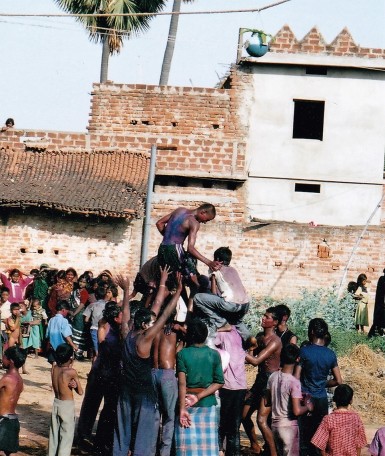
A clay pot is suspended from a rope that hangs between two poles, containing coloured water and a load of rupee coins. Beneath it are twenty or thirty village lads engaged in attempting to reach it. This they have to do by means of making a human pyramid. To be successful, it must reach three persons high. To complicate matters ever so slightly, an equal number of lads hurl dye, water, mud and straw, etc, at them as they climb. The passage of time is enlivened whenever a rickshaw or bicycle attempt to get past, with predictable results. One group of three on a motorbike particularly unwisely decide to hoot imperiously at the group as it approaches. It and its riders immediately disappear beneath a deluge of water, dye, straw, mud, etc.
IMG 2

It takes two to three hours before one lad successfully reaches the pot, hanging by one hand from the rope and tipping out the dye and rupees onto the crowd below. The waiting children swoop, and everybody slowly drifts away.

Bumping into a friend in the evening, it turns out that she spent the afternoon at a teacher’s house (she works at a school) where it was music, dancing and feasting. Lots of decorum. Really not the same.
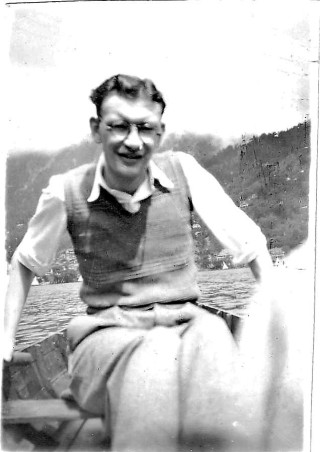
My Father in India

They didn’t talk about it.

It wasn’t as bad as the First World War, when men who had nervous breakdowns were frequently shot for cowardice, but the men of the generation who fought in the Second World War were still reluctant to talk about the hardships they had faced and the horrors they had seen.

When my father did talk to me about it, and it was very rare that he would, it was generally to joke about the fun that he’d had on leave, or, after my first visit to India, to ask about places that he remembered from Delhi.

He had seen fighting in Burma, and stayed in India right up to the time of Partition. He certainly wasn’t going to talk about either of those. When pushed, he’d clam up about Burma, and would only say that what he’d seen in India at the time of Partition was horrible.

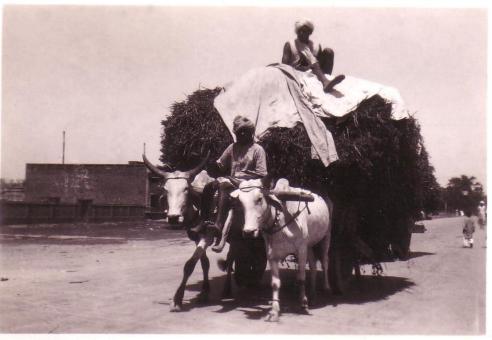
bullock cart

I daresay he told me one or two things that I have forgotten; things that didn’t mean much to me at the time. Perhaps he told me where he had been when he was on leave and was photographed rowing a boat on a lake in the hills; almost certainly in the North of India. Nainital, perhaps? I have been there myself, now, and I’m not certain. If he had told me before I’d been out there, the name would have meant nothing to me, and so I wouldn’t have remembered it.

And by then it was too late to ask him, because he died before I returned for my second visit.

dad 1

Once he had returned to England, he never went back to India, and I certainly never had the impression that he wanted to. I guess that the bad memories must have outweighed the good ones.

I have a dictionary that he bought in Delhi, stamped inside the cover ‘Cambridge Book Depot, New Delhi’ with the price scribbled in pencil; Rs 3/12, and his signature. I also had some old Indian coins, once, that he had given me, but I’m not sure where they are now. Other than the photographs, I’m not aware that he brought anything else back. Certainly, there were never any ‘curios’. Although a part of me wonders whether there might have been once, and whether my mother, a staunch Christian, might have thrown them out after they married. But that is pure conjecture.

hill station 4

And he was interested enough to read books on India’s history. I was surprised, occasionally, on the depth of his knowledge on the subject. He was, though, always interested in history, so I suppose that I shouldn’t have been really, and if he hadn’t have been born working class, I daresay that he might have had a university education, because he excelled at school.

Most of the photos are in fairly poor condition, although I have attempted to improve a couple of the ones that were particularly bad.

It seems strange to think of soldiers as tourists, but whilst they were on leave in India, that is, of course, exactly what they were. There are one or two photos in his collection that were taken of places I have been. One of them is of a view inside the Red Fort of Delhi that differs only in the size of the tree in the picture from one that I took in 1989.

He must have stood in exactly the same spot to take that picture, some 45 years before.

What does this small slice of family history mean for me?

mainstreet poona

It does mean that there is a slight family connection to India, if not in the way that usually comes to mind. He had no family there, and had no responsibilities beyond his army duties, but just the fact of his living out there for a number of years, gives me this connection. Or so I like to think of it.

In the end, India wove its magic over me – nothing much to do with Dad, I suppose, although I expect that was in the mix somewhere. I think that part of why I may have gone out there the first time, was to follow in his footsteps. And now my family can say that they have a connection to India through the time that I have spent out there as well.

Chinese New Year

Well, a couple of days late, but that is just typical me, I’m afraid. So, Gong Xi Fa Cai, everyone!

Of course, It’s a good excuse for me to show off a couple more of my paintings.

chinese new year 1

Chinese New Year #1

Chinese New Year 2

Chinese New Year #2

Both paintings are 24 inches by 18 inches, and are acrylic on board.

The last time that I took part in Chinese New Year celebrations, was when I was staying in Kolkata in 2013. Until then, I had not realised that there was such a large Chinese population there. I was staying in a small guest house some way away from the main streets, and heard the sounds of drumming from outside. When I went to investigate, I found a group of almost 100 young Chinese, all dressed in red T-shirts with their names on the back, a number of dragon and lion costumes, and a good supply of cabbages and coins. I wandered around with them for about an hour or so, as they went from house to house, dispensing good luck.

I think it is fair to say that it was an unexpected treat.

India – My First Time (2)

A few more photographs from 1989 (my apologies for the quality of some of them – all I had with me was a very cheap camera):

After a few days in Delhi, I went to Srinagar, in Kashmir. I took the bus that went through Jammu, and 24 hours after leaving I was deposited in Srinagar.

On the way, I did one of the most stupid things I have ever done in India.

The bus was packed. I think that I was the only westerner on the bus, but I liked it that way. On a 24 hour bus trip, it is pretty well impossible to ignore your neighbours for the entire journey, and so I spent much of the time chatting with the chap sitting next to me, and the ones across the aisle. When the bus halted to allow us to get some food, we sat at the side of the road together munching on the samosas, pakoras and newspaper twists full of nuts that we had bought.

When it started up again, we chatted long into the night before falling asleep.

And at the first stop just after dawn, at another cluster of roadside stalls for breakfast, I joined them at the broken water pipe beside the road where we all brushed our teeth.

Maybe if I had spent longer than just a few days in India by then, the consequences would not have been so violent. But as it was, my stomach had clearly not yet adjusted to Indian bacteria.

And maybe if I had spent longer in India I would have realised that it was not a clever thing to do in the first place.

IMG

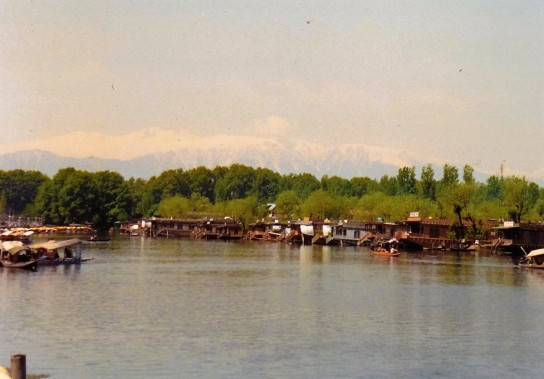
In Srinagar, I stayed on a houseboat on Lake Dal. I no longer remember what it was called, but I was the only guest, and I had the place to myself. These wonderful floating mini-palaces are a relic of the days of British India, when the local Prince refused to allow the British to purchase land to build houses. They got around this by causing the construction of houseboats to stay on, instead. Made from wood, beautifully carved, and furnished opulently throughout, they seemed to me to be unspeakable luxury after my 24 hour bus journey.

The rapidly multiplying bacteria in my stomach, though, were clearly in a hurry to join all of their friends in the Lake. But for someone feeling poorly and reluctant to stray too far from a bathroom for a few days, the houseboat could not have been better. I had my meals cooked for me, and any little treats I fancied I could buy from one of the many shikaras that continually paddled up to the houseboat. These little boats, which also acted as water taxis, sold chocolate, flowers, fruit and vegetables, cigarettes, snacks, flowers, newspapers and yet more flowers.

I passed much of that time on the deck or on the roof reading, or chatting with the folks around me on the nearby boats or on the shikaras.

After a few days I recovered enough to explore the area a little. I walked many of the paths around the lake, which is a more complex shape than the visitor first realises. I would frequently find myself on causeways or small spurs of land sticking far out into the lake. I wandered around the Shalimar and Nishat gardens, and I walked up the long, winding path to the Shankaracharya Temple, on the hill of the same name.

This was March, 1989, and even someone as unobservant as me could not fail to spot the signs of unrest. Once or twice in the evenings I heard what might be shots or small explosions in the distance, which my host casually dismissed as ‘bandits’. On one occasion, walking through Srinagar I found the road blocked outside a mosque, where there was lots of shouting and a large police presence; although on reflection, I have seen much the same thing outside the rail ticket reservation office in Kolkata, and perhaps I should not make too much of it as an incident.

It was only a few short weeks later, however, that the insurgency began in earnest. For a long time there would be very few further visitors to the lovely Vale of Kashmir.

After a week, I returned to Delhi and then headed immediately to Agra, to see the Taj Mahal. I chartered a car and driver, because I wanted to also visit Fatehpur Sikri on the way.

IMG_0002

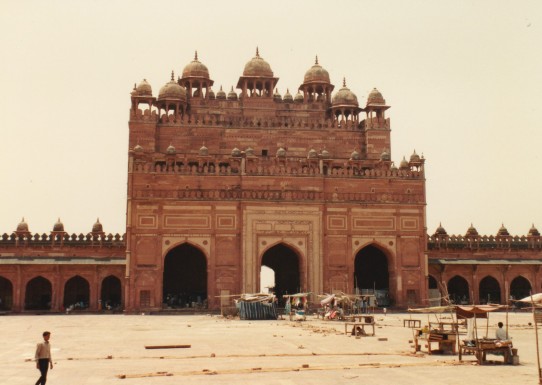
Fatehpur Sikri was built by the emperor Akbar in the sixteenth century. His intention was to create a new capital city that honoured a Sufi Saint whose blessing the emperor believed had given him a male heir. This site was chosen, as it was close to the dwelling of the saint. Unfortunately, the area suffered from water shortages, and the city was abandoned shortly after the emperor died, after only 13 years occupation.

There remains the magnificent, well preserved, fortified city that I wanted to wander around for a few hours. Inside, there were a few stalls selling souvenirs and drinks, and a number of other visitors looking around, but generally there was an impression of peace and emptiness. I have not been back since, but I believe that it is now far more crowded, and that there are far more touts and hawkers on the site.

IMG_0003 (2)

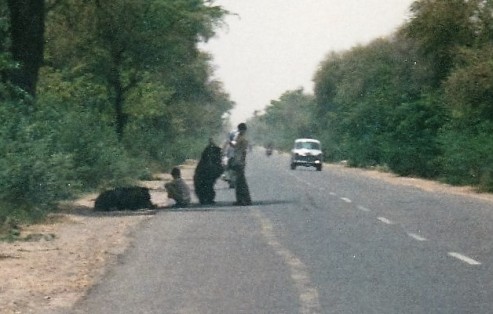
Performing bears at the side of the road. The cruel practice of dancing bears was made illegal in India in 1972, but was certainly still common in 1989. These ones were at the side of the road not far from Fatehpur Sikri, on my way to Agra.

In Agra itself, I visited the Taj Mahal.

the_classic

There are plenty of people who will tell you that it is over-hyped, and that there are many greater buildings in the world. It is possible, also, that some of these people have actually been to Agra.

It may be that there are some buildings that are more impressive, but how can you measure such things?

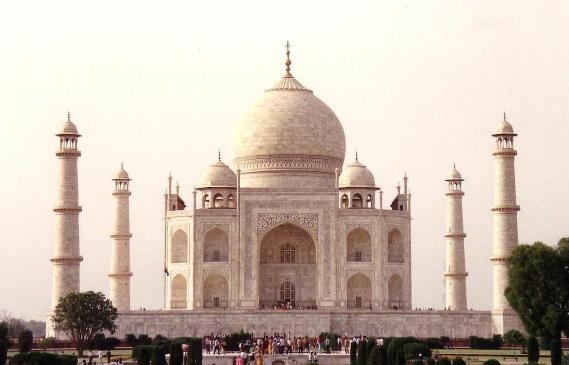
My first sight of it, as I walked through the gateway, made me catch my breath and stop still. For a moment, I could not believe how lovely it was. I then spent a long time wandering around the site, and I still think it one of the most beautiful and magnificent buildings that I have ever seen. I watched the afternoon light fade and die, and the sun go down, and the building seemed to glow and shimmer and almost float before me.

I left when they threw us all out at dusk, knowing that I had just seen something very special.

By Popular Demand

A few weeks ago I put up a couple of pictures of paintings that I had made of Indian subjects, and a number of readers were kind enough to say that I should put up some more.

Today, then, a couple more.

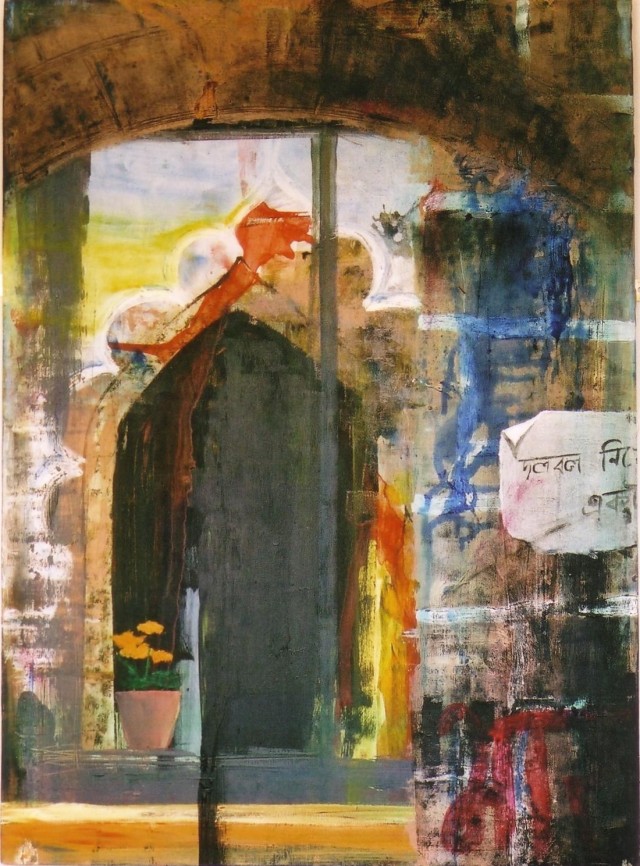
ladakhi door 1

Ladakhi Door #1

Doors are a favourite subject of mine, and this one is from a monastery in Ladakh, Northern India. Ladakh is sometimes known as ‘Little Tibet’, and in some ways, now, it could be said to be more Tibetan than Tibet. Historically, it has been a part of Tibet, and I have an old book of a journey that was taken in 1904, ‘Through Western Tibet’, by Jane Duncan, a doughty traveller, which places Leh in Western Tibet, although I am not certain of exactly where the border lay then.

mosque

Mosque

There was quite a bit of artistic license employed in the making of this painting. It is based on a mosque in Bopal, but I have never been there, instead relying on photographs. I have made no attempt to depict it accurately, but instead I interpreted it to create a totally new aspect.

Both of these paintings are in acrylic, on canvas, and measure 24 inches by 36 inches.

India – my first time (1)

Just a few photos this time, taken on my first proper trip to India. On the only previous visit, in 1988, I had spent a manic 18 hours in Delhi, and then taken a long bus journey to Nepal. That was a journey that really should be the subject of a blog itself, sometime.

On the following year, then, I returned to India, intending to spend rather longer there this time. As it turned out, I had to return to England after a few weeks, but the short time that I was in India whetted my appetite for more. It is said that western visitors to India tend to fall into one or the other of two categories. Either they fall in love with the country, and return whenever they can, or they swear never to go within a thousand miles of it ever again.

I’ve been back about ten times.

Delhi Red Fort 1

The Red Fort (1989)

I arrived in Delhi with a copy of Lonely Planet’s ‘West Asia on a Shoestring’. In those days, the Lonely Planet tomes really were aimed at backpacking budget travellers, with their recommendations for rooms tending to be dormitories and really cheap hotels. My flight arrived in the late afternoon, so that not only was I weary from the long journey, but the light was already fading when I walked out of the airport. In the chaotic maelstrom outside of passengers and taxi drivers fighting over them, I managed to remain calm enough to locate the corner where the buses of the Ex-Servicemen’s Air Link Transport Services waited. I think they are still in operation today (I’m sure someone will tell me), with their yellow (I think) buses providing a cheap link into the centre of Delhi where I was heading.

I was dropped off near the hotel I had decided to use, the Ashok Yatri Niwas, which stood at the junction of Janpath and Ashoka Road. It has long gone, now; a great concrete monster of a place with cement beds and lifts that seemed to take half a day to do the full journey up to the top floor. I don’t think that many people mourn its going, but I was reasonably comfortable there for a couple of nights. It was where I had stayed the previous year for the one night I was in Delhi. There was hot water in the bathroom, as long as you rose early enough, and I remember the cafeteria being fairly basic, but adequate. For someone on a tight budget, it was fine. Back then, it was a case of turn up and hope there was a room, especially if you had just arrived in the country. There was no email in those days. But it was pretty big, and there was room for me.

Unlike my previous flying visit, I now had time to wander about and savour everything around me. And for the first time, it really did seem an alien and exotic society. I had enjoyed browsing in the souks (bazaars) when I had lived in Oman, and also out in the little villages there, but my first taste of India seemed to me to be as exciting and exotic as it got. Everywhere I went, I was surrounded by the noise of traffic and the odours of exhaust fumes. But the traffic was different; the buses appeared to be almost falling to pieces, loud and fierce, with people hanging off the outside as well as being crammed inside behind open, barred, windows. I saw tuk-tuks everywhere; the little three-wheeled taxis that buzzed like wasps through the traffic, squeezing through every available gap. Amongst this impatient, petulant, hooting traffic, carts pulled by horses or buffaloes plodded. Motorbike riders forced their way through, and cyclists cautiously weaved their way along. Everywhere, pedestrians took their lives in their hands to cross the roads, but the traffic all swerved out of the way for the cattle that wandered imperiously through the streets, ignoring it all.

Incredibly, through the traffic pollution so thick that you could grab handfuls of it out of the air, there were dozens of other smells assailing me everywhere I went. I was tempted every few steps by cooking foods, and then I might pass a doorway and a strong smell of incense would waft out. Seconds later, I would suddenly wrinkle my nose as I passed a pool of sewage on the sidewalk, but then immediately I might pass a fragrant flower stall.

delhi_gate

Delhi Gate, in the old city near Chandni Chowk. (1989)

There were temples everywhere, and a shrine of some description every few steps. Here and there were green and white mosques, stalls of old sacking and weathered boards set up outside gleaming new metal, glass and concrete shops. There were holy men jostling office workers, great hump-backed cattle and pariah dogs in corners or in the middle of the footway, beggars, shoe shiners, touts and hustlers, people in a hurry and idlers passing the time of day. I was urged to discretely change money, buy drugs, see pornographic videos, have a massage, change hotels, visit ‘my brother’s’ shop or book a trip to another part of India.

It was dirty, colourful, loud, exciting, and different and I loved it.

I walked everywhere I could, not just because I was on a tight budget, but it is always how I have got to know a place. I went to the Red Fort, on my first full day there, enjoying the relative peace and quiet inside, and it was here that I discovered Mogul architecture: The beautiful soft red stone and the marble, the carvings and inlay, the arches and columns…the only time I’d seen architecture that beautiful, before, was in Grenada, in Spain.

And now, looking at the photos I took, I am struck by an odd discrepancy. In my memory, one of the defining things about Delhi when I arrived was the incredible press of traffic. In my photos, though, there are comparatively few people, and even less traffic. Is my memory at fault? Is it just that there were obviously far fewer people in India 30 years ago? Perhaps it is chance alone.

But I think I’ll return to the architecture at a later date.

A bit of paint splashed around

A different sort of creativity, today. I paint, at times, so here are a couple of my paintings that were inspired by my trips to India.

bihari door

This one is of a door on a house in the North India state of Bihar.


india #1

And this one a more impressionist rendering of doorways, arches and windows.


Although writing has always been the primary medium through which I have tried to express my thoughts and feelings, it was my first trip to India, 28 years ago, that persuaded me to try to paint seriously. Although I have done little in recent years, I still dabble on occasions, and suspect that it is only a matter of time before I begin work on a new painting.

Dull day

It is a particularly dull and miserable day, today, with unbroken thick grey cloud overhead, an unpleasant, damp cold, and a very thin rain in the air. I read bits of my novel, and I yearn at this moment to be in India. That I am looking through a few of the photographs I took in India, at the moment, does not help.

P1050060

I am now at the stage of giving my short novel its first edit. I have written the book from the point of view of an adult female in a rural community in Northern India. It is primarily about both the relationship between the two main characters; a woman and her daughter-in-law, and about the roles and the treatment of women in a male dominated society. The way that I have written it, it is essential for the reader to be able to get inside the head of one of the main protagonists. So, for this reason, I felt that the narrator had to be one of them.

It is a little unusual, of course, but hardly unheard of, for a writer to write with the voice of someone of the opposite sex, although it is more usual for female authors to adopt the voice of a male narrator, rather than the other way round.

(Is that because we are so shallow and easily understood? Don’t answer that, it might be a post for another time, although if I did attempt to write it, I probably wouldn’t have the courage to finish.)

Anyway, whether this voice I have used in my novel sounds authentic or not, might be quite another matter.

I can imagine several areas where I might have succeeded less well than I would have hoped;

a) It might sound like a male voice, especially to female readers.

b) I may have painted a vague, shallow picture of my narrator, subconsciously avoiding difficulties.

c) I may therefore have painted minor characters more brightly than the protagonists.

d) By doing this, I may present as an arrogant westerner, thereby fulfilling images of ex-colonial stereotypes.

On my CV, however, I do have a few months when I was living and working in a small town in Northern India, much of the time spent in rural areas, amongst a dozen or so visits to India in total.

It probably goes without saying that I also have a keen interest in most things Indian, many books about India and, of course, we all have Google.

And writers do, all the time, write about places and situations that are outside their experience, and it is never really possible for anyone to fully understand the thought processes of someone from another time, another culture, or another gender, and so it is a level playing field in that respect.

So, with a glance out of the window at the gloom outside, I’ll get on with it. I do wonder how many male writers have tried to write with a female voice, though, and how successful they felt they were…

…anyone want to come in at this point?

A Day in Ladakh

Wednesday 13th April 2005

This morning, there is a clear blue sky, with just a couple of clouds sitting on top of the Stok Mountain Range. It doesn’t seem quite as cold in the morning as it has been recently.

I go for breakfast at the Budoshah. I don’t really know why I eat here (I certainly don’t always), unless it’s because the morning sun warms the corner that I’m sitting in. I’m the only person here and when I walk in, the waiter always seems frightened to see customers. When I’m eventually given a menu (and everything is always ‘off’ – it’s a Kashmiri restaurant, so two thirds of their dishes are chicken or mutton. The day before yesterday, people were being told ‘no chicken no mutton’.), I ask for scrambled eggs on toast.

I’m told no, they can’t do it. Fried, boiled or omelette, yes. But the cook obviously can’t scramble them.

And black coffee.

‘Pot?’

How big is the pot? I ask.

‘Ah…I get one’. He disappears back into the kitchen, never to return. I sit back and contemplate the Ladakh Mountains in the sunshine, prayer flags waving lazily beside the temple. With luck, it will be another warm day. I think I’ll catch a bus to Thikse Gompa.

My coffee arrives. In a glass.

The toast arrives with heart-stopping chunks of Ladakhi butter – like everything here that calls for butter. I thought at first that it must be cheese. It seems to be the Ladakhi/Tibetan way. I made a mistake and had a cheese sandwich the other day – the cheese is just like butter, so you can imagine what it was like for my poor western tastebuds. I had to scrape most of it off.

leh street

It’s 12.45, and I’m sitting on a rock in hot sunshine at the foot of Thikse Gompa. The bus ride here was remarkable (and where else in India would you find that the driver would wait a few minutes whilst a passenger nipped off the bus to buy some bread?). All the way here, we passed through this wonderful desert scenery, with fairy-tale castles and palaces and the like clinging precariously to the tops of cliffs.

The Ladakhi buses are like all Indian buses, though. Today’s had plenty of pictures inside and on the windscreen (The Dalai Lama, Buddha, etc.), two vases of flowers and a fancy piece of wooden scrollwork on the dashboard, and several drawers incorporated into this.

At the moment I’m having my apricot and water lunch to the accompaniment of drumming in the background; a ritual going on somewhere. There are so many gompas here, and every private house performs their own pujas, that it could be coming from anywhere.

We passed through Shey on the way here. More of this tomorrow, I think. I intend to spend the day there.

I ‘strolled’ up to the gompa, and was shown around by a monk. We chatted in a mixture of Ladakhi, Hindi and English. He is a Ladakhi, in fact all of the monks here are. There are no Tibetans. In fact, despite the large Tibetan population here, he says that there are only two monasteries with Tibetan Lamas.

Untitled-TrueColor-01

We watched a group of young monks kicking around a football, a hundred metres or more below us.

Do families still send one son to be trained as a monk?

No, but there are still many coming.

I was first shown the giant statue of Maitreya Buddha, which is fairly modern, then the fourteenth century gompa, which is very dark and unlit, which made it difficult to properly see the wealth of thankas and statuary. I had to tell him about my family, job and anything else he could think of. That was quite hard going, and I don’t think we totally managed to get through. A pigeon flew into the gompa and started a discussion (not literally, you understand). In Ladakhi, pigeon is (I think) Po-ro, fairly onomatopoeic. In Arabic, I told him, it’s Bulbul, also onomatopoeic. Possibly it is the same in Hindi and Urdu.

Untitled-Scanned-01

Back for tea and a bucket shower.

Later, I’m walking around the market. How strange to go around market stalls and shops in India, not getting pressured and hassled at all. At times it seems almost unreal. You wonder whether suddenly it’s all going to crash around you and normal India will be resumed as soon as possible. The longer that you spend here, the more laid back you become. I don’t think you can help it! Everyone strolls around smiling and Julay-ing you and each other. I know that Ladakhis consider it the height of bad manners ever to lose one’s temper, but it really does seem unreal. I think it would be easy to just sink into the ambience of it all and find you’d suddenly missed your flight out and had overstayed by weeks, or months…

Andrew Harvey said, and I’ll have to paraphrase because I can’t remember the exact quote, ‘The wonder of Leh is that there is absolutely nothing to do. Nothing to do except slow down, switch off and just observe. Just be.’ I understand that, now. I realise that that is what I have been doing the last few days without realising it.

trees

I had Phung Sha and rice for supper at the Amdo -a Tibetan dish. It is a sort of thick vegetable stew, which I shall certainly have again.

I have always wanted to read Rumi, the thirteenth century Persian mystic and poet, and I picked up a copy today from the little bookshop. I am now wrapped up in my blanket reading it by the light of my candles.

Downstairs, my hostess is singing again. Last night, I tiptoed out to the landing to listen to her singing what I was told this morning were Ladakhi folksongs, and I creep out again to listen now.

This time it’s ‘Bob the Builder’.

Jaipur

I have recently discovered Arv’s lovely blogsite ‘Jaipur thru my lens’:

https://jaipurthrumylens.wordpress.com/

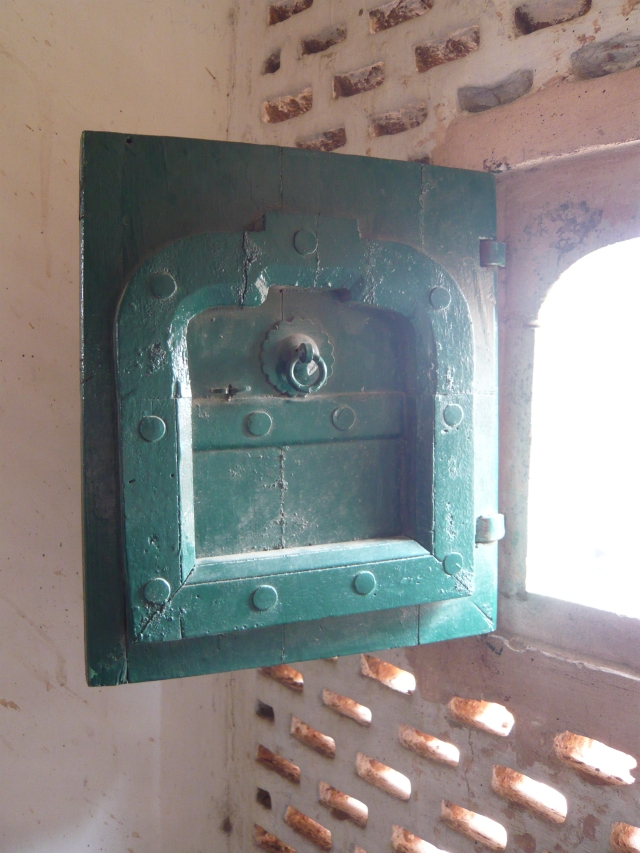
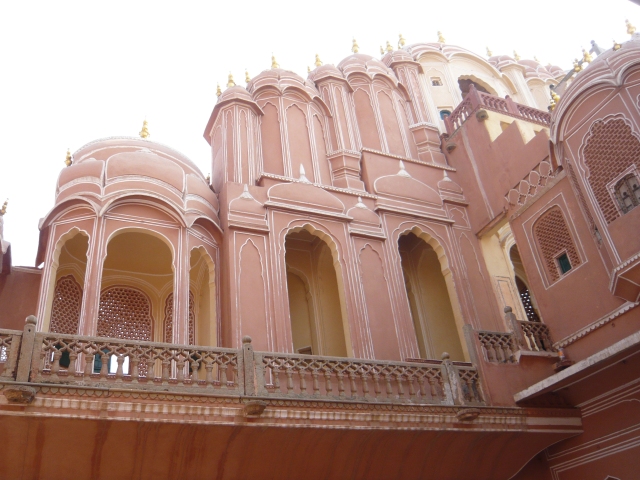
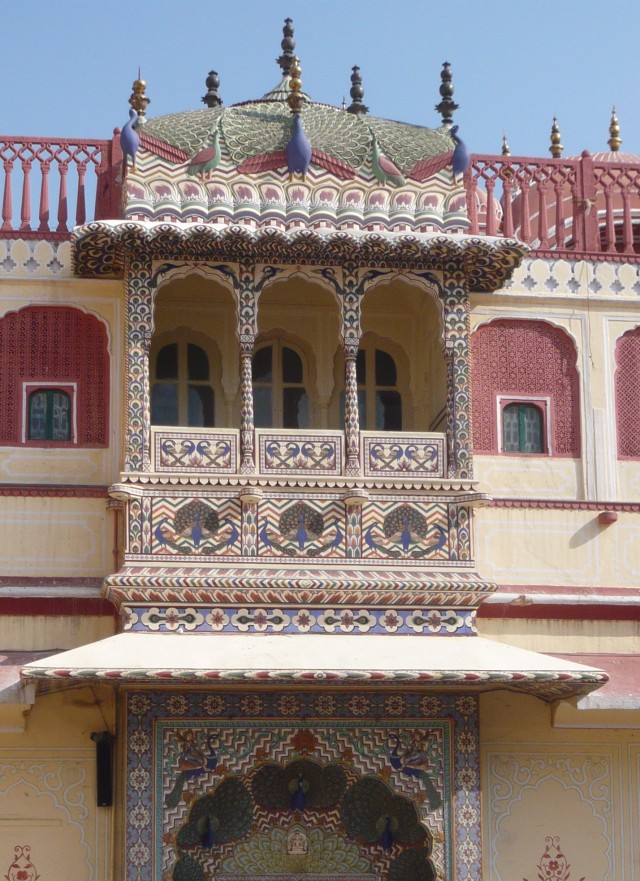
and after reading several posts and enjoying the pictures, I felt that I had to revisit my own photos of Jaipur and share a few of them.

They’re a bit of a mish-mash, but, there you go.

I was there in 2009 for a few days, and probably the thing that I remember most about it is that because I was unwell for much of the time (unusually for me),  I did not get to see many of the places there that I had wanted to see.

I think this is why I enjoyed Arv’s pictures so much.

115


102


089a


091a


092a


157a


109a


132


146a


131


121


156a


123a