100 Word Stories

I know one hundred word stories are a thing on here, or ninety nine word stories, someone supplying a prompt – either a word or a phrase or perhaps a photo – but I was just playing around and came up with this. So no prompts, just a bit of fun.

Those of you of a certain age and musical heritage may identify with it…

‘This was a particularly brutal murder, sergeant.’

‘Yes, sir. With around three hundred people watching. Open and shut case, fortunately.’

‘And he was the keyboard player?’

‘Yes. He was about fifteen minutes into the Hammond Organ solo when he was killed.’

‘Who did it? A member of the audience?’

‘No, the vocalist. She bludgeoned him with the microphone stand. Really vicious. All she’s saying is this was the eighteenth night of the tour and there were still twenty seven to go.’

‘Didn’t any of the other band members attempt to stop her?’

‘No, sir. Apparently, they were egging her on.’

In Another Lifetime I Could Have Been…(1)

…a folk musician.

There are any number of reasons why I haven’t become one in this lifetime, only one being a lack of any obvious talent. Perhaps if I hadn’t gone abroad when I did, I might have inveigled myself into a group of musicians and played a little more, and a little more regularly. Perhaps if I’d practised more I’d have been a little better! Perhaps if I’d actually learned to read music properly I could have learned more tunes properly. Who knows?

I could play both the guitar and mandolin fairly competently, if nothing more. It has been many years now, though, since I owned either – or a fiddle or a whistle either, come to that, both of which I had pretensions of being able to play, at least a little. I still play a pretty mean air mandolin, though, and my air guitar licks would put Richard Thompson to shame, although so far I’ve had limited success with my Henry Parker air guitarwork – unfortunately he uses a different tuning. I am occasionally tempted to buy another mandolin, or perhaps a guitar, but if I’m realistic I have to admit I would never devote the time to them that would be required. It’s going to remain one of those dreams realised only in my imagination.

But a note for that other lifetime: I’m not one of those folk who have to be the very best at whatever they attempt, otherwise they feel it isn’t worth the effort. I wouldn’t have to be a star, I’d be content to be a session musician, a backing musician. Just to make a living doing something you love is awesome and something not given to many. Or not even to make a living, perhaps, just to make music with others is a delight and I could still be happy with it being a spare time occupation.

So, sticking to going to gigs and listening to CDs this time around.

Unhalfbricking

I’ve never written an album review on here before, although I have reviewed a couple of concerts I’ve been to, so this is a first.

And if you have absolutely no interest in folk or folk-rock feel free to give this post a miss.

So, probably just one of you left. Let’s go.

Actually, now I’ve written the thing, it’s not really a review at all. It’s a bit of musical history, if anything. That wasn’t exactly what I’d planned.

Oh well…

Unhalfbricking is not my favourite Fairport Convention album, but it is an extremely important one. Which is not to say I don’t like it, because I do. It was released in 1969 and is their third album.

It is the following album, though, Liege and lief, which is rightly regarded as their most important, and an album that has had a huge influence on the direction folk and folk rock music has taken since its release, but Liege and lief came about as a result both of a tragedy and a new direction partly forced on the band by musical events way over the other side of the Atlantic. After the release of Unhalfbricking, most of the band were involved in a serious road accident (singer Sandy Denny was in a separate vehicle) which led to the hospitalisation of some members and, sadly, the death of both drummer Martin Lamble and the girlfriend of guitarist Richard Thompson.

After discussing whether they would continue as a group or just disband, the decision was made to continue and they hired a new drummer, the amazingly talented Dave Mattacks, and persuaded fiddle player Dave Swarbrick, who had guested on Unhalfbricking, to join the band on a permanent basis. And the decision was also made to change musical direction. Much of the material on their previous albums had been either American in origin – there were Three Bob Dylan covers on Unhalfbricking alone, for example – or country-tinged.

There is one track in particular on Unhalfbricking that helped to lead the band into their new direction, the traditional song A Sailor’s Life, which breaks new musical ground in this recording. What makes the track most memorable is that it is the first time a drumkit had ever been used on a traditional English folk song. It was also the first time Dave Swarbrick had used electric amplification, coming from a background with traditional folk groups. And then the whole track was apparently improvised on the first take, the first time the band had played it together, and listening to it, it is remarkable how you can hear them growing in confidence throughout the performance. And it is a long track, which I suspect has more than a little to do with the musicians getting the feel of working together and seeing what could be done with the material. Experimenting as they go along. Nothing like it had been released before.

Over in America, The Band, who had supported Bob Dylan on tour, had recorded Music from Big Pink in what has been called a reconnection with rural Americana, and listening to this there was a realisation both that by covering American standards Fairport would never be more than just one more wannabe Byrds cover band, but also that they wanted to take a similar direction with traditional British music. Bass player Ashley Hutchings had become deeply interested in the genre and Swarbrick came from a folk heritage. Thus A Sailor’s Life became a bit of a template for what was to come.

Finally, here’s a link to the song on YouTube.

Chanctonbury Rings

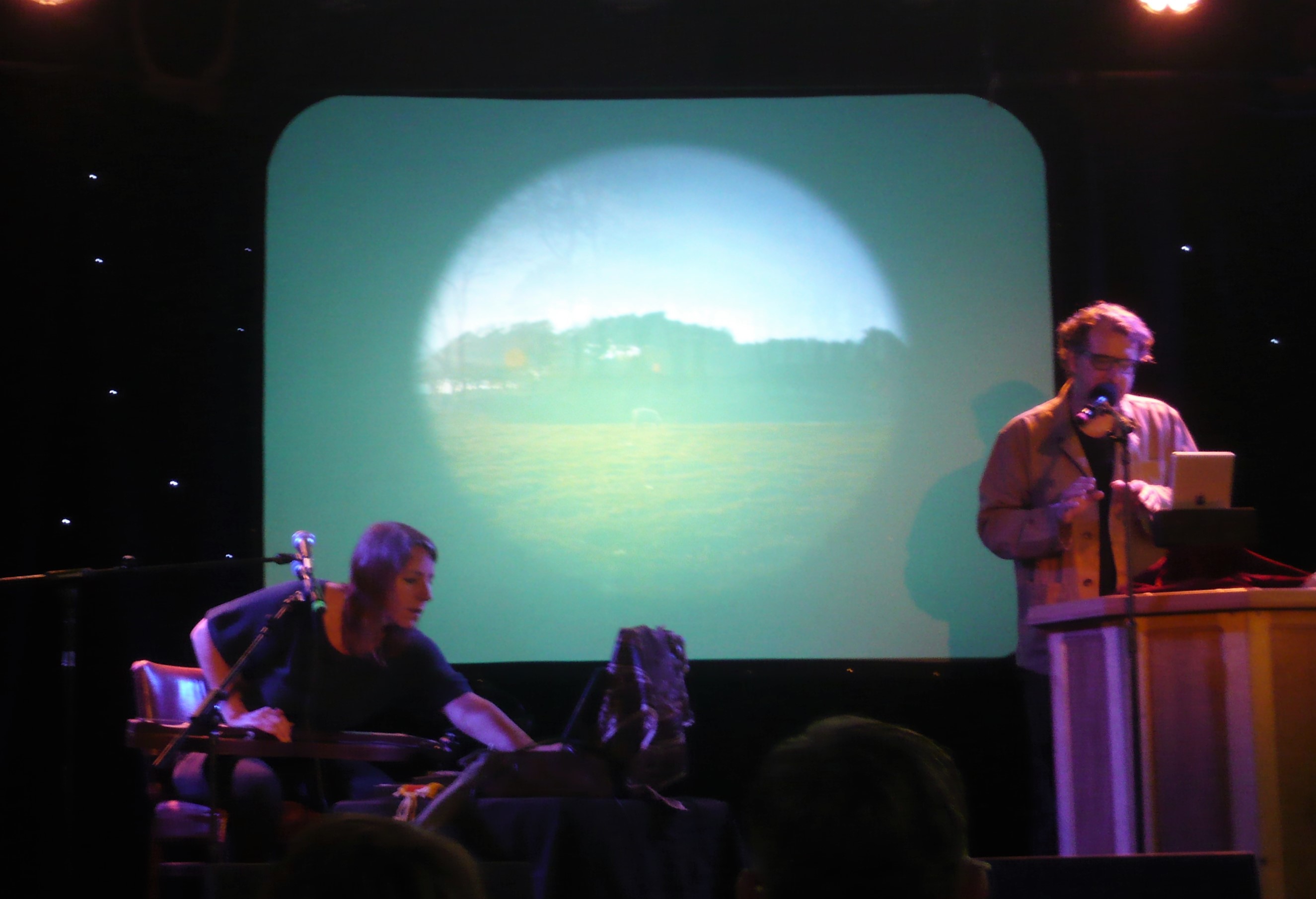
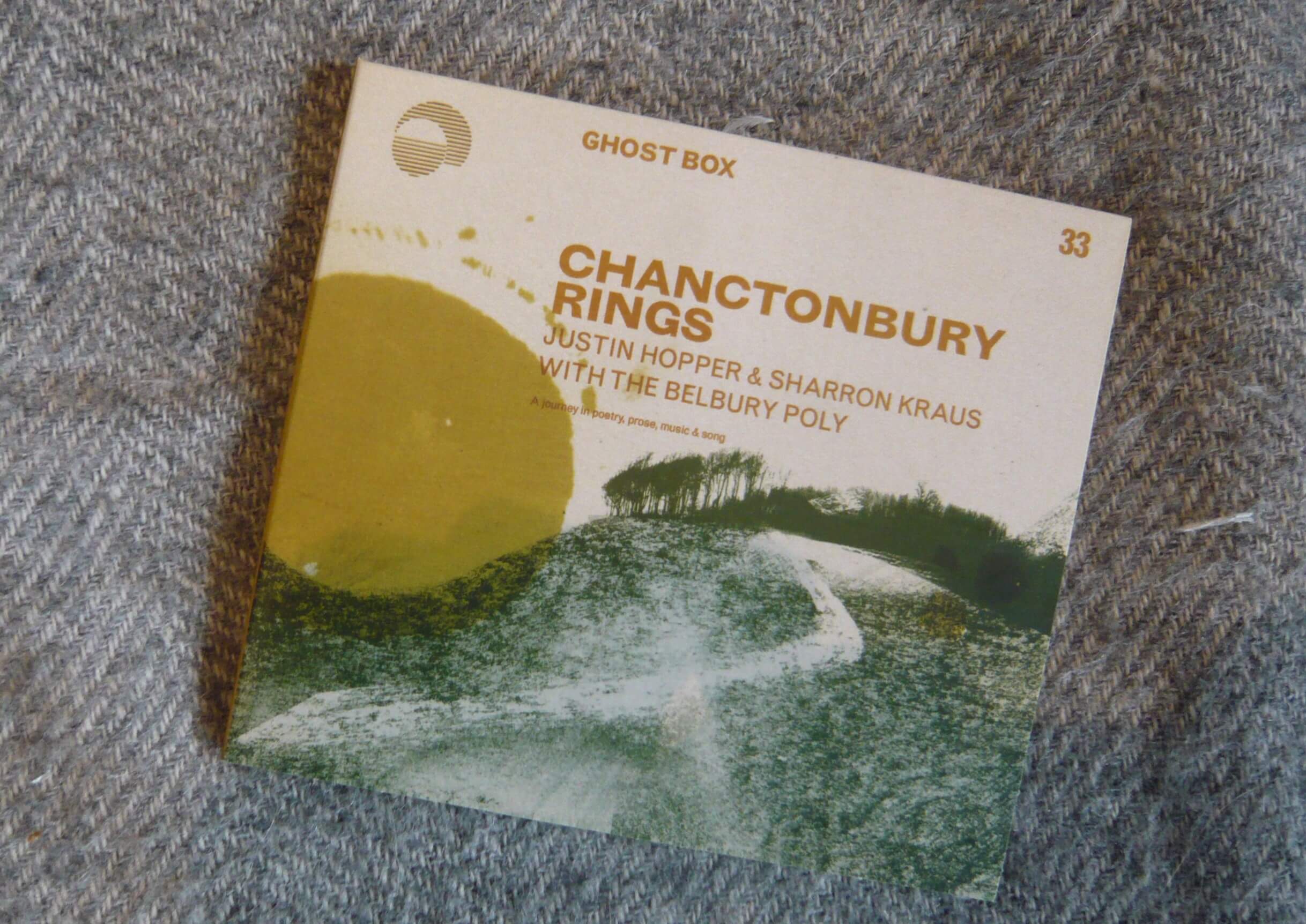
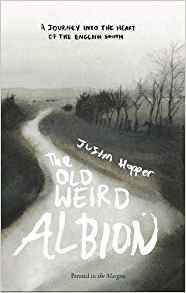
This Tuesday evening just gone. Brighton. 7.30pm. I’m here with my friend Mark to see a gig for the first time since the Pandemic began, a gig I had planned to see last year for my birthday, but which was cancelled – due to the Pandemic, of course. Chanctonbury Rings is a collaboration between writer Justin Hopper, musician Sharron Kraus, and visual artist Wendy Pye, based on extracts from Justin’s 2017 book The Old Weird Albion.

Chanctonbury Rings was released (on CD, vinyl and download) by Ghost Box in 2019, and is described on their website as ‘A spoken word and music project by writer Justin Hopper and folk musician Sharron Kraus. It also features Ghost Box’s own Belbury Poly. Based on live performances of Hopper’s 2017 book The Old Weird Albion, it’s a poetical, autobiographical and psychogeographical account of his experiences at Chanctonbury Ring…‘ It goes on to state: ‘The album is a blend of folk, electronic music, poetry, prose and environmental sound. Kraus’s electro-acoustic soundscapes and songs interweave with Hopper’s rich, intimate narration.’

I first learned of The Old Weird Albion a couple of years ago when I was emailed by a reporter writing a review of the book for the Caught By The River website (which I must post about sometime), who had come across one of my blog posts on Chanctonbury Ring, a prehistoric hill fort on Chanctonbury Hill, part of the Sussex South Downs. In conversation, he told me of both the book and the music project. Naturally, I ended up buying both. (My review of The Old Weird Albion is here if you wish to learn more about it. Of course you do.)

When I heard it was being performed live, I decided I would have to go to see it. Then the Pandemic intervened and it would be over a year before I had another chance.

So on Tuesday we are in the Brighton Spiegeltent, part of the Brighton Fringe, awaiting the show. Outside, pouring rain and a lot of rather drunken football-related chanting. (I believe there was a game on somewhere.)

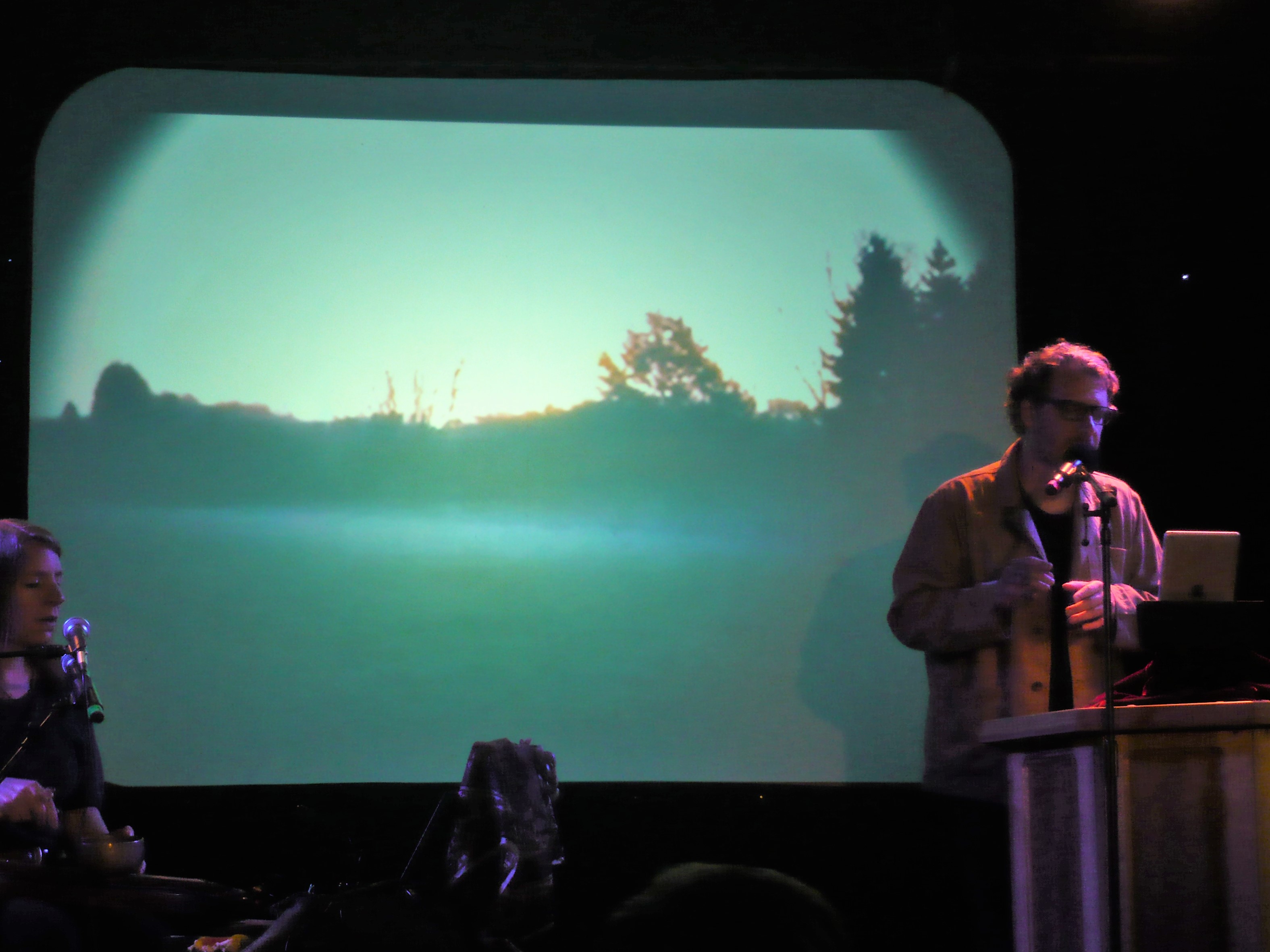
Inside, though, Chanctonbury Rings. The piece is built around the section of the book where Justin visits Chanctonbury Ring one May Day, to watch both the sunrise and the Morris dancers celebrating Beltane, the ancient name for the festival held that day. It combines personal experience with myth and legend, Sharron’s music both punctuating and supporting the narrative, and Wendy’s visuals projected on a screen behind the performers.

Incidentally, Sharron is a musician I had not come across before hearing the album, but I have since been captivated by her own stunning albums. If you have any interest in folk, I’d recommend you give them a listen.

Wendy’s visuals were well-judged photographs and film of Chanctonbury Ring and the surrounding area, at times deliberately grainy and vague and at others lusher, although there was perhaps something ghostly about all of them, each choice inevitably suiting the mood of the narrative at that point.

The spoken words, the music and song, and those visuals weaved around each other and blended happily together, elegantly constructing the world as it appeared to one viewer that May Day morning and projecting the audience, for the duration of the performance, into that world too.

It was magical.

Sunday Supplement – 4

I’ve been playing this album for much of the last week. the first I had heard of Sharron Kraus was on Chanctonbury Ring, the album she worked on with Justin Hopper, based on Justin’s book The Old Weird Albion. Joy’s Reflection is Sorrow is filled with beautiful haunting songs in the folk tradition, with more than a touch of otherworldliness about them.

My world is full of paths that are too well trodden at the moment. I suppose everyone’s is, really. All the paths nearby on the common and through the woods are overflowing with dog walkers and families out for exercise and relaxation, and without going further afield it is difficult to find anywhere to walk in solitude. So a longer walk is demanded this week, out to fields and woods and rivers where I know I shall meet hardly a soul.

I think I shall resist posting progress reports on my writing in future, since I jump from project to project and no sooner do I say I’m doing a final edit of x, than I am working on y and have shelved x for the foreseeable future. I have, for example, found great difficulty in finishing A Good Place, revising the plot and the ending for the third time now…

It’s downright embarrassing, really.

I’m finding writing very difficult at present, though, which is one reason I’m not posting on here very often. Like everyone else, I just need to hang in there.

And I’m reading An Indifference of Birds by Robert Smyth.

This is another book about birds, but in this case it looks at how birds see us and how we affect them. And by extension, it looks at how we affect the whole of the natural world, and the enormous damage we are doing to it. But if that sounds horribly gloomy, the book is a delight to read – beautifully written, and filled with observation and information. Do buy it.

And look after yourselves.

On Windover Hill – The Premier

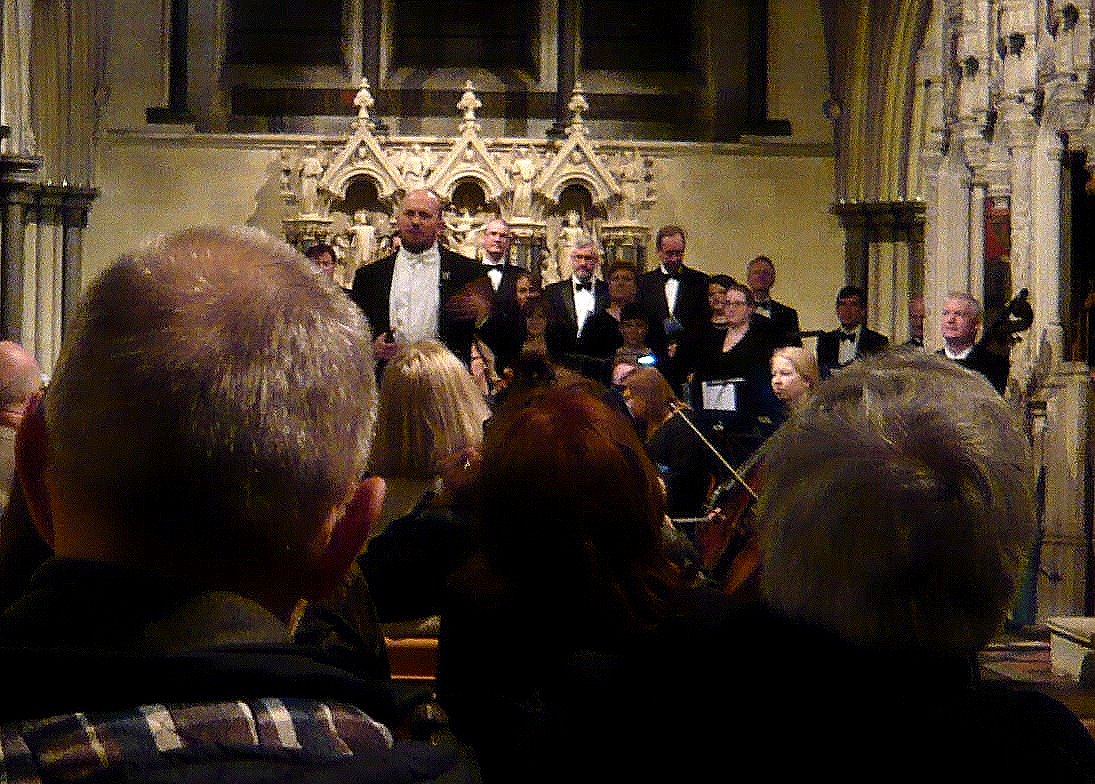
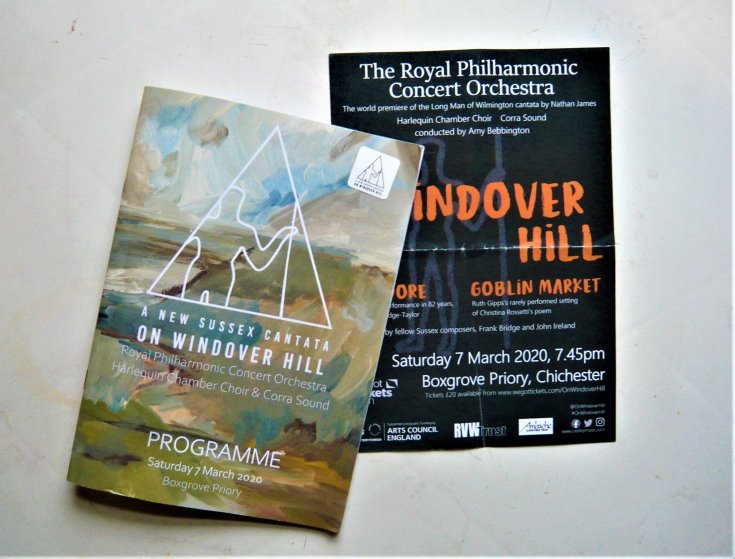
It was Saturday 7th March, and we were in Chichester, Sussex, for the much-anticipated premier of Nathan James’ On Windover Hill cantata.

It took place in the church at Boxgrove Priory, in the village of the same name a few miles outside Chichester. Just over a month ago I posted here about a walk we joined at Windover Hill, viewing and discussing the Long Man of Wilmington – the subject of the cantata, which gives some of the background to this work.

Nathan describes this piece as ‘a result of 3 years of writing and research into the ancient figure and how it has inspired writers, poets, artists, and musicians’.

P1060414 (2)

Nathan introducing the cantata

It was performed by the Royal Philharmonic Concert Orchestra, Harlequin Chamber Choir, and Corra Sound, conducted by Amy Bebbington.

P1060417

The cantata is in nine movements, with each movement scored around a piece from various times ranging from c 1340 BC to 1996. These diverse sources include English folk song, poetry, extracts from plays, literature, and even a piece from 14th century BC Egypt, used here because there is a carving on a chair found in the tomb of Tutankhamun which strongly resembles the Long Man.

The music has a very English feel to it, reminding me strongly at times of Vaughan Williams or Holst, another element that contributes to the sense of it being grounded in Sussex.

Much more about the music, and the story of the project, can be found on the On Windover Hill website, here.

Between several of the movements, there were readings chosen to help illustrate aspects of the mythology of the Long Man – poems, excerpts from books and an extract from an article arguing that the Long Man may have been, in fact, a Long Woman. All pieces by writers challenged by the meaning and significance of the figure. At the back of the church, too, there were a range of artworks inspired by the Long Man. And several times during the performance, a couple of dancers took the floor, their actions visually interpreting the subject of that particular movement.

This, what I might term holistic approach to staging the work, contributed strongly to the listeners total immersion in the work without, I think, distracting from it.

As well as the cantata, the program also consisted of several other pieces, all with a Sussex connection. It began with a beautiful piece by Thomas Weelkes (c 1576-1623) Hosanna to the Son of David. Weelkes, the program notes informed us, was frequently in trouble with the ecclesiastical authorities and was ‘noted and famed for a common drunkard and notorious swearer and blasphemer’. Strangely, I immediately felt an affinity to the fellow.

There were pieces, too, by Frank Bridge, John Ireland, an extract from Goblin Market by Ruth Gipps, and a piece largely unknown today: Wyndore (Windover) by Avril Coleridge-Taylor which was its first performance in this country for 82 years.

The acoustics in the church were wonderful, an especially appropriate setting for a choir. It was a hugely pleasurable and satisfying evening.

P1060405a

The Long Man, photographed on the pre-concert walk

img20200310_16283440

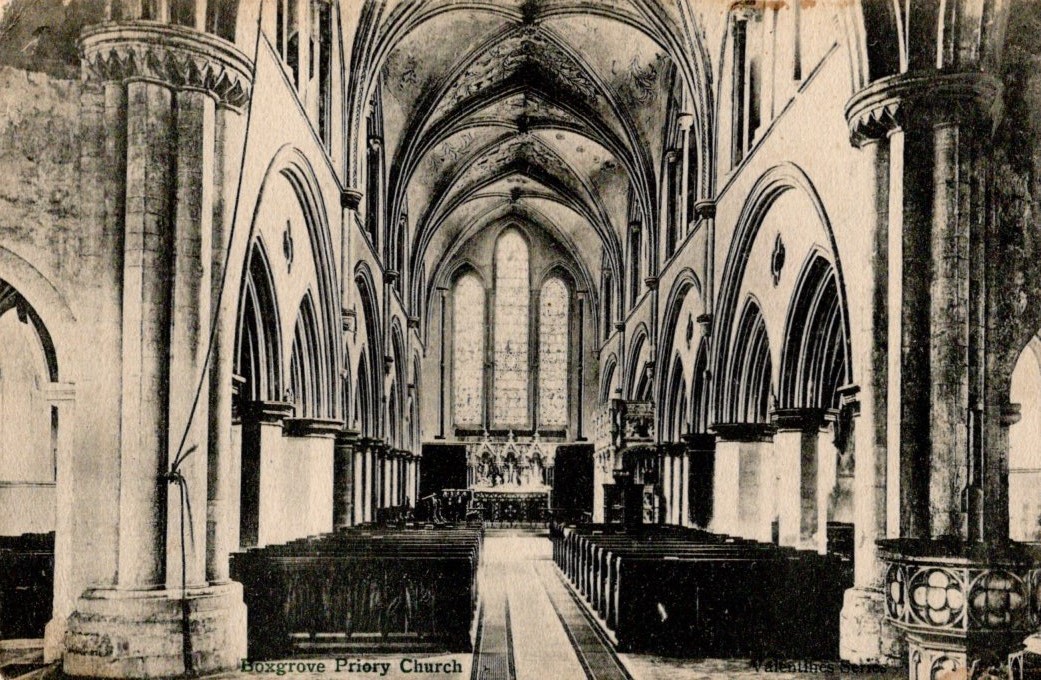
During the afternoon before the concert we wandered around Chichester for a while and I bought a few old postcards of Sussex from the indoor market including, by chance, this one of the Priory church, where the concert was held, about a hundred years ago.

It seemed to fit comfortably into the feeling of history, myth and tradition I felt that day.

On Windover Hill and The Oddness of Time

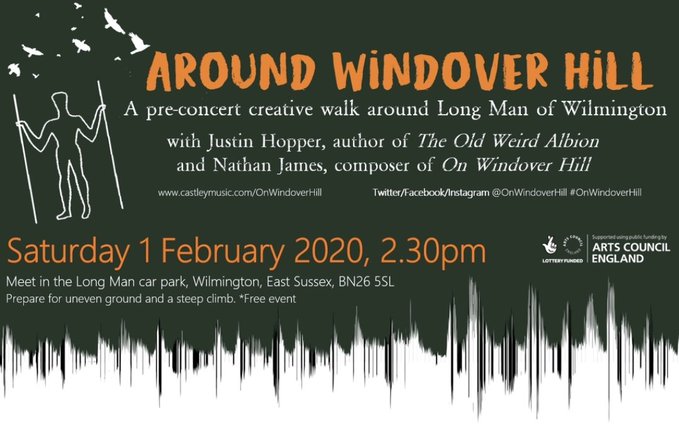
Yesterday, we joined a walk to the Long Man of Wilmington, on the South Downs in Sussex. The walk was led by composer Nathan James, and Justin Hopper, the author of The Old Weird Albion.
EPrcQenWoAQWbeb

The Long Man is a chalk figure etched through the grass into the hillside, below the summit of Windover Hill, revealing the chalk that lies beneath. When and why it was first cut is the subject of myth and speculation – and that brings us neatly to Nathan’s new composition.

P1060405a

On 7th March, Nathan will premier his fantastic new choral work On Windover Hill at Boxgrove Priory, Chichester, Sussex. This has been inspired by the Long Man, its mythology, and the art that has arisen around it, as well as the written history and the geography of the surrounding land. It has a very English feel to it, in the tradition of Vaughan Williams or Holst.

Full details of the work and the performance can be found here. Tickets can also be bought by clicking ‘The Premier’ link in the sidebar there. We have ours, and it would be great to see it sold out!

This walk was by way of a taster for the concert, with a mixture of history and mythology imparted along the way, a poem from Peter Martin, read by himself, and extracts from stories read out by Justin, all of which referenced the Long Man. Also  Anna Tabbush sang two folk songs, one of which was the only song known about the Long Man, appropriately enough called The Long Man and written by the late Maria Cunningham.

P1060395a

I’m not sure How many people I expected to see, but we were around forty, with a surprisingly large number being artists of one sort or another.

The weather was so much better than we had a right to expect – the forecast had been for clouds and rain, but the clouds cleared during the morning, and we had plenty of sunshine as we ascended, although it rather lived up to its name at the top, with more than enough wind for everyone.

P1060404a

Here, the remains of prehistoric burial mounds sit overlooking the Long Man, and the rest of the surrounding countryside.
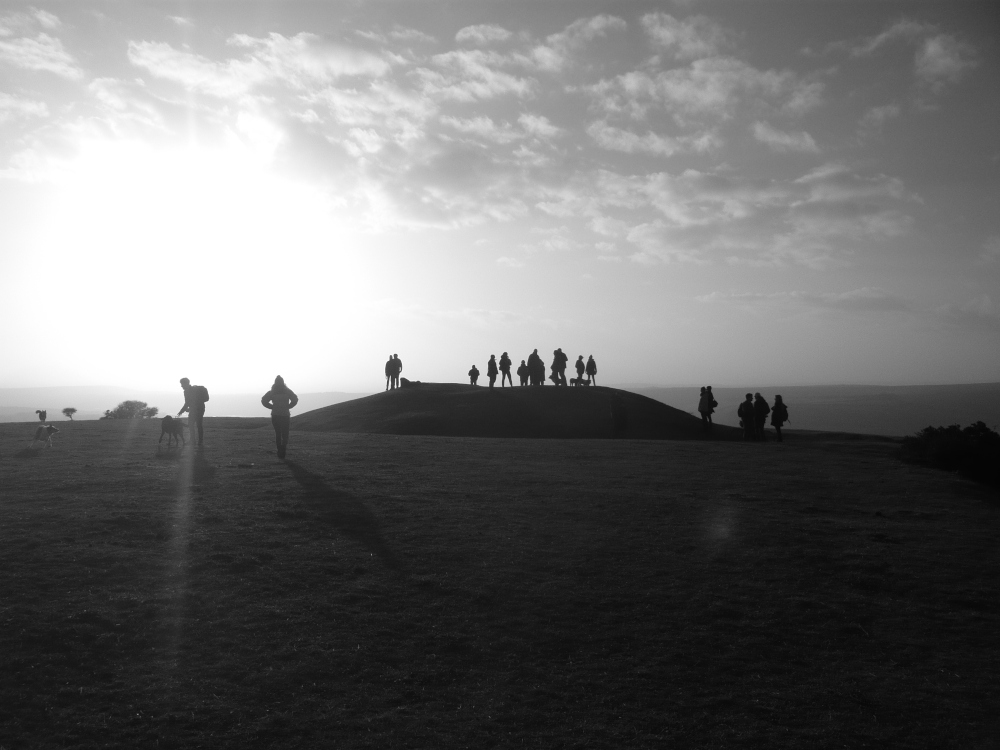
P1060403a

Some landscapes seem to muck around with your perception of time, and Downland seems especially prone to this. I’m not entirely sure why this should be, but suspect it is a combination of factors.

It is a very open landscape, and other than the contours of the land and a few trees, frequently the only features that stand out are prehistoric ones, such as barrows and chalk figures. Due to the uncertainty around their origins, these have a timelessness about them, a fluidity when it comes to grasping their history. We see the long view, which perhaps works on our sense of time as well as space. The more recent additions to the landscape are usually in the form of fences, which can easily seem invisible as we look around for something less ephemeral than the open sky to fix our eyes on.

The Downs are an ancient landscape, in any case. When human beings recolonised what is now Britain after the last Ice Age, at first they kept to the higher ground which gave less impediment to travel and settlement than the marshy and thickly wooded lowlands. Most standing stones and burial mounds from the Neolithic or earlier are found on these higher areas.

I do not get these feelings in more recent landscapes. At a medieval castle or manor house, it is easy to imagine the inhabitants baking bread or sweeping corridors; activities as natural to us today as they were then. I feel a comfortable mixture of the old and the new, a recognisable timeline connecting the past with me.

But barrows, standing stones and hillside figures have a purpose alien and unknown to us. Step on the ground near these remains and you can feel the presence of the unknown. No wonder the belief in the past in faeries and elves who inhabited the underground, and who lived essentially out of time.

They offend our carefully erected sense of order and belonging and, perhaps, still pose a barely acknowledged threat to us today.

I might be imagining it, of course, but listening to the extracts from On Windover Hill on the website, I think I recognise that feeling in places, an unexpected musical response to my own feelings. And then Nathan’s description of his creative process on the website echoes some of this too.

I’m hooked!

Who Knows Where The Time Goes?

016a

Today’s mood music is early Fairport Convention while I tinker around with a poem about crows and contemplate a painting of the same. Sandy Denny’s wonderful voice should lift my spirits a bit. The climate crisis and the dreaded ‘B’ word just leave me feeling depressed and listless.

Perhaps I’ll read something.

Or go for a walk.

I’ll catch up with everyone sometime soon.