Responsible Travelling – Part 1

In a way, this could be titled ethical travelling, but I would like it to cover cultural issues as well as environmental and other ethical concerns. I don’t particularly like proselytising, but I think that we all need to be responsible for our actions: it makes for a happier world for all concerned.

156

So, in no particular order…

Trekking

First of all, when arranging a trek, please try and have a look at the ethical policy of your chosen company. Nowadays, many have a policy of ensuring that porters are properly paid and treated, food is sourced wisely and money makes its way back into the local community. The guides / cooks / sherpas or what-have-yous should be trained to ensure that the environment is treated with respect during the trek. Personally, I feel that from a selfish point of view it makes sense to choose a company that follows these guidelines, because I feel that I will be treated better by them, too. It should not be much more expensive, either.

Secondly, it is not all up to them. One of the most important things we can all do is avoid littering villages and countryside as we trek. Apart from the unpleasantness of spectacular scenery ruined by plastic bags and used loo paper, we can hardly criticise local laxness in this area if we are guilty of the same ourselves.

Deforestation is a major problem in the mountains now, which can only get worse with the effects of global warming. Consequently, anything that we can do to minimise the burning of wood is important, so please do not insist on unnecessary fires to sit around or warm up. You should have brought sufficient clothing on the trek for that. And it seems a minor thing, but if a group of trekkers turn up at a tea house and insist on lots of different dishes, then that will involve a lot of extra firewood to cook them. Try and have the same dish, if possible.

Shopping

Ah, yes. Such an important part of our visit, really. The ultra-cheap clothes, the amazing antique statues, the cheap religious paintings…unbelievable bargains, compared to what we would pay in the west…

…and rather a minefield, unfortunately. Those cheap imitation brand names, as we should all know by now, are usually produced in sweatshop conditions, conditions that would often justify being described as ‘slavery’. As well as being, usually, rather inferior quality. Difficult to avoid them all; after all, who is to say we shouldn’t be buying those attractively embroidered ‘I did the Everest Trail 2017’ or suchlike t-shirts for the equivalent of a couple of dollars?

Well, there is a world of difference between the genuine sweatshop (if I can use such a phrase) and the family sitting around their sewing machines under a tarpaulin beside the stall producing their goods. The latter may be working hard for a poor return, but may be infinitely better off than those with no work and certainly better off than the sweatshop labourer who will earn far less, in conditions far worse. Even today, unfortunately, some of them are bonded labourers.

The antiques…if you go to the Kathmandu valley, you will in many places find the remains of religious statues that have been stolen from their sites beside roads or outside temples. These statues usually find their way to the west to ‘collectors’, or may be sold off to tourists who know no better. In many countries you will need an export licence from the authorities to take antiques over 100 years old out of the country simply to attempt to prevent this sort of desecration. Invariably it is possible to buy modern copies of these items – handcrafted and as beautiful as the originals. It is better for everybody if the traveller contents themselves with these, not least because the smuggler can be hit with a hefty fine or prison sentence. It is also worth mentioning that many of the ‘antiques’ are fakes, in any case.

And the religious paintings. Again, in Kathmandu, Thankas, the paintings that hang in temples, are frequently offered for sale. And again, if genuine, should not be sold. They have probably been stolen. Wherever they are offered for sale, however, there will be bright new paintings for sale – equally beautiful, well made and far cheaper. Spend your rupees on them and support the craftsmen that make a living that way.

BIG or small?

Staying with the shop theme, it seems fairly obvious that by buying from the little shop rather than the supermarket you will be far more likely to be putting money back into the local community. All well and good. Inevitably, though, it is never quite as straightforward as that. Moving south across the border to India, we may find that in the market that we are searching for souvenirs, as well as local traders there may be traders from Tibet or Nepal, Kashmiris and dealers from the city. How you wish to spend your money may pose a dilemma that I cannot solve for you. But at least give it some thought!

The same situation can arise with hotels and trekking companies. I feel that in that situation, the small company or hotel is likely to get my rupees, since, unless I know otherwise, they are more likely to put money back into the local community.

Water, water everywhere…

…but most of it comes in plastic bottles which end up littering the environment, or refilled by unscrupulous rascals with what could be contaminated water, to be sold on again. Avoid this if you can (not always possible, I admit) by taking water purifying tablets and using the local water – read the instructions carefully to see exactly what is required – or using the boiled and filtered water available in some places (See info in places such as Lonely Planet guide books). If you buy plastic bottles, scrunch them up before disposal to prevent their re-use.

In some places, such as Ladakh, you can find environmentally minded laundry shops, where the soapy water is disposed of properly, rather than just poured into local streams. May they prosper and multiply!


Nepal – Annapurna Region

In 1988 I went to Nepal for the first time, travelling by bus from Delhi to Kathmandu. Although the trip took almost 2 days, and the bus was remarkably uncomfortable, it was one of the most spectacular journeys I have ever taken, and a most remarkable experience.

And then I trekked the Annapurna circuit, still considered by many to be one of the 10 classic treks of the world. It took 24 days to complete, and from the time we left Ghorka, until the day we walked down into Pokhara, we were travelling entirely on footpaths and saw no vehicles of any description.

Part of the walk is now over a new road, and whilst this is surely welcome to the inhabitants of the region, I suspect that it takes away a little of the magic of the trek.

village_1.jpg

Village near Manang (posibly Mungji), on the Marsyandi River, close to the Annapurnas. In many ways, a typical Nepalese mountain village, it is built on man-made terraces, up steeply sloping mountainside, to avoid using any of the precious farmland available in the valley.

IMG_0001.jpg

View from Poon Hill. Poon Hill lies a little to the west of Ghorapani on the river Ghora (pani being water), west of the Annapurnas. Sunrise there consequently occurs behind the Annapurna peaks, including the spectacular Machhapuchhare, or ‘fishtail’ peaks. That said, this shot was taken towards the west, looking across the Kali Gandaki valley.

IMG_0002.jpg

This is dawn, though. Machhapuchhare and its double peak are shown clearly on the left.

IMG_0003.jpg

Mountains and glacial lake from the village of Manang.

img_0004

Lower down, the land is heavily terraced, fertile land being at such a premium that every available bit is used. These rice paddies are near the village of Chepe Ghat, on the Marsayandi River.

chorten_2.jpg

Chorten. Chortens, or stupas as they are also commonly known, usually contain relics of saints or priests. The original stupas held relics of the Buddha, such as at the Temple of the Tooth, at Kandy, Sri Lanka.

IMG_0005.jpg

Mountains near the village of Muktinath. In the rain-shadow, here, the landscape is that of a high altitude desert.


IMG_0006.jpg

Mani stones on the Annapurna trail. Mani stones may be carved, painted or both, and serve a similar function to prayer flags, in that they either have a prayer or mantra carved on them (typically ‘Om Mani Padme Hum’ – from which the name ‘Mani Stone’ comes from – meaning ‘Hail to the jewel in the heart of the lotus’ i.e. The Buddha) or they may have a picture of the Buddha himself. Although they may be encountered singly or in small numbers by shrines or at Gompas, at times they make up huge walls containing many hundreds of stones, some of which may have been there for hundreds of years. These walls, like shrines or any other Buddhist relics encountered here, are passed on the left.

IMG_0007.jpg

Houses at Manang.

IMG_0008.jpg

The Upper reaches of the Marsayandi, looking down to Manang.

IMG_0009.jpg

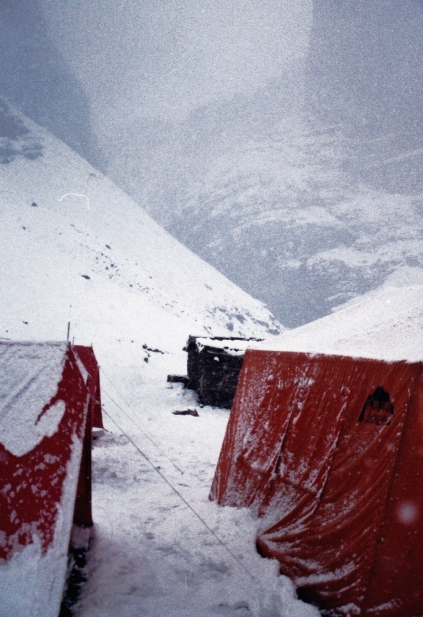
Snowed in below Thorung La. Not an unusual occurrence. Thorung La is at 5415m (17,700ft). We arrived at our campsite early afternoon with the ground clear of snow and the sun out. This was the scene a couple of hours later, delaying our crossing the pass (‘La’ is Tibetan for ‘Pass’) by 24 hours.

IMG_0010.jpg

Crossing Thorung La. On the day we crossed the pass, we left camp just after 4 in the morning, and were down the other side by late afternoon.

IMG_0011.jpg

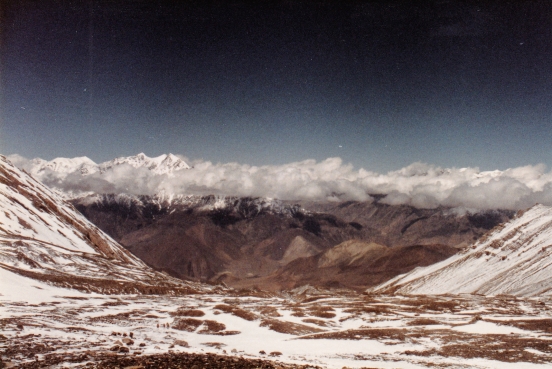
Looking west (and down!) from Thorung La). On this side of the pass there is far less precipitation and the land is noticeably drier. This is looking towards Muktinath.

Kathmandu, Nepal

How on earth have I managed to blog for almost a year, now, and still not put up a single post on Nepal? I think I’d better put that right immediately.
I’m going to start with a selection of pictures from Kathmandu, capital of Nepal.
All of these pictures were taken before the dreadful earthquakes of last year, and I do know that some of the buildings in these pictures (especially in Durbar Square) were sadly destroyed.

015a.jpg

The entrance to Swayambunath. Swayambunath is the main Tibetan Buddhist site of Kathmandu. Sitting on top of a hill overlooking Kathmandu, it comprises temples, stupas and various other buildings, including a couple of Hindu shrines. Here, a Hindu holy man lurks in ambush, ready to dab a tikka mark on the forehead of (especially) western tourists and demand rupees for the privilege.


038.JPG

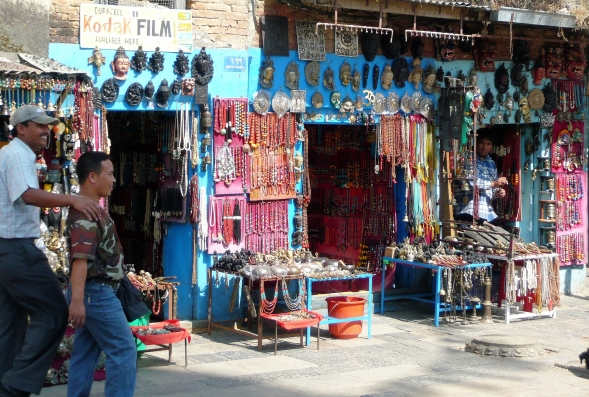
The sacred and the secular at Swayambunath. In Nepal, as in India, it is almost impossible to visit a religious site without Mammon getting a good look in. Here, in the main Buddhist site of Kathmandu, everything from yak bells to masks.


034a
‘One day, my boy, all this will be yours’ – just as long as you have enough money and all the time in the world to bargain hard. More shops – seriously colourful, seriously prepared to sell you anything. And having said that, the hard sell is a world removed from India. It almost feels as though there is no pressure at all. In Nepal, you feel you can relax again, especially if you have just travelled there from India.
056.JPG

Nuns lighting butter lamps beneath a row of prayer wheels at Swayambunath.

030a

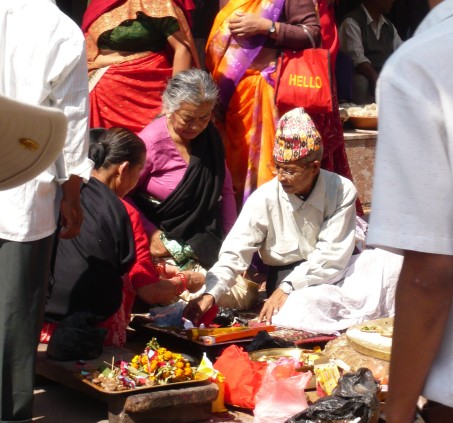
Hindu puja at Swayambunath. Probably a private ceremony at the request of the beneficiary, either for good luck in general or with a particular goal in mind (e.g. birth of a son, successful business venture.)


031b
Portrait of a Hindu lady.
057

Tourist shop in the Swayambunath complex.
100

Buildings in Durbar Square. Durbar (or ‘Palace’) Square is the heart of the old town and the area where the Kings used to live in the 18th and 19th centuries. In contrast to Swayambunath, this area is entirely Hindu, reflecting the vast majority of the lowland Nepali population.

102a

Side street in Thamel, Kathmandu. The lovely old buildings…beautiful wood carvings…collapsing brickwork…wiring all over the place…speed…calm…old and new…………the only things I can’t bring you are the sounds and smells…you must imagine them for yourselves. Coming soon, scratch and sniff websites!!!


098

Bicycle rickshaws awaiting customers in Durbar Square.


067b

Balloon seller and hopeful customer, Durbar Square.


070

Kala Bhairab – an image of Shiva in his most fearsome aspect. Wearing a garland of skulls, the six armed Kala Bhairab tramples a corpse, symbolic of ignorance. Carved originally from a single stone, it was set up by Pratap Malla, king in the 17th century. He was a pious Hindu, but interested in the arts and tolerant of other religions. He even restored much of Buddhist Swayambunath. It is said that telling a lie while standing before Kala Bhariab will bring instant death. It was once used as a form of trial by ordeal.


img
Pashupatinath, on the Eastern side of Kathmandu, is the holiest of the Hindu sites in the city. It is the temple of Shiva, on the Bagmati river and hence it includes the ghats, the most widely used place of cremation for Hindus in Kathmandu, indeed, in Nepal.