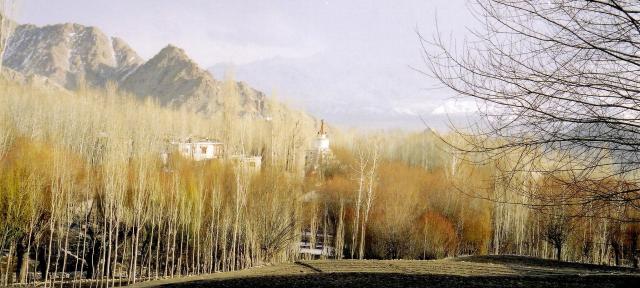
Dull day

It is a particularly dull and miserable day, today, with unbroken thick grey cloud overhead, an unpleasant, damp cold, and a very thin rain in the air. I read bits of my novel, and I yearn at this moment to be in India. That I am looking through a few of the photographs I took in India, at the moment, does not help.

P1050060

I am now at the stage of giving my short novel its first edit. I have written the book from the point of view of an adult female in a rural community in Northern India. It is primarily about both the relationship between the two main characters; a woman and her daughter-in-law, and about the roles and the treatment of women in a male dominated society. The way that I have written it, it is essential for the reader to be able to get inside the head of one of the main protagonists. So, for this reason, I felt that the narrator had to be one of them.

It is a little unusual, of course, but hardly unheard of, for a writer to write with the voice of someone of the opposite sex, although it is more usual for female authors to adopt the voice of a male narrator, rather than the other way round.

(Is that because we are so shallow and easily understood? Don’t answer that, it might be a post for another time, although if I did attempt to write it, I probably wouldn’t have the courage to finish.)

Anyway, whether this voice I have used in my novel sounds authentic or not, might be quite another matter.

I can imagine several areas where I might have succeeded less well than I would have hoped;

a) It might sound like a male voice, especially to female readers.

b) I may have painted a vague, shallow picture of my narrator, subconsciously avoiding difficulties.

c) I may therefore have painted minor characters more brightly than the protagonists.

d) By doing this, I may present as an arrogant westerner, thereby fulfilling images of ex-colonial stereotypes.

On my CV, however, I do have a few months when I was living and working in a small town in Northern India, much of the time spent in rural areas, amongst a dozen or so visits to India in total.

It probably goes without saying that I also have a keen interest in most things Indian, many books about India and, of course, we all have Google.

And writers do, all the time, write about places and situations that are outside their experience, and it is never really possible for anyone to fully understand the thought processes of someone from another time, another culture, or another gender, and so it is a level playing field in that respect.

So, with a glance out of the window at the gloom outside, I’ll get on with it. I do wonder how many male writers have tried to write with a female voice, though, and how successful they felt they were…

…anyone want to come in at this point?

The First Christmas Present

It’s never too early for the first seasonal short story!
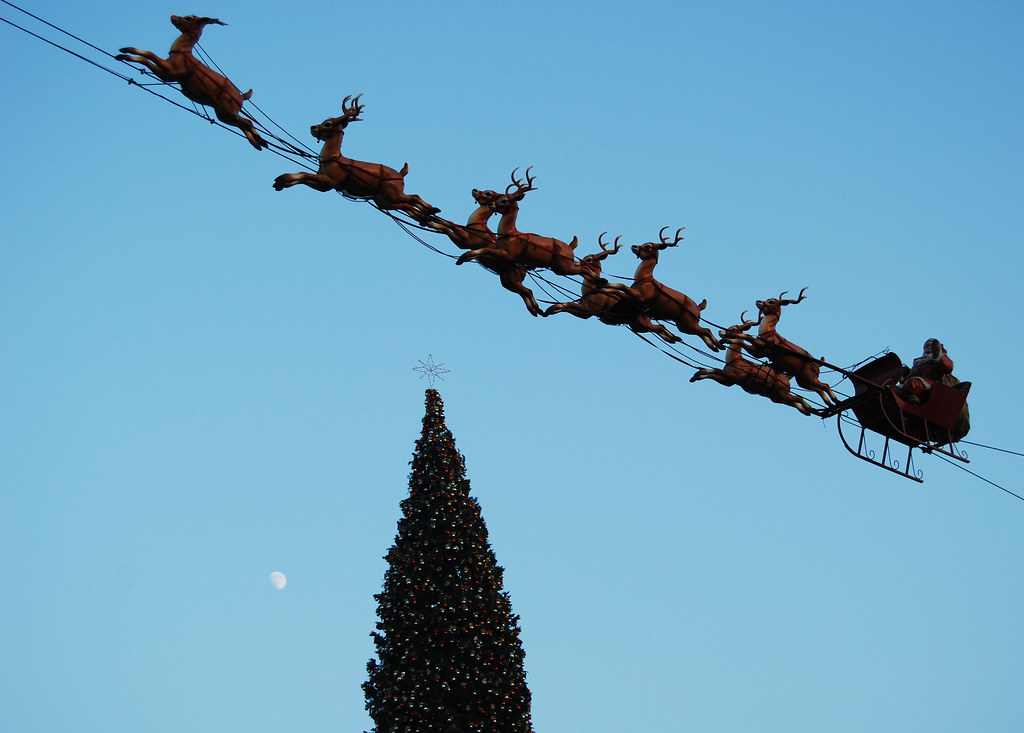
Fat Dude Flying

The First Christmas Present

The old fellow with the white beard and the red jacket leaned queasily over the side of the sleigh, watching the snow covered fields passing below. For a while, the moon was peering out between the clouds and he travelled over a scene of sparkling silver, although the sight did nothing to cheer him up.

He hated heights.

He hated elves, now, too. He’d never met one before today, but he knew now that he hated them. The smug little tossers sat right at the back of the sleigh, eating the mince pies that had been left out for him, and tittering whenever he took a wrong turning.

And he hated children. He especially hated children.


Ever since they took away his benefits and told him he would now be better off, he had struggled for money. Now it was November, and he had decided he had to get a Christmas job. Not that he was looking forward to long nights at the sorting office, or lugging a bloody great bag of Christmas cards from door to door. But it seemed he’d left it rather late, and there was nothing left. At least, nothing for someone of his age. Eventually, he found himself in a tiny little room on the second floor of a run-down office building in a backstreet, the home of an agency that he’d never heard of and with a staff, it appeared, consisting of one gentleman who he initially took to be a caretaker and who introduced himself as Mr Nicol.

‘You’ll do nicely.’ He said. With time-shift, it meant that there was no need to cram all of the deliveries into a single night; they could be spread out over the whole year. In fact, they tended to use two of them, these days.

‘Two of what?’ His mind reeled.

‘Why, Santas, of course. But even then,’ Mr Nicol went on, ‘it’s difficult when one goes sick for two weeks. And so this is where you come in. What is a problem,’ he explained, ‘is E.U. Working Time Directive no.7. This rules out night work for anyone over the age of fifty. So you’ll have to do the deliveries during the day. Still, time-shift takes care of that.’

He still didn’t entirely understand, but he took the job.

The SatNav was crap. It took twice as long. The first time he tried it, he was terrified to find the sleigh suddenly hurtling between buildings that seemed to be no more than a couple of feet apart, at what must have been close on three hundred miles an hour. It then banked and turned in a tiny back garden, subjecting him to a force of about a hundred g, and then shot back down the same terrible alleyway. It then parked itself on the rooftop next to the one that he had just left.

The elves tittered into their hands.

He quickly found it better to just leave it to the reindeer to sort out. They obviously knew what they were doing.

And then it was impossible to tell how much time had gone past. If he noticed the time in any of the houses they visited, it never made any sense. One clock said ten fifteen. Some while later, he noticed one that said nine forty two. The next said four thirty. For a while be began to check the time at each house, but quickly gave up when the times appeared to be completely random. He shrugged. More of this time-shift stuff, he supposed. It made it very hard to decide when he should be on lunch break, and he made a mental note to speak to a union rep. at some point.

Another house. Impossible to know how many he had visited. After the thing with the clocks, he was even wondering whether he still had to visit some of the ones he’d already visited.

No, that was too confusing. He shrugged again, and stepped out of the sleigh. The elves followed him with their sacks, and then they all stepped forward, and next thing they were standing in a hallway, just inside the closed front door. Yes, that was weird, too. The elves obviously knew where they were going; he followed them into a darkened front room where a little glass of liquid stood on the table beside a plate with two mince pies. There was a little note that said ‘For Santa, love Benjy’.

He dropped the mince pies into the bag that he wore around his waist for the purpose, and poured the sherry into the flask. He hated sherry, anyway, so the little tossers were welcome to that. With luck, they’d fall out of the sleigh at some point.

The elves trooped noisily out of the room and up the stairs, reached the landing and opened the first door on the right. Inside, a child was asleep in the bed, a large pillow case draped across the duvet.

‘Greedy little bastard.’ He thought. He picked up the pillow case and held it open, whilst one of the elves seemingly poured in presents randomly from his sack. And then he froze. There was someone coming up the stairs; that wasn’t supposed to happen! All this time-shift stuff was meant to mean that everyone would be asleep from the moment he entered the house until he left again. It all happened in less than a fraction of a nanosecond, in any case.

The footsteps came nearer, and then stopped. A small child appeared at the doorway, but all that he noticed were her sad eyes. She did not seem surprised to see him, nor did she appear overjoyed.

‘You never come to me.’ She said in a quiet, flat voice.

‘I visit all the children!’ He replied, struggling to present himself as jovial.

‘No. You never come to me. You never have.’ He felt himself squirming under her steady gaze.

‘What’s your name?’ He said at last.

‘Mary. I live with my mother. In one of those flats over there.’ She pointed out of the window towards a few yellow lights that seemed to randomly puncture the darkness.

He glanced at the elves, who shrugged unconcernedly, then sighed and pulled a list from his back pocket and put his reading glasses on.

‘I’m sure we, I mean I, do. What’s the address?’ She stepped towards him and gently took the list from his hand, looked at it for a minute and then pointed.

‘There. But you don’t go to our flat; number three.’

He ran his eyes down the list, clicked his tongue irritably, and then looked a second time, certain he must have missed her name. But no, it definitely wasn’t there. He looked up, to meet her gaze again. Oh, hell. He could take one present from, say, three or four others. They would never miss them, and no one would know.

‘We’d know!’ The first elf glowered at him.

‘You can’t do that!’ The other one pouted. He looked from one to the other, and then back to the little girl, and came to a decision. He reached into Benjy’s pillowcase, picked out a couple of presents and held them out to her. She did not move for a moment, but then she gently smiled, reached out, and took the nearest one. Then she turned and left the room, and he heard her footsteps going down the stairs. He darted out to the landing, but already she had vanished.

‘You’ll be in big trouble.’ A spiteful little voice behind him said happily. He said nothing but did the thing with his fingers he had been taught, and they were back in the sleigh again.

It had been their last call. Now he was watching the elves smirking and whispering to each other, as the reindeer ran smoothly through the clouds. Casually, his hand strayed towards the SatNav, and he pressed the ‘over-ride’ button. The sleigh stopped immediately, and spun round a hundred and eighty degrees, catching the elves completely by surprise and throwing them out of the sleigh and into the night sky.

He hated elves.


Photo credit: manmadepants via VisualHunt.com / CC BY-NC-SA
A Day in Ladakh

Wednesday 13th April 2005

This morning, there is a clear blue sky, with just a couple of clouds sitting on top of the Stok Mountain Range. It doesn’t seem quite as cold in the morning as it has been recently.

I go for breakfast at the Budoshah. I don’t really know why I eat here (I certainly don’t always), unless it’s because the morning sun warms the corner that I’m sitting in. I’m the only person here and when I walk in, the waiter always seems frightened to see customers. When I’m eventually given a menu (and everything is always ‘off’ – it’s a Kashmiri restaurant, so two thirds of their dishes are chicken or mutton. The day before yesterday, people were being told ‘no chicken no mutton’.), I ask for scrambled eggs on toast.

I’m told no, they can’t do it. Fried, boiled or omelette, yes. But the cook obviously can’t scramble them.

And black coffee.

‘Pot?’

How big is the pot? I ask.

‘Ah…I get one’. He disappears back into the kitchen, never to return. I sit back and contemplate the Ladakh Mountains in the sunshine, prayer flags waving lazily beside the temple. With luck, it will be another warm day. I think I’ll catch a bus to Thikse Gompa.

My coffee arrives. In a glass.

The toast arrives with heart-stopping chunks of Ladakhi butter – like everything here that calls for butter. I thought at first that it must be cheese. It seems to be the Ladakhi/Tibetan way. I made a mistake and had a cheese sandwich the other day – the cheese is just like butter, so you can imagine what it was like for my poor western tastebuds. I had to scrape most of it off.

leh street

It’s 12.45, and I’m sitting on a rock in hot sunshine at the foot of Thikse Gompa. The bus ride here was remarkable (and where else in India would you find that the driver would wait a few minutes whilst a passenger nipped off the bus to buy some bread?). All the way here, we passed through this wonderful desert scenery, with fairy-tale castles and palaces and the like clinging precariously to the tops of cliffs.

The Ladakhi buses are like all Indian buses, though. Today’s had plenty of pictures inside and on the windscreen (The Dalai Lama, Buddha, etc.), two vases of flowers and a fancy piece of wooden scrollwork on the dashboard, and several drawers incorporated into this.

At the moment I’m having my apricot and water lunch to the accompaniment of drumming in the background; a ritual going on somewhere. There are so many gompas here, and every private house performs their own pujas, that it could be coming from anywhere.

We passed through Shey on the way here. More of this tomorrow, I think. I intend to spend the day there.

I ‘strolled’ up to the gompa, and was shown around by a monk. We chatted in a mixture of Ladakhi, Hindi and English. He is a Ladakhi, in fact all of the monks here are. There are no Tibetans. In fact, despite the large Tibetan population here, he says that there are only two monasteries with Tibetan Lamas.

Untitled-TrueColor-01

We watched a group of young monks kicking around a football, a hundred metres or more below us.

Do families still send one son to be trained as a monk?

No, but there are still many coming.

I was first shown the giant statue of Maitreya Buddha, which is fairly modern, then the fourteenth century gompa, which is very dark and unlit, which made it difficult to properly see the wealth of thankas and statuary. I had to tell him about my family, job and anything else he could think of. That was quite hard going, and I don’t think we totally managed to get through. A pigeon flew into the gompa and started a discussion (not literally, you understand). In Ladakhi, pigeon is (I think) Po-ro, fairly onomatopoeic. In Arabic, I told him, it’s Bulbul, also onomatopoeic. Possibly it is the same in Hindi and Urdu.

Untitled-Scanned-01

Back for tea and a bucket shower.

Later, I’m walking around the market. How strange to go around market stalls and shops in India, not getting pressured and hassled at all. At times it seems almost unreal. You wonder whether suddenly it’s all going to crash around you and normal India will be resumed as soon as possible. The longer that you spend here, the more laid back you become. I don’t think you can help it! Everyone strolls around smiling and Julay-ing you and each other. I know that Ladakhis consider it the height of bad manners ever to lose one’s temper, but it really does seem unreal. I think it would be easy to just sink into the ambience of it all and find you’d suddenly missed your flight out and had overstayed by weeks, or months…

Andrew Harvey said, and I’ll have to paraphrase because I can’t remember the exact quote, ‘The wonder of Leh is that there is absolutely nothing to do. Nothing to do except slow down, switch off and just observe. Just be.’ I understand that, now. I realise that that is what I have been doing the last few days without realising it.

trees

I had Phung Sha and rice for supper at the Amdo -a Tibetan dish. It is a sort of thick vegetable stew, which I shall certainly have again.

I have always wanted to read Rumi, the thirteenth century Persian mystic and poet, and I picked up a copy today from the little bookshop. I am now wrapped up in my blanket reading it by the light of my candles.

Downstairs, my hostess is singing again. Last night, I tiptoed out to the landing to listen to her singing what I was told this morning were Ladakhi folksongs, and I creep out again to listen now.

This time it’s ‘Bob the Builder’.