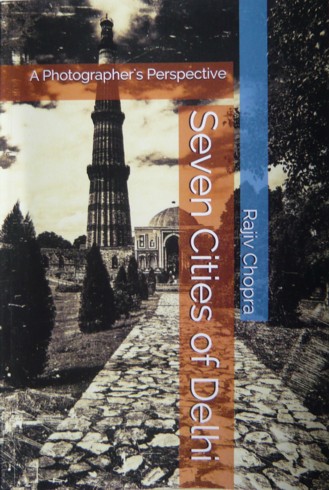
Seven Cities of Delhi by Rajiv Chopra


001

On my first visit to Delhi, almost thirty years ago, I was overwhelmed by the huge numbers of monuments there, such as the Red Fort and Purana Qila. I found the area around Paharganj to be chaotic and exciting and everything an inquisitive Westerner could wish for – a mixture of smells of food and incense and, yes, sewage. A mixture of ugly concrete buildings and beautiful dilapidated buildings left over from the British Raj and often much earlier. Milling crowds of people and cows and rickshaws and bicycles and autos, and history, history, history.

Chadni Chowk was incredibly crowded, the Lodi Gardens completely deserted. The Jama Masjid crowded by tourists and worshippers alike, the Janta Manta often almost empty.

There is so much history everywhere you turn in Delhi.

Other Westerners I met tended to be highly disparaging of Delhi, which was something I couldn’t completely understand since many of these same Westerners seemed to praise Mumbai and Kolkata for the very reasons they hated Delhi.

Yet Delhi is, I think, one of the most exciting and interesting cities I have ever visited. From a historical viewpoint alone, it has over ten thousand listed monuments.

Ten thousand!

Rajiv Chopra is a Delhi based photographer with a passion for recording both the historical Delhi and the street life he comes across from day to day. In this book, he has combined his photographs with a little of the history of the seven historical cities that constitute Delhi, and also a perspective of the differing processes that photography has passed through from its invention up to the present day.

To illustrate all these factors, his book is split into seven sections – one for each of the historical periods – and in each section he has outlined one of these photographic processes so that, for example, in the section covering the first city, Mehrauli, he speaks of daguerrotypes. And then his own photographs he processes through Photoshop to simulate the effects of these processes.

This is not a long book, but it does not pretend to do more than act as an introduction to the history of Delhi. And in this it certainly whets the appetite for more, and then for anyone with even a passing interest in photography it gives a concise and potted description of these photographic processes. Finally the photographs themselves complement the text perfectly.

I unhesitatingly recommend this book for anyone who wants to know a little of the history of Delhi, and who enjoys photographs that give a real flavour of the history of that magnificent city.

Five stars out of five.

You can find Rajiv’s website and blog here

Indian Salt Miners

salt-workers

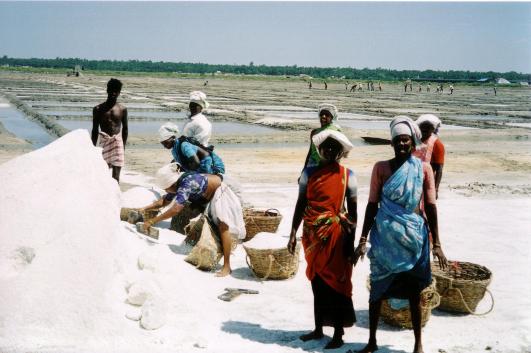
Salt workers pose for a photograph at the salt pans near Marakkanam, just north of Pondicherry (now renamed Puducherry, its original name before the French arrived, although everybody continues to refer to it as Pondicherry, or just ‘Pondi’). The sea is allowed to flow into ‘pans’ (not unlike paddy fields) and then it evaporates over several days under the hot sun, leaving behind a layer of salt which is gathered by hand. Salt has been gathered this way in India since time immemorial.

Even when I took this photograph in 2006, on my first visit to South India, it struck me as a harsh environment in which to have to earn a living. Since then, I have learned more.

Salt is, and always has been, an essential commodity, especially for a population living in hot conditions, but when the British in India imposed a salt tax, this eventually led to the ‘Salt March’ led by Gandhi to Dandi, on the Gujarat coast, where he symbolically gathered salt at the coast after a 200km march, an action that contributed to the loosening of the hold that the British Raj held on India.

In Gujarat alone, approximately 112,000 labourers are employed in the industry (Gujarat State Law Commission figures).

In all, there are approximately 1,000,000 people employed across a total of nine states harvesting salt. Typically, women and girls make up most of the workforce.

But the conditions that the salt miners labour under today are little better than they were then.

They suffer eye problems and blindness from constant exposure to the sun reflected off of the brilliant white of the salt pans. Skin lesions from the salt are common. After a while, feet become septic and absorb salt; so much so, that according to some accounts even after death the salt content in their limbs are so high that hands and feet are difficult to burn during cremation (Daily Telegraph 24/2/10).

In addition, the labourers suffer from many of the other problems common across the labour force, such as exploitation by contractors and money lenders, and poor educational opportunities for their children. There is often inadequate housing, drinking water and food, and an absence of primary healthcare (Indian Express 26/4/16).

It is frequently said that saltpan workers have three ways to die: first gangrene, second TB (tuberculosis) or third blindness.

Their life expectancy is 50 – 60 years.

The hardships and problems they face are slowly being brought to the public’s attention, but clearly there is still a very long way to go before they enjoy what most would regard as decent working conditions.

The Morning After…

Wow, what a weekend!

After the book launch, the parties!

Celebrations!

Oh, and when I looked out of the window to see the streams of bunting all the way along the road, and the swarms of well-wishers gathering outside the house, I was so excited!

Then once I had gone out and signed loads and loads of autographs, I was being chased all over town for interviews by all the big newspapers!

And then I…

Well, okay. That’s not strictly true.

It’s not very true at all.

In fact, it’s not true in even the teeniest tiniest littlest way.

My life does not seem to have altered in the slightest and, actually, I’m glad about that.

070 (2)

Right, now it’s time to get on with the next stage.

I’ve put a link on the image of the book on my sidebar, which goes directly to my book page on Amazon (thanks, Stuart!).

And I’m looking at the best way to create Print on Demand paperback copies of the book, probably by using CreateSpace (lots of recommendations), and hope to have that sorted out in a couple of days. I don’t think it’s too difficult, but my way of dealing with new technology tends to be by shouting at it and slamming doors, so I may take longer than other writers.

But since the release date of the Kindle copy is June 4th, I should have time to arrange for the paperback to be released on the same date.

So, what next?

Actually, it will be great to feel that I can focus on just writing again, and not just constant editing and revision, so it’s back to the long Work in Progress, ‘The Assassin’s Garden’. This has a timeline that stretches from Medieval Persia through Medieval India and the British Raj, through to Edwardian England. It’s already a long novel and nowhere near finished, so I suspect that I might eventually have a trilogy on my hands.

I might even write a short story or two.

Ooh, it’s exciting. I do love this writing lark!

An Alien Culture?

More people travel for leisure purposes today than have ever done so in the past. And many work abroad on short- or long-term contracts, often with a certain amount of leisure time available to experience the culture that surrounds them there.

And this will result in these travellers meeting the people that make up the indigenous society where, for a while, they find themselves. Will there then be a meeting of minds?

Having lived in an ex-pat society, as I have referred to on here before, I am familiar with the laager mentality that often pervades it. I won’t go into all the permutations, but there is frequently a combination of arrogance and fear that leads to a strong feeling of ‘us and them’.

Many travel with the firm conviction that their own society is superior to any other, and are unwilling to see any good at all in any others. Some who go away to work resent being uprooted, and arrive with that resentment packed in their baggage. Some find the experience to be fearful, if they do not understand the language being spoken around them or assume that this alien society has values that somehow threaten them.

And they can either lock themselves away and peer over the barricades, or they can embrace the experience and learn from it.

137 (2)

Travel broadens the mind, it is said, but sometimes it seems to just cement prejudices more firmly in place.

And how easy it is to travel around just looking for things to justify prejudices!

One of the more infuriating things that I come across occasionally is a bigoted and ignorant letter or article in a local newspaper (it often tends to be the local ones) where someone’s idiot views are justified by the phrase ‘I know; I was there’. I imagine them living their entire time in a foreign country in a compound that they rarely leave, yet thinking that they now know exactly how the society functions beyond their walls.

I’ve met one or two of them, over the years.

I spent three years in Oman, working, and I’ve travelled fairly extensively in India, but I do not imagine or pretend that I really have much more than a superficial experience of these places. I knew little of the local culture in Oman beyond what I could see in the streets and villages and markets that I visited. I didn’t know anyone well enough to spend time at their homes or in their social circles. I went with groups of other westerners to places of interest. I did spend a lot of time exploring the desert and the nearby towns on my own, but I was effectively still inside my own little bubble. It is a huge regret that I never got deeper under the surface.

I have, perhaps, managed to learn a little more about the real India, especially through spending time on a project in a village, although I cannot pretend, even to myself, that I really have any idea of what it is like to actually live in an Indian village.

During the later days of the British Raj, the rulers took the approach that their civilisation was naturally superior, and that there was nothing in Indian civilisation worthy of their consideration. The irony of this is that around the end of the eighteenth century, and the first years of the nineteenth, many of the British in India had taken a keen interest in Indian history and culture, themselves doing a tremendous amount to unearth much of the history that had been lost and forgotten. For that comparatively brief period, it would seem that many of the British treated Indians and their culture with a deep respect.

The reasons that this changed are probably deeper than my understanding, but two things stand out. Firstly, that from the beginning of the nineteenth century, many British women came to India in search of husbands, bringing with them what we tend to think of as Victorian attitudes, and secondly, there was an upsurge of evangelism in Britain, which translated itself in India as a movement to convert the ‘heathens’ to Christianity. These combined as a new feeling of superiority, and contempt for a society that was now seen as inferior, especially when much of it resisted their overtures.

With this, the British as a whole seemed to become more intolerant and arrogant, and less respectful of sensibilities. This culminated in the horrors of 1857, which could be said to be caused directly by these attitudes.

To return to the present day, it seems that many travellers have attitudes no better than their Victorian predecessors’. I wrote a post a few months back that mentioned a number of westerners I came across in a Himalayan hill resort, https://mickcanning.co/2015/10/25/the-mad-woman-of-the-hill-station/  should you wish to view it, whose behaviour and attitudes were just downright arrogant and disrespectful. They were doing no more than confirming their prejudices as they travelled, and at the same time I daresay they were confirming many people’s views of western travellers.

Yet there are many people who travel with open ears, open eyes and an open mind, and their rewards are far greater than those of the blinkered traveller. They have the wonderful opportunity to experience and learn about different cultures at first hand, speak to people who hold different beliefs and ideals to them, and perhaps learn a little of what drives them. In return, they have an opportunity to enlighten others, perhaps, to things in their own society that might not be understood by those others. In a small way, each and every one of them can choose to contribute either to different societies coming to understand and become more tolerant, or to the further spread of tensions, mistrust, and misunderstandings.

And all of these little interactions, added together, are as important and influential as the contacts between politicians and diplomats.