Phew!

A mere ten days after mentioning I thought I was close to finishing the final draft of A Good Place, it is, in fact, finished. This is the second novel I have written that’s set in India, this time in a fictitious hill station in the Himalaya, amongst the English diaspora remaining behind after Independence.

Having discarded two previous drafts, the skeleton of the story is now essentially the plot I visualised way back when I started.

There is a lesson in there, somewhere.

It will shortly go off to a couple of beta readers for their comments, and then hopefully after that it will just be a case of one final edit, then the hard part. I intend to at least have a go at finding a publisher and / or an agent.

But for now, I think I’ve earned a beer.

A Quiet Place

Hermits have long gone out of fashion, which is rather a shame. At one time I think I might have viewed it as a good career choice. It had its perks; accommodation was provided, usually in the form of a rude hut (that’s rude as in rudimentary, of course, not because there were obscene drawings on the walls. Although heaven knows what the hut’s occupant might have been driven to in the long winter months…) or a romantically ruined building, food was generally provided, although I suspect that within the job description for a hermit it would have been set out that nourishment came in the form of gruel and acorns rather than an a la carte menu, and people generally left you alone to get on with hermitty things. The downside, though, was what those hermitty things consisted of. There would have been long hours of prayer and contemplation, and I think even if the weather was crap, the hermit would be expected to be out in it praying and contemplating – probably contemplating a hot meal, a hot bath and a warm bed. The estate’s owners and guests would expect to view you hermitting, which you’d have to put up with whenever that might occur – probably every time you felt least like hermitting. The rude hut probably leaked and had an earth floor and nowhere to light a fire and you’d probably have to dig a hole in the woods every time you needed a crap and if the estate servants were late bringing the gruel or even forgot about it altogether, I doubt you’d be welcome going up to the Big House to complain.

I’ve no idea whether the terms and conditions of employment were ever open to negotiation, but if the position still existed today, I’m sure they would be. Hopefully, the profession would have been unionised and today’s hermit could look forward to comfortable lodgings with regular meals, well out of the way of the noise and hubbub of society.

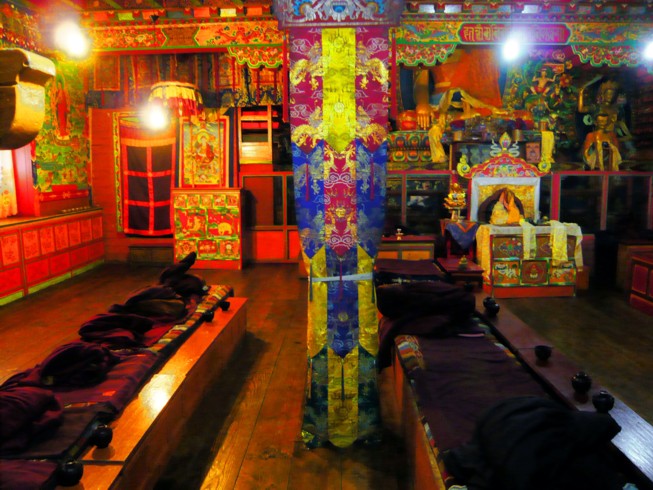
But I didn’t intend to talk about hermits, it just kind of happened. We’ve finally got some decent weather here, and yesterday I was walking through a village in the sunshine and idly thinking there are two situations in which I reckon I could renounce the world. One is in somewhere like Kathmandu in the Buddhist temples there. I’ve always had such a profound feeling of peace and stillness in these places. Buddhism is the only set of beliefs I’ve ever really been attracted to, although more as a philosophy of life than as a religion. I can’t do religion. The world is beautiful and amazing enough without throwing imaginary beings into the mix. But Buddhism is more about being a better person and looking after the world and everyone and everything in it. I could melt into that environment without too much difficulty. At least for a while.

The other situation, especially on an English summer’s afternoon in the countryside, is to retreat to somewhere remote and live a simple life away from the world as much as is practical. I’ve probably told you that before. That’s where the hermit thoughts came in.

But sadly, as already mentioned, hermits aren’t a thing anymore. Not in this country, at least. There are openings available in various other countries, but I don’t think I’m ready to explore those options. Perhaps I’ll just go for another walk.

Unhalfbricking

I’ve never written an album review on here before, although I have reviewed a couple of concerts I’ve been to, so this is a first.

And if you have absolutely no interest in folk or folk-rock feel free to give this post a miss.

So, probably just one of you left. Let’s go.

Actually, now I’ve written the thing, it’s not really a review at all. It’s a bit of musical history, if anything. That wasn’t exactly what I’d planned.

Oh well…

Unhalfbricking is not my favourite Fairport Convention album, but it is an extremely important one. Which is not to say I don’t like it, because I do. It was released in 1969 and is their third album.

It is the following album, though, Liege and lief, which is rightly regarded as their most important, and an album that has had a huge influence on the direction folk and folk rock music has taken since its release, but Liege and lief came about as a result both of a tragedy and a new direction partly forced on the band by musical events way over the other side of the Atlantic. After the release of Unhalfbricking, most of the band were involved in a serious road accident (singer Sandy Denny was in a separate vehicle) which led to the hospitalisation of some members and, sadly, the death of both drummer Martin Lamble and the girlfriend of guitarist Richard Thompson.

After discussing whether they would continue as a group or just disband, the decision was made to continue and they hired a new drummer, the amazingly talented Dave Mattacks, and persuaded fiddle player Dave Swarbrick, who had guested on Unhalfbricking, to join the band on a permanent basis. And the decision was also made to change musical direction. Much of the material on their previous albums had been either American in origin – there were Three Bob Dylan covers on Unhalfbricking alone, for example – or country-tinged.

There is one track in particular on Unhalfbricking that helped to lead the band into their new direction, the traditional song A Sailor’s Life, which breaks new musical ground in this recording. What makes the track most memorable is that it is the first time a drumkit had ever been used on a traditional English folk song. It was also the first time Dave Swarbrick had used electric amplification, coming from a background with traditional folk groups. And then the whole track was apparently improvised on the first take, the first time the band had played it together, and listening to it, it is remarkable how you can hear them growing in confidence throughout the performance. And it is a long track, which I suspect has more than a little to do with the musicians getting the feel of working together and seeing what could be done with the material. Experimenting as they go along. Nothing like it had been released before.

Over in America, The Band, who had supported Bob Dylan on tour, had recorded Music from Big Pink in what has been called a reconnection with rural Americana, and listening to this there was a realisation both that by covering American standards Fairport would never be more than just one more wannabe Byrds cover band, but also that they wanted to take a similar direction with traditional British music. Bass player Ashley Hutchings had become deeply interested in the genre and Swarbrick came from a folk heritage. Thus A Sailor’s Life became a bit of a template for what was to come.

Finally, here’s a link to the song on YouTube.

Lost and Found in Translation

Untitled-Grayscale-02

I have read many novels, short stories and poems translated into English from other languages, but I wonder how much of what I read is true to the original intentions of the authors?

The Argentinian writer Jorge Luis Borges wrote many short stories and poems, all of them in his native Spanish. Although I did buy one collection in Spanish, my own knowledge of that language has always been too poor for me to do anything other than read it slowly and laboriously and, undoubtedly, to miss many of the nuances in the writing. So for that reason, I’ve had to read them in translation.

And in any case, even if I spoke Spanish well I could do little more than read it as translation in my head. Unless I spoke it like a native speaker, I would still likely miss much that the author intended to convey.

And so I buy translations.

Zima Junction by the Russian poet Yevgeny Yevtushenko is a long poem that tells of the poet’s visit to his home town in Siberia, having left some years before to go to live and work in a city. It is a beautiful depiction of rural life in Russia at the time, seen afresh after a gap of several years away, and describes the poets now ambiguous relationship with it.

Long poems can be good vehicles for describing journeys; my own poem The Night Bus does just that, and was written because in that instance I could not find any other medium that worked as well to convey what I wanted to say.

Another favourite of mine is Dart by Alice Oswald, which describes a journey from the source to the sea along the River Dart in Devon, England. She gives voices to the various people encountered along this journey, and to the animals living there…Since it is written in English, I am not left with any worry I am missing things the poet wanted to say, other than perhaps my own occasional inability to understand her.

I have a book of poems from North East India. It is an anthology that I bought in India, with contributions from a huge number of poets. A few of them wrote in English, but the majority of them wrote in other languages – some in Bengali, but the majority in one or other of the plethora of languages to be found in the North East States. And, sadly, most of the translations appear to have been done as a straightforward translation word for word, with no thought given to the feeling of the poem. Any rhythm the poems may originally have had seems to have been lost. The sentences are often clunky and uncomfortable to read. Their meanings have become lost in translation.

But Zima Junction has a natural and comfortable rhythm

The translator of a poem has, to my mind, a task that is more difficult than the translator of prose. Yet, paradoxically, they also have more freedom. More difficult, because they have to get across to the reader ideas or meanings that may be partly concealed in idiomatic language used by the author that perhaps we have no parallel for in English, and hence they may have to completely alter the structure of that part. This will affect a line of poetry far more than it would a line of prose. Immediately, the rhythm of the poem is disrupted, the word count of the line changed.

Yet the reader of a poem has a right to expect a poem. And so, strangely, the translator has the freedom to re-write the poem. In the need for the end result of their translation to be a poem, they may have to completely alter much of the structure to enable the translated words to reassemble themselves as a poem. And so the translators of poems must, by essence, be poets themselves.

So to return to Borges and Yevtushenko, when I read the poems I do wonder whether I am actually reading their poems, or someone else’s?

On Windover Hill and The Oddness of Time

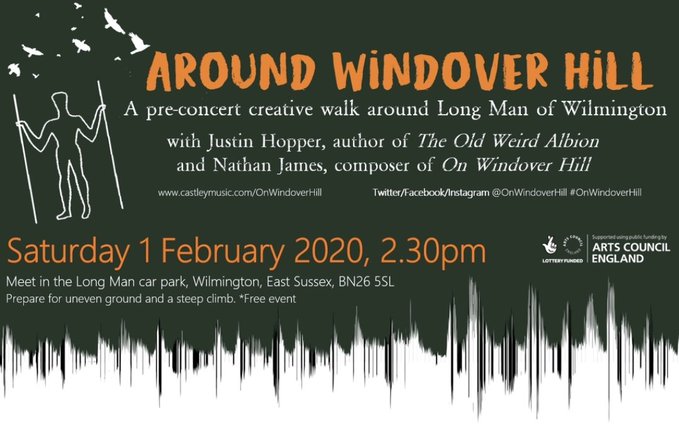
Yesterday, we joined a walk to the Long Man of Wilmington, on the South Downs in Sussex. The walk was led by composer Nathan James, and Justin Hopper, the author of The Old Weird Albion.
EPrcQenWoAQWbeb

The Long Man is a chalk figure etched through the grass into the hillside, below the summit of Windover Hill, revealing the chalk that lies beneath. When and why it was first cut is the subject of myth and speculation – and that brings us neatly to Nathan’s new composition.

P1060405a

On 7th March, Nathan will premier his fantastic new choral work On Windover Hill at Boxgrove Priory, Chichester, Sussex. This has been inspired by the Long Man, its mythology, and the art that has arisen around it, as well as the written history and the geography of the surrounding land. It has a very English feel to it, in the tradition of Vaughan Williams or Holst.

Full details of the work and the performance can be found here. Tickets can also be bought by clicking ‘The Premier’ link in the sidebar there. We have ours, and it would be great to see it sold out!

This walk was by way of a taster for the concert, with a mixture of history and mythology imparted along the way, a poem from Peter Martin, read by himself, and extracts from stories read out by Justin, all of which referenced the Long Man. Also  Anna Tabbush sang two folk songs, one of which was the only song known about the Long Man, appropriately enough called The Long Man and written by the late Maria Cunningham.

P1060395a

I’m not sure How many people I expected to see, but we were around forty, with a surprisingly large number being artists of one sort or another.

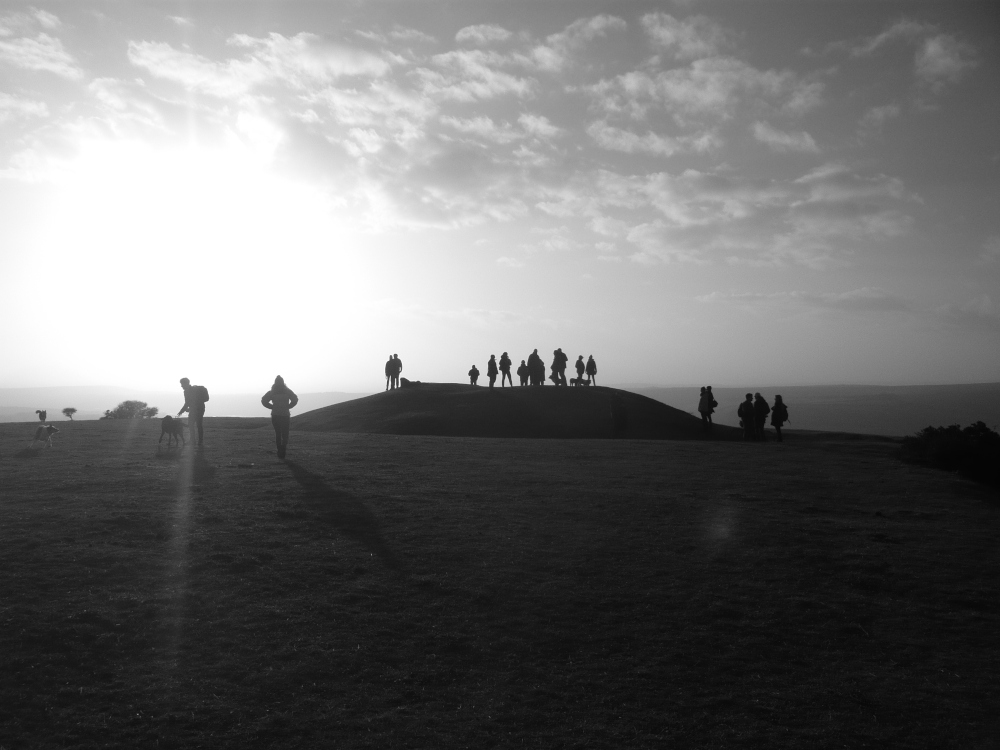
The weather was so much better than we had a right to expect – the forecast had been for clouds and rain, but the clouds cleared during the morning, and we had plenty of sunshine as we ascended, although it rather lived up to its name at the top, with more than enough wind for everyone.

P1060404a

Here, the remains of prehistoric burial mounds sit overlooking the Long Man, and the rest of the surrounding countryside.
P1060403a

Some landscapes seem to muck around with your perception of time, and Downland seems especially prone to this. I’m not entirely sure why this should be, but suspect it is a combination of factors.

It is a very open landscape, and other than the contours of the land and a few trees, frequently the only features that stand out are prehistoric ones, such as barrows and chalk figures. Due to the uncertainty around their origins, these have a timelessness about them, a fluidity when it comes to grasping their history. We see the long view, which perhaps works on our sense of time as well as space. The more recent additions to the landscape are usually in the form of fences, which can easily seem invisible as we look around for something less ephemeral than the open sky to fix our eyes on.

The Downs are an ancient landscape, in any case. When human beings recolonised what is now Britain after the last Ice Age, at first they kept to the higher ground which gave less impediment to travel and settlement than the marshy and thickly wooded lowlands. Most standing stones and burial mounds from the Neolithic or earlier are found on these higher areas.

I do not get these feelings in more recent landscapes. At a medieval castle or manor house, it is easy to imagine the inhabitants baking bread or sweeping corridors; activities as natural to us today as they were then. I feel a comfortable mixture of the old and the new, a recognisable timeline connecting the past with me.

But barrows, standing stones and hillside figures have a purpose alien and unknown to us. Step on the ground near these remains and you can feel the presence of the unknown. No wonder the belief in the past in faeries and elves who inhabited the underground, and who lived essentially out of time.

They offend our carefully erected sense of order and belonging and, perhaps, still pose a barely acknowledged threat to us today.

I might be imagining it, of course, but listening to the extracts from On Windover Hill on the website, I think I recognise that feeling in places, an unexpected musical response to my own feelings. And then Nathan’s description of his creative process on the website echoes some of this too.

I’m hooked!
Wordy Wednesday 1

Many bloggers post photographs on Wednesday under the heading ‘Wordless Wednesday’. Me? I’m going to write a few posts about words – specifically words in English borrowed from languages of the Indian Subcontinent.

I’m just plain awkward, but you knew that, didn’t you?

I am currently editing the first draft of my novel A Good Place, which is set in a hill station in Northern India. And in that hill station live a number of English who remained behind after Partition.

‘I’m sitting on the veranda of the bungalow in my pyjamas.’ Well, no, no one says that in my book. But if they had, what is the significance of that sentence?

The significance is the number of words borrowed from Indian languages.

Untitled-Grayscale-03

Veranda is an Indian word, but coming originally, perhaps, from Persian. The Oxford Dictionary suggests two derivatives, either from the Hindi (varanda) or from the Portuguese (varanda). Digging a little deeper, if I refer to Hobson-Jobson, the Anglo-Indian Dictionary that was published in 1886 and traces pretty well every word or phrase borrowed from the Sub-Continent, I discover a very long entry on this word. It begins by dismissing the possibility of it being derived from the Persian beramada, and goes on to state that it appears to exist independently in both Hindi, and in Portuguese (and Spanish). It then traces the possible routes the word might have taken to reach the English language, before then saying, surprisingly, that it could have its roots in the Persian after all. This seems quite likely to me, since many Persian words made their way to India especially with the Mughals, and it suggests a possible route to the Spanish peninsular when the Islamic armies arrived in the early eighth century.

I tried typing it into Ngram Viewer. This is an online tool that searches through the entire database of books that Google can access online (including ones still under copyright) published since 1800. Looking at the results for all books in English, it tells me it was barely used in 1800, although it does exist, rises steadily to a peak about 1910, and then falls away slowly, although it is still in common usage. Unfortunately Ngram has not been set up to search books in Indian languages, or even Portuguese. I tried Spanish and the pattern was similar, except that after peaking just before 1910 , it dropped sharply, but since then the trend has been upwards. I then noticed something. I had actually looked at the trend in American English. So I then tried British English, and this gave me a rather different pattern; The curve rose gradually until it peaked in the 1950’s and then fell away sharply. Why? I think it must be due to a surge of historical / biographical / nostalgic writing, both fiction and non-fiction, after the British left India.

Don’t worry, I’m not going to try to go into that sort of detail with other words.

Next, bungalow actually refers to a ‘Bengal style’ house (often with a veranda!) that the British frequently chose to live in.

And pyjamas are loose cotton trousers worn in India which were ‘adapted’ for night wear by Europeans.

Okay, class, lesson over. Be sure to wash your hands before eating your snacks (samosas and pakoras today, of course).

Review – The Name of the Rose by Umberto Eco


002

Late in the year 1327 Brother William of Baskerville, a Franciscan monk, and Adso, a Benedictine novice, arrive at a monastery in Northern Italy. Winter is rapidly approaching, and so is both a legation led by a notorious inquisitor and another that contains that inquisitor’s implacable enemies. William is to speak in intercession between them.

But once they arrive at the monastery, a series of brutal murders begins, and, at the request of the Abbot, William and Adso are drawn into the investigation.

Every detective story needs a detective, and in The Name of the Rose it is William of Baskerville, who indeed uses logic and observation to make deductions, much like a medieval Sherlock Holmes.

Untitled-Grayscale-01

As the plot develops, there are long theological debates centred around both the poverty of Christ and the question of whether Christ laughed. Questions I have little knowledge of, but which read as authentic to me. But these debates are central to the plot. On the interpretation of Christ’s poverty alone, men and women are accused of heresy and burnt at the stake.

But everything is centred upon the monastery’s library. This library is the greatest library of its time in Europe, containing innumerable rare, important and beautiful volumes. At the centre of the story lies a mysterious and forbidden book, and this book lies at the centre of the labyrinthine library where only the Librarian and his assistant are permitted. But are the murders being committed to get hold of this book or is there another reason? Could they, in fact, be connected with the predictions in the Book of Revelations?

Untitled-Grayscale-02

This is such a well-known book that I found I forgot it was a translation from the original I was reading. Much like the Bible, of course, which point is salient to the monks, and certainly in medieval times this interpretation was a matter of life or death to thousands.

But the translation of  prose does not pose the same problems as the translation of verse, and I don’t suppose the English translation is any different from the Italian original. But the potentials made me smile

As a long book, it provides a canvas for long descriptions, both of the abbey and the associated buildings – essentially a castle – and of the long debates between the monks and the other players. At times there is undoubtedly a temptation to skip some of these, but the reader is adequately rewarded for persevering in that the descriptions paint a powerful picture of the place and time, while the debates tell much about the importance of religion and the ridiculous interpretations of every word of the Bible that quite literally governed the lives and deaths of everyone at that time.

A word about the pace of the book, though. Some readers may find it a little slow (although if those readers skip the debates and longer descriptions it is as fast-paced as any other), but remember it is not just a detective story, it is also a historical novel and moves at the pace one would expect of a book of that genre.

I read this a very long time ago, and although I remember it as having been a very good book, I had forgotten just how good. I will unhesitatingly give it five stars.

And the meaning behind the title? Well, you need to wait until the end to find out, and then you need to understand Latin…