An Andalusian Adventure (1) – Re-blog

It is certainly much harder to learn a foreign language when you get older. Since we’d like to do some more European travel (in my case, especially Spain) I’ve been trying to polish up my Spanish, but seem to be making very slow progress.

But I said I would re-blog the occasional post so here’s one from 2020 about a walk I took in Spain back when I was young and a hell of a lot fitter than I am now:

img20190318_12075705

It wasn’t my first trip to Spain, although it was a long time ago now. I walked into Malaga with a rucksack on my back and followed the signs for ‘Centro’ until I found myself in the crowded central district of older narrow streets with three- and four-story shops and cafes, guest houses and cheap hotels. The second hotel I tried offered me a perfectly adequate room on the third floor at a very good price.

The hotel was old. The wooden floors of the corridors were worn and polished by the passage of countless feet, and everywhere seemed gloomy. It gave the impression of having more nooks and corners where light never penetrated than it should. But the only light came from the occasional bulbs hanging from the ceilings, and other than by returning to the street, the visitor would only encounter daylight once they had reached their room and opened the curtains.

The bed was old, and sagged a good deal more than it should, and the furniture was so dark with age it was difficult to make out the grain. As a base for a few days, I decided it would suit me fine. As I unpacked and settled in, I suddenly heard a violin being played. It sounded quite close, and I opened my bedroom door to investigate. I had just decided the sound was coming from a neighbouring room when it stopped, and then a door opened. A man about ten years older than myself emerged and stopped when he saw me.

‘I’m sorry,’ he said. ‘Did I disturb you?’

He introduced himself as a German who I shall call Matthias, although I am no longer certain that was his name, and who immediately invited me to go for a beer.

It would have been rude of me to refuse.

Matthias was meandering around Europe, he told me, and supporting himself largely by busking. Later that week I was to see him playing in the street and be surprised at just how many passers-by threw coins into his hat. It seemed a particularly enjoyable way to travel. Over those beers and then over a few more later in the week, we talked travel and philosophy, music and religion. When I meet someone while travelling, I find it interesting how I often have less constraint than I would when I meet someone for the first time in more familiar surroundings. Frequently, I will reveal things about myself I would never dream of doing to someone I meet perhaps for the first time at a friend’s house, or at my writing group. I presume it is the unspoken knowledge we will never meet again.

Beside the entrance to the hotel was a little café where I made it my habit to take a breakfast consisting of strong coffee, sometimes with slices of thick white bread dipped in olive oil, sometimes with fried eggs. It was a good place to sit and watch Malaga waking up. Its clientele were a broad mixture of workers all grabbing a quick breakfast on their way to office, shop or building site. Mostly they sat in silence, reading the morning paper and smoking, other than to give their orders to the waiter. On the bar a tiny transistor radio chattered away in speech too indistinct for me to make out more than the occasional word. In a way, though, that only added to the atmosphere. Despite it being a familiar situation, there was enough of the unfamiliar and the foreign to make it feel a little exotic.

I wanted adventure, I wanted to explore. I’ve wanted to do that for as long as I can remember. I travelled in those days with a few changes of clothes in a rucksack and a minimum of half a dozen paperbacks, which invariably included something by Hermann Hesse and at least one poetry book.

That, at least, hasn’t changed much.

I liked to travel light (other than the books, of course), so I had no camera with me and probably very few of the essentials most people would think to take on a Spanish holiday. No swimwear, for example. I don’t do beaches, at least not in that way.

But I had come to Malaga because I had a peripatetic nature, and my itchy feet were troubling me. After a few days I decided to take a walk out to the little town of Colmenar, to the north of the city. I would take a room there for one night and return to Malaga the following day. Any other destination would have done just as well; the purpose was the journey, and the journey was the purpose. I chose this route simply because while wandering around the outskirts of Malaga I saw a narrow road winding up into the hills with almost no traffic on it, signposted to Colmenar. The morning after I had made the decision, I packed my rucksack and checked out of my hotel immediately after breakfast.

Part 2 to follow

An Andalusian Adventure (1)

img20190318_12075705

It wasn’t my first trip to Spain, although it was a long time ago now. I walked into Malaga with a rucksack on my back and followed the signs for ‘Centro’ until I found myself in the crowded central district of older narrow streets with three- and four-story shops and cafes, guest houses and cheap hotels. The second hotel I tried offered me a perfectly adequate room on the third floor at a very good price.

The hotel was old. The wooden floors of the corridors were worn and polished by the passage of countless feet, and everywhere seemed gloomy. It gave the impression of having more nooks and corners where light never penetrated than it should. But the only light came from the occasional bulbs hanging from the ceilings, and other than by returning to the street, the visitor would only encounter daylight once they had reached their room and opened the curtains.

The bed was old, and sagged a good deal more than it should, and the furniture was so dark with age it was difficult to make out the grain. As a base for a few days, I decided it would suit me fine. As I unpacked and settled in, I suddenly heard a violin being played. It sounded quite close, and I opened my bedroom door to investigate. I had just decided the sound was coming from a neighbouring room when it stopped, and then a door opened. A man about ten years older than myself emerged and stopped when he saw me.

‘I’m sorry,’ he said. ‘Did I disturb you?’

He introduced himself as a German who I shall call Matthias, although I am no longer certain that was his name, and who immediately invited me to go for a beer.

It would have been rude of me to refuse.

Matthias was meandering around Europe, he told me, and supporting himself largely by busking. Later that week I was to see him playing in the street and be surprised at just how many passers-by threw coins into his hat. It seemed a particularly enjoyable way to travel. Over those beers and then over a few more later in the week, we talked travel and philosophy, music and religion. When I meet someone while travelling, I find it interesting how I often have less constraint than I would when I meet someone for the first time in more familiar surroundings. Frequently, I will reveal things about myself I would never dream of doing to someone I meet perhaps for the first time at a friend’s house, or at my writing group. I presume it is the unspoken knowledge we will never meet again.

Beside the entrance to the hotel was a little café where I made it my habit to take a breakfast consisting of strong coffee, sometimes with slices of thick white bread dipped in olive oil, sometimes with fried eggs. It was a good place to sit and watch Malaga waking up. Its clientele were a broad mixture of workers all grabbing a quick breakfast on their way to office, shop or building site. Mostly they sat in silence, reading the morning paper and smoking, other than to give their orders to the waiter. On the bar a tiny transistor radio chattered away in speech too indistinct for me to make out more than the occasional word. In a way, though, that only added to the atmosphere. Despite it being a familiar situation, there was enough of the unfamiliar and the foreign to make it feel a little exotic.

I wanted adventure, I wanted to explore. I’ve wanted to do that for as long as I can remember. I travelled in those days with a few changes of clothes in a rucksack and a minimum of half a dozen paperbacks, which invariably included something by Hermann Hesse and at least one poetry book.

That, at least, hasn’t changed much.

I liked to travel light (other than the books, of course), so I had no camera with me and probably very few of the essentials most people would think to take on a Spanish holiday. No swimwear, for example. I don’t do beaches, at least not in that way.

But I had come to Malaga because I had a peripatetic nature, and my itchy feet were troubling me. After a few days I decided to take a walk out to the little town of Colmenar, to the north of the city. I would take a room there for one night and return to Malaga the following day. Any other destination would have done just as well; the purpose was the journey, and the journey was the purpose. I chose this route simply because while wandering around the outskirts of Malaga I saw a narrow road winding up into the hills with almost no traffic on it, signposted to Colmenar. The morning after I had made the decision, I packed my rucksack and checked out of my hotel immediately after breakfast.

Part 2 to follow

Wordy Wednesday 3

trichy temple 2

Arv’s comments on last week’s Wordy Wednesday post reminded me of some of what stirred my interest in the history of language. Reading about the unexpected discovery in the nineteenth century of the great similarities between words in Sanskrit, the ancient written language of much of the Indian Subcontinent, and words in Ancient Greek and Latin which were a starting point for the study of Linguistics, was something that fascinated me.

The word for ‘father‘, for example, is ‘pita‘ in Sanskrit, and ‘pater‘ in Latin and Greek.

The word for ‘mother‘ is ‘mata‘ in Sanskrit, ‘mater‘ in Latin and ‘meter‘ in Greek.

The word ‘Aryan‘, actually has the meaning of noble or honourable in Sanskrit (arya), which in Latin becomes ‘ariana‘ (holy) and in Ancient Greek ‘areia‘.

And there are other, seemingly more unlikely, connections.

The word for ‘horse‘ is ‘aswa‘ in Sanskrit, and ‘asva‘ in Lithuanian!

Whether the implications behind this are that there was a great mixing of peoples in those days and that different civilisations adopted words from the others, or that all these languages descended from one single, now lost, language in the distant past, can never be known for certain, but the evidence for the latter is extremely strong, especially as the world population was so much smaller then.

Modern research suggests that Sanskrit, spoken by the ancient tribes of India who called themselves ‘Aryans’, entered the Indian subcontinent from the north west, an area both closer to modern day Europe (and its languages) and to the source of the original migration of peoples out of Africa.

Of course, the theory of a single original language puts me in mind of the myth of the Tower of Babel…

My interest was also stirred by a number of similarities I came across when I was travelling or working overseas. One example will suffice:

Cat‘ is ‘chat‘ in French, ‘gato‘ in Spanish and Portuguese ‘katz‘ in German, ‘kot‘ in Polish, ‘kot‘ in Russian and ‘kitta‘ in Arabic.

I think the real significance of these similarities is that when you consider it logically, I don’t suppose that the speakers of all these languages were just waiting for someone to come along and give them a useful word for the furry mouse-catchers they had hanging around their villages and towns. It seems entirely probable that they all contain similar words because all those languages descended from one common source.

And this all leads me to one final thought (deep breath!)…in this ancient, lost, original language of our distant ancestors, we can be fairly certain, for example, that the word for ‘father‘ was something similar to most of its derivatives in use today. As well as the Latin, Greek and Sanskrit examples above, it is ‘padre‘ in Spanish, ‘pere‘ in French, and ‘vater‘ in German.

We may not be able to reconstruct this language (although in the future, who knows?), but we can certainly make a good guess at what a number of its words were, and they were words that most of us are familiar with today.

The Travel Bug bit me – part 1

Travelling! My first inclination to travel to remote regions came from my Grandmother, when I was probably six or seven years old, despite the fact that she had never travelled very far at all in her whole life. In fact, I don’t think that she ever left England.

But she would tell me stories of China, inducing images of Emperors and pig-tailed mandarins, peasants and bandits, and this was coupled with a children’s book; an encyclopaedia I presume, with grainy, black and white pictures of strange scenery. It was extremely evocative, although at the time I did not understand that. I was just excited by the mysterious, the strange and the unknown.  I was hooked, and wanted to go there! Ever since then, the places where I’ve most wanted to travel, other than Britain and Europe, have almost all been in Asia.

The list of places that I have at the moment that I would like to visit, are almost exclusively Asian.

Yes, she has a lot to answer for, that sweet old lady.

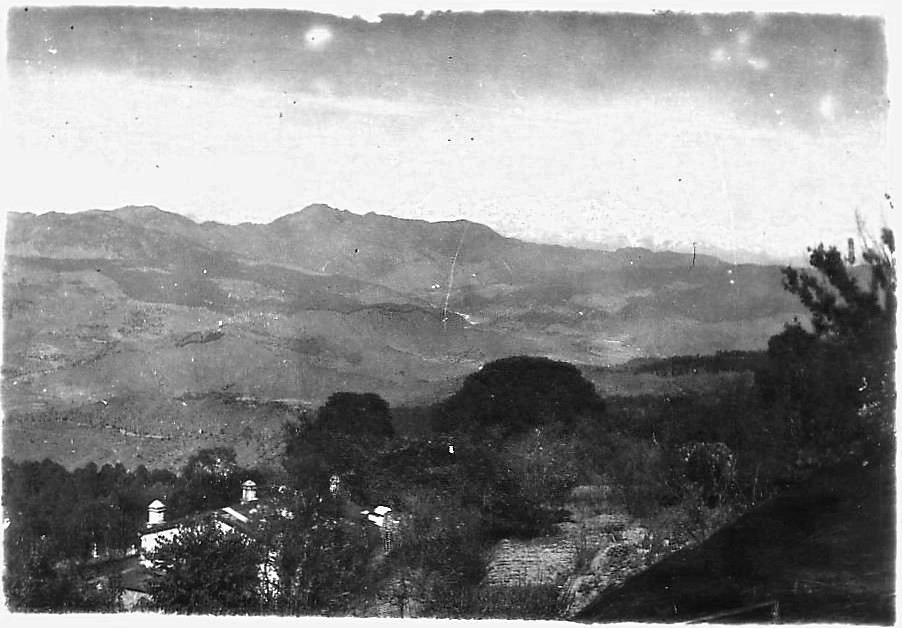
hill station 2

When I was a teenager, I began to use maps, although in rather an ad hoc, hit and miss manner.

They were there for me when I was really stuck, or I just wanted to know in which general direction something lay. It would be a very long time before I began to use them in a skillful way, able to predict the exact lie of the land, navigate in the fog or the dark, or find my way through complicated landscapes with the map and compass. And, do you know, since I’ve learned to do that, I often feel as though I’ve actually lost something rather magical, although I don’t suppose that I can blame it all on that. The maps that I was using as a teenager would tend to be the Bartholomew’s Touring Maps, small scale with little detail. I would feel, as I headed along a Cornish footpath, that I only knew roughly where I was going. It always felt like an adventure; an exploration.

Now, I need to be more and more remote before I can get that feeling, and even then it does not always work. Some ten years ago, I spent a couple of weeks in Ladakh, in the Himalaya in the far north of India, and I was surprised at just how easy all of my walking was. Setting off with map and compass, I always knew exactly where I was, only confused at times by the multiplicity of tracks criss-crossing the landscape. Even then, reference to mountains and villages with map and compass would invariably allow me to set my position.

That doesn’t mean that I wanted to get lost, just that there was a small part of me that said ‘even this is all tame!’ Equally, I can be put off, when using a map, by the knowledge that over the interesting looking ridge that I am heading for, there lies a motorway or building estate, and so I then spend ages trying to plot a route that I try to get perfect, rather than simply heading off in the direction that I want to go and exploring as I go, correcting my course as I travel.

Nothing can tempt me more than a track leading tantalisingly into the distance, perhaps meandering through Mediterranean scrub towards a notch in the skyline, perhaps leading through a glowing archway of trees. Even now, when using map and compass to navigate, I often have to resist the temptation to ignore the map and head off to follow an interesting looking track. I think that this must be a part of my ‘I wonder what’s over the other side of the hill?’ nature. It’s another reason why I’ve never been able to lie on a beach – apart from the fact that this seems a particularly pointless pastime in any case. Any time that I’ve tried it, it never seems to be more than a couple of minutes before I begin to think ‘What’s round that cliff, I wonder?’ or ‘If I head back up the river, I think I might find a way through those hills.’ And then I just have to go to find out.

There are plenty of other things that can destroy a sense of adventure in travelling, other than over-familiarity with maps, of course. I remember the shock and the sense of let-down I received in Germany about 35 years ago, when I spent the best part of a morning struggling up an ill-defined track through thick woodland to the top of a berg in the Black Forest (I was using a tiny touring map at the time, which showed main roads at best). My elation at arriving at the top and surveying the panorama of hills and mountains around me was completely destroyed within a minute, as a coach roared up the other side of the hill, came to a halt a few feet away from me, and then disgorged about 30 Japanese tourists. They spent about two minutes firing off photographs of everything in sight, including myself, before leaping back on board the coach, roaring off down the hill and leaving me gob-smacked in the sudden silence and slowly settling dust.