The third Monday in January – Blue Monday – is supposedly the worst day of the year for those who suffer from depression. So here we are on the 20th, Blue Monday. But there is no scientific reason for this date to be singled out, it is just a modern myth invented, apparently, by a UK travel company who presumably intended it to prompt people to take foreign holidays to cheer themselves up. However, I can see some justification for the claim, while also seeing a certain hope. Justification, because I tend to feel depressed and miserable at this time of the year. Tired. Lacking in energy or, indeed, motivation.
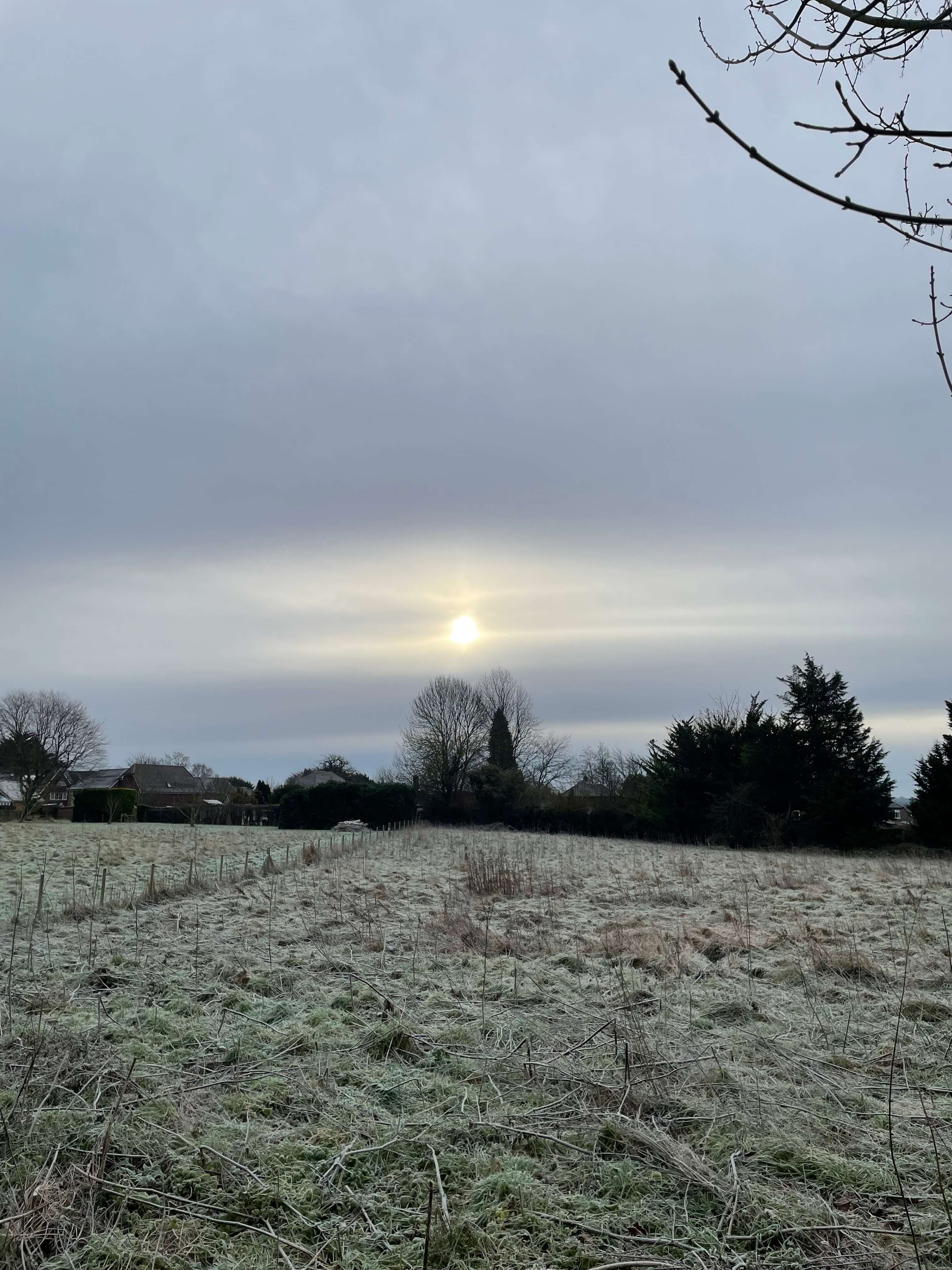
But also a certain hope; by now the daylight hours are lengthening, which becomes apparent when we are fortunate enough to have clear skies around sunrise or sunset. New growth is apparent, with new shoots finding their way up through the earth and leaf or blossom buds swelling on trees and bushes.
I feel so tired at this time of the year. I just feel I need to survive this winter, just get through it. I shall light a fire, wrap up warm, pour a beer and read a pile of books. I am in touch with my inner dormouse and intend to essentially hibernate until Spring.
The May Day festival, Beltane, is a survival, or revival, from the Iron Age, celebrated in Celtic communities – Scotland and Ireland particularly – and revived as a full festival in Scotland in the 1980’s by the Beltane Fire Society. Beltane was a fire festival, although nothing of that remains in the festivities carried out in England. Beltane was first mentioned by name in Irish writings from the late 800’s / early 900’s.
The English version of this festival involves cutting flowers and greenery and dancing around a maypole, which things are also carried out during Beltane, celebrating the beginning of Summer which begins on May 1st. When I was a child, dancing around the maypole was the chief, possibly only, activity carried out on May Day. I have a photograph of my brother, my cousin, and myself, dressed up for the May Day Fair at which there was maypole dancing, but no obvious indication of surplus greenery. Past generations in England celebrated May Day with a day of celebrations which while including maypole dancing as an important manifestation of encouraging the fertility of the soil (and the festival-goers!) would also have included plenty of food and drink and general gaiety.
Mayhem, if you like.
This year, I managed two May Day days out.
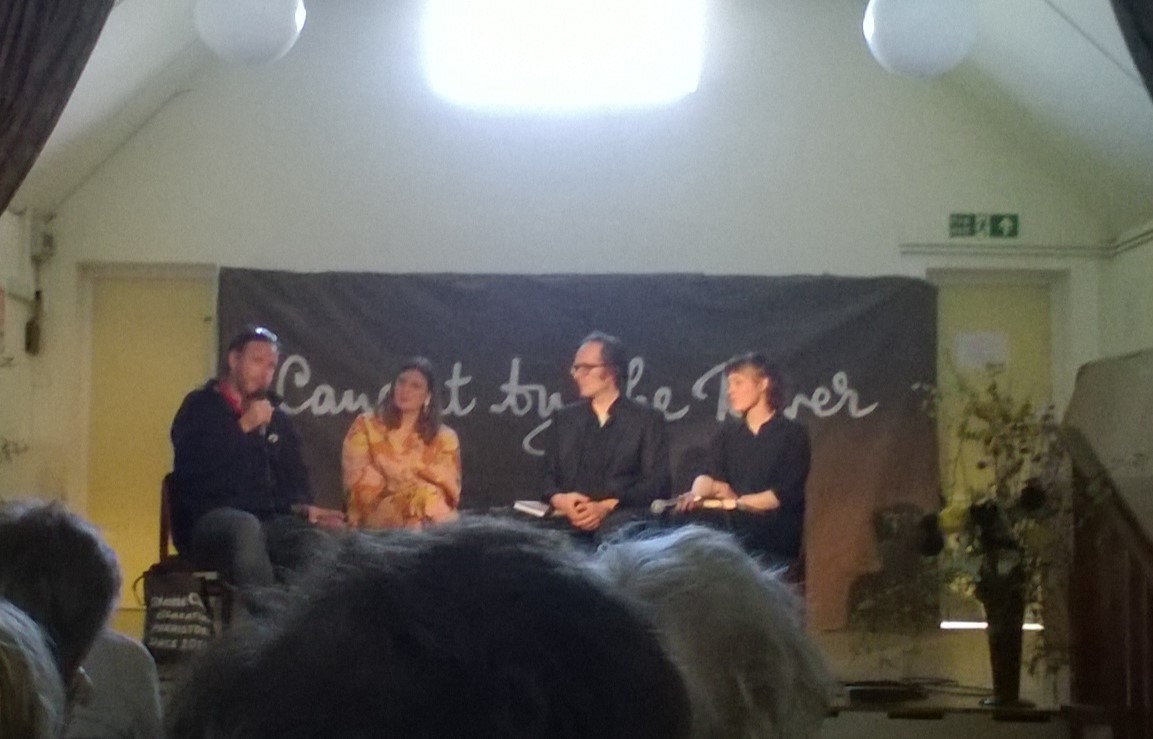
On Saturday, two days before May Day, I visited Kingston near Lewes, in Sussex, for the Caught by the River Mayday event. Caught by the River describe themselves as an arts/nature/culture clash and you can read all about them here. I have followed them now for several years, and this seems as good a time as any to mention that their coverage of arts, nature, and culture are second to none and if you’re not yet following them, well, you should be.
There was mask-making to begin with, especially to involve the children, the makers encouraged to incorporate flowers and greenery into their masks, and almost inevitably a certain amount of folk-horror found its way into some of these.
Nice, Richard.
This was followed by a promenade around the maypole, after which the activity moved indoors.
There were films, talks, and discussions, subjects including rivers, village life in the early eighteenth century, art, standing stones and the like, and the environment. After which, in the late afternoon, we all promenaded up the hillside to the Gurdy Stone.
This is the Gurdy Stone, a modern standing stone on a hillside overlooking Kingston. Here, Local Psycho (Jem Finer and Jimmy Cauty), held a gathering to encode the music of their Hurdy Gurdy song into the stone “To mark the 50,000 year return of the Green Comet and release of The Hurdy-Gurdy song on Heavenly Recordings.”
Throughout the day, naturally, we all had access to the pub.
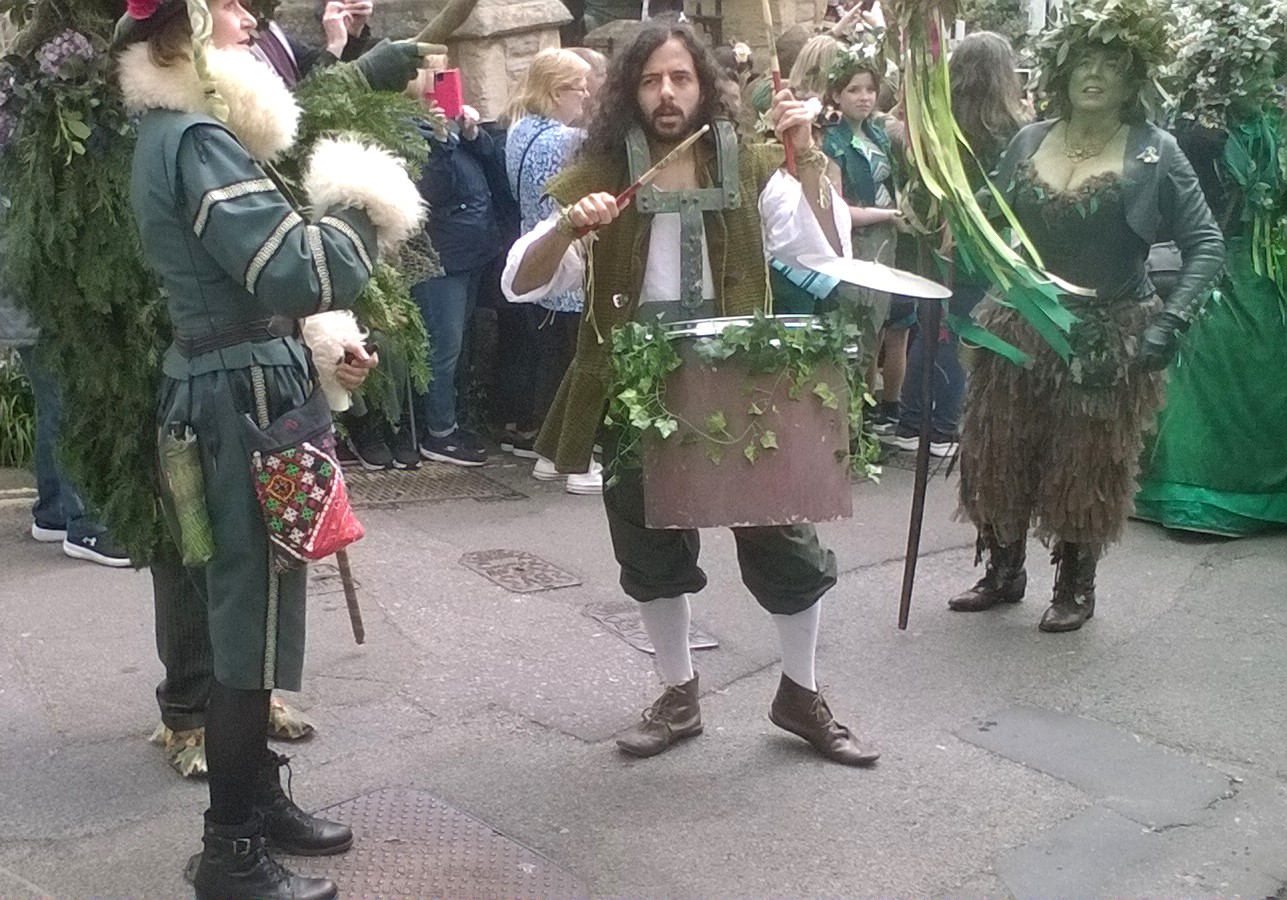
And then on Monday, which was May Day, we went down to Hastings. It rather felt as though everyone in South East England must be in the town, either at the Jack in the Green festivities or watching blokes on motorbikes roaring up and down the seafront for no discernible reason. I don’t much like crowds, and some of this was very difficult. But away from the huge horsepower and testosterone nonsense, amongst the Jack in the Green celebrations the atmosphere was brilliant and the large numbers of people perfectly acceptable. Jack in the Green is a manifestation of the spirit of spring, related to the Green Man, a dancing figure covered in greenery.
The festival in Hastings has grown over the years into a large event involving musicians, dancers, Morris sides, huge figures in addition to Jack in the Green such as the Queen of the May, a witch, and others, plus any number of people joining in the procession around the town, all decorated with as much, or as little, greenery and/or flowers as they feel suitable.
There you go, a Morris side.
Followed by a large witch with a cat. Why the witch? I’ve no idea. Why not? I suppose.
And there you have it. Music. Drumming. Greenery. Crowd involvement. Summer is icumen in and winter’s gone away-o.
Hermits have long gone out of fashion, which is rather a shame. At one time I think I might have viewed it as a good career choice. It had its perks; accommodation was provided, usually in the form of a rude hut (that’s rude as in rudimentary, of course, not because there were obscene drawings on the walls. Although heaven knows what the hut’s occupant might have been driven to in the long winter months…) or a romantically ruined building, food was generally provided, although I suspect that within the job description for a hermit it would have been set out that nourishment came in the form of gruel and acorns rather than an a la carte menu, and people generally left you alone to get on with hermitty things. The downside, though, was what those hermitty things consisted of. There would have been long hours of prayer and contemplation, and I think even if the weather was crap, the hermit would be expected to be out in it praying and contemplating – probably contemplating a hot meal, a hot bath and a warm bed. The estate’s owners and guests would expect to view you hermitting, which you’d have to put up with whenever that might occur – probably every time you felt least like hermitting. The rude hut probably leaked and had an earth floor and nowhere to light a fire and you’d probably have to dig a hole in the woods every time you needed a crap and if the estate servants were late bringing the gruel or even forgot about it altogether, I doubt you’d be welcome going up to the Big House to complain.
I’ve no idea whether the terms and conditions of employment were ever open to negotiation, but if the position still existed today, I’m sure they would be. Hopefully, the profession would have been unionised and today’s hermit could look forward to comfortable lodgings with regular meals, well out of the way of the noise and hubbub of society.
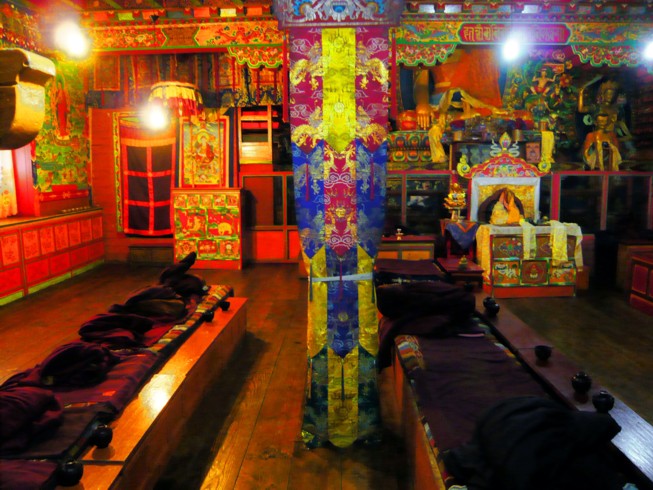
But I didn’t intend to talk about hermits, it just kind of happened. We’ve finally got some decent weather here, and yesterday I was walking through a village in the sunshine and idly thinking there are two situations in which I reckon I could renounce the world. One is in somewhere like Kathmandu in the Buddhist temples there. I’ve always had such a profound feeling of peace and stillness in these places. Buddhism is the only set of beliefs I’ve ever really been attracted to, although more as a philosophy of life than as a religion. I can’t do religion. The world is beautiful and amazing enough without throwing imaginary beings into the mix. But Buddhism is more about being a better person and looking after the world and everyone and everything in it. I could melt into that environment without too much difficulty. At least for a while.
The other situation, especially on an English summer’s afternoon in the countryside, is to retreat to somewhere remote and live a simple life away from the world as much as is practical. I’ve probably told you that before. That’s where the hermit thoughts came in.
But sadly, as already mentioned, hermits aren’t a thing anymore. Not in this country, at least. There are openings available in various other countries, but I don’t think I’m ready to explore those options. Perhaps I’ll just go for another walk.
My intention was to review it today, but as I was writing the review it gradually turned into a polemic against grouse moors and the people who own them. So I’m going to run with that and write the review (properly) next week instead.
So, why is this about grouse moors? Well, in The Compleat Trespasser, grouse moors are one of the habitats John mentions in relation to trespassing.
There’s so much to detest about grouse moors.
Firstly, the fact that they tend to be very large areas of land owned by one rich person who wants to keep everyone else off that land; land that is, to use the hackneyed but nonetheless accurate phrase, the birthright of everyone in this country. Land that has, like much other land, been stolen from us originally by force and then passed around from one rich and powerful person to another. Land that, at one time, people would have depended upon for their livelihoods in a multitude of forms, whether it was growing food, gathering wood for shelter or for fire, fodder for their livestock, or somewhere to live.
Secondly, that same owner does everything in their power to destroy all wildlife other than the grouse they protect, so those grouse can then be killed either by their rich chums, or by others who can afford to pay for the pleasure of killing other creatures. Foxes, rats, rabbits, badgers, crows, hawks…the list is pretty well endless. Trapped, poisoned, shot…the result being a landscape as devoid of life as any desert. And I hate that arrogance that says ‘all these wild animals are my property.’
Thirdly, the drab uniformity of the landscape. Nothing but heather growing, and that burned in ten year cycles to maintain that barren uniformity. And this in turn contributes to accelerated run off and flooding in periods of heavy rainfall, affecting land lower down – often villages or small towns.
And, I daresay, the lack of cover makes it easier for the gamekeepers to watch for intruders.
But, at last opinions are beginning to slowly, but surely, turn against these dreadful habitats and their dreadful owners. I’m sure it will take a while yet, but I’m hopeful that in my lifetime we will see a ban on commercial grouse moors and the beginning of their re-wilding.
The other night there was a piece on the TV news in which a child psychologist bemoaned the fact that children were being frightened by news about the Climate Emergency, suggesting that we should tone it down and perhaps not mention it in schools – I don’t remember the precise details – to which I said ‘Good! Children need to be frightened by it!’
That didn’t go down too well with my wife, who naturally felt that children shouldn’t be frightened.
And usually I would agree with that, but as unfeeling as it might sound I think it is right that they should be frightened by what is happening. It is their future which is inevitably going to be impacted by the actions we do or do not take in the next few years. Their future which our inaction will damage or destroy. And at the moment, that future looks none too promising.
If they are frightened they are likely to raise the issue with their parents, and the resulting conversation may result in more adults learning how imperative it is we take action, and perhaps beginning to add their voices to the demands for action.
And they will be far more frightened if their homes and schools are flooded, or their neighbourhood catches fire, or armed conflict breaks out, all of which look increasingly likely unless we really DO SOMETHING!
It is the actions taken by concerned and frightened children which have become school strikes, and which have led to the formation of Extinction Rebellion, and which may ultimately lead to a people-led drive to finally take meaningful action to try to prevent catastrophe.
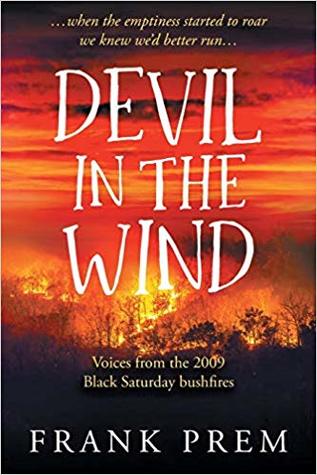
Like Frank’s previous book, Small Town Kid, this collection of poems tells a story of rural and small town Australia. But the similarities between the two books end there.
Whereas the previous collection was a celebration of boyhood in Frank’s hometown, this is an account of the dreadful bushfires of February 2009 that swept through parts of Southern Australia, the area that is home to the author, killing 173 people and leaving a huge area a fire-blackened moonscape.
The poems are a mixture of first-hand accounts, from those who ran desperately from the flames, saving what they could and suddenly terrified at the unbelievable size of the fire and the terrible speed the flames moved at, from firefighters who fought the flames like small companies of soldiers attempting to halt the progress of an overwhelmingly large army, until they literally dropped from exhaustion, from the fire-spotters, and from the frightened friends and relatives trying to raise loved ones down unresponsive phonelines.
In many ways, this is a very difficult book to read, although it is important to do so, especially for those of us fortunate enough to have never had to live through events as terrifying as those described in its poems. It is full of raw emotion and naked detail, traumatised victims and quiet heroes.
At times, I found it essential to look away and take a breather, much as the firefighters had to do, as the emotion became just too much for me.
Poetry is an immensely personal art form. Even when the subject is neither the poet nor the reader, intense emotions come through. Presented in this form, these accounts are shocking. I cannot tell whether they would have felt as shocking had they been prose, but the sparse brevity of the language confronts you almost aggressively, defying you to ignore what they say. Each one seems to scream ‘Listen to me! Don’t you dare turn away until I have finished!’
It is extremely rarely that I would suggest a book should be required reading, but I genuinely think Devil in the Wind should be and is unquestionably a five star read.
Long, long ago, (although not in a galaxy far, far away) I posted a poem about Vikings which was called, astonishingly, Vikings. (It can be found here should you wish to re-visit it.
This is a rather tongue-in-cheek follow up.
The New Viking, a Reformed man
He brought death and terror to these Saxon lands,
Taking iron and fire to fearful hamlets,
But he was defeated by a woman,
A yellow-haired woman, soft and pliant.
And now the screams of battle are the
Bloodcurdling cries of infants.
He beats his sword into a ploughshare,
And grows rows of turnips and cabbages.
His axe cleaves firewood.
Maybe he’ll name his house ‘Dunplundering’.
He no longer lives within sight of his beloved sea,
But he watches trees ripple in the wind;
An ocean of billows topped with brilliant green spume.
Casting long shadows in warm sunlight,
These immobile giants roaring and sighing,
Desperately attempting to free themselves
Of their earthen shackles
Feel uncomfortably close to home.
Those northern winters still call him.
The fire, the mead, the fighting,
The tales of monsters and warriors.
Hamstrung by instinct
He shifts uneasily, guiltily, on his chair by the hearth.
…well, only a cold, but you know what we men are like.
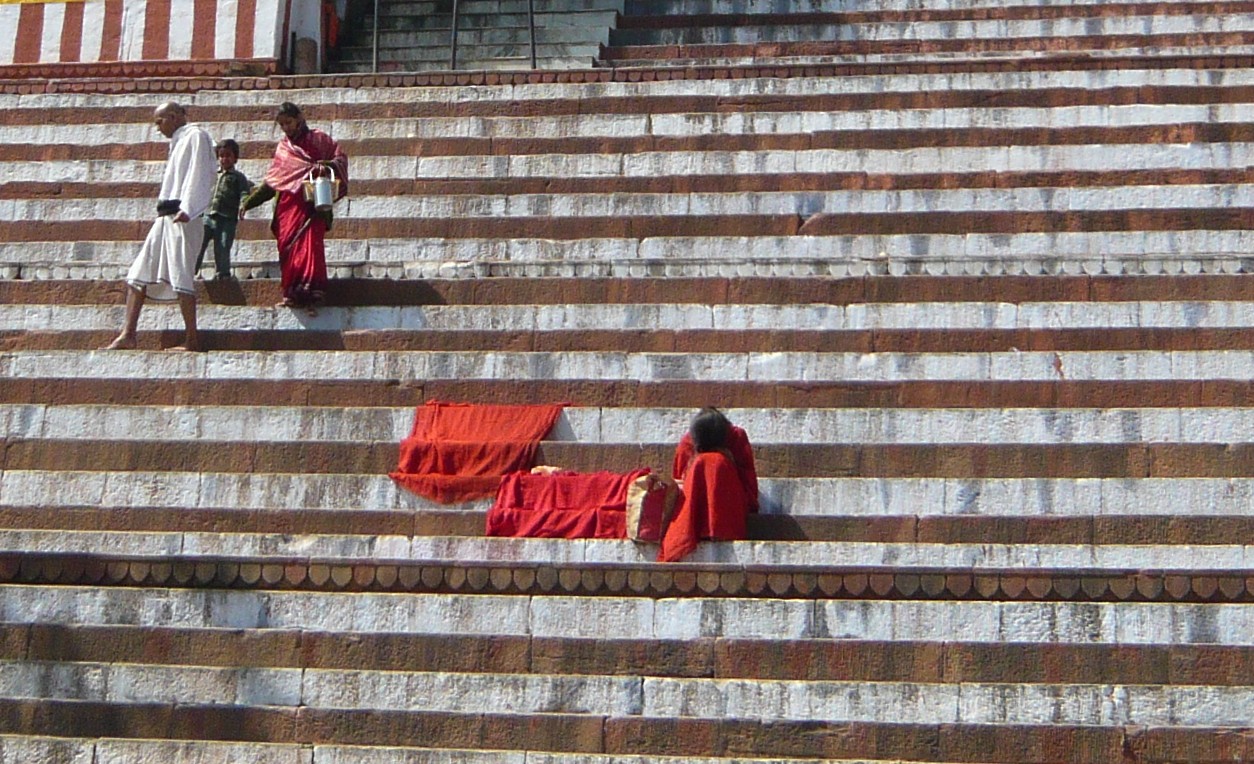
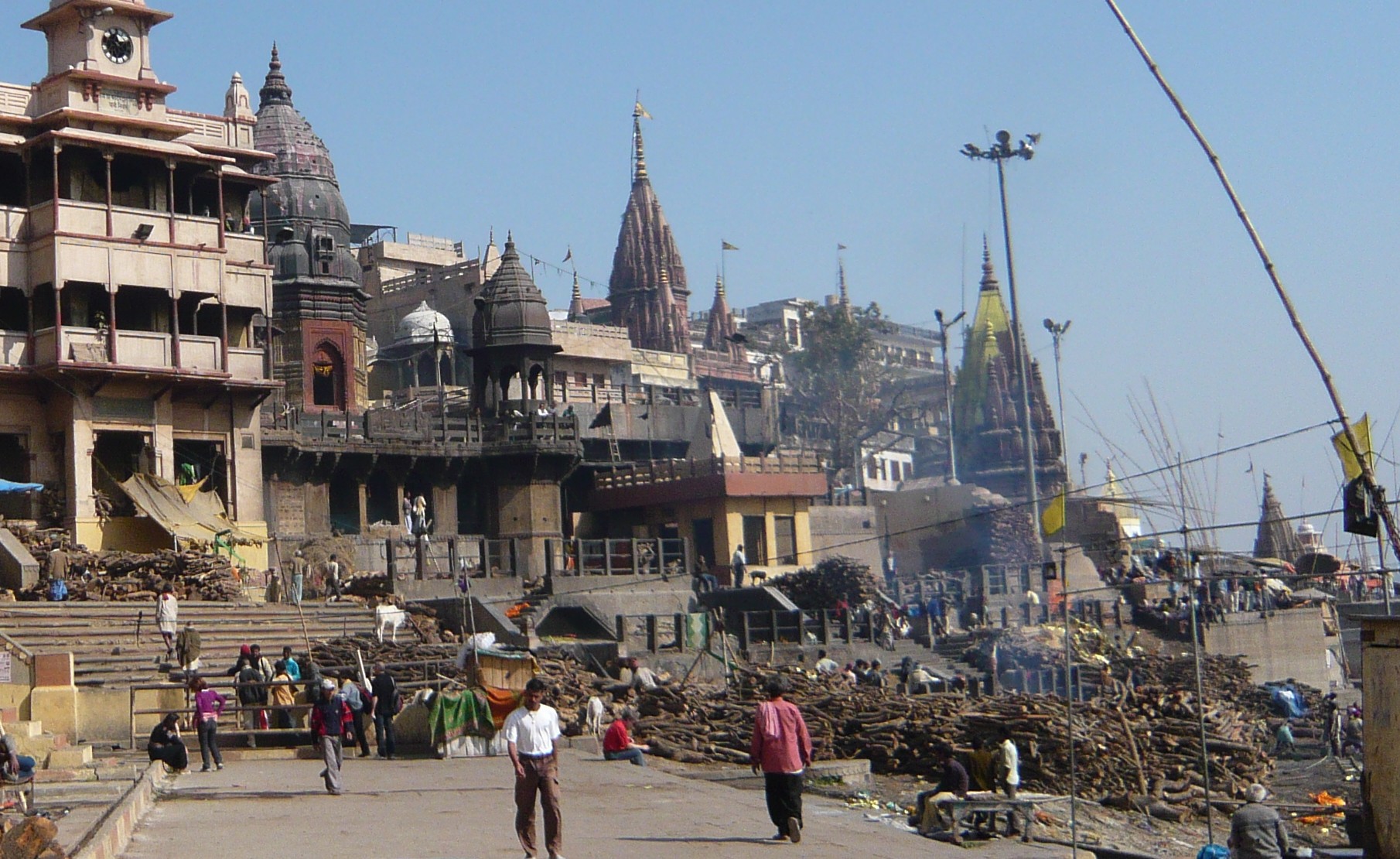
In another attempt to feel instantly better, I’ve nipped across to North India (only in my imagination, unfortunately), to picture Kedar Ghat, on the banks of the Ganges, in Varanasi.
Ghats, a Hindi word, are sets of steps leading down to a river (and also mountain ranges or passes – The eastern and Western Ghats in Central India). It has also come to mean a level place at the edge of a river where Hindus cremate their dead.
In Varanasi, there are between 84 and 87 ghats, depending upon who you get this information from,. The Manikarnika Ghat, or Ghats (possibly this is the origin of the confusion over the number) is the ‘burning ghat’, where cremations are carried out 24 hours a day, all through the year. The source fire there has supposedly been burning for thousands of years, but photography is actively discouraged, hence my only shot is one taken from a distance.
Of course, the ghats are also used for bathing. Hindus bathe en masse there, as a dip in the Ganges is meant to wash away sins. Important pujas (ceremonies) take place at sunrise and sunset. Boat trips to view the ghats are very popular, and finally much of the city’s laundry gets done at the dhobi ghats (dhobi meaning laundry).
It is frequently said that when disaster strikes, that is when you will see the best of human nature. Generosity, bravery, selflessness – this was all on display yesterday at the dreadful fire in West London. The bravery and selflessness of the rescue services, and of many individuals caught up in the horror as it unfolded. The generosity of the entire community and beyond as they rallied around to donate food and clothing, money and shelter to the victims. All this and much more.
But it is important to remember also that every single day countless individuals all over the world carry out countless acts of kindness, bravery and generosity that few others, if any, ever know of.
It is often tempting to look at the news and think that the human race is a barbaric, selfish, and bloodthirsty entity, and I know I am guilty of that at times, but we must never lose sight of the bigger picture. Because if there are many occasions when as a race we fall much lower than any other creature on earth, equally, there are many where we rise far higher.













 Mick Canning