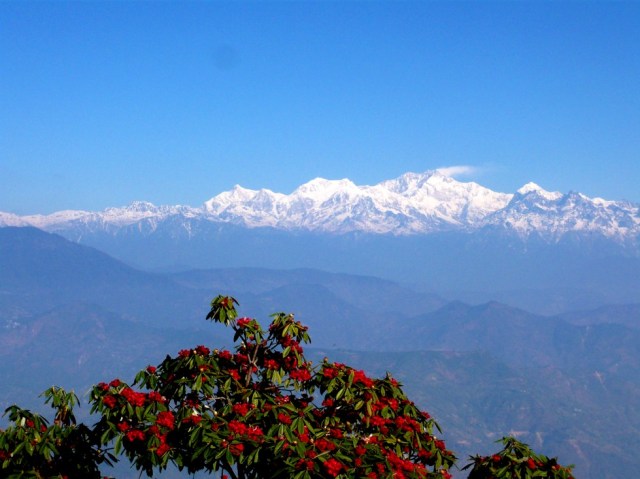
Kanchenjunga, the third highest peak in the Himalaya (and the world) taken from Observatory Hill, Darjeeling. It is the peak right of centre, with the spindrift blowing from the summit.
Have a great Thursday.
Kanchenjunga, the third highest peak in the Himalaya (and the world) taken from Observatory Hill, Darjeeling. It is the peak right of centre, with the spindrift blowing from the summit.
Have a great Thursday.
It’s one of those days, today, when the clouds are thick and dark and slightly threatening, but are shifting rapidly across the sky and continually changing shape in a rather exciting way.
I’ve always loved clouds.
When I was young, I was always very conscious of the sky. I still have a copy of a poem I wrote when I was fifteen or sixteen, which I won’t reproduce here, but was titled ‘Clouds’ and compared their shifting shapes with dreams and ambitions. Quite prescient, in my own case, as it happens, but I’ll not go into that now.

I wonder whether the average fifteen or sixteen year old even sees the sky on a day to day basis, now. After all, you tend to look down at your ‘smart’ phone, do you not?

Summer clouds…
When I dream about getting away from the daily grind, running away from it all, whatever you care to call it, the image in my head is always a compound of the Himalaya, and clouds. Or English Downland, and clouds. Anywhere remote and away from crowds, really. With clouds.
Ethereal, ephemeral, forever changing shape, never boring.
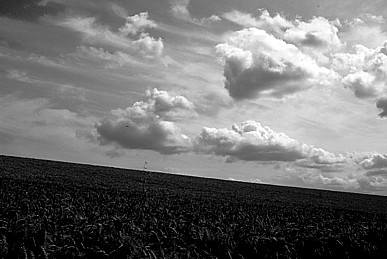
Dramatic clouds…

Clouds like a painting on a masterpiece by Leonardo Da Vinci…

Clouds in my own paintings…
I’m tinkering around with a short(ish) story absolutely stuffed full of clouds at the moment, too. perhaps that’s what led me here.
In which case, I’d better chuck in one more…

From Nepal in 1988. *Sigh*.
Our guide was waiting for us on the edge of the airfield, with a porter who would load our bags into a large basket on his back.
‘Let’s go to our hotel and settle in,’ said Bob. ‘Then we can go and look at some sights, maybe after lunch.’
‘I’m afraid not, Bob. We’re not staying here. Tonight we’re staying in a little place about six or seven miles up the trail.’
‘Oh, alright.’ He looked a little miffed, but then brightened as a thought seemed to strike him. ‘We could have a second breakfast when we get there.’
‘We won’t be there until mid afternoon.’
‘Huh? Why on earth not?’
‘The paths are pretty steep in places, it makes for a long walk.’
‘Walk?!!?!’
‘Yes, walk. We’re trekking, Bob, remember?’
‘Yes…but…I…’

Walking up the path with Bob was a pleasure I can only compare to dancing in a deep sea diving suit. Every few steps I took I would hear a plaintive ‘Mick…wait for me…’ from behind.
By lunchtime we had covered approximately half a mile and could still see the buildings of Lukla. Our guide, the impassive Pasang, calmly directed us to a nearby teahouse, and then left us as we ordered.
Bob wasn’t terribly impressed with the menu, though.
‘Do they have pizza?’
‘Is it on the menu?’
‘I can’t see it.’
‘Then, no.’
‘What are momos?’
‘Tibetan dumplings.’
‘Yuk. Dahl baht?’
‘Rice and lentils.’
‘Oh, God!’
We had fried vegetables. At first, I thought Bob wouldn’t eat his, from the face he made when it arrived, but walking half a mile that morning had clearly given him an appetite, and he managed to force it down.
As we ate, Pasang reappeared with another Nepali. They stood in the doorway for a while, looking at us and talking in low voices. The other man seemed a little upset and kept shaking his head, then they both left again. After about ten minutes, Pasang was back, this time with a much larger man. Again, they talked in low voices, with a lot of head shaking from the stranger, but they eventually shook hands, although neither looked particularly happy, and went back outside.
After we had finished lunch, Pasang took us outside where our porter was waiting, as was the large stranger, who also had one of those huge baskets on his back.
‘You will sit in his basket,’ he said to Bob.
‘What? No fear!’ He looked horrified. Pasang was clearly struggling to keep up his ‘impassive’ image.
‘If you do not,’ he said, sharply, it will be midnight before we reach the guest house. And,’ he looked at Bob meaningfully, ‘you will miss supper.’
Reluctantly, Bob did as he was told. I may have mentioned this already, but Bob is not a slightly built chap. His love of pizza and his fear of exercise combine to produce a body guaranteed to strike fear into the heart of any fitness instructor.
I looked at the stranger with a deep respect.
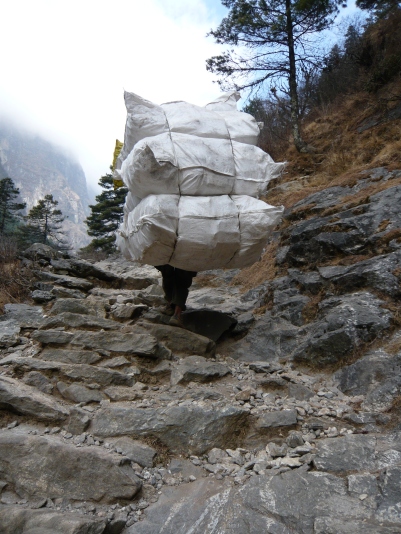
They carry large loads, although not usually as large as Bob.
We set off. Pasang led, the two porters walked just behind him, with Bob peering unhappily over the top of the basket, and reminding me strangely of a cat in a basket going to the vets.
Which led to a few unkind thoughts, I’m afraid.
However, two hours later we were at the tea house where we were to spend the night, with no further mishaps. The afternoon had been lovely, and I had wandered along happily at the back of our little group, taking a few photographs but mainly just enjoying being there.

Bob clambered out of his basket and looked around. Then he whipped his phone out of his pocket. ‘We’ve done really well, haven’t we? Let’s take a couple of selfies!’
The following morning we were woken at six o’clock for an early start, but Bob wasn’t feeling well.
‘I think I’ve caught pneumonia,’ he moaned hoarsely.
‘Oh, it doesn’t look that bad,’ I replied, brightly. ‘Probably just a bit of a sore throat due to the altitude. Let’s see how you are after breakfast.’ He dragged himself out of bed and shuffled wearily to the dining room, where he managed a light breakfast of porridge and banana, omelette, bread, toast, jam and coffee.
‘What do you think?’ I asked Pasang.
‘It is definitely best he stays here until we return,’said Pasang firmly. ‘We should not take the risk of him getting any worse.’ I was about to say that it was only a slight cold, but I saw the wisdom in what he was saying, and so I agreed.
So, it was a shame, but we had to do the rest of the trek without Bob.
Silver linings and all that…
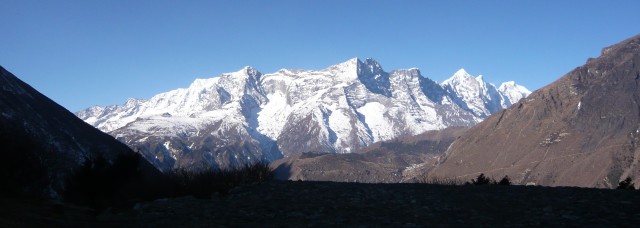


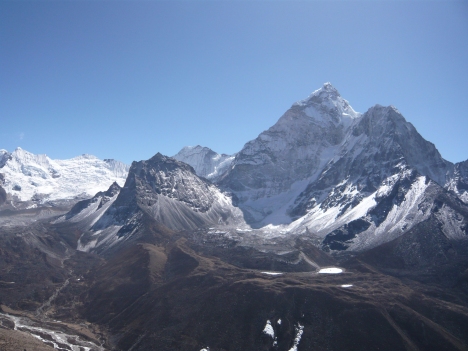

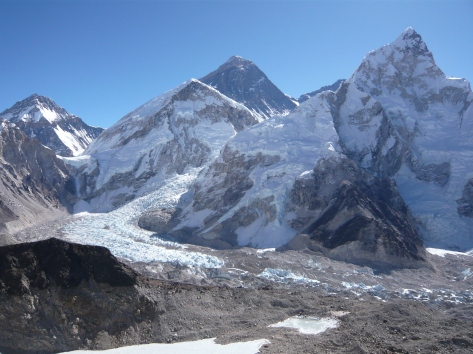
Everest is the one in the middle!

The Wheel of Life, Tibetan Buddhist wall painting, Thikse Gompa. The Wheel represents the cycle of being, the various realms of existence, and the three poisons (desire, ignorance and hatred).
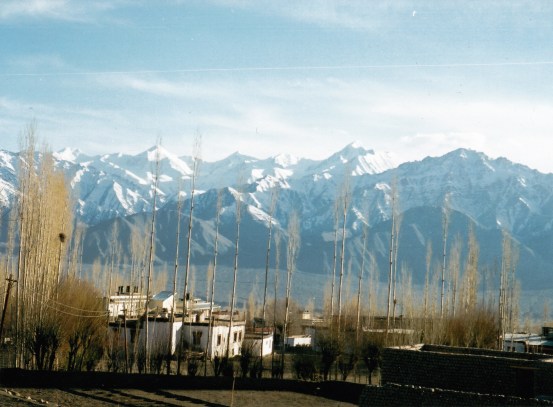
View of the Stok Mountains, Part of the Himalaya Range, above farms and poplars on the edge of Leh, Ladakh.
Outside, my hosts are planting their potatoes, today. It’s been fascinating watching over the last week, as they’ve dug over the whole vegetable garden (about an acre), then divided it up into a total of about fifty smallish and four large plots, all neatly divided with earth walls, between which are carefully dug channels to the stream that runs along the side.
Then, over the last couple of days, half of the plots have had compost dug in and the channels opened one by one to flood each plot for a set time, then closed and the water allowed to soak into the earth.
The first of the large plots is now being planted with potatoes, presumably saved from last year’s crop, and some more digging is commencing at the far end of the garden, where so far there are no small plots.
I’ve just noticed what’s happening at the far end of the garden. It’s going to be one huge potato patch. Dad is digging, Mum is planting, whilst Granny is sorting the potatoes ready for planting. The little girl is happily employed in making mud-pies, like small children anywhere in the world under these circumstances!

The monastery at Thikse, Ladakh. Virtually the whole of the hill is covered in buildings belonging to the monastery, whilst the Gompa or temple crowns the top. Founded in the fifteenth century by monks of the Gelugpa, or ‘yellow hat’ school of Tibetan Buddhism, to which the Dalai Lamas belong.
12.45 and I’m sitting on a rock in hot sunshine at the foot of Thikse Gompa. The bus ride here was remarkable. Where else in India would you find that they don’t bother charging anyone for just going a couple of stops, or that they’d wait a few minutes whilst a passenger nipped off the bus to buy some bread? All along here, passed all this desert scenery, so similar to Oman. And so many fairy-tale castles and palaces and the like hanging precariously to the tops of cliffs.

Building at Thikse Gompa.
If it is so beautiful now, in winter, then what must it be like in the other seasons? I’d dearly love to come back to see! And after all the heat, dust and pollution in Delhi, well, need I say more? I’ve not even been asked once for baksheesh, either.

Mandala painted onto roof of entrance to Shanti Stupa, Leh. The Shanti Stupa, or Japanese Peace Pagoda, is one of more than 70 built around the world by the Japanese Buddhist Nipponzan Myohoji Organisation, which was run by Fujii Guruji. They were built to promote world peace.
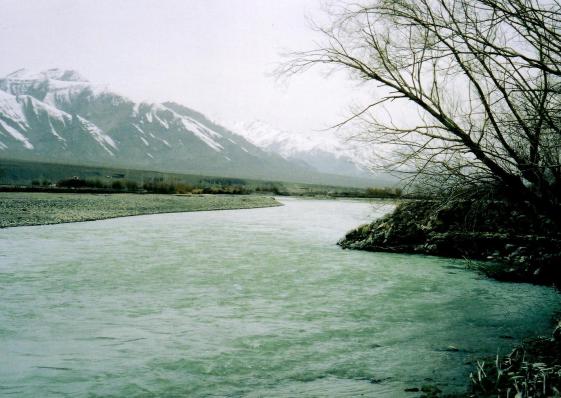
The River Indus at Choglamsar . The Indus originates in Tibet, near Lake Mansarovar – a lake sacred to both Hindus and Buddhists – and after flowing through Northern Kashmir, including Ladakh, passes into, and flows the length of, Pakistan, to the Arabian Sea. So, ironically, the river that gave its name to the state of India, flows mainly through Pakistan.
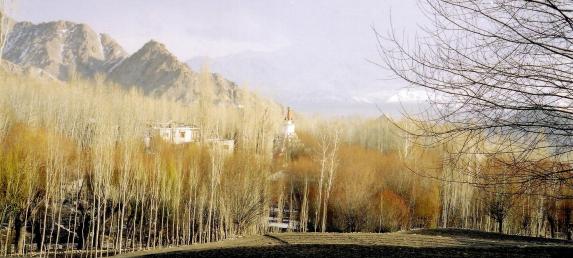
Trees on the edge of Leh. Trees are highly important to Ladakhis – they provide timber for building, fuel, food in the form of walnuts and apricots, and fodder for animals. In all of Ladakh, the only trees that grow are willow, poplar, walnut and apricot.
I fell in love with Kashmir.
It was 1989, and I had come to India to have a closer look. A year before, I had flown to Delhi and the same day taken the bus to Kathmandu to go trekking in Nepal.
This meant that I had a lot of hours sitting and watching Northern India go past the windows of the bus, and this had piqued my interest and convinced me I should go and have a proper look.
So I arrived and, a couple of days later, took the bus up to Srinagar, a journey of 24 hours. In those days, I never kept a travel journal, which is something I regret now. It makes it difficult to piece together the details and leaves me, at best, with impressions and, of course, a number of photographs.
The photos, though, were taken on a cheap camera, and I did not take many.
But I had a week in Srinagar and although I did not venture far afield from there, I loved what I saw of the valley with its gardens, Lake Dal with its confusion of meandering paths through fields and grass, naturally, the houseboats on the lake and also the shakiras, the sampan-like boats used by the fishermen and the traders on the lake.
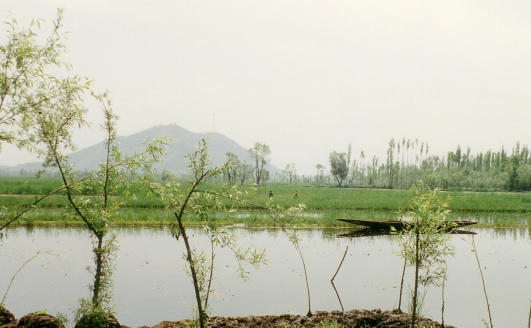
Shakira on Lake Dal
I found a houseboat when I arrived, managing to resist ending up in a hotel in town that was being pressed on me by a fellow on the bus. I seem to remember I found my houseboat by going to the lake, hiring a shakira and asking the boatman to take me to the first of a long line of moored houseboats, where I asked if there was a room. I think at the second or third I struck lucky.
I keep trying to remember the name of my houseboat.
Occasionally, during their waking day, a dreamer will catch a glimpse, a snapshot – no, not even that; perhaps no more than a hint, a flavour of a previous night’s dream. Something akin to catching a scent on the breeze that is gone before it is even realised that it was there. That is the best way I can describe the teasing hint I may get of the name of that boat. I think ‘Ah, yes, it began with ‘S’…no, wait, it didn’t, but there was definitely an ‘S’ in it somewhere. Perhaps…’ then it has gone.
But it was my own floating palace for a week. A marvel of beautifully carved wood, a magnificent bedroom and living room all to myself, and a fellow who lived on board (not the owner, I gathered) who cooked my meals. When I wasn’t ashore exploring, I sat on the deck and read.
I remember the Shalimar Gardens, and that there were at least one or two more; masses of flowers, large lawns, trees…I wandered around there with the high mountains towering above us.
And, there was the beginning of the agitation. At that point, I knew next to nothing of India’s history or politics, and although I could detect the tensions, I was unaware of what they comprised. Once or twice, there were isolated gunshots in the distance, especially at night. ‘Bandits’, said my fellow on board, rather too casually. I came across a mass demonstration outside a mosque in town, with either the police or the army, I’ve no idea which, a very heavy presence. There was a lot of shouting, and the atmosphere was hostile enough for me to make myself scarce fairly quickly.
But I personally encountered nothing but politeness and good humour, and other than the underlying tensions, despite getting ripped off now and again in shops (it was Kashmir, and I was a tourist!), I felt comfortable and happy there. When I left the valley to return to Delhi and thence further afield, it was with the thought I would return again one day.
Regrettably, though, each time I have returned, it has not been considered a safe destination.
Perhaps, though…perhaps…one day…
Long ago in the misty depths of time – that’s last year, actually, I posted a piece about Ladakh (you can find it here if you’d like to read it.)
This, then, is another mixture of photographs and entries from my journal of my 2005 trip to India, which included a couple of weeks spent in Ladakh. I went comparatively early in the year, when the nights are still extremely cold and very few visitors have made their way up from the plains.
Just the way I like it!
Ladakh is high. If you fly in from Delhi (the only way to enter Ladakh for 8 months of the year), you travel from around sea level to 3500m in no time at all. Ladakh means ‘The Land of High Passes’, and is aptly named. Leh, the capital, at 3500m, is one of the lower areas of Ladakh. It’s all uphill from there. Winters are incredibly harsh and the summer growing season brief, yet the Ladakhis traditionally are self-sufficient in everything they need – food, clothing and shelter – and have only recently collided with the western consumer society. In contrast with most of the rest of India, the religion and culture of the majority of the people there is Tibetan Buddhism.

The Roof of the World – View across the Indus valley at 3500m, Thikse, Ladakh.
Friday 8th April 2005
I’m in Ladakh and, hey, wow!
At the airport for 4.30am, to find the flight postponed until 8am, due to weather conditions. It all looked ominous, but just after 7am we were told to check in and after numerous baggage checks, body checks, baggage identifications, etc, we were away at 8.30.
I’ve heard the flight described as one of the most spectacular in the world. I’ve also heard it described as jaw-dropping. I can imagine that it could be bowel-dropping. As we approached the Himalaya, clouds steadily built up and we flew through with tantalising glimpses of great snow-covered ranges below, through the occasional gaps in the cloud. After a while the turbulence built up and we were buffeted quite considerably. Then as we began to near Leh, we slowly lost height, the turbulence increased and we got more views of peaks at under-carriage height. Once we had dropped out of the clouds and the whole valley lay spread into the distance surrounded by snow-swept mountains, it was indeed jaw-dropping.
Then into land after three slow circles around the airstrip. The outside temperature was 2C, we were told, but it certainly didn’t seem that cold.
Once we’d gone through the formalities of registration and baggage reclaim with the refreshingly friendly ground staff, I walked out into the front of the airport and found a taxi. Yousef charged me RS 100/- to go to my choice of guesthouse (The Ti-Sei) and left me his mobile number. He also gave me all the usual (sensible) advice about taking it easy for a day or so.
I’m now sitting in a splendid light and airy room, looking out across the vegetable garden (covered in this morning’s snowstorm) to lines of bare poplars, traditional houses and some splendid mountains, also covered in snow.

Cairn at top of mountain north of Leh.
After a Ladakhi lunch of apricots, apple juice and water, headed north past the Shanti Stupa towards the first line of hills. Reached there at 1.15pm and stopped there for a breather. Silence. Apart from the pounding of the blood in my head. Absolute silence. After a few minutes the call of the muezzin drifts up from Leh, from the Jama Masjid. Then a few bird calls from the crags. Perfect peace. A perfect desert landscape, with pockets of snow. I’m sitting on a boulder, warmed by the sun, my feet in patches of fresh snow.
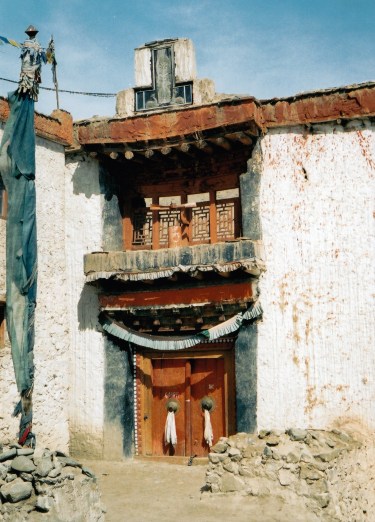
Gompa just below Leh Palace, Leh, ladakh.
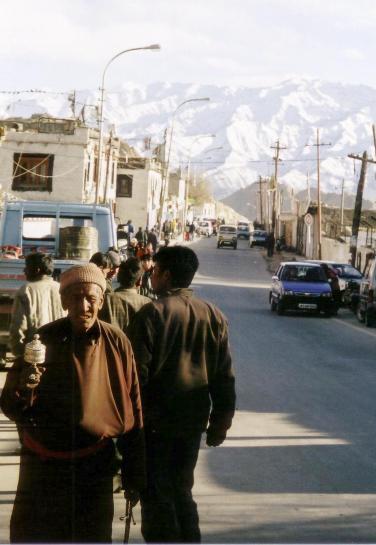
Man spinning prayer wheel, Leh. To Ladakhis, their religion is not somehow separate from their daily life, but an essential part of it.

Leh Palace. Very similar to the Potala in Lhasa, although smaller, this was the home of Ladakh’s royal family from the 17th century, when it was built, until the mid 19th century when they moved to the palace at Stok, on the other side of the Indus Valley, as a result of an invasion by Kashmiri forces.
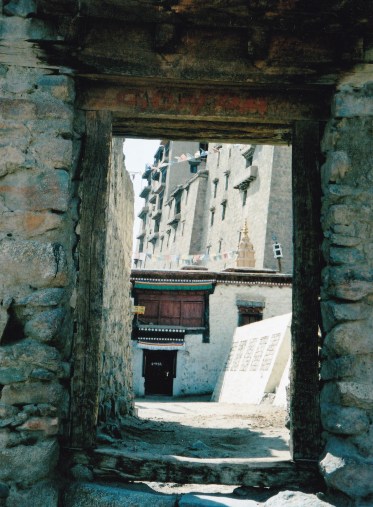
Gateway to Gompa at Leh Palace.
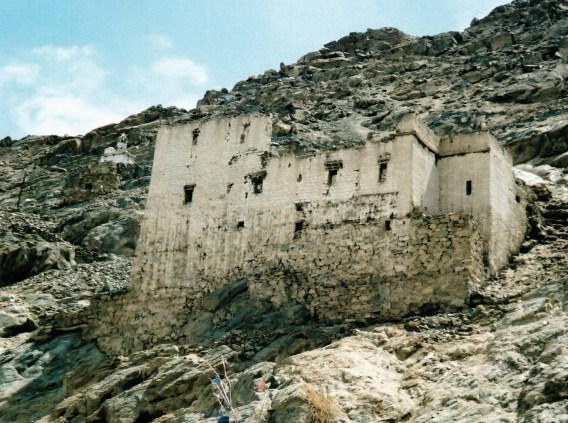
Old buildings on the outskirts of Leh, ladakh. Traditional Ladakhi buildings closely resemble those of Tibet. In fact, there are so many similarities between the two areas, that Ladakh is often referred to as ‘Little Tibet’.
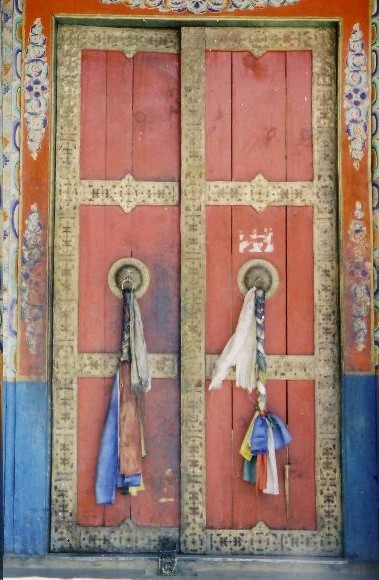
Temple Door at the Monastery at Thikse, Ladakh.
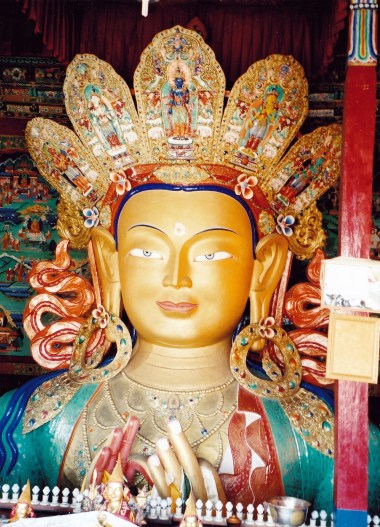
Statue of Maitreya, the Future Buddha, at Thikse Gompa. This statue, 2 stories high (15 metres) in it’s own temple was completed in 1981.
I have to begin this post with a caveat; it is quite possible that one or more of these photographs are not actually of Nainital, but perhaps of somewhere else. They are certainly of India, but there is nothing written on the back of the photographs. The majority were my father’s, taken by him on leave during the 1940’s, and since he died a long time ago I can no longer question him.
Nainital means the ‘eye lake’, and refers to the goddess Parvati. According to legend, her eye fell into the lake when Lord Shiva, her husband, carried her body back to their home on Mount Kailash.

This first one is a postcard I bought on my visit to Nainital in 2005. Normally, you expect a postcard today to be a picture of as good a quality as possible, so I was delighted to find this one. I have no idea how old the original would have been, but I would guess that it dates from the inter-war period.

This one was taken by my father (or so I assume – another caveat, I suppose!) since it was amongst the ones I inherited from him.

This one I believe is of Nainital, although I cannot work out any details of either the direction it was shot, or the buildings down the hillside. Someone who knows Nainital (Rajiv?) might be able to help me with this one.

Snow View, Nainital. The back of the postcard is blank, and so again I have no idea how old it would be. Google is no help, either. I found two other copies of the postcard, but neither told me anything about the picture.
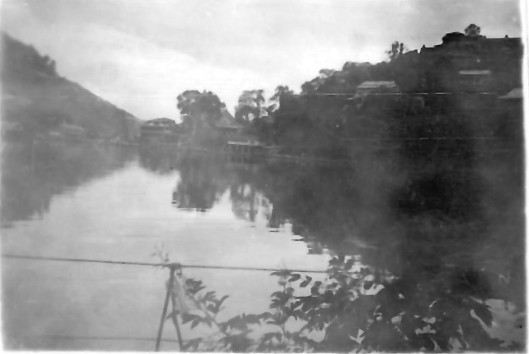
A view across the lake.

And a view of some pretty serious recreational boating.

My father indulging in some of this recreational boating.
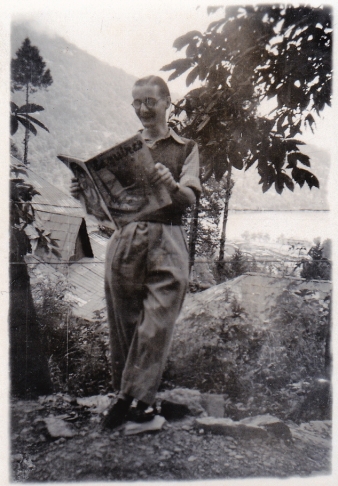
Finally, a photograph of one of his army mates. Although I have no idea who the subject is, I really like the photograph.
Apologies for the weird changes of tense – it was how I wrote the journal (in fits and starts), and I’ve not altered anything, merely missed out a couple of extremely uninteresting entries.
Sunday 29th November 2009
I didn’t get off to sleep for a few hours last night. There was lots of noise outside; lots of revellers going past. And then when I felt that I was almost off, a couple of vehicles crashed into each other just outside the gate. Lots more shouting. Then every time that a vehicle went past after that, I was waiting for another crash.
And the monastery across the road has its first puja at around 4am – the crashing of cymbals and the sounding of foghorns – that always wakes me, too.
So, I’m not entirely refreshed, but back in the restaurant at Green Hotel awaiting breakfast and just perking up with the first coffee.
I think I’m going to put off the visit to Dal Lake until tomorrow, and sit and write this morning. I’m tired and still feeling a little unwell. And read. It’s easier than having to think. I bought a big, thick, book yesterday, which should keep me going for a while.
Then in the afternoon, I mooched. Partly wandering the roads and hills around McLeod Ganj, and partly going for tea and coffee here and there. I have planned to go to the Tibetan music concert at the nearby school at 6pm, and after a shave and shower I head off there, find it, and take a seat along with about a dozen other westerners.
We sit and wait, and about a quarter of an hour or so after the scheduled start time, a chap comes in and announces that he’s sorry, but the musician isn’t coming. He has phoned to say that he couldn’t make it. He apologises to us again, and we get up to go. Because it was organised by a recognised NGO, and was intended to raise funds for the needy, I go and offer the guy RS 100/- towards the costs. In return, he gives me a long, meandering talk about volunteering and costs that I can’t really follow. It’s obvious that he’s been on the whisky and he presses me to meet him tomorrow to talk about the project. I waver, and then agree in a cowardly sort of way.
Once I have escaped, I go up to the Tibetan restaurant where I ate last night, since I rather liked the ambience of it. Unfortunately, tonight it proves to be full of a bunch of hard-drinking Tibetans, which I hadn’t really realised when I sat down to order. I get a beer and a thukpa, and am surrounded by whisky-swilling, chain-smoking Tibetans. This does nothing for my appetite, so I drink up, eat up and go.
I then wander up to the main part of McLeod Ganj and go to ‘Excite’ – the bar looks quite inviting from the outside.
Inside, though, it proves to be otherwise. I get a beer and order some masala peanuts, but don’t think much of them when they arrive. They are simply fried with a few bits of onion and tomato and seemingly no spices at all. I am offered a hookah which I decline. There are no other customers, and no music, in a plain, tatty room. I drink up and go.
Monday 30th November 2009
I cannot find the place that I agreed to meet the Tibetan chap and so, relieved, I go off to Dal Lake instead. It is a very pleasant walk of three kilometres or so each way, mainly through wooded hills, becoming quite autumnal in places. Magnificent birdlife – as well as the familiar ones, I see one with a very long tail that I take to be a Lyre Bird, and a very large eagle passes overhead, quite white underneath.

I pass the church of Saint John in the Wilderness and go in to have a look. It says that it is the largest ‘cathedral’ in the Himalaya, in the diocese of Amritsar. It is big, and nice inside. There is a monument to Lord Elgin outside, but I am more interested in one of the plates inside, to a Thomas Knowles, who met his end at Dharamsala, courtesy of a bear.

I rather like the ambience both inside and outside of the church. It is very peaceful and I linger. I think it is very hard to shake off the spiritual part of you that was formed when you were young, and I felt that I wanted to just stay there all day.
But I didn’t. I walked on to Dal lake, passing through the army training area, full of army personnel training, and along to the lake. It is a lovely spot, surrounded by deodars, and probably even more beautiful when the lake is full of water rather than full of bulldozers and mud.

So I return to McLeod Ganj and go to lunch and, oh dear, food is beginning to taste a little rank, again. Not a good sign.
It is McClouding over, now. So far the pattern of weather each day has been the same – morning warm and sunny, with clouds beginning to come over at lunchtime. By late afternoon it is quite cool.
Later, I go down to visit the Tsuglagkhang Complex; the temples and the residence of the Dalai Lama (he’s out, at the moment). Outside the main temple, there is a puja going on involving a fire. I watch for a while, wander around the temples and then wander out.

Tuesday 1st December 2009
Another visit to the Tsuglagkhang Complex, where I wander round and sit for a while, finishing with a visit to the sobering museum, telling the story of the rape of Tibet.
It is now evening. I am sitting in McLlo’s, looking out of the window down onto Main Square. There are a couple of liquor stores, with plenty of people, especially Tibetans, patronising them and milling around. But there is no trouble. People are peaceful, gentle. One would have to put this down to the influence of Buddhism. People have a code of behaviour that is based not on fear, but on an understanding of what is the right thing to do, for respect for others. There are no rowdy crowds; people don’t feel threatened. That is just one of the wholly benign influences of religion here.
It’s a gorgeous full moon, tonight.
Wednesday 2nd December 2009
After breakfast I decide to sit up on the roof with my book for the morning. Some hours later, I am interrupted when two troupes of monkeys leap onto the roof and begin fighting each other. Honestly, how is one meant to concentrate? I give up and go down.
The cold develops. I spend most of the rest of the day in my room reading.
Saturday 5th December 2009
I still have a bit of a cold/sore throat/headache, but am feeling better in myself. Indeed, walking around the town this morning, I feel that I shall really miss McLeod Ganj. I love the ambience; the only place in India that I have visited that that felt more laid back than here was Ladakh, and this runs it close. The Tibetans are brilliant, and the Buddhist attitude to all things tends to come through all of the time – even the stray dogs get fed and petted and seem much better off than elsewhere, although I suppose that might be because they chase off the monkeys!
And having ranted about westerners enough times, last night the chap at the next table to me called the waiter over to say that he wanted to pay for the supper of the two monks on a nearby table, and I’ve been in conversation this morning with a great group of Americans who are working with the refugees here.
2009. Blimey, that’s almost 8 years ago, now! Doesn’t seem that long! So here’s a couple of extracts from my journal, plus apologies for only taking a few photos.
Friday 27th November 2009
(I’d not been well, and couldn’t face a 12 hour bus journey, so I took a flight to Dharamsala) It all goes smoothly, and we get away just about on time. The plane is a twin engine prop; lovely, and the flight is marvellous. We are crossing the North Indian plains for a while, then all of a sudden the Himalaya jag up like freshly whitened teeth, from side to side across the horizon. We slowly approach, the ground beginning to rise up into hills and the towns disappearing. We pass Shimla atop a ridge, with its airport running along a second ridge, looking for all the world as though the top has been sliced off – and perhaps it has.
Eventually we come into land – another tiny airport where the aircraft taxis up to the small building, switches off, and then when we get out all is quiet, the mountains staring down at us and the air clear and cool. Pick up baggage, out to get a taxi to McLeod Ganj (or Gunj).
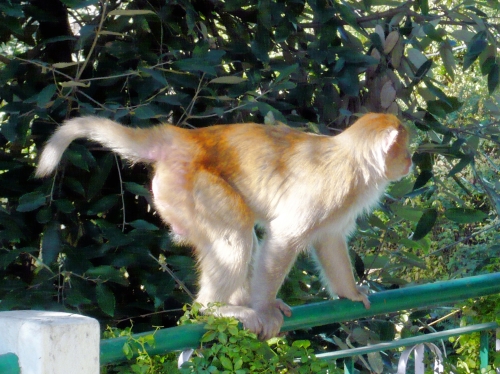
At first, the roadsides are crowded with troops of monkeys – I quickly lose all idea of how many. We pass hundreds. But as we gain height, they disappear and we are surrounded by forest.
In about half an hour, we get to McLeod Ganj and I check into my room at Hotel Ladies Venture. It is basic, but is clean, has hot water, a bed with lots of blankets, a table and a chair. For RS 200/- a night I’m in no position to complain.
So the first thing that I do is go off to explore. I am surrounded by a busy little town full, largely, of Tibetans. Lots of shops and cafes, monks, monasteries, gompas and chortens. No hard sell. In my mind, I turn cartwheels. At the moment I am sitting up on the terrace at Village Meeting Point café, finishing apple pie and Darjeeling tea, watching the sunset amongst the mountains.
This is better.
Later, it gets colder.
Saturday 28th November 2009
I slept pretty well – it didn’t get as cold as I thought that it might. The shower was good, although the hot water didn’t last for too long. This morning I have wandered up through the town to Green Hotel for breakfast. Probably like most places here, it is filled mainly with westerners, discussing Tibetan politics. Most of the more upmarket places, that is. The Tibetans will be in the cheap eateries, since most are not exactly well off.

There is a large ex-pat community of all sorts here, and one of the consequences of this is that such things as real coffee are served all over the place. Also Italian food, etc., etc. It is certainly no hardship for westerners, here. Everywhere offers yoga classes, meditation classes, massage, cookery lessons – you name it. Opportunities of all sorts for volunteering, too.
Today I am just going to wander around and get to know the place a bit. Try to feel the pulse of it, as it were. Like other, similar, places (Bodhgaya) it seems like several separate communities living side by side, interacting occasionally, but still separate. Or should that be different layers?
A sudden commotion beside me, as a monkey nips in through the window and nicks a bowl of porridge off of an adjacent table, making its escape out of the same window. No one seems too bothered.
After breakfast, I change some money and then stroll the kilometre or so uphill to Dharamkot village. The track goes through forest and I pass first through a troop of Macaque monkeys, who chunter a bit at me, but keep out of my way, and then pass lots of birdlife, including a small flock of birds that look a little like tits, with a mainly black head with a small black crest, and one beautiful bird, a little larger, an iridescent turquoise (mainly) like a kingfisher or a roller.

Teashop, this way!
At the top of the hill is a little teashop where I get a lemon tea and join the other few people sitting there in silence. It is perfectly peaceful, a good place to watch the world go by, except that the world decides not to pass that way for the moment.
Back into McLeod Ganj, past the chuntering macaques, to Jimmy’s Italian restaurant for lunch. The rooftop has fantastic views over the town and across the mountains, and I watch a couple of kites slowly circling and calling nearby. If it wasn’t for the fact that I want to explore this fascinating place, I think that I could just sit here for the whole afternoon with a book.
In the event, I don’t do anything much more constructive than that. I read, I wander around; I go for tea and cake. After all, I’m here for ten days or so, so there is no rush to do anything.
I plan to walk to Dal Lake tomorrow, which is no more than half a day there and back.
In 1988 I went to Nepal for the first time, travelling by bus from Delhi to Kathmandu. Although the trip took almost 2 days, and the bus was remarkably uncomfortable, it was one of the most spectacular journeys I have ever taken, and a most remarkable experience.
And then I trekked the Annapurna circuit, still considered by many to be one of the 10 classic treks of the world. It took 24 days to complete, and from the time we left Ghorka, until the day we walked down into Pokhara, we were travelling entirely on footpaths and saw no vehicles of any description.
Part of the walk is now over a new road, and whilst this is surely welcome to the inhabitants of the region, I suspect that it takes away a little of the magic of the trek.

Village near Manang (posibly Mungji), on the Marsyandi River, close to the Annapurnas. In many ways, a typical Nepalese mountain village, it is built on man-made terraces, up steeply sloping mountainside, to avoid using any of the precious farmland available in the valley.

View from Poon Hill. Poon Hill lies a little to the west of Ghorapani on the river Ghora (pani being water), west of the Annapurnas. Sunrise there consequently occurs behind the Annapurna peaks, including the spectacular Machhapuchhare, or ‘fishtail’ peaks. That said, this shot was taken towards the west, looking across the Kali Gandaki valley.

This is dawn, though. Machhapuchhare and its double peak are shown clearly on the left.

Mountains and glacial lake from the village of Manang.

Lower down, the land is heavily terraced, fertile land being at such a premium that every available bit is used. These rice paddies are near the village of Chepe Ghat, on the Marsayandi River.

Chorten. Chortens, or stupas as they are also commonly known, usually contain relics of saints or priests. The original stupas held relics of the Buddha, such as at the Temple of the Tooth, at Kandy, Sri Lanka.

Mountains near the village of Muktinath. In the rain-shadow, here, the landscape is that of a high altitude desert.

Mani stones on the Annapurna trail. Mani stones may be carved, painted or both, and serve a similar function to prayer flags, in that they either have a prayer or mantra carved on them (typically ‘Om Mani Padme Hum’ – from which the name ‘Mani Stone’ comes from – meaning ‘Hail to the jewel in the heart of the lotus’ i.e. The Buddha) or they may have a picture of the Buddha himself. Although they may be encountered singly or in small numbers by shrines or at Gompas, at times they make up huge walls containing many hundreds of stones, some of which may have been there for hundreds of years. These walls, like shrines or any other Buddhist relics encountered here, are passed on the left.

Houses at Manang.

The Upper reaches of the Marsayandi, looking down to Manang.
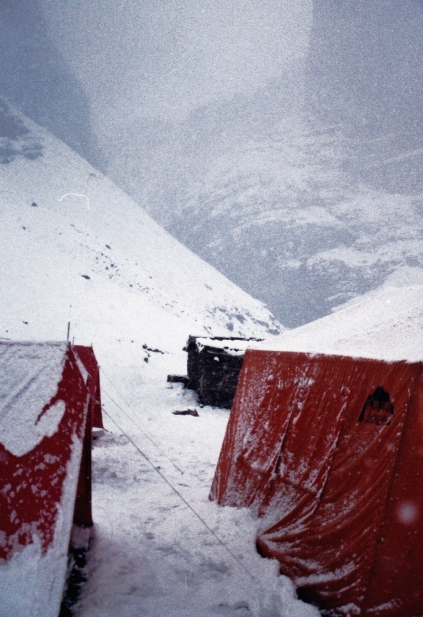
Snowed in below Thorung La. Not an unusual occurrence. Thorung La is at 5415m (17,700ft). We arrived at our campsite early afternoon with the ground clear of snow and the sun out. This was the scene a couple of hours later, delaying our crossing the pass (‘La’ is Tibetan for ‘Pass’) by 24 hours.

Crossing Thorung La. On the day we crossed the pass, we left camp just after 4 in the morning, and were down the other side by late afternoon.
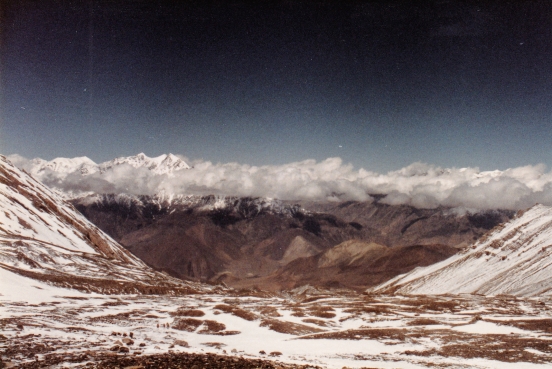
Looking west (and down!) from Thorung La). On this side of the pass there is far less precipitation and the land is noticeably drier. This is looking towards Muktinath.
 Mick Canning