Today is the shortest day of the year. Where I live, we will get approximately half the daylight hours that we will get during the Summer Solstice. Actually, slightly less. We get up in the dark and it is dark again long before supper time. The weather is cold and predominantly miserable.
But from today the daylight hours lengthen – at first imperceptibly, but gradually it becomes noticeable the hours of daylight are increasing. Finally, there is an end to the relentless lengthening of darkness, and within a few weeks it will become obvious that the world is, indeed, moving towards a time of warmth again.
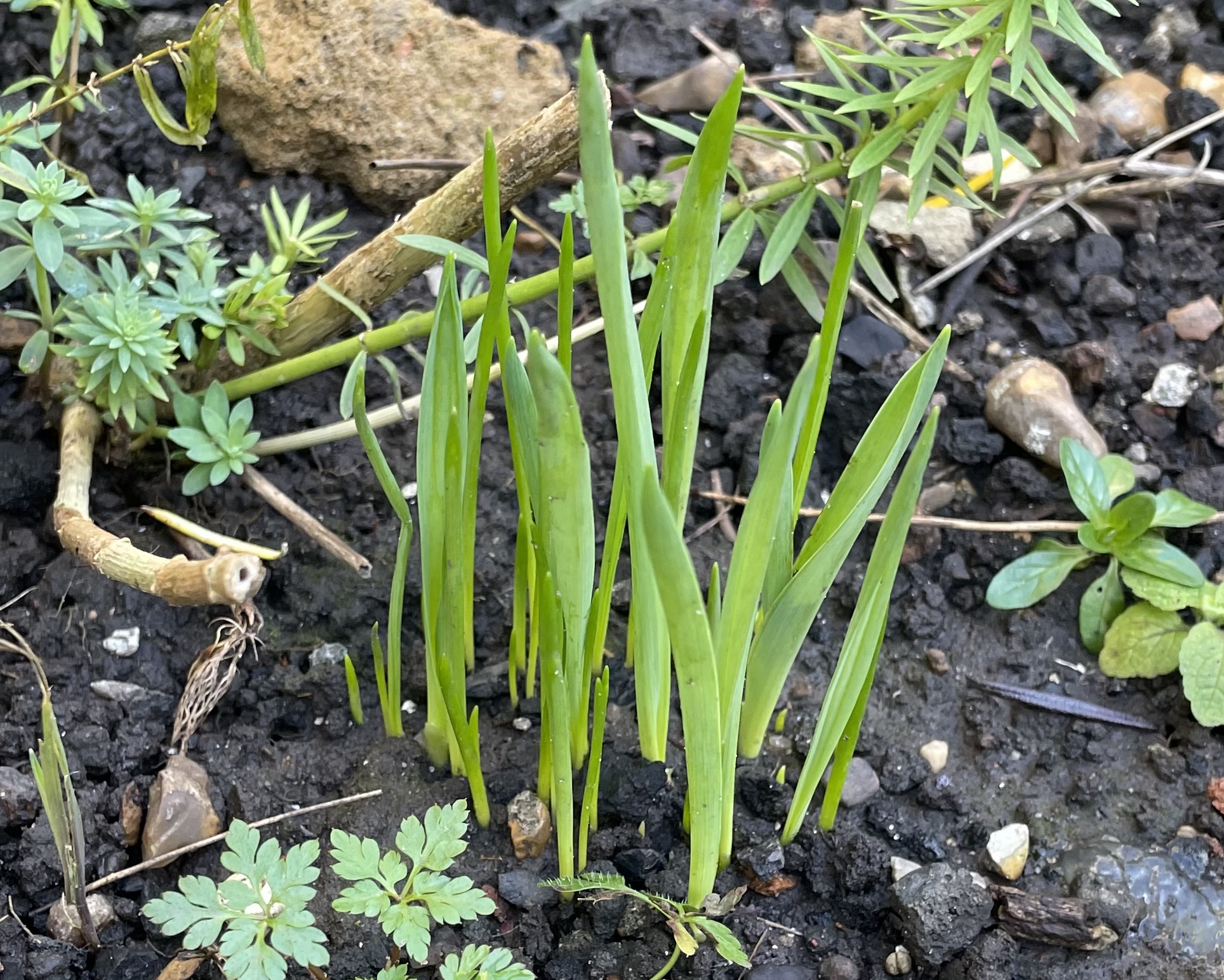
Yet there are already new plants coming up; new growth that has been prompted by…what? When they broke the surface of the ground a few weeks ago the days were still getting shorter and certainly no warmer. Nature is strong and determined. Winter is never a lifeless time of death and decay. There is dormancy and rest, but also a lot of growth if one takes the trouble to look for it.
I’m thinking longingly of Spring, of renewal and growth. In a couple of hours I’m off to see a mumming play – perhaps I’ll leave you to Google that one – down on the Kent coast. Beer will be involved, of course, in line with the best folk traditions. Old – possibly ancient – celebrations of the turning of the year and the approach of Spring.
I’m still here, although you might be forgiven for not realising that.
One or two of you might have noticed, though, that I have been an occasional visitor to your blogs over the last few months, but mostly I’ve kept away from WordPress in that time.
Of course.
Life quite often has a tendency to get in the way of my writing. It gets in the way of most of the things I do, actually.
That’s my excuse.
But I’m still plugging away at A Good Place, my novel set in Northern India about the English left behind after Independence, and am now very close to finishing it. I’m also working sporadically on Echoes and Imaginings Issue 2, now I’ve decided what I want it to be about. It’s gonna take a while to finish, though.
Cos life, you know.
Life getting in the way. What a drag.
But as for posts on here, I just seem to have just run out of ideas for now. It has been rather tempting to post the odd political rant during the last few months, but I don’t do politics on here. It would just make me cross and I’d get into arguments and I don’t want to do that. The point is I haven’t felt I’ve had anything worth writing. And I’m a great believer in that if you haven’t got anything to say, then don’t say it.
My wife often says I’m in touch with my inner vagabond. I’m taking that to mean that I enjoy walking, unless she’s referring to something else. My dress sense, for example. But yes, I love walking, especially long distance walking, but most of all I like to simply wander. There is a tremendous pleasure to be had by just setting off for a long walk without any particular destination in mind. Taking the more interesting-looking path as we go.
Of course, it’s not always possible to travel this way. We need to have some sort of destination in mind unless we’re prepared to just settle down to sleep wherever we find ourselves at nightfall. Usually we don’t have the time and the freedom to travel like this. Some people may also find it unnerving not to have board and lodging all planned in advance.
I’ve only done it occasionally, I must admit, but found it remarkably liberating when I did. There was no pressure to reach a particular destination by nightfall, I just had the freedom to wander along at my own pace until I felt I’d had enough for the day.
Even then, of course, some planning had to be done. Would I carry food or rely on reaching somewhere I could get a meal of some sorts? Would I carry shelter? Extra clothes?
But that is not exactly tramping, of course. It is just an exercise to be enjoyed (or otherwise) for a short period. It’s not a permanent lifestyle.
I’m sure that very few folk have deliberately chosen tramping as a lifestyle, but I’m aware there are some who have. This leads to the obvious question – why? I suppose all of us, at some time, wonder what is really important in life? Riches and property are, indeed, a burden in many ways, as well as conferring the obvious advantages in life. Some people just didn’t want that lifestyle. Some didn’t want the responsibilities of a settled life, with or without a family. There were always some folk who could just never settle anywhere for long. Most, though, would have ended up tramping through loss of employment and / or home.
Certainly I understand the difficulties of the tramping life, especially when one is no longer young. And I certainly wouldn’t want to be trying to survive as a homeless person in a city – rightly or wrongly, I think of tramping as a rural phenomenon. The whole point of it was to be on the move, rather than staying in one place. I doubt it would be possible today, with so many laws against that kind of lifestyle. There were, of course, laws against it in the past, too, but almost certainly much harder to enforce. I think, too, society is just ordered differently today. We think differently to how we did fifty or a hundred years ago. A tramp turning up at a farm today looking for a couple of hours work in return for a meal would get short shrift, and I can’t imagine any householder regarding one with anything other than hostility.
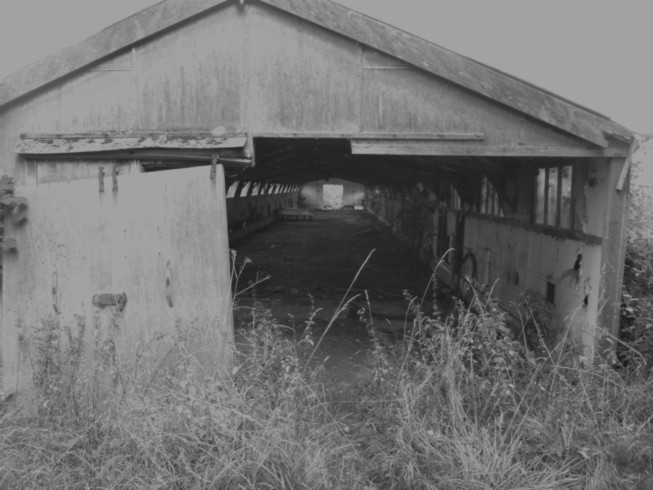
Again, I can’t imagine anyone choosing that lifestyle through the winter. But tramps used to learn of places they could settle for the winter, often carrying out odd jobs in return for permission to sleep in a shed or a barn and the odd meal. In this post I’m talking specifically about Britain, but I suspect it applies equally to hobos in America, swagmen in Australia, and possibly others I’m not aware of elsewhere.
And it would be unlikely to be a long life. But there were always some who chose it as a way of life rather than being forced into it by circumstances, and in another time I might possibly have been one of those.
In the beginning there was lots of very dark darkness and very cold cold stuff, which wasn’t at all nice and although no one existed yet, they were all really miserable.
And Meh, the god of this world, thought ‘Well, this isn’t much fun’ and so He created the universe, with the Milky Way above and the Place of Torment below. And the Milky Way is a beauteous place of flowing streams of milk and cream and comfortable sofas beside cosy fires, while the Place of Torment is a cold and frozen place of hard floors and empty food bowls. And that was the first day, and a jolly good first day’s work it was too.
On the second day, Meh created the earth by vomiting up a giant hairball, and then sat back as life rapidly evolved without any further input from Meh, which was how He liked it, so He could curl up and take a little nap…
From Chapter three:
‘And thou shalt make images of Meh, and cause them to be distributed, yeah, all over the internet and into the world even unto the furthest corners. There shall be infinitely more of these images than those of dogs, for I, Meh, am a jealous god.
‘And be it known my chosen ones, whom I love and have created in my own image, shall be afforded a privileged place in thine homes, otherwise I shall visit plagues upon thy households, yeah, even unto the seventh generation of thy accursed species.
‘But those who treat my beloved offspring well shall have their eternal reward, most especially in the Milky Way, while those who mistreat them shall be condemned to be pounced upon and bitten for all eternity, and great will be the wailing and gnashing of teeth.’
From Chapter seven:
And know that this is the truth, for it is written herein and thou shalt believe it for it is the word of Meh.
It is told there was a Man of Meh, and he came unto the land of Babylon to preach to the people there tolerance and goodwill to all those that walk upon four legs and are furry and purr when pleased, yet the people received him with hostility and drove him out into the desert.
And thus Meh said ‘Lo, I shall send plagues to irritate and annoy these godless people until they learn the error of their ways.’ There was first, then, a plague of fleas, which certainly irritated them, although it was insufficient to cause them to mend their ways. So Meh then turned the milk sour, and this annoyed the people, but they still denied Meh and said ‘We don’t want to listen to some preacher spouting a load of old bollox’ and so Meh then caused all the fish in the fish market to be a bit off, and not really smell all that good. And the people said ‘Oh, leave it out. We’ll make our own rules and laws.’
So Meh did withdraw from the world, and he did sulk a goodly while.
Formerly a deer park, Sarnath lies 10km outside Varanasi and is the place where the Buddha came after his enlightenment at Bodhgaya, to seek out his former companions who were living there in huts and give his first sermon, on the turning of the Wheel of Dharma. This comprises the Buddha’s path to Enlightenment: the Four Noble Truths, the Eightfold path and the Middle Way.
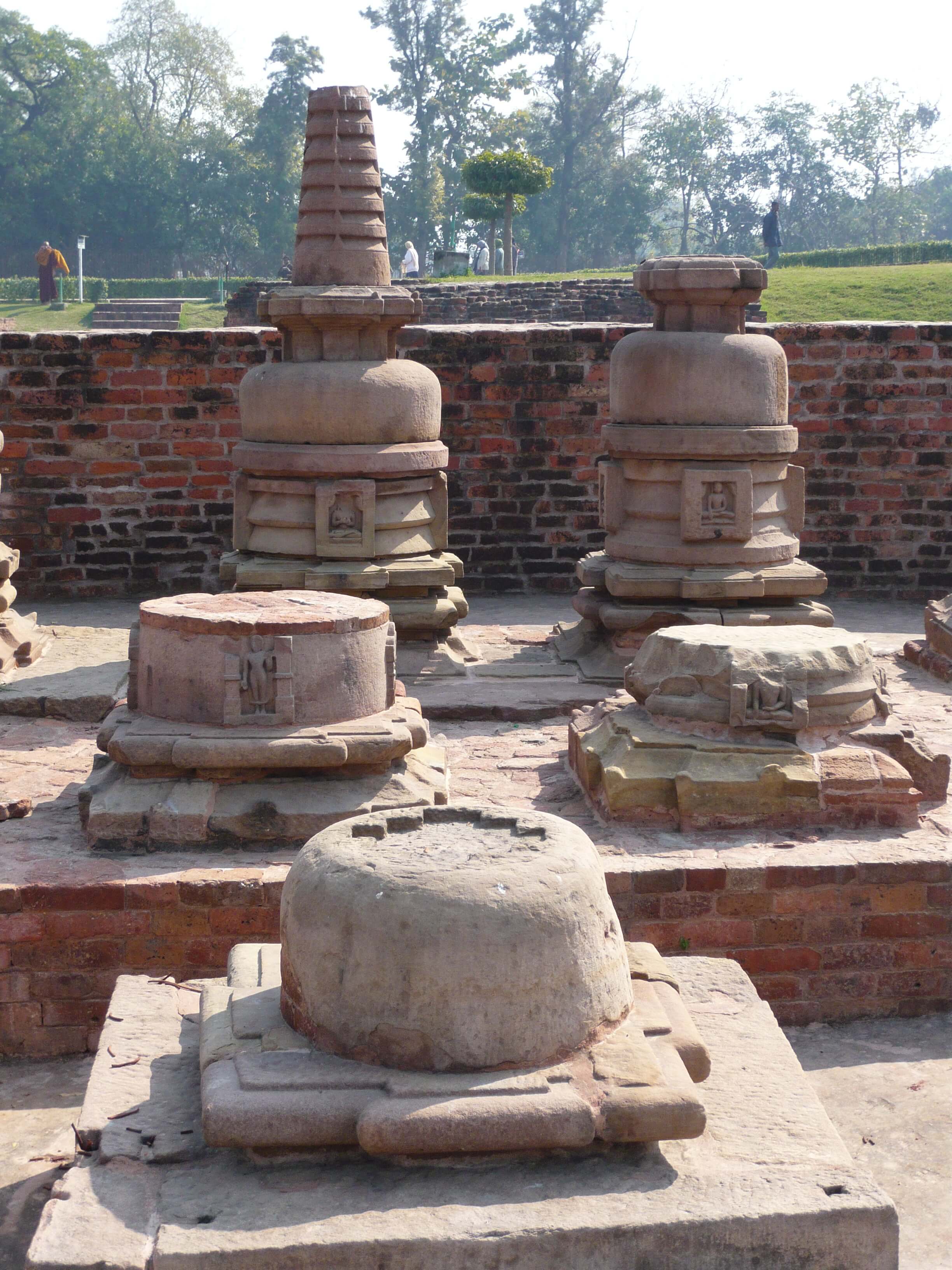
This altar is still used by pilgrims for pujas – not just Buddhists, but also Jains, for whom Sarnath is also sacred.
A monastic tradition flourished at Sarnath for over 1500 years after the Buddha. Many monasteries and two great stupas were built, which survived until the end of the 12th century when they were destroyed during the Muslim invasions and not rediscovered until 1834 by a British archaeological team. Amongst these ruins were a stone column 15.25m high with four lions as its capital, erected by the emperor Ashoka, a convert to Buddhism after witnessing the terrible carnage of a war he had unleashed in the 3rd century BC. This capital was adopted as the symbol of the modern Indian republic.
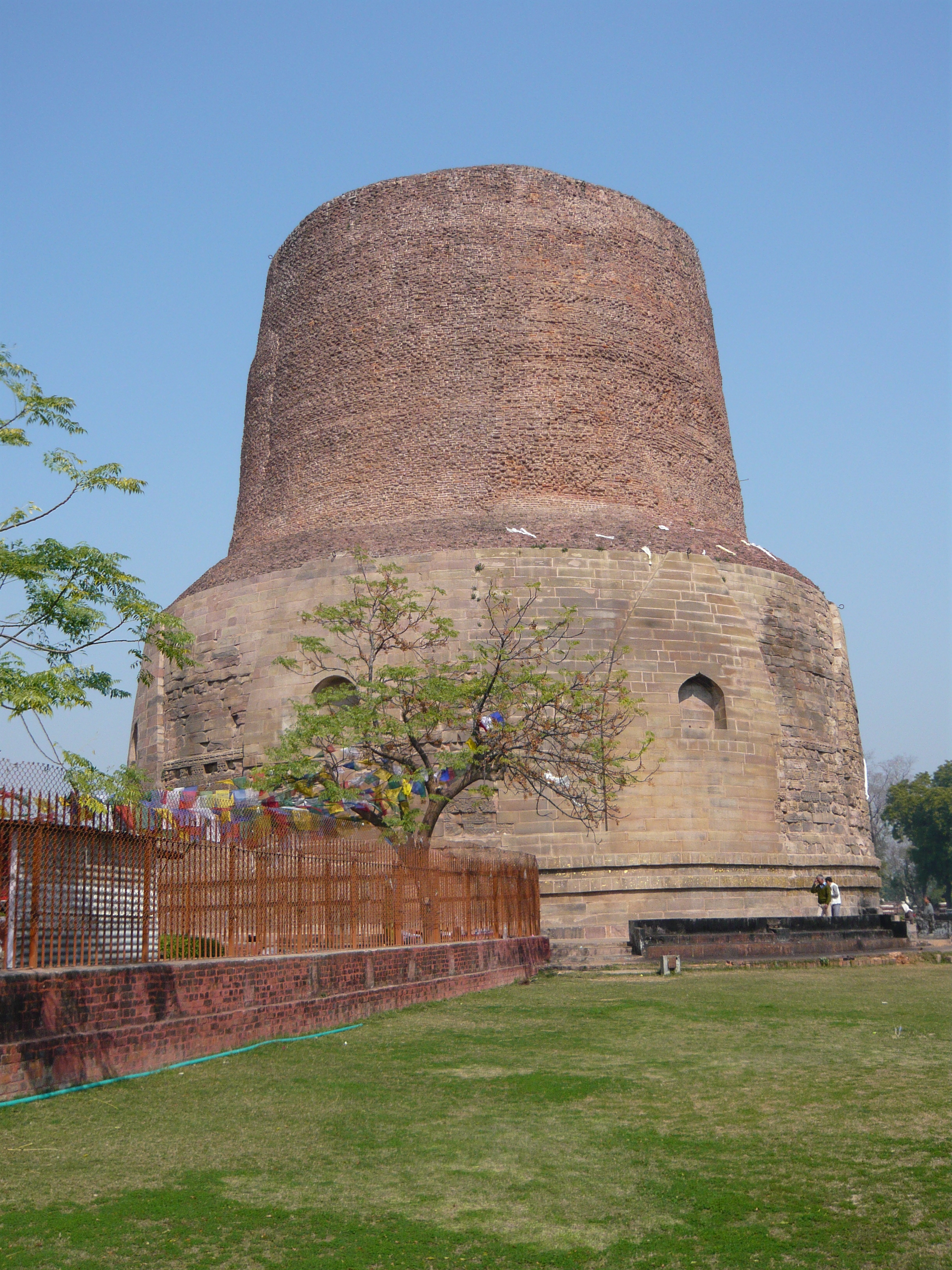
The Dhamekh Stupa. Built in the sixth century, this solid cylindrical tower, 33m high, consists of a stone base with the upper part made of brick, and was virtually the only building to survive the Islamic destruction, perhaps because of its sheer size and bulk. It marks the spot where the Buddha supposedly gave his first sermon. The five former companions, who became his first disciples on hearing him speak, had deserted him when he gave up his ascetic vows. On achieving enlightenment, he determined to follow the ‘Middle Way’, avoiding both luxuries and asceticism. This is the basis of its appeal to me personally – nothing to do with religion, but a sensible lifestyle avoiding extremes, with kindness at its heart. A philosophy of life.
Delicate carvings on the base of the Damekh Stupa.
Just outside the Deer park, there are a number of modern Buddhist monasteries, attracted to the site because of its history. This particular spot was a beautiful peaceful place, but I can’t remember exactly where it was! I think it was outside the Japanese Temple…
Inside the Dharmachakra Japanese monastery
Mulagandhakuti Vihara built by the Mahabodhi Society in 1931
Often, it still feels like summer at this time of year, but I feel autumn has truly arrived now. This morning I walked a path I haven’t walked for a week or more to find the sun was that much lower than it had been and I was constantly having to shade my eyes. It’s all about colours, now. Colours and the cooling of the world. Russet. Browns. Fading drab greens. Yellows and orange. Autumn can be beautiful, although it can also be dull and dreary and occasionally fierce. But mornings often arrive with an added sparkle, with heavy dews on cobwebs and leaves glinting in the low sun, hedgerows of thistledown, rosehips, and hawthorn. There is usually a freshness in the air, especially in the mornings, which has been absent for most of the summer, that invariably lifts my spirits.
I like summer, of course I do, but the arrival of autumn reminds me in some ways of the arrival of spring. In spring we have the stirring of life after a long period of hibernation, whereas the beginning of autumn always feels to me like the start of a new, second, outburst of life. Many plants have a sudden growth spurt, fruits and nuts and berries swell and glow and are plundered by birds and beasts. It is still warm, warm enough to bask in the sun and to feel hot walking up even quite gentle hills.
The Equinox occurs on Friday (at 2.03am in the UK, to be precise) and after this the hours of darkness outnumber the hours of daylight until the end of next March (counting dusk and pre-dawn as night time). After this, the year always feels to me quite different, even if the weather from the one day to the next is much the same. I can already feel myself slipping into a different place; the logs for the burner have arrived and have been stacked ready for use. The apples have been picked, shortly to be wrapped and stored away. Much in the garden is in the process of being cut back for winter. When the days are short and the nights are long, there will be many books to read, lots of music to listen to, a few beers to drink, and many long conversations to be had.
But also many long walks as well, I hope. I love winter too.
Yesterday, I went for a walk around parts of Sussex and Kent. The sun shone – Hooray! I managed the whole walk without aching too much afterwards – Hooray again! I said good morning to some sheep and patted a very nice horse. I just knew it was going to be a Good Day.
At one point I went along a footpath I haven’t used for several years, and was delighted to see this:
And then another four miles or so later there was this:
The council have made this area a Designated Roadside Nature Reserve. Established for several years now, it has a rich variety of wildflowers and grasses, and is fairly humming with insect life.
Grief is a powerful emotion. It can be debilitating and overwhelming. It can consume people, preventing them from living their lives.
Although it sounds a fictional cliché, In some societies ‘professional’ mourners will attend funerals, intentionally provoking powerful outpourings of grief by almost theatrical displays of wailing and crying; perhaps ripping their clothing, throwing themselves to the ground, and thrashing around in distress. This helps to move the bereaved through the process of loss, by bringing feelings and emotions to the surface, rather than allowing them to linger unexpressed for months or years. It helps the mourners to move on – not to forget, but to allow life to continue.
I can understand this, having met people who have been unable to move through grief, seemingly trapped in an ‘I’m okay’ situation, refusing or unable to display their emotions but presumably storing their grief up inside, unexpressed. Refusing help. People who have appeared unable or unwilling to move on. I was fortunate, my grief striking me like a clenched fist and, for periods, I had no choice but to allow myself to weep and rail at fate. But this allowed me to eventually move on, my grief evolved into sadness.
And for anyone struggling with grief themselves, something that helped me at the time was to write a letter to my brother. In my case after remarking it had been a while since I had heard from him, I filled it with humour, using in-jokes we had shared, although other people might have found a different approach beneficial. And the letter sits on my computer still and every once in a while I read it, and it helps me to smile and remember and, of course it makes me feel sad.
Day four of the Poem-A-Day-For-A-Week-Or-So project and a bit of a rush, today, as I’ve been assembling a shed (as you do). Another one, therefore, which will benefit from a revision when I have more time.
In Tripoli I made a vow to travel light, my eyes wide open,
Travel all the time I could, to take my chances when they happened,
Planned to seek out strange new places, take some risks see new horizons,
One thing alone I wanted now, the promise of the unexplored.
.
And I remember where I was, the time of day, the type of weather,
Early morning, early March, this was a time of change for me,
A time for taking big decisions, time to turn my life around,
Time to leave things in the past, the time to turn another page.
.
At the time I made that vow, I yearned to go along the Silk Road,
Travelling any way I could, and though that sadly never happened,
Other projects came and went, journeys all filled with adventure,
Baking deserts, frozen mountains, close to home and far away.
.
I knew the world would not be kind, it would not make my journeys easy,
Whatever it might offer me, I’d leave myself completely open,
Embrace the rain, embrace the wind, embrace the temple and the hillside.
This was my private pact with life and to this day I’ve not yet finished.
Nature dies down in winter. Certainly, at those latitudes where the days become much shorter and the temperatures plummet. Both wind and rain seem to become more frequent. Snow. It is a period of rest and renewal after autumn has put on a final glorious display of colour. Animals adapt to this in one of three ways: some will eat and eat of the autumn bounty of, especially, fruit, putting on large fat reserves and surviving the winter in a state of hibernation, their heart-rates dropping to a scarcely believable one or two beats a minute, their bodies slowly using these fat reserves for the little energy required to maintain a flickering life through those months. Some migrate, seeking a warmer climate until spring returns. These animals are, due to the obvious logistics required to travel hundreds of miles to reach those more hospitable climes, the larger animals and many of the birds. Travel over those kinds of distances would be out of the question for the smaller ones. Others stay put and, in the case of the plant eaters, scratch out a meagre living on whatever leaves and grasses survive through the winter. The carnivores, of course, stay and try to catch them.
Our Neolithic ancestors’ life cycles would be attuned to this pattern too. Autumn must have been lived fast and furiously. In the same way our medieval ancestors worked long hours to bring in the harvests, Neolithic man and woman must have used all the dwindling daylight to bring in as much food and fuel and dry bedding as possible before the winter period. Then by the end of autumn gathering would have largely ceased and they would have moved into a winter rhythm of life.
But how did they get through winter? What of the food they had gathered? Presumably, they had no way of storing fruit – could any of it be dried? Was it fermented for drink? Or was it all eaten as soon as it was gathered, as though they were all so many dormice seeking to build up their reserves? And could this, in fact, have been a part of their strategy to get through those months? To eat and eat until the perishable foods were all gone, and then to stop all but the most essential activities. To expend as little energy as possible and stay as warm as they could. Spending as much time as possible asleep.
And yet, they would still need to eat, and so with dwindling food reserves they would slaughter any beasts kept for that purpose, possibly smoking the meat to enable it to keep for as long as possible. Hunting would continue and might, in some ways, become a little easier. With less vegetation around, there would be less cover for their prey, and in snow there would be clear tracks to follow. But presumably this prey would still need to be pursued, and this would use precious energy, unless they relied more upon pits and snares.








 Mick Canning