Kent’s Standing Stones

Although not perhaps the first county one would think of when discussing ancient standing stones, Kent does have its share. There are two main sites approximately equidistant on either side of the river Medway in north Kent. The eastern site consists of the remains of two burial chambers (Kit’s Coty House and Little Kit’s Coty House) and the White Horse Stone, all within a kilometre of each other, while the western site consists of the Coldrum Stones (burial chamber) and Addington Long Barrow and Addington Burial Chamber.
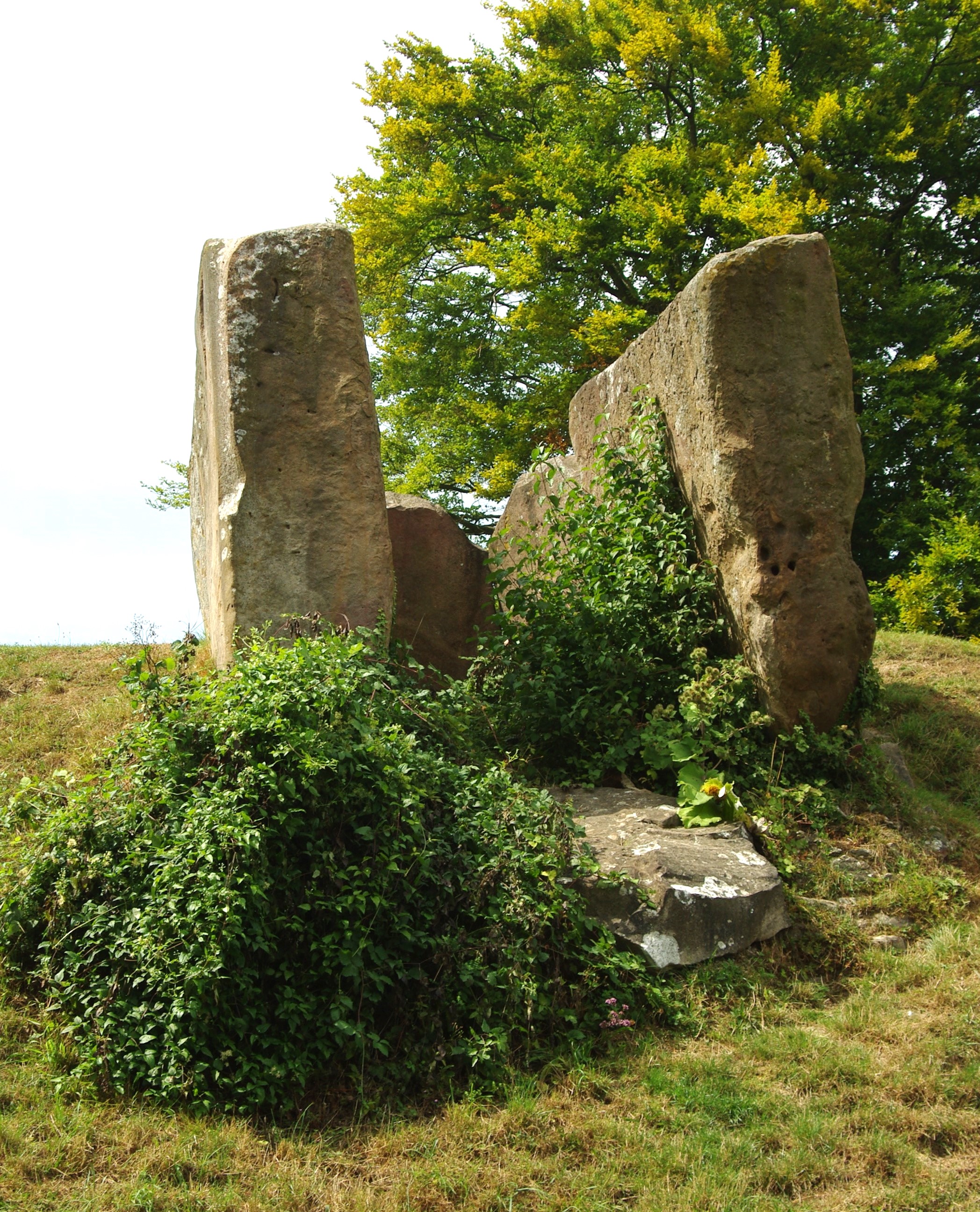
The Coldrum Stones

At Little Kit’s Coty House in a light drizzle, I counted seventeen stones, although Donald Maxwell writing in The Pilgrim’s Way in Kent, a short guide published in 1932, claims twelve to fourteen. Various other authorities suggest between nineteen and twenty-one. This is one of those sets of remains that comprise such a jumble of stones it is supposedly impossible to accurately count them – and just to make it harder, they are also supposed to move around (presumably when no one is looking). Thus they are also known by the name The Countless Stones. The largest ones I reckoned were about four meters by two and about three and a half meters by three. The shapes are very irregular, and since they are in a collapsed state there might have been serious damage to some of them. I immediately wondered whether it had originally been the same shape as Kit’s Coty House, a Neolithic chambered long barrow, just a few hundred meters to the north, where the stones are in the form of a dolmen, which would have been a burial chamber at one end of an eighty-four meter mound.

The Countless Stones, or Little Kit’s Coty House

William Stukeley, writing in 1722, recorded that he was told local people remembered a chamber at Little Kit’s Coty House. It had had a covering stone and was pulled down in about 1690.

Both Kit’s Coty House and Little Kit’s Coty House are reckoned to be just under six thousand years old.
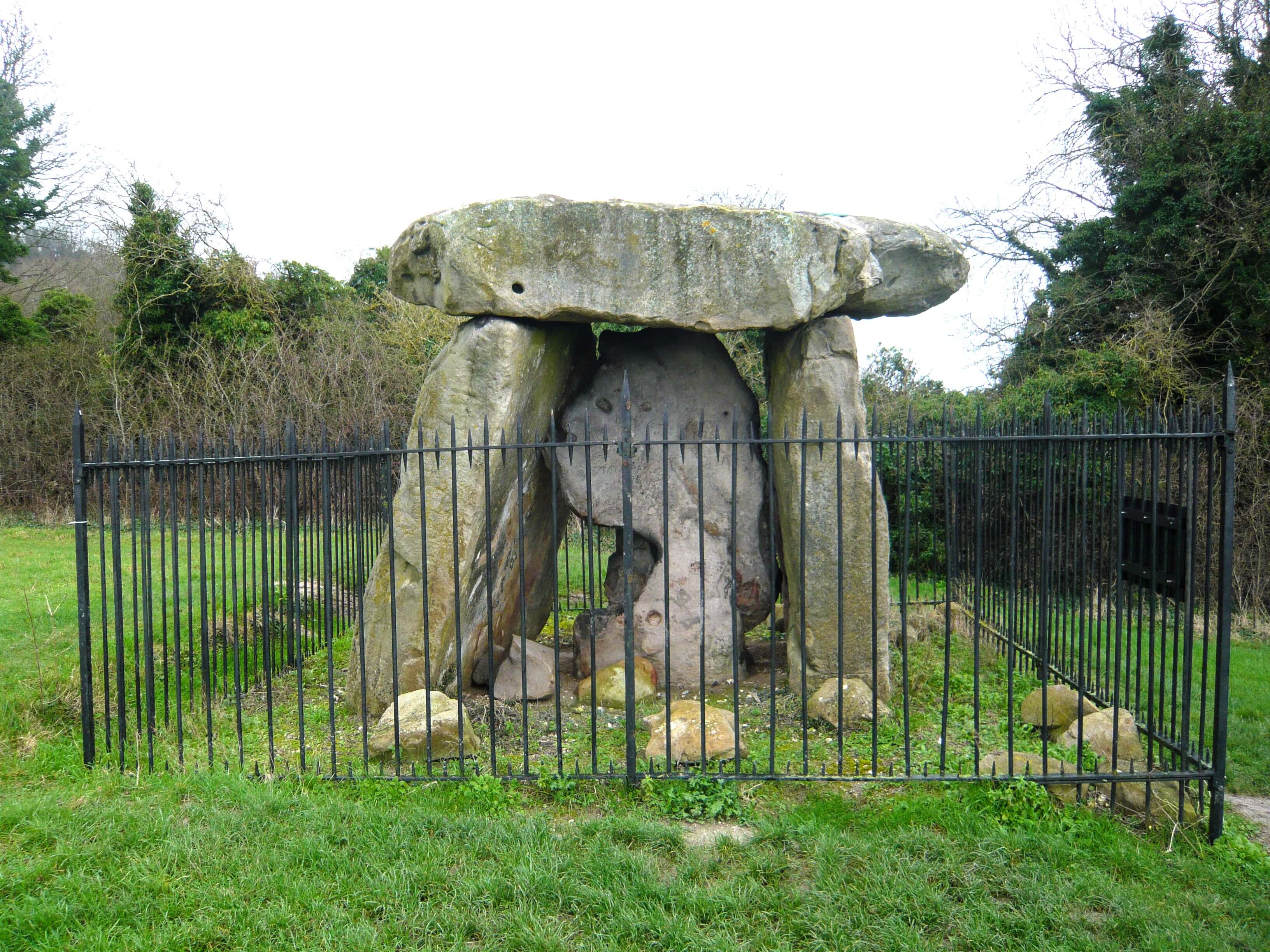
Kit’s Coty House

Some nine or ten kilometres away across the Medway Valley are the Coldrum Stones, or Coldrum Long Barrow, dated to between 3985 and 3855 BC. These ones, looked after by the National Trust, are also a burial chamber. Donald Maxwell claimed that there were forty-one stones and that a further fifteen were broken up at an unspecified date during quarrying work. Maxwell also reported a tradition ‘amongst the country people’ that an avenue of stones stretched across the valley from Coldrum to Kit’s Coty, although there is no evidence it ever existed. But coincidence or not, both of these chambers are situated at the same height, about eighty five meters above sea level.

All three burial chambers, then, have been dated to the same period, a thousand years before Stonehenge was built. It seems reasonable, then, to assume they were produced by the same society.

Coldrum has been proved to be a family tomb, the remains of at least 22 people being interred there, with DNA analysis proving their likely close family relationship. Yet amongst these kinsfolk, recent isotopic analysis has shown that maybe the chamber also contained the remains of individuals interred in the fifth to seventh centuries AD.

The White Horse Stone

I say maybe, as there is a very strong caveat connected to this research, and that is that when the human remains were removed in the early twentieth century they were not only not labelled very thoroughly, but they were also passed around several museums and the possibility exists that some bones ended up mis-accredited. Yet it has been proven that some neolithic burial chambers were re-used for burials in the early Anglo-Saxon period.*

The land here has been sculpted by man. Of course, we sculpt the land more and more violently and obviously in the twenty first century, but here, from all these thousands of years ago, are these simple shapes built by ancient folk to inter and celebrate their dead. And these were interactive places. Evidence from other sites shows that some of the bones of these ancestors would be removed at times, although whether as a simple reminder of their elders, or whether for magic or sacred purposes, can only be conjecture. But I like the thought that these bones might be invested with power, that they could be brought into the everyday for protective or ritual purpose.

Now, we view them in a different light, and their sacredness has evaporated. Like a deconsecrated church, but without ever having been formally deconsecrated. It is possible our ancestors would view our visits there as desecration.

But I’m never sure whether you can take any arrangement of stones for granted; they’ve been dismantled in the past, could they have been reassembled?

Incidentally, for those who enjoy Ley Lines, it is worth mentioning that the Ley Line hunter Paul Devereux has described a line passing through The Coldrum Stones and aligning with six nearby churches. Although just to put a dampener on that, perhaps it is also worth mentioning that students at Cambridge University investigated this particular line using computer simulations based on the Ordnance Survey details and concluded that it wasn’t statistically significant – that it was almost certainly just a chance alignment. You takes your pick.

*Research carried out by members of Durham University, Oxford University School of Archaeology and British Geological Survey (Isotope Facility) 2022
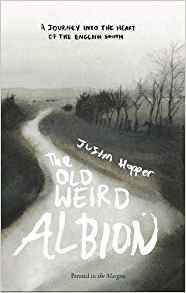
Review of The Old Weird Albion

The Old Weird Albion, by Justin Hopper.

download

The viewer sees a painting that appears to be composed of watercolour and charcoal, of a winding road or track, possibly even a river, leading towards a line of downland hills, the whole created entirely in black and shades of grey, with the title and author scrawled into the picture in brilliant white, as though it were a prehistoric figure etched into the Downs themselves.

And that’s just the cover.

This is a book quite unlike any I have read before, in that it is a book about the south of England, especially the South Downs of Sussex, but it is far more than geography and the associated disciplines such as geology and biology, rural history and architecture, and folklore. Psycho-geography was not a term I had come across before, but there is an aptness to it that becomes apparent as you read.

The book opens at Beachy Head, a beautiful piece of Sussex with a dark reputation for suicide, as a woman throws herself off the edge. Quickly, we learn that this woman was the first wife of the grandfather of the author, Justin Hopper. And we learn that this book is in part a chronicle of his efforts to discover this person and learn something of her life and, consequently, her motives for such an act.

In so doing, he needs to revisit parts of his earlier time in Sussex and examine his own relationship to the area as well as the relationship of other players, not just his grandfather and other members of their family.

He has a gift for sifting and selecting the weird in these relationships, not just at sites that might be naturally expected to encourage the weird, such as Chanctonbury Ring, high on the Downs above Steyning or in old ruined buildings, but also in humdrum blocks of flats in modern developments. He references modern phenomena like crop circles and throughout there is the presence of ‘magic’, in the sense of a natural force. Many of the people he meets are an eccentric mix of the weird, too, although I choose this description carefully, largely in the old, original meaning of the word of ‘fate’ or ‘destiny’.

A strength of this book is its intensity, and I feel impelled to look at the pictures it references and read the books it quotes. So much so that upon finishing the book, I spent some time tracking down an old copy of one of those books, which I am now reading, and which holds my interest in just the way Justin implied it would.

On a personal level, this book came just at the right time for me, in that I am reacquainting myself with the geography and history, and the plants and animals, of the South of England, where I grew up and which formed my love of the natural world, and the book has encouraged me to look at this in a new way.

It is most certainly a five star book for me.

The Beastie From The Eastie

Yes, we’ve had some snow.

And oddly, despite this being the UK, lots of things are still working.

Although, to glance at the newspapers you could be forgiven for thinking the End Of The World was here.

But the sun was out this morning, so I wandered out for a bit of a bimble in the countryside.

view

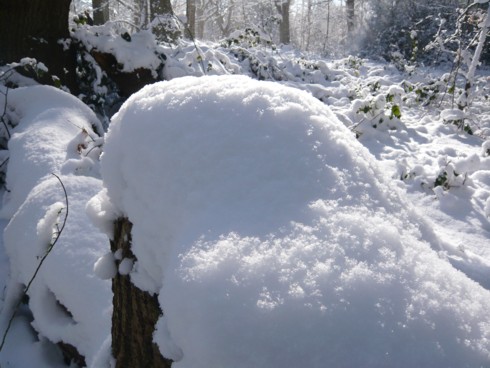
Fresh snow always feels magical.

I suppose this is because it is a pure white, because it sparkles in the sun and even in the night time it appears to glow.

It covers things up, but sits lightly upon them.

There is a purity to fresh snow that causes the landscape to feel cleaner and purer, too.

While the snow is falling, sound seems to be muffled and absorbed, so that one exists in a silent wonderland.

Shadows

It transforms a dull winter landscape into something bright and very special.

some paths are still clear

Some of the paths are still easy to find,

Some paths are less obvious

While others have become less obvious.

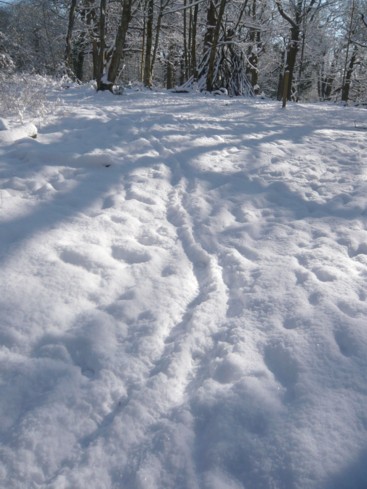
tracks

The animals have their own paths, that we are often unable to tread.

view 2

But there is a silence over everything, and every now and again a breath of wind sends a thousand sparkling snow diamonds drifting down through the branches of the trees.

some things are hidden

The snow hides much…

Footprints

But it reveals where we have been.

Some shapes become more mysterious

And it makes some shapes more mysterious.

Once Upon a Time

046

Are you sitting comfortably? Then I’ll begin.

It is a cliché that causes us to smile, yet variations of that phrase will have been used countless times in the distant past, when our ancestors gathered around the storyteller of the tribe to hear whatever tale he (or she) was about to tell.

And research http://rsos.royalsocietypublishing.org/content/3/1/150645  that was published this week, now tells us that the history of fairy tales turns out to be even longer than anyone suspected, going back to the times of prehistoric tribes. Not that this theory is entirely uncontested, of course.

But I would be surprised if it were untrue.

There have always been storytellers, who performed an important role, especially before the invention of writing. In those days, when all knowledge had to be memorised if it was to be of any use, then the skills of the storyteller in the tribe, someone who was used to organising their thoughts so that they could remember what was important and then recount it to the rest of the tribe, would have been vital for far more than simply entertainment; they would have been essential for the tribe’s survival.

They would have told stories about wild animals; either cautionary tales, or how to hunt them. Stories of skirmishes with other tribes; praising the bravery of their own warriors, and recounting how the other tribe was put to flight, but warning, still, of the danger these other tribes posed.

They must have always speculated on the origins of their world, and come up with the various creation myths. It would be important that all the tribe understood the appropriate rituals they would need to follow to appease the gods and ensure their own welfare.

So these stories would have been a way of sharing information with all the members of the tribe.

Much later, after the invention of writing, these tales began to perform a different function. They would still be used as cautionary tales, but now perhaps aimed more towards children (watch out for cross-dressing wolves and the like), or purely for entertainment.

But in a society where the majority were unable to read, they would remain important.

Throughout history, there has always been a borrowing and reinvention of stories; the myth of a flood that wipes out most of mankind, for example, is found virtually all over the world.

But the difference between a ‘myth’ and a ‘fairy story’ seems a little vague. I suppose the term ‘myth’ does seem to have a little more gravitas.

Many of these stories concern blacksmiths, which might be due to an early awe of those peoples who discovered how to work stronger metal, specifically iron, and fears that they might be using magical or supernatural means to do so. I’ll return to that shortly.

Now let’s take one well-known example of a fairy tale; the story of Snow White plays out both as a royal power struggle, something that has occurred time and again all over the world, and also the classic tale of the wicked stepmother, highlighting the insecurity a child may feel when a parent dies and is replaced by a stranger.

She flees an assassination attempt to find refuge with another people. The fact that they are depicted as dwarves (in the well-known European version) serves to emphasize the fact that they are not her own people.

There are further attempts on her life, but she is finally rescued by a passing prince and lives happily ever after.

Variations of this story crop up across Europe, Turkey, Africa, Asia and America. Whether these tales were passed from tribe to tribe and spread across the world that way, or were invented spontaneously in different parts of the world, it is unlikely we will ever know. It was probably a combination of the two. What is certain, is that they tend to be reinvented regularly.

Stories of mortals striking deals with supernatural beings (i.e. the devil) occur world-wide. What they all have in common is that either the human making it reneges on the deal, and usually finds a way to cheat the supernatural being, or, of course, the devil comes to collect his soul.

It is still a well-used device in literature. There is Goethe’s Faust, and since then many other popular novels on the subject, and we are still happily reinventing this story, as well as all of the other fairy tales, into new stories today.

In Britain, there are numerous folk-tales on this subject, usually concerning blacksmiths who either make pacts with the devil, or who are visited by him in disguise and realise who he really is (the comely maiden with the cloven hooves is often a bit of a giveaway). It usually ends with the devil being grabbed by the nose with red hot pincers and running off screaming. But again, these tales surface from all parts of the British Isles, and are set in times that are contemporary to the story teller. So the fellow telling the tale in an ale-house in a sixteenth century village would mention the blacksmith in a village twenty or so miles away – close enough to be particularly exciting to the listeners, but probably far enough away for there to be no one in his audience who might confidently denounce it as false.

And then, of course, they all lived happily ever after.