As I have mentioned previously, I am sporadically tracing my family tree, something I’ve only really become interested in recently. Perhaps it is mainly an older person’s interest, although I don’t think I’ll explore that now. But I’m keen to pass on the information to my children and grandchildren especially, so they can do further research if they feel like it.
As well as the family connection, though, much of my interest is both the exercise of solving a puzzle – it has much in common with a detective story – and to attempt to ‘see’ something of the person behind a list of dates and names. It is comparatively straightforward to accumulate lists of these folk with no more information than a sort of ‘Fred Bloggs born 1750, married Mary Smith 1770 died 1820’ which is really of little interest to me.
But if you know where to look (and how to search) there is often more information available about our ancestors, although you also need a very large slice of luck to dig up interesting details of the lives of the average person. In my research, then, I have found a few folk, of whom I knew absolutely nothing to start with, not even their names, and have been able to build up a bit of a picture of their lives.
That’s what it’s all about, I reckon.
Here, then, is an example:
My Great Great Grandad was Frederick John Platt. He was born in 1826 or 1827; I cannot find his birth record, but all other documents are consistent in his age.
A couple of census entries:
1851 the family are at 2 Wilmot Street, Bethnal Green. They were: William Platt, 49, Handloom weaver, Ann, 59, Frederick J, 24, Sarah Susanah, 22, also William James Platt, 26, his wife Sarah, 28, and William James 4. All bar William James Junior are Handloom weavers.
1861 at 1 Green Street, Bethnal Green. They are: Frederick J Platt, 34, Broad silk weaver, Louisa S, 30, Broad silk weaver, Louisa M, 6, Frederick W, 5, Henry G, 1, George W, 1 month. All were born in Bethnal Green.
So far so good, but then there is a Crisis.
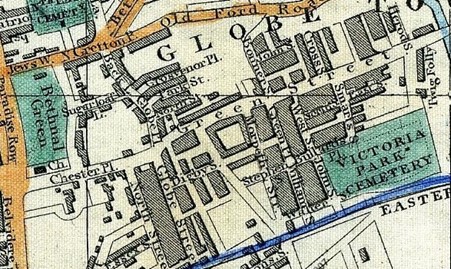
In 1861 Louisa Sarah Platt of 1 Green Street, age 30, died. It must have been very soon after the census was taken (on 7th April) as she was buried on 21st April. I obtained a copy of her entry in the Death Register, and it tells us she died on 14th April 1861 – ‘Found dead at 1 Green Street, Twig Folly Bridge, Bethnal Green’. She was aged thirty and the cause of death was given as ‘exhaustion after her confinement’. You can see on the 1861 census the youngest, George W, is recorded as one month old.
Green Street, Bethnal Green, from Cross’ Map of London 1851. Twig Folly on the right of the map gave its name to the bridge where Green Street crossed Regents Canal.
Then on May 8th 1861 we find the following Poor Law Removal judgement:
Frederick Platt, 34, of 1 Green Street, 5 years last 25 Jan, 3 Parliament Street, Cambridge Road, Mile End, B G (Bethnal Green). Weaver.
Was born at no. 10 Geo. Gardens B G never (ye?) has lived in B G all his life father before him. Had married at St. James the Less 1853, 12 June Co produced to Louisa Sarah, who died 3 weeks ago, Louisa 7, Frederick 5, Henry 17 mos, George 5 weeks, – B G
And then in another hand:
Father pd taxes Harts Lane B G Road about 17 yrs ago and Cranbrook St. about 2 yrs. He lives at 2 Cranbrook St.
I am unclear what the ‘removal’ part of the judgement refers to and can only assume it either means the children were taken from him, or they were all evicted from the property. The final paragraph about his father having paid taxes, I am guessing meant the authorities were then willing to provide some sort of support for the children. He had married Louisa Sarah Whalley sometime between April and June 1853, in Bethnal Green – June 12th according to the Poor Law Judgement – and after she died eight years later, his world seems to have fallen apart. And it seems to have happened so quickly! Less than three weeks after Louisa is buried, this judgement is passed upon the family.
But I suspect the family may already have been in some trouble.
Bethnal Green saw a huge influx of Huguenot immigrants during the late seventeenth and early eighteen centuries, almost exclusively silk weavers. Although I cannot find any evidence to back it up, I was told in my childhood that Mum’s ancestors were Huguenots, and that would suggest the Platts were the ones referred to. Whether Platt is an Anglicized version of a French name, or a Platt had married into a Huguenot family, though, I have not been able to determine. Over the years from the Huguenots’ arrival in Britain, though, various laws were put into effect to protect the British silk industry from foreign competition. However an 1860 treaty with France allowed silks to be imported duty free and very soon the industry was in freefall. Unable to compete in price with the imported cloths, huge numbers of weavers were thrown into poverty.
The next definite sighting of Frederick John Platt is in 1877 when his son, Frederick William, is married. On the form, Frederick John’s occupation is given as undertaker, and Frederick W is a commercial clerk. Clearly, they were no longer part of the weaving community. It is worth noting here that Frederick J’s older brother, William James Platt, has his occupation recorded as undertaker in the 1871 census, having also been a silk weaver prior to this date. It seems probable that Frederick either worked for him, or they were in partnership for a while. William then continues working as an undertaker for the rest of his life
After this, Frederick J seems to again drop off the radar for a while. I have a couple of other possible sightings but cannot find any census record for 1881 that I can be sure are his.
But then on September 15th 1884 Frederick John Platt, widower, 57, marries Sarah Mansfield, widow, 45, at St James the Less, Bethnal Green. By now he is described as a provision merchant of 40 Cranbrook Square.
One way or another, it seems he had managed to rebuild his life.
The 1891 census records a Frederick Platt, 65, ice cream vendor, and Sarah, 52, at 33 Quaker Street, Spitalfields.
And then? A Frederick Platt aged 74 died in Whitechapel, July – September 1899. That seems to be him. If it was, then he seems to have fallen upon hard times again. In January and February 1892 and then frequently from February 1895 through to February 1899 a Frederick Platt, widower, is recorded as being in and out of the workhouse at Stepney. His profession is given variously as wood chopper, labourer, or blacksmith’s assistant, and cause of admission each time as bronchitis or rheumatism.
We don’t realise how lucky we are.


 Mick Canning