In the town I used to live in, there was once a pub called the Hooden Horse, sadly now renamed to something much less interesting. I was reminded of this at an exhibition at Maidstone museum on Hooden Horses. Hooden Horses? Well, briefly…
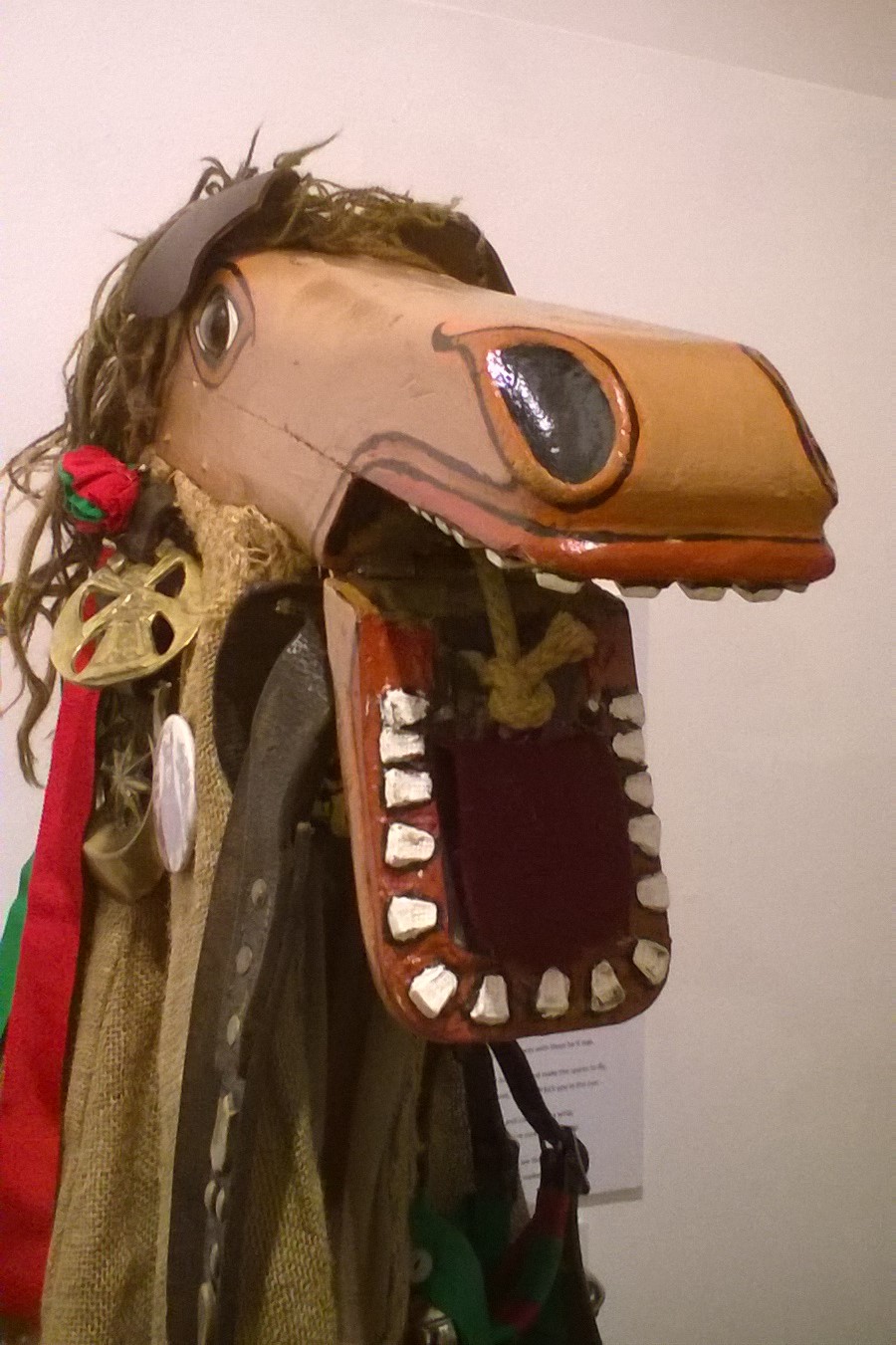
Hoodening is a rural folk tradition unique to East Kent, England. Going back a few hundred years, in the week or so running up to Christmas, groups of farm labourers would dress up as various characters and go from door to door requesting money, cake and beer. One of the characters would be the Hooden Horse, which was an artificial horse’s head made of wood, with a jaw operated by string, on a wooden pole, held by one of the performers with his body covered in cloth – usually sacking. A sort of play was then performed in rhyme, a mixture of plot and satire, usually featuring a few local characters who would be well known to the watchers and might be the butt of jokes and scorn, as well as stock characters such as Molly, a waggoner, and the Mayor. And of course the horse (him)self, invariably called Dobbin. There would also be music performed on whatever might be available – accordions, fiddles, drums or whistles.
The relationship to Morris dancing and Mummers is hard to avoid and, like these traditions, has been revived in modern times by enthusiastic traditionalists.
A photo from the early twentieth century
A modern Hooden Horse
Another early twentieth century photo.
There are many other traditions in Britain involving what is known as ‘animal guising’, where men or women take the guise of an animal, the Padstow ‘obby ‘oss being perhaps the best known of these. The performance on May Day in Padstow, Cornwall, invariably draws large crowds.
On the left, a Hooden horse, and on the right a Mari Lwyd, the ‘skull horse’ of Welsh tradition. Although unconnected (as far as I know) the Welsh had a similar tradition, also taking place around Christmas and New Year. Skull horses are to be found in other parts of England, however, including Yorkshire.
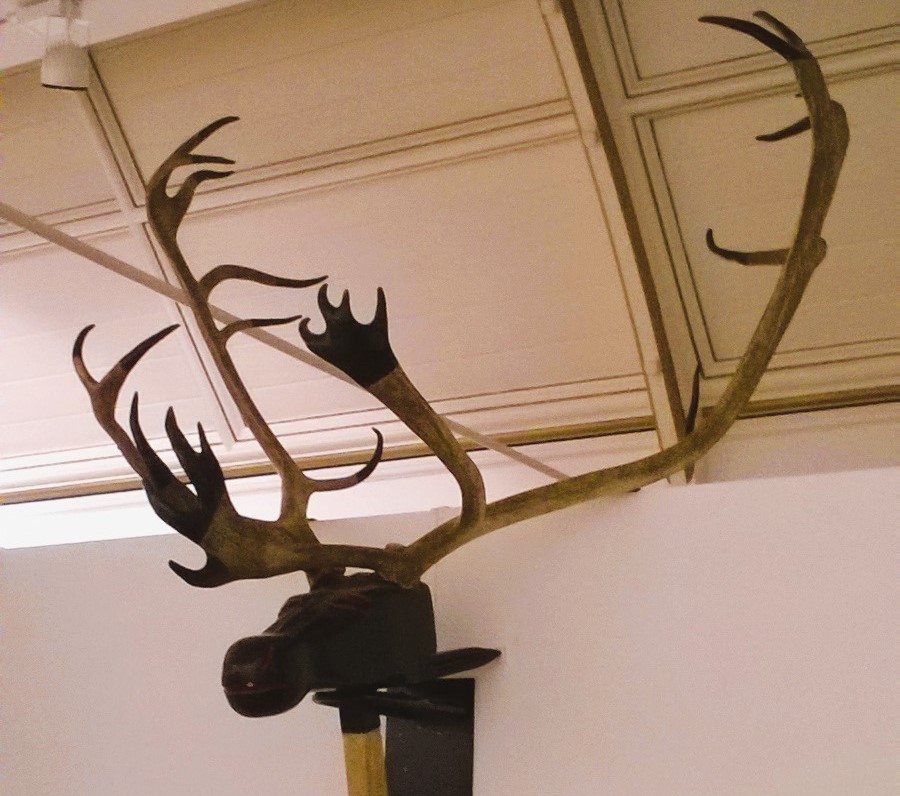
Stag guising is another old tradition – possibly older than horse guising. It was certainly in existence during medieval times and survives today in the form of the Abbots Bromley Horn dancers, Staffordshire, who perform carrying reindeer antlers on poles on the Monday following ‘Wakes Sunday’ in September. Wakes Week became a tradition in industrial Northern England when factories and mills closed down for a week for maintenance giving the workers a holiday. This began in the early nineteenth century, but before this the ritual presumably took place at a different time of year.
The exhibition is on until 17th July 2023 and there is a link to their site here.
Those of us who call ourselves creatives, why do we create? Why do we have this need to make things? I know the usual answer is we write / paint / carve / whatever it is we do, because we have to, because there is something inside of us that needs to find an outlet. But what is that something? In my case, as well as a storyline it is frequently a place where I have spent some enjoyable time. It provides me with a comfortable setting in which to tell a story.
Most of what I do, certainly the work I feel is my best, my most successful (in the sense of expressing what I want to express), falls into that category. My long poem The Night Bus, for example, was the result of a thirty year (admittedly intermittent) search for a way to record my experience of a long bus ride across Northern India into Nepal. I attempted prose and paintings without success, although through this I did develop a style of painting I went on to successfully use on many Indian paintings, and had long given up on the project when chance showed me a way into the poem. The poem I completed succeeds in conjuring up (for me) the impressions and feelings I had on that journey; I can relive the journey again by re-reading the poem. Whether it conveys anything of that to other readers, I naturally cannot know.
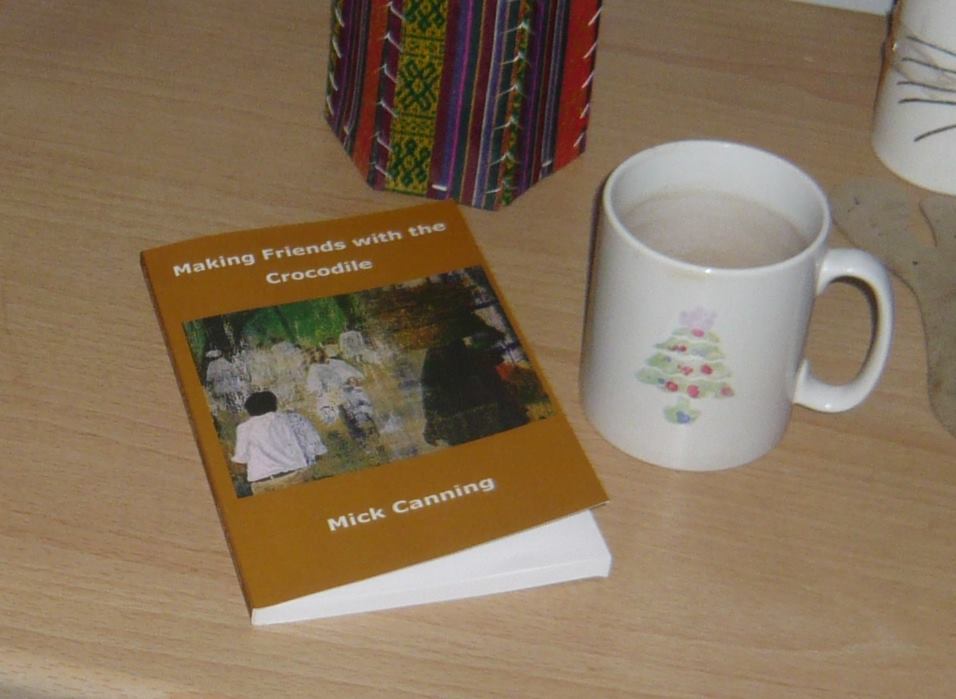
And my stories, too. I look through Making Friends With The Crocodile, and I am in rural Northern India again. I re-read The Last Viking and can easily feel myself on an island off the west coast of Scotland. This is not to imply any intrinsic merit to my writing, other than its ability to transport myself, at least, into the setting I am attempting to describe.
These stories are a composite of three basics: a setting, as mentioned already, a storyline – and again this needs to be something important to me, or I find it pretty well impossible to put my heart into it, and strong, convincing, characters.
It is useful, then, to know where lots of my writing comes from, and what shapes it, what drives it. I have long suspected that this is frequently nostalgia and, recognising that, have wondered whether this might be a bad thing. Nostalgia, after all, has a rather bad press…does it just mean I am living in the past because I am viewing it through rose-tinted spectacles? As a way of not addressing issues of today I should be tackling?
This yearning for nostalgia, though, is a desire for something we see as better than what we have now. To write passionately about something it needs to be something I feel strongly about. Obviously this can also be something we find frightening or abhorrent – dystopian warnings about the future or anger about injustices, for example – but even in those cases the familiar provides a cornerstone of safety, even if only by way of comparison.
This is also true when I paint. I am not someone who can paint to order – if I’m not inspired, it does not work. A number of difficult commissions have proved that point to me. I paint what I like, what moves me. After all, whatever I am creating, it should be foremost for myself.
That book, then…
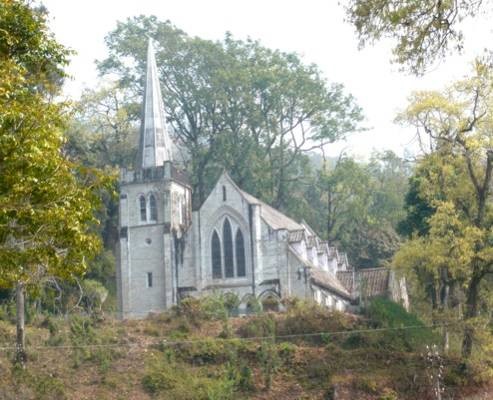
I began writing it about five years ago for all the wrong reasons. I had self-published Making Friends With The Crocodile and decided my next story should also be set in India, and as a contrast decided to write about British ex-pats living in a hill station in the foothills of the Himalaya. I wanted to write about India again. The trouble was, I had no idea what story I was going to tell. I had no stories that might slot into that setting I felt in any way driven to write; it just seemed to feel appropriate at the time. I was pleased by the reception the first book had and felt I ‘should’ write this one.
What could possibly go wrong?
I spent time putting together a plot, with which I was never wholly satisfied, and began writing. Really, I should have seen the obvious at that point and bailed out. But I carried on, and twice reached a point where I thought I had the final draft.
My beta reader then proceeded to point out all the very glaring faults.
So twice I ripped out a third of it and chucked it away, then re-plotted the second half of the book and got stuck into the re-write. I’m sure you can see part of the problem at this point – I wanted to hang onto as much of the story as I could, instead of just starting completely afresh. And now here I am trying to finish the final draft for the third time, as my February project for this year. And it’s just not working for me. But at this point, after well over a hundred and fifty thousand words (half of which I’ve discarded) I just feel I’ve invested too much time and effort in it to abandon it now. Somehow, it has to get finished. I do have an idea for a couple of quite drastic changes which I’ll try this week, but unless I feel I’m making some real progress I’ll then happily put it aside for a while and concentrate on next month’s project: painting and drawing.
And, to be honest, if it eventually ended up as a story of less than ten thousand words, and if I felt satisfied with it, then I’d take that as a result, now.
And the moral of all this? I’m sure there was a point after a couple of months when I knew I shouldn’t have been writing this book. I should have binned it there and then and saved myself a lot of fruitless trouble, but stubbornly ignored the warning signs.
We’ve had cold, bright, sunny days. We’ve had cold snowy sleety days. And today we have lashing rain and wind. It’s milder than it was, but as miserable as sin and the wind still cuts through you!
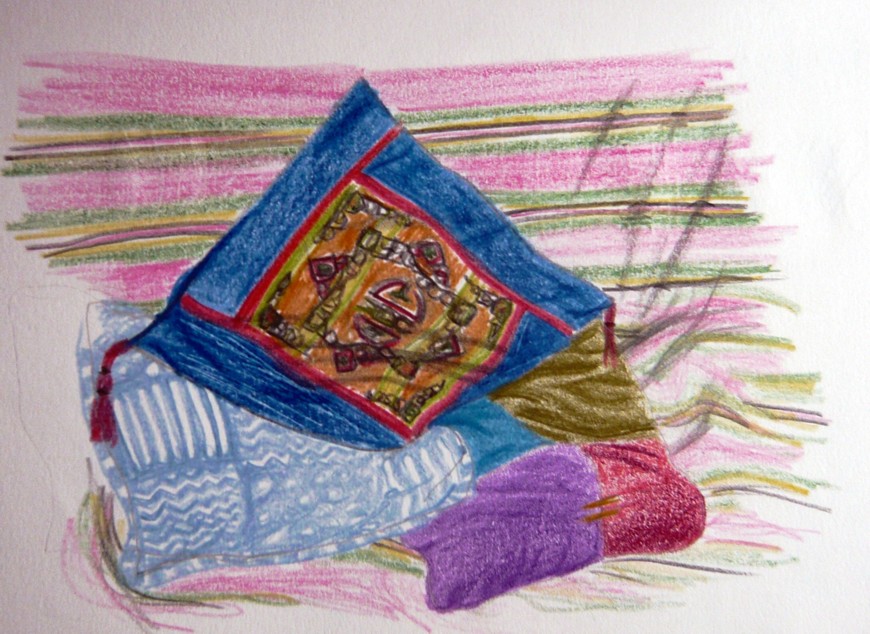
So here is a sketch for the day – cushions on the sofa to remind me of Nepal, since the top one came from there:
And here is a haiku for the day, to remind me of summer:
Amidst the traffic,
In the still airs above me,
A lark dripping down.
And a thought for the day? Another haiku, to remind me to slow down sometimes:
Obsession with time
Is climbing trees in autumn
To get down the leaves.
And today I begin the first edit for A Good Place – initially reading it through and thinking about the voice, the narration, to see if it works for me. Next, another read to look for flaws in the plot, redundancies, things to add and take out. Finally, try to knock the grammar into shape. If I’m happy with that, then it’s on to the beta readers.
The self publishing boom has given rise to the publication of millions of new books, the majority of which would never have been published traditionally because they would be either deemed to be of insufficient interest to return a profit to the publishers or because they were, frankly, just too terrible to see the light of day.
How good a book is can be very subjective in many ways, but certain rules must apply.
If you buy a traditionally published book, you may be reasonably certain that it has been edited and proof-read to a high standard, the printing and layout of the book is of good quality, and the actual contents – plot, dialogue, character development et al – are sufficiently well written as to repay your reading time.
There are no such guarantees with a self published book.
As a member of several Goodreads groups, I receive regular emails which consist largely of other members promoting their books. These promotions frequently consist of a synopsis of the book, extracts, and links. All well and good, but the number of extracts that are poorly written, unedited (it would seem), with poor print layout, and the number of synopses that are equally poor, is very high indeed. Probably the majority, unfortunately. And should I follow the link to the ebook sales site and read a longer extract, frequently this, too, is filled with more of the same errors.
As far as the plot and dialogue and all that goes with that is concerned, I admit that may be partly down to taste. I have no doubt that some poorly written and poorly plotted books still give great pleasure to many readers, and good luck to them. There are certainly examples of the same amongst traditionally published books. And styles go in and out of fashion, anyway.
What I do take issue with, though, is poor, sloppy editing.
Most people cannot afford to pay for professional editing – I certainly can’t. I understand that. It means doing the job yourself, but taking infinite time and care over it. Check it over and over again until it is the best you can do. The odd mistake will slip through, but that happens even in a professionally edited work. Persuade others to act as beta readers for you. They may not be professionals, but they will spot things you don’t. You are too close to the work, anyway.
If you can’t do that, don’t publish the book.
Let’s take layout first. It only takes a careful look at half a dozen professionally published books to get a good idea of what that layout should look like. And you can buy books that supply more detail. If you are serious about your book, you should do that.
Spellcheck is a useful tool, but only if it is used properly. It recognises a correctly spelled word in its database, but has nothing to say about the suitability of its use. I do find it particularly irritating to come across passages where the completely wrong word has been used, no doubt because Spellcheck flagged it up as the correct spelling. Common examples are groyne / groin, sheer / shear, alter / altar etc. etc. etc.
Grammar is the biggest minefield, though. We all get that wrong at times, even the best of us. But at least avoid the biggest howlers – the so-called grocer’s apostrophe, for example. Put the manuscript through a program such as Grammarly, which is free to download, to pick up the majority of the errors.
Another phenomenon I have seen recently is a 4,000 word story published on Amazon as a ‘Novella’. I suppose there’s nothing wrong with selling a story that length, but anything that comes in at 4,000 words is a short story. And quite a short one at that. To describe it as a novella, no matter what price it is being sold at is, quite frankly, a bit of a bloody cheek.
Please don’t do that.
And I’m sure many other readers have their own pet peeves.





 Mick Canning