Return To Tengboche…

…but not literally, unfortunately. I did say I would re-post another travel post from some while back, so here it is.

Four years ago I wrote four short posts about Tengboche. Here I’ve combined them into a single post and added some extra pictures and text to give a little more information about this lovely place.

Tengboche is a monastery complex and a couple of trekking lodges at 3860m on the route up to Everest Base Camp from Lukla, in Nepal. It sits high above the waters of the Dudh Khosi, the rapidly flowing river than runs alongside much of the Everest Trail.

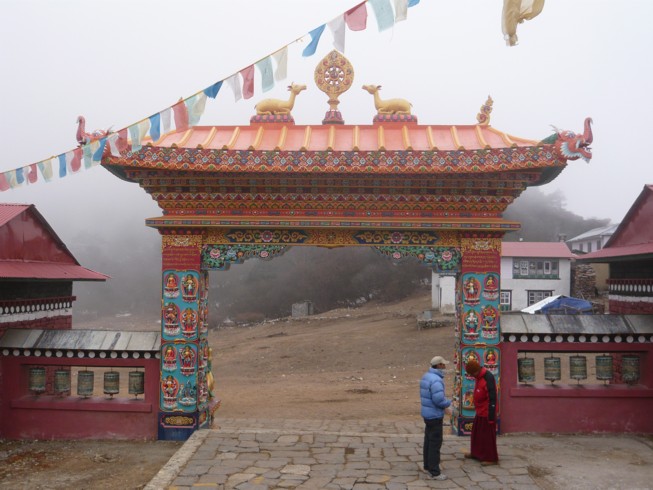
The monastery complex. On arrival in the afternoon, the clouds are low. This seems to be the pattern most days – clear mornings and then the clouds coming in early afternoon. In a general sense, weather patterns in the Himalaya – certainly in some parts, and probably at certain times of the year – can be quite predictable. When I trekked the Annapurna Circuit, for example, we were told one evening that around ten o’clock the next morning there would be strong winds blowing in the valley we were to follow, because that was what happened every day. And blow they did. At ten o’clock.

From inside the monastery grounds. The monastery is a Tibetan Buddhist complex, liberally decorated with the pictures, statues, and symbols to be found in every such place.

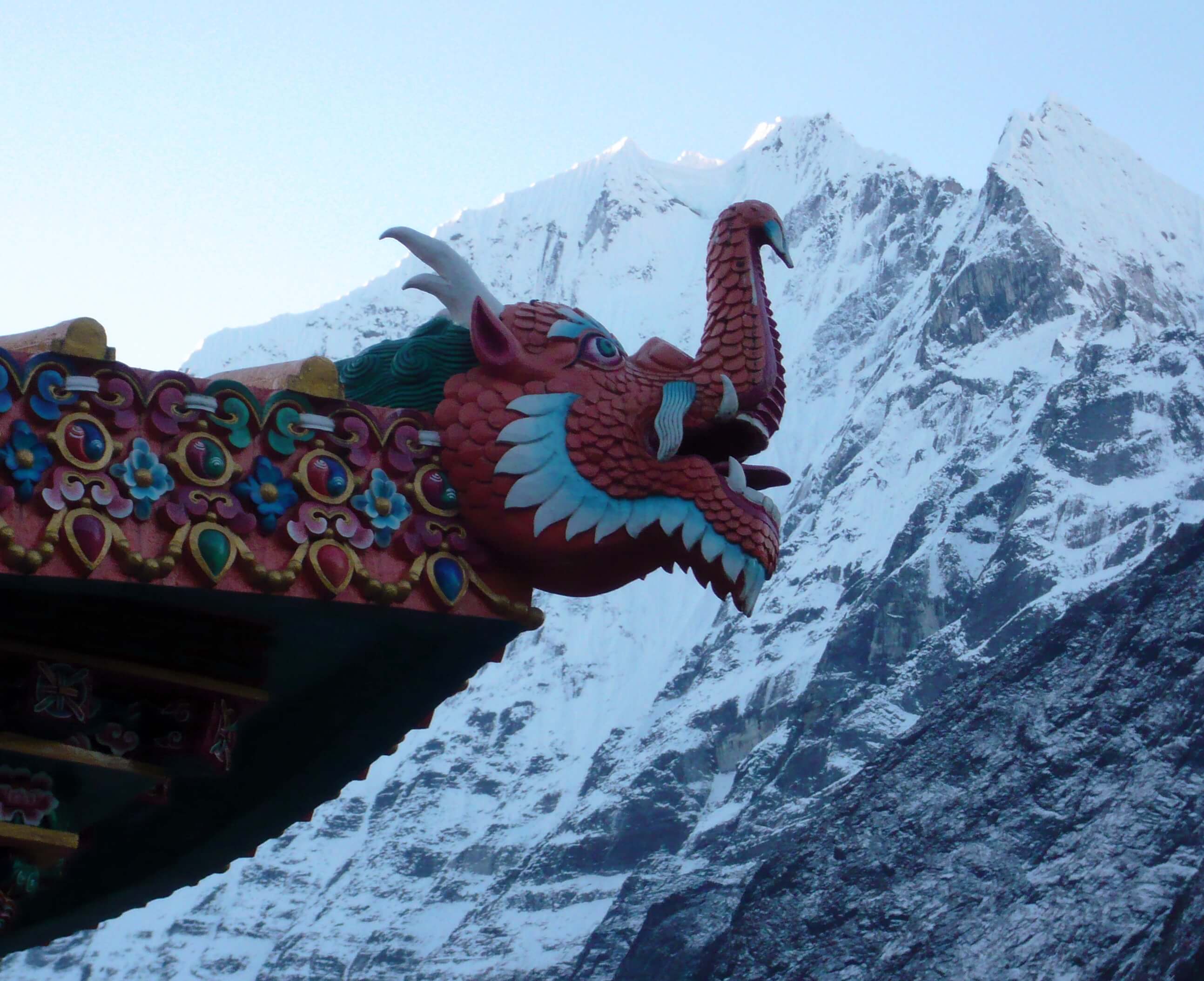
Roof decoration
145a

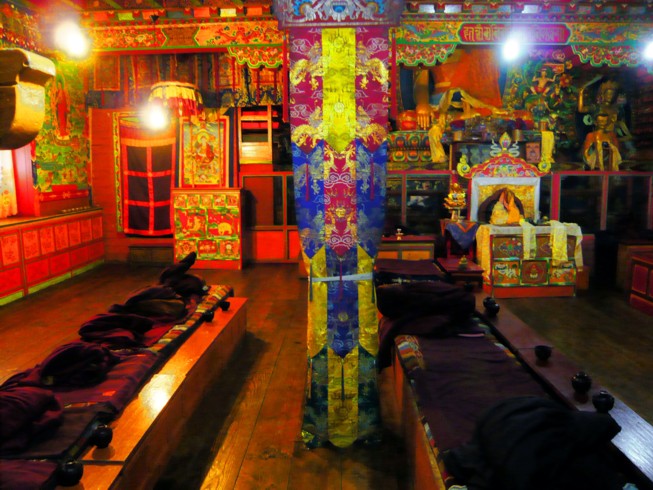
Inside Tengboche monastery following a puja (ceremony).

Rightly or wrongly, I don’t like taking photographs of pujas in monasteries. It feels intrusive and bad mannered. I would feel the same in a church, mosque or temple. This has nothing to do with any beliefs of my own, but is born of simple respect.

I noted in my diary: We have just sat in on a chanting puja, but my meditation failed dismally. I was completely unable to concentrate on my breath as all that I could think of were my freezing feet!

It was blooming cold!

198a

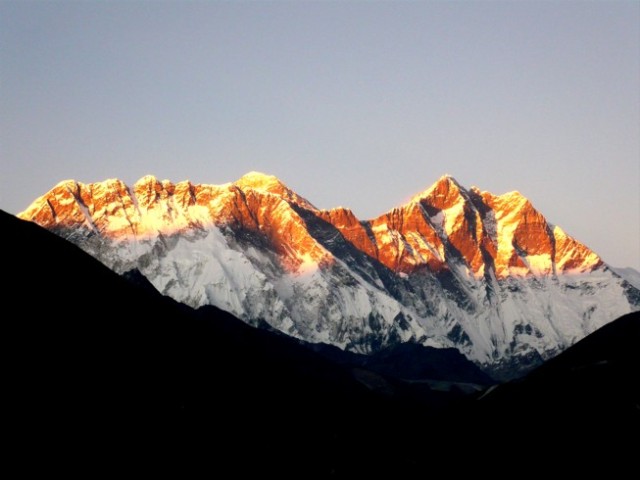
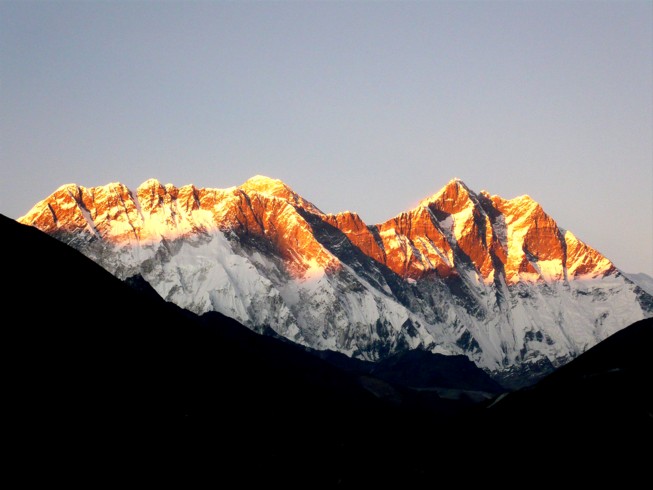
This view must have been photographed so many times, but how fantastic is it? Sunset on Everest (left) and Nuptse (right), photographed from Tengboche. This was taken on my third visit; the other two times the clouds failed to clear in the evening, so this was an unexpected treat.

212a

And this is the same view in the morning – but with the addition of Ama Dablam on the right of the picture. Ama Dablam is possibly my favourite mountain; the classic ‘mountain-shaped’ mountain, similar to the Matterhorn.

Close-up of window showing the dawn chorus orchestra.

We were awoken in the mornings by the harsh notes of conch shells and the clashing of symbols. This was part of the morning puja, rather than a summons for coffee and porridge. It does make for an excellent alarm call, though.

Annapurna Circuit, Nepal – 5: A Life Less Lived?

It could have happened.

Everybody needs a challenge.

198a

Sunset on Everest and Nuptse from Tengboche, Nepal.

Well, most do. I guess there are a few people who are so content with their lot they have no wish to stray out of the round of their day to day life, but I think they must make up a tiny minority.

And while it is a great achievement to be satisfied with your life, and not to constantly want a more expensive car, or clothes or jewellery, we all need something to strive for, otherwise we tend to stagnate.

Even the most altruistic, who might strive to eradicate poverty, or bring justice where there is none, need a more personal challenge sometimes.

For some it might be speed – the need to have a go on a fast motor cycle or racing car somewhere. Maybe to try a bungee jump. To feel the adrenaline surge that comes with the mixture of excitement and fear.

shakira

On Lake Dal, Srinagar, Kashmir, India.

For others it might be the very opposite. Many of us need the opportunity to spend time away from the 21st century. Those of us who do not like the noise and speed and intensity of our modern life, need to find respite in places like the mountains, or deserts, or somewhere else remote from modern life. Woodlands at night, perhaps, or a windswept beach on an island. The challenge is frequently to find these places or to access them. Perhaps even to make the time to do so.

img_0012

Monks on their way to morning Puja, Bodhgaya, India.

Those are the sort of places I need, and where I often feel I can do my best creative work. The only places I feel I can really relax.

And the reason I had to walk the Annapurna Circuit.

Just while putting together this set of posts, at times I have looked around the room at the photographs of the Annapurnas, the maps, then at my rucksack in the corner, and felt an almost irresistible urge to just…go.

This sense of adventure is frequently in conflict with the other strands of my life, though, because (like most people) my lack of money and the demands of work and family, and other commitments, prevent me just scooting off for a week or month away whenever I feel like it.

105

A track through fields and woods a mile or so from where I live.

But I have always tried to take the opportunity to go off to these places when I could, as I reasoned that I couldn’t know how long I would still be able to.

What made me determined to do this was a missed opportunity when I was working temporarily in Peru. I knew that when I finished my six week stint and returned to UK, I might no longer have a job. So when I was offered the chance to stay on for a week to visit Cuzco and Machu Pichu with friends I declined, even though it would only have cost about a hundred dollars for the whole trip. And I regretted it ever afterwards.

179

Little Adam’s Peak, Ella, Sri Lanka.

I have no intention of looking back on my life later and wishing I had done these things when I had the opportunity.

Tengboche – 1

Tengboche is a monastery complex and a couple of trekking lodges on the route up to Everest Base Camp from Lukla, in Nepal. It sits high above the waters of the Dudh Khosi.

145a

Inside Tengboche monastery following a puja (ceremony).

Rightly or wrongly, I don’t like taking photographs of pujas in monasteries. It feels intrusive and bad mannered. I would feel the same in a church, mosque or temple. This has nothing to do with any beliefs of my own, but is born of simple respect.

I noted in my diary: We have just sat in on a chanting puja, but my meditation failed dismally. I was completely unable to concentrate on my breath as all that I could think of were my freezing feet!

It was blooming cold!

Just Look at Ghat!

Ouch! Probably my worst title yet!

I can’t help it…I’ve not been well…

…well, only a cold, but you know what we men are like.

In another attempt to feel instantly better, I’ve nipped across to North India (only in my imagination, unfortunately), to picture Kedar Ghat, on the banks of the Ganges, in Varanasi.

056a

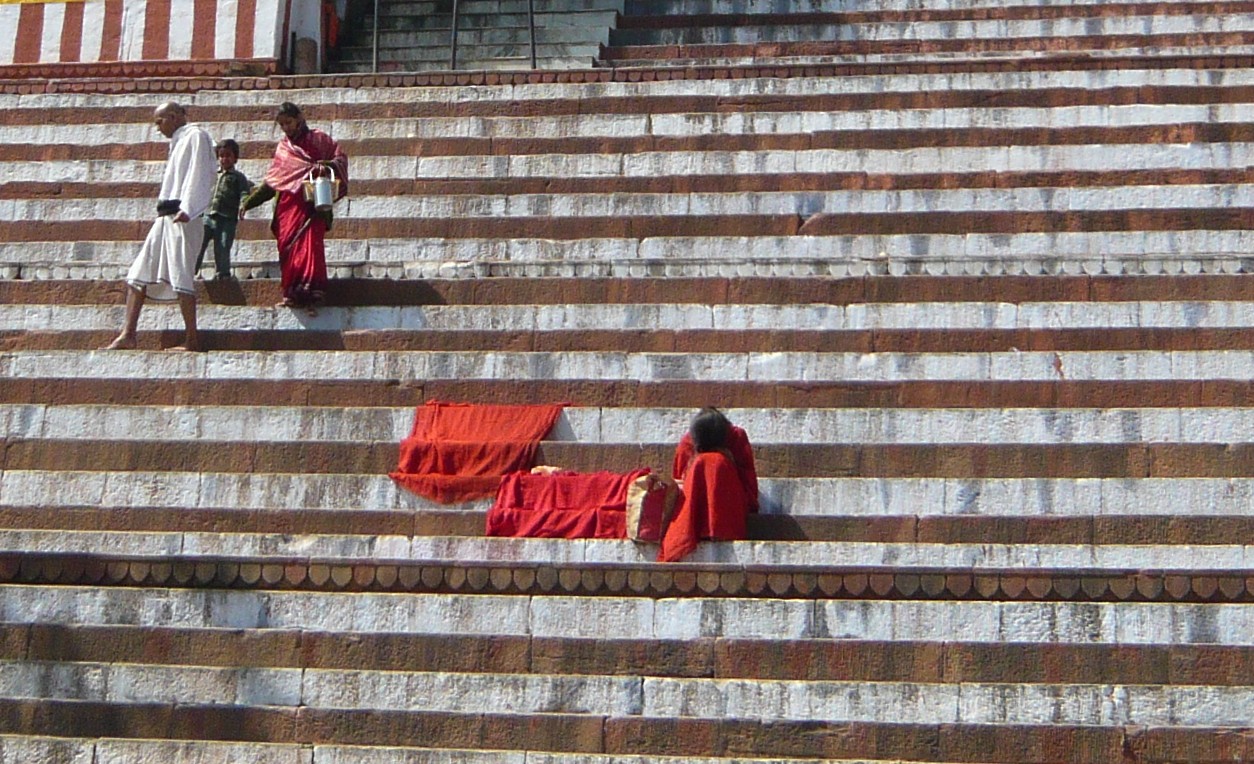
Ghats, a Hindi word, are sets of steps leading down to a river (and also mountain ranges or passes – The eastern and Western Ghats in Central India). It has also come to mean a level place at the edge of a river where Hindus cremate their dead.

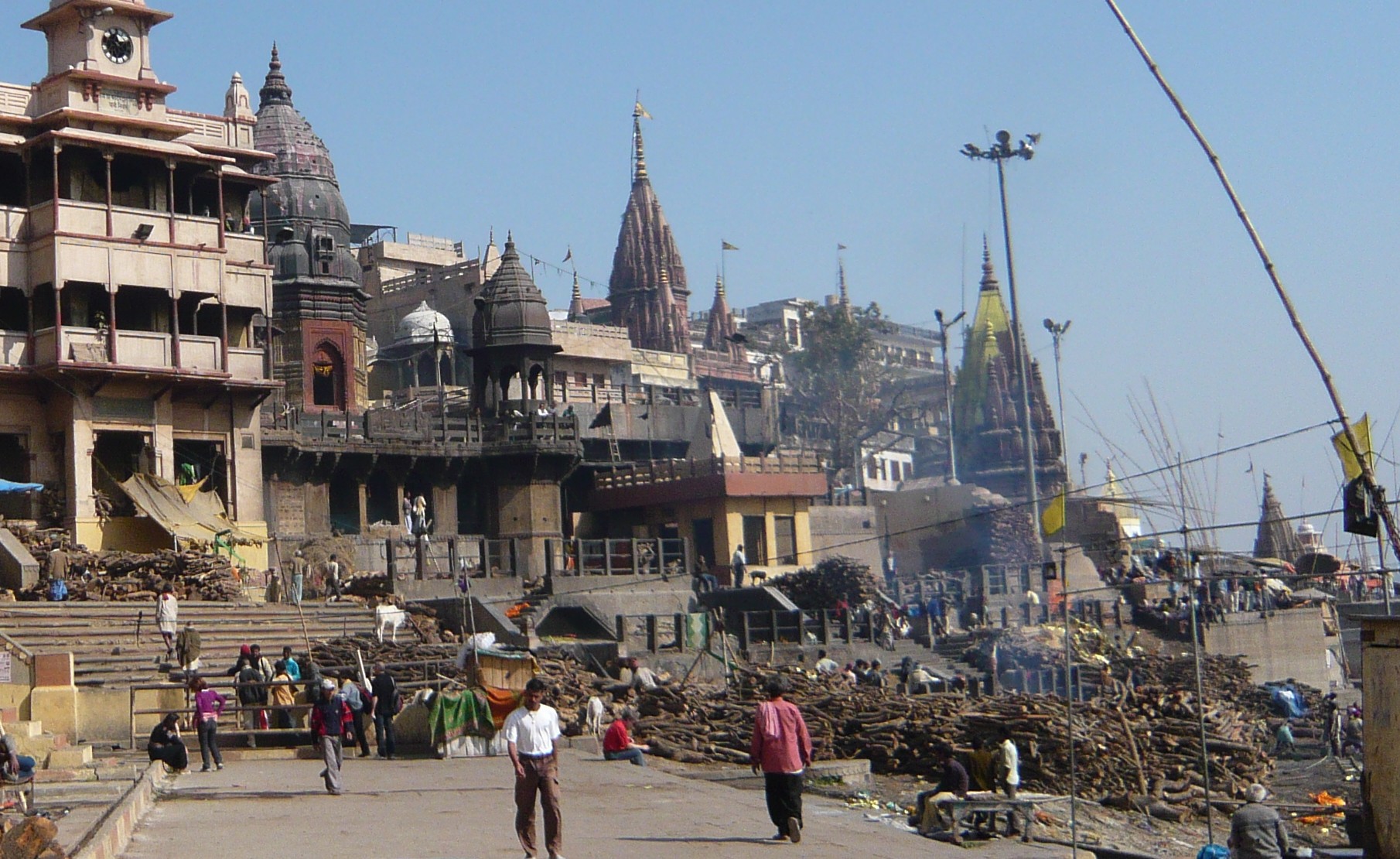
In Varanasi, there are between 84 and 87 ghats, depending upon who you get this information from,. The Manikarnika Ghat, or Ghats (possibly this is the origin of the confusion over the number) is the ‘burning ghat’, where cremations are carried out 24 hours a day, all through the year. The source fire there has supposedly been burning for thousands of years, but photography is actively discouraged, hence my only shot is one taken from a distance.

046a

Of course, the ghats are also used for bathing. Hindus bathe en masse there, as a dip in the Ganges is meant to wash away sins. Important pujas (ceremonies) take place at sunrise and sunset. Boat trips to view the ghats are very popular, and finally much of the city’s laundry gets done at the dhobi ghats (dhobi meaning laundry).

040a

Namaste!

Southern India (1)

Southern India differs from the north in several respects. The first difference that the visitor tends to notice, once they have got away from the typical Indian maelstrom of airport, traffic, city centre, etc, is that with the less densely concentrated population comes a somewhat more laid-back atmosphere and attitude than in the north. The hassles and pressures, the touts, are still there, but seem somehow less intense.

The second real difference is in the culture. Southern India was never really assimilated into the Mogul empire, and only ever partly conquered, so there is a huge wealth of Hindu architecture and a proportional lack of Islamic, with next to no Buddhist remains and no continuing tradition of Buddhism at all. At times, it seems as though the visitor has entered a different country, but India has a way of reasserting itself on the senses…

trichy stall

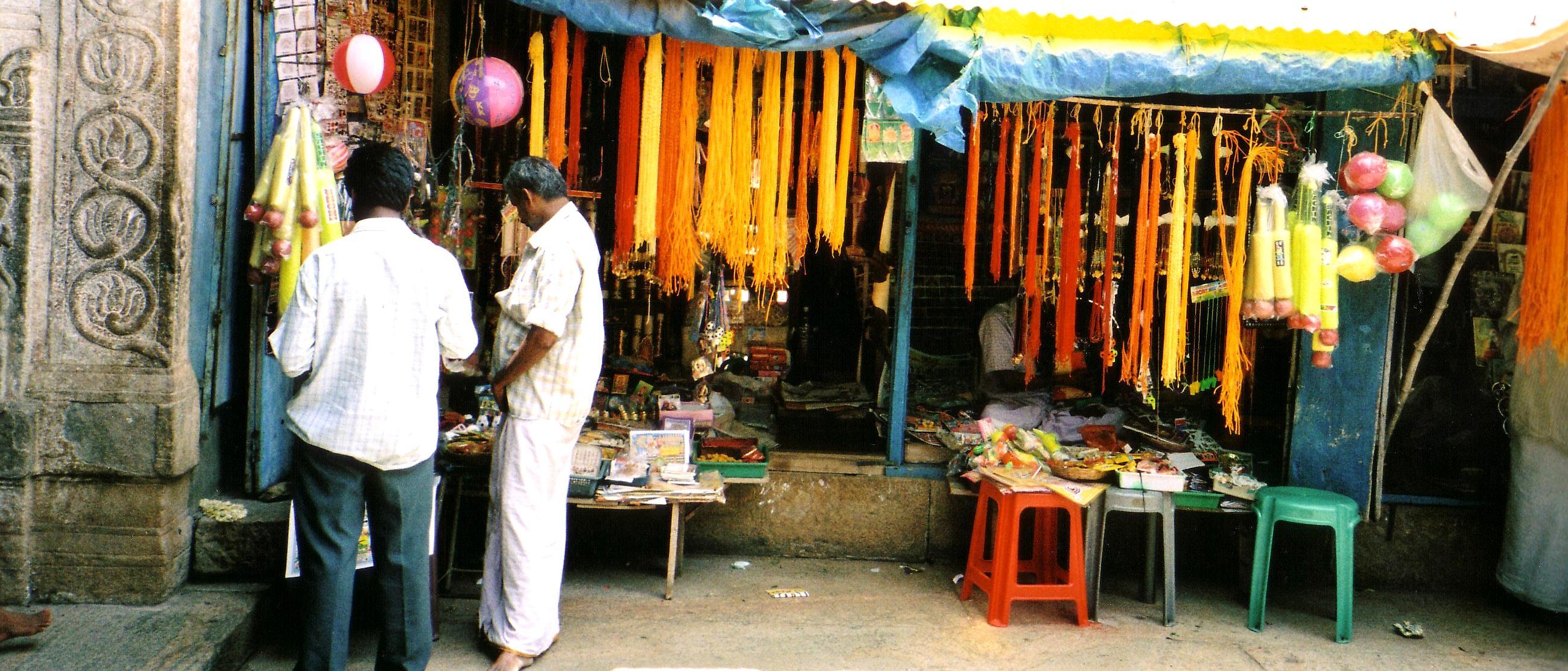
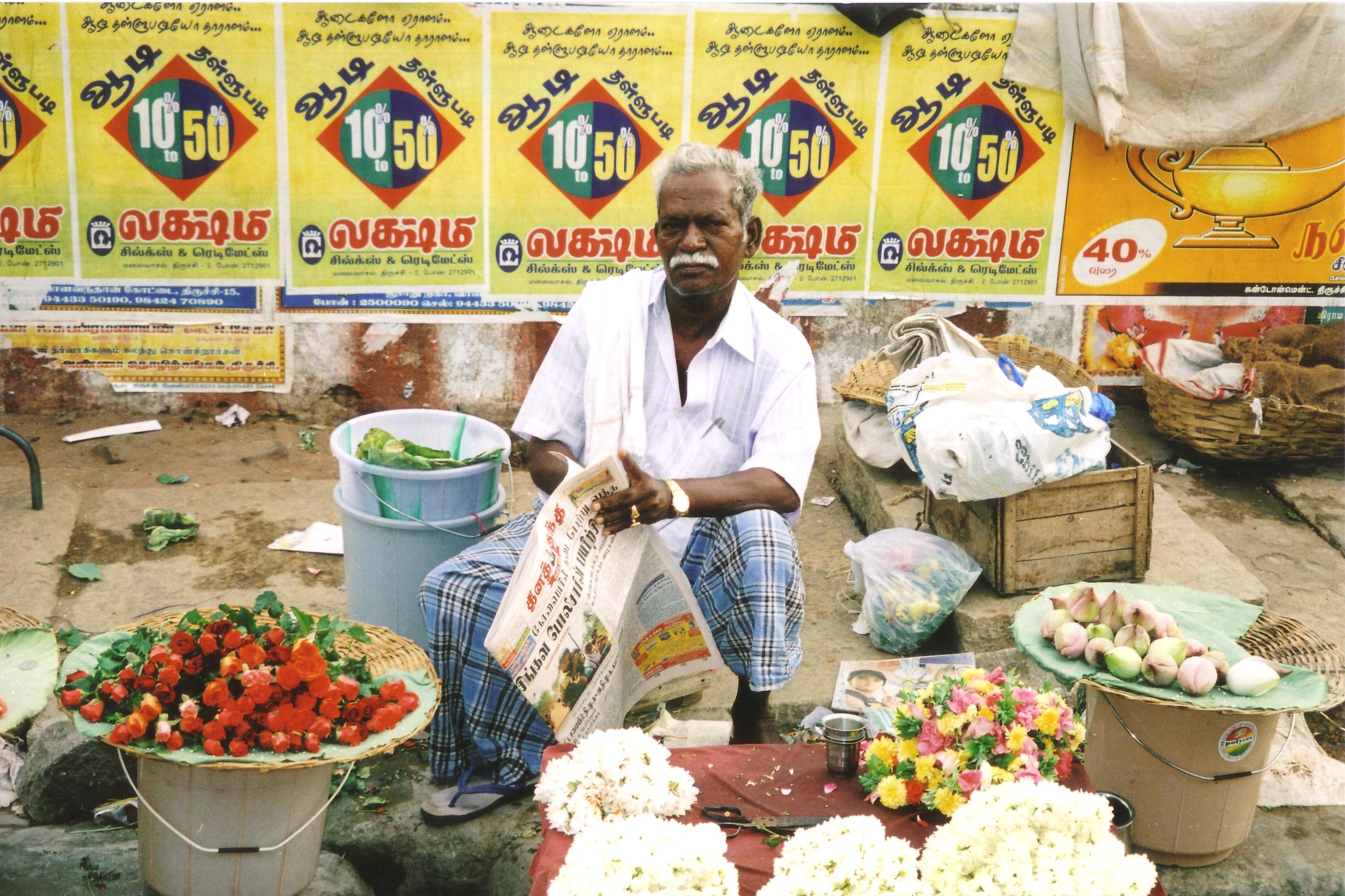
Stall outside Sri Ranganathaswamy Temple, Tiruchirappalli (Trichy), Tamil Nadu State. All over India, amongst the heat, dust and drabness that pervades the majority of the population’s day to day life, one finds colour.

trichy garland seller

Garland seller outside Rock Fort Temple complex, Trichy. The garlands will be used to decorate statues of gods during pujas (ceremonies) conducted in the Temples.

rock fort temple

Rock Fort temple, Trichy.  A view of the main temple from the pathway that leads to the tiny temple at the top of the rock. Non Hindus are not allowed into the main temple, dedicated to Shiva, or the temple at the top dedicated to Ganesh…although for a small donation, the priest is willing to waive this rule…

From my journal:

‘The trip is not particularly uncomfortable. It is a typical five hour trip through India – dust, buffaloes, half a dozen schoolchildren stuffed into an autorickshaw, wait-till-the-other-guy-blinks over-taking, temples large, medium and small, huge dry river beds, The Cauvery full of water, trees, strange crops, broken down trucks, train lines stretching arrow-straight into the distance, rows and rows of stalls with neat piles of fruit and vegetables, rows of hanging water bottles from the roof, biscuits, samozas, cigarettes and crisps, a child squatting in the dirt, mum feeding the family beneath the tree, Tiffin Ready signs, smart petrol stations, mud huts, cement buildings, palm shacks, huge residences surrounded by high walls – all concrete, police traffic blocks (ignored), it all blurs into one.’

trichy temple 2

Part of Sri Ranganathaswamy Temple complex. This is the largest of all temple complexes in India, covering a staggering 60 hectares, and is dedicated to Vishnu. The Gopuram (tower) on the left is painted white, as a symbol of purity, and is one of the buildings that non-hindus are not permitted to enter.

white goporam trichy

The White gopuram, in all its glory.

trichy puja 2

Pillar in Sri Ranganathaswamy Temple, liberally decorated with coloured powders and with offerings of incense, rice and flowers. Devotees of the god concerned will conduct their own personal pujas to ensure health and prosperity, or perhaps for some more specific purpose, such as to request the birth of a son or success in a particular undertaking. Although this temple is dedicated to Vishnu, other gods are represented there and prayed to.

trichy puja 1

Another, nearby, pillar in the same temple. Although in the same temple and close to the pillar in the previous picture, this shrine will be to another, different, god. Its use, however, will be the same.

A Week in McLeod Ganj – part 2

Apologies for the weird changes of tense – it was how I wrote the journal (in fits and starts), and I’ve not altered anything, merely missed out a couple of extremely uninteresting entries.

Sunday 29th November 2009

I didn’t get off to sleep for a few hours last night. There was lots of noise outside; lots of revellers going past. And then when I felt that I was almost off, a couple of vehicles crashed into each other just outside the gate. Lots more shouting. Then every time that a vehicle went past after that, I was waiting for another crash.

And the monastery across the road has its first puja at around 4am – the crashing of cymbals and the sounding of foghorns – that always wakes me, too.

So, I’m not entirely refreshed, but back in the restaurant at Green Hotel awaiting breakfast and just perking up with the first coffee.

I think I’m going to put off the visit to Dal Lake until tomorrow, and sit and write this morning. I’m tired and still feeling a little unwell. And read. It’s easier than having to think. I bought a big, thick, book yesterday, which should keep me going for a while.

Then in the afternoon, I mooched. Partly wandering the roads and hills around McLeod Ganj, and partly going for tea and coffee here and there. I have planned to go to the Tibetan music concert at the nearby school at 6pm, and after a shave and shower I head off there, find it, and take a seat along with about a dozen other westerners.

We sit and wait, and about a quarter of an hour or so after the scheduled start time, a chap comes in and announces that he’s sorry, but the musician isn’t coming. He has phoned to say that he couldn’t make it. He apologises to us again, and we get up to go. Because it was organised by a recognised NGO, and was intended to raise funds for the needy, I go and offer the guy RS 100/- towards the costs. In return, he gives me a long, meandering talk about volunteering and costs that I can’t really follow. It’s obvious that he’s been on the whisky and he presses me to meet him tomorrow to talk about the project. I waver, and then agree in a cowardly sort of way.

Once I have escaped, I go up to the Tibetan restaurant where I ate last night, since I rather liked the ambience of it. Unfortunately, tonight it proves to be full of a bunch of hard-drinking Tibetans, which I hadn’t really realised when I sat down to order. I get a beer and a thukpa, and am surrounded by whisky-swilling, chain-smoking Tibetans. This does nothing for my appetite, so I drink up, eat up and go.

I then wander up to the main part of McLeod Ganj and go to ‘Excite’ – the bar looks quite inviting from the outside.

Inside, though, it proves to be otherwise. I get a beer and order some masala peanuts, but don’t think much of them when they arrive. They are simply fried with a few bits of onion and tomato and seemingly no spices at all. I am offered a hookah which I decline. There are no other customers, and no music, in a plain, tatty room. I drink up and go.

Monday 30th November 2009

I cannot find the place that I agreed to meet the Tibetan chap and so, relieved, I go off to Dal Lake instead. It is a very pleasant walk of three kilometres or so each way, mainly through wooded hills, becoming quite autumnal in places. Magnificent birdlife – as well as the familiar ones, I see one with a very long tail that I take to be a Lyre Bird, and a very large eagle passes overhead, quite white underneath.
222

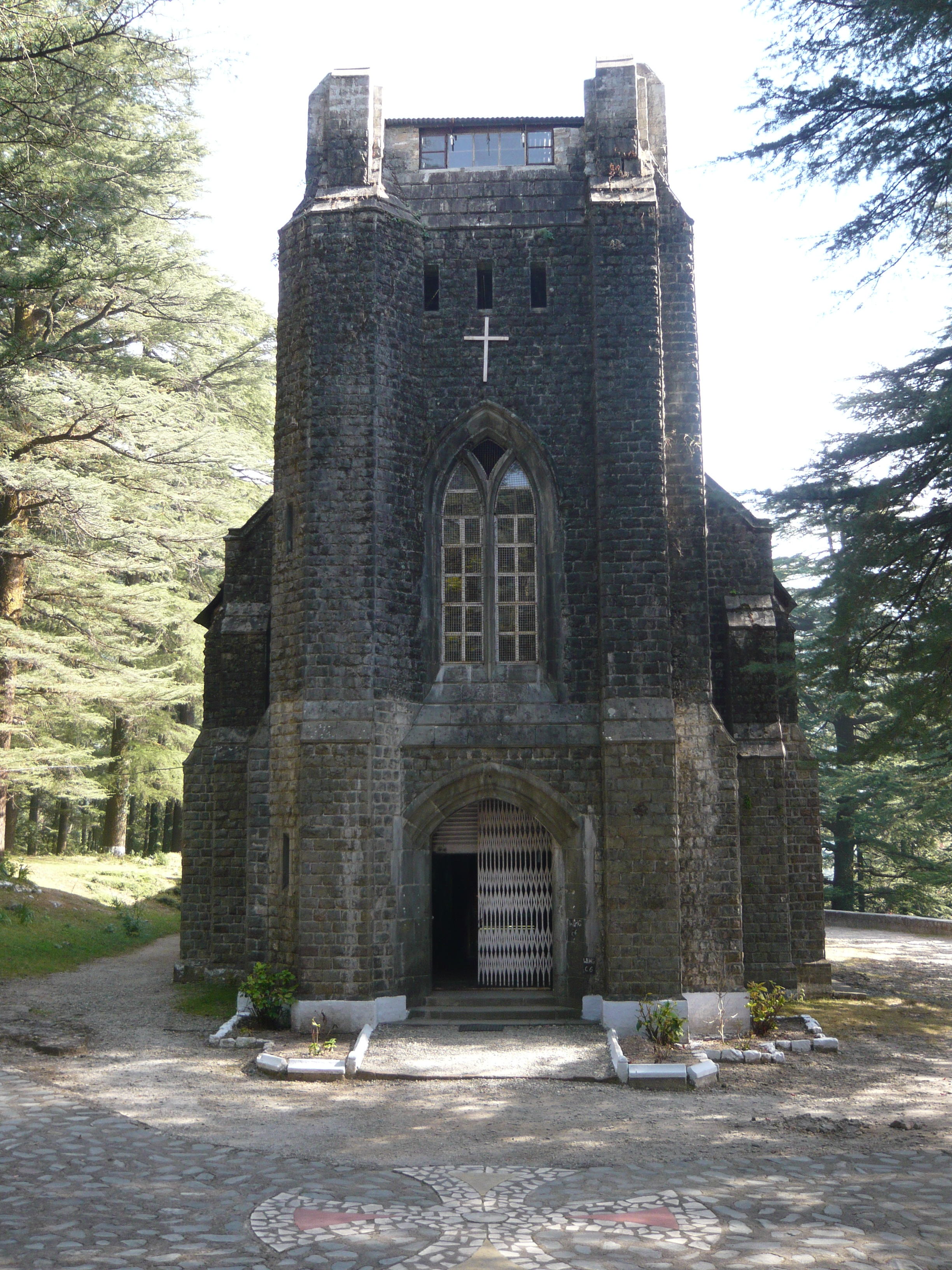
I pass the church of Saint John in the Wilderness and go in to have a look. It says that it is the largest ‘cathedral’ in the Himalaya, in the diocese of Amritsar. It is big, and nice inside. There is a monument to Lord Elgin outside, but I am more interested in one of the plates inside, to a Thomas Knowles, who met his end at Dharamsala, courtesy of a bear.

221

I rather like the ambience both inside and outside of the church. It is very peaceful and I linger. I think it is very hard to shake off the spiritual part of you that was formed when you were young, and I felt that I wanted to just stay there all day.

But I didn’t. I walked on to Dal lake, passing through the army training area, full of army personnel training, and along to the lake. It is a lovely spot, surrounded by deodars, and probably even more beautiful when the lake is full of water rather than full of bulldozers and mud.
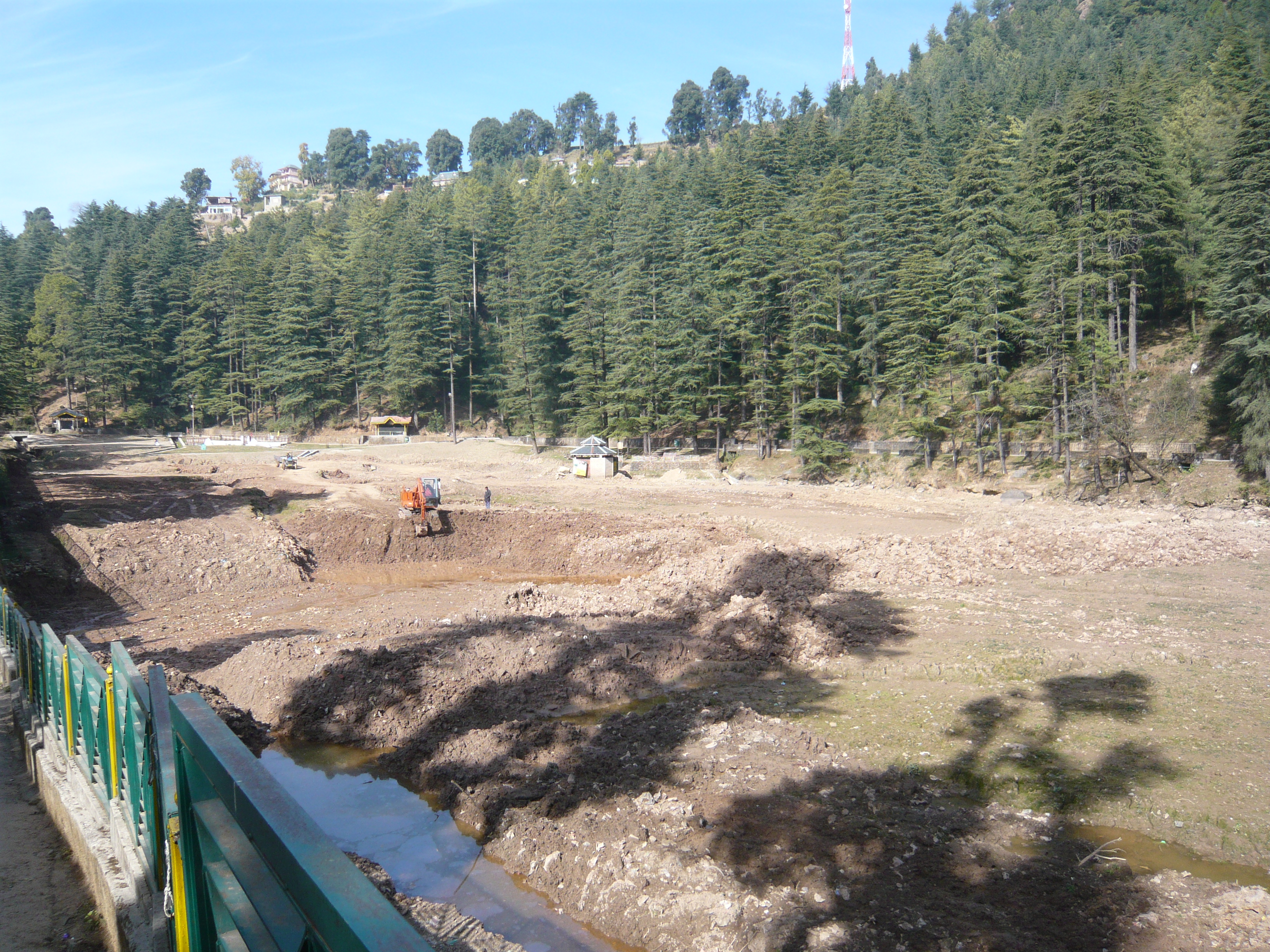
223

So I return to McLeod Ganj and go to lunch and, oh dear, food is beginning to taste a little rank, again. Not a good sign.

It is McClouding over, now. So far the pattern of weather each day has been the same – morning warm and sunny, with clouds beginning to come over at lunchtime. By late afternoon it is quite cool.

Later, I go down to visit the Tsuglagkhang Complex; the temples and the residence of the Dalai Lama (he’s out, at the moment). Outside the main temple, there is a puja going on involving a fire. I watch for a while, wander around the temples and then wander out.

224

Tuesday 1st December 2009

Another visit to the Tsuglagkhang Complex, where I wander round and sit for a while, finishing with a visit to the sobering museum, telling the story of the rape of Tibet.

It is now evening. I am sitting in McLlo’s, looking out of the window down onto Main Square. There are a couple of liquor stores, with plenty of people, especially Tibetans, patronising them and milling around. But there is no trouble. People are peaceful, gentle. One would have to put this down to the influence of Buddhism. People have a code of behaviour that is based not on fear, but on an understanding of what is the right thing to do, for respect for others. There are no rowdy crowds; people don’t feel threatened. That is just one of the wholly benign influences of religion here.

It’s a gorgeous full moon, tonight.

 Wednesday 2nd December 2009

After breakfast I decide to sit up on the roof with my book for the morning. Some hours later, I am interrupted when two troupes of monkeys leap onto the roof and begin fighting each other. Honestly, how is one meant to concentrate? I give up and go down.

The cold develops. I spend most of the rest of the day in my room reading.

Saturday 5th December 2009

I still have a bit of a cold/sore throat/headache, but am feeling better in myself. Indeed, walking around the town this morning, I feel that I shall really miss McLeod Ganj. I love the ambience; the only place in India that I have visited that that felt more laid back than here was Ladakh, and this runs it close. The Tibetans are brilliant, and the Buddhist attitude to all things tends to come through all of the time – even the stray dogs get fed and petted and seem much better off than elsewhere, although I suppose that might be because they chase off the monkeys!

And having ranted about westerners enough times, last night the chap at the next table to me called the waiter over to say that he wanted to pay for the supper of the two monks on a nearby table, and I’ve been in conversation this morning with a great group of Americans who are working with the refugees here.
Bodhgaya (1)

I spent a total of 2 months in Bodhgaya, Bihar, but I seemed to end up with surprisingly few photographs of the town and surrounding countryside. Here are a selection of them, though, and I may put a few more up sometime soon. Hence the somewhat tentative ‘part one’ in the title.

mahabodhi temple


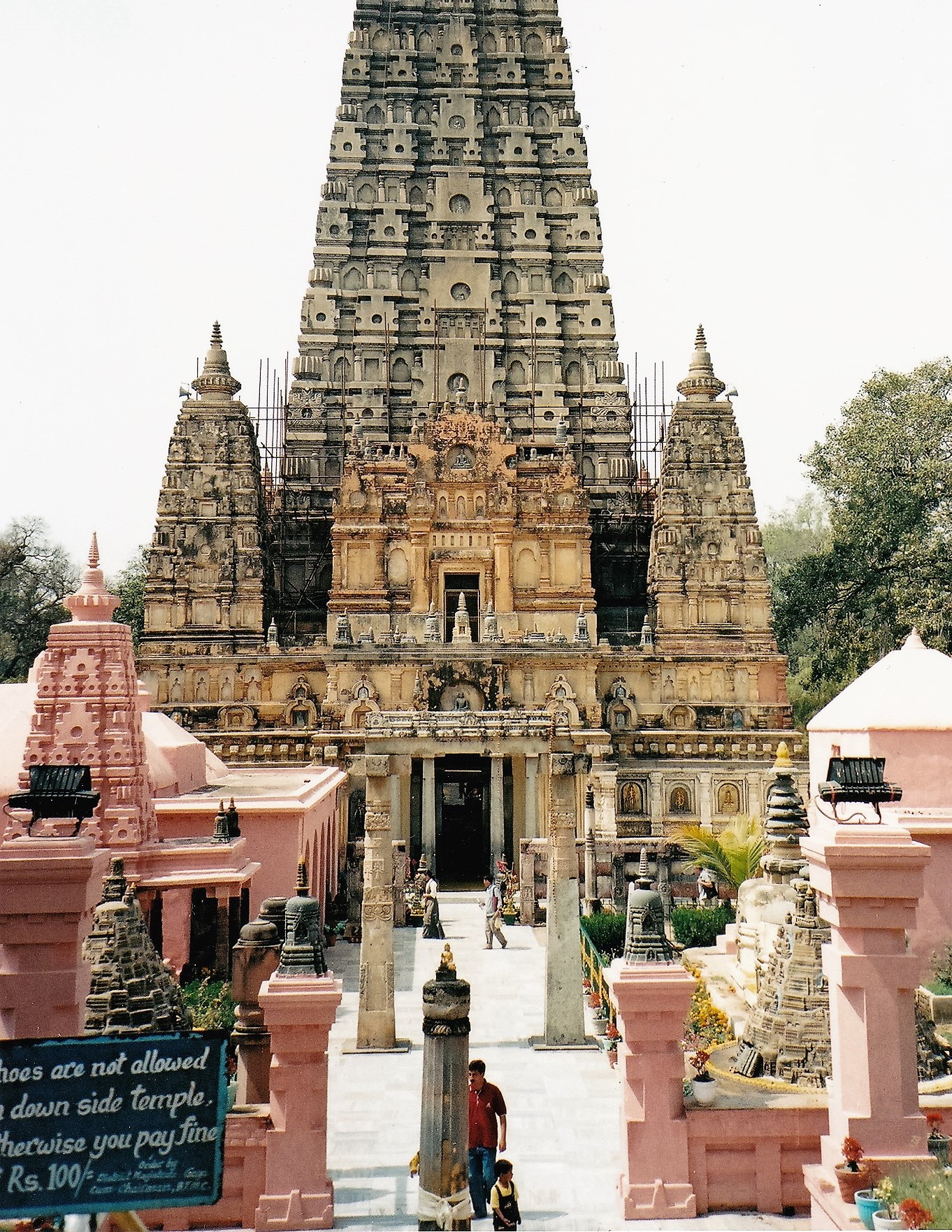
 Bodhgaya is a world heritage site, because the Mahabodhi Temple was built at the site where the Buddha is supposed to have achieved enlightenment, some 2500 years ago. The original temple was built by the emperor Ashoka in the 3rd century BC. The current temple dates from the 11th century AD, and was restored in 1882 by the Burmese. Surrounded by the usual frenetic Northern Indian crowds, and visited by a huge number of pilgrims and visitors, the temple and grounds still manage to somehow achieve an unbelievably peaceful ambience.


IMG_0002

The Bhodi tree at the Mahabodhi Temple. It is a third generation descendant of the tree under which the Buddha is supposed to have achieved enlightenment.


img_0025

Thai temple, Bodhgaya. As well as the Mahabodhi Temple, Bodhgaya also has temples built by virtually every country with a sizeable Buddhist population. As befits the place where the Buddha originally achieved enlightenment, it is an active Buddhist centre with many charitable projects set up and running.


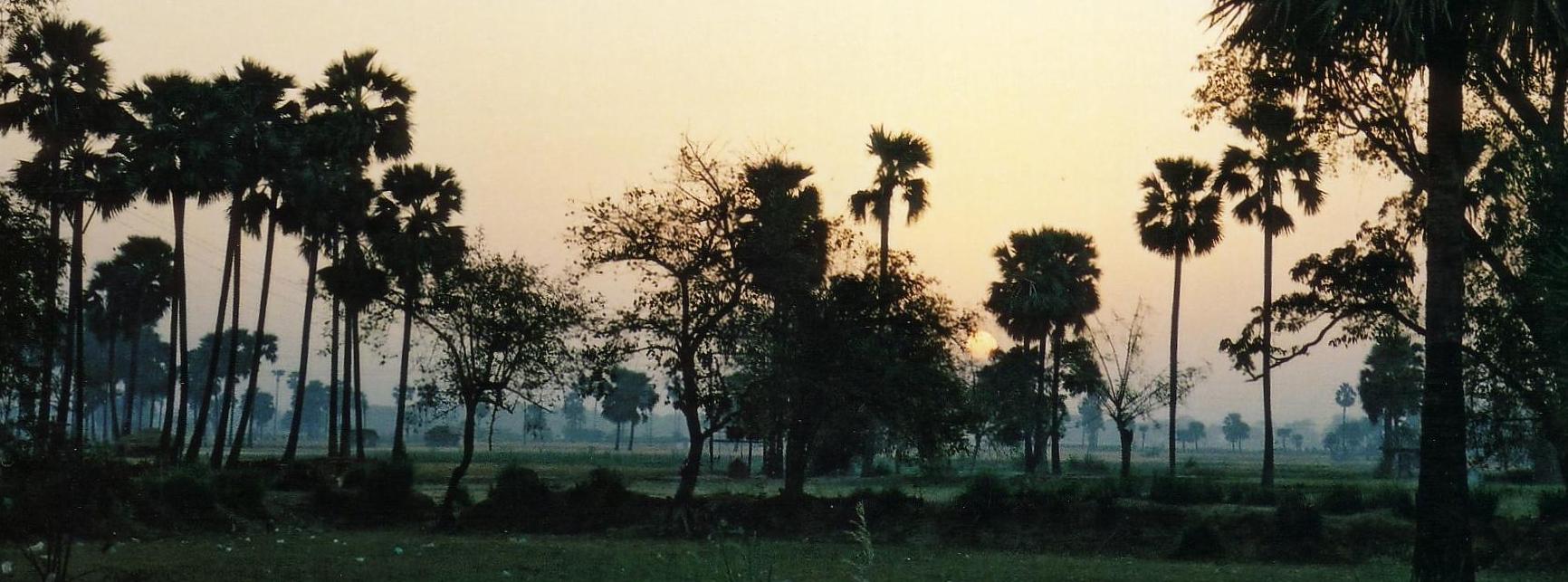
dawn-panorama
Dawn over Sujata Village, Bodhgaya. This was often the view that greeted me when I walked across the dry bed of the River Phalgu from Bodhgaya to the village of Sujata, in the cool of the morning. A rich reward for getting up early!


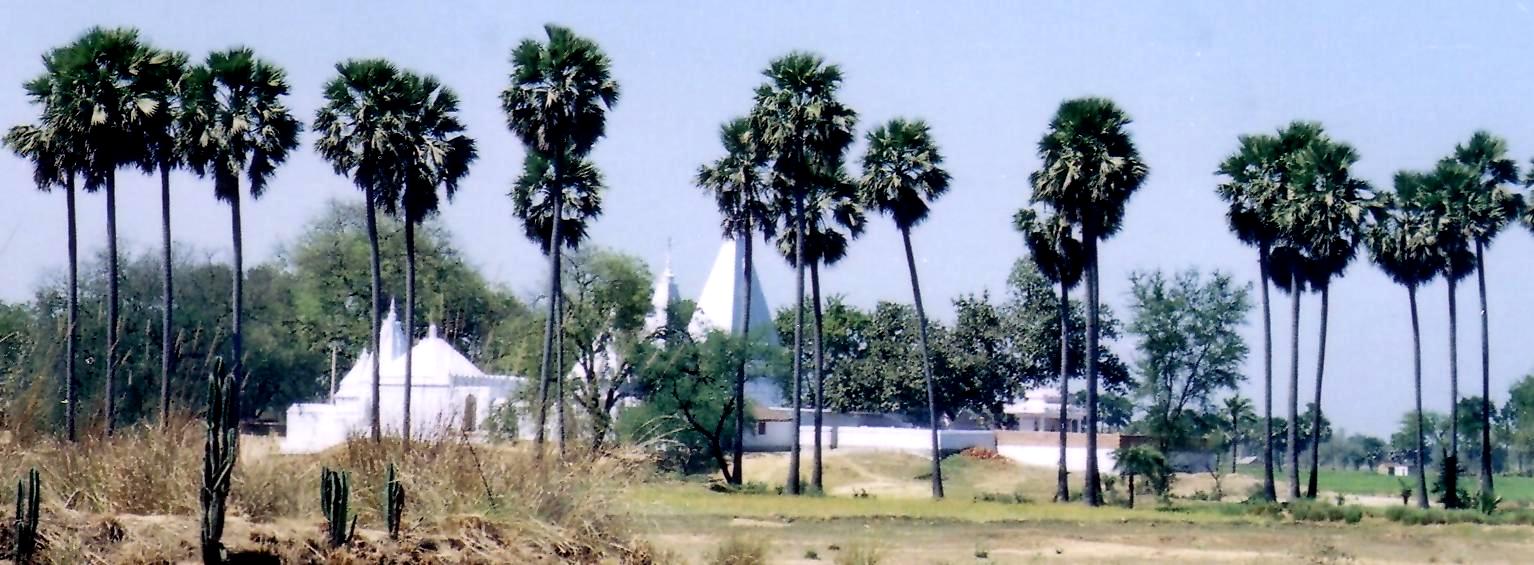
hindu-temples-panorama

Hindu temples on the edge of Sujata Village.

IMG

Fields in Sujata Village. In the vast majority of Indian villages, fields are still worked by hand or with animal labour. here is no exception.

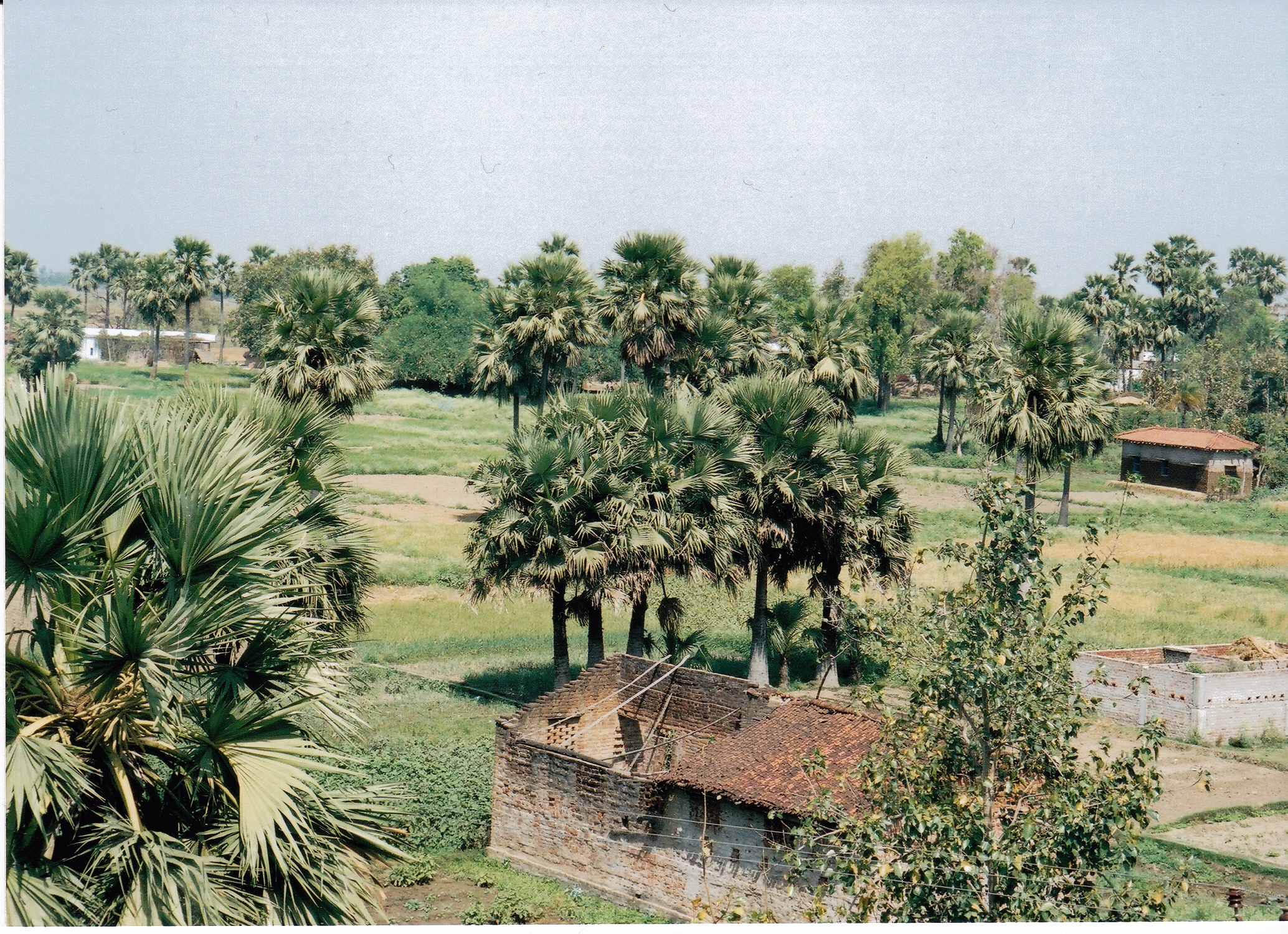
IMG_0016.jpg

Farms at the edge of Bodhgaya. Although Bihar is the most corrupt, poverty-ridden state in India, sitting at the bottom of the table in almost any set of statistics that you may care to consult, the land appears lush and fertile, supporting a strong agriculture.

img_0026

And whilst we’re on a rural theme…a street corner in Bodhgaya.


IMG_0012.jpg

Monks heading for morning puja (ceremony) in Sujata.

temple door bodhgaya.jpg

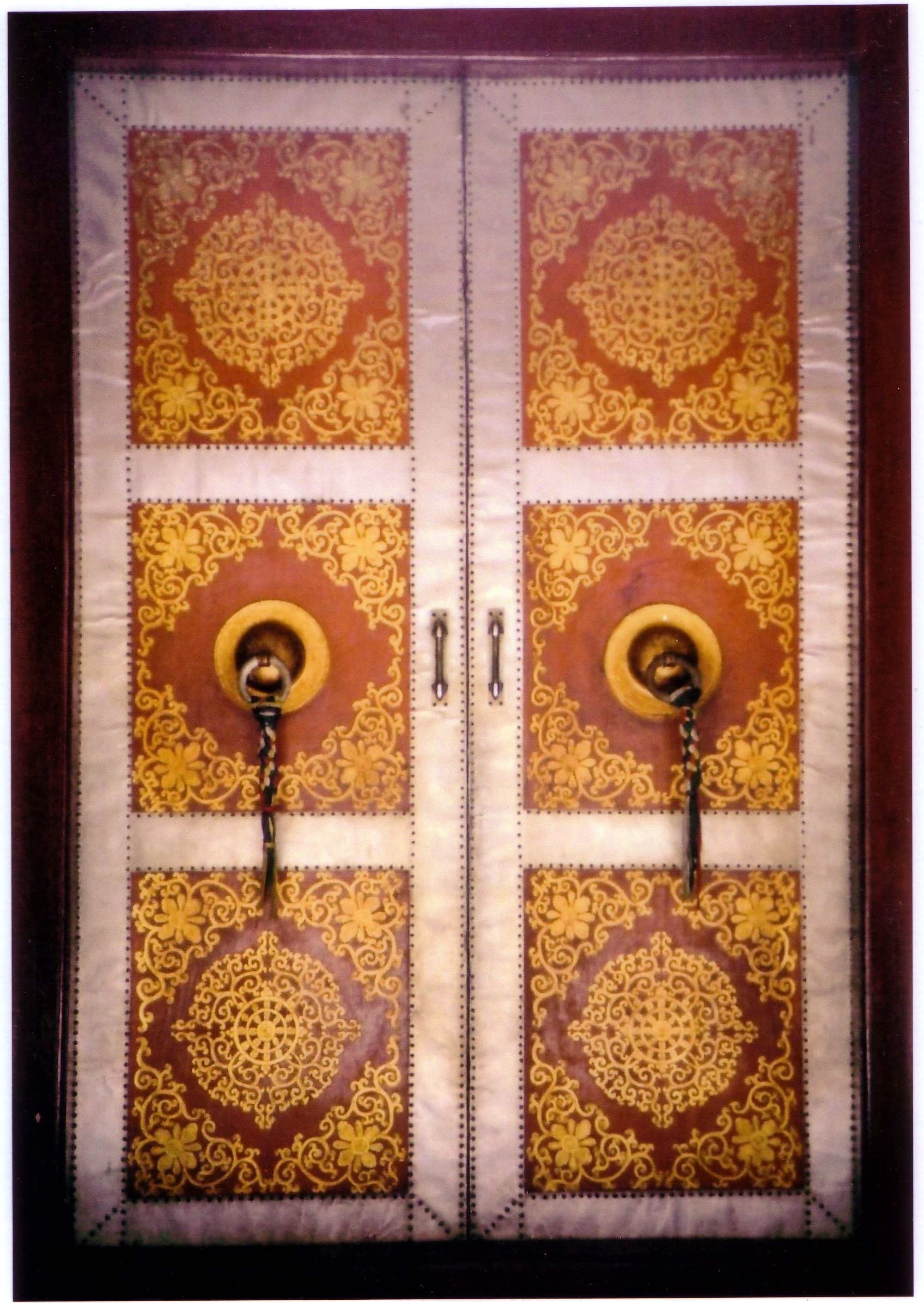
Temple door in Bodhgaya.

img_0027

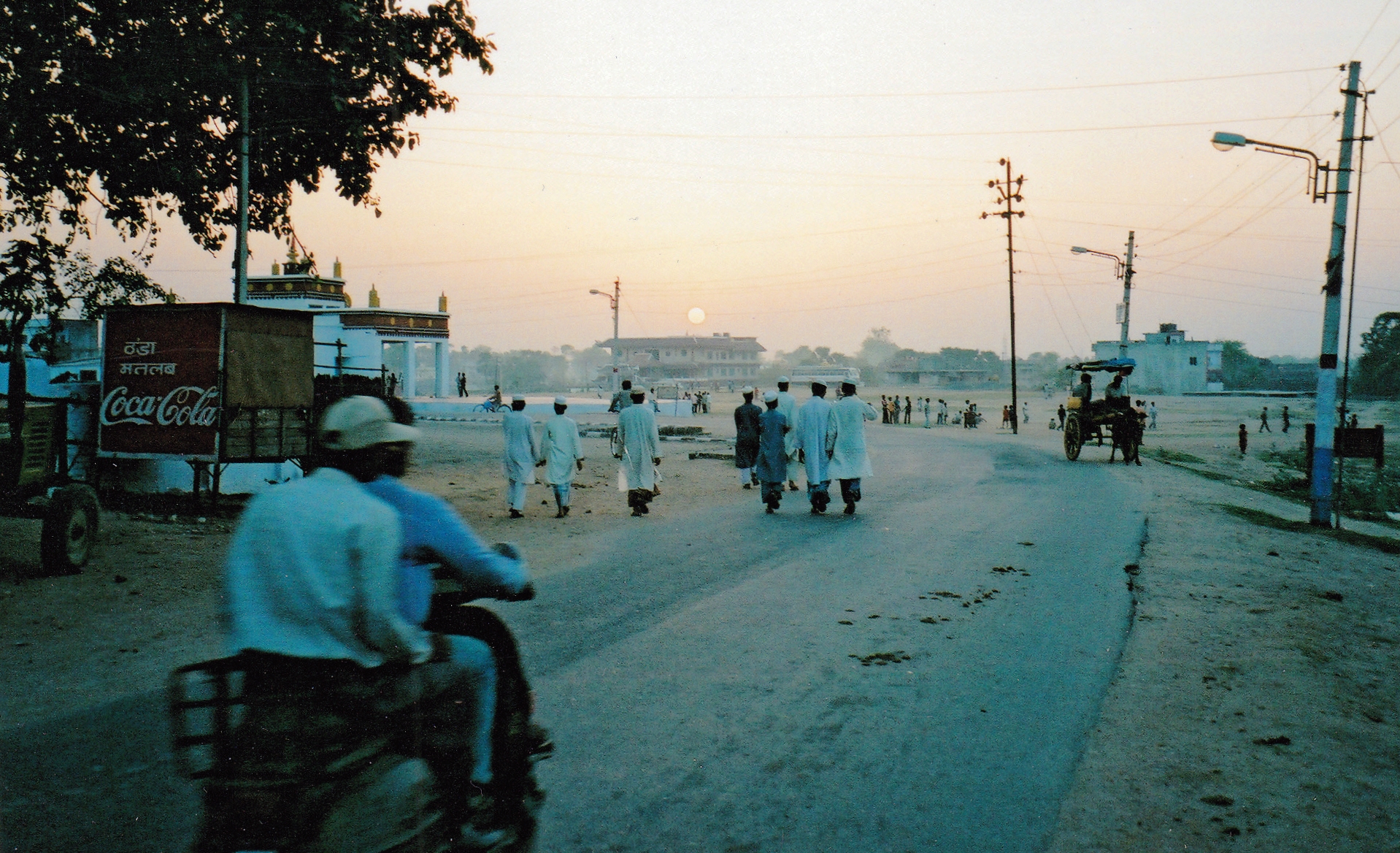
Dawn in Bodhgaya. The moslems are heading for the mosque, whilst most of the others are heading for work, for puja at Hindu or Buddhist temples, or to find breakfast.

I was after breakfast.

Kathmandu, Nepal

How on earth have I managed to blog for almost a year, now, and still not put up a single post on Nepal? I think I’d better put that right immediately.
I’m going to start with a selection of pictures from Kathmandu, capital of Nepal.
All of these pictures were taken before the dreadful earthquakes of last year, and I do know that some of the buildings in these pictures (especially in Durbar Square) were sadly destroyed.

015a.jpg

The entrance to Swayambunath. Swayambunath is the main Tibetan Buddhist site of Kathmandu. Sitting on top of a hill overlooking Kathmandu, it comprises temples, stupas and various other buildings, including a couple of Hindu shrines. Here, a Hindu holy man lurks in ambush, ready to dab a tikka mark on the forehead of (especially) western tourists and demand rupees for the privilege.


038.JPG

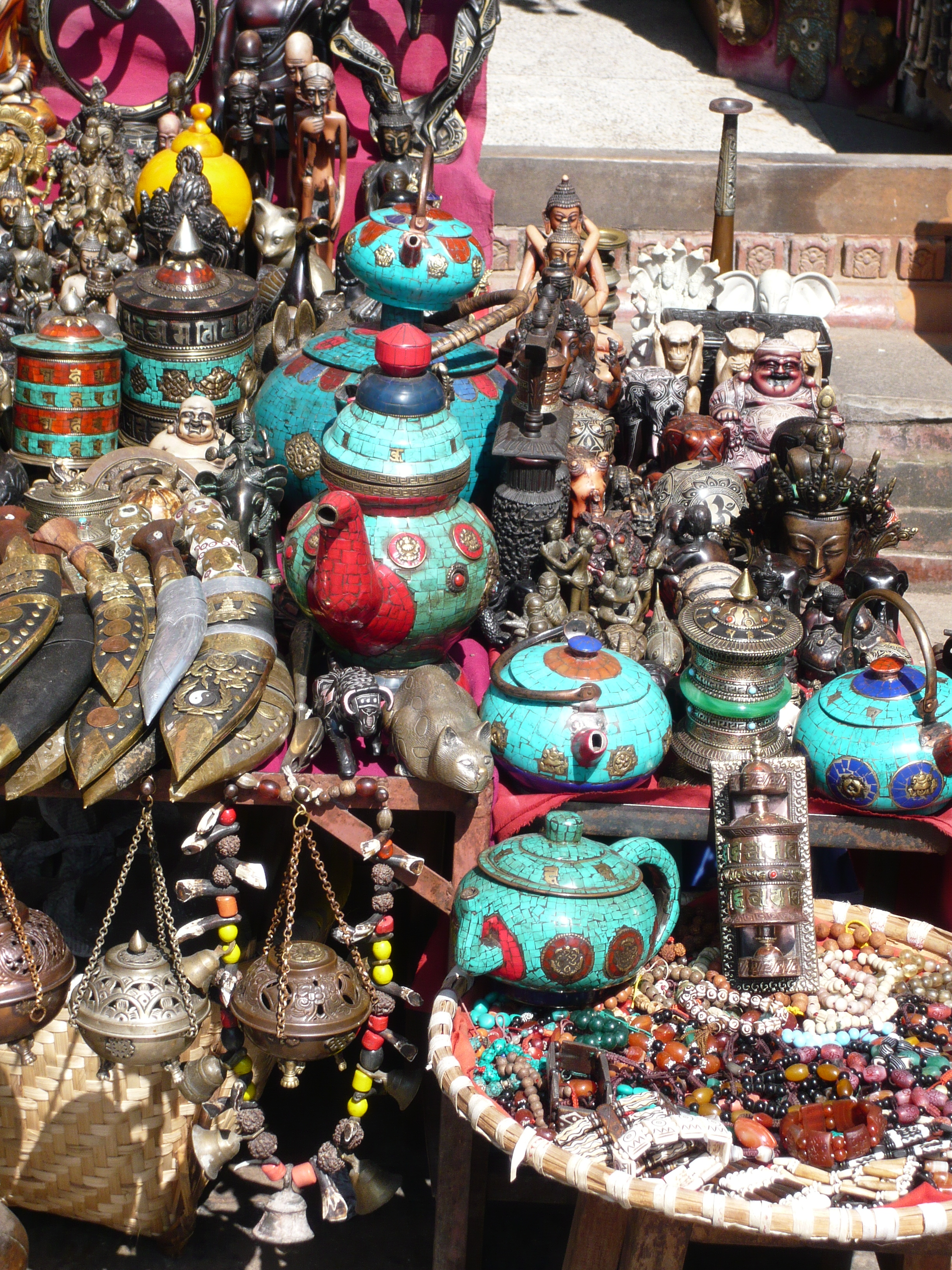
The sacred and the secular at Swayambunath. In Nepal, as in India, it is almost impossible to visit a religious site without Mammon getting a good look in. Here, in the main Buddhist site of Kathmandu, everything from yak bells to masks.
 

034a
‘One day, my boy, all this will be yours’ – just as long as you have enough money and all the time in the world to bargain hard. More shops – seriously colourful, seriously prepared to sell you anything. And having said that, the hard sell is a world removed from India. It almost feels as though there is no pressure at all. In Nepal, you feel you can relax again, especially if you have just travelled there from India.
056.JPG

Nuns lighting butter lamps beneath a row of prayer wheels at Swayambunath.

030a

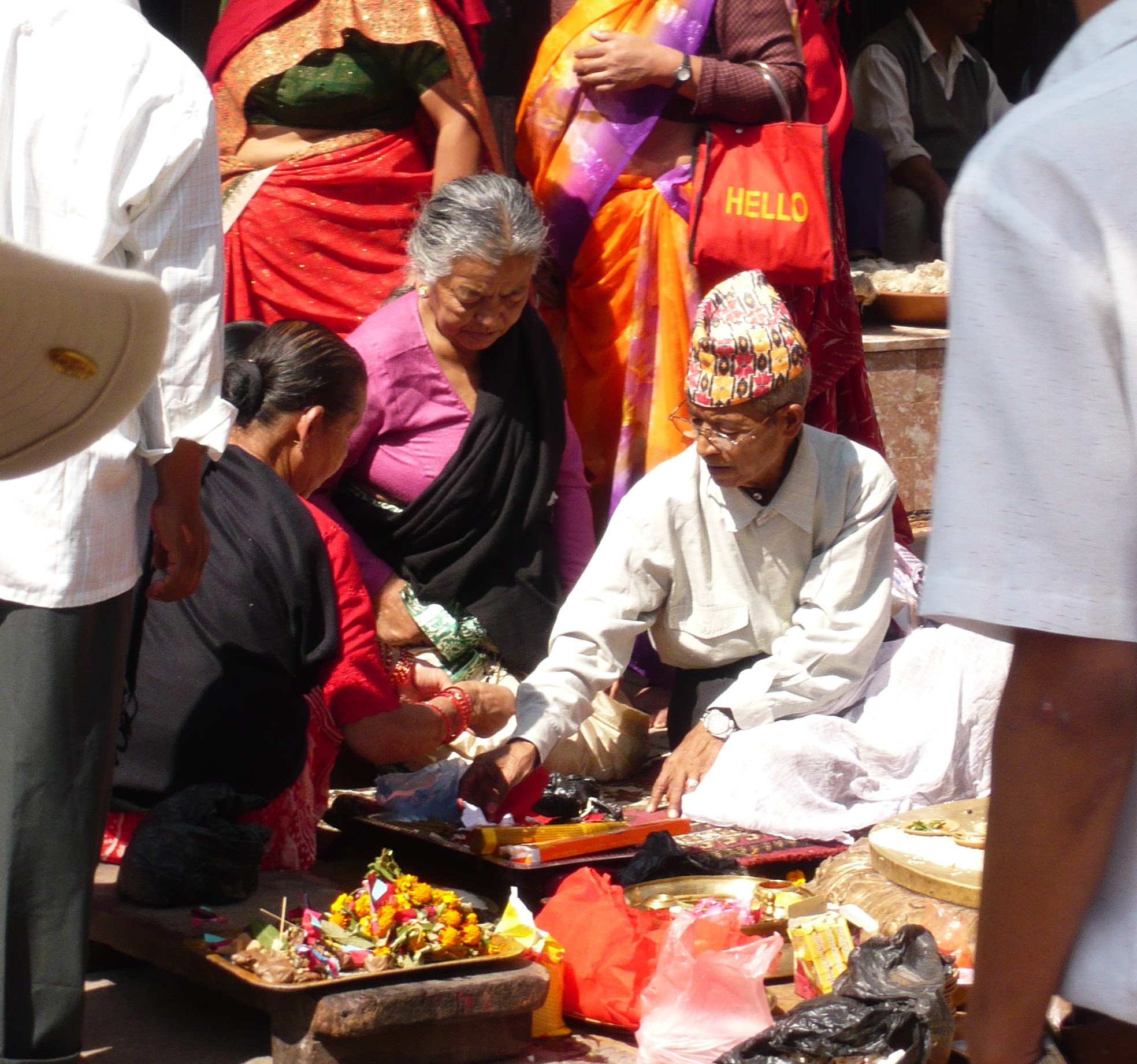
Hindu puja at Swayambunath. Probably a private ceremony at the request of the beneficiary, either for good luck in general or with a particular goal in mind (e.g. birth of a son, successful business venture.)


031b
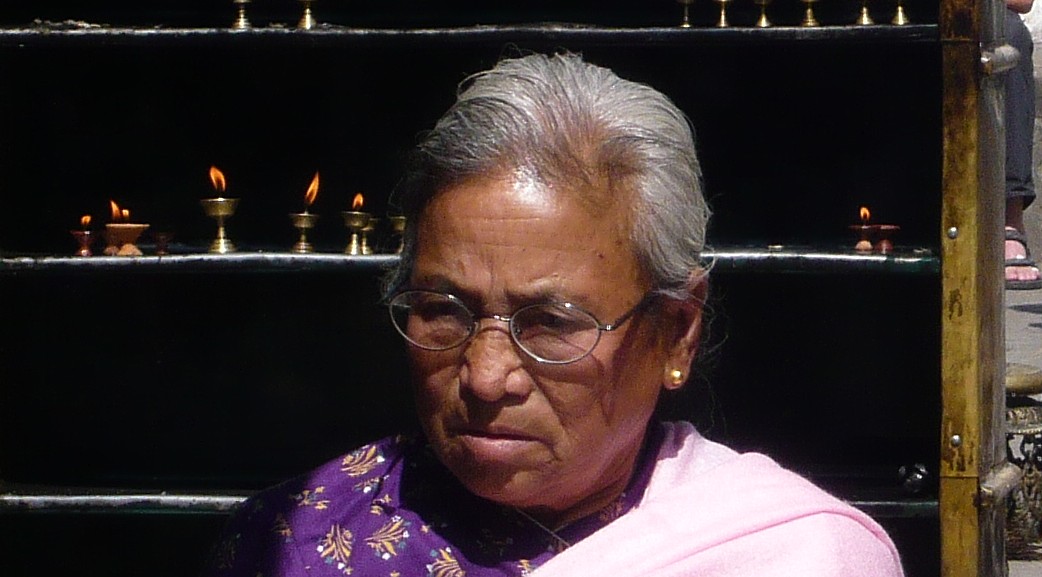
Portrait of a Hindu lady.
057

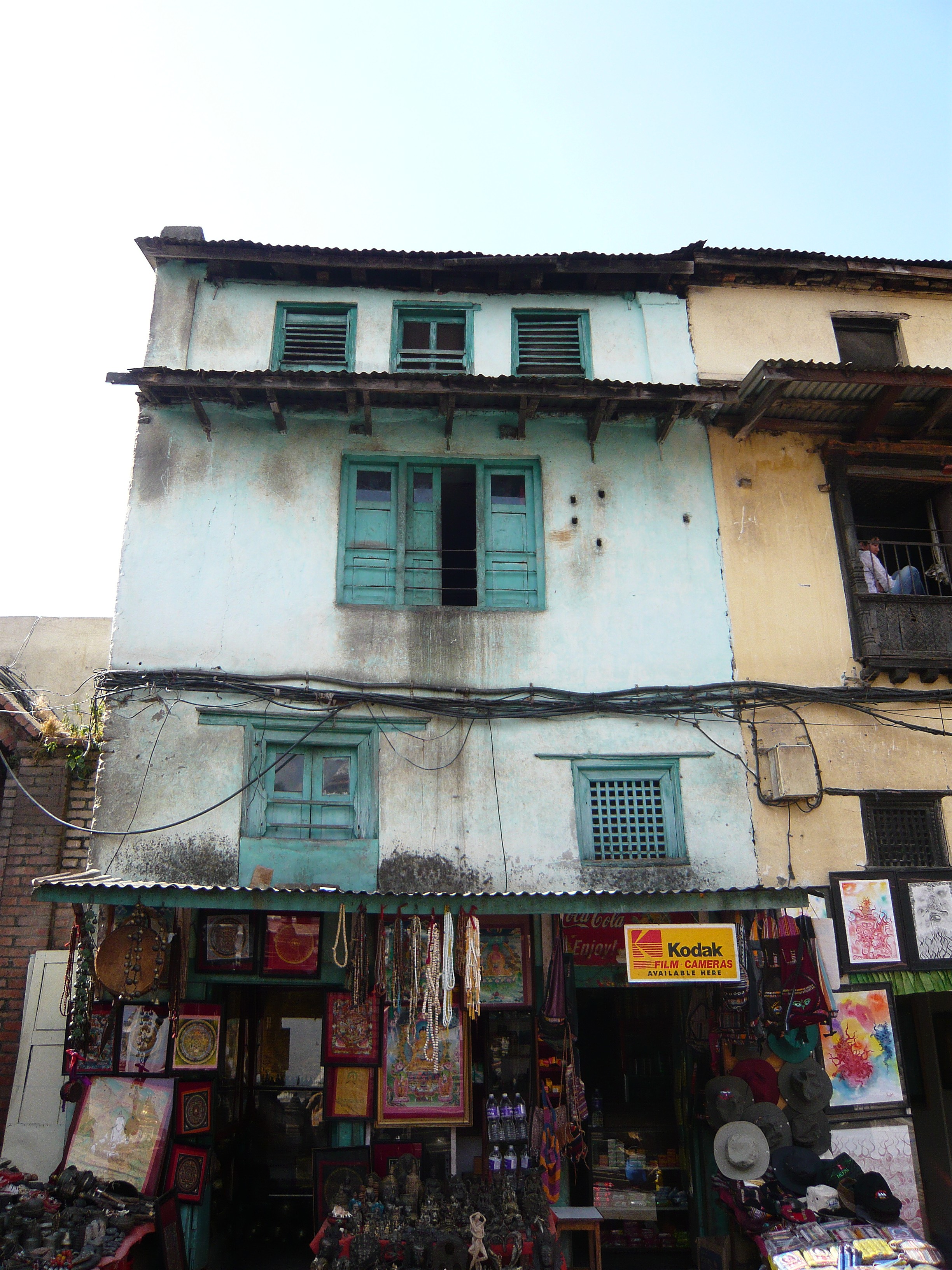
Tourist shop in the Swayambunath complex.
100

Buildings in Durbar Square. Durbar (or ‘Palace’) Square is the heart of the old town and the area where the Kings used to live in the 18th and 19th centuries. In contrast to Swayambunath, this area is entirely Hindu, reflecting the vast majority of the lowland Nepali population.

102a

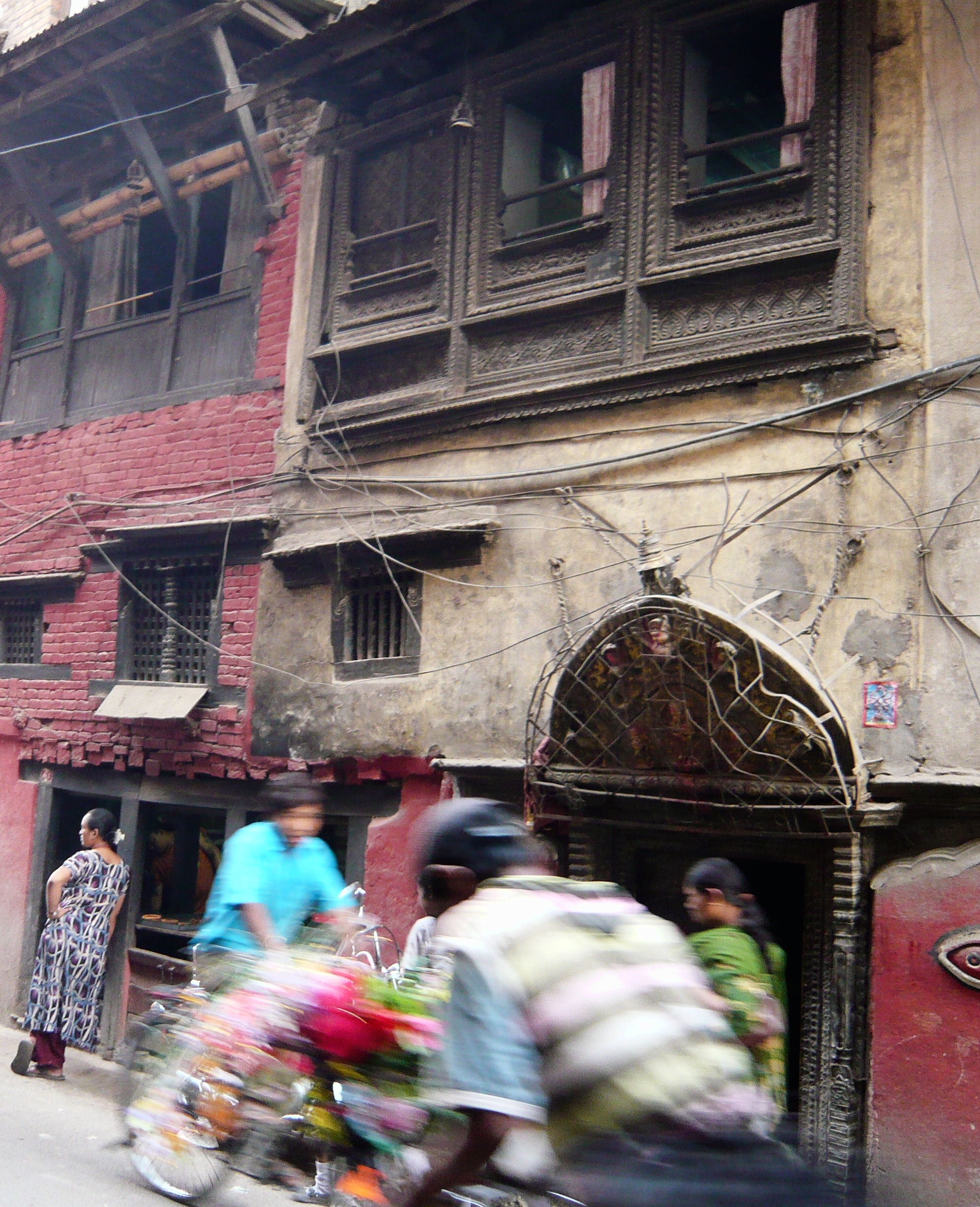
Side street in Thamel, Kathmandu. The lovely old buildings…beautiful wood carvings…collapsing brickwork…wiring all over the place…speed…calm…old and new…………the only things I can’t bring you are the sounds and smells…you must imagine them for yourselves. Coming soon, scratch and sniff websites!!!


098

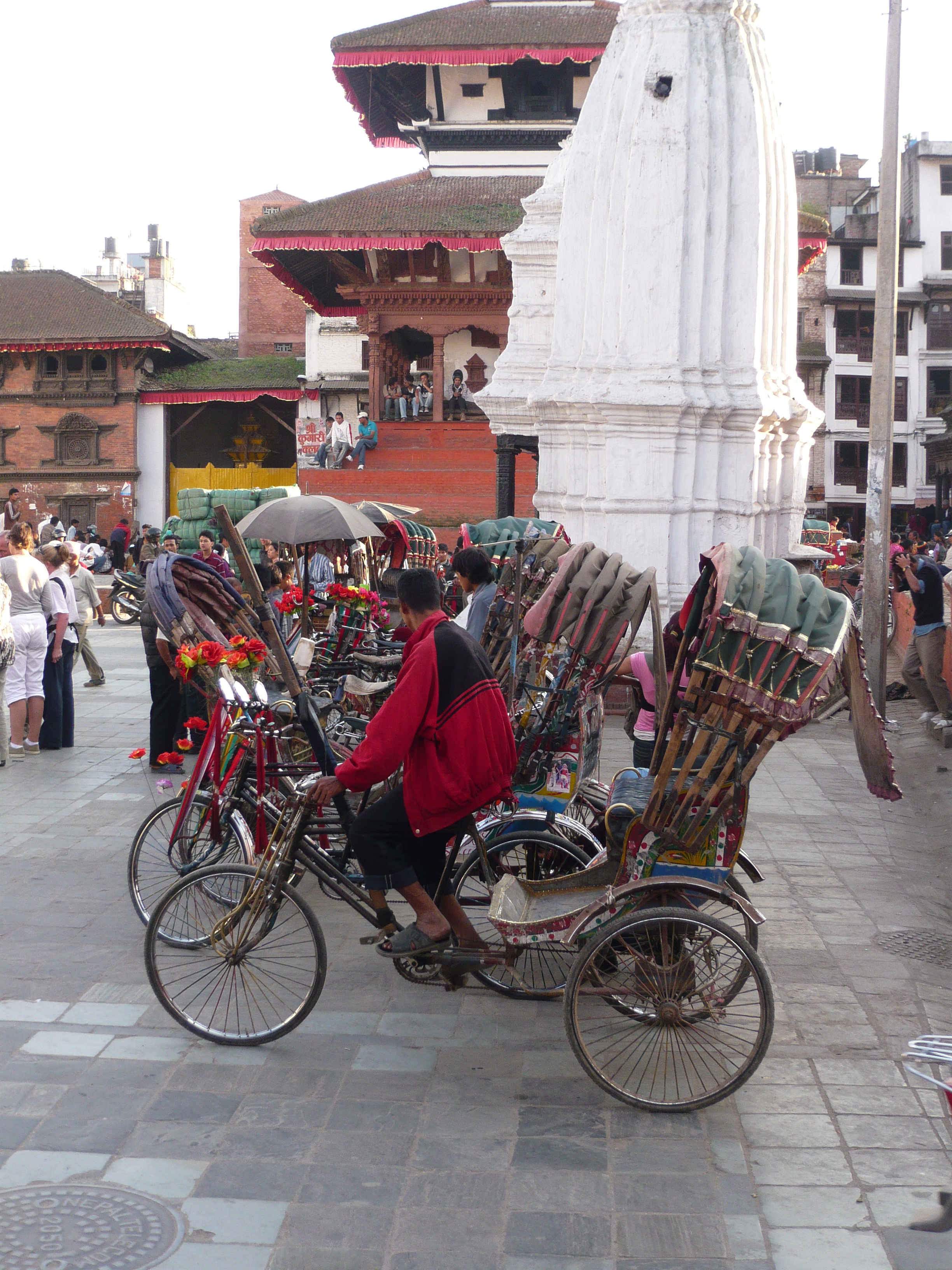
Bicycle rickshaws awaiting customers in Durbar Square.


067b

Balloon seller and hopeful customer, Durbar Square.


070

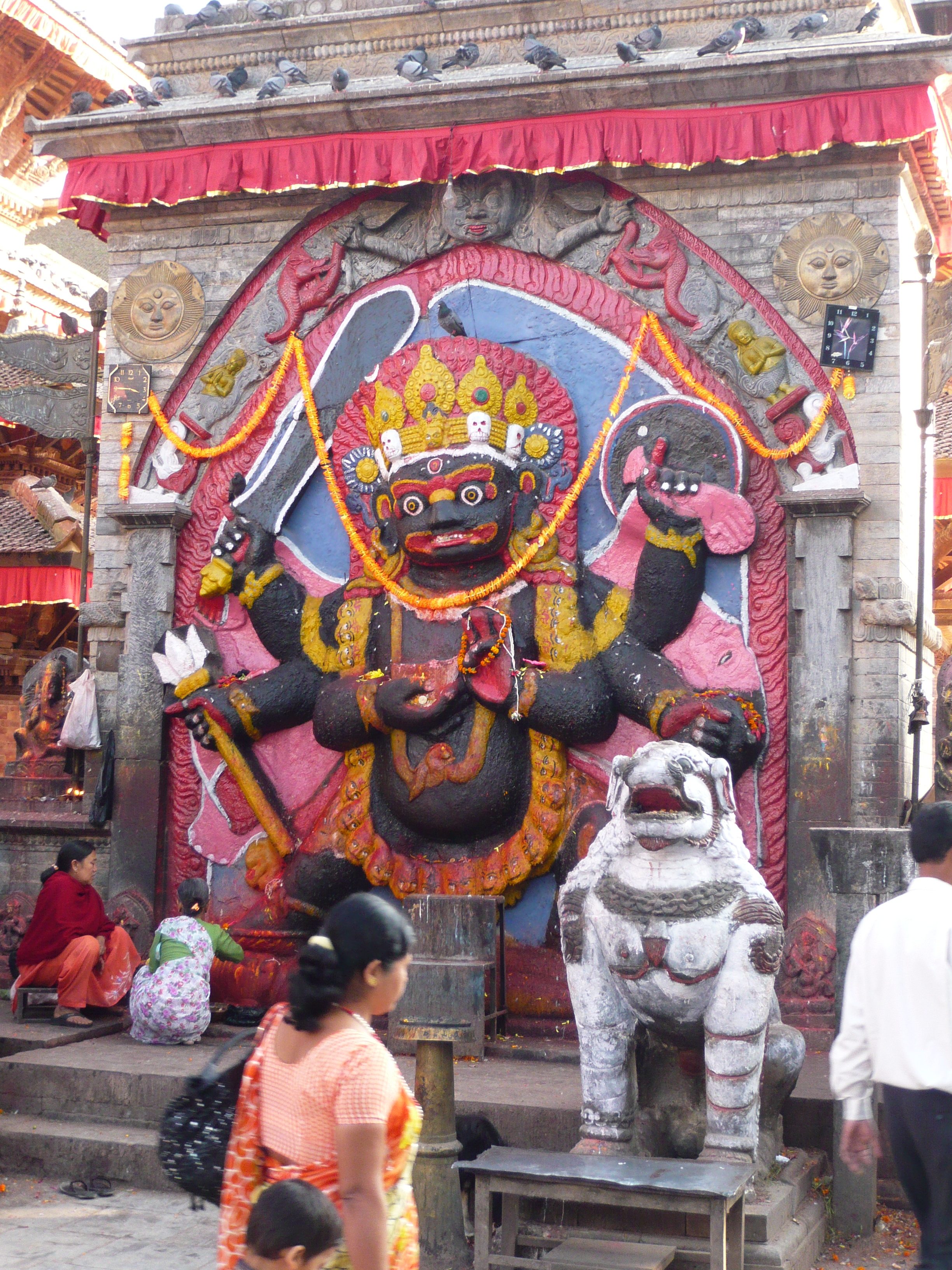
Kala Bhairab – an image of Shiva in his most fearsome aspect. Wearing a garland of skulls, the six armed Kala Bhairab tramples a corpse, symbolic of ignorance. Carved originally from a single stone, it was set up by Pratap Malla, king in the 17th century. He was a pious Hindu, but interested in the arts and tolerant of other religions. He even restored much of Buddhist Swayambunath. It is said that telling a lie while standing before Kala Bhariab will bring instant death. It was once used as a form of trial by ordeal.


img
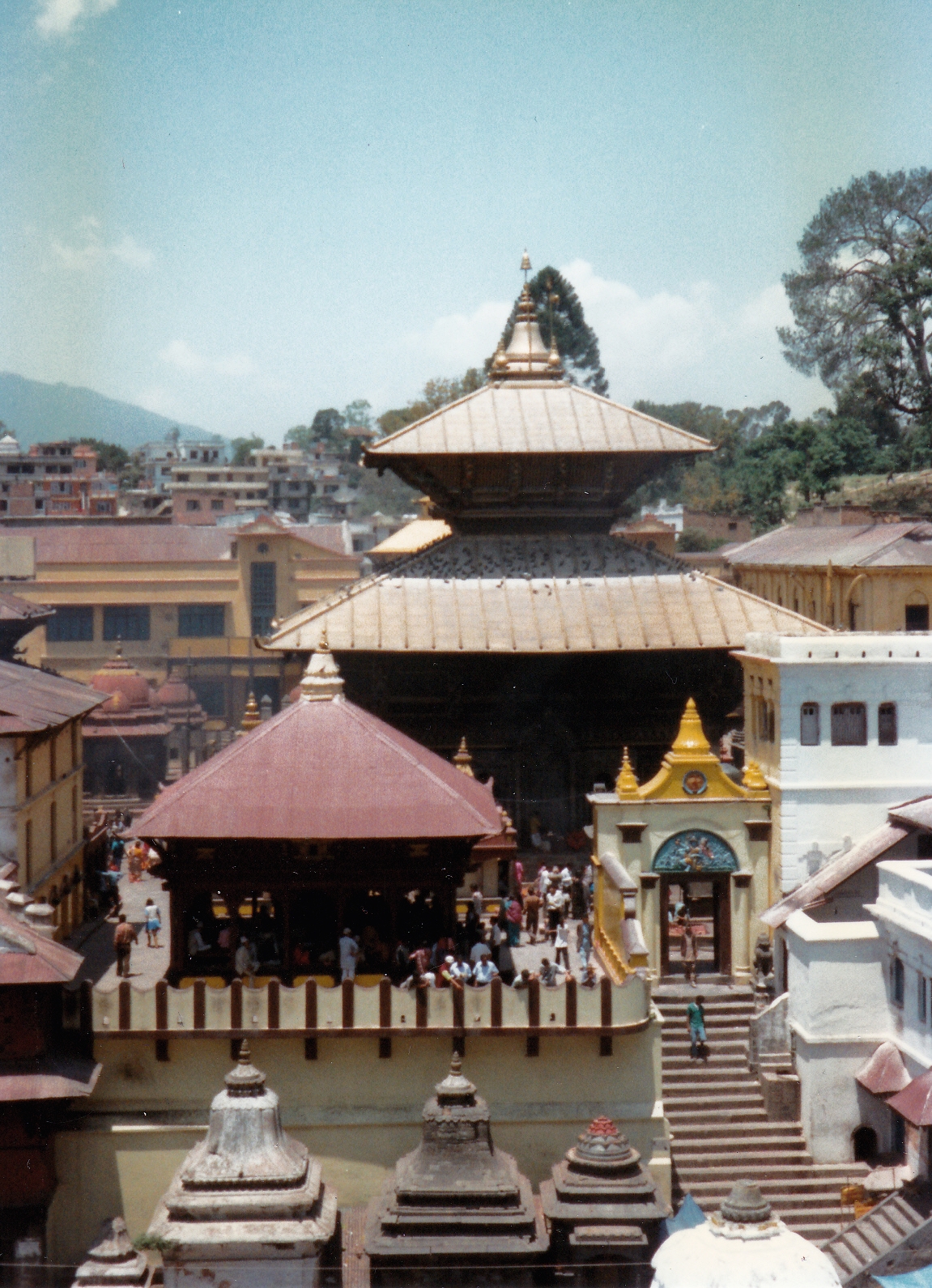
Pashupatinath, on the Eastern side of Kathmandu, is the holiest of the Hindu sites in the city. It is the temple of Shiva, on the Bagmati river and hence it includes the ghats, the most widely used place of cremation for Hindus in Kathmandu, indeed, in Nepal.

My First Long Trip to India (3)

I had read a little bit about Bodhgaya before I travelled out to India, and if I had taken any notice of what I had read, I don’t suppose I would have gone there at all.

The place was crawling with bandits.

I was likely to be kidnapped.

I was certain to be shot and robbed.

IMG

Sitting in the autotaxi as it bumped its way through the countryside between Gaya and Bodhgaya, with the sun shining on the fields and trees, this all seemed most unlikely. Yet, for those who lived there, these fears were very real. Later on in my stay, I travelled with another westerner and two Indians by jeep to Patna, which was a four hour drive.

We were delayed in Patna as the jeep broke down, the result being that we were several hours late in setting out on our return journey. It was beginning to get dark soon after we left Patna, and the two Indians on board were clearly very fearful of being stopped. They said that if we encountered a roadblock, it was quite likely to have been set up by bandits, and that we would veer off of the road and drive hell for leather – anywhere – to avoid them. They were less worried about crashing the jeep in the darkness somewhere than they were of the bandits. I used this as the basis of an incident in my forthcoming novel ‘Making Friends with the Crocodile’. *shameless plug*+.

+Well, why not. It’s my blog, after all.

But, I’m getting ahead of myself, and so back to the autotaxi. My driver had no idea where the guest house was that I wanted to go to, but cheerfully said that would be no problem. Once we reached Bodhgaya, he asked a few people where it was, and I was soon offloaded on the doorstep.

Once I had checked in, I walked into the town to explore and, more importantly, track down some supper.

By the time I reached the Mahabodhi Temple Park, it was dark. The temple looked absolutely stunning lit up by a number of spotlights, but I deliberately decided not to go in until the next day. I felt that I should wait until I felt a little cleaner and fresher. There was no rush; I was there for some time. I was looking forward to getting to know Bodhgaya better and treating it as home for a month or so.

IMG_0003

The road outside, which was the only one in Bodhgaya that was well-paved (and pedestrianized, no less!) was, not surprisingly, full of various vendors and supplicants. But they were not overly pushy, not overly expensive, and interesting. I bought some incense, partly just to help to drive the mozzies out of my room! Just standing outside the park gates I got a great feeling of well-being and pleasure.

The following morning, after breakfast, I visited the temple.

Stunning, I had thought the previous evening, and, yes, stunning it was.

Not stunning in the sense that the Taj Mahal, for example, is stunning, although the architecture is interesting; there was just a massive sense of place, of solidity, and the thought came into my head that Hindus and Buddhists alike ascribe the centre of the world to Mount Meru, but this felt like the centre to me. As I was walking around, several times I just felt an unexpected urge to burst into tears.

All around the temple, there were pilgrims and tourists. At one side, there is an old Neem tree, supposedly a 4th generation descendant of the one that the Buddha sat beneath to achieve enlightenment, two and half millennia ago. When it is grown at a Buddhist temple, it is referred to as a Bodhi (which literally means ‘enlightenment’) Tree.

IMG_0002

The reason that this site is so special, however, is that this was the actual site of the Buddha’s enlightenment. For a Buddhist, places just don’t come more special than this.

Everywhere, groups of pilgrims were conducting pujas (ceremonies); there were large numbers of Japanese and Korean pilgrims, but also many from other countries. This is reflected in the large number of Buddhist temples built in other places around Bodhgaya. There are a dozen or so temples built by Buddhist orders from all of the countries with substantial Buddhist populations, such as Thai, Chinese, Tibetan, Vietnamese…lots to visit, I decided. Outside the gates, a CD of chanting monks was playing. Despite the swarm of visitors, the whole place exuded peace, and I found myself just gently strolling around, sitting, watching everything…

IMG_0001

It was lunchtime, I found with surprise, when I left the temple grounds.

The presence of so many Buddhists in Bodhgaya has led to the setting up of a number of ‘projects’. These take many forms, but there are a good number of medical projects, schools, and orphanages, all set up to provide these services free to those that would otherwise not be able to afford them. Bihar is the poorest state in India, with higher levels of poverty, lower life expectancy and lower rates of literacy than any other state (the last time I checked!).

Human nature being what it is, a few of these are scams. I had checked out the project that I had volunteered for as well as I was able to beforehand, and was reasonably certain that it was genuine. I was volunteering my time, rather than donating money, so I was fairly sure that I would be able to see what was happening on the project as I worked, and if I was helping to (for example) improve the English of a few children, then that would be beneficial regardless of anything else.

I made contact with the project organiser and told him I had arrived in Bodhgaya.

The next morning I was at the orphanage.