A Jolly Wassail and the Howlers (and not forgetting the Hoodeners!)

Yesterday, we went Wassailing.

If you care to Google (other search engines are available) Wassailing, you will learn it traditionally takes place on the Twelfth Night (after Christmas), i.e. 5th January, and is a British custom. You will also discover that wassailing involves groups (traditionally men) visiting apple orchards, usually after dark, and to encourage the trees to be especially fruitful the following year songs are sung, trees might be beaten with sticks to wake them up, and offerings of bread soaked cider left in the branches of certain trees. Perhaps one particular tree would be selected to represent the whole orchard.

A Dictionary of the Sussex Dialect published in 1875 has something to say on the subject. It defines howlers as ‘boys who in former times went round wassailing the orchards. A custom now nearly obsolete. The custom of wassailing used to be observed on the eve of the Epiphany, when the howlers went to the orchards, and there encircling one of the best bearing trees, drank the following toast,-

‘Here’s a health to thee, old apple tree,

May’st thou bud, may’st thou blow,

May’st thou bear apples enow!

Hats full! Caps full!

Bushel, bushel, sacks full!

And my pockets full, too! Huzza!

The wassailers derived their name from the Anglo-Saxon salutation on pledging one to drink, which was waes hael, be of health; to which the person pledged replied drinc hael, I drink your health.

Epiphany occurs usually on 6th January, or on the first Sunday falling between 2nd and 8th January, which tends to tie in roughly with Twelfth Night, at least as far as 6th January goes.

Groups of wassailers might also take the opportunity to go from door to door singing wassailing songs (like the one above and plentiful variations) to earn a penny or two. It is possible that the tradition of Christmas carolling derived from this. A wassail bowl was often also taken around, which would hold spicy mulled cider. This might perhaps also be offered at houses visited, although my copy of the 1849 Chambers Dictionary suggests a wassail bowl was used to drink in the New Year and does not mention anything about wassailing itself. I suppose this might represent a sort of official disapproval of the tradition. But it does confirm that drinking was involved, and I’ve no doubt the revellers enjoyed their share.

Howlers would appear to be a Sussex tradition, the name deriving from the boys ‘howling’ the orchard.

Away from the south of England, wassailing appears to have been more widespread, in the sense that not just apple orchards, but also bees might be wassailed, to encourage them to be productive, and it might also happen at other times of the year.

It being 6th January, we took a bus and a couple of trains and made our way to the village of Worth, just outside Sandwich, in East Kent, to not only join in with wassailing apple orchards but also watch some Hooden Horse antics. Hooden Horses you shriek in confusion? Look no further than this post, which even explains why we chose to go to East Kent.

Anyway, ale was drunk in the pub where we began the afternoon, with the Hooden Horse company performing their version of the traditional play – this particular company have recently revived the custom in this area – before we set off (horse and all) to wassail a nearby orchard on our way into Sandwich. In this case, the wassailing consisted of making plenty of noise as we passed the orchard – many a shout of waes hael and drinc hael, ringing of hand bells, and clashing of sticks. Personally, I am convinced there will be a bountiful harvest there next autumn. Then on to Sandwich for further Hooden Horse Hi-jinks (and further ale) in a welcoming taproom, before we made our way back home (since we had quite a long journey), although hardier folk than us went on for further malarky elsewhere in town.

Warning! Do not let this ‘doctor’ anywhere near your loved ones!

Gathering in the pub car park before the Wassailing walk

In the taproom, Sandwich

  • several of these photos courtesy of Sabina

We’ll just have to look out for another malarky opportunity soon, I guess.

At The Hop

I was talking about hop pockets and pokes last week – and pigs, of course, which was how it all started, but forget the pigs for now. Let’s stick with the pokes and pockets. At the weekend we went for a walk through a part of Kent we hadn’t walked for a few years and part of the walk took us through this field:

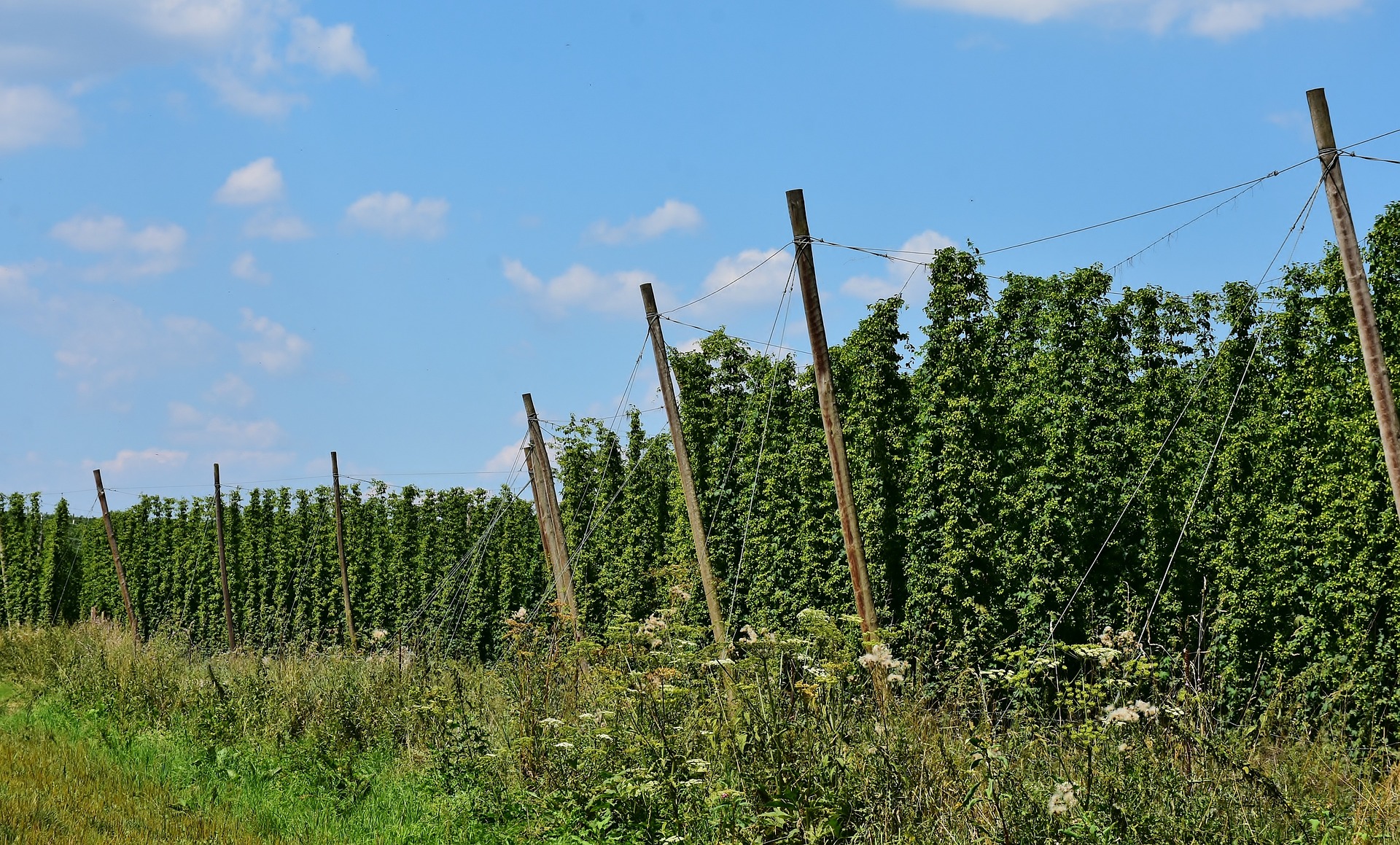
This was a hop garden many years ago. Conveniently close to the oast houses so that as soon as the hops were picked they could be taken in and dried before there was any chance of them spoiling. Taken in bagged up in pokes, and once dried shipped out to the brewers in pockets. A word of explanation for those not familiar with these terms: hops are not grown in fields, they are grown in gardens. Not like your or my back garden, but like a field. But a field full of poles. Hop poles. With huge cable-like wires strung between them to support the hop bines as they grow.

When they are ready for harvesting, the bines are pulled down and the hops picked and put in pokes – large sacks (but you knew that, of course. You remembered it from last week). Then once dried they are shovelled into pockets – another size of sack.

And what are the hops for? Making beer, my friend. Lovely beer.

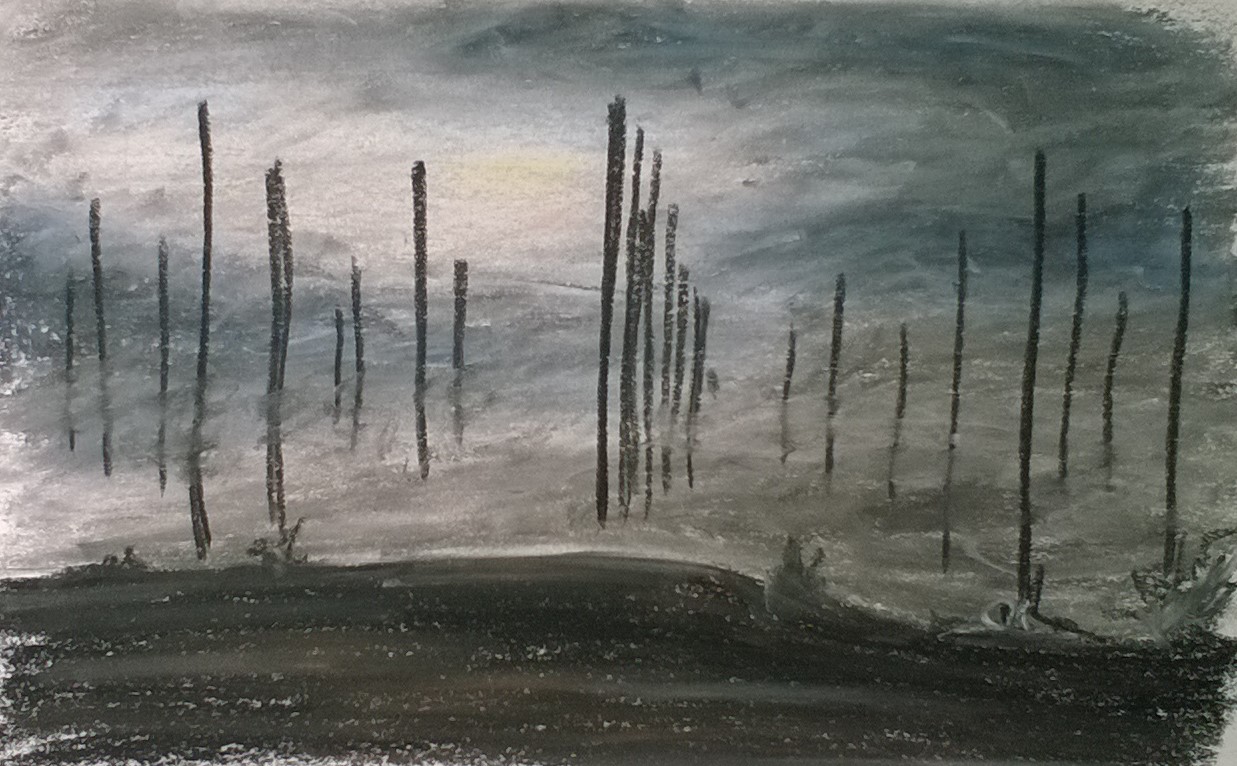
I don’t have a picture of the hop garden from back then, but late one cold, misty, autumn night about thirty years ago, I walked through it and the eeriness was instantly imprinted on me and once I was home I felt compelled to make an oil pastel painting of it (below).

Anyway, as I said I don’t have a photo of the hop garden in question, but this one from Pixabay illustrates very nicely the hop poles and wires with the growing hop bines growing up and across them:

Image by -Rita-👩‍🍳 und 📷 mit ❤ from Pixabay

The poles were supported by wires kept under tension, anchored into the ground around the edge of the garden. Quite a few of these are still in situ around the very edge of the field and just into the woodland and hedgerows bordering it.

In 1872, there were 72,000 acres of land in England growing hops, the majority of these being in Kent, employing over 100,000 seasonal workers at picking time. By 2003, the acreage in Kent was down to just over 1,000 and for the first time ever the county had been overtaken by Herefordshire, which now grew more, although the decline does at least appear to have halted for now. In 2011 there were a total of just over 2,500 acres under cultivation in England but it is such a small number there were fears the industry could die out. Although hops are still used in beer brewing, much of the requirement is imported, especially with a popular shift towards less bitter-tasting beers. But in much the same way that Kent has also lost a huge percentage of its apple orchards, a once rich and diverse farming landscape has become more and more homogenised, with endless huge fields of arable crops and sheep and cattle replacing the hop bines and apple trees.

I spent one autumn apple picking around thirty years ago and the farm I was working on had a large acreage of hop gardens (both apples and hops all sadly gone, now). It was an incredibly busy and bustling time, with our diverse group apple picking – a mixture of locals and Europeans come over for the work – and a traditional mix of workers in the hop gardens; as well as locals, there were a lot of gypsies and possibly still a few people down from London’s East End, which was a traditional way for those workers to make some extra money in the nineteenth and early twentieth centuries. It was busy, noisy, very hard work, and a lot of fun.

And, not surprisingly, there are a number of traditional songs about hop picking. So here is the wonderful Shirley Collins and the Albion Dance Band to perform ‘Hopping down in Kent’ especially for you.

Red Herrings

I had a couple of conversations the other day on detective novels, in which red herrings were mentioned, and it reminded me of something I had been reading a few days before, as well as one verse of an old nursery rhyme, the words recorded in the 1800’s, which goes thus:

The man in the wilderness asked of me
How many strawberries grew in the sea.
I answered him, as I thought good,
As many as red herrings grew in the wood.

Pixabay image

It is supposedly one of the lesser-known nursery rhymes, but I came across it in one of the books my children had when they were small. Possibly, the Tale of Squirrel Nutkin. Again, there is an old song occurring along the English east coast called the Red Herring, of which these are the first two verses:

1
What shall we do with the red herring’s head?
Oh, we’ll make that into feather beds, and all such things,
We’ve red herrings and heads and feather beds, and all such things.

Chorus
Of all the fish that swim in the sea, red herring it is the fish for me,
And all such things.

2
What shall we do with the red herring’s eyes?
Oh, we’ll make ’em into puddings and pies, and all such things,
We’ve red herrings and eyes and puddings and pies,
Red herrings and heads and feather beds, and all such things.

There seem to be many versions of this, one of which was collected by Cecil Sharp, well-known as one of the first people to travel around England in the early 1900’s collecting and writing down folk songs, afraid they would become lost as, in a rapidly modernising world, fewer and fewer people now sang them.

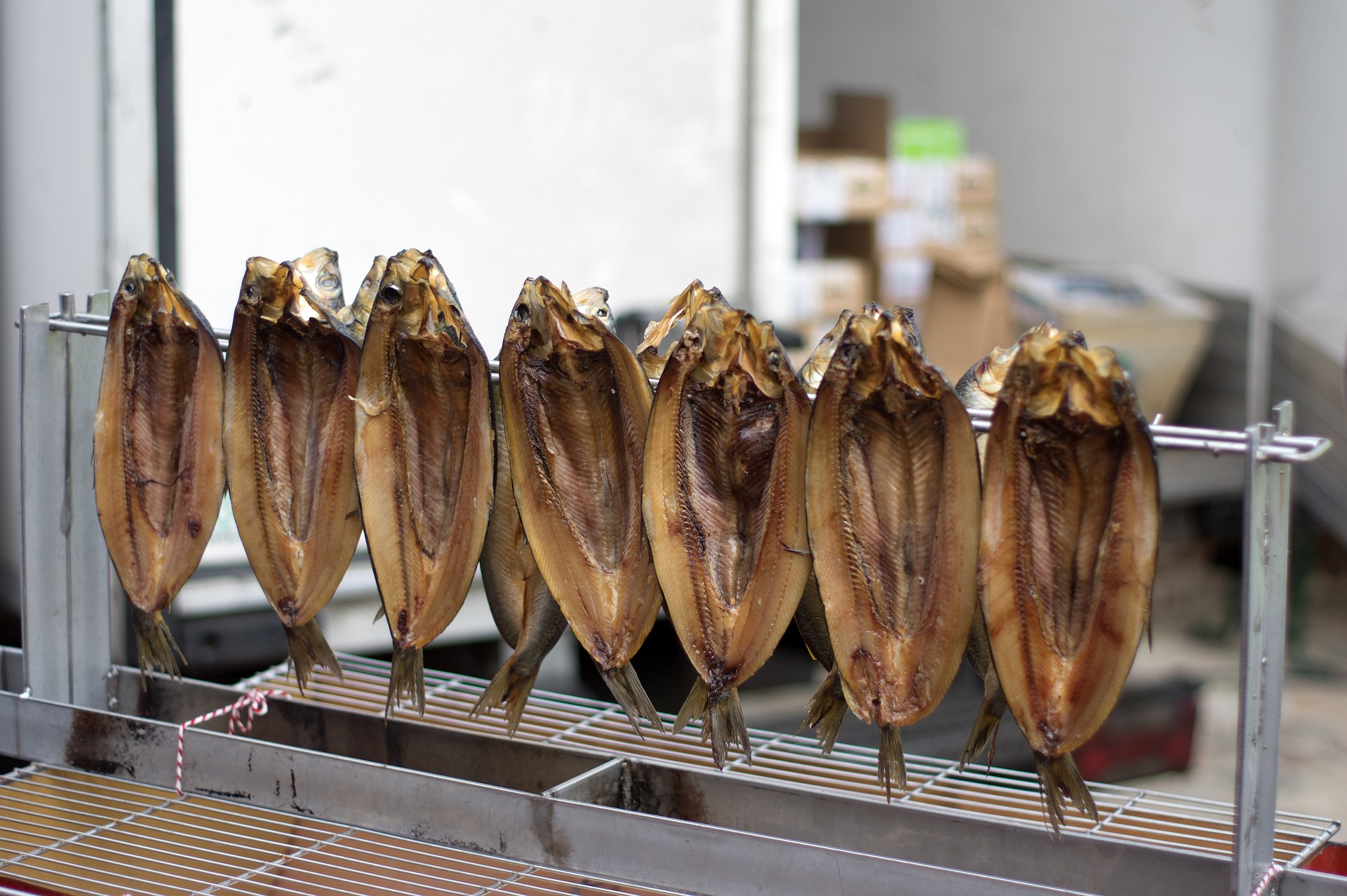
Unusually (because I never trust it as a source) I looked at Wikipedia which merely defined a red herring as a distraction, or something misleading. It suggests the term came from a strong smelling smoked kipper which could be dragged across a track to put hounds off of a scent.

And what it reminded me of was that a dictionary of the Sussex Dialect, published in 1875 does not have a particular entry for red herring, yet under ‘White-Herring’ is found the definition: A fresh herring, as distinguished from a dried one, which is called a red-herring. Delving a little deeper, we find references to dried, smoked, herrings – named red herrings – in use to mask the scent of trails both literally and figuratively, in a story published by William Cobbett in 1807 and also a couple of references from the 1780’s. There is apparently a bit of disagreement over where the phrase was used first in that context, but that doesn’t seem relevant here, it’s just interesting to find out that red herrings actually exist, and how they came to assume the role they have in literature and everyday conversation.

A Christmas Carol – 1

I haven’t seen much of Bob, recently.

To be fair to Bob, he’s been rather busy. But he came round to my house the other day. Well,  the other evening, really. He was carol singing. And it was only just December.

‘What on earth are you doing?’ I asked him. He look puzzled.

‘Carol singing, of course. Why?’

‘Why? It’s only just turned December, that’s why.’

‘Well, all the shops have their decorations up now.’

‘I suppose so.’

‘And some have had, for the last few months.’

307a

‘True, but…’

‘And they’re all playing Christmas songs.’

‘Unfortunately true…’

‘And half the kittens on social media are dressed in red and white and chasing Christmas baubles around on the floor and then batting them with their cute little paws…’

‘Stop it, Bob!’

‘So why can’t I go round carol singing?’

‘Because there’s only one of you and it sounds awful!’

‘Oh…sorr…eee!’

‘And what are you collecting for?’

‘Huh?’

‘That tin you’re rattling. What’s it in aid of?’

‘Our Christmas lunch.’

‘Bob! You can’t do that! You’re supposed to be collecting for charity!’

‘Am I? Who says so?’

‘I…er…I don’t know. You just are, that’s all.’

‘Well, I’m collecting for our Christmas lunch!’ He rattled the tin meaningfully towards me. ‘Silent Night…’ he began again, his voice rising suddenly about two and three sevenths octaves. I shuddered. The kittens left their baubles and ran for cover. ‘Holy Night!’

‘Shut your bloody racket!’ Came my neighbour’s voice – slightly muffled, but carrying a clear threat of violence.

Bob left quickly.


In other years, I’ve written a few short stories for Christmas, but not this year.

Bob has inspired me to re-imagine a few Christmas Carols for the twenty first century.

Here is the first one.

Strident night,

Angry night,

Down cheap booze,

Get into a fight.

Punch and scratch and kick and bite.

Tell the other bloke he’s just a shite.

Sleep in a prison cell…oh!

Sleep in a prison cell.

For those of my readers who do consider Christmas to be a holy festival, I must point out that these little offerings are intended as my rant against the excesses and the commercialisation of Christmas today. I hope you will not take any offence, for none is intended!