Responsible Travelling – Part 2

Volunteering

Many travellers who are spending some time away from home end up volunteering their services at a project that claims to be a Good Cause, or offering to help to sponsor it. And many are, although a goodly number turn out to be money-making scams, some set up very elaborately indeed.

I have seen many sides of charity work – I have worked as a volunteer in UK and in India, worked as a paid employee of a charity and I have been both a trustee and a committee member of charities. I have also watched one go to bad, with various warning signs unheeded and a number of heads buried in the sand.

dawn panorama

So how do you tell a good project from a bad one? There are no hard and fast rules, mainly because projects differ so much. Some are huge, multi-million dollar constructs involving hundreds of volunteers and paid staff whilst others run on a shoestring with one or two staff. Some are run entirely by local people, others may be foreign led or almost entirely staffed by foreigners. They set up and run schools, leprosy or aids centres, save donkeys, teach alternative ways to cook and heat to reduce deforestation, rescue fallen women and street children, restore old temples, and so on and so on. And it is often very difficult to tell a scam from a genuine project.

Firstly, please do not just leap in and offer money. There are several good ways to get a feel for the project. Local knowledge is often a good start – talk to people. If you are spending a while in a place, you will get to know people and you can chat about your chosen project to them. If it is dodgy, someone is very likely to warn you. Or spend a while there as a volunteer before offering any money. Watching how it is run at first hand should give you a feel for it. Other than that, look at its website, if it has one. The project should have a board of trustees, or a committee, to oversee it. Contact them. Ask to see how the money is used and accounted for. This should all be open and in the public domain. Don’t be afraid to ask questions. If the people concerned are reluctant to give answers, or resent your asking, be suspicious. Look for obvious signs and use common sense. A large, flashy building with a few children inside and a big new landcruiser parked out in front, in the midst of a squalid village is going to be locally devisive and should also set your alarm bells ringing. If the trustees and committee all live in Europe or US, then it may be very difficult for them to carry out their duties effectively and again you should be wary.

Naturally, all this is unnecessary if you volunteer through a well-known and reputable agency such as Oxfam or VSO – you can be sure that all has been checked out thoroughly. If you can arrange a placement before you travel, using a reputable charity, you are unlikely to encounter problems. Do a little research.

Photography

Just a bit of common sense here, really. Be aware that in some societies taking photos, especially of people or religious objects and buildings, may not be accepted as easily as it is in the west. Often it is best to ask first. Be aware of people’s sensitivities. Years ago as I waited at Dubai airport, an elderly local gentleman in local costume sat drinking coffee in a cafe. He was approached by a western couple; he taking a number of photos of said local gentleman from intrusively close range, whilst she posed beside him. After a while she virtually sat on his knee as her partner continued to snap. The local gentleman sat impassive and stony faced through this whilst I (and I am sure almost everyone else in the room) cringed and wanted to creep away (or hit them!). I hope that just the thought of it makes you cringe, too! I have virtually stopped taking candid shots in places like markets, largely because I feel quite uncomfortable doing so. I feel as though I am both being intrusive, and treating people insensitively. I have found, though, that I have been rewarded with a lot of great photographs by simply asking people if they minded me photographing them. Very few refuse, and quite a few will pose proudly.

twenty one

Should you take photos of people and offer to send them copies, please make sure that you honour this. Many people that you meet will want their photo taken – in India I have been frequently approached when taking photos by people who wanted me to photograph them. In more remote areas, you may come across people who have never seen their photograph before.

You should also be aware that in many countries airports, bridges, hydro-electric power stations and many other buildings are regarded as military installations and the authorities take a dim view of attempts to photograph them. It is possible to end up facing years in prison for taking that innocent photograph of a nice-looking bridge! Find out before you travel whether this applies to the country you are visiting.

To go or not to go –

The ethics of visiting an oppressed country.

For visiting – to see it as it really is (you probably won’t. The Army/State/Police will ensure that you don’t get to particularly sensitive areas.), to support the local people (you may or may not be. You can choose to spend your money in little stalls or shops but you may have little choice when it comes to hotels. You may be forced to stay in State-run set-ups. You certainly won’t be allowed to show any political support.).

Against visiting – You would be tacitly supporting the State. You would invariably be financially supporting the state. If the State encourages foreign tourism, it is because it wants the tourists’ dollars. Again, this is another dilemma that you will have to solve for yourself. There are several things that you can do, however, if you want to support the people of an oppressed country.

Campaigning – groups such as Amnesty International (www.amnesty.org.uk) or Avaaz (www.avaaz.org) campaign actively in support of prisoners of conscience or oppressed groups or minorities. Join them, sign their petitions, give money, write letters to governments. Add your voice to those demanding change.

Boycotts – Boycotting the goods of an oppressive regime denies them foreign cash.

There and back again

You might want to think about offsetting your carbon emissions when you travel to and from your holiday (and do not forget about any internal flights that you might take). There are a few companies that use carbon offset payments to either plant trees, or work in the area of low carbon technology with the aim of reducing the effects of global warming – for example developing cheap and easy to produce but highly efficient cooking stoves for use in areas such as Nepal where erosion has become a huge problem due to deforestation for cooking fires.

Climate Care are the company I have contributed to, who do a lot of work in this field. Obviously it is better if you take alternative public transport, but not always possible or convenient. There is a limit to how many 30 hour bus rides in ramshackle vehicles it is possible to put up with! It is not possible to be precise, but usually trains are the least polluting option. When island hopping, ferries rather than planes.

It is far more interesting to travel slowly and be part of the environment than to get into a hermetically sealed container and just emerge at the other end. Surely, that is what travel is all about.


Responsible Travelling – Part 1

In a way, this could be titled ethical travelling, but I would like it to cover cultural issues as well as environmental and other ethical concerns. I don’t particularly like proselytising, but I think that we all need to be responsible for our actions: it makes for a happier world for all concerned.

156

So, in no particular order…

Trekking

First of all, when arranging a trek, please try and have a look at the ethical policy of your chosen company. Nowadays, many have a policy of ensuring that porters are properly paid and treated, food is sourced wisely and money makes its way back into the local community. The guides / cooks / sherpas or what-have-yous should be trained to ensure that the environment is treated with respect during the trek. Personally, I feel that from a selfish point of view it makes sense to choose a company that follows these guidelines, because I feel that I will be treated better by them, too. It should not be much more expensive, either.

Secondly, it is not all up to them. One of the most important things we can all do is avoid littering villages and countryside as we trek. Apart from the unpleasantness of spectacular scenery ruined by plastic bags and used loo paper, we can hardly criticise local laxness in this area if we are guilty of the same ourselves.

Deforestation is a major problem in the mountains now, which can only get worse with the effects of global warming. Consequently, anything that we can do to minimise the burning of wood is important, so please do not insist on unnecessary fires to sit around or warm up. You should have brought sufficient clothing on the trek for that. And it seems a minor thing, but if a group of trekkers turn up at a tea house and insist on lots of different dishes, then that will involve a lot of extra firewood to cook them. Try and have the same dish, if possible.

Shopping

Ah, yes. Such an important part of our visit, really. The ultra-cheap clothes, the amazing antique statues, the cheap religious paintings…unbelievable bargains, compared to what we would pay in the west…

…and rather a minefield, unfortunately. Those cheap imitation brand names, as we should all know by now, are usually produced in sweatshop conditions, conditions that would often justify being described as ‘slavery’. As well as being, usually, rather inferior quality. Difficult to avoid them all; after all, who is to say we shouldn’t be buying those attractively embroidered ‘I did the Everest Trail 2017’ or suchlike t-shirts for the equivalent of a couple of dollars?

Well, there is a world of difference between the genuine sweatshop (if I can use such a phrase) and the family sitting around their sewing machines under a tarpaulin beside the stall producing their goods. The latter may be working hard for a poor return, but may be infinitely better off than those with no work and certainly better off than the sweatshop labourer who will earn far less, in conditions far worse. Even today, unfortunately, some of them are bonded labourers.

The antiques…if you go to the Kathmandu valley, you will in many places find the remains of religious statues that have been stolen from their sites beside roads or outside temples. These statues usually find their way to the west to ‘collectors’, or may be sold off to tourists who know no better. In many countries you will need an export licence from the authorities to take antiques over 100 years old out of the country simply to attempt to prevent this sort of desecration. Invariably it is possible to buy modern copies of these items – handcrafted and as beautiful as the originals. It is better for everybody if the traveller contents themselves with these, not least because the smuggler can be hit with a hefty fine or prison sentence. It is also worth mentioning that many of the ‘antiques’ are fakes, in any case.

And the religious paintings. Again, in Kathmandu, Thankas, the paintings that hang in temples, are frequently offered for sale. And again, if genuine, should not be sold. They have probably been stolen. Wherever they are offered for sale, however, there will be bright new paintings for sale – equally beautiful, well made and far cheaper. Spend your rupees on them and support the craftsmen that make a living that way.

BIG or small?

Staying with the shop theme, it seems fairly obvious that by buying from the little shop rather than the supermarket you will be far more likely to be putting money back into the local community. All well and good. Inevitably, though, it is never quite as straightforward as that. Moving south across the border to India, we may find that in the market that we are searching for souvenirs, as well as local traders there may be traders from Tibet or Nepal, Kashmiris and dealers from the city. How you wish to spend your money may pose a dilemma that I cannot solve for you. But at least give it some thought!

The same situation can arise with hotels and trekking companies. I feel that in that situation, the small company or hotel is likely to get my rupees, since, unless I know otherwise, they are more likely to put money back into the local community.

Water, water everywhere…

…but most of it comes in plastic bottles which end up littering the environment, or refilled by unscrupulous rascals with what could be contaminated water, to be sold on again. Avoid this if you can (not always possible, I admit) by taking water purifying tablets and using the local water – read the instructions carefully to see exactly what is required – or using the boiled and filtered water available in some places (See info in places such as Lonely Planet guide books). If you buy plastic bottles, scrunch them up before disposal to prevent their re-use.

In some places, such as Ladakh, you can find environmentally minded laundry shops, where the soapy water is disposed of properly, rather than just poured into local streams. May they prosper and multiply!


The Past is a Foreign Country; We Did Remarkably Similar Things There

Or, following in my father’s footsteps, or something like that.

Putting up some old postcards of Darjeeling earlier this week set me to thinking. And, let’s face it, anything that can achieve that is a good thing!

I have posted before that my father spent time in India, both during the Second World War and in the days leading up to Partition. If you would like to re-read it, the link is here: My Father In India

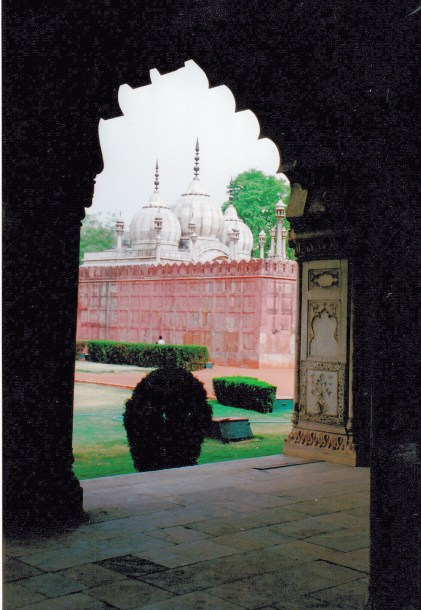
In this post, I mentioned that when I first visited India in 1989, at least, my first proper visit rather than simply passing through on the way to Nepal, I visited the Red Fort in Delhi, taking plenty of photographs, of course.

Some while later, at home, I was going through some of my father’s photographs, and discovered that I had taken a photograph of a view of the mosque in the Red Fort that was almost identical to one that he had.

img

Above: the one my father had. And, below: the one I took.

img_0001

Looking at the minaret in front of the dome closest to the viewer, it seems I took my photograph from the archway to the left of the one my father’s photograph is taken from, but otherwise we must have been standing in the same spot. My father would have been quite a bit younger at that time than I was when I visited the Red Fort, and the circumstances very different. But I’m sure that he felt the same sense of awe that I did.

Now there are mature trees behind the mosque, a couple of low hedges in front, and the creepers on the wall have gone.

Otherwise, the view is the same.

And because my father is no longer here, there is an extra poignancy to this; although our footsteps crossed and merged at this place, thousands of miles away, and we both must have lingered in this same spot and, who knows, possibly thought similar thoughts, the passage of time means in reality we might as well have been tens of millions of miles apart.

And this led me to look more closely at his other photographs.

There are not many, perhaps thirty or forty of them, but it is strange that when he was on leave in India, one time, he went with a few chums up to Nainital, and again there appear to be photos taken from spots where I have stood. The images are not the same, this time, but again our footsteps must have crossed.

I think the greatest regret I have about this, other than the obvious one that he is no longer alive, is that I cannot talk about these places with him. But just sharing them is good, even if it does make me feel sad.

4th February 2017

I was reading through my travel journal for 2005, yesterday.

IMG_0002

The Bodhi Tree at the Mahabodhi Temple, Bodhgaya

On 16th March I arrived at Bodhgaya, for my second visit to this lovely small town. Because I was going to be away from England for my eldest daughter’s birthday, she had asked me to write and send her a poem. I wrote this in the evening after visiting the Mahabodhi Temple, and after meeting with Indian friends I had not seen for a year, and thought it entirely suitable to dedicate to her and to send her.

There is a crazy wisdom here;

I am at the heart of all things Buddhist.

Good friends make life bearable.

Gentle people give me hope.

An unexpected friend gives me unlooked-for joy.

I am here,

This is the eye of the hurricane.

The still point in the centre of the universe.

My hope for the world,

My hope for you.

Unquenchable love.

I don’t write a great deal of poetry, because I don’t feel it is really my forte, but in the light of current events around the world, it seems worth posting here. I revised it a little before I sent it, but this was the original draft.

Sending everyone hopes and thoughts of friendship, peace and tolerance.


Three Weeks in Middle Earth

This is a re-post of something I put up not long after I had started this blog. Since I now find that I am read by many more people than I was then, I thought I’d revise it a little and bung it up again.

With grovelling apologies to J R R Tolkien…

***

Our holiday began with a couple of days home stay in Hobbiton, the only settlement of any note in the Shire. Unfortunately, this rather set the tone for the rest of the trip. Immediately, it proved impossible to pick up a mobile signal of any kind, a problem we were to encounter time and again throughout Middle Earth, which made trying to alter our travel arrangements extremely difficult.

img

Our host claimed that we had been given what he called ‘the best room in the house’. Hole, more like, in every sense. One could be forgiven for thinking that flush toilets had never been invented. Admittedly, it was pleasant in a rather rustic, bucolic sort of way, and the meals were everything that we could have wished for, but the beds were a nightmare – ours seemed to be made for a child, and Cheryl and I lost count of the number of times we banged our heads on the low door frames.

Then, looking for entertainment, we visited three of the bars in the village, all of which advertised themselves as gastropubs, and I’m afraid that each was full of tobacco smoke and were quite simply too noisy. Incidentally, it was in the third one that we visited, that this guy we spoke to slipped me some odd ring, and since then a whole lot of strange dudes seem to be following us around.

The courier seemed a little surprised at our complaints, the following day, claiming that for most tourists Hobbiton is one of the highlights of their holiday, but agreed that we should move on a day early, if he could not find better accommodation for us. As a result of this, we went on to Lothlorien, which could not have been a greater contrast. Two days there at least made us appreciate Hobbiton – where that had been rather rough and ready, noisy and dirty, Lothlorien was simply bland, boring and anodyne. Entertainment seemed to consist solely of rather highbrow concerts and book readings, restaurants were all rather expensive and uninteresting and we felt that we should be tip-toeing around the whole time, hardly daring to speak other than in whispers. At least, though, the oddballs that had been tailing us disappeared for the duration.

But forgive me if I say little of the journey from Hobbiton. Several days through a bleak, cold and windswept landscape, with nothing to see and no accommodation other than our tents. The last part was the worst part, though. We travelled through some ghastly, cold tunnel, where we felt threatened by attack from bandits at any moment, and all sorts of dreadful noises kept happening. It was simply awful, but the courier insisted that it was normal and quite safe. I will be putting in a strongly worded complaint about him after we return.

And the problems we then had at the border were simply unreal. It seemed at first that they were not going to let us into their wretched land. The ringleader appeared to be a particularly unpleasant and overweight, orange-haired elf who was waving his arms around in a strange fashion and shouting, with a horrible bright red face. ‘Were we Dwarves? Had we not just come from Moria, which was one of the restricted lands?’ Were it not that there happened to be a judge in our caravan, I don’t think they would have let us in. As it was, the red-haired elf muttered something about locking us all up and making Lothlorien great again and stared at us most aggressively until we were out of his sight.

However, I don’t want it to sound as though it has all been bad, and that we have done nothing but complain. Possibly the best part of the trip so far, certainly for Cheryl, was staying in the eco lodge in Rohan. She was delighted that we were so close to horses the whole time, and the lodges reminded her strongly of the yurt that she stayed in on a previous trip away. Our hosts were friendly and happy to indulge us in our whims – mine to sit outside the lodge at sundown with a glass or two of the local (admittedly rather rough) ale, and Cheryl’s to help with the mucking out in the stables.

Personally, I definitely preferred Gondor, a modern, forward-looking country with a booming economy. Although some border regions are still occasionally subject to unrest, the capital, Minas Tirith, is considered by the Foreign Office to be safe to visit, although I was less than impressed when our caravan was attacked by a lone Nazgul, which succeeded in killing two of the armed escort that the travel company had provided for us for this stretch of our journey. Our courier, however, assured us that this was an unusual occurrence and that all steps would be taken to ensure that there would be no repeat. It was after this, though, that they suggested we abandon the day trip to see the ruins at Osgiliath, which was rather a disappointment, and something that we had both been looking forward to.

It was equally disappointing to find that they absolutely refused to take us to Mordor. We met a number of folk in Gondor who assured us that it is completely safe to travel there now, and that visas could be easily obtained at the border crossings. So eventually we booked a couple of nights on a houseboat there, through one of them. We did do our research, and after speaking to several of these guys, we are happy that what we are paying is a reasonable sum. After all, it may not seem much to us, but it is a lot to people living in these third world places. This did entail us having to make our own way there, but it proved easy enough to book a place on a caravan leaving tomorrow morning, through a friend of the houseboat guy who we met in a nearby bar.

One great plus here, is that the authorities apparently consider it vitally important that a good signal is available for everyone, which is very welcome after a couple of weeks of mobile coverage that has been, at best, very patchy. I would have been in touch sooner, but that has proved impossible. One consequence of this is that it has taken us some twenty minutes or so just to update our profiles.

Ah, the guy on the front desk has just called to say that these caravan dudes are here to meet us. We are packed ready, and just need to slip away without being seen by the courier. We have left him a note. I’ll keep you updated what happens!

Darren

Sent from my iPhone, Minas Morgul.

Venice…a bit…

Call me arty. Call me something, anyway.

I’m in the middle of a ridiculously busy couple of weeks, so in place of one of my usual ‘witty’ and ‘well-argued’ posts, here are a small selection of pictures that I recently put up on my Picfair site.

I still don’t even have time to catch up with anyone else, but I will in a week or so. Honest!

041

Marionettes, masks and puppets in a shop window display.

185

Arches and columns reflected in floodwaters.

059

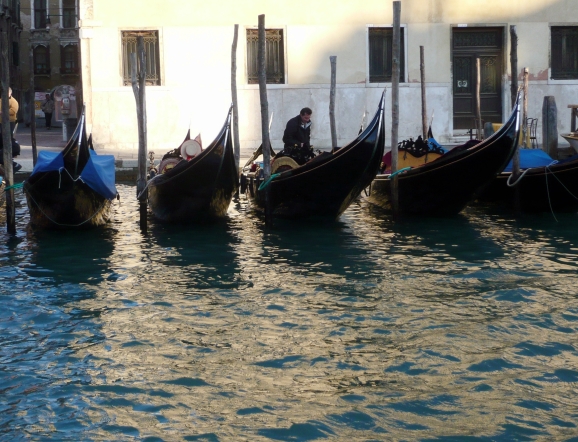
Gondolas. It’s Venice, there have to be gondolas.

154

Umbrellas. It’s raining. You get umbrellas.

166

Chairs in a rainy St Mark’s Square.

081

The Venetian version of a backstreet. Or backwater. Whatever.


Bodhgaya (2) – A Special Place

About six months ago, I put up a post on Bodhgaya (which you can find here if you wish to read it again), and promised I would find a few more photos to post another time.

This is another time.

img_0018

My first picture is of the entrance to the Mahabodhi Temple, which is built on the site where the Buddha achieved enlightenment. The first temple was built by Emperor Ashoka, in the third century BC, and the present one was erected in the fifth or sixth century AD. Visitors remove their shoes (or face a one hundred rupee fine) and descend the steps from the garden that surrounds the temple.

img_0020

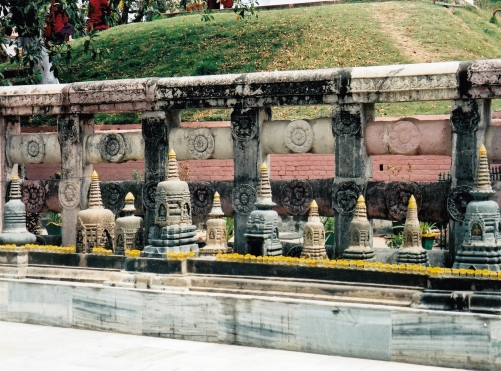
Just before reaching the entrance itself, they will pass this small chorten – one of dozens surrounding the temple – garlanded with marigolds.

img_0019

Many more chortens surround the temple and can be found around the gardens themselves, these ones beside a carved sandstone balustrade.

img_0024

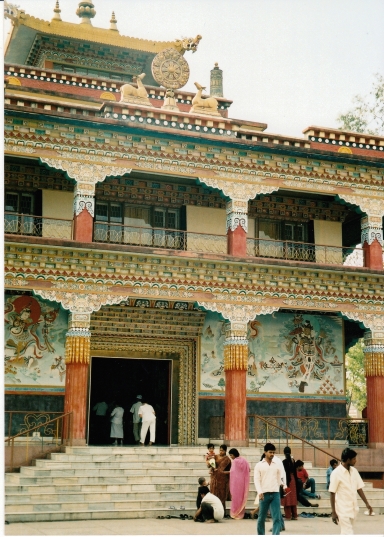
But the Mahabodhi Temple is by no means the only Buddhist temple in Bodhgaya. As the place where the Buddha attained enlightenment, it has naturally been the focus for many Buddhists from around the world, and there are many other temples built by those from the various different branches of Buddhism. This one is one of two Tibetan temples.

img_0017

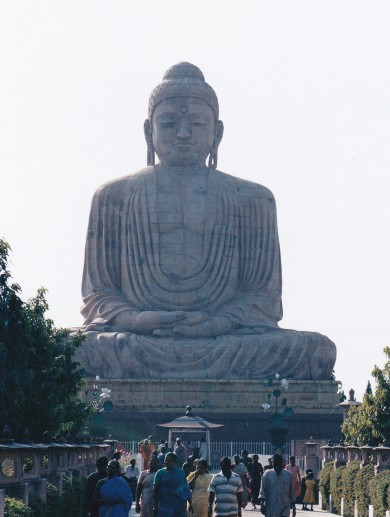
On the edge of Bodhgaya, this twenty five metre tall statue of the Buddha was erected in the grounds of the Japanese Daijokyo temple in 1989.

But Bodhgaya, naturally, is more than simply its temples. Although it is quite naturally a major tourist attraction, it is also home to many people, and daily life is not much different from other towns in Northern India.

img_0023

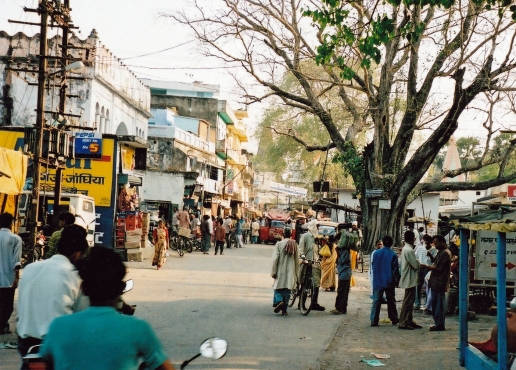
As you approach the temple areas from the northern side of the town, this is a fairly typical scene. In the distance, the share auto that plies between Bodhgaya and Gaya is filling up with passengers, and men and women shop for essentials.

img_0021

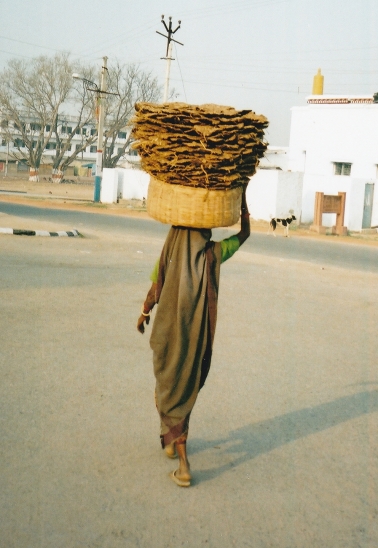
A woman carries a basket of dried cattle dung, which will be used to fuel the cooking fire.

img_0022

And on the edge of the town, the scene quickly becomes rural once again.

From Thursday I shall be away for a few days, but will catch up with comments and other blog posts once I am back.

Stereotypes and Misunderstandings

In countries such as India, there is frequently an impression that Western visitors and therefore, by extension, all Westerners, own vast wealth and have massive amounts of leisure time at their disposal.

After all, they arrive on holiday, perhaps for a month or more, and they go around staying in places that are far beyond the means of the average Indian, spend the equivalent of several month’s wages on souvenirs, often hop on an aircraft to take a journey that would be one hundredth of the price by rail, flaunting expensive cameras and watches and phones and designer clothes. So who wouldn’t think that?

011a

This is not helped by the impressions given by many Western films and programs, where work seldom seems to get in the way of whatever action the film is depicting.

This often affects how local people interact with visitors, and their feelings about them.

I suspect it even drives a certain amount of international migration, too.

And so I think it very important to highlight a few facts;

Basically, the differences in exchange rates of different currencies give the impression of great wealth which is not, in fact, true.

A few numbers:

The average annual wage in the UK is currently £28,000, or $34,400. This sounds a lot (even to me!) but that hides a huge variation, of course.

It is quite hard to find figures that agree about the average annual Indian wage, with estimates varying from around $600, up to around $3500, although this may well reflect the massive difference between the rural worker and a worker in, for example, the IT industry. For sake of argument, I’m going to use the figure of $2000, which could still be slightly on the high side, looking at some of the sites I’ve gone to.

This would give the average UK worker a wage 17 times higher than the Indian. Sounds good for us, but the average cost of a house in the UK is now some £300,000 – that’s $369,000, and it is now almost impossible for young people to buy their own house unless they are helped by well-off parents, and they have very well-paid jobs. The average rent, otherwise, is around $12,300 per year. About a third of the average wage.

To find an average cost to rent in India is also difficult (for me!). I scoured a lot of sites, and seemed to come up with a figure of somewhere around $1,200 a year, although there were massive variations, both between cities and within them. If I have got these figures correct, that is around a half of the average wage.

The prices of basic commodities such as foodstuffs or power vary a lot between India and UK, too. Whereas I have bought street food in India for a rupee or two, making a lunch for perhaps 15 or 20 cents, it would cost me at least $2.50 to $3 in UK for the equivalent.

This isn’t to draw up an accurate comparison between the two – it would be quite a study to do that – but to try to make the point that the average person in the UK is better off (materially) than the average person in India, but not by nearly as much as many might think.

India has more of a problem with poverty, but the West has quite a bit, too. And whilst the poor in the West are emphatically not as badly off as their cousins in India, they still endure considerable hardship. Even with the existence of the supposed safety net of Social Security. There is homelessness. There is malnourishment.

Incidentally, and I pose this as a question to my Indian friends, I frequently read articles that focus on aid and development in poor (especially rural) areas of India, highlighting the fact that a large percentage of the population have to survive on around two dollars a day.

In the light of the above, I wonder whether this isn’t a little disingenuous, since that figure may not be as far below the average wage as many in the West believe, and wonder what you think?

I think it matters, because I believe this might distract attention from where work is needed more, such as improving sanitation, work conditions and medical care.

A random bit of Delhi for the weekend

‘Once I leave, I am back out in noisy, smelly, confusing, squalid, hassling, bright Paharganj. When I first came here, it seemed very strange and exotic, had an unusual, exciting feel to it that was difficult to identify but was certainly the strange, unfamiliar sounds, smells, sights and feel of an unknown culture. Even the bits that were new, still seemed dirty and somehow old, as if something about them owed their existence to the distant, Indian past. This has gone and I miss it most keenly, since I keep getting a hint of it, floating unexpectedly on the breeze with sounds and smells that remind me of when I first came out here. This has been replaced, however, by something almost as precious…I feel completely at home.’ 13th November 2009
006 (2).JPG


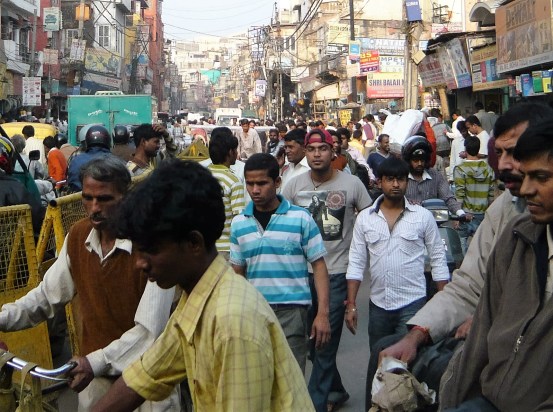
Crowds near the Ajmeri Gate, Old Delhi

010.JPG

Turkman gate, Old Delhi. One of the gates in the city walls at the time of the Indian Mutiny / 1st Indian War of Independence, it dates from the seventh city of Delhi, Shahjehanabad. More recently, in 1976, during the Emergency declared by Indira Gandhi’s government, it was the scene of another infamous episode, when crowds protesting about the bulldozing of their houses in an effort to clear slum areas and force them out of the city were fired upon by the police, killing several of them.

011a

Tenements near the Turkman Gate, Old Delhi


IMG_0023.jpg

Mihrab, or Arch, in a building in the Lodi Gardens, Delhi

delhi_gate

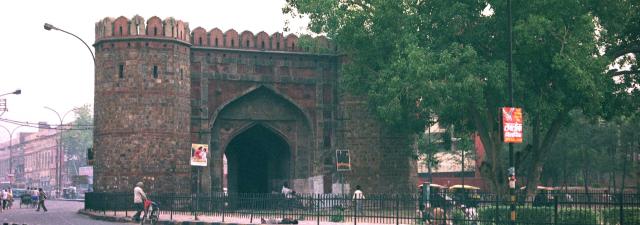
Delhi Gate, in the old city near Chandni Chowk. This photo was taken in 1989. When I passed the same gate in 2009, the traffic was a whole lot worse!

191.JPG

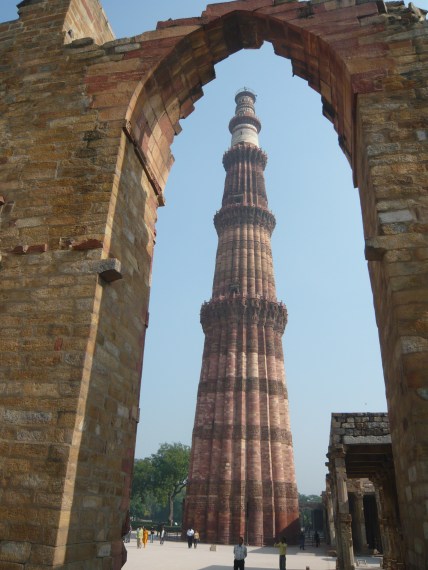
The great tower of Qutb Minar. The first of the Moslem invasions was by Muhammed, Sultan of Ghur in what is now Afghanistan, in 1192. Having overrun a large part of the Northern Indian plains, he returned to Ghur, leaving his new territory in the hands of his army commander and favourite slave, Qutbuddin Aibak. Qutbuddin decided to leave a monument to his religion that was designed to overawe his new subjects and inspire his own people, and set about building a mosque with a massive tower nearby. The tower itself is almost 73m high and is 15m in diameter at the base, tapering to 2.5m at the top.

183

Decorative details of the stonework. Most artistic decoration is, as usual with Islamic craftwork, patterned work and verses from the Koran. At Qutb Minar, there are also plentiful stylised, and sometimes surprisingly realistic, depictions of plants with flowers and buds and long, winding stems and tendrils. To construct the mosque, artisans used stone from Hindu and Jain temples and many stones and panels still depict the original carvings, frequently defaced but still recognisable.

178.JPG

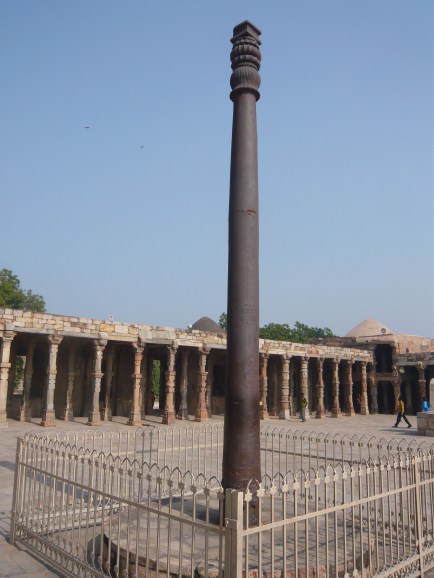
The famous ‘non-rusting’ iron pillar. This stands in the courtyard of the mosque and was here long before the mosque was built. It was made in the reign of Chandragupta II (AD 375-413), is composed of almost pure iron (99.72%) and shows only the slightest sign of rusting. A sanskrit inscription on the pillar indicates that it probably stood originally outside a Vishnu temple, possibly in Bihar, and was moved later to this site. It would probably have had a garuda, the vehicle of Vishna, on the top. 

207.JPG

Squinch-arch in Iltutmish’s Tomb. A squinch is a ‘bridging’ structure, used here to support a dome (now gone). Iltutmish was Shamsuddin Iltutmish (ruled 1211-1236), 3rd ruler of Delhi (after Qutbuddin and Aram).

175a

Brahminical motifs on the columns of the Quwwat-ul-Islam Mosque. These pillars were originally part of the Hindu and Jain temples that were razed in the area when Qutbuddin built his capital. It is chronicalled that 27 temples were destroyed. They would have been reassembled by Hindu craftsmen, Qutbuddin using local labour.


The Travel Bug Bit Me – part 3

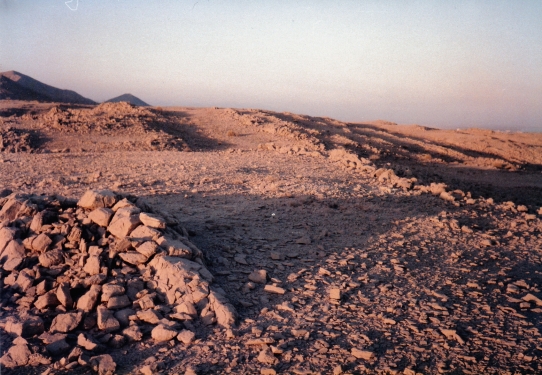
When I lived in Oman, the land around where I lived and worked was all stone desert; hills and valleys of razor sharp broken boulders, water worn stones at the bottom of dry valleys, with occasional villages and settlements and old, crumbling, mud brick forts dating from the time that the Portuguese were there. Almost invisible tracks used by goats and nomads wound their way through this wonderful landscape, or simply followed the routes of the wadis, the dry river valleys. I had a very small scale map of the country, as well as a few very large scale maps that I had pinched from the office where I worked (I did return them when I left). These would consist largely of huge areas of blank paper, with the occasional ‘tree’ or ‘large boulder’ helpfully marked, although they did show the main wadi courses and mountain ridges.

I was very tempted to write ‘here be dragons’ on them occasionally.

img_0001

Never before had I quite understood what silence was. And it was the first place (to be followed by the Himalaya) that I was to truly see a night sky. I was periodically astonished by the desert’s outbursts – blasts of hot wind like an opened oven door; flash floods that appeared from a blue sky in minutes, to ferociously drench the unfortunate climbers on the top of a previously baking jebel (hill); and tiny earthquakes and landslides – I was no doubt fortunate never to witness a serious one. I would overnight in the desert with friends and we would lie on our backs to watch the unbelievable night sky with its thousands of stars, satellites and shooting stars, before ascending a 10,000ft mountain in the morning, or exploring a stretch of uninhabited coastline.

I spent almost every spare hour that I had out in that desert, either trying to find my way across trackless ridges in my jeep, or just walking; walking everywhere within walking distance and discovering just how much there is actually to see in a desert. I was supremely happy in that environment, and some 20 years later when I had to change aircraft in Muscat, I found myself looking out at the purple tinted hazy mountain lines with something very close to homesickness.

Today, even waiting on the station to get a train to go to the next stop, a coffee in hand, a bag over my shoulder with a book in it, I am on a journey. And that journey feels clearly related to the longest journeys that I have ever taken. There can still be the same sense of travelling, of departing and arriving. The search for food and shelter… I think that it shows just how much a journey largely exists in the mind. Often our perceptions of a journey seem to differ from that journey’s reality (as many things do, I suppose). A long, difficult journey can seem to be over quicker than a short, easy one.

Just packing a rucksack, even an overnight bag when I used to have to occasionally stay over where I once worked – a wash bag and towel, sleeping bag and clothes – I feel as though I’m off on a journey. There is a certain amount of excitement…

And I know, too, how smell is such a strong, evocative, sense. Just with the kitchen window open, at 10pm on a slightly rainy October evening, I suddenly catch a scent of something – something cooking nearby, or a hint of smoke, perhaps – and I am instantly transported to Nepal, high in the mountains, remembering an evening with sherpas and villagers beside a river where we ate and then sat around talking and drinking and listening to those sherpas and villagers singing.

Okay, I’m ready to go and pack, now…