A rather nicer day today, although very cold. A day for double socks, a duvet jacket and hands thrust deep into pockets. The birds are into their winter silence, flitting low down between bushes and clumps of trees, although a blackbird does set up an aggrieved alarm call as I approach.
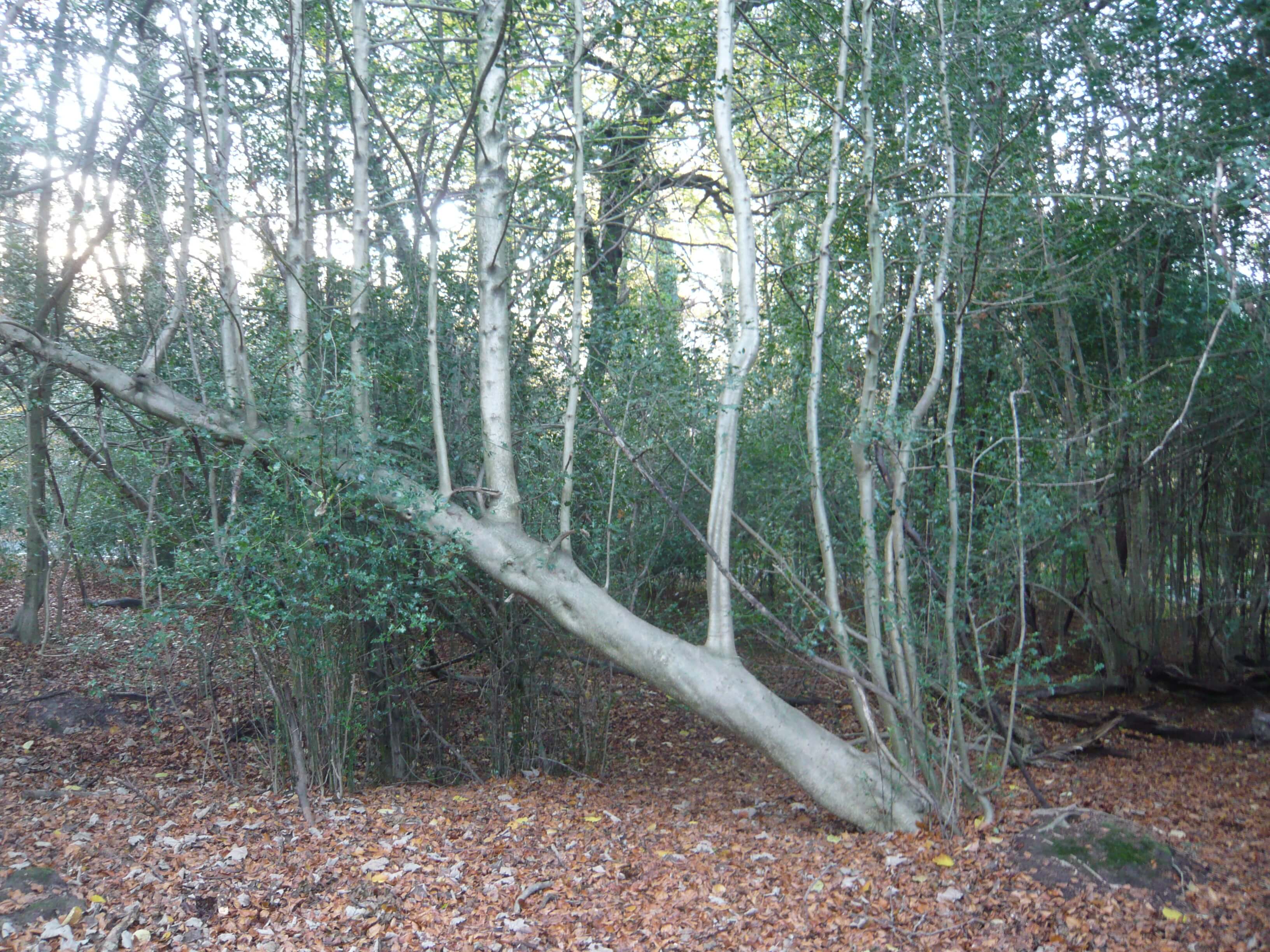
This holly tree keeled over some years ago, but life finds a way to hang in there. Now it throws out lateral branches that act like new trunks.
This holly nearby is laden with berries, which folklore claims is a sign of a harsh winter to come. It’s not, of course, it’s merely the result of the weather patterns we have had earlier this year. It may still be a harsh winter, but the berries are not a portent.
But it’s a very Novembery day, almost a Decembery day. The leaves have fallen and the sun is very low.
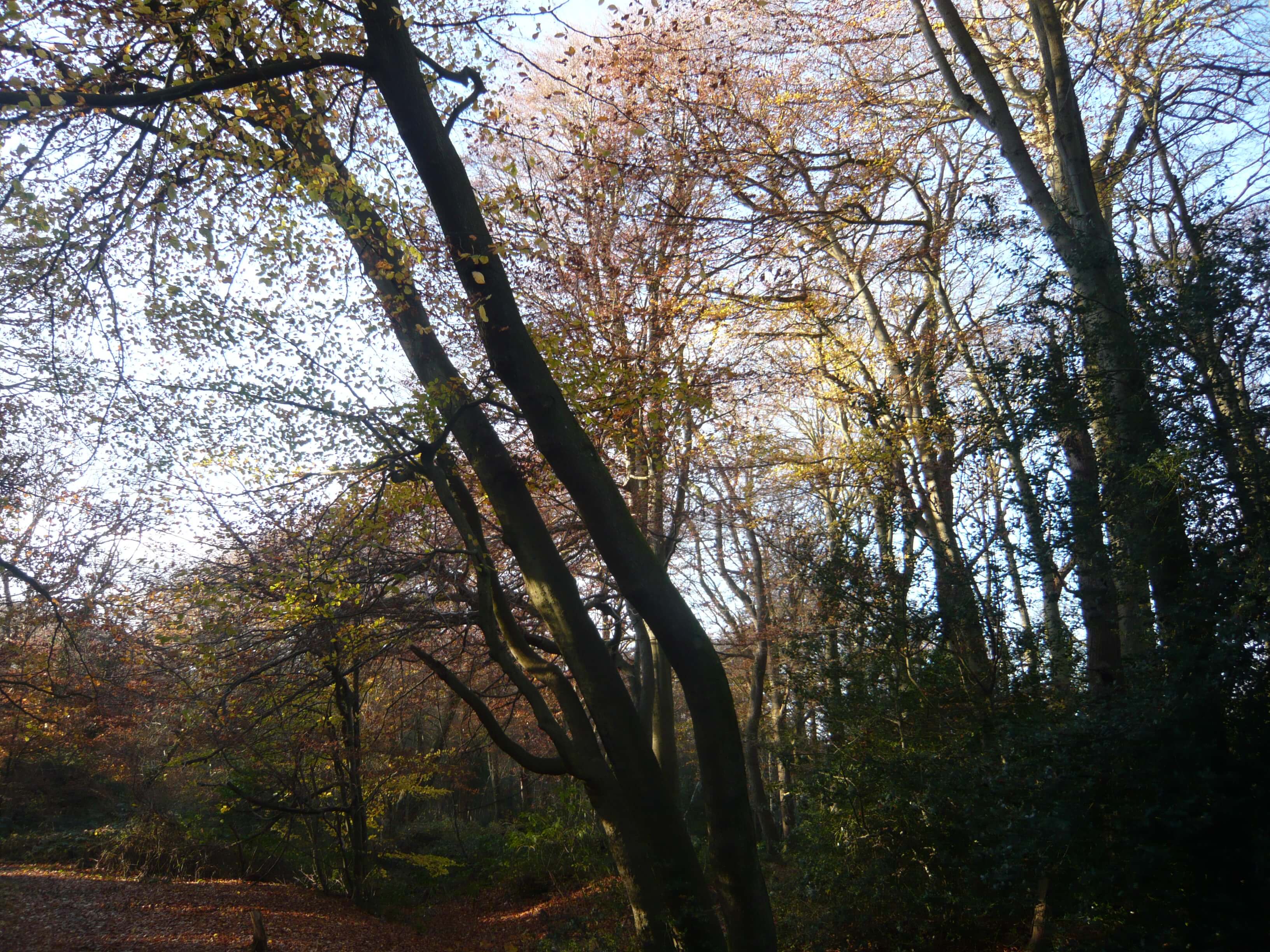
But where the sun strikes the trees the light is still glorious.
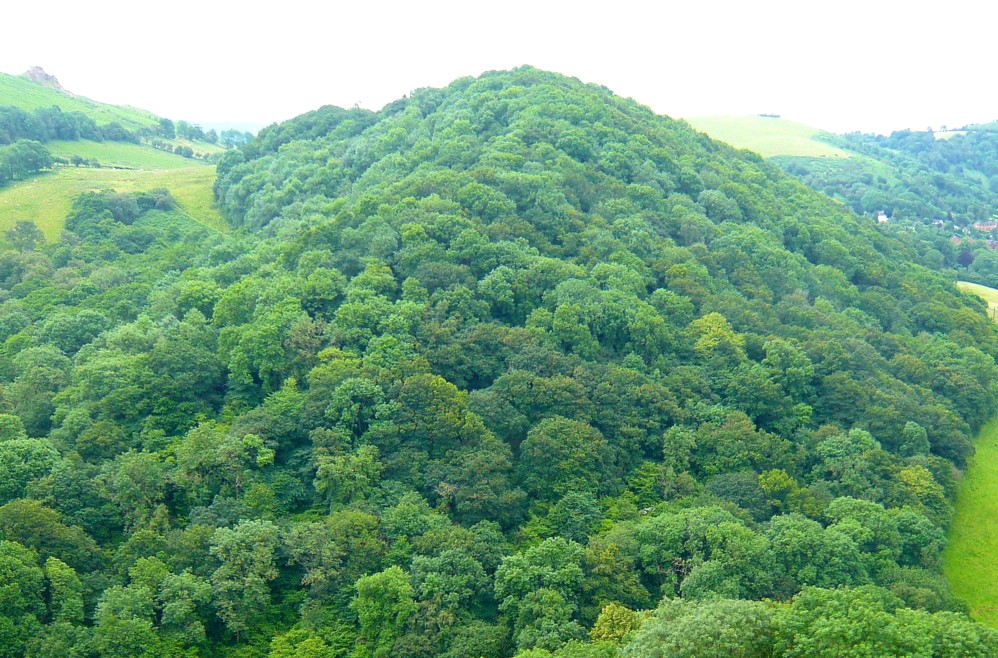
June is the Thick Month. Trees and bushes and stands of wildflowers have acquired a lush density by now, branches and stems encased in full-sized leaves, rich and vividly green. Leaves massed and packed in swaying light-blocking swathes. Nothing has yet faded, although there is a gradual falling away of birdsong now mating is over and broods are being raised, although this is compensated for by what seems to be an increase in insect noise, especially bee hum – certainly in our garden. The flowers are beset by mason, carder and bumblebees, and large numbers of solitary bees which provide a delightful oxymoron for this recorder, at least.
Going out and about through the woods a mile from my home, I feel I could almost be walking indoors, such is the density of the tree canopy above me, and when it begins to rain I do indeed remain dry, other than from the occasional drip finding its way through. But it is muddy underfoot in places, the sheltering swathes also keeping the sun from drying out the ground. The thick wet dark humus-rich soil smells sweet and clean, reminding me of a ‘plum-pudding smell,’ as Kenneth Grahame described the river-bank in The Wind in the Willows.
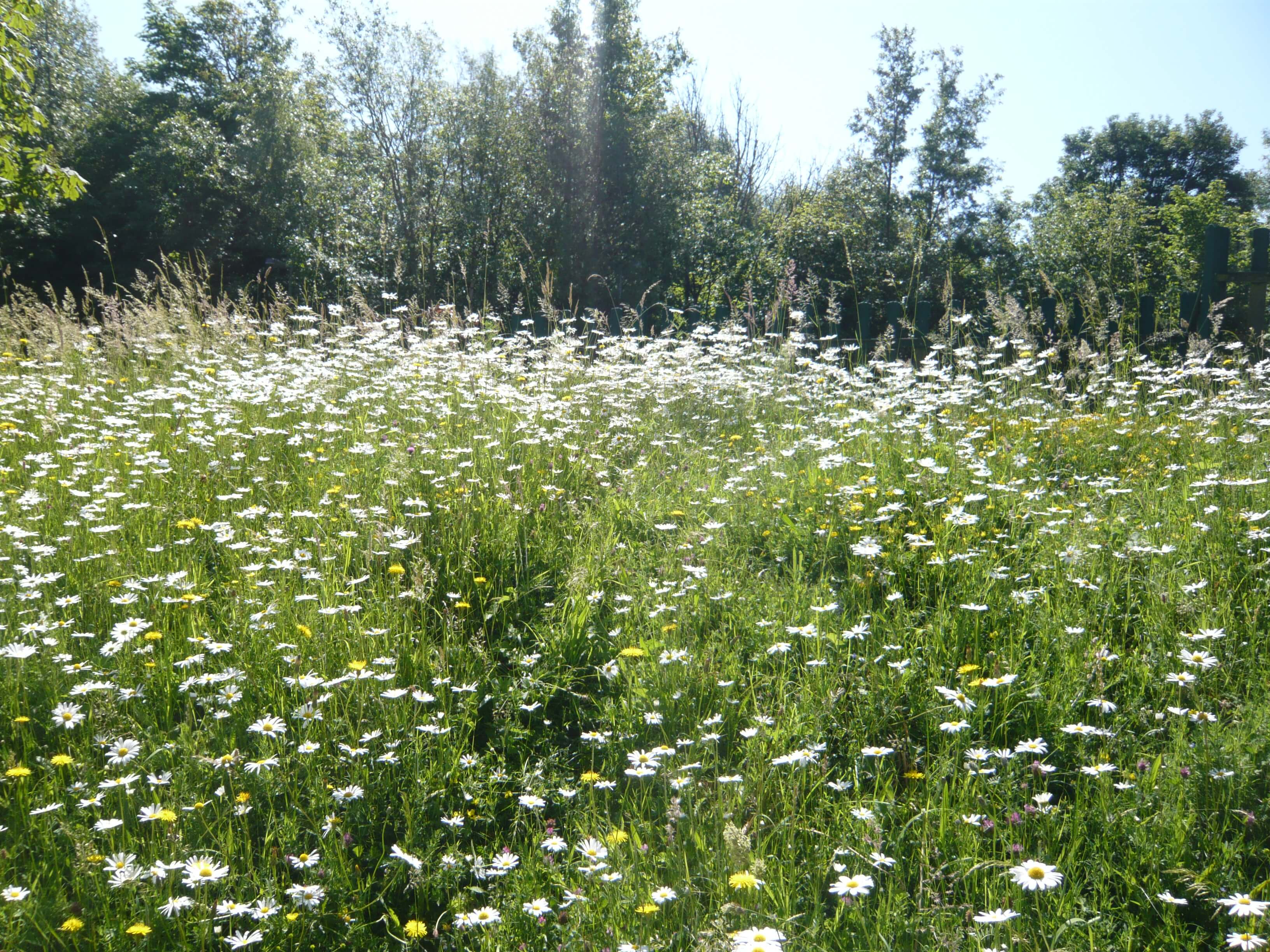
The fields, too, are thick with wildflowers and grass, as are roadside borders where councils have refrained from scalping them. As much as I rejoice to find the occasional rarer species amongst them, I think my greatest pleasure is just to see masses of the commoner species; buttercups or ox eye daisies, vetches or speedwells.
I generally see nothing rare when I am walking my patch, but I could never think of any of this as ‘ordinary’.
The second of my ‘Poem a Day’ poems. Just getting this far is a bit of an achievement, I suppose, although I’m not particularly happy with either the meter or the rhythm. It feels as sloppy as the day itself was. But I think it has potential if I do a bit of work on it sometime later.
Mud
Today, the sun has been sent into exile,
Leaving just a weary daylight.
It has gone, and we shall never see its like again.
I thought I would write a poem a day for a week or so. Here is yesterday’s. Of course, if this goes like most of my projects, I’ll probably give up tomorrow. We’ll see.
It’s beginning to feel both as though autumn has been with us forever, and that it is especially reluctant to leave us, this year.
This year has been a mast year; the trees and bushes have been laden with prodigious quantities of nuts and berries. The hawthorns, especially, seem to be weighed down with berries, and we have gathered large quantities of nuts from the hazel in our garden. There are so many acorns beneath the oaks nearby that there is a thick, continuous, crunchy, carpet of them underfoot. Traditionally, this has been said to indicate a harsh winter ahead, although how the trees and bushes are meant to work this out when we have no idea what the weather will be then, heaven only knows.
What it really indicates, of course, is that the climatic conditions have been such throughout the year that these trees and bushes have successfully produced their large crops. Nothing to do with what will come along later.
On the other hand, the leaves have held onto their greens for longer than usual and only turned late, and still seem most reluctant to fall. It has taken the determined efforts of a few strong winds just to remove about half of them. Certainly, around my part of Britain, anyway.
It is not cold. There are no signs of a proper winter chill approaching, with the long-range weather forecast contenting itself with predictions of the occasional cold spell in the next month, which takes us through to mid-December. In the garden the grass and many of our other plants are still engaged in that crazy autumn growth spurt.
Of course, it was never unusual for November to be wet and mild, and we may yet have a biting cold winter, although I wouldn’t bet on it. It is a long, long time since we have had a winter like that in these parts. In my lifetime, only the winters of 1963 and 1978/79 really stand out as being extremely harsh, although a few others have had shorter periods of cold and snow. The expectation for winter around here now is that it will just be chilly and wet. I think only once in the last six or seven years have we had more than just the odd flurry of snow; that was from the so-called ‘Beast from the East’ a couple of years ago, and even that only lasted a few days.
We seem to have lost winter somewhere along the way, which sounds very careless of us.
In fact, that is quite a good way of describing it.
You don’t need me to tell you we have been careless in the way we have interacted with nature, the result being our world is heating up dangerously. And in our part of the world, this has led to hotter, drier, summers and milder, wetter, winters. There has been a notable increase in destructive flooding events. Downpours are frequently very heavy and long-lasting. Rather than being spread out through the month, we may get an entire month’s worth of rain in less than a day. Summers, conversely, have become very dry.
This is absolutely nothing to the extreme climate conditions suffered by millions of others in other parts of the world, but it helps to bring it home to us that the Climate Emergency is real, and it is happening. With everything else happening in the world at the moment, this seems to have been conveniently ignored by the mainstream media for the last six months.
Inhospitable deserts. High mountain passes. Hills or moorland in thick, blanketing fog or sudden treacherous snowfall.
A situation in which I test my skills and resilience to the limit, aware of the consequences of a miscalculation or of taking my eye off the ball for too long. Certainly not a case of me fightingagainst the desert, or the mountain, because it’s not a battle. I have no need to ‘conquer’ anything, merely to respectfully request safe passage.
At the moment I have to accept second best, walking in woodlands near my home. At least there are fewer people around while it is raining, although those who are include a posse of shrieking children – honestly, where are the wolves and bears when you need them? Two hundred years ago in Britain children would either have avoided all but the lightest of woodland, or passed through as silently as possible. Although the bears and wolves were long gone by then, the children would have been raised on a diet of nursery stories that taught them the dangers of venturing into wild places, the remnants of very necessary advice from those earlier times when careless children frequently got eaten.
Happy days!
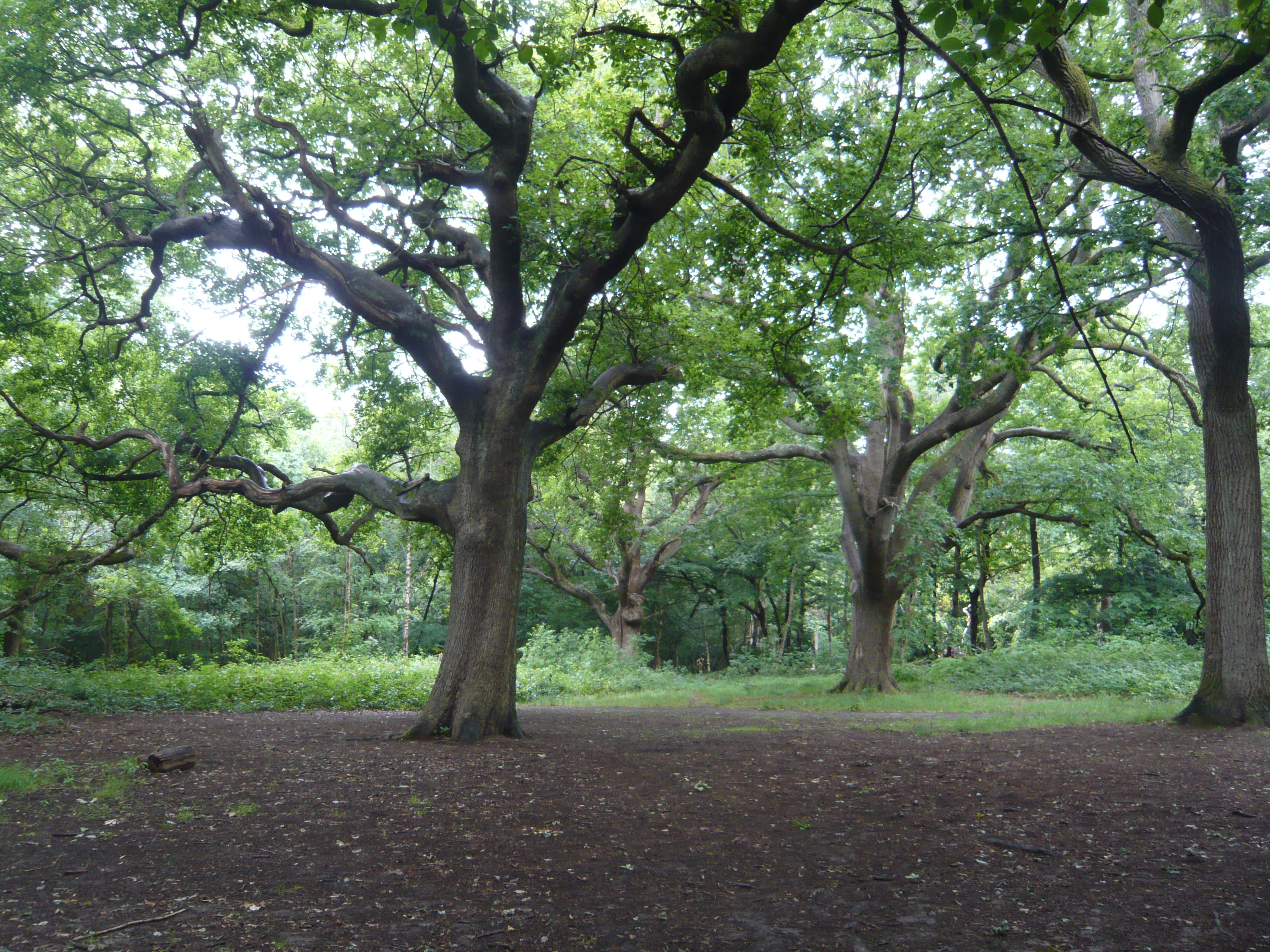
Don’t misunderstand me, I love these woodlands, and am very grateful I can get to them easily. Within them, for example, is this wonderful grove of oak trees. The oaks are not particularly old, probably around two hundred years I would imagine, but are stunningly beautiful. Some have branches thick with moss, all have wonderfully sculpted bark and all are home to huge numbers of creatures.
Already one or two have a limb dropping to the ground for extra stability. And the grove as an ecosystem within the wider woodland is perfect – each tree is around twenty five meters from its neighbours, which appears perfect when I look at the size of the canopy of each tree: its branches just about meet the branches of its neighbours, but there is no sense of their growth being restricted. I wonder whether this is chance, the result of long centuries of naturally evolving woodland – when one tree dies and eventually falls, that newly-opened space exploited by another seedling, or perhaps intelligent planting by a long-forgotten landowner?
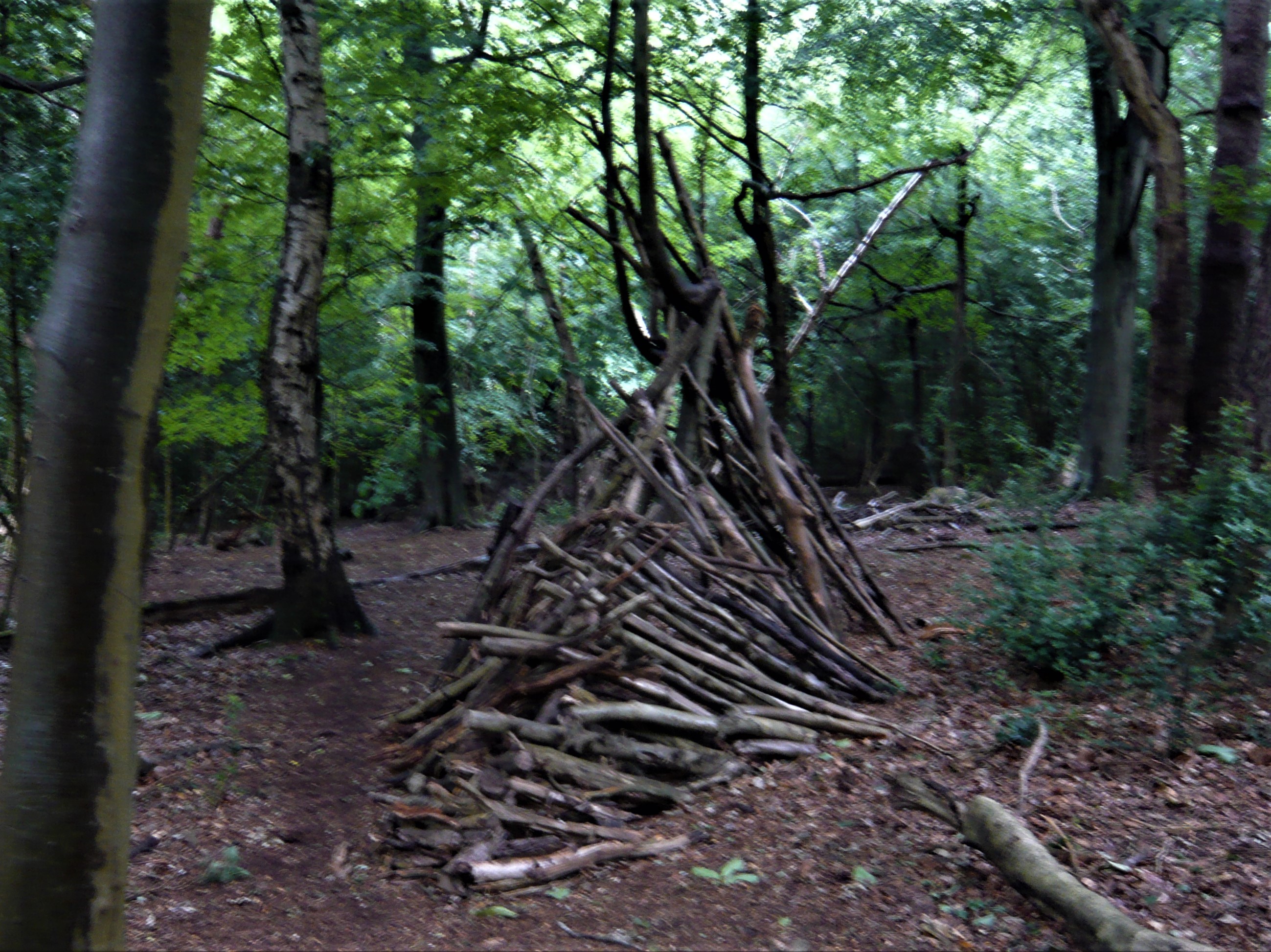
Where the woods are managed, especially the cutting in those areas where the holly is spreading in dense swathes crowding out all other growth, there are stacks of cut logs and branches exploited by children (shrieking or otherwise) to make dens. None of them would keep out the weather, but that’s not really their point. What I particularly like about them, other than it’s good to find children who want to play in this environment, rather than just sit in front of a screen, is most of these dens end up resembling the skeleton of some fantastic monster. And although that hardly turns these woods into a wilderness, it does give them just the faintest frisson of excitement, especially in the gloom.
And reminds me I want to be in the wilderness…
As is basic human nature, of course, the longer the restrictions (either imposed or of my own choosing) go on, the more I yearn for that wilderness.
I’m posting this poem again, as it rather illustrates what I’ve personally found particularly frustrating during the recent lockdown. We can go for longer walks now, it is true, but that’s still not the same.
If I could just wave a wand,
I would wander the world.
With my notebook in hand,
And a bag on my back.
I would sleep under hedges,
In hotels and haylofts.
Drink beers under trees,
And eat cheese on the moor.
I’d watch clouds over hilltops,
And boats on the ocean.
Shapes and shadows at sunset,
A moon with a view.
And I’d write trivial poems
Of snowfall and sunlight,
Birds singing at dawn
And the sounds of a stream.
There’s the lure of a skyline,
And skylarks above me,
Wine and woodsmoke my welcome,
At the end of the day.
To travel, to journey,
There’s magic in wandering
Over moorland and downland,
Through woods and through fields.
The world’s full of wonders
All waiting for wanderers.
Let me follow these paths
For as long as I can.
The poem can be found in my collection The Night Bus, which is available here. should your interest have been piqued by this…
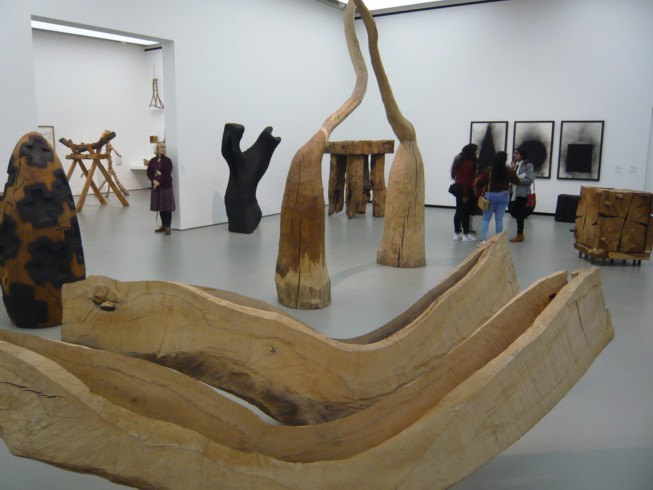
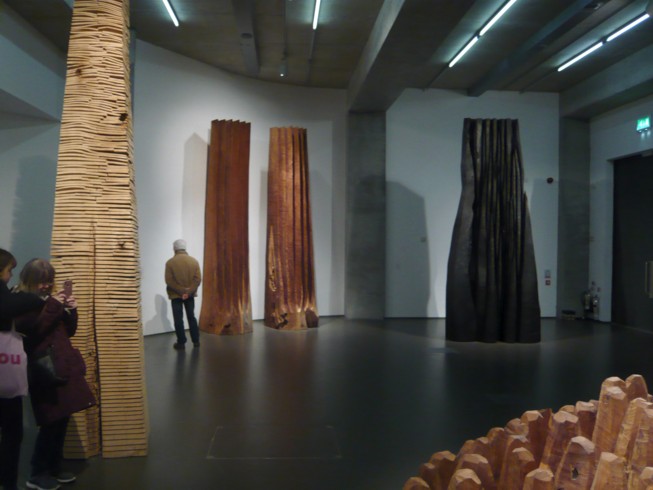
A few days ago we went to the Towner Gallery in Eastbourne, Sussex, specifically to see the Eric Ravilious paintings and prints on permanent exhibition there. There was also a large exhibition by the sculptor David Nash, who works with wood on a large scale. The fact that the whole exhibition, which also included a gallery of paintings, prints and a couple of small installations, and was intended to highlight the effects of the Climate Crisis, was the first one ever curated by Caroline Lucas M.P. of the Green Party was an added bonus for me.
As much as I enjoyed the Ravilious, I was blown away by Nash’s sculptures. To see wooden sculptures on that scale is unusual in itself – usually that would be the preserve of stone or metal – but that very scale plays tricks with the mind and the eye. Boxes and bowls many times larger than one would expect meet the eye as you walk around the galleries, and many of the pieces also deceive where perhaps one looks to be made from several separate pieces of wood, but on closer inspection are carved from a single block like the boat shapes in the top picture, or the ‘stack’ in the one below that.
Much of the work is left rough-hewn, but even this can be deceptive. Some pieces have been carefully finished to give that appearance.
Sculpture is the art form that seems to exist to interact with the natural world. A number of the works here are based on natural forms, but there are also stories of projects Nash has undertaken where his sculpture is either living, in the form of carefully planted and managed groves of trees, or interact in other ways.
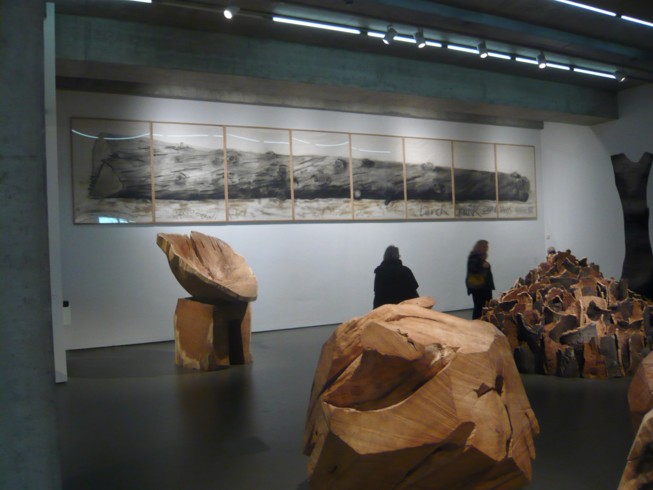
‘Boulder’ is one such project. One of the first large-scale pieces Nash made was to cut a boulder-shaped chunk from a tree (illustrated at the top of Nash’s charcoal drawing above) in 1978. This was then transported to a stream near to where he lives and works, in the Welsh hills, and rolled into the water. Since then, it has slowly made its way downstream until it reached the estuaries and inlets of the sea, where it finally disappeared in 2015. Nash documented its travels in a series of photographs and films made regularly all the while, and presented in the exhibition as a film.
Nash’s sketch of a Larch trunk
It feels as though there is something of this meeting of art and the natural world in old ruins overrun with scrub and grass. They frequently seem to have a sculptural quality that complements the landscape around them, in a way that more pristine buildings do not.
And I like the sense that an artwork, like a ruined building, is not permanent and that eventually the natural world will absorb it back into itself. That it will reclaim it. Perhaps the artist and the environmentalist in me merge here.
My own sculptures are in wood, and some of them are set out in our garden where they gradually degrade over the years through the action of sun and rain, until they appear strangely like some weird plants that have sprouted unexpectedly there.
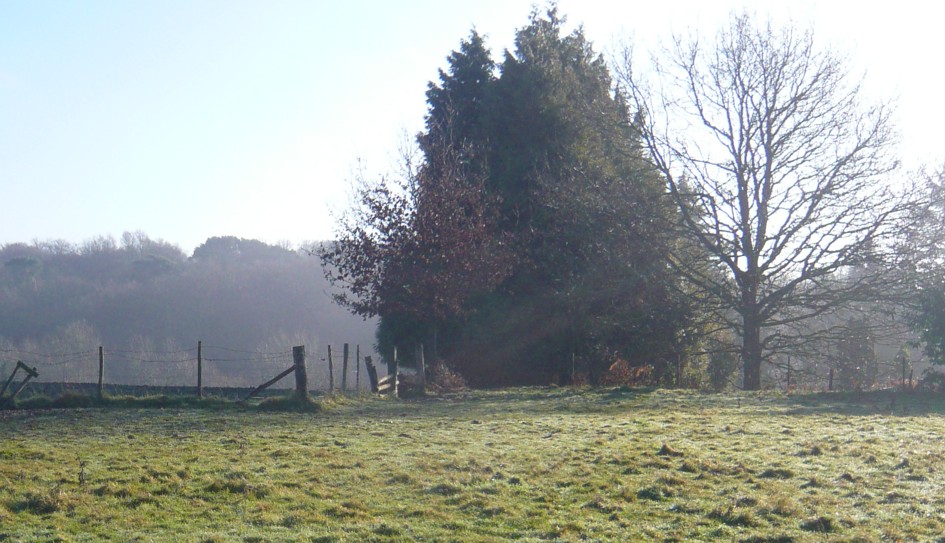
I went out for a walk in the morning as the overnight mist was lifting, and the air was cool but not cold, under a sunny, clear sky filled with birdsong. I felt a powerful sense of renewal in the world.
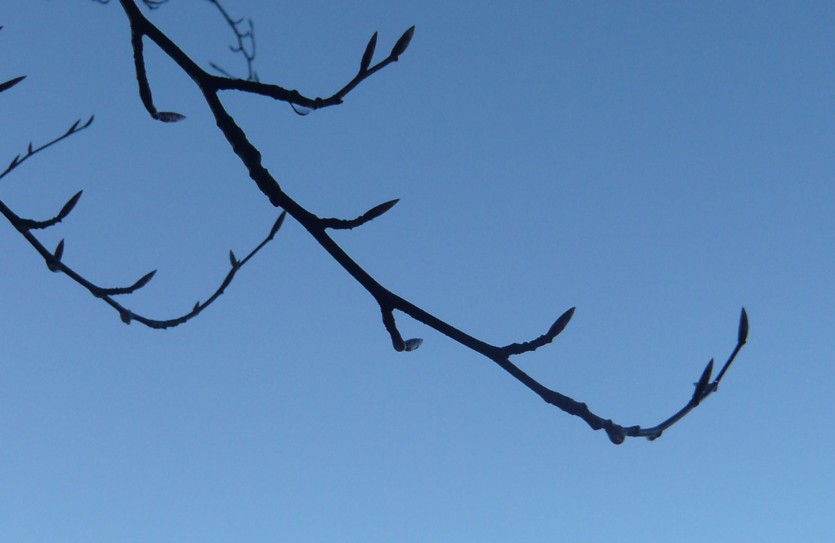
There is little new growth yet, but the trees were covered in buds. Although we are not long past the shortest day of the year, the ridiculously mild temperature and the sun which felt warm on my face, reminded me that there is one more minute of daylight today than there was yesterday, and tomorrow there will be one more than that. And it will not be long before each day gains an extra two minutes, then three, then four…
The air smelt clearer and cleaner than it had for months, and I felt like beginning a long journey. I yearned to be walking on the Downs, or heading through fields and woods with my destination nothing more elaborate than a bed in a basic bunkhouse or hostel, and somewhere to get a meal, preferably in a tiny village surrounded by hills and streams and woods. This is a feeling I get every Spring, that it is a time to explore more of the world.
Everything seems to be fresh. I need to do something new, something positive. To plant some trees, perhaps (always a good idea).
I thought of Christmas. This year, we had a string of lights in one room, with handfuls of greenery as the only other decorations. This, for me, is a way to make sense of the season. It has nothing to do with religion, unless it be the ancient religions that worshipped the sun and the moon and celebrated the turn of the year at the Winter Solstice when the seasons begin their long, slow journey back towards the promise of Spring and the harvests of Autumn. A simple wisdom, in tune with the natural world.
I do not, I cannot – I will not – associate it with any other form of mythical gods. For me, it is all about the natural cycle of the seasons, simple and uncomplicated.
And I particularly like the period when Christmas is definitely over, and we’re only just getting into the new year. Everything seems to have this feeling of renewal, which was the whole point of the Yule festival. A time to look forward and plan for the coming year. This will be where the tradition of New Year Resolutions comes from, no doubt.
This year, I shall resolve to try and simplify my life further, and to live more in tune with the natural world.
What we need are machines that remove the carbon dioxide from the atmosphere, cost nothing to produce, are made entirely from natural products available worldwide, produce no harmful waste materials, fit into the landscape harmoniously and also provide countless other benefits to us, wildlife and the environment.
We already have them.
They are called trees.
We need to plant them in their millions and to stop cutting down those we already have.













 Mick Canning