
‘Information’ Overload

I’ve had this post in mind for a while without actually getting around to writing any of it. But I felt it would fit in well here, following on from my last post.

We are supposedly better informed today than we were twenty, fifty, a hundred years ago. I’m not sure I agree, though. Certainly, there is no lack of information available, and access to it couldn’t be any easier. In fact whatever you want to know, you can find it online. Anything. Whether it be true or false, it’s there online. And because all this information is easily available, and because billions of people have access to the internet, it can be spread incredibly far and wide in a tiny amount of time. It is certainly not just AI that has led to this. The internet was full of misinformation long before AI was an issue.

I heard a few years ago that university students were forbidden to use Wikipedia as a source for essays and research. The people who add information to Wikipedia do not have to be any kind of expert. There is a certain amount of checking, but I don’t know how rigorous it is. Certainly, it is not unknown for mistakes and deliberate falsehoods to be added. This is why I have never used it as an information source. At best I have found what I might be looking for on there, but then gone to a reliable site to check it. For medical information, for example, I would use the UK’s NHS site. For historical information, I might use a top university website, or a large museum’s. A site where the information will have been uploaded by experts and specialists.

YouTube seems to be ridiculously popular with huge numbers of people as an information source. There are, of course, YouTube channels by very reputable people and institutions, but also a huge number of ones which exist solely to spread misinformation and total lies. And while it may be easy to tell some of the bad ones from the good, that still leaves large numbers that might or might not be reputable.

The same is true of social media. Countless sites run by Holocaust deniers, Nazi sympathisers, and every sort of conspiracy theorist from Flat Earthers to those who believe the world is run by paedophile alien lizard people. Again, while most of these are obviously what they are, many are less so.

Why so many sites spreading disinformation? The first reason is that there are many people who believe the crazy conspiracy theories. I’m not getting into the hows and whys of this, but the psychology is interesting. But the second reason is money. Many of these sites are monetised, so that the more clicks they get, the more views, the more money the site owner ‘earns’. Probably a feeling of power, too.

And to return to AI briefly, if anyone is in any doubt that it will make things up or provide misinformation, should you ask an AI program for examples of misinformation from an AI program, it will provide them. Whichever way you look at that, it is proof.

The advent of physical self-publishing, too, has contributed to this, albeit less seriously. The vast majority of self-published books are fiction, but who is there to check the accuracy of the supposedly factual ones?

As difficult as it is to separate fact from fiction now, how will it be in five, ten, or twenty years down the line? Or a hundred? We already treat historical records with a certain amount of suspicion, aware that many of them will be biased or fabricated. I suspect that generations to come will decide it is impossible to be certain of anything that happened in these times.

In a way, they will be the new Dark Ages.
A Justification of Theft

Clickbait? Perhaps, but I have a point to make.

There is a blog I follow which regularly posts about good people. People who make a difference to their world. Kindness. They change lives. And it makes for a refreshing read in a world which often appears to be so full of shit we could be drowning in the stuff. I also see now on social media – at least on Facebook, which is the only one I follow other than Instagram – AI generated posts on good people. I know they’re AI generated, because the signs are all there. I don’t intend to list the signs, as most people are aware of them already. These AI generated posts seem to fall into the same few categories. There is the rough biker with the heart of gold adopting a defenceless little girl. The retiree who’s lost his wife and finds meaning in life through spreading love through his community. There’re one or two others, but they all seem to fall into a few predictable categories. And you read these long tear-jerkers and reach the end and you go ‘Ah, isn’t that lovely.’ Or you’re meant to, anyway. But they are AI generated, the people don’t exist (although the original ones may have been based on real people), and these things did not really happen. But does this matter?

I think it does, for several reasons. AI invents stuff. If this is not the intention of the user, these are known as ‘AI Hallucinations’. If it can’t find what it’s been asked to find, it will sometimes make something up instead. Equally, it may draw data from untrustworthy sources. Then there are AI programs which are designed to make up stuff. If we understand that, then when we read something we understand is AI generated, we don’t necessarily believe it. And since we don’t believe the characters or the narrative, then the message it is designed to deliver is rejected. We all know that kindness is a good thing, but being told that by a computer program that has clearly fabricated the vehicle of delivery diminishes the message.

It is the exact opposite of ‘Don’t shoot the messenger’, because in this case the message is rejected because the messenger is flawed.

And the more we read these posts, knowing they are AI generated but if we’re still happy to take them completely at face value, the more we help to normalise the things. The more we accept AI into our lives and accept these fabrications.

So there are more than one type of AI program. Many of those that are really good at inventing stuff, and there are quite a few, are designed specifically to write books. They advertise themselves as producing books ‘in minutes, not months’. A few clicks on the button and hey presto! I’ve written a book! I’ll get back to this at some point, but are these people authors? No. They’re not. They’re frauds. But this brings me back to those original posts, which someone has created using an AI program similar to the book writer programs to deliberately invent the contents.

And to the more important point, the point where both the hallucinations, but even more importantly the deliberately fabricated material, really matter.

AI is, as we’ve seen, designed to invent stuff. Okay, that’s a simplification, but the point is that it’s designed to give the user exactly what they ask for. If someone requests it to write a piece justifying theft, or infanticide, for example, (not to ask it if it can be justified, but telling it to actually do so) it will do that, citing either nasty stuff it’s dug up from some remote hole on the internet, or, more likely, completely inventing stuff because the real justifications don’t exist. And it will look reasonably believable, perhaps writing something along the lines of ‘the Cornel University experiments of 1983 – 1984 by Taylor and Whickham et al demonstrate that…’ etc etc. And the casual reader will think ‘oh, I never realised that. So perhaps there’s something in it after all.’ But these citations will be made up.

And to go slightly off topic for a moment, there are the illustrations. AI generated photos are still usually recognisable as such, but they’re getting much better. Ones that have been subtly manipulated are now very hard to detect. The implications there should be obvious, can we now believe anything we see or are told?

This is not to suggest AI is an unmitigated evil. Its champions will point out advances in, for example, medicine and material sciences, which are very real and extremely important. But the issues of misinformation and, as frequently cited, intellectual property theft, to say nothing of the potential to completely destroy careers in the literary and artistic worlds, are also very real.

So how do we fight this? I’m afraid I’ve no idea. The genie is out of the bottle and I see no way it’s going back in again. Other than burning down the internet we are stuck with it and over the next year or so (or less – who knows?) it’s going to get harder and harder to tell truth from complete (and possibly dangerous) crap. While the programs are becoming better at presenting the genuine data they are requested to present, the ones inventing stuff are getting better at making this appear real. All we can do is be aware of this, be cautious and critical. And perhaps we could go back to getting our facts from books which, although not infallible, are far more likely to be accurate. Publishers are still the gatekeepers there, and they tend to do a pretty good job. Research stuff properly. Rather than accepting important medical information, for example, from Joe Bloggs on Facebook, look it up on a respectable site, like the NHS (in UK).

Maybe just stay off the internet more.

Which is probably a good idea anyway.

Excerpts From The Book of Meh

From Chapter one:

In the beginning there was lots of very dark darkness and very cold cold stuff, which wasn’t at all nice and although no one existed yet, they were all really miserable.

And Meh, the god of this world, thought ‘Well, this isn’t much fun’ and so He created the universe, with the Milky Way above and the Place of Torment below. And the Milky Way is a beauteous place of flowing streams of milk and cream and comfortable sofas beside cosy fires, while the Place of Torment is a cold and frozen place of hard floors and empty food bowls. And that was the first day, and a jolly good first day’s work it was too.

On the second day, Meh created the earth by vomiting up a giant hairball, and then sat back as life rapidly evolved without any further input from Meh, which was how He liked it, so He could curl up and take a little nap…

From Chapter three:

‘And thou shalt make images of Meh, and cause them to be distributed, yeah, all over the internet and into the world even unto the furthest corners. There shall be infinitely more of these images than those of dogs, for I, Meh, am a jealous god.

‘And be it known my chosen ones, whom I love and have created in my own image, shall be afforded a privileged place in thine homes, otherwise I shall visit plagues upon thy households, yeah, even unto the seventh generation of thy accursed species.

‘But those who treat my beloved offspring well shall have their eternal reward, most especially in the Milky Way, while those who mistreat them shall be condemned to be pounced upon and bitten for all eternity, and great will be the wailing and gnashing of teeth.’

From Chapter seven:

And know that this is the truth, for it is written herein and thou shalt believe it for it is the word of Meh.

It is told there was a Man of Meh, and he came unto the land of Babylon to preach to the people there tolerance and goodwill to all those that walk upon four legs and are furry and purr when pleased, yet the people received him with hostility and drove him out into the desert.

And thus Meh said ‘Lo, I shall send plagues to irritate and annoy these godless people until they learn the error of their ways.’ There was first, then, a plague of fleas, which certainly irritated them, although it was insufficient to cause them to mend their ways. So Meh then turned the milk sour, and this annoyed the people, but they still denied Meh and said ‘We don’t want to listen to some preacher spouting a load of old bollox’ and so Meh then caused all the fish in the fish market to be a bit off, and not really smell all that good. And the people said ‘Oh, leave it out. We’ll make our own rules and laws.’

So Meh did withdraw from the world, and he did sulk a goodly while.

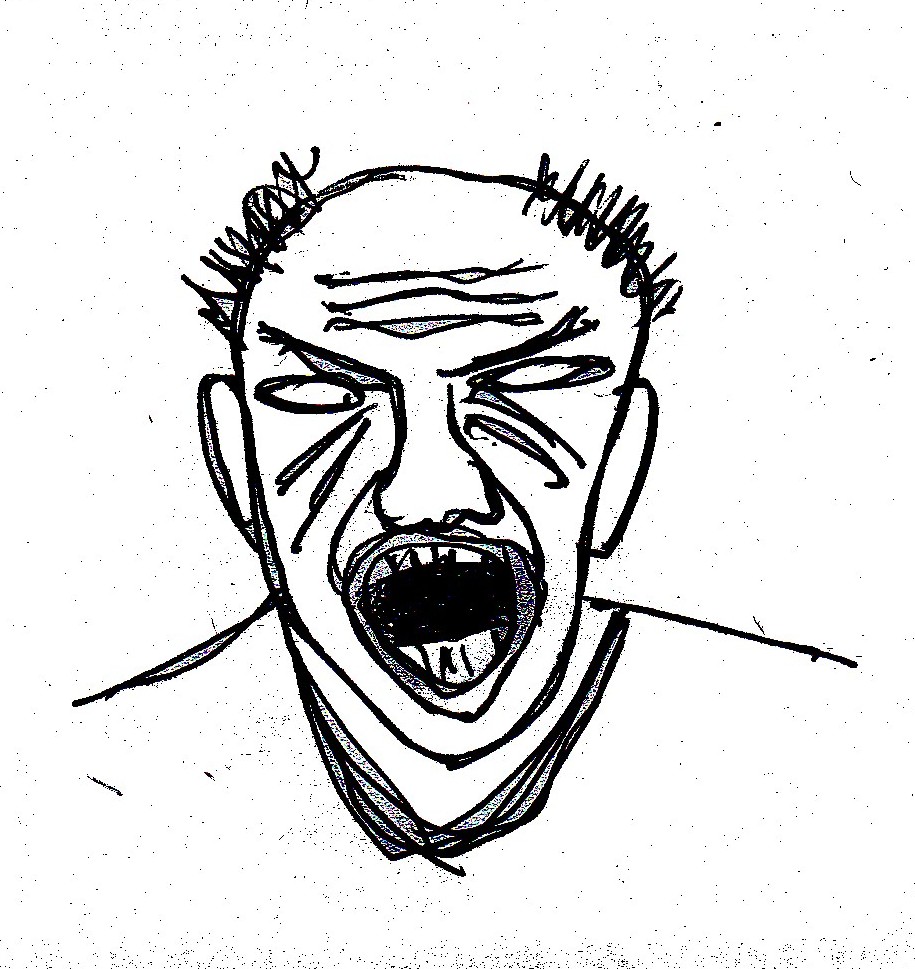
How to Swear

Strangely, I was inspired to write this post after my virtual trip to Nepal with Bob, although ever since the unfortunate and divisive events in the US and the UK, I have been inundated with a request from my follower to produce this guide.

This guide, then, is intended for those who find themselves in situations of such extreme frustration that a safety valve needs to be opened before anything useful and practical can be done about the problem. Or, indeed, before a physical injury is sustained unnecessarily.

I feel your pain, I truly do.

And so I humbly offer you, the reader, this handy cut-out-and-keep Guide to Swearing.

Swearing loyalty, swearing allegiance to something, swearing to tell the truth…that’s not what this is about, even though it’s a related subject.

No, this is about swearing!

IMG_0003

The swearing we might indulge in when someone or something irritates us beyond simply acknowledging that fact.

The swearing we might indulge in to demonstrate to others, or even just ourselves, how remarkably annoyed by that situation or person we are.

Something along the lines of ‘Blistering barnacles!’ for readers of a certain age. Or the mutterings of Mutley in ‘Wacky Races’ for other readers of a certain age. I’m afraid these cultural references will be lost on some…you’ll just have to swear at me for using them.

Firstly, and most importantly, one should choose the correct moment. I would not advocate swearing at any random time, for it is unlikely to have the desired restorative effect and, indeed, leaves the unwary user merely looking like a pillock.

Examples of bad moments might be during a marriage proposal, or an important meeting with your boss.

Whereas an example of a good moment might be, for the English cricket supporter, the following. Let us say that after losing an early wicket, in comes number 3, a contentious choice in any case, given his recent form, and promptly gives away his wicket with an ill-advised and airy shot to the first ball he faces. That would be an excellent time.

I used to find that a really good occasion would sometimes arise when I worked night shifts. Being awoken in the middle of the day, when I had just managed to get to sleep, by an insistent caller at the front door who demanded to know whether I had invited Jesus into my life, invariably worked.

A little bit of research might be helpful, here. Since you are unlikely to be the only person indulging in a bit of swearing (unless you live in a convent, or somesuch…and maybe not even then), you could stand out from the crowd by using some of the less-commonly heard swearwords. You might derive a certain amount of satisfaction, for example, by comparing your unfeeling relative to the intimate parts of a mammal, but how much more interesting for both spectators and participants to employ some rarely heard Viking term for the feeling one gets when an unusually cold gust of wind catches one unexpectedly just as one begins to perform on the privy?

That’s class, that is.

A few key words:

Adjectives. A careful use of adjectives will enable the Swearer to not only modify and enhance the power and meaning of the chosen epithets, but also, with a certain amount of skill, extend the outburst for up to a minute without the need to introduce a new noun, keeping those in reserve in case a second assault is required.

Breathing. Remember to breathe while swearing. Running out of breath suggests that not only have you not given due thought to the composition of your swear, but, worse still, perhaps have also lost control of the entire situation.

Cursing. Now, this is another thing entirely, and outside the remit of this post. Rather than simple (or complex) swearing, cursing implies the actual placing of a curse upon another person, with the aim of causing them injury, sickness or death. I shall deal with this more fully in my up-coming post ‘Getting Promotion at Work and Dealing With Troublesome In-laws’. There are those who hold that the two are interchangeable (cursing and swearing, I mean, not promotion and troublesome in-laws), and that the person who, in a moment of great stress and deep personal antipathy shouts something along the lines of ‘Trip over a nasty lump in the ground and hurt yourself, you frightfully horrid person!‘ is merely swearing, yet all they are doing is actually attempting to curse the recipient, albeit in an amateur and rather un-thought out way, and then tacking onto the end something that is technically a mere insult, which should only be used in other, carefully defined, situations (see ‘Using insults in carefully defined situations‘).

Happy ****ing swearing.