Review of Shadowlands by Matthew Green

In this book Matthew Green charts the decline and eventual abandonment of eight British settlements; a diverse selection ranging from the Stone Age settlement of Skara Brae in the Orkneys, through several Medieval villages and cities and up to the twentieth century, to an area emptied of its inhabitants during the Second World War and a village that was abandoned when the valley it inhabited was flooded to create a reservoir – although in that case ‘abandoned’ is the wrong word, since that particular story is a harrowing tale of folk driven from their homes at the diktat of decision makers far away, not even of their own country.

In each chapter he tells the story of the decline of the settlement drawing upon written records for all but the oldest, Skara Brae, for which he relies upon archaeological evidence, and some of the more recent, for which he uses a mixture of eye-witness accounts and the testimonies of those who had heard their stories at first hand. Of all the stories here, that of Dunwich is probably the most famous, with its myths of bells from long-drowned churches being heard far out under the waves, although the popular description of Dunwich as a ‘drowned city’ is inaccurate, as it fell away into the sea as the cliffs beneath it were eroded away. But much is known of Dunwich, with many extant records and maps of the city, enabling Matthew to chart its decline and eventual end in some detail.

Hirta is the biggest island of the St Kilda archipelago and was occupied for at least two thousand years until 1930, when the final thirty six islanders voted to leave. By then, most of the families and younger residents had left for the mainland, and their traditional way of life had become unsustainable. Until a couple of hundred years ago the islanders were virtually cut off from the rest of Scotland, due to the distance and the difficulty of making a landing at the island. Existing almost exclusively on a diet of seabirds (remarkably, they were apparently lousy fishermen!), the islanders lived a remarkably difficult life and it is no surprise that as they were exposed more and more to the outside world, more and more of the islanders opted to leave for a better life.

I found I was drawn deep into these stories not just because I found them so fascinating, but also because of Matthew’s skilful and easy style. A very well researched and beautifully presented book, I’d definitely give it five stars out of five.

The Compleat Trespasser by John Bainbridge

This time, the review without any distracting rants. Probably.

51pfb0Ihk8L._AC_UY218_

Sub-titled Journeys into Forbidden Britain, it immediately sets out its agenda: it is both a potted history of how the land was stolen from the inhabitants of Britain, and the long struggles to regain access to much of it, with numerous anecdotes of the author’s own escapades trespassing.

The story of how the inhabitants of Britain came to lose their access to the majority of the land is a story that has been repeated throughout most of Europe and beyond. Land forcibly taken by invading armies and distributed partly to their soldiers, but mainly their officials or nobility. Land enclosed by lords and kings for hunting purposes, burning villages and evicting their inhabitants from the land. Land taken by acts of Parliament to further enrich the gentry. Land given by kings to the established church, so that peasants might labour only to feed the rich and corrupt clergy.

Land that has been kept private and jealously guarded both by strict and cruel laws, and by equally cruel methods by the landowners themselves. Thus laws that deemed the starving and dispossessed villager might be executed for taking a rabbit from land he once lived on, to feed his family. Thus the mantrap that would cut a mans leg off. Thus countless thousands beaten and sometimes killed by gamekeepers and owners.

When I attempted to review this a week ago, it ended up turning into a full-blown rant against grouse moors (I do rants so well, these days!), but even today it is not just grouse moors that are fenced off just so the idle rich can enjoy slaughtering wildlife – there is plenty of woodland and more open land enclosed around the country and dedicated to pheasant shooting, for example. There are country houses with huge estates. Land taken by the MOD for training purposes, and never returned. There are many landowners determined to block access to legal rights of way. Although the Countryside Rights of Way act of 2000 was supposed to restore access to most of the countryside, there is still much that is off-limits.

Yet there are good landowners, too. The tales of John’s own trespassing include several encounters with sympathetic landowners happy to see walkers on their land, with the obvious proviso that they cause no damage.

The improved access rights we do have today were earned the hard way. Since Victorian times there have been mass trespasses intended to both bring the issue into the public forum, and to try to force change. The Kinder Trespass of 1932 is probably the most famous, yet many preceded that. It is thanks to the countless trespassers and campaigners of those days that we have improved access rights today.

The book finishes, though, with a plea. Firstly to campaign for further land reform, for better access rights – rights that are enjoyed in Scotland, but not England, Wales or Ireland. And secondly with a warning – the current government campaigned at the last election on a promise to criminalise trespass, so that anyone who deliberately or inadvertently strays from a public footpath onto private land might find themselves on a charge in a criminal court.

Anyone who enjoys the countryside in any form, enjoys spending time there, and walking in it, should read this book. It provides a very good, clear, account of where we are, how we got here, and what has been done to get us someplace better.

But also that we still have some way to go.

David Nash and Impermanence

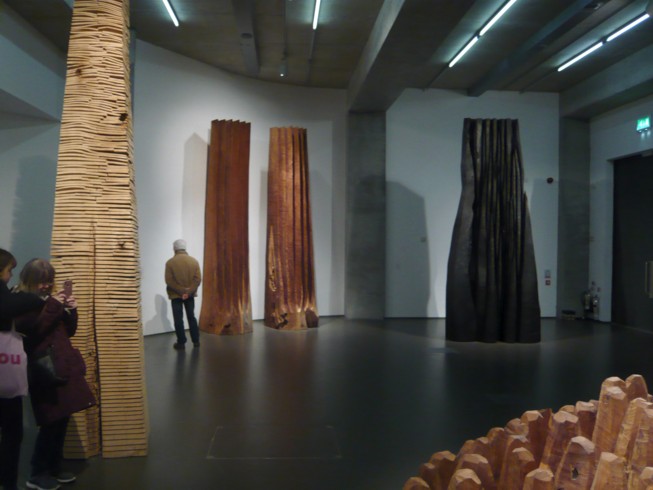
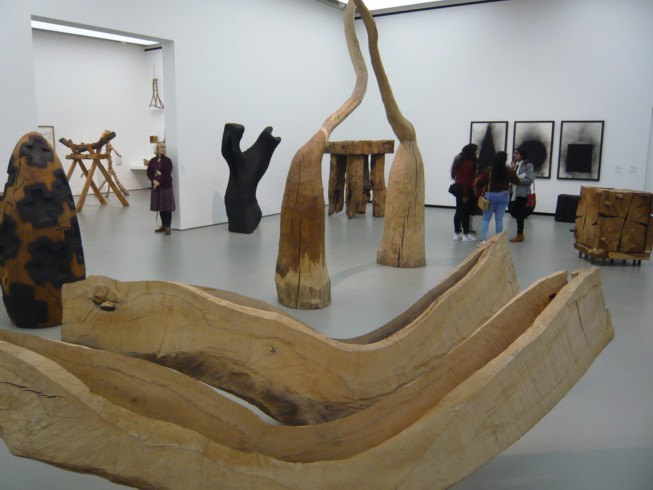
A few days ago we went to the Towner Gallery in Eastbourne, Sussex, specifically to see the Eric Ravilious paintings and prints on permanent exhibition there. There was also a large exhibition by the sculptor David Nash, who works with wood on a large scale. The fact that the whole exhibition, which also included a gallery of paintings, prints and a couple of small installations, and was intended to highlight the effects of the Climate Crisis, was the first one ever curated by Caroline Lucas M.P. of the Green Party was an added bonus for me.

007a


002a

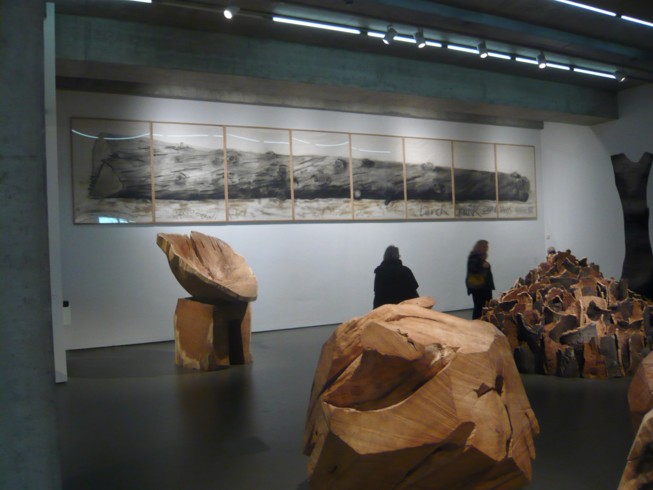
As much as I enjoyed the Ravilious, I was blown away by Nash’s sculptures. To see wooden sculptures on that scale is unusual in itself – usually that would be the preserve of stone or metal – but that very scale plays tricks with the mind and the eye. Boxes and bowls many times larger than one would expect meet the eye as you walk around the galleries, and many of the pieces also deceive where perhaps one looks to be made from several separate pieces of wood, but on closer inspection are carved from a single block like the boat shapes in the top picture, or the ‘stack’ in the one below that.

Much of the work is left rough-hewn, but even this can be deceptive. Some pieces have been carefully finished to give that appearance.

Sculpture is the art form that seems to exist to interact with the natural world. A number of the works here are based on natural forms, but there are also stories of projects Nash has undertaken where his sculpture is either living, in the form of carefully planted and managed groves of trees, or interact in other ways.

004a

‘Boulder’ is one such project. One of the first large-scale pieces Nash made was to cut a boulder-shaped chunk from a tree (illustrated at the top of Nash’s charcoal drawing above) in 1978. This was then transported to a stream near to where he lives and works, in the Welsh hills, and rolled into the water. Since then, it has slowly made its way downstream until it reached the estuaries and inlets of the sea, where it finally disappeared in 2015. Nash documented its travels in a series of photographs and films made regularly all the while, and presented in the exhibition as a film.

006a


003a


003b

Nash’s sketch of a Larch trunk

It feels as though there is something of this meeting of art and the natural world in old ruins overrun with scrub and grass. They frequently seem to have a sculptural quality that complements the landscape around them, in a way that more pristine buildings do not.

And I like the sense that an artwork, like a ruined building, is not permanent and that eventually the natural world will absorb it back into itself. That it will reclaim it. Perhaps the artist and the environmentalist in me merge here.

My own sculptures are in wood, and some of them are set out in our garden where they gradually degrade over the years through the action of sun and rain, until they appear strangely like some weird plants that have sprouted unexpectedly there.

The Sussex Downs Murder – Not Really A Review

24958623

For anyone who loves the English South Downs – and whodunnits – this book makes an interesting read.

On the one hand, it is a fairly average 1930’s detective murder mystery, although I have certainly read much worse, but on the other it provides some marvellous insights into the South Downs in the area specifically around Chanctonbury Ring in that time, which is really what took my interest.

Personally, I prefer murder mysteries involving ‘normal’ people, rather than the typical country house full of assorted Colonels and ladies and royalty and such-like, so popular at the time – other than the thought of bumping off the Upper Classes, of course! But this book delivers in that it is set on a downland farm, where the farmer goes missing, believed murdered. It even has, as a cover, an adaptation of one of the fabulous Leslie Carr railway posters of the 1930’s – what’s not to like?

The introduction mentions its ‘sense of place’, and the writing seems to me especially good at conveying an accurate feel of the landscape. One thing that comes over very strongly is the emptiness of the countryside at that time. The Downs have been sparsely inhabited since Roman times; before then, much of the population chose to live on the higher, drier, lands of the chalklands of South and South East England, away from the forested and frequently marshy lower areas where travel was difficult and clearance very hard work. After the arrival of the Romans, however, all this changed, and since then the chalklands have been left largely to a small population living mainly by farming sheep.

We now have many people visiting for leisure purposes and on fine days popular routes such as the walk to Birling Gap from Eastbourne (or from convenient car parks much closer!) may easily see hundreds of visitors striding along the footpaths and hanging off the edge of the cliffs taking selfies (other stupid ways to kill oneself are available). On the same day, though, nearby footpaths may see no visitors at all. It is still a sparsely populated area.

John Bude evokes this sense of emptiness well. His descriptions of the roads and paths on and around the area really allow the reader to feel this. His characters walk the lanes and roads of the downs frequently without meeting anyone else on their journeys. Farms and houses are ‘isolated’, and even at a time when most people would travel by public transport to cover any distance, the population is so small that when questioned by the detective on the case, a bus conductor can remember who was on his bus several weeks before.

There are four lime kilns near Washington, on the edge of the area described in the story, which I suspect were the inspiration for the lime kiln featured on the farm in the book. No spoilers, but you might well guess their relevance to a murder mystery.

But it is the descriptions of the roads and paths that particularly take my interest, roads and paths virtually empty of footfall or traffic even during the day, emphasising how lightly populated the area was, and still is today, to a degree. Other than popular footpaths such as the long distance South Downs Way, and those footpaths running between popular tourist spots, it is still easy to find solitude in this quiet area of the otherwise heavily populated South East England.

Review of The Old Weird Albion

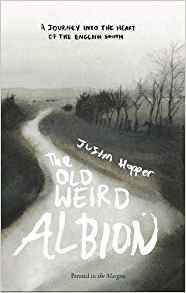
The Old Weird Albion, by Justin Hopper.

download

The viewer sees a painting that appears to be composed of watercolour and charcoal, of a winding road or track, possibly even a river, leading towards a line of downland hills, the whole created entirely in black and shades of grey, with the title and author scrawled into the picture in brilliant white, as though it were a prehistoric figure etched into the Downs themselves.

And that’s just the cover.

This is a book quite unlike any I have read before, in that it is a book about the south of England, especially the South Downs of Sussex, but it is far more than geography and the associated disciplines such as geology and biology, rural history and architecture, and folklore. Psycho-geography was not a term I had come across before, but there is an aptness to it that becomes apparent as you read.

The book opens at Beachy Head, a beautiful piece of Sussex with a dark reputation for suicide, as a woman throws herself off the edge. Quickly, we learn that this woman was the first wife of the grandfather of the author, Justin Hopper. And we learn that this book is in part a chronicle of his efforts to discover this person and learn something of her life and, consequently, her motives for such an act.

In so doing, he needs to revisit parts of his earlier time in Sussex and examine his own relationship to the area as well as the relationship of other players, not just his grandfather and other members of their family.

He has a gift for sifting and selecting the weird in these relationships, not just at sites that might be naturally expected to encourage the weird, such as Chanctonbury Ring, high on the Downs above Steyning or in old ruined buildings, but also in humdrum blocks of flats in modern developments. He references modern phenomena like crop circles and throughout there is the presence of ‘magic’, in the sense of a natural force. Many of the people he meets are an eccentric mix of the weird, too, although I choose this description carefully, largely in the old, original meaning of the word of ‘fate’ or ‘destiny’.

A strength of this book is its intensity, and I feel impelled to look at the pictures it references and read the books it quotes. So much so that upon finishing the book, I spent some time tracking down an old copy of one of those books, which I am now reading, and which holds my interest in just the way Justin implied it would.

On a personal level, this book came just at the right time for me, in that I am reacquainting myself with the geography and history, and the plants and animals, of the South of England, where I grew up and which formed my love of the natural world, and the book has encouraged me to look at this in a new way.

It is most certainly a five star book for me.

Strolling in Sussex (1)

Yesterday, I went for a bit of a walk. The oppressive humidity of the previous day had lessened, fortunately, and it was an overcast morning with a cool breeze.

Just the way I like it.

I decided to take the train a few stops down the line, where I could get out at one of those stations that bears the name of a village a mile or so away but stands on its own in the middle of the countryside. The nearest building (other than the station itself) is a farm. Hopefully I could have a day’s gentle walking with nothing more demanding around me than birds, insects, trees and wildflowers.

I really, really, needed to do that.

It seemed a good start at the station. A good omen. While waiting for my train to draw in, my eye was drawn to a single large, white, bindweed flower in the tangle of brambles and vines and bushes, trees and garden plants escaped and gone native that serves as a barrier behind the platform.

Most gardeners hate bindweed. I suppose we do, really. Once it gets into the garden it grows at a ridiculously rapid rate and strangles any other plants in its way. And even pulling it up doesn’t get rid of it. It just regenerates. I tell you, come the end of days it will just be scorpions, cockroaches and bindweed left.

But this flower looked lovely. The largest, pure white, bindweed flowers often remind me of the calla lily, only a calla lily that is not so…let’s say…excited. One of my favourite artists is Georgia O’Keeffe. I’ve probably told you that before. But O’Keeffe was particularly known for painting large flower paintings, many of them more than a little ‘suggestive’. And the calla lily was one of her favourites. I’d show you one of hers but, you know, copyright and all that. I’ll leave you to look it up if you wish to.

040a

So, here’s the bindweed flower.

Anyway, I got on my train and later I got off at the correct station and began walking along the footpath and got shouted at by some sheep.

Really, there’s no other way to describe it. On one side of the footpath were a couple of dozen sheep in a field where the grass had been cropped very short and there seemed to be very little left for them to eat. As soon as they saw me, they came rushing over to the fence bleating loudly. Obviously demanding to be re-housed in the field on the other side of the footpath.

In that field, thick lush grass was being munched by a couple of dozen quite contented sheep. I didn’t hear a (Bo) peep out of them.

‘Really sorry,’ I told them. ‘I can’t help you.’ I walked on feeling oddly guilty.

But I got over it.


023a

For the rest of the morning I walked slowly through fields and along lanes, stopping frequently to look at flowers and insects and, really, just enjoying being where I was.

021a

011a

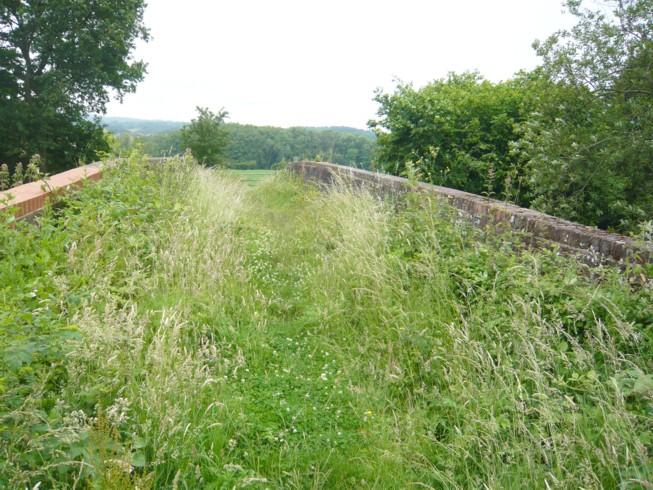
Bridge over the railway

016a

024a

010a

I was just beginning to think it must be lunchtime when my path took me through a field of long grass.

This field lay between a stream I had just crossed, and a wood where I was heading. The wood stood a little higher than the surrounding fields, and the long grass of the field I was to cross was thick and green. The breeze caught the top of the grass, so it waved like the sea or a large lake and as I began to wade through it, it really did feel as though I waded through water.

027a

And there was the drag of the grass against my legs, and the top of the grass sparkled a little in the breeze, just as wavelets would. And there was also the sense that I was not quite sure what I might suddenly step upon. Just to complete the illusion, there were also some lovely blue damselflies darting around.

Then I finally stepped ashore at the edge of the wood, walked up a slight sandy slope that might have been a beach, and sat down to eat my sandwich.

Now, I have to tell you that this was the best sandwich in the world, and I won’t brook any disagreement. Thick wholemeal bread, cheese, several large slices of raw onion, and several thick slices of tomato. Perhaps it was my mood, and the setting, but it was damned good.

And then it was time to explore the wood.

The Weald of Kent and Sussex

South East England is my area. It is where I was raised and, other than a few years spent abroad, it is where I have lived my whole life. In particular, the Weald and the Downs. Not so much the coastline, which has never particularly attracted me, but the hills and valleys, the woodlands and rabbits, the hidden crags and open downland, the land of streams and foxes and badgers, birds and villages and butterflies.

039a

On the Sussex Downs

There is a curious fact about the wooded areas of South east England, which is that there is more woodland, covering a greater area now, than was the case four hundred years ago.

032a

Back then, South East England was the industrial heartland of Britain. This was before the discovery of the coal seams of the North and the Midlands, and the various factors which would eventually lead to the greatest impact of the Industrial revolution being in those areas.  Instead, the modest iron deposits of the Weald were mined and worked into firedogs and nails, cannon and cooking pans, as the wealth of words such as hammer and forge in place names still bear witness.


037b

Huge numbers of trees were cut down to feed the fires of these forges, and huge numbers also for charcoal burning, for building, and near the coast the great Kent and Sussex oaks were in huge demand to build the large number of ships the navy demanded. But then from the mid eighteenth century onwards, industry began to shift northwards.

Despite the pressures on the land for building and for farming in this crowded corner of our crowded island, there is actually more woodland now than there was during the fifteenth and sixteenth centuries. And that is not something that can be said of many parts of Britain or, I suspect, many parts of the world at all.

010a

The Weald is an area whose underlying rocks are sandstone and clay, which means that the unimproved soils are inevitably either light and sandy or thick and claggy. In some parts there are old sunken tracks known as ‘Summer Roads’, so-called because they became impassable in the winter months, when they might have had a foot or more of thick, wet, muddy, clay on their surface. When these were in use, journeys between villages that might take an hour or two in summer, could became almost impossibly long during the winter.

037x

At the moment, all everything in the news seems depressing and unpleasant and so, this post is an indulgence. Just a smattering of information, and a few photos of places I love, largely to improve my mood.

Those Old Paths

We seem to be in the middle of a spell of warm, sunny weather. It seems Spring really has arrived, although things could always change quickly, of course. But it’s the sort of weather that tempts me out to go walking as much as I can. We are extremely fortunate in the UK to have such a wonderful network of footpaths, open to the public.

042a

Dartmoor footpath

Many of the ancient tracks are still just that; just trackways that have never been turned into roads over the years. Often, this is due to their locations in the landscapes they traverse. Neolithic or Bronze Age man lived in a landscape that frequently comprised dense, almost impenetrable, forest, with networks of streams meandering through marshy lowlands, and wherever possible they would utilise the higher ground to move around, and hence we have long-distance footpaths today still following these same routes such as the Ridgeway, while modern roads tend to utilise the lower, flatter land where possible. Walking these Old Ways (and it is impossible to even mention them without referencing Robert Macfarlane’s wonderful book, The Old Ways!) always gives me goosebumps, as I feel I’m following in the steps of these prehistoric travellers.

And yes, we are lucky. Not only do we have so many of these paths, but we have the right to walk them whenever we please. But this has not always been the case. Up until comparatively recently, huge areas of the British countryside were owned by the landed gentry who denied the public any access. In 1932, the first mass trespass by five hundred men and women at Kinder Scout, in the Peak District, led to the imprisonment of five of the trespassers but this led to a second, three weeks later at nearby Castleton, involving ten thousand trespassers.

This growing movement, demanding the right to roam, led eventually to the creation of the first of the national parks in 1951, and to the Countryside Right Of Way act in 2000. So today it is possible to walk plentiful footpaths pretty well anywhere in the country, thanks to this incredibly successful movement of direct action.

My header picture at the very top of the page, incidentally, is a view of the Peak District looking towards Kinder Scout.

And it’s another gorgeous day today, so we’re off for a walk to make the most of it. I’ll catch up with everyone later.

A Walk And Other Things

It was bitterly cold but sunny first thing yesterday morning, but after a couple of hours the air had warmed up enough to tempt me out. I was due a walk anyway, having not even left the house the previous day.

Every year there is a point somewhere around the middle of February when I feel the warmth of the sun for the first time that year, but yesterday morning there was already a hint of that.

It wasn’t cold enough to freeze the ground, except in a few particularly exposed places, and so it was very muddy underfoot. Therefore it was a delight to occasionally walk through drifts of last years leaves.

And there was so much birdsong. So much so that it became a background noise that was easy to filter out after a while, except when a particularly loud or unusual song caught my attention. Not that I do that deliberately, since birdsong is one of the delights of the countryside. At some point or another when I’m out, I can usually hear the rooks, but maybe because of the sun and the noise from the other birds they seemed to be silent. I’ve always associated them with cloudy skies for some reason, perhaps because I’m so used to hearing them on moorland and in the hills and mountains.

But I’m sure they like a sunny day every bit as much as the next bird.

This morning is cloudy again and the rooks are back. Outside I hear crark crark crark, and the occasional cronk. There is rain and sleet forecast for later, so I go into town in the morning. By the time I get home, the sky is already full of dark clouds and threatening to drop some weather soon.

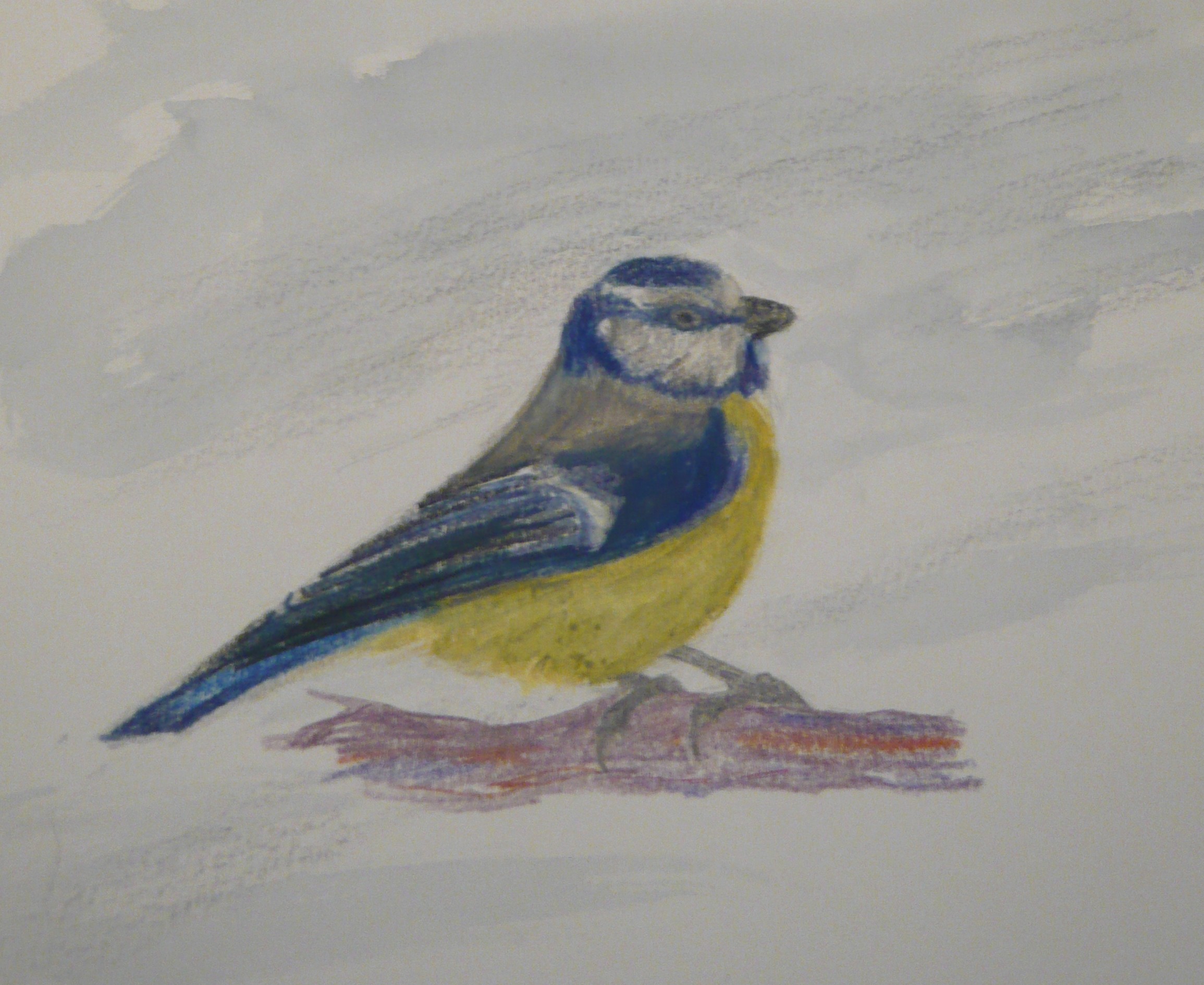
The afternoon, then. I partly spent painting this little fellow:

035

The blue tit is one of the few British birds whose population seems to be increasing slightly at the moment, in contrast to most whose populations have fallen – sometimes dramatically – over the last few years. We seem to be losing lots of the birds I took for granted as a child, which is such a sad thing. As a race, we seem to be so damned good at exterminating other creatures.

Sojourn on Dartmoor

I’ve been on Dartmoor. My goodness, it was nice to get away.

016a

Dartmoor is frequently misty and moody, as it was on one walk.

021a

Yet it can often be fine and sunny. But whichever it is, I always think of it as unfailingly beautiful.

049a

The sheep get everywhere, including on the top of old spoil heaps from derelict mine workings.

036a

Hooten Wheals is one such disused mine, with a plethora of remnants of old buildings and machine structures still extant. I believe the circular structures are the remains of buddles, circular shallow settling tanks used to extract the minerals from the rock.

056a

There are also plentiful remains of farms, houses and all sorts of settlements, from prehistoric times through to the recent past. These buildings at Swincombe are probably not particularly old.

052a

Old stone crosses are found all over Dartmoor. Their uses include marking the boundaries of the influences of various abbeys and waymarking paths. This one (and the one in the distance) are on Ter Hill.

042a

And because Dartmoor is so open, you get skies.

Wonderful skies.