Historic Darjeeling

Digging into my (admittedly rather small) old postcard collection, I came across a few picturing Darjeeling.

imga

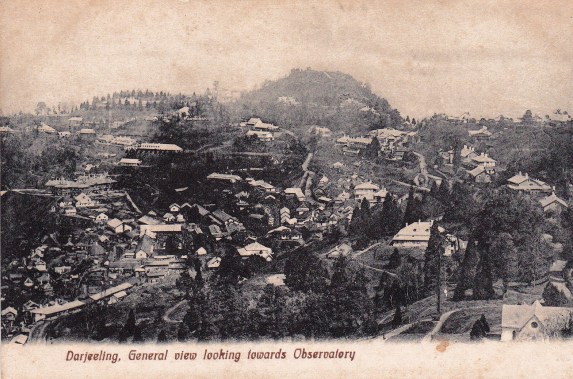
On this first one, other than the title, there is no information on the card. It is unused (as are the other two here), so I do not even have a postmark to help me guess what date the picture was taken. I would guess, however, that although the postcard was probably printed in the 1930’s, the photo could be ten or twenty years older than that. It looks as though the road on the right is The Mall, and the one running from left to right a little way below the skyline could be Hill Cart Road. Looking through a magnifying glass, it is possible to see that there are plenty of pedestrians, but I cannot make out a single vehicle. The photo would have been taken from a high spot on Dr Zakir Hussein Rd, near where the TV tower now stands.

img_0001

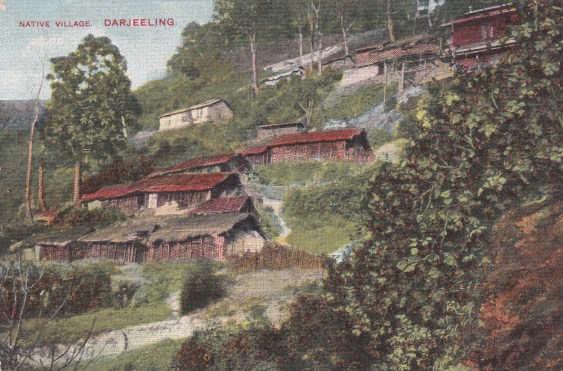
The second one is simply labelled ‘Native Village, Darjeeling’, and is the representation of a hand-tinted black and white photo. ‘Darjeeling’ is much more than the town, of course, and covers a large area all around it. Other than that, I could not hazzard more than a guess where this village lies. Searching through a few internet sites, however, I found another copy of this with a date of 1910.

img_0002

Finally, ‘The Railway Loop above Tindharia, Darjeeling’. Also hand coloured, this particular picture appears to be a copy of a photograph taken in 1880 by Bourne and Shepherd. Also known as ‘Agony Point’, this was built to enable trains to tackle the steep gradients by spiralling around instead of going straight up or down. It is renowned for being an incredibly tight loop.

Perhaps this is also a good place to slip in a link to my previous blog post:

My First Long Trip to India (5) in which I wrote about my impressions of Colonial era India when I visited Darjeeling for the first time.

4th February 2017

I was reading through my travel journal for 2005, yesterday.

IMG_0002

The Bodhi Tree at the Mahabodhi Temple, Bodhgaya

On 16th March I arrived at Bodhgaya, for my second visit to this lovely small town. Because I was going to be away from England for my eldest daughter’s birthday, she had asked me to write and send her a poem. I wrote this in the evening after visiting the Mahabodhi Temple, and after meeting with Indian friends I had not seen for a year, and thought it entirely suitable to dedicate to her and to send her.

There is a crazy wisdom here;

I am at the heart of all things Buddhist.

Good friends make life bearable.

Gentle people give me hope.

An unexpected friend gives me unlooked-for joy.

I am here,

This is the eye of the hurricane.

The still point in the centre of the universe.

My hope for the world,

My hope for you.

Unquenchable love.

I don’t write a great deal of poetry, because I don’t feel it is really my forte, but in the light of current events around the world, it seems worth posting here. I revised it a little before I sent it, but this was the original draft.

Sending everyone hopes and thoughts of friendship, peace and tolerance.


Bodhgaya (2) – A Special Place

About six months ago, I put up a post on Bodhgaya (which you can find here if you wish to read it again), and promised I would find a few more photos to post another time.

This is another time.

img_0018

My first picture is of the entrance to the Mahabodhi Temple, which is built on the site where the Buddha achieved enlightenment. The first temple was built by Emperor Ashoka, in the third century BC, and the present one was erected in the fifth or sixth century AD. Visitors remove their shoes (or face a one hundred rupee fine) and descend the steps from the garden that surrounds the temple.

img_0020

Just before reaching the entrance itself, they will pass this small chorten – one of dozens surrounding the temple – garlanded with marigolds.

img_0019

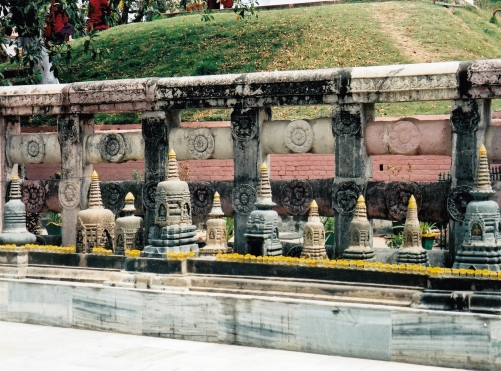
Many more chortens surround the temple and can be found around the gardens themselves, these ones beside a carved sandstone balustrade.

img_0024

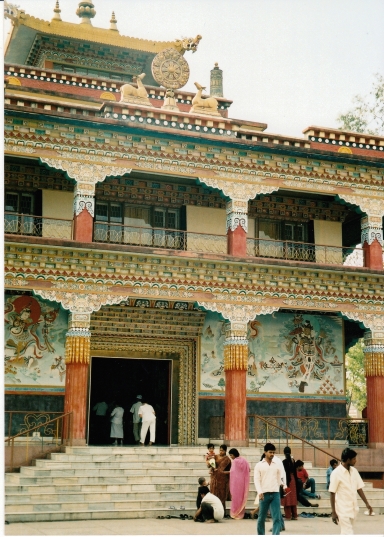
But the Mahabodhi Temple is by no means the only Buddhist temple in Bodhgaya. As the place where the Buddha attained enlightenment, it has naturally been the focus for many Buddhists from around the world, and there are many other temples built by those from the various different branches of Buddhism. This one is one of two Tibetan temples.

img_0017

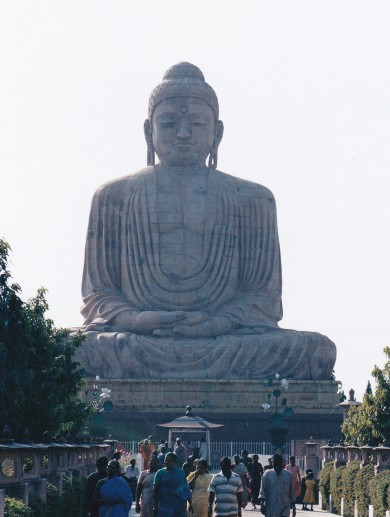
On the edge of Bodhgaya, this twenty five metre tall statue of the Buddha was erected in the grounds of the Japanese Daijokyo temple in 1989.

But Bodhgaya, naturally, is more than simply its temples. Although it is quite naturally a major tourist attraction, it is also home to many people, and daily life is not much different from other towns in Northern India.

img_0023

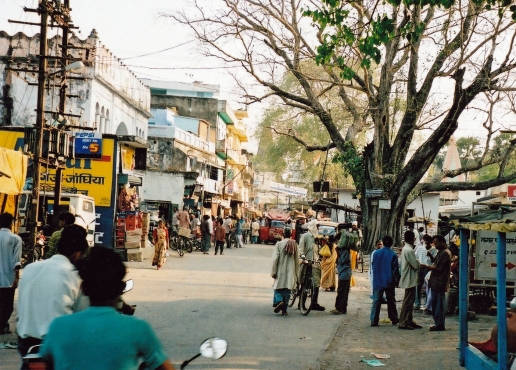
As you approach the temple areas from the northern side of the town, this is a fairly typical scene. In the distance, the share auto that plies between Bodhgaya and Gaya is filling up with passengers, and men and women shop for essentials.

img_0021

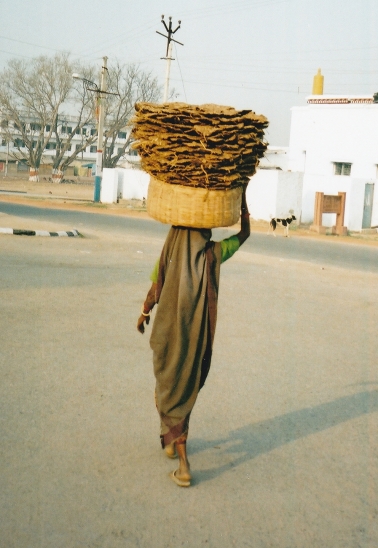
A woman carries a basket of dried cattle dung, which will be used to fuel the cooking fire.

img_0022

And on the edge of the town, the scene quickly becomes rural once again.

From Thursday I shall be away for a few days, but will catch up with comments and other blog posts once I am back.

The Indian edition of my book is published!

Well, it’s taken me long enough, as I’m sure everyone will agree, but I have finally managed to publish Making Friends with the Crocodile as a Print on demand paperback in India! Hurrah!

It is published by Pothi, and is available on their site, here, and on Amazon.in and Flipkart.

pothi-advertising

It is still available as a Kindle e-book from Amazon, and is also available as an e-book from Kobo, worldwide, for those who do not favour Kindle.

I have been told plenty of times that I need to be more proactive promoting the book, but I’m not terribly good at that. However, this is me having another pathetic stab at it:

Buy it now! It’s great! Please…pretty please…

Oh well, I’m working on it.

Should you be kind enough to buy it, or, indeed, if you have already done so, please consider leaving a review. Reviews encourage others to buy the book, and, on Amazon, once a book has garnered a certain number, then Amazon list it a little more prominently – which is a tremendous help to the author!

And I have been lucky enough to garner some very complimentary and generous reviews, so far. A few excerpts:

‘This beautifully written story, set in a village in Bihar, draws you in from its first page.’

‘Making Friends with the Crocodile is a very fine book. And it takes us into the harsh reality of the life of women in rural India, much more effectively than any official report.’

‘The characters are depicted with obvious respect for a culture that is both beautiful and at times shocking. By the novels finale, though tragic, we are left with a very thought provoking and memorable story.’

‘This is a novel with depth and real emotional involvement. Told simply and with an honesty that defies disbelief at events and attitudes, it packs some serious punches. It’s a story that will live with me for a long time, and one that has materially altered my opinions about certain cultural norms. Researched in real depth and related in language that fits the narrator so well, it’s a very good read.’

‘Mick has delved into the mind of a middle- aged woman living in rural Bihar and has beautifully sketched the love – hate relationship she shares with her daughter in law. The book gives a lot of perspective on the mind-set and predispositions that prevail in the rural north Indian society (which apply, at large to many other parts as well).’

The blurb: ‘Siddiqa was only just into her teens when she was forced to leave her home to live with her new husband and his family in another village. The years have passed, and now Siddiqa has three children of her own. Her grown up son has brought his new wife, Naira, to live with them, so Siddiqa is no longer the lowliest in the household, for she has a daughter-in-law.

Life in rural India is particularly harsh for women. This novel explores themes of female oppression and tradition and asks whether the next generation will find life any easier.

I suppose that at least when I publish my next book, I should have a much better idea of how to go about it.

Indian Salt Miners

salt-workers

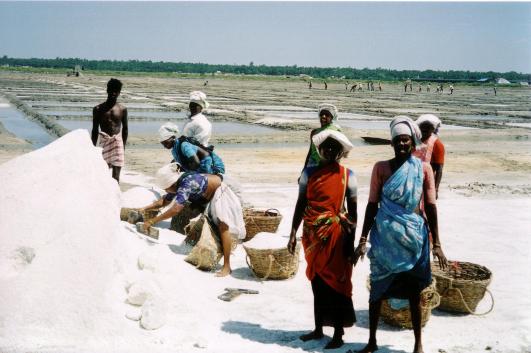
Salt workers pose for a photograph at the salt pans near Marakkanam, just north of Pondicherry (now renamed Puducherry, its original name before the French arrived, although everybody continues to refer to it as Pondicherry, or just ‘Pondi’). The sea is allowed to flow into ‘pans’ (not unlike paddy fields) and then it evaporates over several days under the hot sun, leaving behind a layer of salt which is gathered by hand. Salt has been gathered this way in India since time immemorial.

Even when I took this photograph in 2006, on my first visit to South India, it struck me as a harsh environment in which to have to earn a living. Since then, I have learned more.

Salt is, and always has been, an essential commodity, especially for a population living in hot conditions, but when the British in India imposed a salt tax, this eventually led to the ‘Salt March’ led by Gandhi to Dandi, on the Gujarat coast, where he symbolically gathered salt at the coast after a 200km march, an action that contributed to the loosening of the hold that the British Raj held on India.

In Gujarat alone, approximately 112,000 labourers are employed in the industry (Gujarat State Law Commission figures).

In all, there are approximately 1,000,000 people employed across a total of nine states harvesting salt. Typically, women and girls make up most of the workforce.

But the conditions that the salt miners labour under today are little better than they were then.

They suffer eye problems and blindness from constant exposure to the sun reflected off of the brilliant white of the salt pans. Skin lesions from the salt are common. After a while, feet become septic and absorb salt; so much so, that according to some accounts even after death the salt content in their limbs are so high that hands and feet are difficult to burn during cremation (Daily Telegraph 24/2/10).

In addition, the labourers suffer from many of the other problems common across the labour force, such as exploitation by contractors and money lenders, and poor educational opportunities for their children. There is often inadequate housing, drinking water and food, and an absence of primary healthcare (Indian Express 26/4/16).

It is frequently said that saltpan workers have three ways to die: first gangrene, second TB (tuberculosis) or third blindness.

Their life expectancy is 50 – 60 years.

The hardships and problems they face are slowly being brought to the public’s attention, but clearly there is still a very long way to go before they enjoy what most would regard as decent working conditions.

A random bit of Delhi for the weekend

‘Once I leave, I am back out in noisy, smelly, confusing, squalid, hassling, bright Paharganj. When I first came here, it seemed very strange and exotic, had an unusual, exciting feel to it that was difficult to identify but was certainly the strange, unfamiliar sounds, smells, sights and feel of an unknown culture. Even the bits that were new, still seemed dirty and somehow old, as if something about them owed their existence to the distant, Indian past. This has gone and I miss it most keenly, since I keep getting a hint of it, floating unexpectedly on the breeze with sounds and smells that remind me of when I first came out here. This has been replaced, however, by something almost as precious…I feel completely at home.’ 13th November 2009
006 (2).JPG


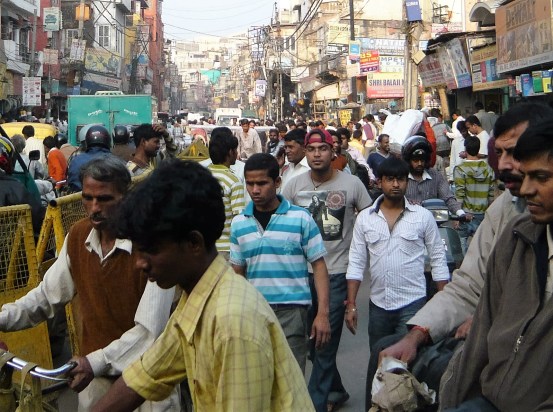
Crowds near the Ajmeri Gate, Old Delhi

010.JPG

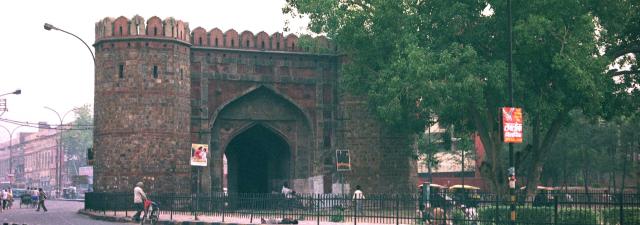
Turkman gate, Old Delhi. One of the gates in the city walls at the time of the Indian Mutiny / 1st Indian War of Independence, it dates from the seventh city of Delhi, Shahjehanabad. More recently, in 1976, during the Emergency declared by Indira Gandhi’s government, it was the scene of another infamous episode, when crowds protesting about the bulldozing of their houses in an effort to clear slum areas and force them out of the city were fired upon by the police, killing several of them.

011a

Tenements near the Turkman Gate, Old Delhi


IMG_0023.jpg

Mihrab, or Arch, in a building in the Lodi Gardens, Delhi

delhi_gate

Delhi Gate, in the old city near Chandni Chowk. This photo was taken in 1989. When I passed the same gate in 2009, the traffic was a whole lot worse!

191.JPG

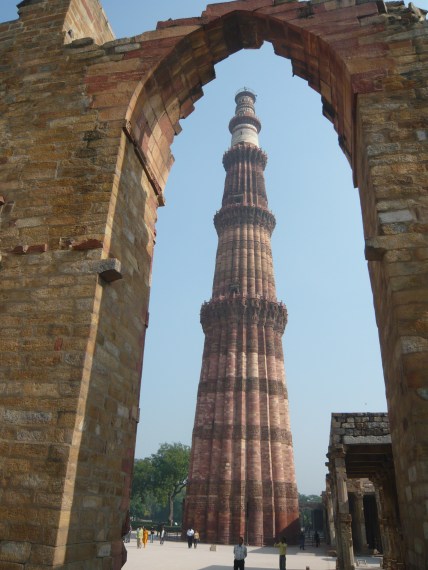
The great tower of Qutb Minar. The first of the Moslem invasions was by Muhammed, Sultan of Ghur in what is now Afghanistan, in 1192. Having overrun a large part of the Northern Indian plains, he returned to Ghur, leaving his new territory in the hands of his army commander and favourite slave, Qutbuddin Aibak. Qutbuddin decided to leave a monument to his religion that was designed to overawe his new subjects and inspire his own people, and set about building a mosque with a massive tower nearby. The tower itself is almost 73m high and is 15m in diameter at the base, tapering to 2.5m at the top.

183

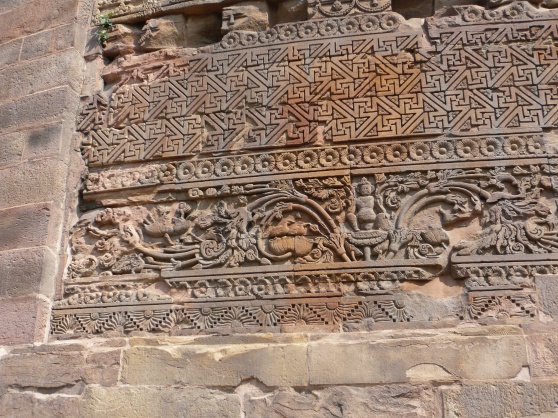
Decorative details of the stonework. Most artistic decoration is, as usual with Islamic craftwork, patterned work and verses from the Koran. At Qutb Minar, there are also plentiful stylised, and sometimes surprisingly realistic, depictions of plants with flowers and buds and long, winding stems and tendrils. To construct the mosque, artisans used stone from Hindu and Jain temples and many stones and panels still depict the original carvings, frequently defaced but still recognisable.

178.JPG

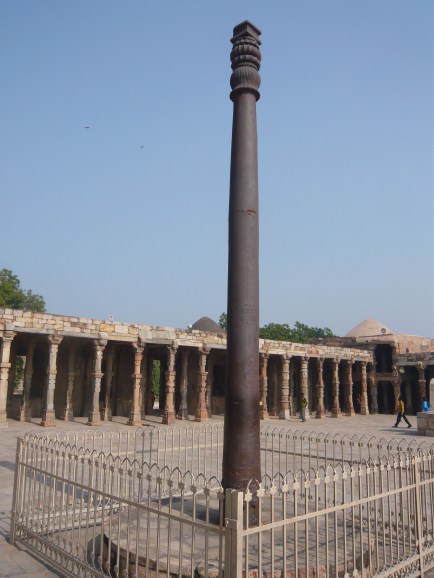
The famous ‘non-rusting’ iron pillar. This stands in the courtyard of the mosque and was here long before the mosque was built. It was made in the reign of Chandragupta II (AD 375-413), is composed of almost pure iron (99.72%) and shows only the slightest sign of rusting. A sanskrit inscription on the pillar indicates that it probably stood originally outside a Vishnu temple, possibly in Bihar, and was moved later to this site. It would probably have had a garuda, the vehicle of Vishna, on the top. 

207.JPG

Squinch-arch in Iltutmish’s Tomb. A squinch is a ‘bridging’ structure, used here to support a dome (now gone). Iltutmish was Shamsuddin Iltutmish (ruled 1211-1236), 3rd ruler of Delhi (after Qutbuddin and Aram).

175a

Brahminical motifs on the columns of the Quwwat-ul-Islam Mosque. These pillars were originally part of the Hindu and Jain temples that were razed in the area when Qutbuddin built his capital. It is chronicalled that 27 temples were destroyed. They would have been reassembled by Hindu craftsmen, Qutbuddin using local labour.


Varanasi and Sarnath

The city of Varanasi is probably the most important place in India to Hindus, whilst the ruins of Sarnath, some 10km away, mark the remains of a site of great importance to Buddhists. I stayed there for three days, some 8 years ago.
039
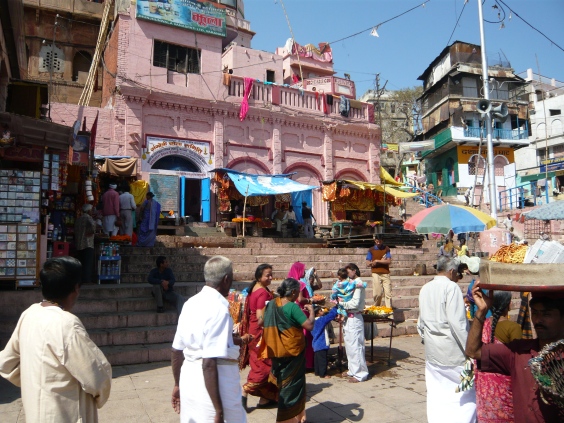
Dasaswamedh Ghat, Varanasi. Taken from the top of the steps (ghats). The River Ganges is the holiest river to Hindus, and Varanasi is the one of the holiest cities. Previously named Benares (and often so still called) and Kashi (City of Life), it is visited by Hindus in their millions who come to bathe in the Ganges to purify their souls. In a final journey, many are cremated here and their ashes cast into the river, believing that this will help to achieve liberation from rebirth.

040

The river Ganges from Dasaswamedh Ghat, Varanasi.

038

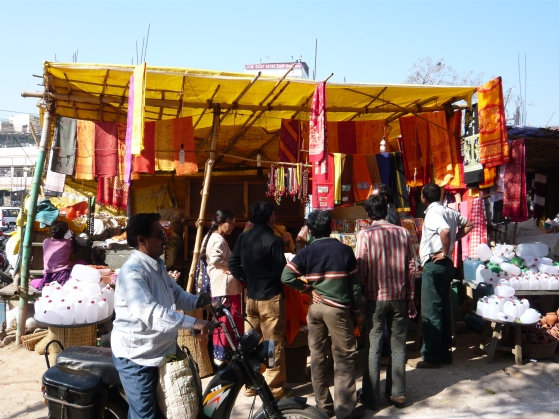
Stalls on the ghats at Varanasi. Varanasi never seems less than vibrant and colourful.

055

And another stall near the ghats.

049

Down at the ghats I was trailed by this cheerful young rogue demanding money to have his photo taken or to show me the sights or sell me souvenirs or lead me to stalls where I could purchase to my heart’s content or…whatever.

037

Street scene in Varanasi. The church in the middle distance is Saint Thomas’. This was taken quite early in the morning when I was on my way to the ghats. Early afternoon as I was returning, it was packed solid, traffic completely unable to move.

004

10km outside Varanasi lie the ruins of Sarnath. After the Buddha had achieved enlightenment at Bodhgaya, he came to Sarnarth – a walk of some 250kms or so, through what would have been highly dangerous country then – to seek out his former companions and in the Deer Park there he gave his first sermon, on the turning of the wheel of law. This comprises the Buddha’s path to Enlightenment: the Four Noble Truths, the Eightfold path and the Middle Way. In the 3rd century BC, the emperor Ashoka, a convert to Buddhism after witnessing the terrible carnage of a war he had unleashed, built stupas and monasteries here as well as an engraved pillar. These survived until the end of the 12th century when they were destroyed during the Muslim invasions and not rediscovered until 1834 by a British archaeological team.

008


This altar stone in the ruins of Sarnath) is still being used by pilgrims for pujas.

013.JPG

Dhamekh Stupa at Sarnath . This solid cylindrical tower, 33m in height, supposedly marks the place where the Buddha gave his first sermon. The base is stone, covered in delicate carvings, and the upper part brick.

016.JPG

Carvings adorning the base of the Dhamekh Stupa.

A Shared Humanity

‘The world knows nothing of its greatest men’ goes the old saying. Or women, of course, since it is men who tend to write these things. I may have alluded to this before.

017

I was reading a blog post by Rajiv earlier today, on the partition of India and Pakistan in 1947, and we swapped a couple of comments, the result of which decided me to write this short post. You can read Rajiv’s post here: Partition in the Punjab

Those of us who did not live through that time, cannot really imagine the full horror of it all. The figures alone are dreadful.

14 million people were displaced, forced to move from their homes to either what remained India or became East or West Pakistan, by any means of transport available, frequently on foot. Those that survived the journey, frequently one of tremendous hardship, carried memories that were often too dreadful to relate.

Most lost their possessions.

Families were split apart and separated, many of them never to meet again.

Millions of refugees.

Up to 1 million were killed in what were effectively religious killings – the actual figure is unknown. Trains were set on fire, men and women, adults and children, lost their lives in what became a frenzy of killing.

Much, of course, has been written of this over the years, and the blame placed on many shoulders. The British were extremely culpable in this case, mainly through neglect and thoughtlessness. Those that assumed power in India and Pakistan need to take their share of the blame, too.

But the world, as I remarked at the start of this post, knows nothing of its greatest men. Or, in this case, its greatest men and women, or at least very little of them.

On both sides of the new borders, whilst most people succumbed to fear and many to hatred, whilst innocent lives were taken and dreadful acts carried out, there were many, many people who sheltered and saved those of other religions who had been their friends and neighbours before, often at great personal risk.

They gained nothing from it, but simply displayed their common humanity.

I have read of a few examples of this, a few stories from both sides of that border, and I have seen it mentioned briefly in documentaries.

But now, before the last players in that tragedy finally pass away, it would be marvellous if there could be a concerted effort to collect these stories and record them, as an inspiring example of people reaching out to each other across what is, once again, becoming a depressingly familiar religious divide, and, most importantly, remembering and commemorating their bravery.

How India Changed an Englishman

I wrote a piece for The Good Men Project, about my time in India and how I came to write Making friends with the Crocodile’. Sushi Menon kindly edited it to make it readable, and gave it a title, and you can find it here:

How India Changed An Englishman

Making Friends with the Crocodile cover

Bodhgaya (1)

I spent a total of 2 months in Bodhgaya, Bihar, but I seemed to end up with surprisingly few photographs of the town and surrounding countryside. Here are a selection of them, though, and I may put a few more up sometime soon. Hence the somewhat tentative ‘part one’ in the title.

mahabodhi temple


 Bodhgaya is a world heritage site, because the Mahabodhi Temple was built at the site where the Buddha is supposed to have achieved enlightenment, some 2500 years ago. The original temple was built by the emperor Ashoka in the 3rd century BC. The current temple dates from the 11th century AD, and was restored in 1882 by the Burmese. Surrounded by the usual frenetic Northern Indian crowds, and visited by a huge number of pilgrims and visitors, the temple and grounds still manage to somehow achieve an unbelievably peaceful ambience.


IMG_0002

The Bhodi tree at the Mahabodhi Temple. It is a third generation descendant of the tree under which the Buddha is supposed to have achieved enlightenment.


img_0025

Thai temple, Bodhgaya. As well as the Mahabodhi Temple, Bodhgaya also has temples built by virtually every country with a sizeable Buddhist population. As befits the place where the Buddha originally achieved enlightenment, it is an active Buddhist centre with many charitable projects set up and running.


dawn-panorama
Dawn over Sujata Village, Bodhgaya. This was often the view that greeted me when I walked across the dry bed of the River Phalgu from Bodhgaya to the village of Sujata, in the cool of the morning. A rich reward for getting up early!


hindu-temples-panorama

Hindu temples on the edge of Sujata Village.

IMG

Fields in Sujata Village. In the vast majority of Indian villages, fields are still worked by hand or with animal labour. here is no exception.

IMG_0016.jpg

Farms at the edge of Bodhgaya. Although Bihar is the most corrupt, poverty-ridden state in India, sitting at the bottom of the table in almost any set of statistics that you may care to consult, the land appears lush and fertile, supporting a strong agriculture.

img_0026

And whilst we’re on a rural theme…a street corner in Bodhgaya.


IMG_0012.jpg

Monks heading for morning puja (ceremony) in Sujata.

temple door bodhgaya.jpg

Temple door in Bodhgaya.

img_0027

Dawn in Bodhgaya. The moslems are heading for the mosque, whilst most of the others are heading for work, for puja at Hindu or Buddhist temples, or to find breakfast.

I was after breakfast.