A Quiet Place

Hermits have long gone out of fashion, which is rather a shame. At one time I think I might have viewed it as a good career choice. It had its perks; accommodation was provided, usually in the form of a rude hut (that’s rude as in rudimentary, of course, not because there were obscene drawings on the walls. Although heaven knows what the hut’s occupant might have been driven to in the long winter months…) or a romantically ruined building, food was generally provided, although I suspect that within the job description for a hermit it would have been set out that nourishment came in the form of gruel and acorns rather than an a la carte menu, and people generally left you alone to get on with hermitty things. The downside, though, was what those hermitty things consisted of. There would have been long hours of prayer and contemplation, and I think even if the weather was crap, the hermit would be expected to be out in it praying and contemplating – probably contemplating a hot meal, a hot bath and a warm bed. The estate’s owners and guests would expect to view you hermitting, which you’d have to put up with whenever that might occur – probably every time you felt least like hermitting. The rude hut probably leaked and had an earth floor and nowhere to light a fire and you’d probably have to dig a hole in the woods every time you needed a crap and if the estate servants were late bringing the gruel or even forgot about it altogether, I doubt you’d be welcome going up to the Big House to complain.

I’ve no idea whether the terms and conditions of employment were ever open to negotiation, but if the position still existed today, I’m sure they would be. Hopefully, the profession would have been unionised and today’s hermit could look forward to comfortable lodgings with regular meals, well out of the way of the noise and hubbub of society.

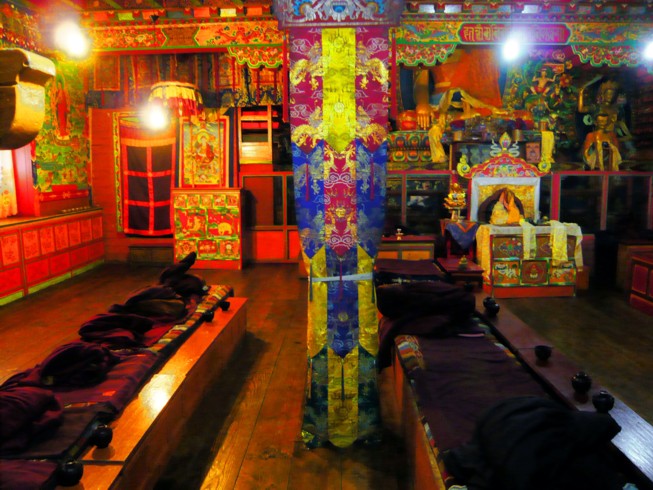
But I didn’t intend to talk about hermits, it just kind of happened. We’ve finally got some decent weather here, and yesterday I was walking through a village in the sunshine and idly thinking there are two situations in which I reckon I could renounce the world. One is in somewhere like Kathmandu in the Buddhist temples there. I’ve always had such a profound feeling of peace and stillness in these places. Buddhism is the only set of beliefs I’ve ever really been attracted to, although more as a philosophy of life than as a religion. I can’t do religion. The world is beautiful and amazing enough without throwing imaginary beings into the mix. But Buddhism is more about being a better person and looking after the world and everyone and everything in it. I could melt into that environment without too much difficulty. At least for a while.
The other situation, especially on an English summer’s afternoon in the countryside, is to retreat to somewhere remote and live a simple life away from the world as much as is practical. I’ve probably told you that before. That’s where the hermit thoughts came in.

But sadly, as already mentioned, hermits aren’t a thing anymore. Not in this country, at least. There are openings available in various other countries, but I don’t think I’m ready to explore those options. Perhaps I’ll just go for another walk.

The Oddness of Time – 2

I was eleven, and it was my first year in secondary school.

I don’t remember the day or the date, which in a way surprises me, since everything else was so vivid. But I was walking with Chas, a sometime friend, and we had just finished a maths lesson and were on morning break. The day was overcast, and I suspect it was early summer.

003a

We had just walked down the half dozen steps that ran down to the Lower Quad from the strip of asphalt beside the cloisters which connected the two main school buildings, and separated the Upper Quad from its lower cousin. At that point, I know I had not yet realised that ‘Quad’ was short for ‘Quadrangle’ – why would I? I was in my first year there, all was relatively new and there were more than enough new things to get my head around and cope with, without adding any unnecessary ones into that particular stew.

At the bottom of the steps I looked to my right at the large building that housed the dining hall and the geometry room, among others. There was nothing unusual or special about it that day, I just looked at it and had a powerful realisation – an understanding – that I would never again experience exactly what I was experiencing in that moment.

I might view the same view again, and perhaps the weather would be the same. Maybe even every boy in the school might occupy exactly the same place as they occupied at that moment, either outside where I could see them or elsewhere, unlikely though that might be. But it could never actually be the same again.

The universe would have changed; in one year we would occupy the same position relative to the sun, but not to all the other bodies in space. That would never be repeated. The Virginia Creeper on the dining hall wall would have changed – grown larger, grown new new leaves and lost many of the older ones. So too the other trees and plants.

We would never occupy the same point in time again.

I did not discover anything new that day. I did not add anything to the sum of human knowledge. But what I did was actually experience my existence in a way I had never done before, and have done only a few times since.

It is tempting to look back across that huge gulf – over fifty years, more than half a century – and fill my eleven year old head with profound thoughts that were not there at the time. But I knew I would never experience that moment again, yet I understood instinctively that I would forever be able to recall it. In a way like a snapshot, but a snapshot that included physical feelings and a strange sense of wonder.

Time is sometimes described as an infinite series of moments – because only the present exists – much like an old-fashioned cine film where the perception of movement is supplied by viewing a rapid sequence of still images, each one a gradual progression between the previous ones and the following ones, yet in a way this idea negates the whole concept of motion, since if that really was our experience, we should lose the consequences of motion; just think of the effects of a car crash, or a punch to the jaw, for example.

This was a snapshot in time, but it was anything but frozen. I felt it not only as a moment, but as part of continuous stream. I could still feel the rest of the world flowing past me as I stood there.

Buddhists speak of ‘Little Enlightenments’, which are moments when one has an almost overpowering feeling of existence, a strong sense of being connected to the whole world, during which that person experiences a heightened awareness – they seem to hear what is around them more clearly, see unusual detail and find that even colours appear more vivid than usual. At the same time thought seems unusually profound. This only lasts a short time, perhaps a couple of seconds, but leaves behind a powerful impression. I have twice experienced this, and each time I was somehow reminded of my experience that day at school.

And I wonder if the connection there is that I had an unexpected understanding of time for a few moments at the foot of the steps below the cloister.


Of Caterpillars And Philosophy

The life cycles of butterflies and moths really are an example of how utterly bizarre life can be.

As a child, I was always outdoors playing in the woods and fields and keenly interested in wildlife. I had an especial interest in butterflies for a long while, and I’m quite confident that as a ten year old I could have named every single British species, and told you a reasonable amount about their life cycles. I knew, for example, that every butterfly or moth started out as an egg, hatched into a caterpillar which ate like there was no tomorrow, and then turned into a chrysalis.

And as that child, I assumed that inside this chrysalis the caterpillar just grew a pair of wings, lengthened its legs, and made a couple of other adjustments too minor for me to worry about and then hatched out into whatever butterfly or moth it happened to be.

It is not quite like that, of course.

When it turns into that chrysalis, the caterpillar essentially ingests itself, so that its insides turn into a kind of organic soup (which makes me think of the so-called ‘Primeval Soup’ of amino acids out of which life supposedly first arose on Earth about two billion years ago, which is actually not a bad analogy). From this soup a completely new creature forms.

So, let me now introduce you all to Trevor.

016a

Trevor has been living in our back garden for the last few weeks. He is the caterpillar stage of an Elephant Hawk Moth (probably – some of the hawk moth caterpillars not only resemble each other fairly closely, but may also have variations within the species). In that time he has been doing his best to eat a small tree.

You’ll excuse him if he doesn’t say hello, I’m sure, as he is much too busy eating at the moment. It’s what he does. It’s pretty well all he does.

Eventually, he will reach a stage when he stops eating, finds a handy spot to attach himself, and then turn into a chrysalis (or pupa) and will eventually hatch out into a moth – an Elephant hawk Moth, if I’ve identified him correctly, although I’m sure he won’t care in the slightest what I think.

You may be familiar with the Zen koan (essential a riddle that cannot be solved by pure logic) that asks ‘if you light one candle from the flame of another candle, is the new flame the same as the old one, or an entirely new one?’

Which brings me, rather neatly if I might say so, to today’s riddle. Bearing in mind all of the above, is the newly hatched butterfly or moth the same creature as the caterpillar that preceded it, or a new being entirely?

I think we should be told.

Do It Tomorrow

IMGP2317

We have all been encouraged to think

That our time is so important.

Yet it is only when we become old,

And we have so much less of it left,

That we realise this is not the case.


We’ve been told we must save time,

Instead of using it and moving on.

How precious time is,

As if it were a commodity we might hoard

And use when we need it most.


Instead of squandering it on what makes us happy,

And filling it with unimportant things.


But I say, let what you’re doing fill your time.

If you’re washing up,

Then let your plates be the cleanest.

And if you’re looking at the winter sun on frosty leaves,

Well, let that be the best experience you have ever had.


Sometimes I have these flashes,

When I think I’ve understood something deep and profound.

And usually it means an evening drinking wine,

Or half an hour sitting on a sunlit hillside.

But I do wonder what we’re all so busy chasing.


And if you think this lesson worth remembering,

There’s no better time than now.


Wow, What a Book #3, #4, #whatever

Well, Saturday already. Seems only yesterday it was Friday *sigh* I suppose I’d better get on with it.

I don’t think I’ll do ten of these after all, because I rather run the risk of listing books just because I like them, rather than because they have had a real and measurable influence on me. So today I present the final three.

1. Silent Spring, by Rachel Carson.

Image result for silent spring

I read this book when I was in my mid twenties, and it really did open my eyes to what we as a species were doing to the planet. Up until that point, I had not really understood the impact that we were having on the environment. Shocked, I became interested in learning more, and then even more shocked as I learned what food and drink manufacturers put in their products for us to consume. At that time, one of them was the nasty compound dropped by the Americans on Vietnam during the Vietnamese War; a defoliant that was known to be carcinogenic.

It was used as orange food colouring.

I got hold of a list of all the ‘E’ numbers that were permitted additives, and which the industry certainly didn’t want us to know about. Certain ones were very nasty indeed. It was at this point that I became very keen on reading the labels on food and drink packaging.

I became involved with various pressure groups, such as Greenpeace.

That book changed my life.

2. The Razor’s Edge by W Somerset Maugham.

download

In some ways, this could lay claim to be the book that has had the greatest influence on my adult life, but in a different way to Silent Spring.

I’d always tried to be a reasonably decent human being, but reading this made me rethink the way that I wanted my life to be. It is the story of a man who returns from the first world war and begins to question his place in society. He finds the trappings of modern western life, and its values, empty and meaningless – its focus on making money, selfishness and greed. He then searches for something meaningful in his own life, through education, religion and travel, and explores his relationships to others.

The message in this book immediately resonated with me; that there is much more to life than the pursuit of money, essential though some of it it might be to my survival. Other people mattered. Helping others was important. What is called the spiritual life, whether or not you believe in a god or not, was an important part of us all.

5. The War of the Worlds by H G Wells.

hgg

Are you serious? you ask. How could this book be an influence on your life? One of the first science fiction books, and admirable for that, but an influence?

Well, it is easily told, and the answer will probably surprise you. This book provided the initial impetus for me to become a vegetarian.

Yes, a vegetarian. There is a passage in the book where the narrator recoils with disgust as the Martians take the blood from still-living humans for their nutrition, but then comments that it was probably the same reaction as an intelligent rabbit would feel observing our own eating habits. That made me consider whether it was necessary for me to eat meat, and I came to the conclusion that no, it was not.

Wow, What a book #2

To continue with the 10 books that have most influenced my life.

My second choice is The Lord of the Rings, by J R R Tolkien.

Image result for the lord of the rings book cover

I suspect that very few readers are unaware of the story of The Lord of the Rings, having either read the book, seen the film, or both. And at this point, it might be a good idea to just make it clear that I am talking about the book here, and not the Peter Jackson films, or even the ill-fated attempt at animating the entire book in 1978, an attempt that got as far as the first book, and was, to be honest, rather dreadful. Let me content myself by just saying it was a bit ‘Disney’. I’m not that mad on the Peter Jackson films either, to be honest, but back to the book.

So, I’m not going into any great detail about the story, but, in a nutshell, it involves a quest to destroy a ring that gives great power to the wearer, but inevitably corrupts and destroys them. It’s maker, Sauron, is attempting to find it, and the free peoples of the world must not only keep it from him, for if he recovers it it he will then have power to enslave the entire world, but also take it to the fiery mountain, Mount Doom, where it had been forged, to cast it into the flames and destroy it.

Mount Doom is, inconveniently, inside Sauron’s heavily fortified and guarded kingdom.

Elves, dwarves, men, wizards, hobbits, orcs…you all know it, don’t you?

As readers, we are all different. Some of us like a plot that gallops along so fast that we can barely keep up, with writing that limits itself to the action and no more than the minimum descriptions necessary.

Others, like me, enjoy the scenery and the atmosphere of the described world almost as much as the plot itself – join the Slow Book Movement now! Just send a completed application form to…sorry, wrong place. Where was I? Oh yes, most readers like a mixture of the two, of course.

But as one of these Slow Readers, there is a massive amount in this book that appeals to me. When I read descriptions of the hobbits setting off to walk through woods and fields as the sun comes up through early autumn mists, I might have been reading a description of a morning when I had done just that whilst wild camping in the countryside in my part of England. I have always loved walking on footpaths and through fields and woods, and disliked roads and towns.

The countryside Tolkien described around the Shire – the home of the hobbits – might have been my countryside. there were chalk downs and woods and streams, even one or two names (for example Michel Delving) that could have been local.

There were other woodlands in the book, and if they were described as magical, then that was little more than I naturally felt about woodlands anyway. Aren’t they all magical?

And, on top of all that, there were mountains. Today, I love mountains! But I had never seen one at this point, and suddenly I wanted to go and climb one. There were inns and beer, adventure and song, friendship and dangers. What was not to like?

The whole book is really made up of three books, and the first book, which has always been my favourite, is the one which is mainly set in this land that I could almost identify. This was not the first fantasy book that I had read, but it was, and still is, the one whose descriptions have the greatest power to draw me in. It is the one that, to me, seems the most real.

All of this, with the themes of courage and friendship, self sacrifice and loyalty, and the message that good will eventually triumph over evil, come together in a mixture that is in just the right proportions to appeal to me.

But how has it actually influenced me?

For a start, when I began to write, everything that I wrote seemed to be influenced by that book. This was not actually a good thing, because other than The Lord of the Rings, I don’t really enjoy fantasy! But I wrote that way for a long while.

Today, though, what remains is the descriptive writing. I wonder whether I might otherwise have been a very different reader and writer, since before I read LOTR, I read mainly detective stories and adventure novels.

And I explored a lot of the Middle English literature that influenced Tolkien, from Beowulf to Sir Gawain and the Green Knight, which I suppose not too many people do today.

I visited mountains because of that book.

And a measure of how strong this appeal was (and remains) is that I have probably read the book about twenty times. The last but one time, though, was around twenty years ago. When I decided to re-read it last year, I did wonder whether I would be disappointed. I strongly suspected that I might have ‘grown out of it’.

I needn’t have worried.

I enjoyed it just as much as I ever had; I noticed one or two details I had either forgotten or never really noticed in the first place, and I found myself drawn in every bit as strongly as I had been before.

I loved it.

Wow, What a Book! #1

I thought that I would pick out what might be the 10 books that have most influenced my life. Well, I say 10 books, but I may tire of this long before I reach 10, so let’s just see what happens.

You see, these are not really reviews, although it is necessary to give some idea of the plot of each book, it is more about how they have influenced me, and I may decide after a while that I’m just giving away too much about myself.

Or that I’m just going over and over the same ground.

Okay, then. Let’s get on with it. The rules:

Firstly, I must have read the book more than 5 years ago. I know this is an arbitrary figure, but any book that I have read recently is likely to be clearer in my mind, and so appear a little more important to me than it really is. It needs time to settle.

Secondly, I need to be able to demonstrate to myself exactly how it is that the book has influenced me. Just to say ‘it was important to me’ will not be enough. That would be little better than just saying ‘I like it’. Perfectly valid, but hardly the stuff of a blog post. This is another reason to impose the 5 year rule – there must have been enough time elapsed to see the influence.

So I’ll start today with Steppenwolf by Hermann Hesse.

Image result for steppenwolf Hesse

Sometimes, you get the feeling that some people have just been born into the wrong century. Not that they would prefer dressing in cravats or crinolines, although they might anyway, or that they have a hankering after a little piracy or bubonic plague, but rather you can see that they don’t fit in with the pace of modern life, or much like the ethos of the times.

There must be quite a few people like that, which must partly explain the immense popularity of Steppenwolf both when it was released, and then especially in the 1960’s and 1970’s.

It was the second book by Hesse that I had read, after cutting my teeth on ‘The Journey to the East’ as a teenager, and I was a little unprepared for its message.

Whereas ‘The Journey to the East’ felt like a bit of drug-induced fantasy, although a very clever and readable one, without any obvious message beyond ‘free yourself from the conventions of society, man’, Steppenwolf clearly had a more serious message to convey.

It begins with the protagonist, Harry, contemplating taking his own life, because he sees himself as a serious writer both at odds with the world that he lives in (Germany, post WWI), whose values, especially the bourgeois ones, he despises, but also with his inner alter ego, the very opposite of the sophisticated artist that he sees himself, which he calls the Steppenwolf – or the wolf of the steppes. He hates and fears this alter ego, who he feels he cannot control, and who sneers at everything that Harry holds dear.

It is whilst Harry is contemplating suicide, that he comes across a booklet entitled ‘Treatise on the Steppenwolf’ and as he reads it, he discovers that it is about himself. the booklet talks about Harry and his alter ego, but also explains that there are many, many more of these other sides to his character.

Through the rest of the book, Harry learns how to reconcile these many sides of himself and, more importantly, how he can manage to live in this world that up until then, he sees no value in.

When I read the part of the book that consisted of the treatise on the various different natures that made up the protagonist of the novel, it was the first indication to me that we really do have these different sides to our characters; sides that do not need to be in conflict with each other, but can coexist quite peaceably. As a typical young man, I knew that there were parts of me that yearned for safety, parts that simply wanted to rebel. Parts that enjoyed home life and parts that wanted nothing more than to wander the world with my possessions in a rucksack. There was the aesthete and there was the lover. The artist and the fighter.

Until then, the rebel in me had sneered at the home lover, and the artist seemed to be in perpetual conflict with the fighter. I had felt embarrassed by parts of my character and, just as did the hero of Steppenwolf, rather tried to repress them.

What this book did was to show me that it was natural to feel like that, and that the secret was to accept all of these sides of me, and allow them to all have their moments of dominance, and their moments of passivity. They did not need to be in conflict.

It completely changed my outlook on life.

Religion or Philosophy?

Now, here’s a thing.

It is rather a fashion nowadays to declare that religions are all wrong and should be banned, because science and reason have somehow proved that there is no god (they haven’t).

But I would like to consider every religion in the world as a school of philosophy, and consider what I might take from each that would be useful to my life and my development.

Whether there might actually be a god or not then becomes unimportant.

Most Buddhists, for example, would seem a little unsure of whether there is a god or not, but if asked, the majority of them would reply that it does not matter. The argument being that it is impossible to prove either way, and therefore it is impossible to know either way. So why not just live your life as well as you can?

SR312thumb

Traditionally, religions have provided society with a set of moral rules. It may be that these rules were the first imperatives that human beings treat other with decency. Since none of us were around in the long years when our race was evolving speech and higher thought, and learning how to co-operate with fellow members of the tribe and – who knows – perhaps their neighbours, this must of necessity be pure speculation. Yet I find it highly likely these moral codes were the first suggestions that human beings might treat an enemy, for example, with mercy, rather than simply killing them, which might otherwise be the obvious course of action. Morality over expediency, if you like.

Some examples:

Islam forbids charging interest on loans. How many who have fallen victim to the money-grubbing lowlife that run these ‘payday’ loan companies charging astronomical rates of interest might have sympathy with this view? It teaches also that it is a moral duty to give alms; to help those in need.

112 (2)

Christianity is big on love and mercy; at least in the New Testament. It teaches tolerance and forgiveness.

Buddhism teaches that to want things is to become enslaved to those desires that can never be satisfied. How much better to live simply and to be content with what we have? It teaches also compassion for all living beings.

Hinduism teaches that all life is sacred, and that we should all refrain from injuring others.

ganesh shrine kodai

These are only the main four faiths in the world today, but every other religion that I have read about also teaches a code of moral imperatives.

And in a world run by huge multi-national companies with no moral compass whatsoever and politicians who only look after their own, where we are continually and aggressively informed that we must worship money and consume more and more pointless trash, and that it does not matter if we destroy the environment just as long as companies make bigger profits, anything that can make us pause to consider what is actually important in life should be encouraged rather than denigrated.

343

It would therefore be ridiculous to simply dismiss out of hand entire canons of work, solely on the grounds that the writers of these philosophies believed in a god whom the reader might not (or does not want to) believe in. Everybody has a spiritual side, whether or not they believe in some sort of god. The spiritual side of a person champions beauty over money, generosity over selfishness, kindness over cruelty. These are values that most of us still claim to value today.