Sigh

Poem number five in my Poem-A-Day-For-A-Week-Or-So series. Snow outside, test cricket on the TV, beer in the cupboard. That’s my day sorted, then.

The sea sighs for you tonight.

It sucks at the shingle

And smears your footprints

Like a wet thumb rubbed across writing.

Where once you walked and left your

Prints, it gently wipes the land clean.

Lovingly it lays its cheek to the ground

And nuzzles your memory.

.

We are more than specks

In the infinity of time and space

Yet somehow we need to

Make sense of our lives.

Rock endures

But so does the wind and the rain.

More so, in fact, since in the end

Mountains are levelled

And the wind and rain remain.

.

In the end the passage of many feet

May be more durable than

Dwellings of stone.

I Made A Vow

Day four of the Poem-A-Day-For-A-Week-Or-So project and a bit of a rush, today, as I’ve been assembling a shed (as you do). Another one, therefore, which will benefit from a revision when I have more time.

In Tripoli I made a vow to travel light, my eyes wide open,

Travel all the time I could, to take my chances when they happened,

Planned to seek out strange new places, take some risks see new horizons,

One thing alone I wanted now, the promise of the unexplored.

.

And I remember where I was, the time of day, the type of weather,

Early morning, early March, this was a time of change for me,

A time for taking big decisions, time to turn my life around,

Time to leave things in the past, the time to turn another page.

.

At the time I made that vow, I yearned to go along the Silk Road,

Travelling any way I could, and though that sadly never happened,

Other projects came and went, journeys all filled with adventure,

Baking deserts, frozen mountains, close to home and far away.

.

I knew the world would not be kind, it would not make my journeys easy,

Whatever it might offer me, I’d leave myself completely open,

Embrace the rain, embrace the wind, embrace the temple and the hillside.

This was my private pact with life and to this day I’ve not yet finished.

Dragon

A Poem a Day For a Week Or So number three. I had fun with this one.

Dragon

This serpentine and massive body,

Tough dark brown scales about its girth,

With emerald green draped carelessly

Lies sinuously upon the earth.

.

One huge, long, foot, so saurian,

With wrinkled toes, long tapering claws,

Sweet scented earth clings yet to them and

Rain drips in the shocking maw.

.

Cowards’ blades have cruelly felled it

Here, of all enchanted places!

Huge and sad and impotent

Lies still amongst its golden pieces.

Mud

The second of my ‘Poem a Day’ poems. Just getting this far is a bit of an achievement, I suppose, although I’m not particularly happy with either the meter or the rhythm. It feels as sloppy as the day itself was. But I think it has potential if I do a bit of work on it sometime later.

Mud

Today, the sun has been sent into exile,

Leaving just a weary daylight.

It has gone, and we shall never see its like again.

.

In the steady rain,

Climbing this hill is an act of defiance

A far more daunting prospect than usual.

It is like a resistance.

One step forwards and two steps back

I slide and slither upon the track,

Barely keeping my footing at times.

.

In places, mist curls beneath the trees

Where the birds voice their own defiance

Loud and clear.

.

Beneath the endless grey,

Still lower clouds like smoke from gunfire,

From shell bursts or industrial disaster

The earth torn up and churned

From countless toiling feet.

But other than the birds,

I have the world to myself.

Clutch

I thought I would write a poem a day for a week or so. Here is yesterday’s. Of course, if this goes like most of my projects, I’ll probably give up tomorrow. We’ll see.

Clutch

Crook-backed

Misshapen

Bent and jug-eared

Skeletal spindle-shanked and

Shaggy ancient

.

Like troll

The rising sun leaves it forever

Frozen on this hillside

.

Mid-clutch

.

Ice coursed through crippled limbs

Wedged and clinging

Four hundred years too much

In the end

Wandering

I’m posting this poem again, as it rather illustrates what I’ve personally found particularly frustrating during the recent lockdown. We can go for longer walks now, it is true, but that’s still not the same.

015a

If I could just wave a wand,

I would wander the world.

With my notebook in hand,

And a bag on my back.


I would sleep under hedges,

In hotels and haylofts.

Drink beers under trees,

And eat cheese on the moor.


I’d watch clouds over hilltops,

And boats on the ocean.

Shapes and shadows at sunset,

A moon with a view.


And I’d write trivial poems

Of snowfall and sunlight,

Birds singing at dawn

And the sounds of a stream.


There’s the lure of a skyline,

And skylarks above me,

Wine and woodsmoke my welcome,

At the end of the day.


To travel, to journey,

There’s magic in wandering

Over moorland and downland,

Through woods and through fields.


The world’s full of wonders

All waiting for wanderers.

Let me follow these paths

For as long as I can.

The poem can be found in my collection The Night Bus, which is available here. should your interest have been piqued by this…

Vikings

Allow me to introduce a new joint venture, a magazine (or zine, as I’m informed we hip youngsters now say):

img_20200601_202436_133d

The final poem in my recent collection, The Night Bus, is a poem called Vikings, and it is reproduced in this here zine with a series of super illustrations.

41XAtkb6ssL._SX311_BO1,204,203,200_

This is a collaboration between myself and my talented friend Mark Prestage. As already indicated the poem is mine, while Mark designed, cut and printed the linocuts.

img_20200601_202436_133c

Mark also did the hard work of putting the zine together, while I just sat around and drank beer. The zine is printed on 16 pages of high quality paper, in a preliminary edition of 40 numbered copies.

img_20200601_202436_133b

In the UK the price is £4.50 including postage and packaging, and it can be ordered from my Etsy site: here, or directly from me (just email me) using Paypal. Unfortunately the cost of postage overseas makes it impractical to offer outside of the UK (typically doubling the cost of the zine, or even more).

If people make lots of approving noises, we have ideas for similar projects in the future.

Mark also blogs here: drifting in lower case and twits: twit and is well worth a visit.

Lost and Found in Translation

Untitled-Grayscale-02

I have read many novels, short stories and poems translated into English from other languages, but I wonder how much of what I read is true to the original intentions of the authors?

The Argentinian writer Jorge Luis Borges wrote many short stories and poems, all of them in his native Spanish. Although I did buy one collection in Spanish, my own knowledge of that language has always been too poor for me to do anything other than read it slowly and laboriously and, undoubtedly, to miss many of the nuances in the writing. So for that reason, I’ve had to read them in translation.

And in any case, even if I spoke Spanish well I could do little more than read it as translation in my head. Unless I spoke it like a native speaker, I would still likely miss much that the author intended to convey.

And so I buy translations.

Zima Junction by the Russian poet Yevgeny Yevtushenko is a long poem that tells of the poet’s visit to his home town in Siberia, having left some years before to go to live and work in a city. It is a beautiful depiction of rural life in Russia at the time, seen afresh after a gap of several years away, and describes the poets now ambiguous relationship with it.

Long poems can be good vehicles for describing journeys; my own poem The Night Bus does just that, and was written because in that instance I could not find any other medium that worked as well to convey what I wanted to say.

Another favourite of mine is Dart by Alice Oswald, which describes a journey from the source to the sea along the River Dart in Devon, England. She gives voices to the various people encountered along this journey, and to the animals living there…Since it is written in English, I am not left with any worry I am missing things the poet wanted to say, other than perhaps my own occasional inability to understand her.

I have a book of poems from North East India. It is an anthology that I bought in India, with contributions from a huge number of poets. A few of them wrote in English, but the majority of them wrote in other languages – some in Bengali, but the majority in one or other of the plethora of languages to be found in the North East States. And, sadly, most of the translations appear to have been done as a straightforward translation word for word, with no thought given to the feeling of the poem. Any rhythm the poems may originally have had seems to have been lost. The sentences are often clunky and uncomfortable to read. Their meanings have become lost in translation.

But Zima Junction has a natural and comfortable rhythm

The translator of a poem has, to my mind, a task that is more difficult than the translator of prose. Yet, paradoxically, they also have more freedom. More difficult, because they have to get across to the reader ideas or meanings that may be partly concealed in idiomatic language used by the author that perhaps we have no parallel for in English, and hence they may have to completely alter the structure of that part. This will affect a line of poetry far more than it would a line of prose. Immediately, the rhythm of the poem is disrupted, the word count of the line changed.

Yet the reader of a poem has a right to expect a poem. And so, strangely, the translator has the freedom to re-write the poem. In the need for the end result of their translation to be a poem, they may have to completely alter much of the structure to enable the translated words to reassemble themselves as a poem. And so the translators of poems must, by essence, be poets themselves.

So to return to Borges and Yevtushenko, when I read the poems I do wonder whether I am actually reading their poems, or someone else’s?
I Am The Wind

Untitled-Grayscale-01

I clatter dry leaves along dusty footpaths

And bear burdens far greater

Than mere birds and clouds.


On high, cold, moors I blow

In the hollow eyes of sheep, inert and prone,

And ruffle the hissing grass over barrows

Of long-dead chieftains.


From the fading fires of the sick and the dying

I blow prayers in the smarting eyes

Of disinterested and uncaring gods.


I steal your thoughts.

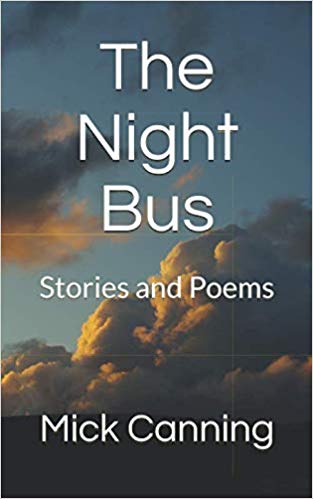
The Night Bus

After a day of faffing and kerfuffle (and a little bad language, but not too much) yesterday, I have posted my new book up on Amazon.

312EjL1fieL._SY346_

The Kindle e-book will be released on 30th November and is available to pre-order now. It will take a few days yet for the paperback edition to be ready, as I need to check through a printed proof first. I’ll post when that is done.

The book is in two parts. A collection of seven short – and not so short – stories, which make up the bulk of the book, followed by a selection of recent poems.

I have always enjoyed travel and, one way or another, nearly every piece in here is to do with travel. The only exceptions are a couple of the poems that seemed to fit in among the others for aesthetic reasons.

Some of the stories are quite dark, but the majority of the poems have a lighter touch. In these, especially, I hope that my love of the natural world comes through.

Two of the longer stories are set in India; in one, a young man goes in search of a mysterious destiny, while in the other a travelling Englishman becomes embroiled in a chilling disappearance. One story speaks of the support and comradeship of a close-knit island community while another tells of jealous intelligences far older than mankind.

Of the poems, there is one long piece, which gives the title to this collection and tells of a long journey across India and into the mountains and, among others, one short series of poems about the ancient paths and tracks of Britain.

An early piece of writing advice I was given, and for which I am eternally grateful, was ‘Write the stories and poems you want to read’. This I have done, and I hope you will want to read them too.