A Bit of Digging

Well, they arrived yesterday.

I have finally got my family history book formatted and printed, and I reckon it looks quite decent. So all I need to do now is to get it posted out to family members.

While researching all this, I naturally made a lot of discoveries. Some were certainly more unexpected than others, though. From previous research my father had done, we already suspected that my great grandfather had changed his name, possibly on a whim, from Prater to Canning. I was able to confirm this by, amongst other things, a comparison of various dates of birth in his family. This immediately removes the possibility of my searching back to see whether my name has any noble / famous / important roots. This is something that matters a lot to some people, although obviously only along the male line, which is why it seems to matter much more to men.

Although I turned it up too recently for the book, I have learned details about my father’s life in WWII which I would otherwise never have come to know. I had no idea – and seemingly nor had anyone else in the family – that from 1940 until joining the regular army in 1943 and being posted to India and Burma, he had been part of what had been dubbed ‘Churchill’s Secret Army’, soldiers trained to operate behind enemy lines in the event of a German invasion of Britain. Fulfilling the same role as the French Resistance, they would have carried out acts of sabotage and hit-and-run attacks to slow the enemy advance. it was only after that threat had receded that he joined the ‘Regulars’.

And then, less unexpectedly, there were the stories of extreme hardship: the early deaths, the poverty, the workhouse, tuberculosis and pleurisy…

Of course, if it was possible to search back far enough, we would all find we had a common early human ancestor, which gives the lie to the importance of race.

Does any of this research really matter? Well, in some ways, no. Does it sound crazy if I say that despite all my work, it does not matter that much to me? I’m very much in two minds over this. A lot of this felt more like an intellectual exercise than a personal quest. It was interesting to find out where my great grandparents and their parents had lived, for this felt just close enough to be a part of me. But before them? And especially when I could discover nothing more than their names and some vague dates? No, not really. Throughout this project I have been especially keen to be able to put names to old photographs, for this seemed the only way to make these people come alive again, or at least begin to. That I’ve been able to positively identify some of them feels more satisfying than pushing a line back another hundred years, although I do have nearly every branch back at least to the 1700’s, but in every case it is the stories I’ve found out about these people that matter.

But back to my question. Does any of this research matter? I do think it has the potential to bring us a little closer to our families by emphasising our shared history, and I’ve greatly enjoyed long discussions with cousins about our various researches and discoveries. But beyond that? Well, I’ve enjoyed learning the social history involved with my family, the realities of how people actually lived in the towns and countryside over the last few hundred years. And as well as emphasising my connection to my extended family it has also, as I wrote a few month ago, given me a greater sense of connection to the land where I live.

I have enjoyed exploring the past, but I’m not going to live there.

Connections

Through researching my family tree, I’ve discovered some new connections to the land.

It’s not just that I’ve found ancestors in new parts of the country, although that certainly has a bearing on things, it’s more that I have a reinforced sense of a long personal connection to the land, this land, where my ancestors spent their entire lives living and working. A connection so many of us seem to have lost these days. I’m following the threads of folk who scraped a living in villages in Norfolk or Essex or Hampshire, frequently living in poverty or at the very least on the very edges of it. A hard life for most of them. Widows with no way of supporting themselves other than plaiting ‘straw dollies’ for a few pence, labourers in their seventies still having to endure hard physical graft to stay out of the workhouse (where they would have had to work even harder, for even less reward). People for whom starvation would have been a very real threat. Even comparatively healthy families would have relied on all the womenfolk trying to bring a few extra pennies into the household.

Some of these connections are selective – I can reject a connection I’m uncomfortable with, such as through industrial work in towns or cities which is something I have little experience of, and no love of in the first place, but I cannot claim a connection that isn’t there in the first place.

And within this experience, there is the time element – both how long ago these events were, but also how long they lasted, which contributes to the intensity of this connection for me.

These folk weren’t just the very poorest, of course. Amongst my ancestors there are also a wide range of craftsmen and women such as weavers, shoemakers, and printers, but also other poor labourers such as shop assistants, launderesses, servants, stokers, coal porters, cable hands…the list goes on and on. Not that there’s anything special about my family tree – everyone has these folk in their past.

I think – I know – some people just look for royalty or knights in armour when they research their trees. They dream of having the right to a coat of arms, or bragging rights to a famous name. None of us come into it completely open to what we find. We all have some expectations – to push our ‘lines’ back as far as we can, for example, or discover connections to the famous. Personally, I’m delighted to find my ancestors were the urban and rural poor. I don’t want to find the rich and privileged in my tree. Is that inverse snobbery? Perhaps.

But it’s the connection to the land I’m referring to here. I’ve always felt a strong personal connection to the land, to the physical world, and every census entry or marriage certificate I come across showing my ancestors earning their living that way seems to strengthen my own connections as well as a sense of continuity with my forebears.

Sickness and Diseases

I’ve mentioned that I’ve been researching my family tree, and a few days ago I was looking for details of one of my ancestors who lived in what was then a small village just outside Norwich. Looking on the parish records not only did I find the entry for his burial, but then noticed that the rector at that time had begun noting down what each person had died of. It was by no means complete, though, because he had added these notes for a year or so and then just stopped. Whether he’d got fed up with it or been told to stop for some reason, I obviously have no idea. But as I glanced through them, I became fascinated by them. I felt they left quite a lot of information about the place and time (rural England in the 1850’s) and thought a bit of it worth sharing.

My ancestor was on page 5 of these records, and the burials had all been conducted by the same rector from the first entry on page one. He added these notes from entry number two, through to twenty nine, then again for number thirty three, and then stopped. This is a summary of the relevant entries:

1   Male     5 weeks   Dec 1851

2   Male       44         Dec 1851      paralysis

3   Male       14         Jan 1852       consumption

4   Male       53         Jan 1852       consumption

5   Male         6         Jan 1852       scarlet fever

6   Male         3         Jan 1852       scarlet fever

7   Female    17         Feb 1852      typhus fever

8   Male        33         Feb 1852      consumption

9   Female    3¾        Jan 1852      scarlet fever

10 Male        53         Feb 1852      liver complaints. Publican.

11 Male        61         Mar 1852      paralysis, consumption

12 Male        19         Mar 1852      consumption 2½ years

13 Female    62         Apr 1852       cancer

14 Female    78         May 1852      old age

15 Male        33         Apr 1852      consumption

16 Male        55         May 1852     decline and heart disease

17 Female    69         Aug 1852      old age

18 Female      5         Aug 1852      inflammation of bowels

19 Female    13         Aug 1852      typhus fever

20 female     21         Aug 1852     consumption

21 Female    76         Aug 1852     coroner’s inquest. Verdict died by visitation of God

22 Male        63        Sep 1852     coroner’s inquest. Verdict died from injury in the head caused by fall

23 Female     71        Feb 1853      paralytic stroke and old age

24 Male         49        Apr 1853      labourer. Decline

25 Female     71        Feb 1853      coroner’s inquest. died by visitation of God, She dropped down dead when in perfect health

26 Male        85         Apr 1853      labourer. Paralysis

27 Male      infant      May 1853      jaundice

28 Female    64         Jun 1853      drowned herself in 11 inches of water. Morbid religious depression. A dissenter. Verdict temp insanity

29 Female   infant     Jun 1853      thrush

After this there are no further comments from the rector, other than:

33 Male        72        Sep 1853      disease of heart

There is quite a lot that is of interest here, and just from a statistical point of view we can see that nine of the burials were children under sixteen – just under a third of the total. Of those six were five or under. Lots of children died in those days. Yet somewhat surprisingly, fourteen of them – roughly half – were over fifty, with four in their seventies and one of eighty five. A very good age for the time. There doesn’t seem much difference in the average ages males and females lived to, although this is a tiny sample, of course. All the rural poor had tough lives, both male and female, which brings us to the comments added by the rector.

Number twenty six really caught my eye. Male, aged 85, a labourer, died of what the rector calls paralysis. No old age pension for them, they worked until they dropped. Number twenty four is also described as a labourer. Obviously the rector felt it worth mentioning, although why just those two, who knows?

Then we have the common diseases we’ve pretty well consigned to the past, now. Scarlet fever. Typhoid. Consumption – properly called tuberculosis. They killed frequently, especially the young.

And when the cause of death couldn’t be determined, even by inquest? ‘Visitation of God’. Although why those ones weren’t just put down to old age I can’t imagine. Unless somebody saw something…

Two more comments I have to mention, though. Number ten, male, age 53, died of liver complaints. The rector had to mention he was a publican, of course.

And then there is number twenty eight. Female, aged 64, drowned herself in 11 inches of water. Morbid religious depression. A dissenter. Verdict temp insanity. The rector belonged to the Church of England, and I’m sure he relished the suggestion that dissenters were mad. All the different denominations of the church seem to regularly go to war with the others, which, if you fancy a bit of a giggle, I satirised here some while ago.

A Bit Of Family History

As I have mentioned previously, I am sporadically tracing my family tree, something I’ve only really become interested in recently. Perhaps it is mainly an older person’s interest, although I don’t think I’ll explore that now. But I’m keen to pass on the information to my children and grandchildren especially, so they can do further research if they feel like it.

As well as the family connection, though, much of my interest is both the exercise of solving a puzzle – it has much in common with a detective story – and to attempt to ‘see’ something of the person behind a list of dates and names. It is comparatively straightforward to accumulate lists of these folk with no more information than a sort of ‘Fred Bloggs born 1750, married Mary Smith 1770 died 1820’ which is really of little interest to me.

But if you know where to look (and how to search) there is often more information available about our ancestors, although you also need a very large slice of luck to dig up interesting details of the lives of the average person. In my research, then, I have found a few folk, of whom I knew absolutely nothing to start with, not even their names, and have been able to build up a bit of a picture of their lives.

That’s what it’s all about, I reckon.

Here, then, is an example:

My Great Great Grandad was Frederick John Platt. He was born in 1826 or 1827; I cannot find his birth record, but all other documents are consistent in his age.

A couple of census entries:

1851 the family are at 2 Wilmot Street, Bethnal Green. They were: William Platt, 49, Handloom weaver, Ann, 59, Frederick J, 24, Sarah Susanah, 22, also William James Platt, 26, his wife Sarah, 28, and William James 4. All bar William James Junior are Handloom weavers.

1861 at 1 Green Street, Bethnal Green. They are: Frederick J Platt, 34, Broad silk weaver, Louisa S, 30, Broad silk weaver, Louisa M, 6, Frederick W, 5, Henry G, 1, George W, 1 month. All were born in Bethnal Green.

So far so good, but then there is a Crisis.

In 1861 Louisa Sarah Platt of 1 Green Street, age 30, died. It must have been very soon after the census was taken (on 7th April) as she was buried on 21st April. I obtained a copy of her entry in the Death Register, and it tells us she died on 14th April 1861 – ‘Found dead at 1 Green Street, Twig Folly Bridge, Bethnal Green’. She was aged thirty and the cause of death was given as ‘exhaustion after her confinement’. You can see on the 1861 census the youngest, George W, is recorded as one month old.

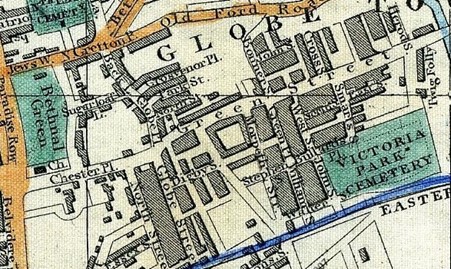
Green Street, Bethnal Green, from Cross’ Map of London 1851. Twig Folly on the right of the map gave its name to the bridge where Green Street crossed Regents Canal.

Then on May 8th 1861 we find the following Poor Law Removal judgement:

Frederick Platt, 34, of 1 Green Street, 5 years last 25 Jan, 3 Parliament Street, Cambridge Road, Mile End, B G (Bethnal Green). Weaver.

Was born at no. 10 Geo. Gardens B G never (ye?) has lived in B G all his life father before him. Had married at St. James the Less 1853, 12 June Co produced to Louisa Sarah, who died 3 weeks ago, Louisa 7, Frederick 5, Henry 17 mos, George 5 weeks, – B G

And then in another hand:

Father pd taxes Harts Lane B G Road about 17 yrs ago and Cranbrook St. about 2 yrs. He lives at 2 Cranbrook St.

I am unclear what the ‘removal’ part of the judgement refers to and can only assume it either means the children were taken from him, or they were all evicted from the property. The final paragraph about his father having paid taxes, I am guessing meant the authorities were then willing to provide some sort of support for the children. He had married Louisa Sarah Whalley sometime between April and June 1853, in Bethnal Green – June 12th according to the Poor Law Judgement – and after she died eight years later, his world seems to have fallen apart. And it seems to have happened so quickly! Less than three weeks after Louisa is buried, this judgement is passed upon the family.

But I suspect the family may already have been in some trouble.

Bethnal Green saw a huge influx of Huguenot immigrants during the late seventeenth and early eighteen centuries, almost exclusively silk weavers. Although I cannot find any evidence to back it up, I was told in my childhood that Mum’s ancestors were Huguenots, and that would suggest the Platts were the ones referred to. Whether Platt is an Anglicized version of a French name, or a Platt had married into a Huguenot family, though, I have not been able to determine. Over the years from the Huguenots’ arrival in Britain, though, various laws were put into effect to protect the British silk industry from foreign competition. However an 1860 treaty with France allowed silks to be imported duty free and very soon the industry was in freefall. Unable to compete in price with the imported cloths, huge numbers of weavers were thrown into poverty.

The next definite sighting of Frederick John Platt is in 1877 when his son, Frederick William, is married. On the form, Frederick John’s occupation is given as undertaker, and Frederick W is a commercial clerk. Clearly, they were no longer part of the weaving community. It is worth noting here that Frederick J’s older brother, William James Platt, has his occupation recorded as undertaker in the 1871 census, having also been a silk weaver prior to this date. It seems probable that Frederick either worked for him, or they were in partnership for a while. William then continues working as an undertaker for the rest of his life

After this, Frederick J seems to again drop off the radar for a while. I have a couple of other possible sightings but cannot find any census record for 1881 that I can be sure are his.

But then on September 15th 1884 Frederick John Platt, widower, 57, marries Sarah Mansfield, widow, 45, at St James the Less, Bethnal Green. By now he is described as a provision merchant of 40 Cranbrook Square.

One way or another, it seems he had managed to rebuild his life.

The 1891 census records a Frederick Platt, 65, ice cream vendor, and Sarah, 52, at 33 Quaker Street, Spitalfields.

And then? A Frederick Platt aged 74 died in Whitechapel, July – September 1899. That seems to be him. If it was, then he seems to have fallen upon hard times again. In January and February 1892 and then frequently from February 1895 through to February 1899 a Frederick Platt, widower, is recorded as being in and out of the workhouse at Stepney. His profession is given variously as wood chopper, labourer, or blacksmith’s assistant, and cause of admission each time as bronchitis or rheumatism.

We don’t realise how lucky we are.

Let’s Rid the Internet of Kittens

What is it about the internet and kittens, for goodness’ sake? There are far too many pictures of them.

Okay, that’s too provocative. Let’s move on.

005

She Who Dislikes Being Referred To This Way has been away for a few days. I had presumed that I would sleep better without the snoring, and the duvet being constantly pulled off me, but I was wrong.

For some reason, I’ve not slept particularly well at all.

Perhaps it was the wild parties I’ve no idea why not.

I had intended to begin a painting, maybe even get it finished, but although I carefully planned said painting, even finding a few resource pictures to use, once I sat down in front of the paper, it just refused to happen. My mind went completely blank and my enthusiasm kicked the wall sulkily for a few moments and then ran out of the house sobbing.

Oh well, back to the writing.

I did have a few ideas for short stories and, because I know how to use my time both productively and wisely, immediately started writing two of them, as well as continuing with both the novels I’m writing. That’s what you’re meant to do, right? Isn’t it?

Oh, and a poem.

And, of course, I need to do research for all the various Tales In Process. Isn’t it amazing what a little bit of research throws up?

Here are just a couple of little snippets, a few gobbets of curiosity, that I have come across recently while researching topics in medieval Persia and India, for use in my #1 Novel In Progress, The Assassin’s Garden.

All of the prostitutes in Fatephur Sikri, India, during the short time that it was Akhbar’s capital, were kept in an area just outside the city called ‘The Devil’s Quarter’.

You do get sidetracked, of course, but perhaps that will be an integral part of the plot? Possible spoiler alert?

I wouldn’t like to say.

And at one point, there is a long journey undertaken in my book, by caravan.

‘Caravan’ is a Persian word, I discover. That seems appropriate. In some parts of Persia they would travel by day and rest by night.

In others, the reverse was true. Something to do with the temperature, I expect.

In the nineteenth century, there were caravans that existed just to transfer corpses to holy cities for burial. These disappeared in the early twentieth century, largely due to better understanding of how diseases spread!

And, obviously, I mean the caravans that are chock full of camels and traders and an ill-assorted collection of ne’er-do-wells, not the wretched giant metal boxes blocking ninety percent of our roads as soon as the weather shows even the faintest promise of a few hours of sunshine.

But enough of caravans, for now, I’ve got some words to beat into shape.

Oh, and there are still people who would prefer pictures of kittens?

Pitfalls for Writers – no.6: Historical Accuracy


‘Dear Mr. Author.

Whilst reading your book ‘Oh what fun and laughter we had during the time the Black Death wiped out our village’ the other day, I was disappointed to notice that you mentioned July 23rd 1449 as having been a sunny day in your fictitious village. From the descriptions you provide, you have clearly located said village a little to the south of present day Norwich, and my extensive researches prove that July 23rd 1449 would have been a rainy day there.

Yours disgruntledly,

A Pedant.’

How accurate do you need to be, as a writer, with historical facts?

If you are writing a non-fiction book, you have to be scrupulously accurate, no matter what subject it is.

End of.

On the other hand, if you are writing fiction, you have a certain amount of leeway. First of all, though, it is worth saying that if you sell enough copies of your book you will eventually attract correspondents like the fellow above. Is that something to worry about? Only if they get to know where you live, perhaps. Otherwise, send them a nice reply, thanking them for their diligence, and assuring them that you will correct your dreadful fault in the next edition. On the other hand:

‘Dear Mr Author.

The Black Death was actually sweeping the country in 1349, not 1449.

Yours smugly,

A Historian.’

This time, you’ve screwed up.

And yes, it matters.

Very minor inaccuracies are bound to slip through, and very few people will notice them. And if they do, they will not think anything of them.

Except for Arthur Pedant, of course.

The big things are another matter. Imagine reading a novel set in the days around the Russian Revolution, and then the author tells you that the Bolsheviks rose up against the state in 1927 instead of 1917. Or that they were led in the beginning by Stalin. Immediately, the author’s credibility has evaporated, as has their story.

Because the reader no longer believes the author, and they no longer accept their story.

The moral here, then, is don’t skimp on the research!

It is possible to radically change the facts of history, but the difference is that to do this the author must present it as the whole point of the story. In steampunk novels, the whole history of Victorian Britain is altered, but the reader accepts this as it is the premise behind the genre. It is seen not as a mistake, but as a narrative invention.

In many science fiction novels, the premise is a future that is the result of a different history than that which actually happened. For example, the Germans won the Second World War, or of different worlds or dimensions in which history diverges from the accepted version. Again, this is accepted by the reader, as it is the premise that the story is set on.

It is possible to break this rule, but to do so the author has to break it in such a way that it is quickly obvious that they have done it deliberately, and not by mistake.

One might, for example, set a novel in Victorian England that is not steampunk – a detective story, perhaps – but in which Queen Victoria is assassinated in 1860. As this is something that no one could possibly put in by accident, it will be seen as part of the invented narrative and accepted.

Well, probably. Where is Arthur Pedant?

The Past is Another Country…

…they do things differently there (L.P.Hartley )

Almost 20 years ago I was a care-worker, paying visits to support elderly folk who were, for various reasons, unable to cope on their own. I would provide support in a number of ways – cooking, washing and dressing,and cleaning, for example.

One man I visited quite often would talk a lot about his younger days – as is natural. He had a wealth of stories, and I always told him he should get someone to write them down. It is the ordinary person’s stories that are frequently the most interesting, and the ones that we usually don’t hear. Famous politicians, sports stars, movie stars…well, they write autobiographies, or have them written for them, and we hear all about the other famous people they knew and the hotels they stayed in…yawn, yawn, yawn.

But we hear far less about the family in the village 80 years ago, their day to day life and how the outside world impacted upon them.

Below, there is a photo of London Road, just outside of Tunbridge Wells, taken earlier today.

005

My client told me that during his youth, he would walk back along this road after an evening out in town, describing how there was nothing but open fields on both sides for much of the walk. Looking at it now, it is hard to picture that, since I have never known it any way other than how it looks now.

But prior to this, in his childhood, he lived in the village of Groombridge, on the other side of Tunbridge Wells, and he told me how, as a schoolboy during the First World War, he and his classmates ran out of the class one day and across a field, to see a German Zeppelin airship that had just been shot down.

It is stories like this, that are the genuinely interesting stories that come out of the past.

And for my large Work In Progress, the past really is a foreign country. Much of it is set in Persia and India, in a time frame that covers some 300 years up until the late 19th century.

Now, I was about to write that if it is difficult for me to picture the main road near where I live as it was some 50 to 75 years ago, then it is far more difficult for me to picture the places in India and Persia where and when I have set my novel, but then I realised that this is not actually true.

And so this post is now taking a turn that I had not expected when I sat down to write it.

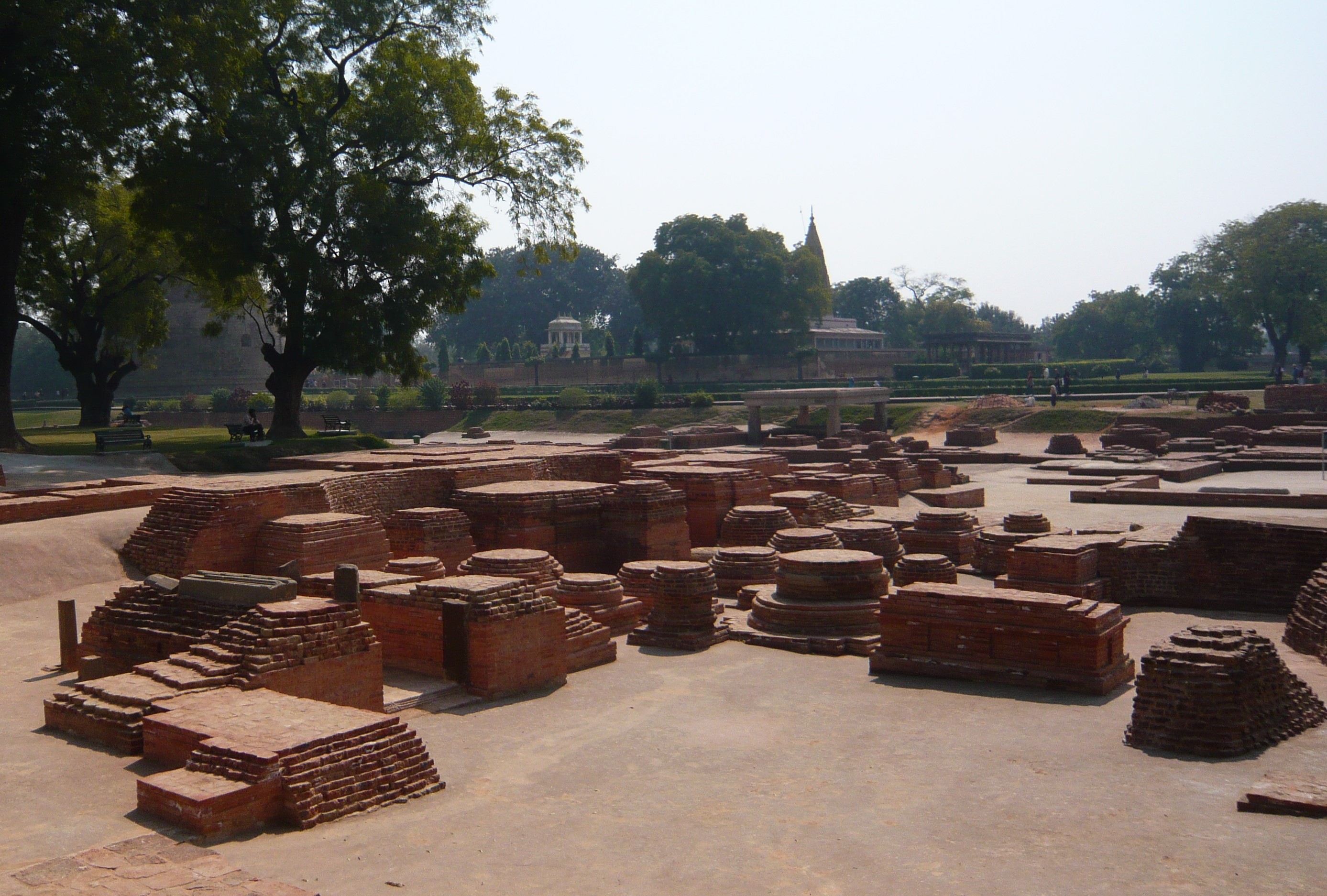
The Indian capital at the time was at Fatehpur Sikri, which today is just the remains of those buildings – it was only occupied for some 22 years, and then abandoned. I have visited the site and walked around it, and it is quite easy to imagine it occupied by Akhbar, his court, and the general population.

I have never been to Persia (modern day Iran), so my impressions are formed only at second hand. And much of what I have read consists of works about the 1500’s, and I am familiar with many of the paintings of the period, so again it seems almost natural to imagine it as it was then.

And then when I have travelled in India, as well as in the Middle East, I have spent a lot of time visiting the old parts of the towns and cities, and many rural areas where life follows the same patterns that it has for hundreds of years, and so, again, it seems more natural to picture the settings for my book in those time periods that concern me.

Finally, researching these areas, I often come across old black and white photos of places of interest to me, and since I have not been there, they are the only impression of these places that I have.

Of course, Tunbridge Wells in the Victorian era is much harder for me to visualise. All of the modern buildings get in the way of my imagination. All of the roads are surfaced with tarmac, the open spaces have largely gone, and many parts of the common that used to be open and windswept are now covered in trees.

On a slightly different note….

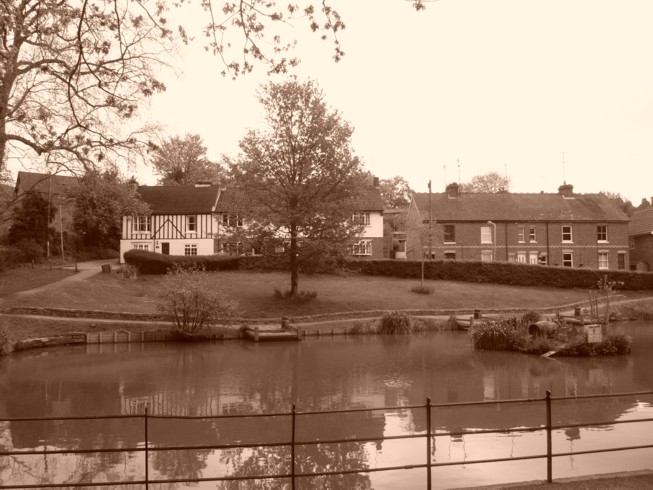
As a project, I occasionally take photos in sepia of the area around where I live, as though they might have been taken about 80 years ago – around the time that my elderly client was walking along the London Road, winds blowing across the fields either side of him, and the only light from the moon. Each photo that I take has something in it to show that it was taken recently though, rather than a long time ago, such as a modern vehicle, a modern street lamp, road markings, or modern windows. The shot below is an example.

Holden Pond

Easy to feel that it might be taken in 1930.

The Problem of Historical Truth

In my previous post about the pitfalls of online research, I began by alluding to the unreliability of newspaper reports. If you were to read reports on an important item of news in a number of different newspapers, you frequently might be forgiven for thinking that they were actually talking about completely different events. There will be political bias, of course, and the prejudices and agendas of reporters and editors alike. Are the individuals in an armed insurgency terrorists or freedom fighters? It is a point of view. Are strikers in an industry greedy mischief-making saboteurs, or victimised and mistreated victims of greedy corporations? Again, it is a point of view.

It can be very hard today to see through the fog of opinions and misinformation on any topic. How much more so when we delve back into time?

History is written by the victors. For example, what we know about Caesar’s campaigns in Gaul and Britain were written largely by the Roman conquerors, especially Caesar himself. Most of what we know of the reign of Ashoka, in India, comes from the edicts that he caused to be inscribed upon the remarkable number of rocks and pillars that are still in existence.

023 (2)

Even tales written by the vanquished are likely to be inaccurate, of course. The cruelty of the victors, their barbarity; all of their actions will be exaggerated.

The historian understands that information comes largely from primary and secondary sources. A primary source might be, for example, an account written at the time (Caesar, above) or Parish registers of births, marriages and deaths. These sources are considered to be most likely to be accurate, being compiled at the time of the events described, but clearly they might all be deliberately or accidently falsified. Secondary sources might be newspapers, which are largely made up of analysis and opinion, and therefore considered to be an interpretation of information that has been derived from another (hopefully primary!) source.

A primary source is also referred to as evidence, yet I wonder whether a better distinction would be made if ‘evidence’ referred only to unwritten sources; archaeological remains, buildings, pottery, jewellery and coins and their like, which, whilst needing interpretation, are unlikely to be prey to the kind of distortions that written sources might be. Caesar, after all, might have claimed to take ten thousand prisoners when he only took five hundred, yet pottery of a particular type that is found at a particular spot, tells a story that needs to be interpreted, yet is unlikely to be a falsehood.

We need to be careful, though, when it is interpreted in light of contemporary writing, to avoid the temptation of unconsciously corroborating those writings.

Having written the above, we do have to take a certain amount on trust, because it is not practical to question everything in the world that we come across.

Yet, just because we discover that Troy really does exist, does not mean that all of the stories of the Iliad are now, somehow, all true. That would be like an author writing an incredibly impossible fantasy tale, in which the city of Vienna still exists and features, yet claiming it must be true because Vienna is a real place.

During the first year of World War One, a fictional short story ‘The Bowmen’ was published in the London Evening News by Arthur Machen. In this tale, he describes a battle between English and German soldiers at Mons, in France, in which the beleaguered British were aided by the sudden appearance of phantom archers who intervened to keep the British safe. Although this was fiction, the story quickly ‘went viral’, as we might put it today, and was readily believed by many in Britain. Of course, there was a feeling then that the British were good and the Germans evil, and so it was natural that God might intervene to help and protect them. A far stronger belief in God, in those days, also contributed to the feeling that it was natural to find that a miracle had occurred.

Although Machen republished the tale in a book with a long introduction explaining that it was fiction, and examining reasons the public thought it was true, not only did the belief persist, but further reports of angels on the battlefield began to appear. As a child in the 1960’s, I remember reading an account of this in a comic, with it presented as the truth. In 2001, the Sunday Times reported that photographic evidence to support the story had been discovered, although this was proved to be a hoax.

The Sunday Times also published exerts from Hitler’s Diaries in 1983, until these, too, were proved to have been forged.

Memories are notoriously unreliable. I was reading just a few days ago of an experiment where a group of people were encouraged to discuss childhood memories, with selected members of the group feeding in deliberately false information. After an initial hesitation, it seemed that all of them accepted these false memories as real, even to the extent of agreeing that they had taken part in a balloon ride, when they had not, and describing what they had seen from the balloon, and their feelings during the ride. The point being that they came to believe these were their own, real, memories.

How reliable are our own memories, then? And what can we trust? Clearly, there must be a lot of historical narrative that has been honestly recorded, that is simply not true, and we are unlikely to ever know what it is.