India – My First Time 2 (reblog)

The second and final part of an early travel post:

A few more photographs from 1989 (my apologies for the quality of some of them – all I had with me was a very cheap camera):

After a few days in Delhi, I went to Srinagar, in Kashmir. I took the bus that went through Jammu, and 24 hours after leaving I was deposited in Srinagar.

On the way, I did one of the most stupid things I have ever done in India.

The bus was packed. I think that I was the only westerner on the bus, but I liked it that way. On a 24 hour bus trip, it is pretty well impossible to ignore your neighbours for the entire journey, and so I spent much of the time chatting with the chap sitting next to me, and the ones across the aisle. When the bus halted to allow us to get some food, we sat at the side of the road together munching on the samosas, pakoras and newspaper twists full of nuts that we had bought.

When it started up again, we chatted long into the night before falling asleep.

And at the first stop just after dawn, at another cluster of roadside stalls for breakfast, I joined them at the broken water pipe beside the road where we all brushed our teeth.

Maybe if I had spent longer than just a few days in India by then, the consequences would not have been so violent. But as it was, my stomach had clearly not yet adjusted to Indian bacteria.

And maybe if I had spent longer in India I would have realised that it was not a clever thing to do in the first place.
IMG

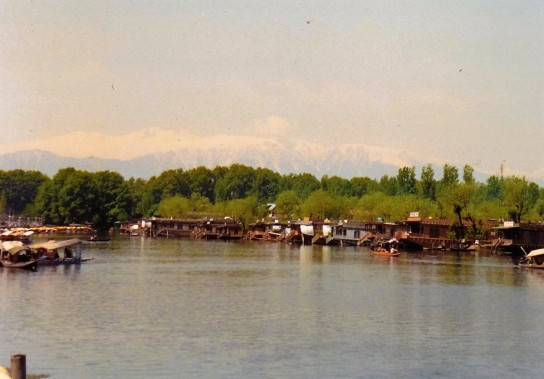
In Srinagar, I stayed on a houseboat on Lake Dal. I no longer remember what it was called, but I was the only guest, and I had the place to myself. These wonderful floating mini-palaces are a relic of the days of British India, when the local Prince refused to allow the British to purchase land to build houses. They got around this by causing the construction of houseboats to stay on, instead. Made from wood, beautifully carved, and furnished opulently throughout, they seemed to me to be unspeakable luxury after my 24 hour bus journey.

The rapidly multiplying bacteria in my stomach, though, were clearly in a hurry to join all of their friends in the Lake. But for someone feeling poorly and reluctant to stray too far from a bathroom for a few days, the houseboat could not have been better. I had my meals cooked for me, and any little treats I fancied I could buy from one of the many shikaras that continually paddled up to the houseboat. These little boats, which also acted as water taxis, sold chocolate, flowers, fruit and vegetables, cigarettes, snacks, flowers, newspapers and yet more flowers.

I passed much of that time on the deck or on the roof reading, or chatting with the folks around me on the nearby boats or on the shikaras.

After a few days I recovered enough to explore the area a little. I walked many of the paths around the lake, which is a more complex shape than the visitor first realises. I would frequently find myself on causeways or small spurs of land sticking far out into the lake. I wandered around the Shalimar and Nishat gardens, and I walked up the long, winding path to the Shankaracharya Temple, on the hill of the same name.

This was March, 1989, and even someone as unobservant as me could not fail to spot the signs of unrest. Once or twice in the evenings I heard what might be shots or small explosions in the distance, which my host casually dismissed as ‘bandits’. On one occasion, walking through Srinagar I found the road blocked outside a mosque, where there was lots of shouting and a large police presence; although on reflection, I have seen much the same thing outside the rail ticket reservation office in Kolkata, and perhaps I should not make too much of it as an incident.

It was only a few short weeks later, however, that the insurgency began in earnest. For a long time there would be very few further visitors to the lovely Vale of Kashmir.

After a week, I returned to Delhi and then headed immediately to Agra, to see the Taj Mahal. I chartered a car and driver, because I wanted to also visit Fatehpur Sikri on the way.
IMG_0002

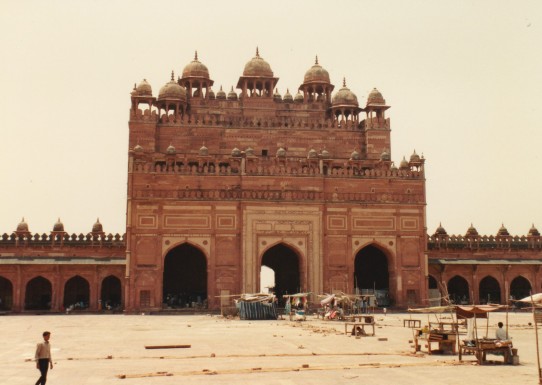
Fatehpur Sikri was built by the emperor Akbar in the sixteenth century. His intention was to create a new capital city that honoured a Sufi Saint whose blessing the emperor believed had given him a male heir. This site was chosen, as it was close to the dwelling of the saint. Unfortunately, the area suffered from water shortages, and the city was abandoned shortly after the emperor died, after only 13 years occupation.

There remains the magnificent, well preserved, fortified city that I wanted to wander around for a few hours. Inside, there were a few stalls selling souvenirs and drinks, and a number of other visitors looking around, but generally there was an impression of peace and emptiness. I have not been back since, but I believe that it is now far more crowded, and that there are far more touts and hawkers on the site.
IMG_0003 (2)

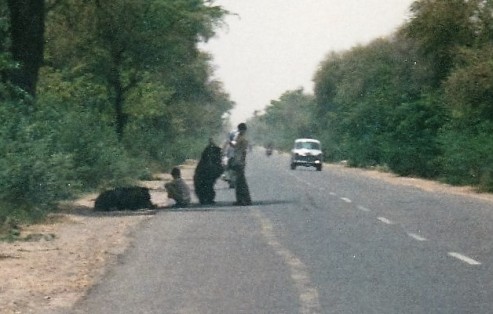
Performing bears at the side of the road. The cruel practice of dancing bears was made illegal in India in 1972, but was certainly still common in 1989. These ones were at the side of the road not far from Fatehpur Sikri, on my way to Agra.

In Agra itself, I visited the Taj Mahal.
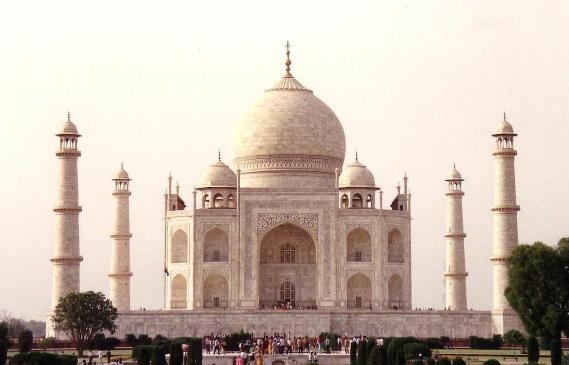
the_classic

There are plenty of people who will tell you that it is over-hyped, and that there are many greater buildings in the world. It is possible, also, that some of these people have actually been to Agra.

It may be that there are some buildings that are more impressive, but how can you measure such things?

My first sight of it, as I walked through the gateway, made me catch my breath and stop still. For a moment, I could not believe how lovely it was. I then spent a long time wandering around the site, and I still think it one of the most beautiful and magnificent buildings that I have ever seen. I watched the afternoon light fade and die, and the sun go down, and the building seemed to glow and shimmer and almost float before me.

I left when they threw us all out at dusk, knowing that I had just seen something very special.

India – My First Time 1 (reblog)

As promised, a repost of one of my early travel posts. This is part one of two, so I’ll re-post the second one shortly:

Just a few photos this time, taken on my first proper trip to India. On the only previous visit, in 1988, I had spent a manic 18 hours in Delhi, and then taken a long bus journey to Nepal. That was a journey that really should be the subject of a blog itself, sometime.

On the following year, then, I returned to India, intending to spend rather longer there this time. As it turned out, I had to return to England after a few weeks, but the short time that I was in India whetted my appetite for more. It is said that western visitors to India tend to fall into one or the other of two categories. Either they fall in love with the country, and return whenever they can, or they swear never to go within a thousand miles of it ever again.

I’ve been back about ten times.

Delhi Red Fort 1

The Red Fort (1989)

I arrived in Delhi with a copy of Lonely Planet’s ‘West Asia on a Shoestring’. In those days, the Lonely Planet tomes really were aimed at backpacking budget travellers, with their recommendations for rooms tending to be dormitories and really cheap hotels. My flight arrived in the late afternoon, so that not only was I weary from the long journey, but the light was already fading when I walked out of the airport. In the chaotic maelstrom outside of passengers and taxi drivers fighting over them, I managed to remain calm enough to locate the corner where the buses of the Ex-Servicemen’s Air Link Transport Services waited. I think they are still in operation today (I’m sure someone will tell me), with their yellow (I think) buses providing a cheap link into the centre of Delhi where I was heading.

I was dropped off near the hotel I had decided to use, the Ashok Yatri Niwas, which stood at the junction of Janpath and Ashoka Road. It has long gone, now; a great concrete monster of a place with cement beds and lifts that seemed to take half a day to do the full journey up to the top floor. I don’t think that many people mourn its going, but I was reasonably comfortable there for a couple of nights. It was where I had stayed the previous year for the one night I was in Delhi. There was hot water in the bathroom, as long as you rose early enough, and I remember the cafeteria being fairly basic, but adequate. For someone on a tight budget, it was fine. Back then, it was a case of turn up and hope there was a room, especially if you had just arrived in the country. There was no email in those days. But it was pretty big, and there was room for me.

Unlike my previous flying visit, I now had time to wander about and savour everything around me. And for the first time, it really did seem an alien and exotic society. I had enjoyed browsing in the souks (bazaars) when I had lived in Oman, and also out in the little villages there, but my first taste of India seemed to me to be as exciting and exotic as it got. Everywhere I went, I was surrounded by the noise of traffic and the odours of exhaust fumes. But the traffic was different; the buses appeared to be almost falling to pieces, loud and fierce, with people hanging off the outside as well as being crammed inside behind open, barred, windows. I saw autos everywhere; the little three-wheeled taxis that buzzed like wasps through the traffic, squeezing through every available gap. Amongst this impatient, petulant, hooting traffic, carts pulled by horses or buffaloes plodded. Motorbike riders forced their way through, and cyclists cautiously weaved their way along. Everywhere, pedestrians took their lives in their hands to cross the roads, but the traffic all swerved out of the way for the cattle that wandered imperiously through the streets, ignoring it all.

Incredibly, through the traffic pollution so thick that you could grab handfuls of it out of the air, there were dozens of other smells assailing me everywhere I went. I was tempted every few steps by cooking foods, and then I might pass a doorway and a strong smell of incense would waft out. Seconds later, I would suddenly wrinkle my nose as I passed a pool of sewage on the sidewalk, but then immediately I might pass a fragrant flower stall.

delhi_gate

Delhi Gate, in the old city near Chandni Chowk. (1989)

There were temples everywhere, and a shrine of some description every few steps. Here and there were green and white mosques, stalls of old sacking and weathered boards set up outside gleaming new metal, glass and concrete shops. There were holy men jostling office workers, great hump-backed cattle and pariah dogs in corners or in the middle of the footway, beggars, shoe shiners, touts and hustlers, people in a hurry and idlers passing the time of day. I was urged to discretely change money, buy drugs, see pornographic videos, have a massage, change hotels, visit ‘my brother’s’ shop or book a trip to another part of India.

It was dirty, colourful, loud, exciting, and different and I loved it.

I walked everywhere I could, not just because I was on a tight budget, but it is always how I have got to know a place. I went to the Red Fort, on my first full day there, enjoying the relative peace and quiet inside, and it was here that I discovered Mogul architecture: The beautiful soft red stone and the marble, the carvings and inlay, the arches and columns…the only time I’d seen architecture that beautiful, before, was in Grenada, in Spain.

And now, looking at the photos I took, I am struck by an odd discrepancy. In my memory, one of the defining things about Delhi when I arrived was the incredible press of traffic. In my photos, though, there are comparatively few people, and even less traffic. Is my memory at fault? Is it just that there were obviously far fewer people in India 30 years ago? Perhaps it is chance alone.

But I think I’ll return to the architecture at a later date.

The Conquering Hero Comes!

This is another day when I feel frustrated because I’d like to be out travelling, although I did get to have a great long walk on the South Downs on Saturday. But rather than post about that at the moment, I have a fancy to re-post this piece I wrote a few years ago:

I’ve never wanted to ‘conquer’ mountains.

img_0010

Or any other parts of the world, really.

I’ve always felt this was the wrong way to think of a journey. It was ridiculous to think I could impose my will upon a mountain, or on a desert, or indeed upon any part of my route. That I could, perhaps, somehow bend it to my will.

I feel it is more a case of preparing as best as possible, including mentally, and then perhaps said mountain will tolerate my presence; will allow me passage.

‘Conquering’ also carries the implication of invasion, of fighting, of strife. That is not the sort of relationship I want with mountains, or with any other place I choose to travel.

Certainly, in the past I have travelled at least partly with that mindset at times.

IMG_0005

Some of you may recall I wrote about an extremely foolish journey I took in Oman when I lived there over thirty years ago (Mr. Stupid Goes For a Walk). Although I was running low on water, I pushed myself to the limit to reach the final ridge of hills on the route I had decided I was going to achieve one day, nearly killing my stupid self in the process. And although I achieved my aim, I didn’t feel victorious.

Only a bit stupid.

I prefer instead to think of myself as a visitor. And as a visitor, I need to have some manners. You do not expect to find the visitors pushing through your house and demanding to see this or to be given that, so I don’t.

I am not out to break records, nor to prove how tough I am.

This does not imply a lack of ambition, nor a lack of determination. Indeed, I have both – it’s just that the mindset is a little different. In particular, I give myself different priorities. I want to reach my goal but if I don’t, it does not matter. I think I’m more attuned to my own safety, and perhaps that of others. I hope I can be receptive to the feelings of others, too.

A good example in the climbing world is that of the mountains in Nepal that climbers are forbidden to reach the summit of, due to the belief that they are the abode of gods. Theoretically, a climber will stop some 10 meters or so short of the summit. Opinion is naturally divided over whether a climber would, or wouldn’t, in the absence of any witnesses, respect that ban.

I would respect it every time.

The mountains, of course, are inanimate. They do not wish me harm or otherwise. Neither do deserts or oceans. Even the most inhospitable of landscapes is neutral. It does not care whether I succeed in my aim to reach or traverse a particular part of it, and it will not hinder or help me in the attempt.

154

My feelings about a landscape are just my reactions to it, and if I should choose to give this landscape a kindly or vindictive character, I am only projecting my own feelings onto it.

This may give me comfort, or otherwise, but will make no material difference.

Maybe I am simply suggesting it’s good to travel with humility.

I have touched upon that before!

An Andalusian Adventure (2)

Part 1 can be found here: Part 1

It was a long way to Colmenar. I was walking up into the Malaga Mountains, with no map and no directions other than a road sign at the edge of Malaga suggesting that by following this road I would eventually reach my destination.

I suspect I have undertaken other journeys where I have been better prepared.

But the day was perfect for walking, with high drifting clouds and a light breeze to keep me cool, and having done little for several days other than eat, drink and wander around Malaga, I was feeling fit, fresh, and eager to get going.

As the hours went by and I slowly gained height, the clouds began to build up, and the temperature gradually dropped. About an hour from my destination, it finally began to rain. Immediately the temperature plummeted, and I rapidly went from merely chilled to decidedly cold.

Usually, we approach rain all wrong. Buddhists would say unskilfully. If it begins to rain, we hunch ourselves up, both physically and mentally. We fear becoming cold and wet. We need to let go of this fear. It’s a good lesson to learn. Stop. Take several long, slow, deep, breaths, and let go of this feeling. Let go of this need. We act as though hunching ourselves up will keep us dry and make us warmer. It doesn’t. Unless one can find shelter, it is better to accept the rain and finish the journey.

It is a cliché to speak of heightened awareness, yet that is also a by-product of this letting go. We remove our focus from the rain and instead allow it to go elsewhere, where it is really needed. We should throw back our heads and embrace the rain, enjoy the freshness of the rain on our faces. Listen to the sound of the rain on the ground and the leaves around us.

Back then, I hadn’t learned that lesson. I hurried towards the town as fast as I could.

One of the first buildings I came to was an inn. I went into the bar and asked for a room. The room I was given was reached by leaving the bar again and walking around the side of the building. The door to my room had a gap at the bottom of an inch or two, but otherwise fitted the door frame well enough. It was locked and unlocked by the type of huge key frequently described as a jailor’s key. The room was furnished only with a bed, a chair, and a small chest of drawers. There was a mirror above the chest of drawers and a crucifix above the head of the bed, but other than those the whitewashed walls were bare. There was a small window which was shuttered. The floor was of flagstones, with no carpet or mat. To use toilet or bathroom it was necessary to leave the room again and continue still further around the building to reach a very basic room. But again, it was clean. And there was a toilet that worked, and a sink with a cold tap. There was also a shower set into the ceiling I could have braved, but it felt much too cold for that.

Later, I would occupy rooms like this in many other places, in many other countries. Simple, perfectly clean, and usually very cheap. I am not sure whether it is because they appeal to the minimalist in me, but in many ways I prefer them to more comfortable accommodation.

Whenever I have stayed in one, I have always felt I was carrying too much baggage with me. I have been beset with the feeling I should be throwing out some of the items I have in my bag – do I need all those clothes? All those other items? It has been a recurring regret of mine that I have never managed to live a simpler lifestyle than I have. I have never enjoyed the frenetic hurry and clamour of modern urban life, and I hate how easily my life can become complex and filled with what feels like unnecessary fuss.

Here, even the spartan contents of my rucksack seemed too much. Perhaps I had too many books with me…

But now I was here, I changed out of my wet clothes and opened the shutters so I could look out at the low cloud and misty horizon. The rain drummed comfortingly on the roof and I settled down to read a book for an hour or so. I was content, and that’s a good place to be.

I cannot remember what I had for supper that night, but I do remember I drank a bottle of cheap red wine with it. Perhaps that is the reason.

I rather think I slept well, too.

And as in all good stories, the morning dawned bright and clear, the sun shining low in a clear blue sky. Before I left the town, I passed a couple of shops and bought a few items for my lunch: bread, a huge tomato, a hunk of cheese, a couple of apples, a bottle of cheap wine.

img20190318_12103098

With the improved weather, and the fact I had more downhill stretches that day than uphill ones, I allowed myself the luxury of returning to Malaga slowly, including a stop for lunch of about an hour. Compared to the UK, Spain is a large country and the rural population is comparatively small. Although I was not far from the city, I saw almost no one else on my walk and I meandered along slowly through a mixture of low trees and bushes, many of them in flower – the distinctive Mediterranean maquis vegetation – rocky outcrops and clumps of flowers, and the occasional lone farmhouse. The ground was dry and dusty, as though the rain of the previous day had never happened, and the sun was hot. With my lunch consisting of about half a bottle of wine as well as the food, I was feeling extremely weary and footsore when I reached Malaga again. I found the hotel I’d stayed in before and got a room on the same floor. After showering, I finished the bread and cheese and decided all I wanted to do was read my book for a while and then have an early night.

There was a knock at the door and when I opened it Matthias was standing there grinning.

‘I saw you arrive earlier. We go for beer, now!’

An Andalusian Adventure (1)

img20190318_12075705

It wasn’t my first trip to Spain, although it was a long time ago now. I walked into Malaga with a rucksack on my back and followed the signs for ‘Centro’ until I found myself in the crowded central district of older narrow streets with three- and four-story shops and cafes, guest houses and cheap hotels. The second hotel I tried offered me a perfectly adequate room on the third floor at a very good price.

The hotel was old. The wooden floors of the corridors were worn and polished by the passage of countless feet, and everywhere seemed gloomy. It gave the impression of having more nooks and corners where light never penetrated than it should. But the only light came from the occasional bulbs hanging from the ceilings, and other than by returning to the street, the visitor would only encounter daylight once they had reached their room and opened the curtains.

The bed was old, and sagged a good deal more than it should, and the furniture was so dark with age it was difficult to make out the grain. As a base for a few days, I decided it would suit me fine. As I unpacked and settled in, I suddenly heard a violin being played. It sounded quite close, and I opened my bedroom door to investigate. I had just decided the sound was coming from a neighbouring room when it stopped, and then a door opened. A man about ten years older than myself emerged and stopped when he saw me.

‘I’m sorry,’ he said. ‘Did I disturb you?’

He introduced himself as a German who I shall call Matthias, although I am no longer certain that was his name, and who immediately invited me to go for a beer.

It would have been rude of me to refuse.

Matthias was meandering around Europe, he told me, and supporting himself largely by busking. Later that week I was to see him playing in the street and be surprised at just how many passers-by threw coins into his hat. It seemed a particularly enjoyable way to travel. Over those beers and then over a few more later in the week, we talked travel and philosophy, music and religion. When I meet someone while travelling, I find it interesting how I often have less constraint than I would when I meet someone for the first time in more familiar surroundings. Frequently, I will reveal things about myself I would never dream of doing to someone I meet perhaps for the first time at a friend’s house, or at my writing group. I presume it is the unspoken knowledge we will never meet again.

Beside the entrance to the hotel was a little café where I made it my habit to take a breakfast consisting of strong coffee, sometimes with slices of thick white bread dipped in olive oil, sometimes with fried eggs. It was a good place to sit and watch Malaga waking up. Its clientele were a broad mixture of workers all grabbing a quick breakfast on their way to office, shop or building site. Mostly they sat in silence, reading the morning paper and smoking, other than to give their orders to the waiter. On the bar a tiny transistor radio chattered away in speech too indistinct for me to make out more than the occasional word. In a way, though, that only added to the atmosphere. Despite it being a familiar situation, there was enough of the unfamiliar and the foreign to make it feel a little exotic.

I wanted adventure, I wanted to explore. I’ve wanted to do that for as long as I can remember. I travelled in those days with a few changes of clothes in a rucksack and a minimum of half a dozen paperbacks, which invariably included something by Hermann Hesse and at least one poetry book.

That, at least, hasn’t changed much.

I liked to travel light (other than the books, of course), so I had no camera with me and probably very few of the essentials most people would think to take on a Spanish holiday. No swimwear, for example. I don’t do beaches, at least not in that way.

But I had come to Malaga because I had a peripatetic nature, and my itchy feet were troubling me. After a few days I decided to take a walk out to the little town of Colmenar, to the north of the city. I would take a room there for one night and return to Malaga the following day. Any other destination would have done just as well; the purpose was the journey, and the journey was the purpose. I chose this route simply because while wandering around the outskirts of Malaga I saw a narrow road winding up into the hills with almost no traffic on it, signposted to Colmenar. The morning after I had made the decision, I packed my rucksack and checked out of my hotel immediately after breakfast.

Part 2 to follow

A Yearning For Wilderness

Inhospitable deserts. High mountain passes. Hills or moorland in thick, blanketing fog or sudden treacherous snowfall.

IMG_0035

A situation in which I test my skills and resilience to the limit, aware of the consequences of a miscalculation or of taking my eye off the ball for too long. Certainly not a case of me fighting against the desert, or the mountain, because it’s not a battle. I have no need to ‘conquer’ anything, merely to respectfully request safe passage.

deserty-desert

At the moment I have to accept second best, walking in woodlands near my home. At least there are fewer people around while it is raining, although those who are include a posse of shrieking children – honestly, where are the wolves and bears when you need them? Two hundred years ago in Britain children would either have avoided all but the lightest of woodland, or passed through as silently as possible. Although the bears and wolves were long gone by then, the children would have been raised on a diet of nursery stories that taught them the dangers of venturing into wild places, the remnants of very necessary advice from those earlier times when careless children frequently got eaten.

Happy days!

P1060456

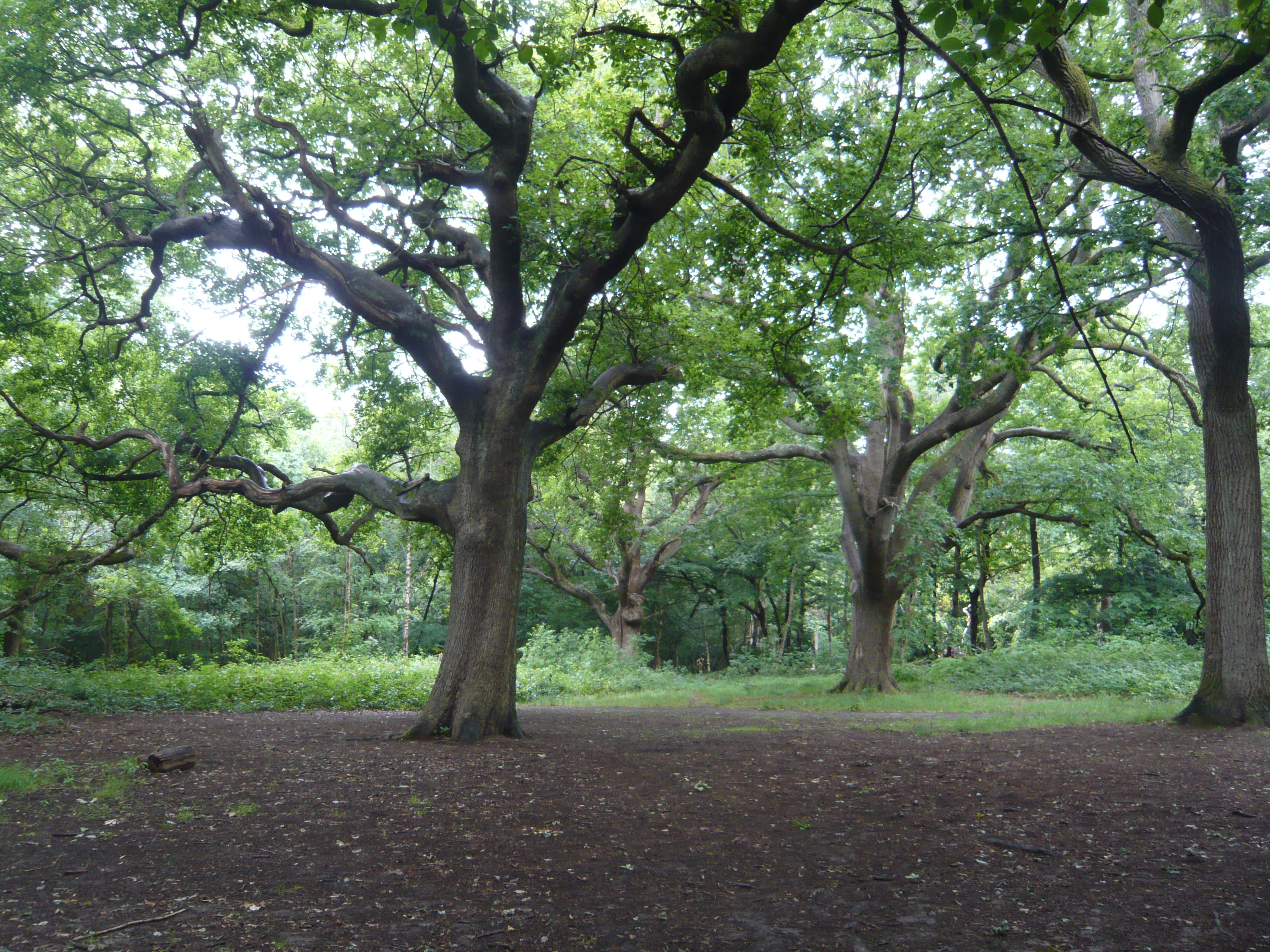
Don’t misunderstand me, I love these woodlands, and am very grateful I can get to them easily. Within them, for example, is this wonderful grove of oak trees. The oaks are not particularly old, probably around two hundred years I would imagine, but are stunningly beautiful. Some have branches thick with moss, all have wonderfully sculpted bark and all are home to huge numbers of creatures.

P1060458

P1060459

Already one or two have a limb dropping to the ground for extra stability. And the grove as an ecosystem within the wider woodland is perfect – each tree is around twenty five meters from its neighbours, which appears perfect when I look at the size of the canopy of each tree: its branches just about meet the branches of its neighbours, but there is no sense of their growth being restricted. I wonder whether this is chance, the result of long centuries of naturally evolving woodland – when one tree dies and eventually falls, that newly-opened space exploited by another seedling, or perhaps intelligent planting by a long-forgotten landowner?

P1060466

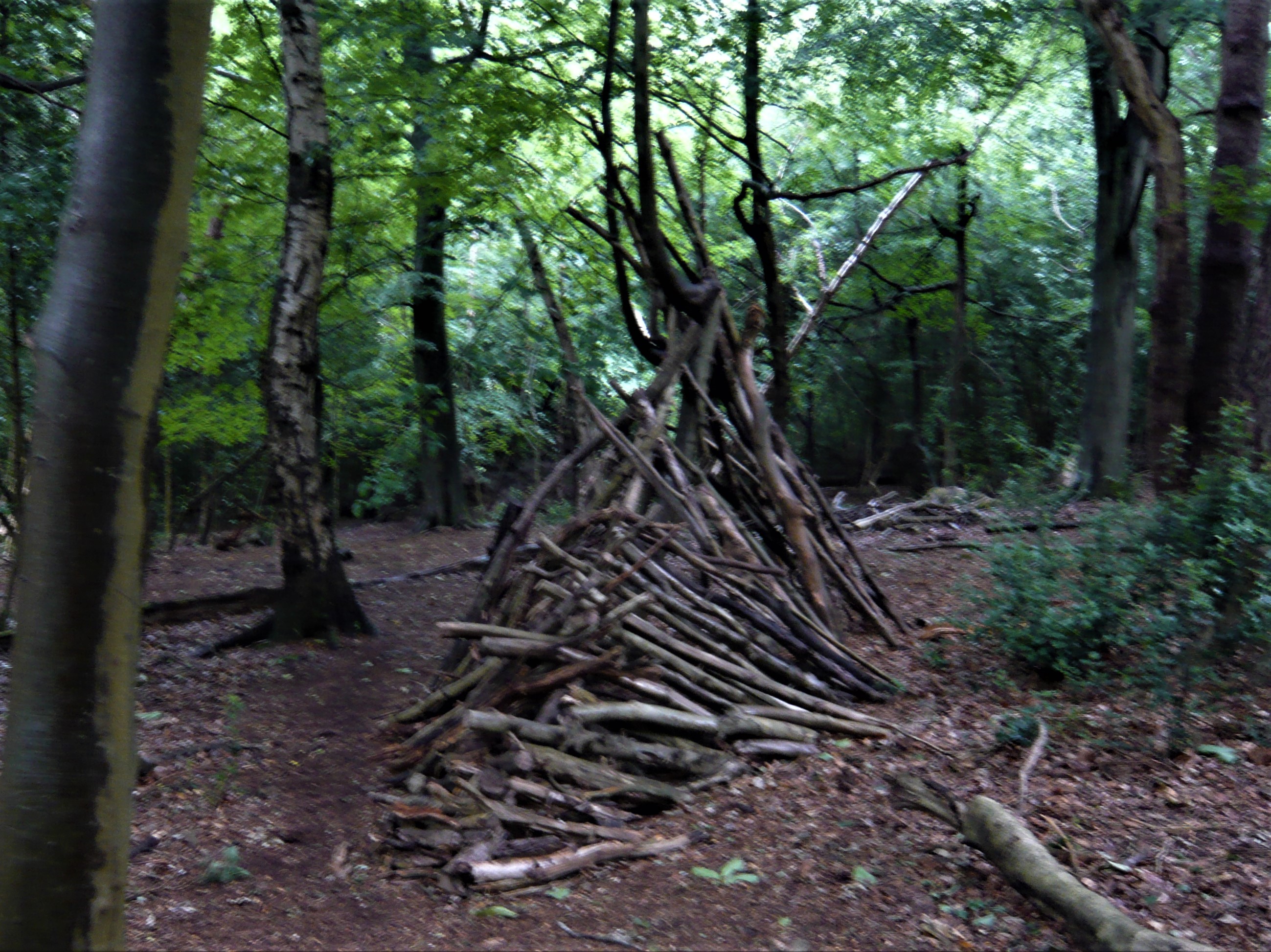
Where the woods are managed, especially the cutting in those areas where the holly is spreading in dense swathes crowding out all other growth, there are stacks of cut logs and branches exploited by children (shrieking or otherwise) to make dens. None of them would keep out the weather, but that’s not really their point. What I particularly like about them, other than it’s good to find children who want to play in this environment, rather than just sit in front of a screen, is most of these dens end up resembling the skeleton of some fantastic monster. And although that hardly turns these woods into a wilderness, it does give them just the faintest frisson of excitement, especially in the gloom.

And reminds me I want to be in the wilderness…

img20190318_12020089

As is basic human nature, of course, the longer the restrictions (either imposed or of my own choosing) go on, the more I yearn for that wilderness.

Patience!

A Busy Time in West Bengal

For the last couple of months, during Lockdown and its easing, I have spent an awful lot of time up in the Himalayan foothills of West Bengal.

bookshop (2)

Okay, that’s not strictly true, but for most of that time I have spent my working day revising, re-writing, and editing A Good Place, my novel set in a fictitious hill station there. I have some new characters to weave in, some old ones to remove, and the story line to alter in several major ways, including a different ending.

I finished the first draft some nine months ago, but there were parts I didn’t feel entirely satisfied with then, and my beta reader unerringly picked those out for major revision. I then spent a while thinking about the story line and took out nearly all the final third of the book and chucked it.

That left me with a lot to rewrite.

Much of the problem stemmed from the fact that after I published Making Friends With the Crocodile, which is set in an Indian village with peopled with all Indian characters, I wanted to write a novel dealing with the British who remained behind in India after partition. A kind of balance to my writing. That was all well and good, but I began writing the novel before I was completely satisfied with the story line, and the more I wrote of it the less I liked it. So I kept changing the story line as I wrote rather than doing what I really should have done, which was delete the whole thing and go away and write something completely different, waiting until I knew what I really wanted to write. But I’m now content that I have the story I want to tell, rather than Just A Story.

Consequently, I have been virtually living in West Bengal during these days, inevitably leading to yearnings to be there in person. Which does nothing to ease the feelings of frustration at enduring the travel restrictions of Lockdown.

050a

However, one of the advantages of having several projects on the go at once, which I always have, is that I can switch to another for a while when I need to. Last week, then, I spent one day giving a final edit to a short story which gave me the opportunity to spend the day (in my head!) in rural Sussex, which was very welcome. Especially as that is somewhere we can get to now, with a minimum of hassle.

And A Good Place? I’m glad you asked. I think I’m close to finishing the second draft, which will be a blessed relief.

Just so long as my beta reader doesn’t throw her hands up in horror when she reads it…

Ghost Roads

I love old roads that have fallen into disuse, or been relegated to the role of footpath.

There is one a few miles away on the edge of the next town. It used to be part of the road running from London to Hastings, but when the ‘A’ road that now serves that purpose was built, it not only rendered it redundant for the purposes of long distance travel, but the new cutting actually sliced through it, so it now ends at the top of a hill. From that point, there are only a couple of footpaths leading away in different directions.

Almost fifty years ago (really? Ye Gods!) I cycled along there on my way to the coast from the London suburb in which I lived as a teenager. Many of the roads I used that day are now very much wider, and all are much busier, save the one on the edge of that town. When I walk there from my house, it feels that for that part of the walk I am on a ghost road. I can still think myself onto my cycle, into that year, and the absence of traffic feels weird. If I think hard, I can almost feel spectral traffic going past. What adds to that effect, is that I often walk that way in the evening and the light – or lack of it – only encourages those feelings.

I think of it as a Ghost Road, but that definition really refers to a road that is haunted. Such a road is the B3212 that crosses Dartmoor, and on the stretch between Postbridge and Two Bridges it passes the cluster of buildings known as Powdermills. Powdermills is so-called because most of it was built for the manufacture of gunpowder. The buildings are spaced far apart in case of accidents (translation: the gunpowder blowing them to Kingdom Come), and for the same reason the roof of each building was of tarred paper. This allowed the blast of an accident to disperse upwards, hopefully giving the occupants of the building a slight chance of survival.

Anyway, there were many such accidents and many deaths. The B3212 is supposedly haunted at the bend nearest Powder Mills, just where it passes over the Cherry Brook, by a pair of hairy hands that try to wrench the steering wheel of unwary drivers that pass that way, causing them to crash. I admit to occasionally slowing down at that point and taking my hands off the wheel to see if anything happened.

It didn’t.

But I still like to think a Ghost Road is one that has fallen into partial or complete disuse. Perhaps old Roman roads that survive as footpaths are ghost roads; there are certainly stories around the country of spectral Roman legions marching along them at the dead of night.

046a

I think there is something magical about any road falling into disuse and gradually becoming overgrown. A road constructed for wheeled traffic used only by foot traffic. It has a special feel when you walk it, different to the feel of other footpaths.

A country lane at night can feel like a Ghost Road, especially in the light of a full moon.

Another type of Ghost Road is the ancient trackway. These paths criss-cross the British countryside and are often of great antiquity. Formed originally by the passage of feet, both human and animal, but used later by carts and other four-wheeled vehicles. These also seem to have that magical feel, although in this case I feel I’m sharing the passage with the ghosts of countless other travellers over thousands of years.

And in the midst of the lockdown during the Covid-19 pandemic we seemed to acquire a few more of these Ghost Roads – an unexpected benefit of the pandemic, in my opinion. It seems a real shame they have become busy again.

The Joy of Unknowing (2)

As soon as I had written my last blog post, I thought of this piece I wrote quite a long time ago which offers a similar take on travel and navigation. I am tempted to tidy it up a bit and perhaps update it to mention GPS, but instead I’ll leave it as it is.

Untitled-Grayscale-01

When I was a teenager, I began to use maps, although in rather an ad hoc, hit and miss manner. They were there for me when I was really stuck, or just wanted to know which general direction something lay. It would be a very long time before I began to use them in a careful, detailed way, able to predict the exact lie of the land, navigate in the fog or the dark, find my way through complicated landscapes with the map and compass. And, do you know, since I’ve learned to do that, I feel as though I’ve lost something rather magical, although I don’t suppose that I can blame it all on that. The maps that I was using as a teenager would tend to be the Bartholomew’s touring maps, small scale with little detail. I would feel, as I headed along a Cornish footpath, that I only knew roughly where I was going. It felt like an adventure, an exploration.

Untitled-Grayscale-02

Now, I need to be more and more remote to get that feeling, and even then it does not always work. Having just spent some time in Ladakh, in the Himalaya in the far north of India, I was surprised at just how easy all of my walking was. Setting off with map and compass, I always knew exactly where I was, only confused at times by the multiplicity of tracks criss-crossing the landscape. Even then, reference to mountains and villages with map and compass would invariably allow me to set my position. It doesn’t mean that I wanted to get lost, just that there was a small part of me that said ‘even this is all tame!’ Equally, I can be put off, by using the map, by the knowledge that over the interesting looking ridge that I was heading for, lies a motorway or building estate, and so I spend ages trying to plot a route that I try to get perfect, rather than simply heading off in the direction that I want to go and exploring as I go, correcting my course as I travel.

Nothing can tempt me more than a track leading tantalisingly into the distance, perhaps meandering through Mediterranean scrub towards a notch in the skyline, perhaps leading through a glowing archway of trees. Even now, when using map and compass to navigate, I often have to resist the temptation to ignore the map and head off to follow an interesting looking track. I think that this must be a part of my ‘I wonder what’s over the other side of the hill?’ nature. It is another reason why I’ve never been able to lie on a beach – apart from the fact that it seems a particularly pointless pastime in any case. Any time that I’ve tried it, it never seems to be more than a couple of minutes before I begin to think ‘What’s round the cliff?’ or ‘If I head back up the river, I think I might find a way through those hills.’ And then I just have to go to find out.

The Joy of Unknowing (1)

We have just returned from a few days away in Shropshire, which is one reason you haven’t heard from me recently.

We were incredibly lucky with the weather, and spent the time walking and reading and mooching around towns and villages. And finding time for the occasional meal and cold beer, of course.

Yes, we did some lovely walks. And I find it a natural thing to be constantly identifying and photographing whatever I see when out for a walk. I have always been interested in all aspects of the environment, be it the plants and animals, the geography and geology, the weather, or the historical impact of people on the environment in forms such as old trackways, deserted buildings, or ancient boundaries.

006a

And we have spent several fantastic days surrounded by an environment rich in all these things, as we have walked through woods, fields, and open hillsides, seen ancient settlements, butterflies, birds, and many wildflowers, and all this in an area of some of the most complex geology in the UK.

But sometimes I feel myself tiring of the constant need to identify and record everything; it is really a way of trying to own them.

And when you post on social media too, it can feel at times a little like a competition to put up the best pictures of this or that wildflower or bird or mountain, which naturally need to be identified and named. Especially on Twatter, whose format seems to encourage this.

017a

So, on our first morning away, as we walk up a track heading into the hills above Church Stretton, under early morning blue skies with the air crystal clear and beautifully cool, I decide that for now I am just going to exist in the moment.

Because by doing this, I am relieved of the constant necessity of deciding whether this bird is a rook or a crow, or whether that flower is greater stitchwort or lesser stitchwort.

018a

Because it doesn’t really matter.

And for now, instead of having to always know whether it is this or that bird singing, I can allow myself to simply think there is singing. There is birdsong.

Or, even better, there is a sound I find melodic, and it pleases me.

By doing this, I can relax and centre myself, which is something I feel has been badly lacking in my life recently. I have struggled with social media in any case, feeling a huge pressure to post new material and to read the many I follow, even when I don’t feel up to it.

It feels like a return to a much simpler time in my life. I can enjoy the views of the hills, the sounds of the streams and birds, and just concentrate on being.

This must have been part of the pleasure I felt as a child on every occasion when I could roam outdoors. Certainly, I was curious about what I saw, but since I knew so little about them, there was always an openness to the experience and the excitement of discovery. I would see butterflies I had not seen before, and I would just get the thrill of seeing them without having to know anything more about them. I would see wildflowers I didn’t recognise and just enjoy the shapes and colours.

Naturally, you cannot really unknow things in that way, just as you cannot really return to that point in your childhood, but it is possible, even if for only a short while, to let go of the need to identify and quantify (and therefore own) everything, and simply exist in the here and now.