The Compleat Trespasser by John Bainbridge

This time, the review without any distracting rants. Probably.

51pfb0Ihk8L._AC_UY218_

Sub-titled Journeys into Forbidden Britain, it immediately sets out its agenda: it is both a potted history of how the land was stolen from the inhabitants of Britain, and the long struggles to regain access to much of it, with numerous anecdotes of the author’s own escapades trespassing.

The story of how the inhabitants of Britain came to lose their access to the majority of the land is a story that has been repeated throughout most of Europe and beyond. Land forcibly taken by invading armies and distributed partly to their soldiers, but mainly their officials or nobility. Land enclosed by lords and kings for hunting purposes, burning villages and evicting their inhabitants from the land. Land taken by acts of Parliament to further enrich the gentry. Land given by kings to the established church, so that peasants might labour only to feed the rich and corrupt clergy.

Land that has been kept private and jealously guarded both by strict and cruel laws, and by equally cruel methods by the landowners themselves. Thus laws that deemed the starving and dispossessed villager might be executed for taking a rabbit from land he once lived on, to feed his family. Thus the mantrap that would cut a mans leg off. Thus countless thousands beaten and sometimes killed by gamekeepers and owners.

When I attempted to review this a week ago, it ended up turning into a full-blown rant against grouse moors (I do rants so well, these days!), but even today it is not just grouse moors that are fenced off just so the idle rich can enjoy slaughtering wildlife – there is plenty of woodland and more open land enclosed around the country and dedicated to pheasant shooting, for example. There are country houses with huge estates. Land taken by the MOD for training purposes, and never returned. There are many landowners determined to block access to legal rights of way. Although the Countryside Rights of Way act of 2000 was supposed to restore access to most of the countryside, there is still much that is off-limits.

Yet there are good landowners, too. The tales of John’s own trespassing include several encounters with sympathetic landowners happy to see walkers on their land, with the obvious proviso that they cause no damage.

The improved access rights we do have today were earned the hard way. Since Victorian times there have been mass trespasses intended to both bring the issue into the public forum, and to try to force change. The Kinder Trespass of 1932 is probably the most famous, yet many preceded that. It is thanks to the countless trespassers and campaigners of those days that we have improved access rights today.

The book finishes, though, with a plea. Firstly to campaign for further land reform, for better access rights – rights that are enjoyed in Scotland, but not England, Wales or Ireland. And secondly with a warning – the current government campaigned at the last election on a promise to criminalise trespass, so that anyone who deliberately or inadvertently strays from a public footpath onto private land might find themselves on a charge in a criminal court.

Anyone who enjoys the countryside in any form, enjoys spending time there, and walking in it, should read this book. It provides a very good, clear, account of where we are, how we got here, and what has been done to get us someplace better.

But also that we still have some way to go.

Ghost Roads

I love old roads that have fallen into disuse, or been relegated to the role of footpath.

There is one a few miles away on the edge of the next town. It used to be part of the road running from London to Hastings, but when the ‘A’ road that now serves that purpose was built, it not only rendered it redundant for the purposes of long distance travel, but the new cutting actually sliced through it, so it now ends at the top of a hill. From that point, there are only a couple of footpaths leading away in different directions.

Almost fifty years ago (really? Ye Gods!) I cycled along there on my way to the coast from the London suburb in which I lived as a teenager. Many of the roads I used that day are now very much wider, and all are much busier, save the one on the edge of that town. When I walk there from my house, it feels that for that part of the walk I am on a ghost road. I can still think myself onto my cycle, into that year, and the absence of traffic feels weird. If I think hard, I can almost feel spectral traffic going past. What adds to that effect, is that I often walk that way in the evening and the light – or lack of it – only encourages those feelings.

I think of it as a Ghost Road, but that definition really refers to a road that is haunted. Such a road is the B3212 that crosses Dartmoor, and on the stretch between Postbridge and Two Bridges it passes the cluster of buildings known as Powdermills. Powdermills is so-called because most of it was built for the manufacture of gunpowder. The buildings are spaced far apart in case of accidents (translation: the gunpowder blowing them to Kingdom Come), and for the same reason the roof of each building was of tarred paper. This allowed the blast of an accident to disperse upwards, hopefully giving the occupants of the building a slight chance of survival.

Anyway, there were many such accidents and many deaths. The B3212 is supposedly haunted at the bend nearest Powder Mills, just where it passes over the Cherry Brook, by a pair of hairy hands that try to wrench the steering wheel of unwary drivers that pass that way, causing them to crash. I admit to occasionally slowing down at that point and taking my hands off the wheel to see if anything happened.

It didn’t.

But I still like to think a Ghost Road is one that has fallen into partial or complete disuse. Perhaps old Roman roads that survive as footpaths are ghost roads; there are certainly stories around the country of spectral Roman legions marching along them at the dead of night.

046a

I think there is something magical about any road falling into disuse and gradually becoming overgrown. A road constructed for wheeled traffic used only by foot traffic. It has a special feel when you walk it, different to the feel of other footpaths.

A country lane at night can feel like a Ghost Road, especially in the light of a full moon.

Another type of Ghost Road is the ancient trackway. These paths criss-cross the British countryside and are often of great antiquity. Formed originally by the passage of feet, both human and animal, but used later by carts and other four-wheeled vehicles. These also seem to have that magical feel, although in this case I feel I’m sharing the passage with the ghosts of countless other travellers over thousands of years.

And in the midst of the lockdown during the Covid-19 pandemic we seemed to acquire a few more of these Ghost Roads – an unexpected benefit of the pandemic, in my opinion. It seems a real shame they have become busy again.

Flint Flakes and Very Big Snails

We are now allowed to go out to exercise for an unlimited amount of time each day.

This may not have been top of everyone’s Relaxing-the-Lockdown-Rules-Wish-List, but other than the opportunity to finally begin to see some family and friends, I think it was top of mine. On this first day of slightly increased freedom, I take camera and notebook and go off for a longer walk than I’ve been used to this last couple of months. Nothing particularly long, but it feels good to know there is no reason at all for me to limit my walk or have to justify it to anyone.

Naturally, there are other walks I want to do even more, but I’m still reluctant to use public transport to get to somewhere I want to walk and, to be quite frank, the government has not made it clear whether I’m allowed to (although they’ve given the police a major headache if they want to try to control it). So for the moment, the South Downs will have to wait.

But now I am thinking of a walk I did almost exactly a year ago, to reacquaint myself with an area of the North Downs I lived close to a long time ago. I planned to walk along an ancient trackway running along part of the ridge of the Downs, and marked as such on the Ordinance Survey map. This is an area where many Roman remains have been found over the years, mainly in the wide river valley nearby, but I had no idea how old the trackway was thought to be, whether it pre-dated the Romans or was more recent.

But many of these routes were in use long before the Romans arrived, since the early Britons found the lower lands were frequently too marshy and thickly wooded for either easy settlement or for travel. And so it is highly likely this route is several thousand years old. One of the Old Ways. And just walking along it gives me a sense of continuity with the past.

In a wooded area the footpath passed a wide, shallow pit, although there was nothing marked on my map. Mindful that it was always possible it had been dug out by early settlers mining flints, I stopped and poked around in a few areas of exposed earth until I found a couple of flint flakes that appear to have been worked.

P1060431 (2)

To my un-scholarly eye one flake appears to just be a waste flake struck off the flint being knapped (R), but the other could be the tip of perhaps a knife that was being worked but broke in the process, or even a stone chisel (L).

Having adjusted the focus of my eyesight, as it were, to looking for worked flints, I almost missed the fact that the obvious snail shell partially revealed nearby was larger than it should have been, measuring about 5 cm across.

The Romans brought all sorts of goodies to Britain, including a large edible snail (there’s no accounting for tastes) that we now call the Roman Snail. Although found over much of Europe, they have become rare in recent times. In the UK, too, they are now only found in a few areas, including parts of the North Downs, and are protected under Schedule 5 of the Wildlife and Countryside Act making it illegal to kill, handle or possess them without a licence.

The shell I found obviously belonged to one that had long ago gone to meet its maker (or maybe a few herbs and a thick gravy), although I had no way of telling how long ago.  Whether there is still a population of living snails in that area I don’t know either, since that is information that tends to be kept as secret as possible.

But both the finding of the flint flakes and the snail shell seemed to reinforce that feeling I had of continuity with the past.

On Windover Hill and The Oddness of Time

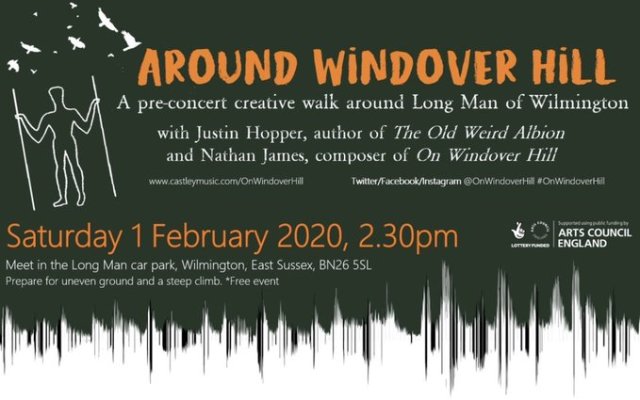
Yesterday, we joined a walk to the Long Man of Wilmington, on the South Downs in Sussex. The walk was led by composer Nathan James, and Justin Hopper, the author of The Old Weird Albion.
EPrcQenWoAQWbeb

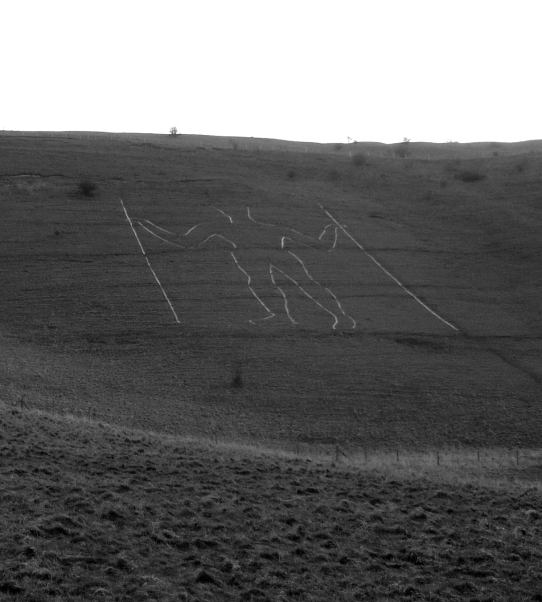
The Long Man is a chalk figure etched through the grass into the hillside, below the summit of Windover Hill, revealing the chalk that lies beneath. When and why it was first cut is the subject of myth and speculation – and that brings us neatly to Nathan’s new composition.
P1060405a

On 7th March, Nathan will premier his fantastic new choral work On Windover Hill at Boxgrove Priory, Chichester, Sussex. This has been inspired by the Long Man, its mythology, and the art that has arisen around it, as well as the written history and the geography of the surrounding land. It has a very English feel to it, in the tradition of Vaughan Williams or Holst.

Full details of the work and the performance can be found here. Tickets can also be bought by clicking ‘The Premier’ link in the sidebar there. We have ours, and it would be great to see it sold out!

This walk was by way of a taster for the concert, with a mixture of history and mythology imparted along the way, a poem from Peter Martin, read by himself, and extracts from stories read out by Justin, all of which referenced the Long Man. Also  Anna Tabbush sang two folk songs, one of which was the only song known about the Long Man, appropriately enough called The Long Man and written by the late Maria Cunningham.

P1060395a

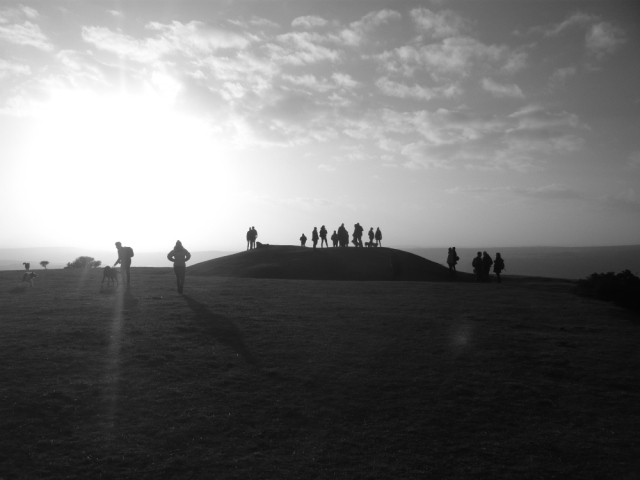
I’m not sure How many people I expected to see, but we were around forty, with a surprisingly large number being artists of one sort or another.

The weather was so much better than we had a right to expect – the forecast had been for clouds and rain, but the clouds cleared during the morning, and we had plenty of sunshine as we ascended, although it rather lived up to its name at the top, with more than enough wind for everyone.
P1060404a

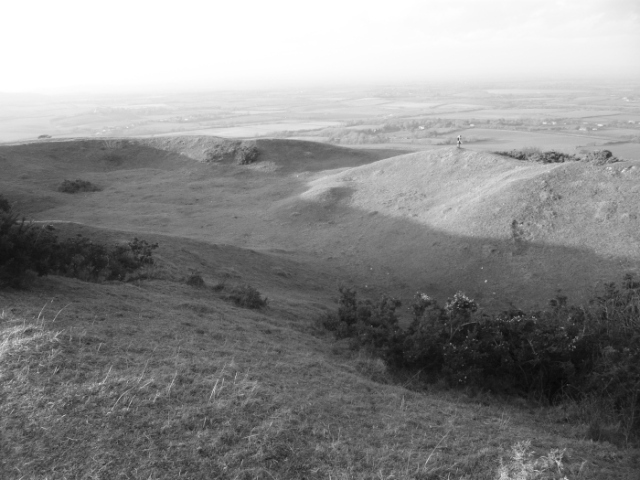
Here, the remains of prehistoric burial mounds sit overlooking the Long Man, and the rest of the surrounding countryside.
P1060403a

Some landscapes seem to muck around with your perception of time, and Downland seems especially prone to this. I’m not entirely sure why this should be, but suspect it is a combination of factors.

It is a very open landscape, and other than the contours of the land and a few trees, frequently the only features that stand out are prehistoric ones, such as barrows and chalk figures. Due to the uncertainty around their origins, these have a timelessness about them, a fluidity when it comes to grasping their history. We see the long view, which perhaps works on our sense of time as well as space. The more recent additions to the landscape are usually in the form of fences, which can easily seem invisible as we look around for something less ephemeral than the open sky to fix our eyes on.

The Downs are an ancient landscape, in any case. When human beings recolonised what is now Britain after the last Ice Age, at first they kept to the higher ground which gave less impediment to travel and settlement than the marshy and thickly wooded lowlands. Most standing stones and burial mounds from the Neolithic or earlier are found on these higher areas.

I do not get these feelings in more recent landscapes. At a medieval castle or manor house, it is easy to imagine the inhabitants baking bread or sweeping corridors; activities as natural to us today as they were then. I feel a comfortable mixture of the old and the new, a recognisable timeline connecting the past with me.

But barrows, standing stones and hillside figures have a purpose alien and unknown to us. Step on the ground near these remains and you can feel the presence of the unknown. No wonder the belief in the past in faeries and elves who inhabited the underground, and who lived essentially out of time.

They offend our carefully erected sense of order and belonging and, perhaps, still pose a barely acknowledged threat to us today.

I might be imagining it, of course, but listening to the extracts from On Windover Hill on the website, I think I recognise that feeling in places, an unexpected musical response to my own feelings. And then Nathan’s description of his creative process on the website echoes some of this too.

I’m hooked!
Who Knows Where The Time Goes?

016a

Today’s mood music is early Fairport Convention while I tinker around with a poem about crows and contemplate a painting of the same. Sandy Denny’s wonderful voice should lift my spirits a bit. The climate crisis and the dreaded ‘B’ word just leave me feeling depressed and listless.

Perhaps I’ll read something.

Or go for a walk.

I’ll catch up with everyone sometime soon.

A Little Piece Of Wilderness

I went for a walk yesterday, in search of wilderness.

Although we live on the edge of a small town, surrounded by gentle countryside, I still contrive to find some wilderness. It takes me about ten minutes to leave the streets and houses behind, and then I slow my pace and feel myself relax. Tensions drop away as soon as I am surrounded by trees.

There is little wilderness to be had where I walk, yet that does not mean there is none.

Hedgerows can be corridors of wilderness. Perhaps a transient wilderness, but a wilderness all the same. Many hedgerows in the British Isles are hundreds of years old, and although each individual one may be comparatively small, places within them may have been undisturbed for most of that time and during that time many species of plants have flourished there and smaller creatures made their homes.

My path goes through a thin belt of woodland, too open to be classed as a hedgerow and too open to have private, wild, places, but once I emerge into the daylight again, there is a hedgerow alongside the path. And for a short distance, the hedgerow widens several feet, and becomes a true wilderness.

002

Here, a patch of elder, sycamore and ash trees are surrounded by a dense undergrowth of brambles, interspersed with patches of nettles, a couple of holly bushes, and a few smaller plants squeezing into the daylight where they can.

It is the home of flies and spiders and beetles, visited while I am there by blue tits, magpies and some smaller birds I cannot identify.

Deep within it, there will be mice and shrews, and very likely larger mammals making their homes.

It is impenetrable by anyone without hacking their way in, and fortunately there is no incentive for anyone to do that.

It is wild, and I love that it is there.

An Abundance of Greyness

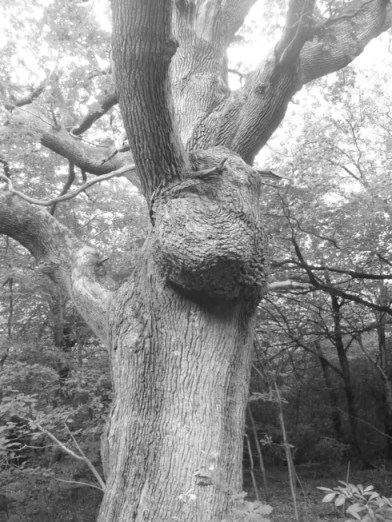
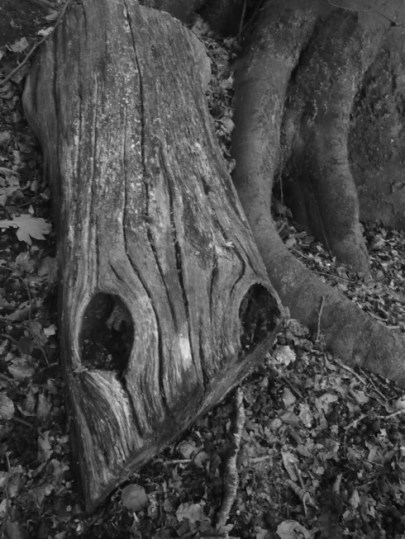
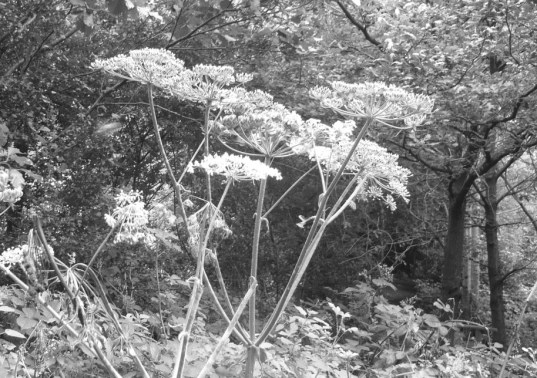
It is a grey, overcast, cool and drizzly August day, and I am feeling particularly flat and uninspired, and disinclined to human company. So in the absence of mountains, what else would I rather do than go for a walk in the woods?

046a

Taking black and white photographs to reflect my mood, naturally…

015a

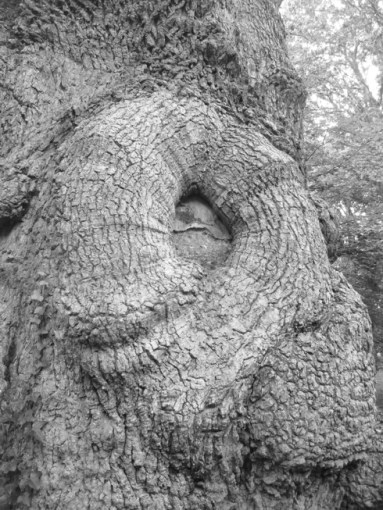
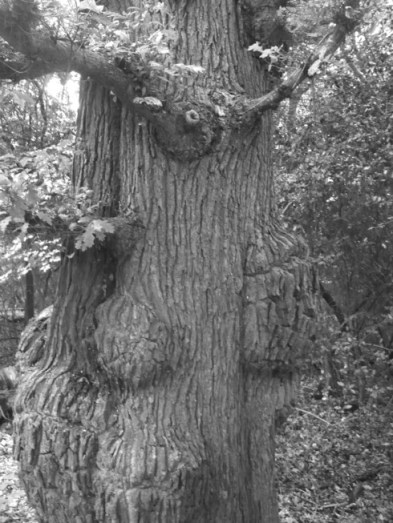
Loving the Oak trees that seem to somehow look as awkward and as out of sorts as I feel…

010a


018a


027a


036a

Relishing the lushness of the plants that still seem comparatively fresh…

040a

The fantastic shapes of old wood…

050a

The roots that look as though they might attempt to encircle the earth like Yggdrasil, the mighty tree of Norse legend…

061

The paths…

044a

And the umbels.


The Joy of Unknowing (2)

As soon as I had written my last blog post, I thought of this piece I wrote quite a long time ago which offers a similar take on travel and navigation. I am tempted to tidy it up a bit and perhaps update it to mention GPS, but instead I’ll leave it as it is.

Untitled-Grayscale-01

When I was a teenager, I began to use maps, although in rather an ad hoc, hit and miss manner. They were there for me when I was really stuck, or just wanted to know which general direction something lay. It would be a very long time before I began to use them in a careful, detailed way, able to predict the exact lie of the land, navigate in the fog or the dark, find my way through complicated landscapes with the map and compass. And, do you know, since I’ve learned to do that, I feel as though I’ve lost something rather magical, although I don’t suppose that I can blame it all on that. The maps that I was using as a teenager would tend to be the Bartholomew’s touring maps, small scale with little detail. I would feel, as I headed along a Cornish footpath, that I only knew roughly where I was going. It felt like an adventure, an exploration.

Untitled-Grayscale-02

Now, I need to be more and more remote to get that feeling, and even then it does not always work. Having just spent some time in Ladakh, in the Himalaya in the far north of India, I was surprised at just how easy all of my walking was. Setting off with map and compass, I always knew exactly where I was, only confused at times by the multiplicity of tracks criss-crossing the landscape. Even then, reference to mountains and villages with map and compass would invariably allow me to set my position. It doesn’t mean that I wanted to get lost, just that there was a small part of me that said ‘even this is all tame!’ Equally, I can be put off, by using the map, by the knowledge that over the interesting looking ridge that I was heading for, lies a motorway or building estate, and so I spend ages trying to plot a route that I try to get perfect, rather than simply heading off in the direction that I want to go and exploring as I go, correcting my course as I travel.

Nothing can tempt me more than a track leading tantalisingly into the distance, perhaps meandering through Mediterranean scrub towards a notch in the skyline, perhaps leading through a glowing archway of trees. Even now, when using map and compass to navigate, I often have to resist the temptation to ignore the map and head off to follow an interesting looking track. I think that this must be a part of my ‘I wonder what’s over the other side of the hill?’ nature. It is another reason why I’ve never been able to lie on a beach – apart from the fact that it seems a particularly pointless pastime in any case. Any time that I’ve tried it, it never seems to be more than a couple of minutes before I begin to think ‘What’s round the cliff?’ or ‘If I head back up the river, I think I might find a way through those hills.’ And then I just have to go to find out.

The Joy of Unknowing (1)

We have just returned from a few days away in Shropshire, which is one reason you haven’t heard from me recently.

We were incredibly lucky with the weather, and spent the time walking and reading and mooching around towns and villages. And finding time for the occasional meal and cold beer, of course.

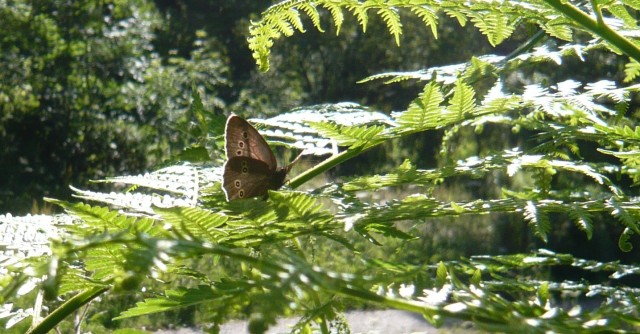
Yes, we did some lovely walks. And I find it a natural thing to be constantly identifying and photographing whatever I see when out for a walk. I have always been interested in all aspects of the environment, be it the plants and animals, the geography and geology, the weather, or the historical impact of people on the environment in forms such as old trackways, deserted buildings, or ancient boundaries.

006a

And we have spent several fantastic days surrounded by an environment rich in all these things, as we have walked through woods, fields, and open hillsides, seen ancient settlements, butterflies, birds, and many wildflowers, and all this in an area of some of the most complex geology in the UK.

But sometimes I feel myself tiring of the constant need to identify and record everything; it is really a way of trying to own them.

And when you post on social media too, it can feel at times a little like a competition to put up the best pictures of this or that wildflower or bird or mountain, which naturally need to be identified and named. Especially on Twatter, whose format seems to encourage this.

017a

So, on our first morning away, as we walk up a track heading into the hills above Church Stretton, under early morning blue skies with the air crystal clear and beautifully cool, I decide that for now I am just going to exist in the moment.

Because by doing this, I am relieved of the constant necessity of deciding whether this bird is a rook or a crow, or whether that flower is greater stitchwort or lesser stitchwort.

018a

Because it doesn’t really matter.

And for now, instead of having to always know whether it is this or that bird singing, I can allow myself to simply think there is singing. There is birdsong.

Or, even better, there is a sound I find melodic, and it pleases me.

By doing this, I can relax and centre myself, which is something I feel has been badly lacking in my life recently. I have struggled with social media in any case, feeling a huge pressure to post new material and to read the many I follow, even when I don’t feel up to it.

It feels like a return to a much simpler time in my life. I can enjoy the views of the hills, the sounds of the streams and birds, and just concentrate on being.

This must have been part of the pleasure I felt as a child on every occasion when I could roam outdoors. Certainly, I was curious about what I saw, but since I knew so little about them, there was always an openness to the experience and the excitement of discovery. I would see butterflies I had not seen before, and I would just get the thrill of seeing them without having to know anything more about them. I would see wildflowers I didn’t recognise and just enjoy the shapes and colours.

Naturally, you cannot really unknow things in that way, just as you cannot really return to that point in your childhood, but it is possible, even if for only a short while, to let go of the need to identify and quantify (and therefore own) everything, and simply exist in the here and now.

Strolling in Sussex (1)

Yesterday, I went for a bit of a walk. The oppressive humidity of the previous day had lessened, fortunately, and it was an overcast morning with a cool breeze.

Just the way I like it.

I decided to take the train a few stops down the line, where I could get out at one of those stations that bears the name of a village a mile or so away but stands on its own in the middle of the countryside. The nearest building (other than the station itself) is a farm. Hopefully I could have a day’s gentle walking with nothing more demanding around me than birds, insects, trees and wildflowers.

I really, really, needed to do that.

It seemed a good start at the station. A good omen. While waiting for my train to draw in, my eye was drawn to a single large, white, bindweed flower in the tangle of brambles and vines and bushes, trees and garden plants escaped and gone native that serves as a barrier behind the platform.

Most gardeners hate bindweed. I suppose we do, really. Once it gets into the garden it grows at a ridiculously rapid rate and strangles any other plants in its way. And even pulling it up doesn’t get rid of it. It just regenerates. I tell you, come the end of days it will just be scorpions, cockroaches and bindweed left.

But this flower looked lovely. The largest, pure white, bindweed flowers often remind me of the calla lily, only a calla lily that is not so…let’s say…excited. One of my favourite artists is Georgia O’Keeffe. I’ve probably told you that before. But O’Keeffe was particularly known for painting large flower paintings, many of them more than a little ‘suggestive’. And the calla lily was one of her favourites. I’d show you one of hers but, you know, copyright and all that. I’ll leave you to look it up if you wish to.

040a

So, here’s the bindweed flower.

Anyway, I got on my train and later I got off at the correct station and began walking along the footpath and got shouted at by some sheep.

Really, there’s no other way to describe it. On one side of the footpath were a couple of dozen sheep in a field where the grass had been cropped very short and there seemed to be very little left for them to eat. As soon as they saw me, they came rushing over to the fence bleating loudly. Obviously demanding to be re-housed in the field on the other side of the footpath.

In that field, thick lush grass was being munched by a couple of dozen quite contented sheep. I didn’t hear a (Bo) peep out of them.

‘Really sorry,’ I told them. ‘I can’t help you.’ I walked on feeling oddly guilty.

But I got over it.


023a

For the rest of the morning I walked slowly through fields and along lanes, stopping frequently to look at flowers and insects and, really, just enjoying being where I was.

021a

011a

Bridge over the railway

016a

024a

010a

I was just beginning to think it must be lunchtime when my path took me through a field of long grass.

This field lay between a stream I had just crossed, and a wood where I was heading. The wood stood a little higher than the surrounding fields, and the long grass of the field I was to cross was thick and green. The breeze caught the top of the grass, so it waved like the sea or a large lake and as I began to wade through it, it really did feel as though I waded through water.

027a

And there was the drag of the grass against my legs, and the top of the grass sparkled a little in the breeze, just as wavelets would. And there was also the sense that I was not quite sure what I might suddenly step upon. Just to complete the illusion, there were also some lovely blue damselflies darting around.

Then I finally stepped ashore at the edge of the wood, walked up a slight sandy slope that might have been a beach, and sat down to eat my sandwich.

Now, I have to tell you that this was the best sandwich in the world, and I won’t brook any disagreement. Thick wholemeal bread, cheese, several large slices of raw onion, and several thick slices of tomato. Perhaps it was my mood, and the setting, but it was damned good.

And then it was time to explore the wood.