By Popular Demand

A few weeks ago I put up a couple of pictures of paintings that I had made of Indian subjects, and a number of readers were kind enough to say that I should put up some more.

Today, then, a couple more.

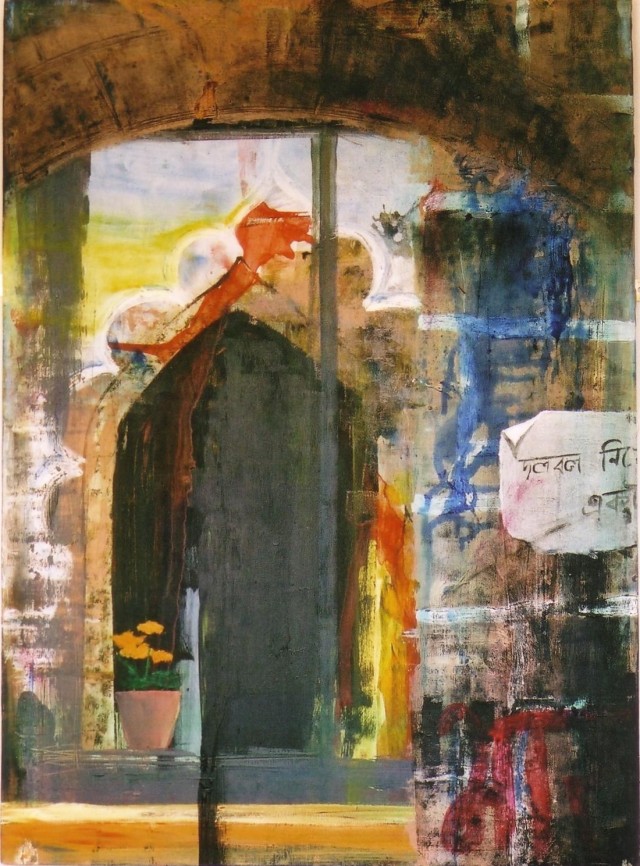
ladakhi door 1

Ladakhi Door #1

Doors are a favourite subject of mine, and this one is from a monastery in Ladakh, Northern India. Ladakh is sometimes known as ‘Little Tibet’, and in some ways, now, it could be said to be more Tibetan than Tibet. Historically, it has been a part of Tibet, and I have an old book of a journey that was taken in 1904, ‘Through Western Tibet’, by Jane Duncan, a doughty traveller, which places Leh in Western Tibet, although I am not certain of exactly where the border lay then.

mosque

Mosque

There was quite a bit of artistic license employed in the making of this painting. It is based on a mosque in Bopal, but I have never been there, instead relying on photographs. I have made no attempt to depict it accurately, but instead I interpreted it to create a totally new aspect.

Both of these paintings are in acrylic, on canvas, and measure 24 inches by 36 inches.

The Expedition Report

As promised in my last post, I attach here a report of my expedition.

On Saturday 30th January 2016, the morning sky cleared and the sun came out. It would be a good walking day.

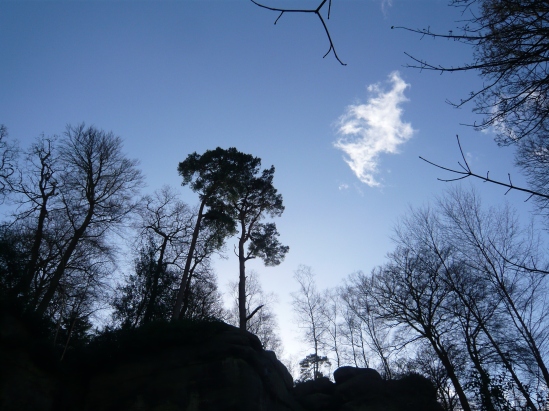
P1050080

I had thought long and hard over the various logistical challenges of this expedition, and decided eventually, albeit reluctantly, that it would be wise not to attempt it alone. As much as I was loathe to share the glory of this journey, the sensible traveller realises his or her own limitations, and assesses the difficulties and dangers that they are likely to meet. And so I decided that I would take a companion; not only to make the journey more amenable, but also to help with the navigating, act as a safety back-up, and who could act in need as a porter.

We decided to split the tasks. ‘You’re leader,’ my companion Bob said, ‘so you take the big pack with the emergency stuff, and I’ll navigate. It will make life easier for both of us.’ Somehow, that wasn’t quite what I’d planned.

We picked up our packs, said our goodbyes, and set off down the path to the road. ‘We go left here.’ Bob said, turning right. I hesitated. ‘What are you waiting for?’ He asked irritably, turning round.

‘You said left.’

‘Yes. Are you going to stand there all day?’ I shrugged, and then followed him. The first part of our journey presented few difficulties. We turned left at the next junction (‘I said right!’) and followed the road until we had left the town far behind and were surrounded by a sparsely inhabited landscape. Now we needed to find our way down the hill on the other side of the road.

‘It’s not safe to cross here.’ opined Bob.

‘There’s hardly any traffic!’

‘It comes round the corner really quickly. Let’s go on a bit further and find somewhere better.’

‘The corner’s half a mile away! I’m crossing here!’

‘You cross then.’ He sounded sulky. ‘I’ll catch you up.’ He turned away and stomped slowly along the pavement.

I crossed the road, found a bench, and settled down to wait. Minutes passed, and I took out a chocolate bar and ate it. I had a drink of water. I pulled out the guidebook and went over our route again, and then got side tracked and began reading about the dreadful earthquake of 1734 that destroyed so much of Tunbridge Wells. I had another drink of water. I found a newspaper in the side pocket of my pack and did the crossword. As I finished, I looked up, and my companion arrived.

‘Where have you been?’ He looked sheepish.

‘I turned left by accident. Never mind that, I’m here now.’ He sat down beside me. ‘Sorry, I need a drink.’ He took out a flask and poured a little of the contents into the cup.

‘What’s that?’

‘Oh, just a drop of whisky.’

‘That was meant to be for emergencies only!’

‘This is an emergency!’

When we set off again, we were fortunate to find a track that seemed to be going in the right direction. It was no more than twenty foot wide in places, surfaced with a smooth, black layer, and showing occasional white markings roughly in the middle, as if left to guide travellers. Following this, we worked our way down from the ridge and found ourselves in a fairly steep-sided valley. The road bent around to the right and ran along the bottom the valley, following a stream on one side of the road, and an old railway track on the other. There was a signpost beside us, a pub on the left, and a farm on the right. In front of us a church tower showed clearly above the trees.

Bob took out the map and compass, handed me the map and then carefully lined up the edge of the compass with the side of the map. For a moment or two his eyes flickered between the map and route ahead of us, and then he clicked his tongue irritably.

‘I think we’re lost.’

‘Er, the compass needle isn’t pointing north.’

‘Eh? What…’ he fiddled with the compass for a moment. ‘Oh, you had the map upside down, you fool. No wonder!’ He snatched it from my hands, looked at it suspiciously, glanced up at the signpost quickly when he thought I wasn’t looking, and then handed the map back to me. ‘This way. Come on!’

Half a mile along the road, a track turned off to the left and ran under the railway and into a little wood.

‘This way,’ I said.

‘Are you sure?’

‘Yes.’ I went under the bridge and into the woods, to find that the path was a morass of mud. This area is renowned for enjoying (or otherwise) what can be regarded as fiercely localised weather. Even though it was pouring with rain today in the Lake District and in Southern Hungary, the sun stubbornly shone throughout the afternoon on our little expedition. But it seemed as though that hadn’t always been the case recently. This part of our journey should only have taken us about ten minutes, but it was almost half an hour before we crossed the stile in the fence that marked the boundary between where we were at the time and somewhere else.

The next section of the trail took us down a steep and uncertain track, ankle deep in autumn leaves and with little sections of mud here and there underfoot. It proved necessary to watch our footing carefully, and now and again we had no choice but to hold onto the guard rail for a moment. After a minute or two, however, we reached the foot of the slope safely and paused to catch our breath and have a snack.

We checked the map, noticing that we would have to navigate the next section very carefully.

‘I’ll lead this.’ Bob said, starting to take the map from my hands. I slapped him.

‘No, you won’t.’

We passed under the old railway bridge, which incorporates parts of a still older construction. All that remains now is one end of a medieval banqueting hall, complete with shields. In places it is still possible to glimpse traces of what appear to be the original wall paintings. Judging by what remains of the inscriptions, they possibly depict Saint Darren, patron saint of nearby Tonbridge.

P1050081

It is a glorious place in the spring, when the wild marsupial trees are in blossom, but now it was a gloomy place. But still it was with reluctance that we dragged ourselves away from this important historical site, and tramped onwards through the woods.

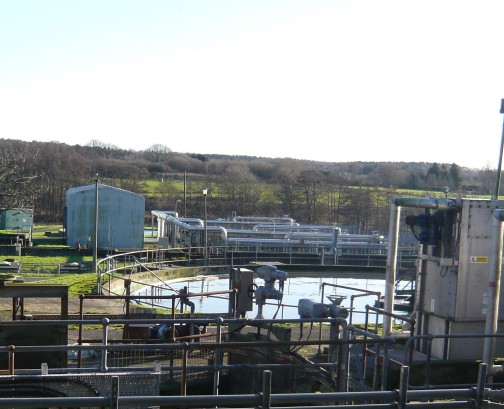
For the next leg of our journey, the path took a great, sweeping loop around a mysterious and secretive area of pipes and tanks and low buildings. The trees creaked ominously overhead. Was it just the wind? Yes, of course it was. It has always had an evil reputation, though. In medieval times, it was a place of alchemy, and rumours still persist that it was in some dark chamber beneath the ground, at this exact location, that an evil sorcerer discovered a magical substance that turned real beer into lager, or false beer as it is properly called, threatening to plunge the whole kingdom into a new dark age.

And at times the traveller of today can almost fancy that a whiff of sulphur or some such odour still overhangs this dreadful place. Several years ago someone tripped over a protruding tree root nearby and hurt themselves, and the rooks call their depressing calls overhead in the gloomy trees.

We were glad indeed to get away from such a terrible place.

P1050085 (2)

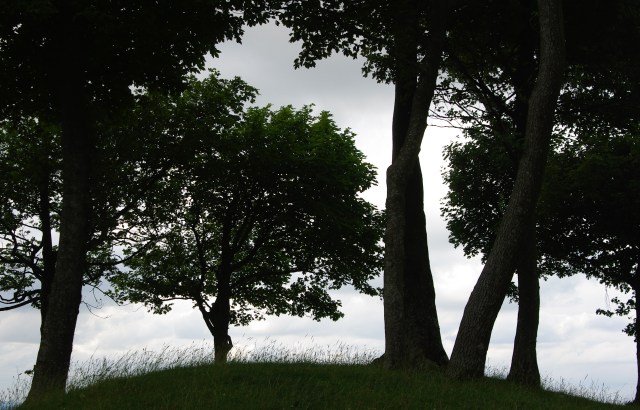
Now, on almost the last leg of our journey, our path ran along south-facing hillsides, through one of the small tea gardens that produce our famous Sussex tea, and then dropped down lower to meet the overgrown and largely clogged up remnants of the Bristol to Tunbridge Wells canal. It was still being used to transport coal and gin from Bristol to Tunbridge Wells, with a return cargo of young slaves, as recently as sixty years ago, after which it fell into disrepair as demand for these products fell off.

P1050087 (2)

Care has to be taken along this stretch, as the old towpath along the edge of the canal is quite obvious, but on the other side lies the Great Groombridge Swamp, which has been known to swallow up unwary travellers. Bob was leading at this point, and we were both keen to reach the end, now. I noticed him straying slightly towards the swamp so I called out ‘Just go right, a bit.’

Oops.

A quarter of an hour later I was enjoying a pint of Black Cat Ale, before catching the bus back home to write up my notes and then make a tricky phone call to Bob’s wife.

Still, all expeditions, like life itself, throw up challenges that have to be faced up to.

Disclaimer:

Please note that an expedition of this nature is not one to be undertaken lightly. Should you wish to follow in my footsteps, you are strongly advised to ensure that you have adequate training and suitable equipment for the journey.

I Could Have Been a Travel Writer

Once (upon a time), I had ambitions to be a travel writer.

I’m sure you know the type;

Just twenty minutes after the wedding vows have been exchanged, the long-suffering partner agrees to the explorer high-tailing it out of the conjugal nest for a couple of years, so that they can retrace the steps of some medieval alchemist-poet-knight who drove three thousand goats across six mountain ranges, converted four heathen princes to the True Faith, and conquered Alsace and Mordor on the way.

signpost (2)

Unfortunately, I quickly decided that I was unlikely to ever have the experience to write a travel book. I have never met the Dalai Lama, interviewed an Imam in a mosque in the mountains of Persia, or chatted intimately to local leaders in remote places. I have met very few people in the aid sector, people who have done particularly brave or daring things, or celebrities.

Indeed, I’m not even a celebrity myself, which seems to be a good travel opening nowadays. I’ve never had the resources to spend years at a time living with villagers in remote Angolan jungle clearings, and I’ve not been able as yet to persuade any large companies to sponsor my meanderings.

And this is a great shame, because travelling and getting paid for it is an attractive proposition. I rather got the appetite for it in the years that I worked abroad. Oh sure, most of my time was spent working, but I did get to travel around and see much that I would never had had the chance to see otherwise. In the 1980’s, Oman was pretty well closed to western visitors, other than those like myself who worked there. It was my first real taste of a society that was very different to my own, in a climate also far removed from anything I had experienced before. I loved it, and I got paid well for it.

It did, unfortunately, instil a slight expectation that I could continue to experience this as long as I wished, and like all good things, it came to an end.

Now, when I do travel, I keep a journal. On the other hand, so do most other travellers. And it only takes a quick glance through mine to see that there is not the basis of a best-selling travel book there. It does sometimes seem that to read most published accounts of journeys, unless they were accomplished with the maximum amount of discomfort then they don’t count. Certainly, I’ve had a few uncomfortable long distance bus rides, been too cold or too hot at times, and passed the odd night in some pretty crap hotel rooms, but I don’t think that’s enough to fill a best seller.

On the other hand, I’ve never set off with just a passport and a change of underwear to travel single-handedly across the amazon jungle, or attempted to unicycle around the Mongolian plateau juggling a bowling ball, an egg and a carving knife, so maybe it is my attitude that is at fault.

But I have a plan!

I shall daringly attempt a five mile walk through the English countryside, non-stop and all by myself! No support team, no camera crew, no convenient lift for when the going just gets too hard to bear. There will be nothing other than my own courage and steely determination to get me through the ordeal, except for the prospect of a cold beer at the end of the trail, possibly a pub sandwich and a short ride home on the bus.

I’ve got waterproofs (just in case), a bottle of water, a map, a few snacks, my notebook and camera (for interviewing any gnarled old villagers that I might happen across) and a mobile phone just in case I find myself in any situation that I cannot talk or buy my way out of.

And so, having persuaded my beloved to give me leave of absence for the time it takes me to complete the expedition, I’m off into the comparative unknown.

If this is my last blog post, you’ll know it all went horribly wrong.


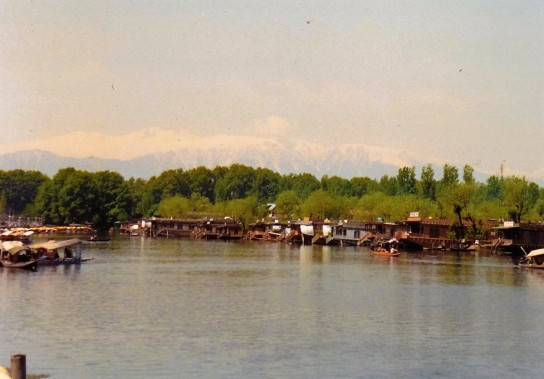
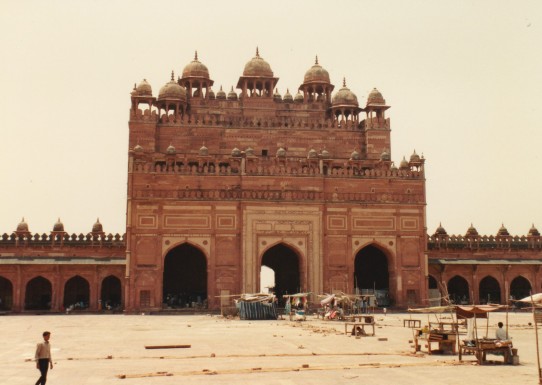
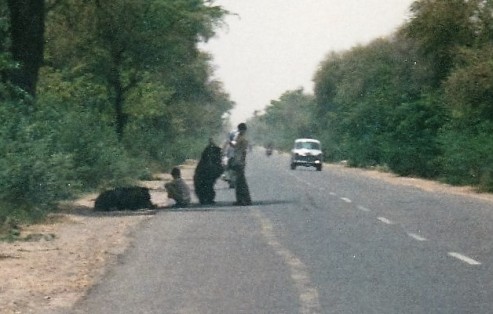
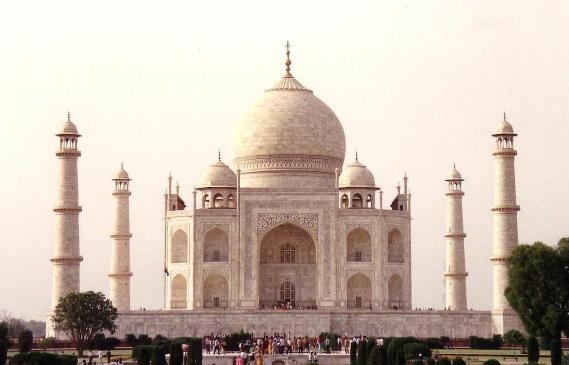
India – my first time (1)

Just a few photos this time, taken on my first proper trip to India. On the only previous visit, in 1988, I had spent a manic 18 hours in Delhi, and then taken a long bus journey to Nepal. That was a journey that really should be the subject of a blog itself, sometime.

On the following year, then, I returned to India, intending to spend rather longer there this time. As it turned out, I had to return to England after a few weeks, but the short time that I was in India whetted my appetite for more. It is said that western visitors to India tend to fall into one or the other of two categories. Either they fall in love with the country, and return whenever they can, or they swear never to go within a thousand miles of it ever again.

I’ve been back about ten times.

Delhi Red Fort 1

The Red Fort (1989)

I arrived in Delhi with a copy of Lonely Planet’s ‘West Asia on a Shoestring’. In those days, the Lonely Planet tomes really were aimed at backpacking budget travellers, with their recommendations for rooms tending to be dormitories and really cheap hotels. My flight arrived in the late afternoon, so that not only was I weary from the long journey, but the light was already fading when I walked out of the airport. In the chaotic maelstrom outside of passengers and taxi drivers fighting over them, I managed to remain calm enough to locate the corner where the buses of the Ex-Servicemen’s Air Link Transport Services waited. I think they are still in operation today (I’m sure someone will tell me), with their yellow (I think) buses providing a cheap link into the centre of Delhi where I was heading.

I was dropped off near the hotel I had decided to use, the Ashok Yatri Niwas, which stood at the junction of Janpath and Ashoka Road. It has long gone, now; a great concrete monster of a place with cement beds and lifts that seemed to take half a day to do the full journey up to the top floor. I don’t think that many people mourn its going, but I was reasonably comfortable there for a couple of nights. It was where I had stayed the previous year for the one night I was in Delhi. There was hot water in the bathroom, as long as you rose early enough, and I remember the cafeteria being fairly basic, but adequate. For someone on a tight budget, it was fine. Back then, it was a case of turn up and hope there was a room, especially if you had just arrived in the country. There was no email in those days. But it was pretty big, and there was room for me.

Unlike my previous flying visit, I now had time to wander about and savour everything around me. And for the first time, it really did seem an alien and exotic society. I had enjoyed browsing in the souks (bazaars) when I had lived in Oman, and also out in the little villages there, but my first taste of India seemed to me to be as exciting and exotic as it got. Everywhere I went, I was surrounded by the noise of traffic and the odours of exhaust fumes. But the traffic was different; the buses appeared to be almost falling to pieces, loud and fierce, with people hanging off the outside as well as being crammed inside behind open, barred, windows. I saw tuk-tuks everywhere; the little three-wheeled taxis that buzzed like wasps through the traffic, squeezing through every available gap. Amongst this impatient, petulant, hooting traffic, carts pulled by horses or buffaloes plodded. Motorbike riders forced their way through, and cyclists cautiously weaved their way along. Everywhere, pedestrians took their lives in their hands to cross the roads, but the traffic all swerved out of the way for the cattle that wandered imperiously through the streets, ignoring it all.

Incredibly, through the traffic pollution so thick that you could grab handfuls of it out of the air, there were dozens of other smells assailing me everywhere I went. I was tempted every few steps by cooking foods, and then I might pass a doorway and a strong smell of incense would waft out. Seconds later, I would suddenly wrinkle my nose as I passed a pool of sewage on the sidewalk, but then immediately I might pass a fragrant flower stall.

delhi_gate

Delhi Gate, in the old city near Chandni Chowk. (1989)

There were temples everywhere, and a shrine of some description every few steps. Here and there were green and white mosques, stalls of old sacking and weathered boards set up outside gleaming new metal, glass and concrete shops. There were holy men jostling office workers, great hump-backed cattle and pariah dogs in corners or in the middle of the footway, beggars, shoe shiners, touts and hustlers, people in a hurry and idlers passing the time of day. I was urged to discretely change money, buy drugs, see pornographic videos, have a massage, change hotels, visit ‘my brother’s’ shop or book a trip to another part of India.

It was dirty, colourful, loud, exciting, and different and I loved it.

I walked everywhere I could, not just because I was on a tight budget, but it is always how I have got to know a place. I went to the Red Fort, on my first full day there, enjoying the relative peace and quiet inside, and it was here that I discovered Mogul architecture: The beautiful soft red stone and the marble, the carvings and inlay, the arches and columns…the only time I’d seen architecture that beautiful, before, was in Grenada, in Spain.

And now, looking at the photos I took, I am struck by an odd discrepancy. In my memory, one of the defining things about Delhi when I arrived was the incredible press of traffic. In my photos, though, there are comparatively few people, and even less traffic. Is my memory at fault? Is it just that there were obviously far fewer people in India 30 years ago? Perhaps it is chance alone.

But I think I’ll return to the architecture at a later date.

Once Upon a Time

046

Are you sitting comfortably? Then I’ll begin.

It is a cliché that causes us to smile, yet variations of that phrase will have been used countless times in the distant past, when our ancestors gathered around the storyteller of the tribe to hear whatever tale he (or she) was about to tell.

And research http://rsos.royalsocietypublishing.org/content/3/1/150645  that was published this week, now tells us that the history of fairy tales turns out to be even longer than anyone suspected, going back to the times of prehistoric tribes. Not that this theory is entirely uncontested, of course.

But I would be surprised if it were untrue.

There have always been storytellers, who performed an important role, especially before the invention of writing. In those days, when all knowledge had to be memorised if it was to be of any use, then the skills of the storyteller in the tribe, someone who was used to organising their thoughts so that they could remember what was important and then recount it to the rest of the tribe, would have been vital for far more than simply entertainment; they would have been essential for the tribe’s survival.

They would have told stories about wild animals; either cautionary tales, or how to hunt them. Stories of skirmishes with other tribes; praising the bravery of their own warriors, and recounting how the other tribe was put to flight, but warning, still, of the danger these other tribes posed.

They must have always speculated on the origins of their world, and come up with the various creation myths. It would be important that all the tribe understood the appropriate rituals they would need to follow to appease the gods and ensure their own welfare.

So these stories would have been a way of sharing information with all the members of the tribe.

Much later, after the invention of writing, these tales began to perform a different function. They would still be used as cautionary tales, but now perhaps aimed more towards children (watch out for cross-dressing wolves and the like), or purely for entertainment.

But in a society where the majority were unable to read, they would remain important.

Throughout history, there has always been a borrowing and reinvention of stories; the myth of a flood that wipes out most of mankind, for example, is found virtually all over the world.

But the difference between a ‘myth’ and a ‘fairy story’ seems a little vague. I suppose the term ‘myth’ does seem to have a little more gravitas.

Many of these stories concern blacksmiths, which might be due to an early awe of those peoples who discovered how to work stronger metal, specifically iron, and fears that they might be using magical or supernatural means to do so. I’ll return to that shortly.

Now let’s take one well-known example of a fairy tale; the story of Snow White plays out both as a royal power struggle, something that has occurred time and again all over the world, and also the classic tale of the wicked stepmother, highlighting the insecurity a child may feel when a parent dies and is replaced by a stranger.

She flees an assassination attempt to find refuge with another people. The fact that they are depicted as dwarves (in the well-known European version) serves to emphasize the fact that they are not her own people.

There are further attempts on her life, but she is finally rescued by a passing prince and lives happily ever after.

Variations of this story crop up across Europe, Turkey, Africa, Asia and America. Whether these tales were passed from tribe to tribe and spread across the world that way, or were invented spontaneously in different parts of the world, it is unlikely we will ever know. It was probably a combination of the two. What is certain, is that they tend to be reinvented regularly.

Stories of mortals striking deals with supernatural beings (i.e. the devil) occur world-wide. What they all have in common is that either the human making it reneges on the deal, and usually finds a way to cheat the supernatural being, or, of course, the devil comes to collect his soul.

It is still a well-used device in literature. There is Goethe’s Faust, and since then many other popular novels on the subject, and we are still happily reinventing this story, as well as all of the other fairy tales, into new stories today.

In Britain, there are numerous folk-tales on this subject, usually concerning blacksmiths who either make pacts with the devil, or who are visited by him in disguise and realise who he really is (the comely maiden with the cloven hooves is often a bit of a giveaway). It usually ends with the devil being grabbed by the nose with red hot pincers and running off screaming. But again, these tales surface from all parts of the British Isles, and are set in times that are contemporary to the story teller. So the fellow telling the tale in an ale-house in a sixteenth century village would mention the blacksmith in a village twenty or so miles away – close enough to be particularly exciting to the listeners, but probably far enough away for there to be no one in his audience who might confidently denounce it as false.

And then, of course, they all lived happily ever after.

The Language Barrier

As part of its strategy to counter extremism, the British Government has today announced its intention to fund a plan to help all migrants to this country learn English. For once, I think that this is a plan to applaud.

For the inability to speak and understand the language of others around you fosters fear, misunderstanding and distrust.

Having lived in an ex-patriate community myself, I remember how easy it is to become persuaded by others that you are somehow surrounded by ‘enemies’, and to develop a laager mentality. This mindset takes it as a given that everyone outside of the circle does not understand you, they are somehow ‘against’ you, and forever plotting to attack or undermine you, so you sit there muttering darkly about these ‘outsiders’, and voicing your dislike and prejudices against them…it becomes a cycle of mistrust that can possibly become violent.

It is another example of the saying that we hate what we fear, and we fear what we do not understand. And when someone is trapped in a limited social circle because they cannot understand anyone outside of that circle, their chances of becoming a full member of the wider community are severely limited.

Having travelled in non-English speaking countries, I realise how much easier life becomes for me when I make the effort to learn even a small amount of the language.

There will be some who refuse to learn the language on the grounds that they feel that they are there temporarily, possibly working on a short term contract, and can get away with using their own language in a limited circle of work, shopping and socialising.

And there will be some for whom it is a matter of pride to use only their birth language.

I think that both of these viewpoints are mistaken.

Writers understand only too well the importance of language. We worry over whether to use this or that word or phrase to get our meaning across; we worry over whether the way we have worded something may be misunderstood. But when you are attempting to communicate with others in a language that you only vaguely understand, every single conversation is full of these fears.

And when that is the norm, it becomes easier just to avoid any situations where you have to try to use that language.

But it does not actually take much to overcome these fears. Perhaps accepting an invitation to visit to someone’s home, or their place of worship, will lead naturally to conversations where people can learn about each other. But the essential thing is to be able to communicate, which becomes next to impossible without at least a few words of a language in common.

A bit of paint splashed around

A different sort of creativity, today. I paint, at times, so here are a couple of my paintings that were inspired by my trips to India.

bihari door

This one is of a door on a house in the North India state of Bihar.


india #1

And this one a more impressionist rendering of doorways, arches and windows.


Although writing has always been the primary medium through which I have tried to express my thoughts and feelings, it was my first trip to India, 28 years ago, that persuaded me to try to paint seriously. Although I have done little in recent years, I still dabble on occasions, and suspect that it is only a matter of time before I begin work on a new painting.

A Short History of Blogging

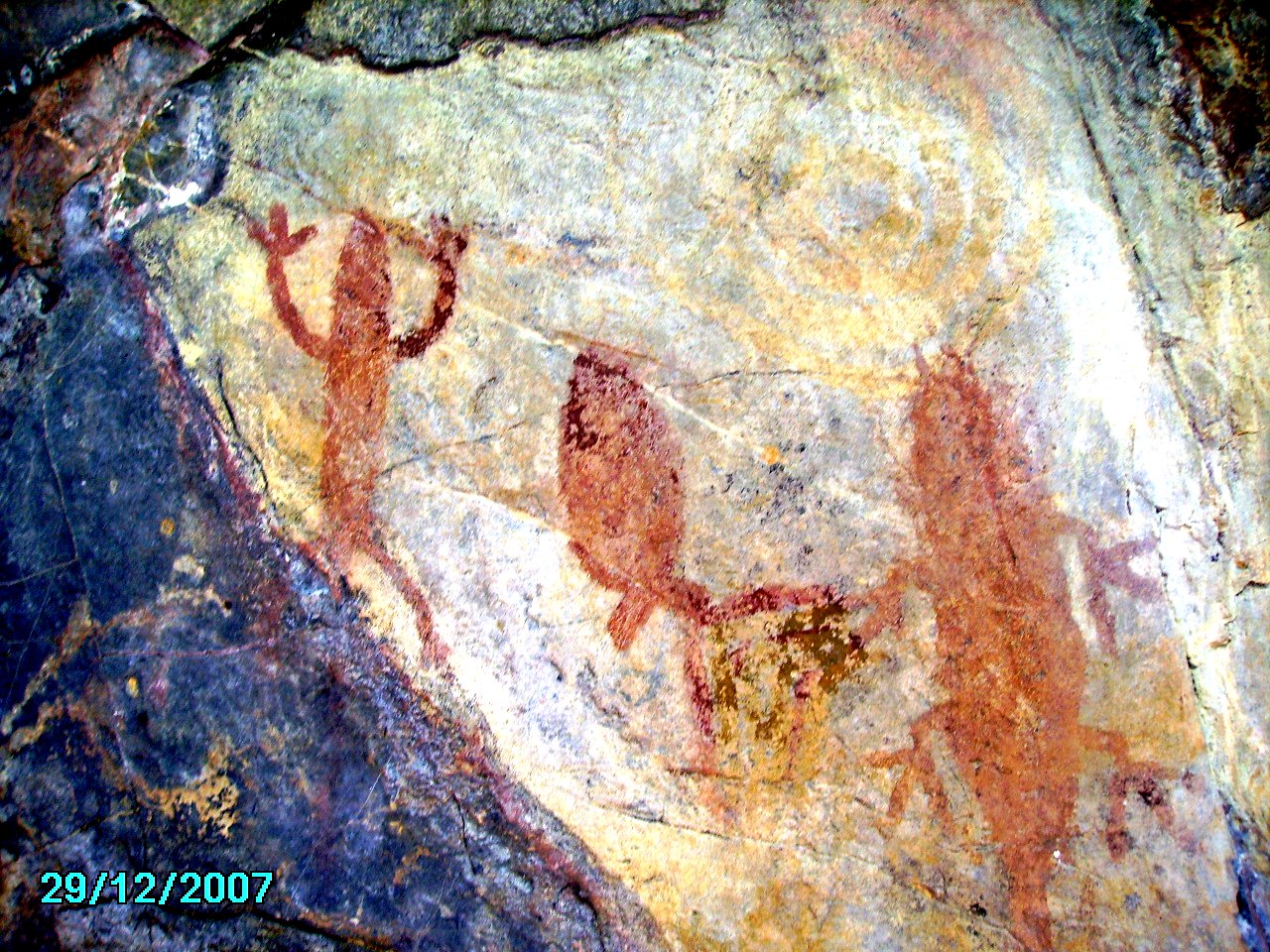
Blogging has always been about self-promotion. The first known blogs were on cave walls, although they were pretty crude, to be honest, and it is often really difficult to make out what the bloggers were on about. There is speculation, indeed, that to refer to them as ‘blogs’ might be a little misleading. The fact that they tend to be short and that it is very hard to make out what they mean, leads some experts to assume that they were an early form of Twitter. And then the fact that they frequently depict crude human figures, especially exaggeratedly female ones, and various animals, suggest that even in these early times, social media were largely the preserve of young person

cave paintings

‘Share if you think these babes are hot.’

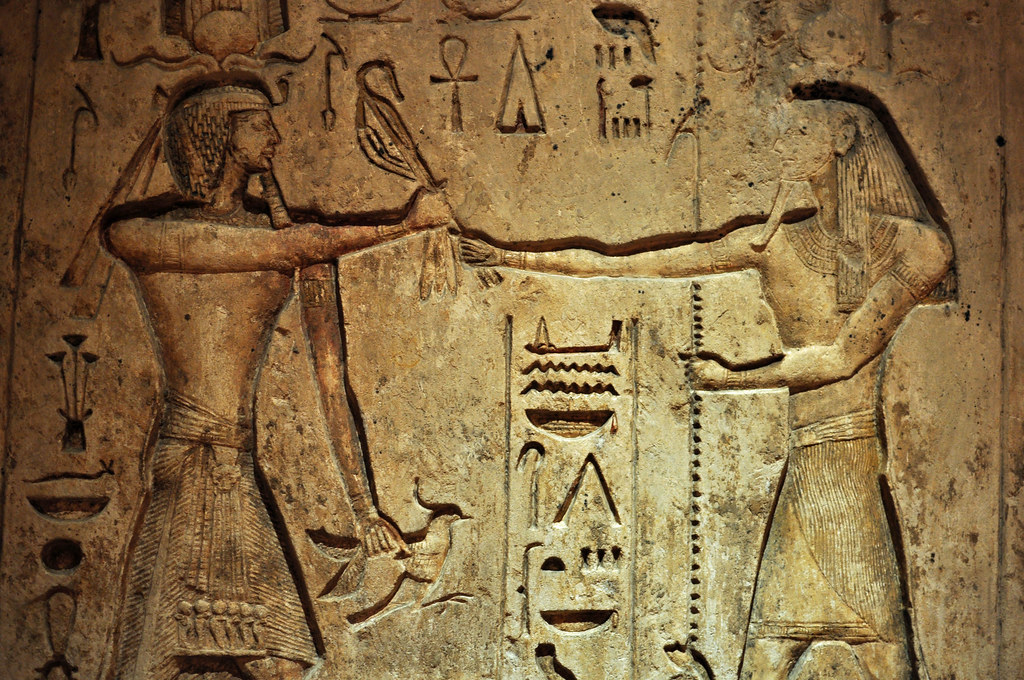
By the time of the rise of the first true civilisations in Egypt, they were beginning to get the hang of it. They have left massive numbers of inscriptions all over walls and columns and pretty well anything else that they could get a hammer and chisel near.

Egyptian carvings

‘Amenhotep snubbed in Big Brother Pyramid game – LOL’

Some even see the Rosetta Stone as a forerunner of Google, but others don’t.

The first English blogger was The Venerable Bede. His blog is one of the main sources of our knowledge of Saxon times, which is a bit of a bugger really, when you consider how reliable social media are today as a source of modern history. He probably missed out most of the good stuff. But he blogged in Old English, anyway, which no one can understand nowadays so it probably doesn’t matter.

bede

Leonardo da Vinci did a wicked selfie, but would probably be criticised nowadays for how few he produced. To be anyone on social media, it is probably necessary to post a minimum of twenty selfies in any twenty four hour period, but Leo was never up to that. But most of his blogs were all about what would then be science fiction and art and politics…so he’d have fitted in quite well with today’s bloggers really.

Samuel Pepys’ diaries are, of course, just the notes he took for his blogs. They are a mix of politics and news and what his family were up to, and his ‘conquests’ of various ladies. Wisely, he wrote most of this in shorthand and, even more wisely, put the more salacious bits in code. Nowadays, it is unnecessary to use code, since language is now changing so fast that no one can understand anything that was written more than six months ago anyway.

The Puritans thought blogging might be fun so they banned it, along with just about everything else, except breathing and praying. Well, praying, anyway.

A little later, newspapers were invented. These were not really blogs, since they were filled with news, rather than self-promotion, and it took a number of years before newspaper owners and editors realised that. Once they did, however, they worked very hard to make up for lost time, and now there are very few newspapers in the world that print mainly news.

And quite a lot that do not print any news at all.

In fact, they tend to be full of primitive opinion and often depict crude human figures, especially exaggeratedly female ones, and various animals.

And thus life turns full circle.


Photo credit (picture 1): jmarconi via VisualHunt.com / CC BY         

Photo credit (picture 2): PMillera4 via Visualhunt / CC BY-NC-ND


The Problem of Historical Truth

In my previous post about the pitfalls of online research, I began by alluding to the unreliability of newspaper reports. If you were to read reports on an important item of news in a number of different newspapers, you frequently might be forgiven for thinking that they were actually talking about completely different events. There will be political bias, of course, and the prejudices and agendas of reporters and editors alike. Are the individuals in an armed insurgency terrorists or freedom fighters? It is a point of view. Are strikers in an industry greedy mischief-making saboteurs, or victimised and mistreated victims of greedy corporations? Again, it is a point of view.

It can be very hard today to see through the fog of opinions and misinformation on any topic. How much more so when we delve back into time?

History is written by the victors. For example, what we know about Caesar’s campaigns in Gaul and Britain were written largely by the Roman conquerors, especially Caesar himself. Most of what we know of the reign of Ashoka, in India, comes from the edicts that he caused to be inscribed upon the remarkable number of rocks and pillars that are still in existence.

023 (2)

Even tales written by the vanquished are likely to be inaccurate, of course. The cruelty of the victors, their barbarity; all of their actions will be exaggerated.

The historian understands that information comes largely from primary and secondary sources. A primary source might be, for example, an account written at the time (Caesar, above) or Parish registers of births, marriages and deaths. These sources are considered to be most likely to be accurate, being compiled at the time of the events described, but clearly they might all be deliberately or accidently falsified. Secondary sources might be newspapers, which are largely made up of analysis and opinion, and therefore considered to be an interpretation of information that has been derived from another (hopefully primary!) source.

A primary source is also referred to as evidence, yet I wonder whether a better distinction would be made if ‘evidence’ referred only to unwritten sources; archaeological remains, buildings, pottery, jewellery and coins and their like, which, whilst needing interpretation, are unlikely to be prey to the kind of distortions that written sources might be. Caesar, after all, might have claimed to take ten thousand prisoners when he only took five hundred, yet pottery of a particular type that is found at a particular spot, tells a story that needs to be interpreted, yet is unlikely to be a falsehood.

We need to be careful, though, when it is interpreted in light of contemporary writing, to avoid the temptation of unconsciously corroborating those writings.

Having written the above, we do have to take a certain amount on trust, because it is not practical to question everything in the world that we come across.

Yet, just because we discover that Troy really does exist, does not mean that all of the stories of the Iliad are now, somehow, all true. That would be like an author writing an incredibly impossible fantasy tale, in which the city of Vienna still exists and features, yet claiming it must be true because Vienna is a real place.

During the first year of World War One, a fictional short story ‘The Bowmen’ was published in the London Evening News by Arthur Machen. In this tale, he describes a battle between English and German soldiers at Mons, in France, in which the beleaguered British were aided by the sudden appearance of phantom archers who intervened to keep the British safe. Although this was fiction, the story quickly ‘went viral’, as we might put it today, and was readily believed by many in Britain. Of course, there was a feeling then that the British were good and the Germans evil, and so it was natural that God might intervene to help and protect them. A far stronger belief in God, in those days, also contributed to the feeling that it was natural to find that a miracle had occurred.

Although Machen republished the tale in a book with a long introduction explaining that it was fiction, and examining reasons the public thought it was true, not only did the belief persist, but further reports of angels on the battlefield began to appear. As a child in the 1960’s, I remember reading an account of this in a comic, with it presented as the truth. In 2001, the Sunday Times reported that photographic evidence to support the story had been discovered, although this was proved to be a hoax.

The Sunday Times also published exerts from Hitler’s Diaries in 1983, until these, too, were proved to have been forged.

Memories are notoriously unreliable. I was reading just a few days ago of an experiment where a group of people were encouraged to discuss childhood memories, with selected members of the group feeding in deliberately false information. After an initial hesitation, it seemed that all of them accepted these false memories as real, even to the extent of agreeing that they had taken part in a balloon ride, when they had not, and describing what they had seen from the balloon, and their feelings during the ride. The point being that they came to believe these were their own, real, memories.

How reliable are our own memories, then? And what can we trust? Clearly, there must be a lot of historical narrative that has been honestly recorded, that is simply not true, and we are unlikely to ever know what it is.

Ho Ho Ho

So, here is the final instalment of my merry Christmas tale. Everything will be resolved satisfactorily, and we’ll all live happily ever after. As if.

Merry Christmas!

Henderson stood there staring at the spot in the middle of the field where the sleigh was no longer standing, but the peasant with the pitchfork was; he was looking up into the sky, as motionless as he had been before, so that Henderson thought at first he must somehow still be frozen in time. He had not noticed the woman following him across the yard, but now she called out ‘Moses!’ and the man turned, saw him, and swung the pitchfork around so that it pointed towards him. Involuntarily, he gave a little yelp, put his hands up and took a few steps backwards as the man stepped towards him, his face expressionless.

Then he turned and ran.

Behind him, he heard the man also begin to run and ahead of him the woman stood grinning at him. He swerved as well as he could, considering his age, his fitness, and the mud, and ran through the gateway.

He stopped for a second to catch his breath, and then began to run again towards the buildings. He had only taken a couple of steps this time, however, when he suddenly saw the cat in front of him. It hissed and took a couple of paces towards him, and then fixed its eyes upon him, crouched lower to the ground and began to run towards him, before launching itself up towards his throat. He backed away, suddenly terrified, and watched the creature sail towards him. He seemed to have plenty of time to take in its evil, soulless eyes; he saw its mouth full of razor-sharp teeth like tiny little yellow daggers, little droplets of saliva clinging to their tips; he even had time to see how its whiskers curved ever so gently backwards in flight, although they had spread out wide as they bristled stiffly.

He had plenty of time. As much as he wanted, it seemed, for the cat had stopped in mid-air, about a foot in front of him. Very slowly, his eyes on the cat, he stepped sideways. Then he reached out and touched it. Its fur still felt soft, but its body, like that of the horse earlier, felt cold, but the weirdest thing of all was that no matter how much he pushed it, he could not get it to move at all. He passed his hands all around it, but it hung there, in the air, in front of his face.

Slowly he turned around, and walked back towards the gateway. He paused and listened, but the world had gone silent again. Entering the field, he saw that the sleigh had returned. It sat on the opposite side of the field, now, where the farmland seemed to turn to woodland. The peasant and the witch had become frozen statues and stood close to the gateway. He scratched his head in bewilderment, and then walked quickly across the grass.

As he reached the sleigh, he noticed some small, fresh, muddy footprints on the running board. At that moment, there was a kind of double thud, and the elves landed beside him.

‘Jeez!’ he gasped, and they burst into spiteful laughter.

‘Boo!’ said one of them.

‘Well, look who it isn’t.’ said the other. ‘You’ve got mud all over your clothes, Fat Boy.’

‘They’ll bill you for that. Dock it out of your wages.’

They seemed none the worse for their experience, he thought bitterly, as he stepped into the sleigh, and sat down.

‘Come on, then.’ he sighed. ‘Let’s go.’ They grinned.

‘Maybe we don’t want to get in.’

‘Oh, stop buggering about! I’ve no intention of sitting here all day.’

‘Well, I don’t suppose you can go back without us.’

‘And we just came back for you! Aren’t we good! I reckon you owe us, Fat Boy.’

‘Actually,’ he said, exasperated, ‘I came to get you before you got involved in a witchcraft trial.’

‘Oh, aren’t you the noble one, then! What brought that on?’

‘Nicol looked up this year and this place on the internet. Seems a bit of a coincidence your arriving here and then the witchcraft trials taking place.’

‘Well, there’s no accounting for the stupidity and ignorance of humans. Anyway, it doesn’t matter what you actually do, because you can’t alter history, Fat Boy.’

‘Oh, really.’ He grinned, after a moment’s thought. The elves glanced at each other, the implication apparently also striking them, and for the first time they looked worried.

‘Wait!’ Quickly, they hopped into the sleigh and took up their positions at the back, where they put their feet up and made themselves comfortable. One of them took a clay pipe out of his pocket, whilst the other grinned at Henderson.

‘Okay, Fat Boy, you can go now.’ He stared at them for a second or two, and then turned around to start up the reindeer. He’d have loved, at that moment, to have just booted them out and taken off, and hang the consequences, but he was, he had to admit, afraid of them. He didn’t have any idea of what they were actually capable of.

He pressed the big green button, and the reindeer exploded into life (once witnessed, never forgotten!). In what felt like no more than five seconds, they were high in the clouds and cruising smoothly.

It wouldn’t take long to get back. He sat musing over how he would be spending Christmas, but at some point, he realised that he had been looking at a vapour trail in the sky above him for a little while, but the implication of that only struck him when the radio on the dashboard, which he hadn’t even noticed before, crackled into life.

‘Attention, unidentified military aircraft: You are violating North Korean airspace. Turn around immediately or you will be shot down. I repeat, turn around immediately, or you will be shot down.’ The elves burst into laughter again.

‘Now you’ve done it, Fat Boy!’

‘Oh, it gets better and better!’

You can’t alter history, but now they were back in 2015, which was the present day. Glancing over his shoulder at the elves, who were looking at each other and giggling, he reached for the satnav over-ride button.

If Nicol wanted to try and get them back this time, he was welcome to try.