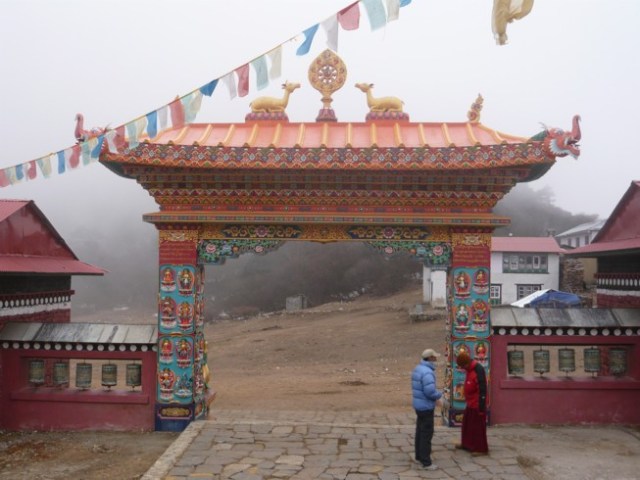
Commonly, late in the afternoon mists form and the temperature plummets. But even in the enveloping grey, Tengboche is colourful and beautiful.

Commonly, late in the afternoon mists form and the temperature plummets. But even in the enveloping grey, Tengboche is colourful and beautiful.

To compare with the photo in the previous post, this is the same view in the morning – but with the addition of Ama Dablam on the right of the picture. This is possibly my favourite mountain; the classic ‘mountain-shaped’ mountain, similar to the Matterhorn.
Tengboche is a monastery complex and a couple of trekking lodges on the route up to Everest Base Camp from Lukla, in Nepal. It sits high above the waters of the Dudh Khosi.

Inside Tengboche monastery following a puja (ceremony).
Rightly or wrongly, I don’t like taking photographs of pujas in monasteries. It feels intrusive and bad mannered. I would feel the same in a church, mosque or temple. This has nothing to do with any beliefs of my own, but is born of simple respect.
I noted in my diary: We have just sat in on a chanting puja, but my meditation failed dismally. I was completely unable to concentrate on my breath as all that I could think of were my freezing feet!
It was blooming cold!
Long ago in the misty depths of time – that’s last year, actually, I posted a piece about Ladakh (you can find it here if you’d like to read it.)
This, then, is another mixture of photographs and entries from my journal of my 2005 trip to India, which included a couple of weeks spent in Ladakh. I went comparatively early in the year, when the nights are still extremely cold and very few visitors have made their way up from the plains.
Just the way I like it!
Ladakh is high. If you fly in from Delhi (the only way to enter Ladakh for 8 months of the year), you travel from around sea level to 3500m in no time at all. Ladakh means ‘The Land of High Passes’, and is aptly named. Leh, the capital, at 3500m, is one of the lower areas of Ladakh. It’s all uphill from there. Winters are incredibly harsh and the summer growing season brief, yet the Ladakhis traditionally are self-sufficient in everything they need – food, clothing and shelter – and have only recently collided with the western consumer society. In contrast with most of the rest of India, the religion and culture of the majority of the people there is Tibetan Buddhism.

The Roof of the World – View across the Indus valley at 3500m, Thikse, Ladakh.
Friday 8th April 2005
I’m in Ladakh and, hey, wow!
At the airport for 4.30am, to find the flight postponed until 8am, due to weather conditions. It all looked ominous, but just after 7am we were told to check in and after numerous baggage checks, body checks, baggage identifications, etc, we were away at 8.30.
I’ve heard the flight described as one of the most spectacular in the world. I’ve also heard it described as jaw-dropping. I can imagine that it could be bowel-dropping. As we approached the Himalaya, clouds steadily built up and we flew through with tantalising glimpses of great snow-covered ranges below, through the occasional gaps in the cloud. After a while the turbulence built up and we were buffeted quite considerably. Then as we began to near Leh, we slowly lost height, the turbulence increased and we got more views of peaks at under-carriage height. Once we had dropped out of the clouds and the whole valley lay spread into the distance surrounded by snow-swept mountains, it was indeed jaw-dropping.
Then into land after three slow circles around the airstrip. The outside temperature was 2C, we were told, but it certainly didn’t seem that cold.
Once we’d gone through the formalities of registration and baggage reclaim with the refreshingly friendly ground staff, I walked out into the front of the airport and found a taxi. Yousef charged me RS 100/- to go to my choice of guesthouse (The Ti-Sei) and left me his mobile number. He also gave me all the usual (sensible) advice about taking it easy for a day or so.
I’m now sitting in a splendid light and airy room, looking out across the vegetable garden (covered in this morning’s snowstorm) to lines of bare poplars, traditional houses and some splendid mountains, also covered in snow.

Cairn at top of mountain north of Leh.
After a Ladakhi lunch of apricots, apple juice and water, headed north past the Shanti Stupa towards the first line of hills. Reached there at 1.15pm and stopped there for a breather. Silence. Apart from the pounding of the blood in my head. Absolute silence. After a few minutes the call of the muezzin drifts up from Leh, from the Jama Masjid. Then a few bird calls from the crags. Perfect peace. A perfect desert landscape, with pockets of snow. I’m sitting on a boulder, warmed by the sun, my feet in patches of fresh snow.
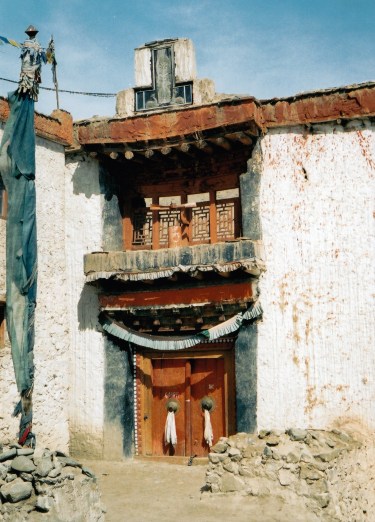
Gompa just below Leh Palace, Leh, ladakh.
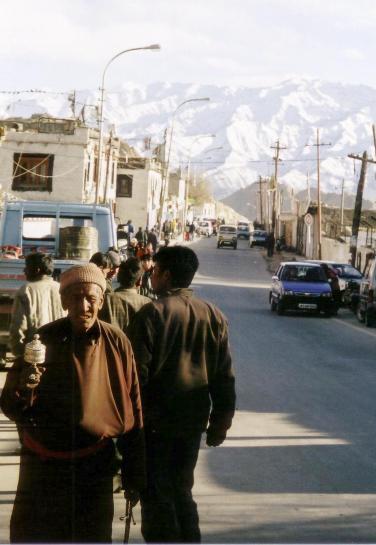
Man spinning prayer wheel, Leh. To Ladakhis, their religion is not somehow separate from their daily life, but an essential part of it.

Leh Palace. Very similar to the Potala in Lhasa, although smaller, this was the home of Ladakh’s royal family from the 17th century, when it was built, until the mid 19th century when they moved to the palace at Stok, on the other side of the Indus Valley, as a result of an invasion by Kashmiri forces.
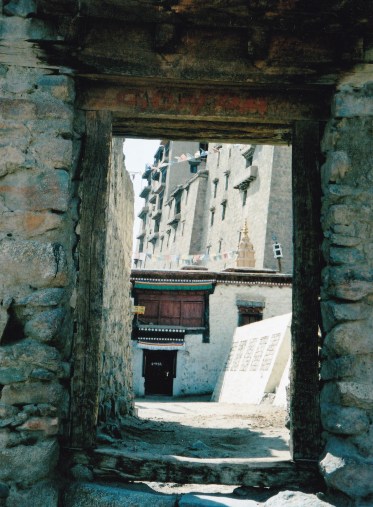
Gateway to Gompa at Leh Palace.
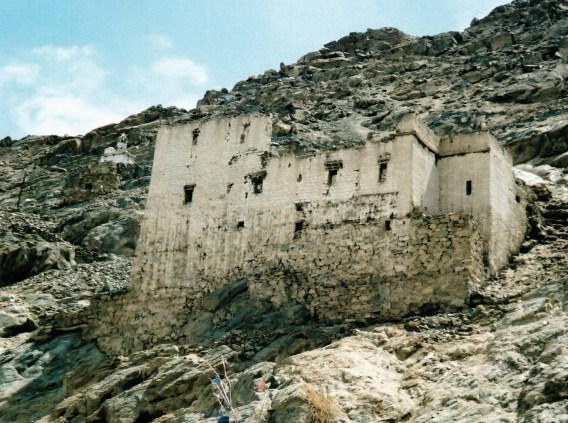
Old buildings on the outskirts of Leh, ladakh. Traditional Ladakhi buildings closely resemble those of Tibet. In fact, there are so many similarities between the two areas, that Ladakh is often referred to as ‘Little Tibet’.
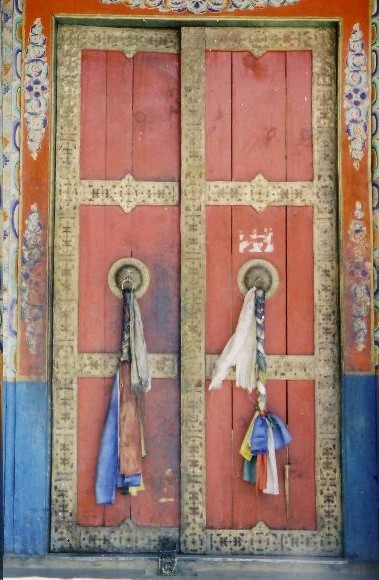
Temple Door at the Monastery at Thikse, Ladakh.
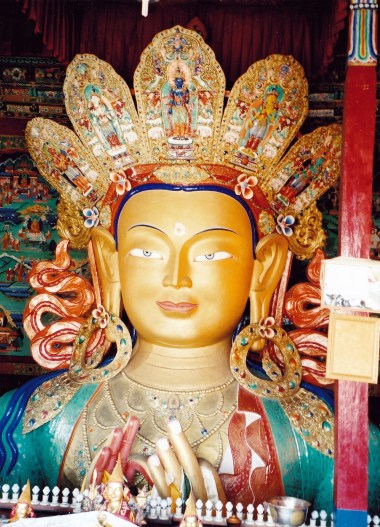
Statue of Maitreya, the Future Buddha, at Thikse Gompa. This statue, 2 stories high (15 metres) in it’s own temple was completed in 1981.
I was reading through my travel journal for 2005, yesterday.

The Bodhi Tree at the Mahabodhi Temple, Bodhgaya
On 16th March I arrived at Bodhgaya, for my second visit to this lovely small town. Because I was going to be away from England for my eldest daughter’s birthday, she had asked me to write and send her a poem. I wrote this in the evening after visiting the Mahabodhi Temple, and after meeting with Indian friends I had not seen for a year, and thought it entirely suitable to dedicate to her and to send her.
There is a crazy wisdom here;
I am at the heart of all things Buddhist.
Good friends make life bearable.
Gentle people give me hope.
An unexpected friend gives me unlooked-for joy.
I am here,
This is the eye of the hurricane.
The still point in the centre of the universe.
My hope for the world,
My hope for you.
Unquenchable love.
I don’t write a great deal of poetry, because I don’t feel it is really my forte, but in the light of current events around the world, it seems worth posting here. I revised it a little before I sent it, but this was the original draft.
Sending everyone hopes and thoughts of friendship, peace and tolerance.
In 1988 I went to Nepal for the first time, travelling by bus from Delhi to Kathmandu. Although the trip took almost 2 days, and the bus was remarkably uncomfortable, it was one of the most spectacular journeys I have ever taken, and a most remarkable experience.
And then I trekked the Annapurna circuit, still considered by many to be one of the 10 classic treks of the world. It took 24 days to complete, and from the time we left Ghorka, until the day we walked down into Pokhara, we were travelling entirely on footpaths and saw no vehicles of any description.
Part of the walk is now over a new road, and whilst this is surely welcome to the inhabitants of the region, I suspect that it takes away a little of the magic of the trek.

Village near Manang (posibly Mungji), on the Marsyandi River, close to the Annapurnas. In many ways, a typical Nepalese mountain village, it is built on man-made terraces, up steeply sloping mountainside, to avoid using any of the precious farmland available in the valley.

View from Poon Hill. Poon Hill lies a little to the west of Ghorapani on the river Ghora (pani being water), west of the Annapurnas. Sunrise there consequently occurs behind the Annapurna peaks, including the spectacular Machhapuchhare, or ‘fishtail’ peaks. That said, this shot was taken towards the west, looking across the Kali Gandaki valley.

This is dawn, though. Machhapuchhare and its double peak are shown clearly on the left.

Mountains and glacial lake from the village of Manang.

Lower down, the land is heavily terraced, fertile land being at such a premium that every available bit is used. These rice paddies are near the village of Chepe Ghat, on the Marsayandi River.

Chorten. Chortens, or stupas as they are also commonly known, usually contain relics of saints or priests. The original stupas held relics of the Buddha, such as at the Temple of the Tooth, at Kandy, Sri Lanka.

Mountains near the village of Muktinath. In the rain-shadow, here, the landscape is that of a high altitude desert.

Mani stones on the Annapurna trail. Mani stones may be carved, painted or both, and serve a similar function to prayer flags, in that they either have a prayer or mantra carved on them (typically ‘Om Mani Padme Hum’ – from which the name ‘Mani Stone’ comes from – meaning ‘Hail to the jewel in the heart of the lotus’ i.e. The Buddha) or they may have a picture of the Buddha himself. Although they may be encountered singly or in small numbers by shrines or at Gompas, at times they make up huge walls containing many hundreds of stones, some of which may have been there for hundreds of years. These walls, like shrines or any other Buddhist relics encountered here, are passed on the left.

Houses at Manang.

The Upper reaches of the Marsayandi, looking down to Manang.
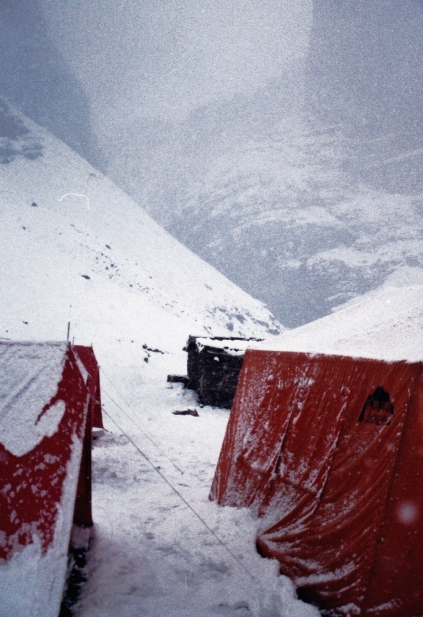
Snowed in below Thorung La. Not an unusual occurrence. Thorung La is at 5415m (17,700ft). We arrived at our campsite early afternoon with the ground clear of snow and the sun out. This was the scene a couple of hours later, delaying our crossing the pass (‘La’ is Tibetan for ‘Pass’) by 24 hours.

Crossing Thorung La. On the day we crossed the pass, we left camp just after 4 in the morning, and were down the other side by late afternoon.
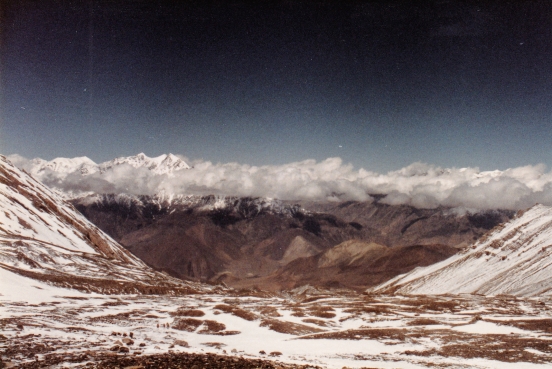
Looking west (and down!) from Thorung La). On this side of the pass there is far less precipitation and the land is noticeably drier. This is looking towards Muktinath.


The river Ganges from Dasaswamedh Ghat, Varanasi.
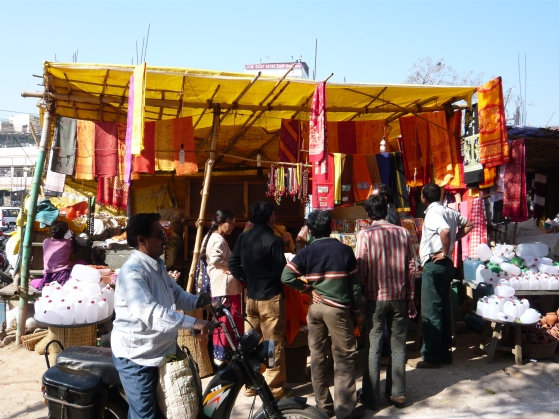
Stalls on the ghats at Varanasi. Varanasi never seems less than vibrant and colourful.
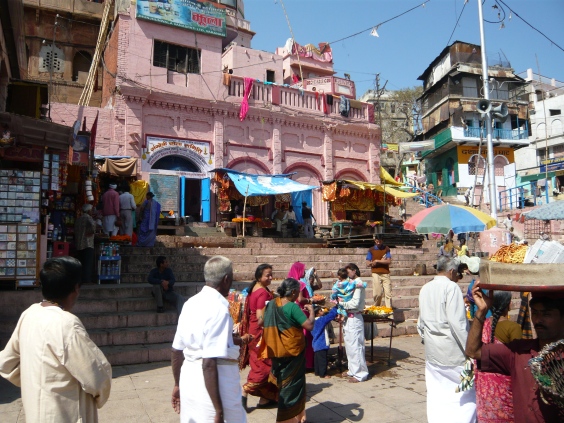
And another stall near the ghats.


Street scene in Varanasi. The church in the middle distance is Saint Thomas’. This was taken quite early in the morning when I was on my way to the ghats. Early afternoon as I was returning, it was packed solid, traffic completely unable to move.


This altar stone in the ruins of Sarnath) is still being used by pilgrims for pujas.

Dhamekh Stupa at Sarnath . This solid cylindrical tower, 33m in height, supposedly marks the place where the Buddha gave his first sermon. The base is stone, covered in delicate carvings, and the upper part brick.
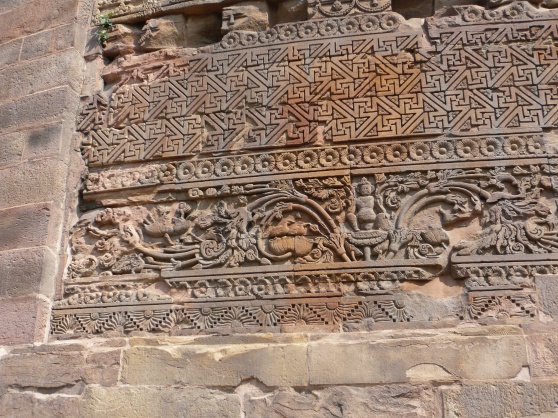
Carvings adorning the base of the Dhamekh Stupa.
I spent a total of 2 months in Bodhgaya, Bihar, but I seemed to end up with surprisingly few photographs of the town and surrounding countryside. Here are a selection of them, though, and I may put a few more up sometime soon. Hence the somewhat tentative ‘part one’ in the title.
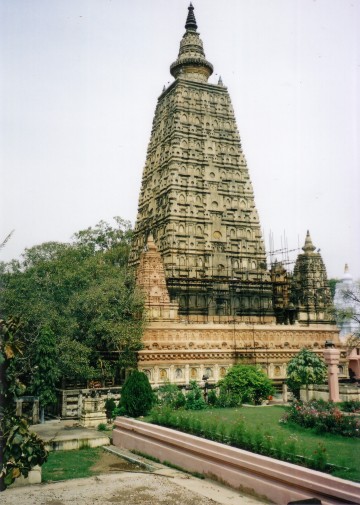
Bodhgaya is a world heritage site, because the Mahabodhi Temple was built at the site where the Buddha is supposed to have achieved enlightenment, some 2500 years ago. The original temple was built by the emperor Ashoka in the 3rd century BC. The current temple dates from the 11th century AD, and was restored in 1882 by the Burmese. Surrounded by the usual frenetic Northern Indian crowds, and visited by a huge number of pilgrims and visitors, the temple and grounds still manage to somehow achieve an unbelievably peaceful ambience.
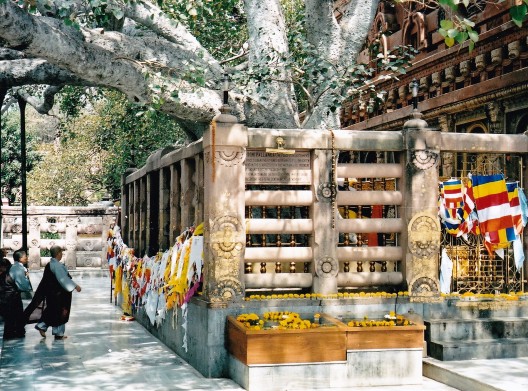
The Bhodi tree at the Mahabodhi Temple. It is a third generation descendant of the tree under which the Buddha is supposed to have achieved enlightenment.
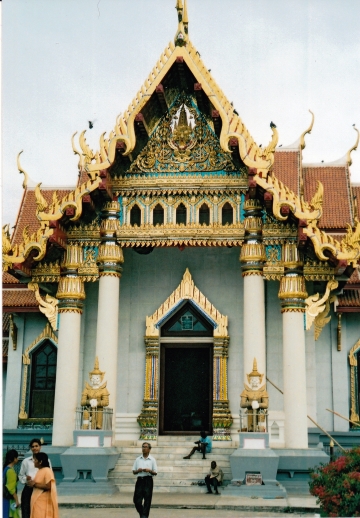
Thai temple, Bodhgaya. As well as the Mahabodhi Temple, Bodhgaya also has temples built by virtually every country with a sizeable Buddhist population. As befits the place where the Buddha originally achieved enlightenment, it is an active Buddhist centre with many charitable projects set up and running.


Hindu temples on the edge of Sujata Village.
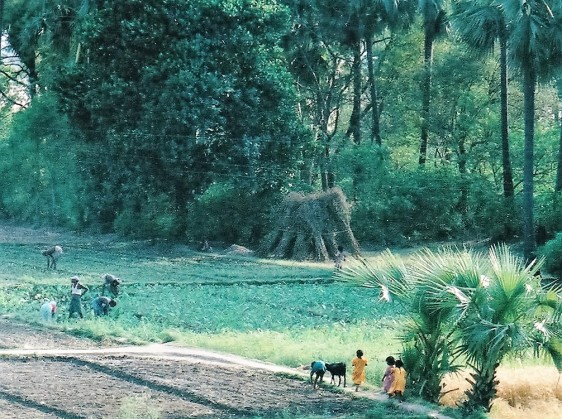
Fields in Sujata Village. In the vast majority of Indian villages, fields are still worked by hand or with animal labour. here is no exception.

Farms at the edge of Bodhgaya. Although Bihar is the most corrupt, poverty-ridden state in India, sitting at the bottom of the table in almost any set of statistics that you may care to consult, the land appears lush and fertile, supporting a strong agriculture.

And whilst we’re on a rural theme…a street corner in Bodhgaya.
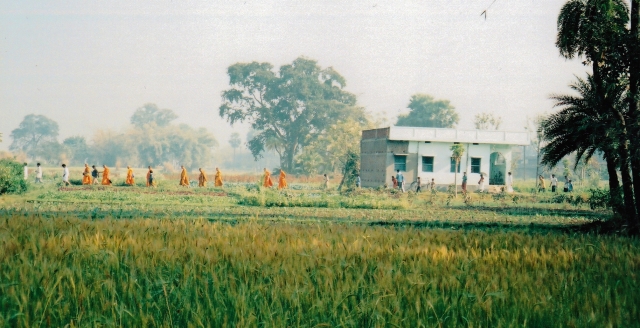
Monks heading for morning puja (ceremony) in Sujata.

Temple door in Bodhgaya.
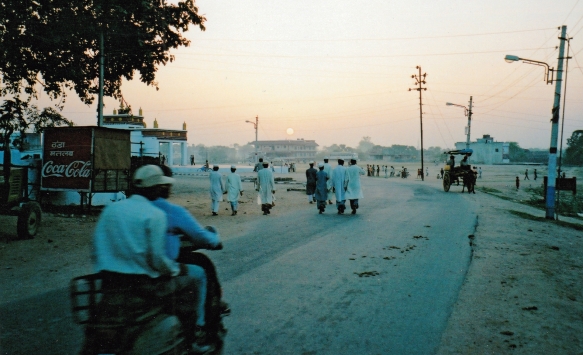
Dawn in Bodhgaya. The moslems are heading for the mosque, whilst most of the others are heading for work, for puja at Hindu or Buddhist temples, or to find breakfast.
I was after breakfast.
I’ve had a go at woodcarving, too. Would you like to see a few? You would? That’s marvellous.
As if I ever needed an excuse to blow my own trumpet!

The first one is my version of a Sri Lankan carving. This piece consists of two panels; the first one depicting a garuda (a mythical bird who carried the god Vishnu) and the second depicting a lion. It is 10 in x 20 in, and carved in sycamore wood.
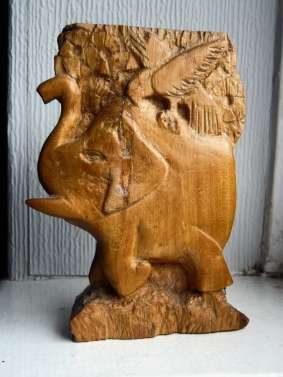
The second one is also a copy of a Sri Lankan carving, this time an elephant attacked by an eagle. My version is in Ash, and measures roughly 6 in x 3 in.
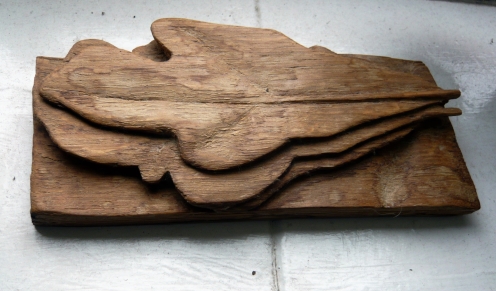
The third piece is a totally different subject; my interpretation of a painting by the American artist Georgia O’Keeffe of oak leaves. I have carved it in -appropriately enough – oak wood, and it measures 7 in by 3 in.

Finally, this is my interpretation of a medieval piece from a church in England – I forget which one – depicting the crucifixion of Christ, with Christ flanked by Saint John the Baptist and the Virgin Mary. Again, it is carved in oak wood and measures approximately 8 ins x 13 ins.
Every now and again I think that I would like to work on another carving (possibly one of those two or three unfinished ones I still have hanging around the house!), but we are rather short on space. If I ever manage to get hold of a studio again, I promise myself that I will.
I am not sure why, but I frequently think of the room that I stayed in when I went to McCloud Ganj in 2009. It was not my best trip to India, since it was the one time that I have picked up a bad stomach bug that I could not shake off for the entire duration of my trip. I had a few days in Jaipur, the condition of my digestive system rapidly going downhill despite medication and fasting, and finally took the bus back to Delhi where I felt strangely comfortable in the familiar warren of Paharganj.
When I felt that my stomach had at least stabilised, although it was by no means cured, I decided I was well enough to go and spend a week or so in Dharamshala. Or McCloud Ganj, which is what most people mean when they mention Dharamshala. McCloud Ganj is where the Dalai Lama and many Tibetan refugees actually live; Dharamshala is a town close by. Anyway, instead of taking the bus – a twelve hour journey that I just couldn’t face – I splashed out and took a flight.
Actually, the flight was wonderful.
The plane was a twin engine prop, rather than a jet, carrying just a few passengers. If one has to travel by air, then I think that there is no nicer way of doing it. We were crossing the North Indian plains for a while, then all of a sudden the Himalaya jagged up like freshly whitened teeth from side to side across the horizon. We slowly approached, the ground beginning to rise up into hills and the towns disappearing. We passed Shimla atop a ridge, with its airport running along a second ridge, looking for all the world as though the top had been sliced off – and perhaps it had.
Eventually we came into land – a tiny airport where the aircraft taxied up to the small building, switched off, and then when we got out all was quiet. After the hum of the engines during the flight, the sudden silence with the mountains staring down at us, and the air clear and cool, was breathtaking and almost indescribably beautiful. I just wanted to stand still and drink it all in, but was eventually ushered into the terminal.
And the aircraft terminal was small enough to feel that it was built on a human scale. A few rooms and halls, and not too many people around. And even those people appeared to be in no real hurry, unlike the larger airports that I usually find myself in.
I thought immediately of Leh airport, in Ladakh. That had the same feel.
So I picked up my luggage, and went outside to get a taxi to McLeod Ganj (or Gunj).
Once in McLeod Ganj, I checked into my room at Hotel Ladies Venture. It was basic, but it was clean, had hot water, a bed with lots of blankets, a table and a chair. For RS 200/- a night I had nothing to complain about, and if you wish to read this as a recommendation, then feel free to do so.

I shall write a proper blog post on McCloud Ganj at some point, but suffice to say I did very little during the week that I was there, other than wander around and look at the mountains, read, eat and drink, and visit the Tsuglagkhang Complex; the temples and the residence of the Dalai Lama (who was out when I visited).
But my guest house room has stuck in my mind.
By the end of my second day there, I had slightly rearranged the room to get it how I wanted it. My few books were lined up on the windowsill. Various belongings were on the table. I had hung a string of prayer flags along the wall. Little touches.
I have stayed in far nicer rooms. I have enjoyed better health at other times. But every time that I feel my life is too cluttered; too full of unnecessary junk and too complicated, it is this room that suddenly springs to mind, and I’m not entirely certain why.
It might have something to do with the fact that I do travel light, and so have nothing with me but essentials plus a few books and my notebook (although I would argue that they are also essentials!).
It might have something to do with the fact that my room that week felt like a bit of a refuge, partly because I still felt unwell, although I am not entirely convinced by this since I loved the town, the people were lovely, and I was completely at ease there.
I think that it is simply symbolic of the feeling that I constantly have that I need desperately to declutter and simplify my life. I think that when feelings of stress and anxiety threaten to overwhelm me, then it is an image of a refuge. I think that it is a reminder of much that I love about India and its people.
Dammit, I need to get out there again!
 Mick Canning