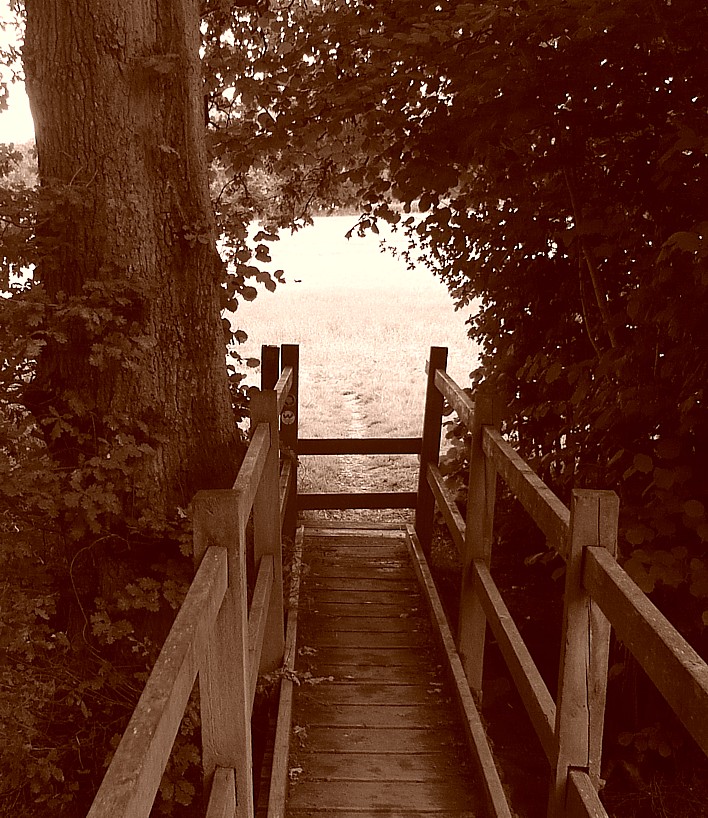
Himalayan Foothills

I am going offline for a few days, since I need a bit of a break, so I will leave you with a selection of photographs from the Himalayan Foothills, Northern India. When I log on again in a few days, I’ll catch up with everyone’s blogs and comments.

By ‘Foothills’ I mean the ranges of hills and smaller mountains that guard the approach to the Himalaya proper, where the big beasties rise up to heights of over 8000m with permanent ice and snow cover. The old Raj hill stations such as Nainital and Darjeeling were built at heights of around 2000m – high by UK standards, but certainly not by Himalayan ones.

one

Naini Tal, Nainital Town, Northern India. Morning Light. Nainital lake, (‘naina’ is Sanskrit for eye and ‘tal’ means lake) in Hindu mythology, is one of the emerald green eyes of Sati, Shiva’s wife. This was my first view of it after getting off of the overnight bus from Delhi.

two

Gadhar Kunkyop Ling Gompa, Nainital. Unlike many other Himalayan towns, Nainital has no sizeable Tibetan population, and this Monastery, perched high to the North East, overlooking the lake, is the only one in Nainital and home to just seven monks.

three

Morning mist, Nainital.

four

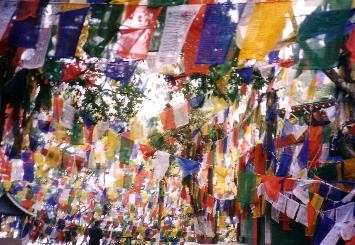
A sea of prayer flags on Observatory Hill, Darjeeling. Darjeeling, unlike Nainital, has a large Tibetan population and many Gompas both in the town and the surrounding hills. Observatory Hill is the site of the original temple of Dorje Ling, long destroyed, but after which the town was named, once the British had persuaded the then ruler of the area, the Chogyal of Sikkim, to lease them the land to build a hill station. The hill is now home to a Hindu shrine, with the British built church of Saint Andrew close-by.

But no Gompa.

five

The ‘Toy Train’ stopped outside Samten Choling Gompa at Ghoom, near Darjeeling. This train runs for 51 miles from Siliguri to Darjeeling, rising a total of just over 7000 ft. It has numerous steep gradients and sharp curves, including the famous one at ‘Agony Point’ – originally the loop there was a diameter of only 59.5 ft and the train literally overhung the mountainside as it rounded the curve. All in all, quite a remarkable engineering feat and deservedly a World Heritage site.

six

Druk Sangak Gompa, a large Buddhist monastery on the edge of Darjeeling, West Bengal. A fairly new gompa, it was inaugurated by the Dalai Lama in 1992.
seven

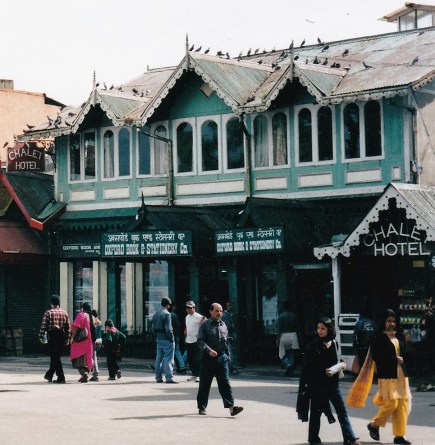
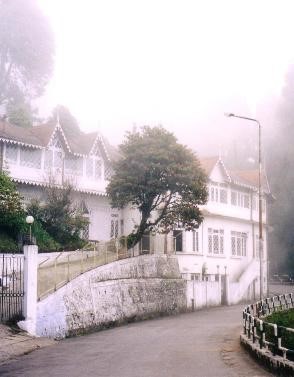
Not Chelmsford, UK, but Darjeeling, West Bengal). Many of the old British hill stations, such as Darjeeling, still retain much of their colonial character.
eight

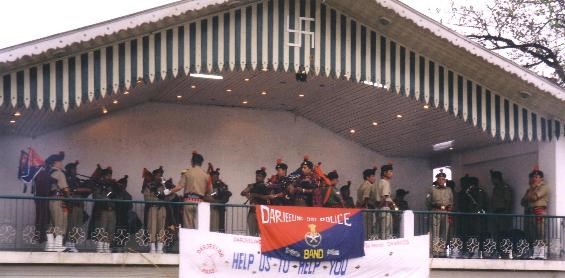
A clash of cultures! And what a clash. East meets west, with brass band in the park meeting the Indian Himalaya, courtesy of the Darjeeling Police Band. The band played in a bandstand on the Chowrasta, the open square at the top of Darjeeling, close to Observatory Hill. In the days of the Raj, this would, no doubt, have been familiar to all who lived there. Close your eyes and think of England…
nine

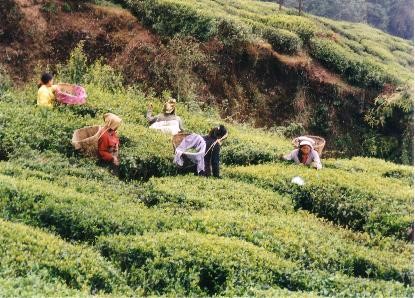
Tea pickers, Darjeeling. Think of Darjeeling, think of tea. In the hills surrounding Darjeeling are numerous tea estates, where the job of tea picking, sorting, drying and packing goes on much as it has done for the last 150 years.

ten

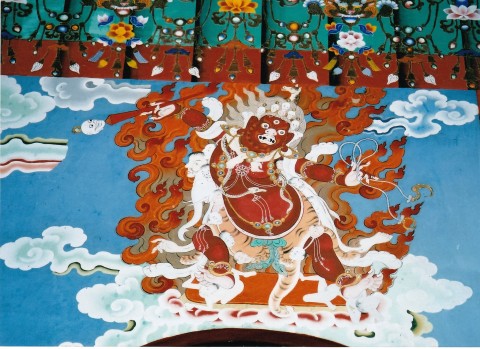
Buddhist painting on rock wall, by open air shrine, Darjeeling. As well as the larger gompas, you come across small shrines and gompas unexpectedly around odd corners everywhere.

eleven

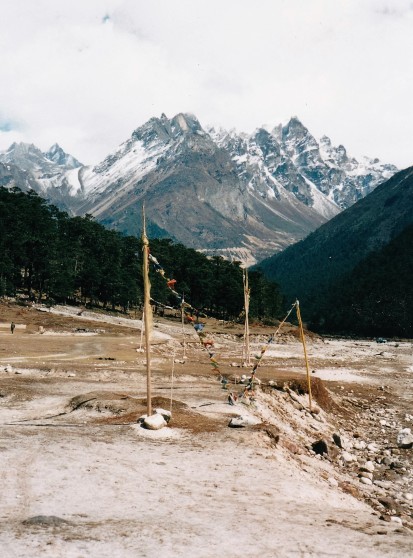
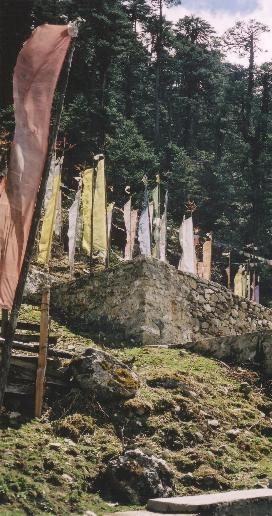
Prayer Lags in Yumthang Valley, Northern Sikkim. This is as far north in Sikkim that you are allowed to travel, just a few miles south and west of Tibet. Everybody is still very touchy about borders.

twelve

Crossing a bridge in the Yumthang valley. It should be safe, considering the number of prayer flags!

thirteen

Unnamed 6000m peaks overlooking the Yumthang Valley. We asked our guide the names of these peaks, only to be disparagingly told ‘They don’t have names. They’re less than 6000m tall.
fourteen

And more prayer flags…

fifteen

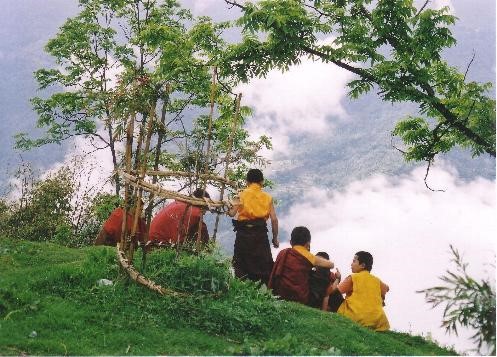
Young monks on a hillside, Phodong Gompa, Sikkim.

sixteen

Monastery wall painting, Lachung Gompa, Northern Sikkim. Lachung Gompa is about 2km above Lachung village, at a height of about 3000m. It is not a ‘working’ gompa, the monks living down in the village rather than at the gompa, so it is generally kept locked and only used on festivals and full moon days.
seventeen

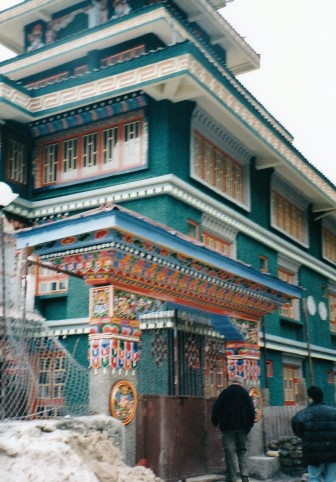
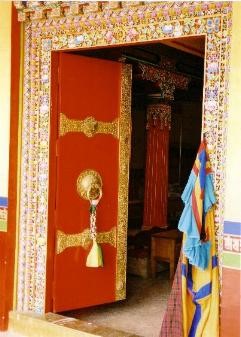
Monastery door, Tharpa Choling Gompa, Kalimpong, W.B. Kalimpong, not far from Darjeeling, but 1000 metres lower, has also a large Tibetan population.

eighteen

Statue of Chenrezig (Avalokiteshvara), Durpin Gompa, Kalimpong, West Bengal. Chenrezig (Tibetan) or Avalokiteshvara is the Bodhisattva (a being who has partly or completely attained the state of enlightenment) of compassion. The well-known mantra ‘Om Mani Padme Hum’ is dedicated to him.

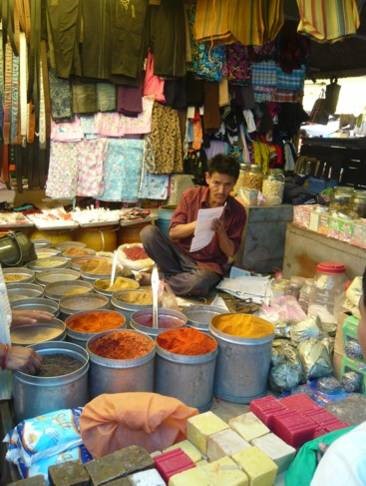
Kalimpong market:
nineteen

I watched this gentleman for some time before I approached and asked for a photo. he was rapidly serving a succession of customers at great speed, making up little paper screws of spices and powders at a tremendous rate…

twenty

…whereas this gentleman served his customers at a more leisurely pace, as if he had all the time in the world.

twenty one

This gentleman was delighted to be photographed with his fine collection of Kukris. As I prepared to take the photo, he picked up a kukri and brandished it with a none too convincing snarl, to the obvious amusement of most of the people around him.

twenty two

This stall-holder seemed to find it hilarious that I should want to photograph her.

twenty three

This lady, on the other hand, was delighted to be photographed; volunteering eagerly when a lady on a nearby stall refused.
twenty four

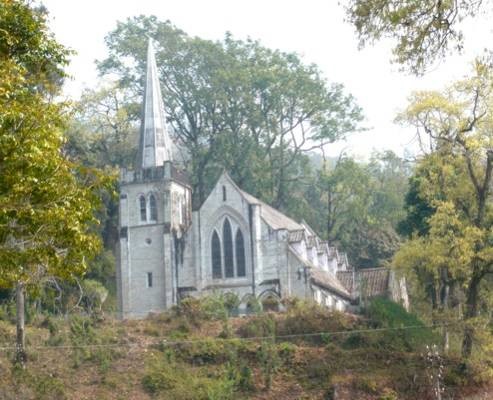
The Katherine Graham Memorial Chapel, in the grounds of the Dr Graham School and home, Kalimpong. Built in 1925, it looks to have materialised straight out of the Scottish Highlands. Dr Graham was a Scottish missionary, and built the home and school originally to educate the children of local tea estate workers. It now has a far broader intake.

twenty five

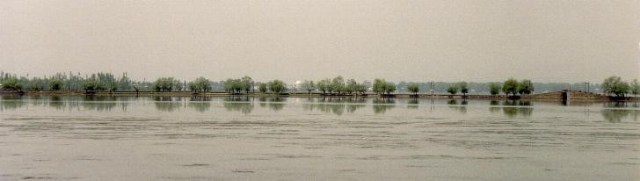
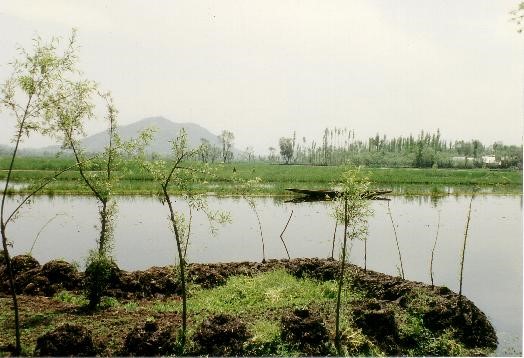
Lake Dal, Srinagar, Kashmir. Unfortunately, it is still probably unwise to visit most of Kashmir, and things will probably remain this way for some considerable time to come. A pity, because this really is a most beautiful part of India and Pakistan. I took these photos in 1989, a very short while before the area became off-limits to tourists.
twenty six

Panorama – Lake Dal, Srinagar, Kashmir). In the distance is the Hazratbal Mosque, a comparatively modern mosque, enshrining a hair of the prophet.

twenty seven

Hindu shrine. Near the shore of Lake Dal in Kashmir.

twenty eight

Houseboats around the shore of Lake Dal, Shrinagar, Kashmir. In the nineteenth century, the British, who first developed Srinagar as a hill station to get away from the stifling heat of the Indian Plains in the summer, found that the then Maharajah refused to sell them land to build houses. The solution? They built boats to live on…great, elaborate, ornate carved and decorated houseboats. These same boats, with many more recent editions, now function as floating hotels to tourists. The majority are moored not on the actual shore, but a little way off, often on the edge of small islands. This gives the local shakira (a type of small boat unique to Lake Dal) owners a chance to clean up, as a taxi service.
twenty nine

Shakira moored on Lake Dal.

Kathmandu, Nepal

How on earth have I managed to blog for almost a year, now, and still not put up a single post on Nepal? I think I’d better put that right immediately.
I’m going to start with a selection of pictures from Kathmandu, capital of Nepal.
All of these pictures were taken before the dreadful earthquakes of last year, and I do know that some of the buildings in these pictures (especially in Durbar Square) were sadly destroyed.

015a.jpg

The entrance to Swayambunath. Swayambunath is the main Tibetan Buddhist site of Kathmandu. Sitting on top of a hill overlooking Kathmandu, it comprises temples, stupas and various other buildings, including a couple of Hindu shrines. Here, a Hindu holy man lurks in ambush, ready to dab a tikka mark on the forehead of (especially) western tourists and demand rupees for the privilege.


038.JPG

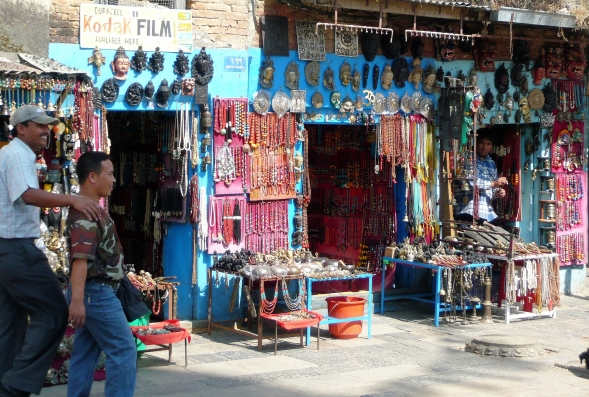
The sacred and the secular at Swayambunath. In Nepal, as in India, it is almost impossible to visit a religious site without Mammon getting a good look in. Here, in the main Buddhist site of Kathmandu, everything from yak bells to masks.


034a
‘One day, my boy, all this will be yours’ – just as long as you have enough money and all the time in the world to bargain hard. More shops – seriously colourful, seriously prepared to sell you anything. And having said that, the hard sell is a world removed from India. It almost feels as though there is no pressure at all. In Nepal, you feel you can relax again, especially if you have just travelled there from India.
056.JPG

Nuns lighting butter lamps beneath a row of prayer wheels at Swayambunath.

030a

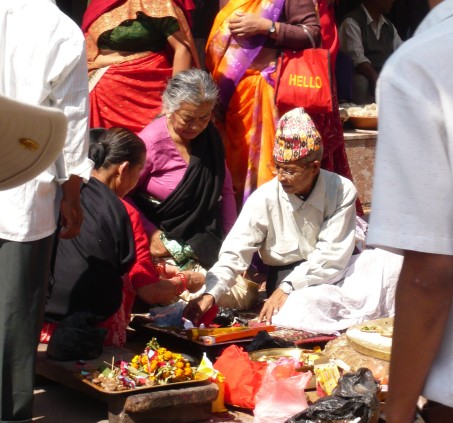
Hindu puja at Swayambunath. Probably a private ceremony at the request of the beneficiary, either for good luck in general or with a particular goal in mind (e.g. birth of a son, successful business venture.)


031b
Portrait of a Hindu lady.
057

Tourist shop in the Swayambunath complex.
100

Buildings in Durbar Square. Durbar (or ‘Palace’) Square is the heart of the old town and the area where the Kings used to live in the 18th and 19th centuries. In contrast to Swayambunath, this area is entirely Hindu, reflecting the vast majority of the lowland Nepali population.

102a

Side street in Thamel, Kathmandu. The lovely old buildings…beautiful wood carvings…collapsing brickwork…wiring all over the place…speed…calm…old and new…………the only things I can’t bring you are the sounds and smells…you must imagine them for yourselves. Coming soon, scratch and sniff websites!!!


098

Bicycle rickshaws awaiting customers in Durbar Square.


067b

Balloon seller and hopeful customer, Durbar Square.


070

Kala Bhairab – an image of Shiva in his most fearsome aspect. Wearing a garland of skulls, the six armed Kala Bhairab tramples a corpse, symbolic of ignorance. Carved originally from a single stone, it was set up by Pratap Malla, king in the 17th century. He was a pious Hindu, but interested in the arts and tolerant of other religions. He even restored much of Buddhist Swayambunath. It is said that telling a lie while standing before Kala Bhariab will bring instant death. It was once used as a form of trial by ordeal.


img
Pashupatinath, on the Eastern side of Kathmandu, is the holiest of the Hindu sites in the city. It is the temple of Shiva, on the Bagmati river and hence it includes the ghats, the most widely used place of cremation for Hindus in Kathmandu, indeed, in Nepal.

Sri Lanka (2)

Sra Lanka – Ancient Cities

Today, a return to Sri Lanka, and a few of the photographs that I took at some of the ancient sites.

Dambula – Rock Temple – reclining Buddha. There are 5 caves in all, each one more splendid than the last (assuming, of course, that you visit them in the correct order!), containing some 150 Buddha images.

SRPanorama 1thumb

SR250athumb

Dambula – Rock Temple -feet of reclining Buddha statue.

BELOW: A further selection of images from the caves at Dambulla.

SR247thumb

SR241thumb

SR238athumb

SR227thumb

SR243thumb

SR283thumb

Anuradhapura – Red brick Jetavanarama Dagoba.

SR261thumb

Anuradhapura – moonstone. Moonstones were not merely designed to be decorative, the patterns and figures are all relevant to Buddhist cosmic symbology.

SR288thumb

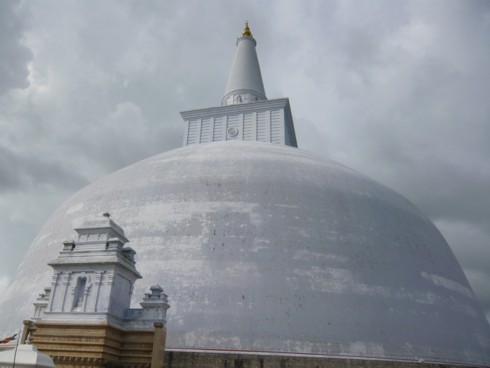
Anuradhapura. The Ruvanvelisaya Dagoba.

SR289athumb
Anuradhapura. Elephant carvings at the Ruvanvelisaya Dagoba.

SR265athumb
Buffaloes at Anuradhapura doing what they do best!

My First Long Trip to India (6)

There seemed to be so much rain falling in Sikkim that I began to wonder whether they had their own private monsoon.

It sounded as though it was raining all night, although ‘raining’ does not really do it justice as a weather phenomenon; that would rather be like suggesting that Lapland has a little bit of snow in the winter, or that it could sometimes be quite sunny in the Kalahari Desert.

It was hammering down.

It started whilst I was out in the evening, and it only stopped around dawn. When I went out to find some breakfast, thick, black clouds were still filling the sky, and it was much cooler than it had been the previous evening. Small rivers seemed to be hurtling along the sides of all the roads, and random lakes occupied much of the lower areas.

At first sight, I was really disappointed in Gangtok. It appeared very modern, with lots of new buildings and virtually nothing that appeared to be old. It was very clean (possibly due to it being extremely well-washed) and tidy. There seemed to be really very little for the visitor to see.

I decided to arrange to go on a trek as soon as I could.

Just to make it a little more difficult, though, all treks had to be arranged through officially approved agents, and there was technically a requirement for a minimum of four people per trek, although it was possible to do it with less.

And it wasn’t cheap.

Eventually, I ended up with a three day trip to the Yumthang valley – as far north in Sikkim as you are allowed to go – leaving the following morning. There were three of us: myself and a pleasant Swiss couple. After a lot of form-filling and passport photocopying, I handed over my money, and walked outside into the torrential rain.

The next day at dawn there was a blue sky, or at least as much of it as I could see from my window. A rain-washed blue, I’d be tempted to say. I packed, and then went off to the hotel where I was to meet the others. There I had breakfast, stored a bag for my return, and sat around reading and waiting to go.

IMG_0008

We set off just after ten o’clock in a jeep, and I was excited to be travelling again among the high mountains with Nepalese style villages. We stopped for lunch at an inn, which again was very clean and modern. And so far, the weather had been good. We had a good view of Kanchenjunga when we left Gangtok, and by lunchtime there were just a few clouds over the mountain tops. By one fifteen we had reached Mangan, the capital of north Sikkim, and another police check post, to show our passes. Only, this time the check post was empty – apparently, the fellow was at lunch, so we had to kick our heels for twenty minutes.

I was making quick notes as we drove along, which seem to give a good snapshot of the area. And so:

Gangs of women breaking stones to mend the road.

Suspension bridges.

Huge clumps of huge bamboo.

Bell flower bushes.

Masses of butterflies.

Gompas.

Landslides.

Rivers rushing across roads.

Good and bad bits of road.

Bottlebrush trees.

Orchids!

Buddhist symbols painted inside and outside buildings.

Long, long lines of prayer flags beside the road.

We reached Lachang, at 4pm, at an altitude of 8500ft or so. The hotel we were booked into was very smart and new, constructed and decorated entirely in Tibetan style. They gave us a supper of Tibetan vegetable soup, cheese momos and fruit, and then I went off for an early night.

IMG_0004

I awoke to blue skies and snow covered mountain peaks, and at seven o’clock the sun was streaming around some awesome jagged peaks towering over the village.

Seven thirty and we were on our way by jeep again. The last twenty one kilometres was through an area that is designated a ‘prohibited area’ – no one is allowed in without a permit, and cameras are strictly prohibited. Naturally, when we got to the valley there were plenty of people snapping away, despite the presence of numerous soldiers. When I saw soldiers actually posing for photographs, I decided it was probably safe to get my own camera out.

More notes:

Glaciers.

There are thirty one species of rhododendron in Sikkim.

Landslips.

Tibet just a few miles away.

The valley is at an altitude of 11500ft.

There was a cold wind blowing up the valley from the south. Yumthang is 140km from Gangtok by road. I wonder what it is as the crow flies?

Butterflies – clouded yellow, painted lady, tortoiseshell – they all seemed to be ones that I knew from UK.

IMG_0003

We walked 8km back and then the jeep picked us up. It was beautiful.

Hot springs just below Yumthang – a malodorous, sulphurous pool in a stone shed!

Clouds were dropping down as we headed back to Lachang for lunch.

sikkim flags

There were a number of tall mountains to the south of the valley, and I asked our guide their names. They have no names, he replied. They are all less than 6000m, so they don’t bother naming them in Sikkim (although I’m sure that traditionally they must have had names – all the mountains seen from a town or village would have had names, even if just local ones).

IMG_0002

I think it was at this point that I decided I would have to visit Ladakh.

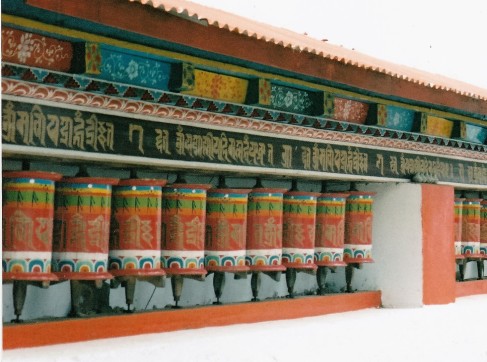
In the afternoon we drove up the other side of the valley to visit Lachang Gompa. It was not a ‘working’ monastery, since the monks live down in the village. Therefore it was locked, as it is only used on full moon days and festivals. But we could at least go around the outside, to see the huge prayer wheels (and spin them) and see the beautiful frescoes.

IMG_0005


IMG_0006


IMG_0007

The following morning we left at 6.30 on a fine, clear morning. The idea behind leaving so early was to go to a viewpoint high above a valley, but by the time that we got there it was the usual mass of clouds drifting above and below us. Some rain at times. Sunny periods. Outlook changeable.

And so back to Gangtok.

That night it poured with rain again, and the following morning, as usual, there was thick, low clouds filling the skies and the valleys. This was followed by another heavy overnight rainstorm.

Time to move on.

I had breakfast, checked out, and went straight to the jeep park. Just after midday, I was in Kalimpong. On the way, the sky soon cleared, and it was hot sunshine long before we reached West Bengal.

My First Long Trip to India (5)

I picked up my bus ticket from the travel agent, and went for lunch. Whilst I was eating, I looked at the newspaper and noticed that the ‘People’s War’ (Naxalites) had blown up the railway line near Jehanabad again. It was a good job that I had decided to get the bus to Patna.

And so, the following morning, after packing, having breakfast and attending to a few final tasks that I had promised I would do, I went off to the Project to say goodbye. I knew it would be difficult! It seemed as though everyone came up for a hug, and then I went off with the manager back to my guest house to pick up my pack, and then off to meet the bus. One final, slightly teary, goodbye, and I was on the bus and off.

Four and half hours later in Patna, I was set down amidst total chaos. There were flashing lights, seas of red flags, loud music blaring through countless loudspeakers,millions of people, it seemed, singing – another Hindu festival. I found the station, with a little difficulty, and then the nearest restaurant and bar, for some sustenance.

I learned that the chaos had a name – Ram Naumi.

As I ate, it felt quite odd to know that outside was Patna, and that the Project and the open countryside weren’t just around the corner. It rather felt as though I had just left home.

My train left roughly on time, and I slept well until the morning. We then trundled along gently, getting in about one thirty (two hours late) to New Jalpaiguri. It was slightly cooler, and felt almost refreshing. I hadn’t expected a temperature drop then, I must admit. Presumably it was because we were that much closer to the mountains. Soon, I found myself and my rucksack jammed into a bicycle rickshaw heading north through the long streets of Siliguri, at the foot of the Himalaya, during what should have been lunchtime. There followed a three hour jeep ride in which we immediately began to climb up away from the plains as we left Siliguri, through farms, tea gardens and jungle that gradually began to look more typical of Nepal than of the India that I had lived in for the previous month and a half.

tea gardens


I arrived in Darjeeling at dusk, found myself a room and settled in to enjoy a week’s rest. I then proceeded to explore the temples, markets and surrounding countryside, make plans to move on to Sikkim and dropped into Joey’s Bar for the odd beer.

Later, I decided to have afternoon tea at the Planter’s Club, a hangover from the tea planting days of the Raj. It’s something that I felt I ought to sample.

I wasn’t disappointed. Inside, I was the only customer and it was much as I had imagined that it would be; dark wood floor and ceiling, brick fireplace, piano in the corner, trophy heads high up all around the walls. I was served tea by a Nepali who wanted to talk politics. That morning there had been a strike that had closed the town down for several hours, over the irregularity of water supplies. We agreed that it was down to the government. And when that’s finally solved, he added, then there’s the electricity…

He asked if I wanted music and I said yes, almost immediately regretting it, but was surprised when it was classical music. Looking around, it really did look as though the Colonels and their ladies had gone home and everything was still waiting for them. Outside, it was raining gently and just above me a couple of lights glowed yellow in the afternoon gloom. The shade of Miss Haversham from Great Expectations seemed to hover at my shoulder. All that was needed was a thick layer of dust over everything and the image would have been complete.

Also, it was strange that there was nothing Indian in there, and if it was in the UK, then it would look really ordinary, yet it had a powerful atmosphere there. Only, I suppose, because I knew that I was in India. And then, as Fur Elise played softly in the background, I was suddenly, utterly and helplessly homesick. Nothing like the continual yes, it’ll be nice to get back and see everyone once I’ve finished here, but I could picture myself strongly, sitting in an old stone inn somewhere in Wales having a beer with friends, or perhaps sitting around a log fire with close family. Seeing my family! As the music continued, I sat at the table with my tea, unable to think of anything but home.

It finished, and another piece started. I forget now what it was, but I had to literally shake myself to break the spell. I sat a while longer, paid the bill, and left.

A couple of days later I went and had tea again at the Planters – this time there were several Indian families in there and some Hindi pop playing – a decidedly different ambience! Although the afternoon was again gloomy, the piano still in the corner and the threadbare heads staring balefully down, I was unable to conjure up anything like the same feelings. It seemed impossible that I should have felt so differently here a couple of days before. I felt that I had re-joined India.

Darjeeling still retains much of its old colonial character, in places.

bookshop (2)

The Oxford Bookshop, on Chaurasta, where I spent far too much and had to have my purchases shipped home.

prayer flags

A sea of prayer flags on Observatory Hill. Darjeeling has a large Tibetan population and many gompas (monasteries) both in the town and surrounding hills. Observatory Hill is the site of the original temple of Dorge Ling , long destroyed, but after which the town was named, once the British had persuaded the then ruler of the area, the Chogyal of Sikkim, to lease them the land to build a hill station. the hill is now home to a Hindu shrine, with the British-built church of Saint Andrew close-by.

But no gompa.

After a week in Darjeeling, I moved on to Sikkim. After a really cold night, I left Darjeeling in a share-jeep for Gangtok on a lovely sunny morning, with clouds ebbing and flowing across the horizon and in the valleys. I got there about two, and then got a room in the travel lodge. It was big and clean, with lots of hot water, and the rest of the day I spent looking around the town.

My First Long Trip to India (3)

I had read a little bit about Bodhgaya before I travelled out to India, and if I had taken any notice of what I had read, I don’t suppose I would have gone there at all.

The place was crawling with bandits.

I was likely to be kidnapped.

I was certain to be shot and robbed.

IMG

Sitting in the autotaxi as it bumped its way through the countryside between Gaya and Bodhgaya, with the sun shining on the fields and trees, this all seemed most unlikely. Yet, for those who lived there, these fears were very real. Later on in my stay, I travelled with another westerner and two Indians by jeep to Patna, which was a four hour drive.

We were delayed in Patna as the jeep broke down, the result being that we were several hours late in setting out on our return journey. It was beginning to get dark soon after we left Patna, and the two Indians on board were clearly very fearful of being stopped. They said that if we encountered a roadblock, it was quite likely to have been set up by bandits, and that we would veer off of the road and drive hell for leather – anywhere – to avoid them. They were less worried about crashing the jeep in the darkness somewhere than they were of the bandits. I used this as the basis of an incident in my forthcoming novel ‘Making Friends with the Crocodile’. *shameless plug*+.

+Well, why not. It’s my blog, after all.

But, I’m getting ahead of myself, and so back to the autotaxi. My driver had no idea where the guest house was that I wanted to go to, but cheerfully said that would be no problem. Once we reached Bodhgaya, he asked a few people where it was, and I was soon offloaded on the doorstep.

Once I had checked in, I walked into the town to explore and, more importantly, track down some supper.

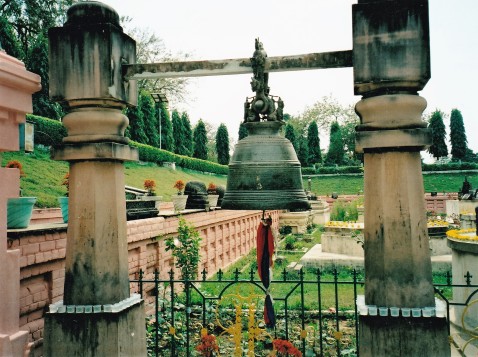
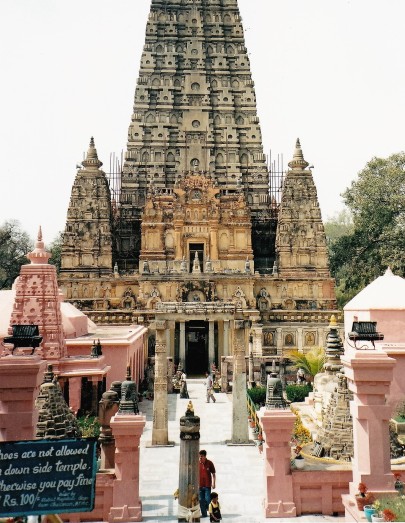
By the time I reached the Mahabodhi Temple Park, it was dark. The temple looked absolutely stunning lit up by a number of spotlights, but I deliberately decided not to go in until the next day. I felt that I should wait until I felt a little cleaner and fresher. There was no rush; I was there for some time. I was looking forward to getting to know Bodhgaya better and treating it as home for a month or so.

IMG_0003

The road outside, which was the only one in Bodhgaya that was well-paved (and pedestrianized, no less!) was, not surprisingly, full of various vendors and supplicants. But they were not overly pushy, not overly expensive, and interesting. I bought some incense, partly just to help to drive the mozzies out of my room! Just standing outside the park gates I got a great feeling of well-being and pleasure.

The following morning, after breakfast, I visited the temple.

Stunning, I had thought the previous evening, and, yes, stunning it was.

Not stunning in the sense that the Taj Mahal, for example, is stunning, although the architecture is interesting; there was just a massive sense of place, of solidity, and the thought came into my head that Hindus and Buddhists alike ascribe the centre of the world to Mount Meru, but this felt like the centre to me. As I was walking around, several times I just felt an unexpected urge to burst into tears.

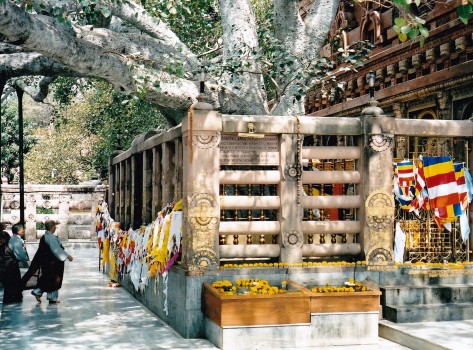
All around the temple, there were pilgrims and tourists. At one side, there is an old Neem tree, supposedly a 4th generation descendant of the one that the Buddha sat beneath to achieve enlightenment, two and half millennia ago. When it is grown at a Buddhist temple, it is referred to as a Bodhi (which literally means ‘enlightenment’) Tree.

IMG_0002

The reason that this site is so special, however, is that this was the actual site of the Buddha’s enlightenment. For a Buddhist, places just don’t come more special than this.

Everywhere, groups of pilgrims were conducting pujas (ceremonies); there were large numbers of Japanese and Korean pilgrims, but also many from other countries. This is reflected in the large number of Buddhist temples built in other places around Bodhgaya. There are a dozen or so temples built by Buddhist orders from all of the countries with substantial Buddhist populations, such as Thai, Chinese, Tibetan, Vietnamese…lots to visit, I decided. Outside the gates, a CD of chanting monks was playing. Despite the swarm of visitors, the whole place exuded peace, and I found myself just gently strolling around, sitting, watching everything…

IMG_0001

It was lunchtime, I found with surprise, when I left the temple grounds.

The presence of so many Buddhists in Bodhgaya has led to the setting up of a number of ‘projects’. These take many forms, but there are a good number of medical projects, schools, and orphanages, all set up to provide these services free to those that would otherwise not be able to afford them. Bihar is the poorest state in India, with higher levels of poverty, lower life expectancy and lower rates of literacy than any other state (the last time I checked!).

Human nature being what it is, a few of these are scams. I had checked out the project that I had volunteered for as well as I was able to beforehand, and was reasonably certain that it was genuine. I was volunteering my time, rather than donating money, so I was fairly sure that I would be able to see what was happening on the project as I worked, and if I was helping to (for example) improve the English of a few children, then that would be beneficial regardless of anything else.

I made contact with the project organiser and told him I had arrived in Bodhgaya.

The next morning I was at the orphanage.

My First Long Trip to India (2)

And so, fifteen years after my first trip to India, I was back again in Delhi.

004 (2)


Eventually I felt brave enough to leave the café and go off to do my tasks. First of all, I had to sort out my train ticket, so I headed off to the Tourist Bureau (The Official One!) at New Delhi Station. But as I headed up the steps towards the office, I was stopped by a friendly chap who told me it was closed. ‘But no bother’ he said. ‘You come with me and I take you to Tourist Office where they sell you ticket’.

Before I realized what I was doing, I turned to follow him. By the time that we were out of the station and threading our way through the taxis and crowds on the concourse I had remembered that this was a common ploy to get people to ‘Tourist Offices’. Nowadays I have no problem with using them – in fact I will often seek them out to buy me tickets, but more of that later. I glanced up at my new best friend, who was a few steps ahead of me, and peeled unobtrusively off and headed back into the station.

I went back up the steps towards the Tourist Bureau. The first thing that struck me was the silence. Downstairs, all was noise and smells, colour and chaos, but up here was a big, gloomy, echoing corridor, empty as far as I could see. After wandering up and down for a while, I found the Bureau which was, naturally enough, open, and fairly crowded. Inside, whilst I awaited my turn at the counter, I chatted to a fellow traveller from England who decided that it was his task to lecture me at length on how to approach getting a ticket out of Indian Railways. Foremost amongst this advice, he said, hectoring me sternly, was keeping your cool amidst all the provocation, bureaucracy and hassle.

Eventually, he was called to the counter. They went through his application form and documents with him, seemingly finding fault with something. He lost his cool with them, and left without a ticket.

I chortled quietly to myself.

When it was my turn, I found the process fairly straightforward, although long-winded. But I left with my ticket to Gaya stashed securely in my wallet.

010a

Why Gaya? Gaya is certainly not a tourist destination, but it is the nearest town of any size to Bodhgaya. When I had decided to come to India, instead of limping around Britain in pain, I had come to the conclusion that instead of just travelling around for three months or so, I should at least spend some time doing something worthwhile.

We all like to think that we’re having an existential crisis at times. Okay, that’s probably not true. But lots of us do. What is an existential crisis, though? Is it simply that we are going through a time in our history when more and more of us question our role, our place in our society? Or could there be more to it than that? It certainly would now seem to be a time when many people in the west have come to doubt whether the values that they are taught are actually of any importance, and indeed whether they really have any value at all.

On the other hand, there are just as many members of that society who feel that the whole subject is just bunkum, and that those who complain about these things are merely whinging, work-shy degenerates. Sod your existential issues, mate, I’ve got a family to feed.

Is it really, then, just so much nonsense? Maybe our situation is such that we can afford to have these crises now; that we now have the opportunity to address them. When life is simply a struggle to keep a roof over one’s head and to put food on the table, then one’s priorities are very different from those with the leisure to ponder ‘life’s imponderables’. In past times, we would have had to just carry on regardless, although there were writers then who recognised and explored them, such as Hermann Hesse and Somerset Maugham. The only other realistic option, other than becoming a vagrant, would have been to completely renounce the world and to join a monastery or become a hermit.

India, though, handles these things rather differently. Hindus have a duty to seek pleasure and success and to accumulate wealth, but also, eventually, to renounce the world and seek moksha; liberation, after the discovery that the other three paths give no lasting satisfaction. This is seen in the persons of the many ascetics who wander the land, or live alone or in ashrams, having given up all worldly possessions.

Bodhgaya is in Bihar, the poorest state in India. It is also the place where the Buddha is said to have achieved enlightenment. For this reason, there are many Buddhist temples there, attracting a goodly number of Buddhist pilgrims, and, naturally, not a few tourists, and also a number of charitable projects.

And a few rogues.

I was attracted to the idea of spending time there, both to experience the temples and atmosphere, but also to work for a while on one of the projects. I did some research whilst in the UK, and arranged to help out at a project that comprised a school and orphanage in a village on the outskirts of Bodhgaya.

Smugly pleased with myself for obtaining my ticket to Gaya, I then went to find an Internet cafe and e-mailed everyone, then meandered back to a café for lunch.

Two days later, I was in Bodhgaya.

Kandy and Environs

A few pictures from Sri Lanka, today. I have only had the pleasure of one visit there so far, but it is another place that I should like an opportunity of returning to at some point. These ones are all from the time that we spent around Kandy, Sri Lanka’s second city up in the hills of the Central Province, and which enjoys a much cooler climate than that down in Colombo.

106a

On the bus to Lankatilake. Like most of the rest of the Indian subcontinent, the cabs and interiors of buses, taxis and lorries in Sri Lanka tend to be dedicated to placating whichever deities preside over traffic accidents and mishaps. The majority in Sri lanka, like this one, are Buddhist.

082

Lankatilake Buddhist temple, some 10km SW of Kandy. The temple also has a Hindu shrine incorporated in it.

094

Inside the Buddhist shrine.

093

Bodhi tree at Lankatilake temple. Bodhi trees are to be found at all Buddhist temples, and are all descendants of the tree that the Buddha achieved enlightenment beneath, 2500 years ago at Bodhgaya, Northern India. Properly, they are Sal or Neem trees. Only the ones descended from the original Bodhi tree are called Bodhi trees.

098

Lotus flower in the tank at Lankatilake. As in India, ‘tank’ refers to any artificially created body of water, from temple pools all the way up to reservoirs.This tank is a small, circular construction, and can be seen on the left in the photo of Lankatilake above. With its roots in the mud, its stem growing through the water and its beautiful flower in the air, The lotus has special significance to Buddhists – it represents the true nature of beings, who rise through samsara (the suffering of this world) into the beauty and clarity of enlightenment.

096

Hindu temple entrance at Lankatilake.

095

Dagoba at Lankatilake. ‘Dagoba’ is the name used in Sri Lanka for the structures known elsewhere as pagodas. They are usually built around a holy relic of some sort.

063

Here in this shop in Kandy, you can get postcards and masks, false teeth and gramophone needles, shoes and Buddhas, elephants and exhortations to love Jesus. Something for everyone, really.

200a

The Departure Board at Kandy station. We were waiting for the 3pm train to Colombo, departing from platform 3.


119

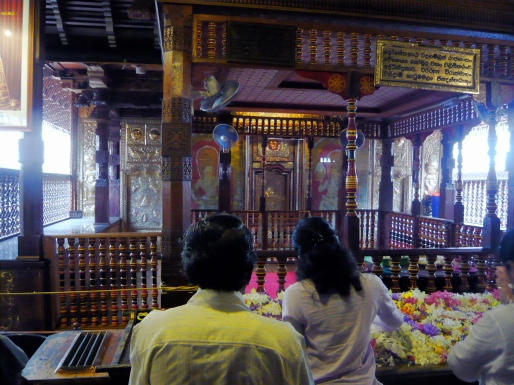
Beautifully carved and painted ceilings in the Temple of the Tooth, Kandy.

123

Entrance to the shrine room, Temple of the Tooth.

134

Moonstone, Temple of the Tooth. A moonstone is a richly carved stone, frequently placed at the bottom of a flight of steps. It is semi-circular in shape.

127

Door, Temple of the Tooth.

Religion or Philosophy?

Now, here’s a thing.

It is rather a fashion nowadays to declare that religions are all wrong and should be banned, because science and reason have somehow proved that there is no god (they haven’t).

But I would like to consider every religion in the world as a school of philosophy, and consider what I might take from each that would be useful to my life and my development.

Whether there might actually be a god or not then becomes unimportant.

Most Buddhists, for example, would seem a little unsure of whether there is a god or not, but if asked, the majority of them would reply that it does not matter. The argument being that it is impossible to prove either way, and therefore it is impossible to know either way. So why not just live your life as well as you can?

SR312thumb

Traditionally, religions have provided society with a set of moral rules. It may be that these rules were the first imperatives that human beings treat other with decency. Since none of us were around in the long years when our race was evolving speech and higher thought, and learning how to co-operate with fellow members of the tribe and – who knows – perhaps their neighbours, this must of necessity be pure speculation. Yet I find it highly likely these moral codes were the first suggestions that human beings might treat an enemy, for example, with mercy, rather than simply killing them, which might otherwise be the obvious course of action. Morality over expediency, if you like.

Some examples:

Islam forbids charging interest on loans. How many who have fallen victim to the money-grubbing lowlife that run these ‘payday’ loan companies charging astronomical rates of interest might have sympathy with this view? It teaches also that it is a moral duty to give alms; to help those in need.

112 (2)

Christianity is big on love and mercy; at least in the New Testament. It teaches tolerance and forgiveness.

Buddhism teaches that to want things is to become enslaved to those desires that can never be satisfied. How much better to live simply and to be content with what we have? It teaches also compassion for all living beings.

Hinduism teaches that all life is sacred, and that we should all refrain from injuring others.

ganesh shrine kodai

These are only the main four faiths in the world today, but every other religion that I have read about also teaches a code of moral imperatives.

And in a world run by huge multi-national companies with no moral compass whatsoever and politicians who only look after their own, where we are continually and aggressively informed that we must worship money and consume more and more pointless trash, and that it does not matter if we destroy the environment just as long as companies make bigger profits, anything that can make us pause to consider what is actually important in life should be encouraged rather than denigrated.

343

It would therefore be ridiculous to simply dismiss out of hand entire canons of work, solely on the grounds that the writers of these philosophies believed in a god whom the reader might not (or does not want to) believe in. Everybody has a spiritual side, whether or not they believe in some sort of god. The spiritual side of a person champions beauty over money, generosity over selfishness, kindness over cruelty. These are values that most of us still claim to value today.