A Warning To Other Writers

Oh, this sodding book.
I…no, first, a little bit of context.

Those of us who call ourselves creatives, why do we create? Why do we have this need to make things? I know the usual answer is we write / paint / carve / whatever it is we do, because we have to, because there is something inside of us that needs to find an outlet. But what is that something? In my case, as well as a storyline it is frequently a place where I have spent some enjoyable time. It provides me with a comfortable setting in which to tell a story.
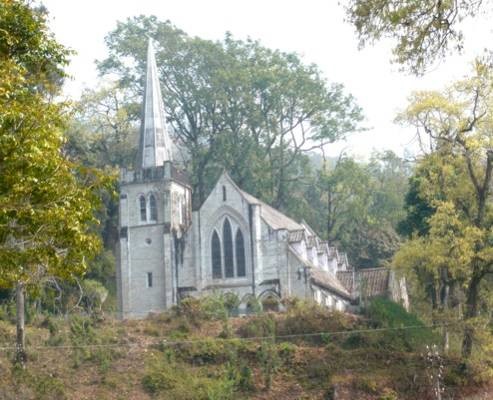
Most of what I do, certainly the work I feel is my best, my most successful (in the sense of expressing what I want to express), falls into that category. My long poem The Night Bus, for example, was the result of a thirty year (admittedly intermittent) search for a way to record my experience of a long bus ride across Northern India into Nepal. I attempted prose and paintings without success, although through this I did develop a style of painting I went on to successfully use on many Indian paintings, and had long given up on the project when chance showed me a way into the poem. The poem I completed succeeds in conjuring up (for me) the impressions and feelings I had on that journey; I can relive the journey again by re-reading the poem. Whether it conveys anything of that to other readers, I naturally cannot know.

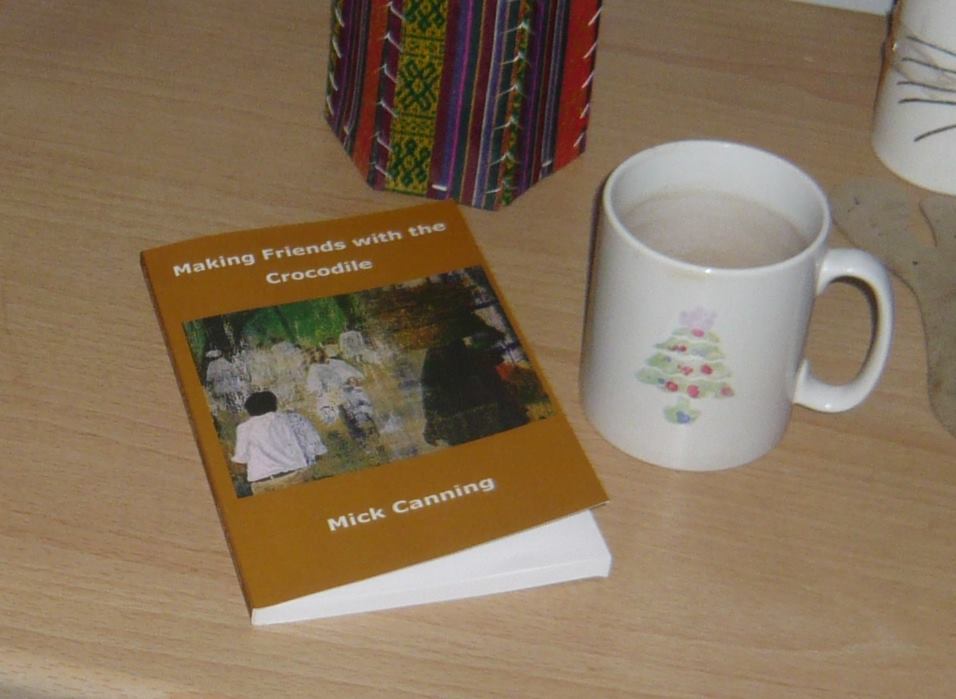
And my stories, too. I look through Making Friends With The Crocodile, and I am in rural Northern India again. I re-read The Last Viking and can easily feel myself on an island off the west coast of Scotland. This is not to imply any intrinsic merit to my writing, other than its ability to transport myself, at least, into the setting I am attempting to describe.

These stories are a composite of three basics: a setting, as mentioned already, a storyline – and again this needs to be something important to me, or I find it pretty well impossible to put my heart into it, and strong, convincing, characters.

It is useful, then, to know where lots of my writing comes from, and what shapes it, what drives it. I have long suspected that this is frequently nostalgia and, recognising that, have wondered whether this might be a bad thing. Nostalgia, after all, has a rather bad press…does it just mean I am living in the past because I am viewing it through rose-tinted spectacles? As a way of not addressing issues of today I should be tackling?

This yearning for nostalgia, though, is a desire for something we see as better than what we have now. To write passionately about something it needs to be something I feel strongly about. Obviously this can also be something we find frightening or abhorrent – dystopian warnings about the future or anger about injustices, for example – but even in those cases the familiar provides a cornerstone of safety, even if only by way of comparison.

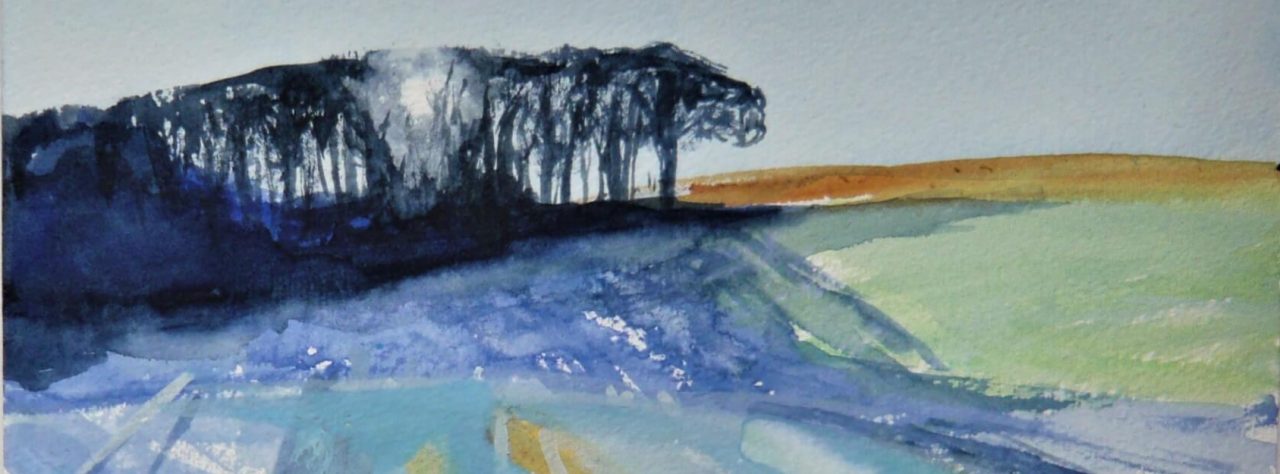
This is also true when I paint. I am not someone who can paint to order – if I’m not inspired, it does not work. A number of difficult commissions have proved that point to me. I paint what I like, what moves me. After all, whatever I am creating, it should be foremost for myself.

That book, then…

I began writing it about five years ago for all the wrong reasons. I had self-published Making Friends With The Crocodile and decided my next story should also be set in India, and as a contrast decided to write about British ex-pats living in a hill station in the foothills of the Himalaya. I wanted to write about India again. The trouble was, I had no idea what story I was going to tell. I had no stories that might slot into that setting I felt in any way driven to write; it just seemed to feel appropriate at the time. I was pleased by the reception the first book had and felt I ‘should’ write this one.

What could possibly go wrong?

I spent time putting together a plot, with which I was never wholly satisfied, and began writing. Really, I should have seen the obvious at that point and bailed out. But I carried on, and twice reached a point where I thought I had the final draft.

My beta reader then proceeded to point out all the very glaring faults.

So twice I ripped out a third of it and chucked it away, then re-plotted the second half of the book and got stuck into the re-write. I’m sure you can see part of the problem at this point – I wanted to hang onto as much of the story as I could, instead of just starting completely afresh. And now here I am trying to finish the final draft for the third time, as my February project for this year. And it’s just not working for me. But at this point, after well over a hundred and fifty thousand words (half of which I’ve discarded) I just feel I’ve invested too much time and effort in it to abandon it now. Somehow, it has to get finished. I do have an idea for a couple of quite drastic changes which I’ll try this week, but unless I feel I’m making some real progress I’ll then happily put it aside for a while and concentrate on next month’s project: painting and drawing.

And, to be honest, if it eventually ended up as a story of less than ten thousand words, and if I felt satisfied with it, then I’d take that as a result, now.

And the moral of all this? I’m sure there was a point after a couple of months when I knew I shouldn’t have been writing this book. I should have binned it there and then and saved myself a lot of fruitless trouble, but stubbornly ignored the warning signs.

My Virtual Reality

One of the things about growing…older, let’s say…and I’m not saying it’s a good thing or a bad thing, is the growing realisation that we’re never going to live in that place that we are convinced is perfect for us, or have the day to day lifestyle that is everything we want.

One consolation for the writer, even if it’s rather a shallow consolation, is the opportunity to write these places and lifestyles for ourselves. For the last year or so, nearly all my creative writing has been rather experimental, which is one reason I’ve not put much up on here. Rather than focusing on writing the complexities of a story arc, I have been very much concerned with the character of the characters I have written, and possibly even more concerned with the environment they occupy.

In a way, then, I’m exploring different versions of myself – although that, surely, is what all writers do anyway? – and it is instructive how much all of these versions have in common. For anyone who knows me, the information that these scenes involve almost nothing of town or city should come as little surprise. But it’s a learning process, a personal learning process. And even the photos I’ve chosen to accompany this post serve to reinforce what I already know about myself.

And the other strand that occurred to me as I thought about all this, is how it has brought home to me that the priority in my writing – my absolute, number one priority – is that first and foremost I am writing for myself. Whatever I write has to please a rather demanding reader; myself. And if that means my writing is even less ‘commercial’ than it was before, then so be it.

Strangely, this seems to have removed the pressure of time. I’ve always ended a writing day either pleased with the amount I’ve written or berating myself for not having written more. As if that was the sole measure of how successful or productive my day had been! Now, though, writing just for myself, success can be equated with how good I feel the output is; and by ‘good’ I mean quality (as defined by me, for me). So even a few lines that work well may be a good day’s work. I think this time pressure, this fixation with writing a certain amount each day, is a purely commercial pressure; an I-need-to-finish-another-book thing.

So goodbye to that. It’s not for me.

A Busy Time in West Bengal

For the last couple of months, during Lockdown and its easing, I have spent an awful lot of time up in the Himalayan foothills of West Bengal.

bookshop (2)

Okay, that’s not strictly true, but for most of that time I have spent my working day revising, re-writing, and editing A Good Place, my novel set in a fictitious hill station there. I have some new characters to weave in, some old ones to remove, and the story line to alter in several major ways, including a different ending.

I finished the first draft some nine months ago, but there were parts I didn’t feel entirely satisfied with then, and my beta reader unerringly picked those out for major revision. I then spent a while thinking about the story line and took out nearly all the final third of the book and chucked it.

That left me with a lot to rewrite.

Much of the problem stemmed from the fact that after I published Making Friends With the Crocodile, which is set in an Indian village with peopled with all Indian characters, I wanted to write a novel dealing with the British who remained behind in India after partition. A kind of balance to my writing. That was all well and good, but I began writing the novel before I was completely satisfied with the story line, and the more I wrote of it the less I liked it. So I kept changing the story line as I wrote rather than doing what I really should have done, which was delete the whole thing and go away and write something completely different, waiting until I knew what I really wanted to write. But I’m now content that I have the story I want to tell, rather than Just A Story.

Consequently, I have been virtually living in West Bengal during these days, inevitably leading to yearnings to be there in person. Which does nothing to ease the feelings of frustration at enduring the travel restrictions of Lockdown.

050a

However, one of the advantages of having several projects on the go at once, which I always have, is that I can switch to another for a while when I need to. Last week, then, I spent one day giving a final edit to a short story which gave me the opportunity to spend the day (in my head!) in rural Sussex, which was very welcome. Especially as that is somewhere we can get to now, with a minimum of hassle.

And A Good Place? I’m glad you asked. I think I’m close to finishing the second draft, which will be a blessed relief.

Just so long as my beta reader doesn’t throw her hands up in horror when she reads it…

Self Publishing – a Blessing or a Curse?

That depends on who you talk to, of course.

pothi edition

The self publishing boom has given rise to the publication of millions of new books, the majority of which would never have been published traditionally because they would be either deemed to be of insufficient interest to return a profit to the publishers or because they were, frankly, just too terrible to see the light of day.

How good a book is can be very subjective in many ways, but certain rules must apply.

If you buy a traditionally published book, you may be reasonably certain that it has been edited and proof-read to a high standard, the printing and layout of the book is of good quality, and the actual contents – plot, dialogue, character development et al – are sufficiently well written as to repay your reading time.

There are no such guarantees with a self published book.

As a member of several Goodreads groups, I receive regular emails which consist largely of other members promoting their books. These promotions frequently consist of a synopsis of the book, extracts, and links. All well and good, but the number of extracts that are poorly written, unedited (it would seem), with poor print layout, and the number of synopses that are equally poor, is very high indeed. Probably the majority, unfortunately. And should I follow the link to the ebook sales site and read a longer extract, frequently this, too, is filled with more of the same errors.

As far as the plot and dialogue and all that goes with that is concerned, I admit that may be partly down to taste. I have no doubt that some poorly written and poorly plotted books still give great pleasure to many readers, and good luck to them. There are certainly examples of the same amongst traditionally published books. And styles go in and out of fashion, anyway.

What I do take issue with, though, is poor, sloppy editing.

Most people cannot afford to pay for professional editing – I certainly can’t. I understand that. It means doing the job yourself, but taking infinite time and care over it. Check it over and over again until it is the best you can do. The odd mistake will slip through, but that happens even in a professionally edited work. Persuade others to act as beta readers for you. They may not be professionals, but they will spot things you don’t. You are too close to the work, anyway.

If you can’t do that, don’t publish the book.

Let’s take layout first. It only takes a careful look at half a dozen professionally published books to get a good idea of what that layout should look like. And you can buy books that supply more detail. If you are serious about your book, you should do that.

Spellcheck is a useful tool, but only if it is used properly. It recognises a correctly spelled word in its database, but has nothing to say about the suitability of its use. I do find it particularly irritating to come across passages where the completely wrong word has been used, no doubt because Spellcheck flagged it up as the correct spelling. Common examples are groyne / groin, sheer / shear, alter / altar etc. etc. etc.

Grammar is the biggest minefield, though. We all get that wrong at times, even the best of us. But at least avoid the biggest howlers – the so-called grocer’s apostrophe, for example. Put the manuscript through a program such as Grammarly, which is free to download, to pick up the majority of the errors.

Another phenomenon I have seen recently is a 4,000 word story published on Amazon as a ‘Novella’. I suppose there’s nothing wrong with selling a story that length, but anything that comes in at 4,000 words is a short story. And quite a short one at that. To describe it as a novella, no matter what price it is being sold at is, quite frankly, a bit of a bloody cheek.

Please don’t do that.

And I’m sure many other readers have their own pet peeves.


Welcome to my Crisis!

I’ve been hiding from the internet.

No, I didn’t go away, unfortunately, although a holiday was what I both have been and am still craving. I made a rash promise some weeks ago to put up a Facebook Author page, to do a minor relaunch of my novel, and to serialise a bawdy Elizabethan detective story. Really, I should know myself better than that.

dawn panorama

I think it was the short story that finally broke me.

Writing, for me, is a pleasure, comparable to painting. It is all about crafting the finished product, taking my time and eventually producing the best I can. When all goes well, the process is immensely satisfying from beginning to end.

Within that process, of course, there are times of writer’s block, false starts and finishes, wrong turnings, and many other things to go wrong. And the editing can be an infuriating process. But overall, there needs to be a flow.

Making Friends with the Crocodile worked for me at the length it was (45,000 words), since I wrote it almost as a stream of consciousness as the story unfolded in my mind. It came out in a rush partly because of its importance to me, and partly because I found I could visualise the characters, the story and the setting clearly. Once I had reached the end, I knew that was the end.

Obviously, many stories take a lot more coaxing to get down on paper. I’ve struggled with ones that need to be forced, certainly in places, partly because at that point they are not ‘me’ at the heart of them; I have lost that flow. But sometimes because of the length.

One reason I stopped entering short story competitions is I write a lot of long short stories. I am perfectly aware of the dictum that whatever you write can be edited down to the required length and that, indeed, they should be edited down.

But I also strongly believe that when a story presents itself to be written, that story has an internal length that needs to be respected, even after editing. Some require a few hundred words, some a lot more. But to attempt to turn Making Friends with the Crocodile into a 120,000 word novel or a 5.000 word short story, I am sure would have meant a lesser read. It would have been padded out for the sake of it, or stripped down to bare bones that would have meant that the characters could not have been drawn as strongly as I wanted them to be, and therefore encouraged less empathy from the reader.

Where is all this leading?

I began the short story / serial. It was working quite well, and I had a good few chuckles to myself as I was writing it and then, suddenly, it was almost 10,000 words long and nowhere near finished.

Oh dear.

So I attempted to cram and trim and edit and get it down to a suitable length for serialisation, but I was not happy with the result. Oh no. And I had one of my minor panic-I-can’t-cope-stress attacks and decided the only way to deal with it was to hide.

So, I’m not going to serialise it after all. I will finish it, but the attempt to condense it into a few instalments simply wasn’t working, and what I ended up with felt completely wrong. I will return to it at some point in the future, and finish it as the novella that it clearly is.

There is another strand to all this:

I made the Facebook Author page. That was the easy bit, and I’ll show you where it is next time. And I put together the re-launch promotion piece by the simple expedient of gathering together extracts from lots of the kind reviews the book has had.

But I am in a state of recurring panic, once again, over this huge need to self-promote to sell books. Of course, we all want to, but we are forever urged to use this or that platform, accept this or that offer, etc. Now, we are told that we ‘must’ have a YouTube channel. Really? And a presence on all sorts of social media. Are we not ‘serious’ writers if we are not prepared to move heaven and earth to sell a couple of extra books? That we should ‘invest’ a hundred or five hundred dollars here and there to advertise ourselves?

I have sold a few, and what is really important to me is the tremendous feedback that I’ve had.

Blowing my own trumpet is anathema to me, as I have written in the past. I just can’t do the selling and marketing the way that seems to be presented as essential. It’s an aspect of life that I hate, and a reason I have never gone into ‘business’. Everything around the promotion and marketing just seems relentless and is something that I cannot cope with.

Fortunately, I am not interested in fame. The idea frightens me.

And I really struggle with social media. I have had two goes at being on Facebook, and cope with it at the moment by not going on it very much. I spent ages trying to see the use of Linkedin, and have solved that one by closing my account last week. I really see no use for it.

And I am not doing Twatter.

So here I am back on WordPress, which is a platform I do enjoy. I’ll dip in and out of it a bit over the next few weeks or months, I suspect, since I still feel a bit panicky, but I will be there.

Thank you for your patience!

I have some news!

I have some news.

I’m sure some of you (especially the writers) will remember that I reported here a week or two back the disturbing news that fictitious characters now have the legal right to sue their creators for defamation of character, or any other hurt (real or perceived) caused through those said creators’ thoughtless and heartless actions.

imgp2288

In case you want to have a look, the link is below.

Sue me and I’ll have you killed!

Well, news reaches me this morning of a new grouping of characters, namely sidekicks in detective stories, who have come together under the name of Sidekicks Of Detectives (or ‘Sods’) to challenge their positions as The Most Stupid Person In A Detective Story.

Initially, the group was to have been organised by Captain Hastings, sidekick to the famous Poirot, but after some heated discussion it was agreed that, actually, he couldn’t organise his way out of his own front door without help, and the task was then delegated to Doctor Watson, who arranged a meeting at a coffee shop, one of a well-known chain, in Central London. Unfortunately, he forgot to mention either which branch it was, or the time of the meeting, and so there has only been limited progress on that front, so far.

But, further cases have already come to court.

A number of characters from ‘Three men in a boat’, by Jerome K Jerome, Bertie Wooster and others created by P G Wodehouse, and various characters from books by Spike Milligan began a collective case, but were laughed out of court.

Dan Brown is being sued by every single character he invented.

And there is some confusion in America, where Donald Trump has apparently filed a case against himself on the grounds that he has irreversibly blackened his own character.

I’m told he is confident of winning the case, since the stories he has spread about himself are scarcely believable, and that it is generally held that he must be a fictitious character, since the majority of observers and commentators say they ‘can’t believe this guy is for real!’

The trouble is, all this is symptomatic of our legislative culture. It was the retrospective case brought by Big Ears and Mr Plod against the estate of Enid Blyton that, I think, I found most distressing. By all accounts, they cooked it up over an evening of heavy drinking, after being taunted by the Tubby Bear family, and it is strongly suspected (although it cannot be proved) that much of the impetus came from a third character – possibly one of the Fluffy Cats, since they are known to be bad through and through (it’s okay, I can say that. It was proved in a recent court case of character assassination that the Fluffy Cats brought, and lost, against the estate).

But Big Ears and Mr Plod did win their case, and now not only is it a legal requirement that in future they both be referred to as intelligent, but Big Ears must henceforth be renamed as ‘Graham’. And his ears are officially ‘of normal dimensions’. Or else.

Which brings me to my own characters.

I have decided that I am not going to be dictated to, or browbeaten by, some miserable little…hang on, there’s someone at the door. I’d better just get that. Hello? What? A writ? about what? Oh…

I’m sorry, I have to stop there.

Sue me and I’ll have you killed!

…slowly, he inched his way along the ledge, his heart in his mouth. It was too late to even contemplate turning back now. The sun was sinking rapidly in the pale sky in front of him, dropping towards the distant plains that were almost hidden in the desert haze. It would be completely dark within the hour. For the first time, he knew real fear. He could never survive a night on this thin, narrow ledge – God knows, there was barely enough room to stand and almost nothing to hold on to. It was inevitable that he would slip off at some point. Even now, there was a thin skin of ice on much of the surface, and the terrible cold would descend as soon as the sun disappeared.

Gritting his teeth, he edged towards what looked like a slightly better foothold, and cried out in sudden terror as his foot slid into space, the momentum taking him over the edge and falling…

Hell, I can’t do that! Stop! Phew, that was close.

As writers, we have to be so careful, because nowadays even our characters have rights, did you know that? And we can’t just be doing this and that to them, just as we please. Only the other day, a lawyer claiming to be acting for a character in a well-known children’s series attempted to take the author to court and sue her for, literally, defamation of character.

This character claimed that the author had totally misrepresented his actions, and applied motives to them that could only be described as evil.

And she said he had no nose, which was just spiteful.

He has claimed damages running into millions of dollars.

If this character is successful, then it is difficult to know where we will see this ending.

The fact that the author has created said character is no defence in law. Really, they are like our children. And whereas a few hundred years or more ago, parents had absolute authority over their children, and, short of killing them, could do whatever they so willed with them, nowadays they have more rights than their parents. And I’m afraid that it may come to that with our characters, too.

‘Why should I be killed off?’ They cry. ‘What right have you…?’ And so they will challenge it.

It has even been mooted in some quarters that these characters should perhaps be able to resort to the legal process appropriate for the time and world that they have been created for. Thus, a dragon in a tale set in ancient times, peeved because the author claimed it ate virgins and had bad breath (not sure if the two are connected…) might very well demand that it meet the author in Trial by Combat, a trial that the author would probably be rather ill-prepared to face.

Upset a Tudor monarch or a Viking chieftain, and I wouldn’t give much for your chances.

And any authors writing tales set in the future, who had unwisely failed to specify what sort of legal process was in existence at this time, might find the lawyers, or even their characters, being given the right to specify this. And that might get very nasty indeed.

But there may still be one remedy open to us. If our characters hold the threat of litigation over us, we might, just might, be able to retaliate by threatening to make their next incarnation even more horrible than the one that they are prosecuting us over. Threaten to sue me for creating you with a flatulence problem? Go ahead, and see what problems you have in my next novel! Don’t forget I’m writing a series! You had quite a decent time in the last one, it’ll be the torture chamber for you next!

It might work, but I’m still nervous about it.

001

So what am I going to do? I’m just going to write nice stories about pussy cats, from now on, that’s what.

Authors, you have been warned!