A Jolly Wassail and the Howlers (and not forgetting the Hoodeners!)

Yesterday, we went Wassailing.

If you care to Google (other search engines are available) Wassailing, you will learn it traditionally takes place on the Twelfth Night (after Christmas), i.e. 5th January, and is a British custom. You will also discover that wassailing involves groups (traditionally men) visiting apple orchards, usually after dark, and to encourage the trees to be especially fruitful the following year songs are sung, trees might be beaten with sticks to wake them up, and offerings of bread soaked cider left in the branches of certain trees. Perhaps one particular tree would be selected to represent the whole orchard.

A Dictionary of the Sussex Dialect published in 1875 has something to say on the subject. It defines howlers as ‘boys who in former times went round wassailing the orchards. A custom now nearly obsolete. The custom of wassailing used to be observed on the eve of the Epiphany, when the howlers went to the orchards, and there encircling one of the best bearing trees, drank the following toast,-

‘Here’s a health to thee, old apple tree,

May’st thou bud, may’st thou blow,

May’st thou bear apples enow!

Hats full! Caps full!

Bushel, bushel, sacks full!

And my pockets full, too! Huzza!

The wassailers derived their name from the Anglo-Saxon salutation on pledging one to drink, which was waes hael, be of health; to which the person pledged replied drinc hael, I drink your health.

Epiphany occurs usually on 6th January, or on the first Sunday falling between 2nd and 8th January, which tends to tie in roughly with Twelfth Night, at least as far as 6th January goes.

Groups of wassailers might also take the opportunity to go from door to door singing wassailing songs (like the one above and plentiful variations) to earn a penny or two. It is possible that the tradition of Christmas carolling derived from this. A wassail bowl was often also taken around, which would hold spicy mulled cider. This might perhaps also be offered at houses visited, although my copy of the 1849 Chambers Dictionary suggests a wassail bowl was used to drink in the New Year and does not mention anything about wassailing itself. I suppose this might represent a sort of official disapproval of the tradition. But it does confirm that drinking was involved, and I’ve no doubt the revellers enjoyed their share.

Howlers would appear to be a Sussex tradition, the name deriving from the boys ‘howling’ the orchard.

Away from the south of England, wassailing appears to have been more widespread, in the sense that not just apple orchards, but also bees might be wassailed, to encourage them to be productive, and it might also happen at other times of the year.

It being 6th January, we took a bus and a couple of trains and made our way to the village of Worth, just outside Sandwich, in East Kent, to not only join in with wassailing apple orchards but also watch some Hooden Horse antics. Hooden Horses you shriek in confusion? Look no further than this post, which even explains why we chose to go to East Kent.

Anyway, ale was drunk in the pub where we began the afternoon, with the Hooden Horse company performing their version of the traditional play – this particular company have recently revived the custom in this area – before we set off (horse and all) to wassail a nearby orchard on our way into Sandwich. In this case, the wassailing consisted of making plenty of noise as we passed the orchard – many a shout of waes hael and drinc hael, ringing of hand bells, and clashing of sticks. Personally, I am convinced there will be a bountiful harvest there next autumn. Then on to Sandwich for further Hooden Horse Hi-jinks (and further ale) in a welcoming taproom, before we made our way back home (since we had quite a long journey), although hardier folk than us went on for further malarky elsewhere in town.

Warning! Do not let this ‘doctor’ anywhere near your loved ones!

Gathering in the pub car park before the Wassailing walk

In the taproom, Sandwich

  • several of these photos courtesy of Sabina

We’ll just have to look out for another malarky opportunity soon, I guess.
A Pig In A Pocket

Most people know the meaning of the saying to buy a pig in a poke, of course. It means to buy something without first checking you’re getting what you think you’re paying for. And where does the saying originate? Again, most people can tell you it comes from a few hundred years ago – actually the Middle Ages – when a buyer at a market might be offered a piglet in a sack and if they were foolish enough to buy it without first checking the contents, were likely to find later that the sack contained only a cat, although why it didn’t make a fuss and let people know it was a cat, and a cat that really didn’t want to be in this dratted sack, no one is saying.

(And was it actually a live cat or a dead one? Over to schrodinger for that one…)

If the buyer was wise enough to check, and opened the bag to see what was within, they would then be letting the cat out of the bag.

So, what is a ‘poke’, then? Let’s take the long route to this one, the scenic route… Go back a couple of hundred years when pockets weren’t something let into our clothes, but were more like cloth bags tied around the waist. A kind of medieval bumbag, if you will. Or just a bag on a piece of string tied around the waist if you won’t. This is why in the nursery rhyme we learn that:

‘Lucy Lockett lost her pocket,

Kitty Fisher found it;

Nothing in it, nothing in it,

But the binding round it.

which sounds very odd if you think only of what we understand as pockets nowadays and must confuse huge numbers of children when they hear it.

But the point is that the pocket was a bag, which in French is ‘poche‘ and from which comes the old English word for a large bag, a sack, which is ‘poke‘, with pocket being a diminutive of that: poke-et.

So, let’s back up there. A poke is a large bag, a sack. As mentioned above, I’ve seen dictionaries citing ‘poche‘ as the origin of the word, but a favourite source of mine, a Victorian dictionary of Sussex dialect, when discussing the saying cites the original Anglo Saxon word Pocca, meaning a pouch.

They’re probably both right.

But just to add a little more weight to all this, when hops are picked (at least in Kent and Sussex) they are first measured by the tallyman into a poke (yes, a large sack), then taken to an oast house where they are dried, after which they are shovelled into a hop pocket (a different sized sack) before being taken off for sale to the brewer.

To make lots of lovely beer!

Red Herrings

I had a couple of conversations the other day on detective novels, in which red herrings were mentioned, and it reminded me of something I had been reading a few days before, as well as one verse of an old nursery rhyme, the words recorded in the 1800’s, which goes thus:

The man in the wilderness asked of me
How many strawberries grew in the sea.
I answered him, as I thought good,
As many as red herrings grew in the wood.

Pixabay image

It is supposedly one of the lesser-known nursery rhymes, but I came across it in one of the books my children had when they were small. Possibly, the Tale of Squirrel Nutkin. Again, there is an old song occurring along the English east coast called the Red Herring, of which these are the first two verses:

1
What shall we do with the red herring’s head?
Oh, we’ll make that into feather beds, and all such things,
We’ve red herrings and heads and feather beds, and all such things.

Chorus
Of all the fish that swim in the sea, red herring it is the fish for me,
And all such things.

2
What shall we do with the red herring’s eyes?
Oh, we’ll make ’em into puddings and pies, and all such things,
We’ve red herrings and eyes and puddings and pies,
Red herrings and heads and feather beds, and all such things.

There seem to be many versions of this, one of which was collected by Cecil Sharp, well-known as one of the first people to travel around England in the early 1900’s collecting and writing down folk songs, afraid they would become lost as, in a rapidly modernising world, fewer and fewer people now sang them.

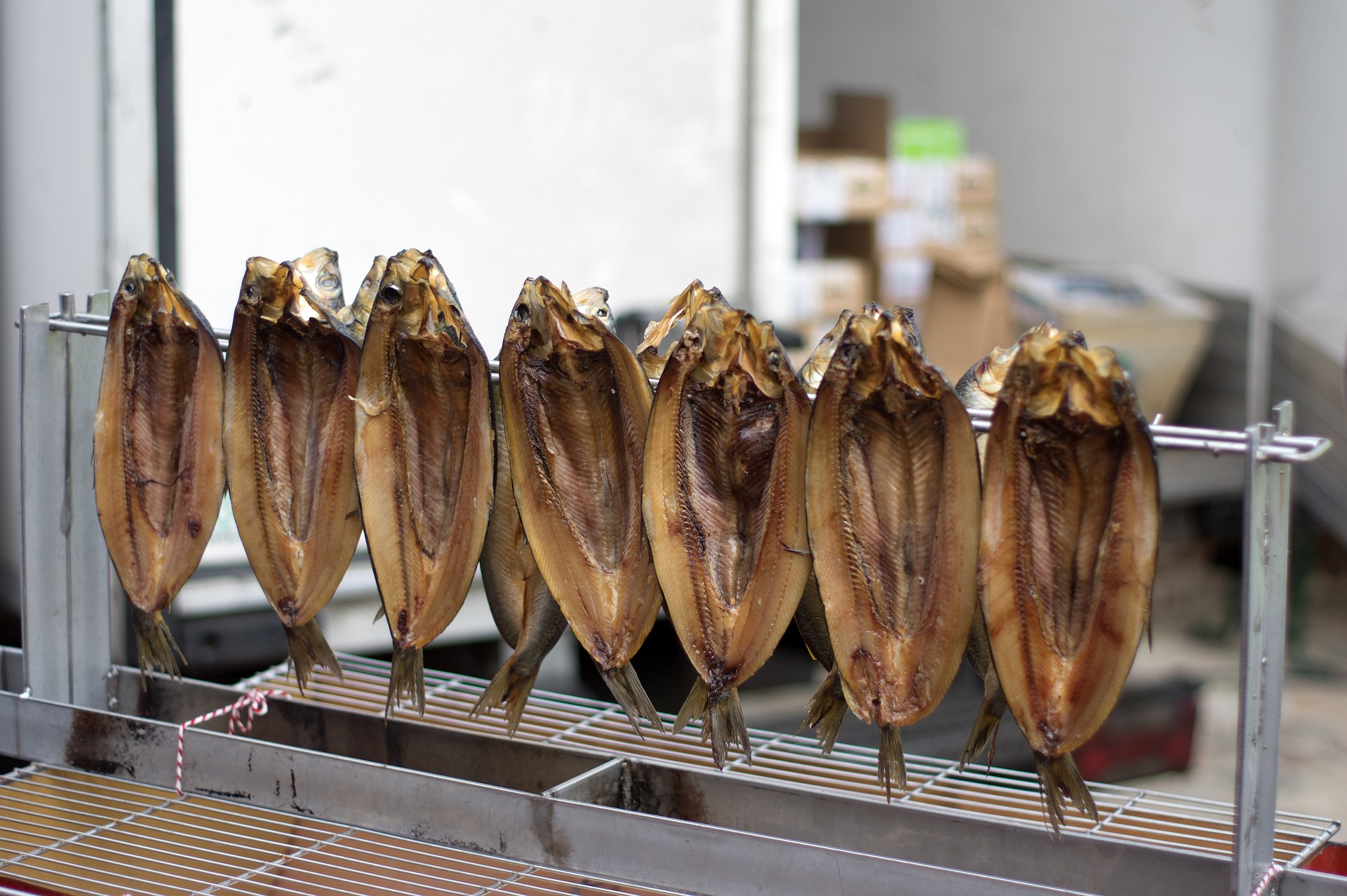
Unusually (because I never trust it as a source) I looked at Wikipedia which merely defined a red herring as a distraction, or something misleading. It suggests the term came from a strong smelling smoked kipper which could be dragged across a track to put hounds off of a scent.

And what it reminded me of was that a dictionary of the Sussex Dialect, published in 1875 does not have a particular entry for red herring, yet under ‘White-Herring’ is found the definition: A fresh herring, as distinguished from a dried one, which is called a red-herring. Delving a little deeper, we find references to dried, smoked, herrings – named red herrings – in use to mask the scent of trails both literally and figuratively, in a story published by William Cobbett in 1807 and also a couple of references from the 1780’s. There is apparently a bit of disagreement over where the phrase was used first in that context, but that doesn’t seem relevant here, it’s just interesting to find out that red herrings actually exist, and how they came to assume the role they have in literature and everyday conversation.

World Book Day

World Book Day, celebrated today, 7th March, has the declared aim: Our mission is to give every child and young person a book of their own.

It is celebrated in the UK, although I have no idea whether this is an idea that has been taken up elsewhere, and would be interested to find out.

Schools, in particular, seem to have embraced the idea, with children encouraged to attend classes dressed as their favourite book or literary character. Thus hundreds of Harry Potters and Willy Wonkas and Very Hungry Caterpillars march into schools across the country once each year.

A splendid thought!

Which brings me to a marvellous project aimed at schools across the country.

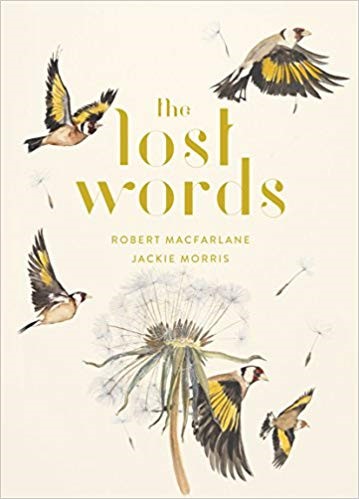
Growing, in a way, out of Robert Macfarlane’s brilliant book Landmarks is The Lost Words, a collaboration between Robert Macfarlane and artist Jackie Morris. I can do no better than to quote Jackie Morris on the reasons: It had come to the attention of some who work in the world of words that certain words were slipping out of common usage. As a result when it came to amend the junior dictionary for a new edition these words were gone… These words included bluebell, conker, heron, acorn and perhaps the one that cut the deepest for me, kingfisher.

lost words

So The Lost Words is aimed towards children, to encourage them, through the words and paintings of the book, to discover the natural world that so many of them know nothing of.

So many grow up today without any meaningful contact with the natural world, and this book aims to encourage them to know and to love and protect it.

And the project – the campaign, really, in a very ad hoc way, is to raise money where necessary to place a copy of the book in every school in Britain. It has already been achieved in Scotland, I understand, and hopefully, it will soon be achieved in every other school in Britain.

Wordy Wednesday 2

Coolie – now there is a word that is remarkably offensive; offensive not so much because of what it is, but the implications behind it.

coolie 1

The Oxford Dictionary defines the word thus: unskilled native labourer in eastern countries and gives the word’s origin as perhaps from Kuli, an aboriginal tribe of Gujarat, India.

Hobson-Jobson, the 1886 Anglo-Indian Dictionary, has rather more to say upon the matter.

It gives the spelling as ‘cooly’ and the definition as follows: a hired labourer, or burden-carrier; and, in modern days especially, a labourer induced to emigrate from India, or from China, to labour in the plantations of Mauritius, Reunion, or the West Indies, sometimes under circumstances, especially in French colonies, which have brought the cooly’s condition very near to slavery.

It goes on to give further definitions and details of the word, and then makes several suggestions for its origin. One possibility, agreeing with the Oxford Dictionary, is that it derives from Koli, the name of a caste or race in Western India who frequently carried out these tasks and who, the dictionary reports, had long held a reputation for ‘savagery, filth and general degredation.’ This would make its origin analogous to that of slave, which is presumed to come from the racial term Slav.

But it suggests the waters are rather muddied by a couple of similar words in the Sub-continent: In Southern India a Tamil word Kuli signifying ‘hire’, and Khol is a Tibetan word for slave.

And then there is also a Turkish word kol meaning a slave while, more specifically, kuleh  means ‘a male slave, a bondsman’.

But back to the implication. It is impossible to get away from the colonial undercurrents with this word, as brought out in the Hobson-Jobson definition above. So to use the word to describe a person or persons today, is to call them a servant or slave of a foreign overlord.

Wordy Wednesday 1

Many bloggers post photographs on Wednesday under the heading ‘Wordless Wednesday’. Me? I’m going to write a few posts about words – specifically words in English borrowed from languages of the Indian Subcontinent.

I’m just plain awkward, but you knew that, didn’t you?

I am currently editing the first draft of my novel A Good Place, which is set in a hill station in Northern India. And in that hill station live a number of English who remained behind after Partition.

‘I’m sitting on the veranda of the bungalow in my pyjamas.’ Well, no, no one says that in my book. But if they had, what is the significance of that sentence?

The significance is the number of words borrowed from Indian languages.

Untitled-Grayscale-03

Veranda is an Indian word, but coming originally, perhaps, from Persian. The Oxford Dictionary suggests two derivatives, either from the Hindi (varanda) or from the Portuguese (varanda). Digging a little deeper, if I refer to Hobson-Jobson, the Anglo-Indian Dictionary that was published in 1886 and traces pretty well every word or phrase borrowed from the Sub-Continent, I discover a very long entry on this word. It begins by dismissing the possibility of it being derived from the Persian beramada, and goes on to state that it appears to exist independently in both Hindi, and in Portuguese (and Spanish). It then traces the possible routes the word might have taken to reach the English language, before then saying, surprisingly, that it could have its roots in the Persian after all. This seems quite likely to me, since many Persian words made their way to India especially with the Mughals, and it suggests a possible route to the Spanish peninsular when the Islamic armies arrived in the early eighth century.

I tried typing it into Ngram Viewer. This is an online tool that searches through the entire database of books that Google can access online (including ones still under copyright) published since 1800. Looking at the results for all books in English, it tells me it was barely used in 1800, although it does exist, rises steadily to a peak about 1910, and then falls away slowly, although it is still in common usage. Unfortunately Ngram has not been set up to search books in Indian languages, or even Portuguese. I tried Spanish and the pattern was similar, except that after peaking just before 1910 , it dropped sharply, but since then the trend has been upwards. I then noticed something. I had actually looked at the trend in American English. So I then tried British English, and this gave me a rather different pattern; The curve rose gradually until it peaked in the 1950’s and then fell away sharply. Why? I think it must be due to a surge of historical / biographical / nostalgic writing, both fiction and non-fiction, after the British left India.

Don’t worry, I’m not going to try to go into that sort of detail with other words.

Next, bungalow actually refers to a ‘Bengal style’ house (often with a veranda!) that the British frequently chose to live in.

And pyjamas are loose cotton trousers worn in India which were ‘adapted’ for night wear by Europeans.

Okay, class, lesson over. Be sure to wash your hands before eating your snacks (samosas and pakoras today, of course).