Review of Wilding by Isabella Tree

I wrote this just over a month ago, and never got around to posting it, for some reason.

91wfR0v1kNL._AC_UY218_ML3_

I have just finished reading Wilding, and I am almost overwhelmed with several feelings. The first is that I need to come back to this book after a month or two and re-read it, since there is just so much to take in. The second is that this book presents so much information that appears new to us in the twenty first century, yet was common knowledge some fifty to a hundred years ago and was hiding all the while in plain sight, as well as some new conclusions that were also, really, hiding in plain sight. And third, a feeling this might just be one of the most important books I have ever read.

This means I am attempting what appears to be ridiculous, and that is to review a book I don’t think I am yet ready to fully appreciate. But first impressions count for a lot, so here goes, although to keep this brief enough for one blog post, I can hardly even skim the surface.

Knepp is an estate in Sussex, England, which the author and her husband farmed for many years the way most farming is done nowadays – intensively. But as returns gradually diminished and the soil became more and more degraded despite the application of the usual chemical cocktails, they decided in desperation to take a leap of faith and re-wild part of the farm. The reasoning was they were going broke farming traditionally, so something new was needed – perhaps something revolutionary. What had they got to lose?

It was a huge learning curve for them, and many of the steps they took had unforeseen consequences. By allowing the land to revert to the condition it would have been in thousands of years ago, they discovered that many of our birds and insects, for example, actually favour environments and foods different to those we have assumed they do. Interestingly, on reading books written a hundred years or so ago about, for example, birds, they were simply rediscovering what was known then, but overlooked since. Just one example – pigeons do not actually prefer the seeds of cereal crops, but wild grass seed. The fact that they eat so much cereal seed today is due to the destruction of the areas of wild grass they would gave grazed before.

Probably the most important conclusion to take from this book is that a return to a more traditional, environmentally-friendly form of farming is not only better for the environment, but in the long term is even better for farmers who might be initially worried about losing out financially. It’s a win-win situation in that it would enable much wildlife to recover from its precarious, endangered, situation, it would reduce the risk of flooding during periods of heavy rainfall, restore soil fertility without pumping massive loads of chemicals onto the land and, consequently, into the water systems, and reward farmers with not only a better environment but healthier crops and stock which, in turn, would be healthier and more nutritious for the consumer.

Along with most others, I have always understood that back in the Neolithic period, when man was first making his mark upon the landscape in what would become Britain, most of the land was covered in thick, dense, woodland. I also understood that the large wildlife here – the megafauna – consisted of the likes of elk, cattle (aurochs), wild horse, mammoth and the such-like. Basically the kind of large animals that graze and browse the open, lightly wooded, grasslands of the African savanna today. Could we really not see the contradiction in this? This strongly suggests that the natural post-glacial vegetation of the British Isles was an open woodland, rich in undergrowth and grass, maintained by the regular grazing and browsing of this megafauna.

And from that, we understand that much of the habitat association we make today with our native wildlife is just plain wrong – we see birds and animals favouring a particular habitat and assume that is their preference, rather than understanding we have forced them into this by removing their real preferred ones.

There is so much to take in and think about in the this book, as I said at the beginning of this post, that a single review can only begin to hint at the mass of information to take in.

If you have any interest at all in our environment and what we have done to it, this book is an essential read.
David Nash and Impermanence

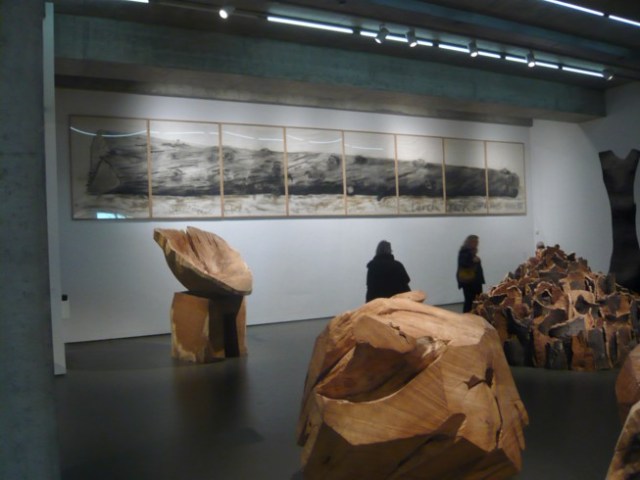
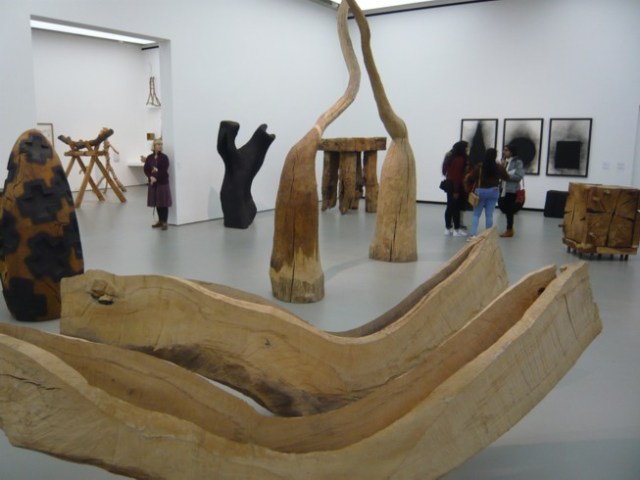
A few days ago we went to the Towner Gallery in Eastbourne, Sussex, specifically to see the Eric Ravilious paintings and prints on permanent exhibition there. There was also a large exhibition by the sculptor David Nash, who works with wood on a large scale. The fact that the whole exhibition, which also included a gallery of paintings, prints and a couple of small installations, and was intended to highlight the effects of the Climate Crisis, was the first one ever curated by Caroline Lucas M.P. of the Green Party was an added bonus for me.

007a


002a

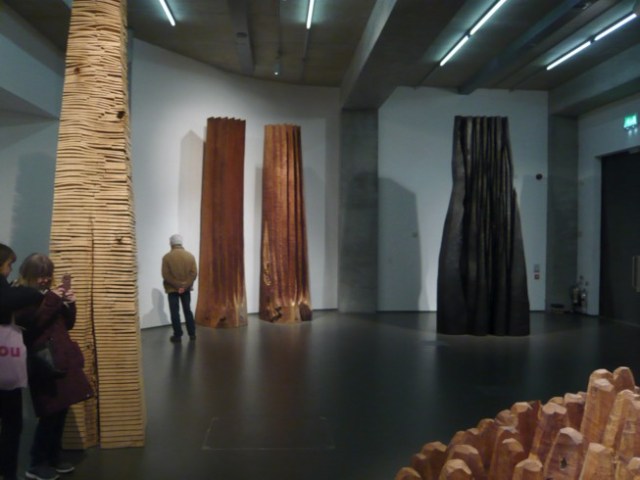
As much as I enjoyed the Ravilious, I was blown away by Nash’s sculptures. To see wooden sculptures on that scale is unusual in itself – usually that would be the preserve of stone or metal – but that very scale plays tricks with the mind and the eye. Boxes and bowls many times larger than one would expect meet the eye as you walk around the galleries, and many of the pieces also deceive where perhaps one looks to be made from several separate pieces of wood, but on closer inspection are carved from a single block like the boat shapes in the top picture, or the ‘stack’ in the one below that.

Much of the work is left rough-hewn, but even this can be deceptive. Some pieces have been carefully finished to give that appearance.

Sculpture is the art form that seems to exist to interact with the natural world. A number of the works here are based on natural forms, but there are also stories of projects Nash has undertaken where his sculpture is either living, in the form of carefully planted and managed groves of trees, or interact in other ways.

004a

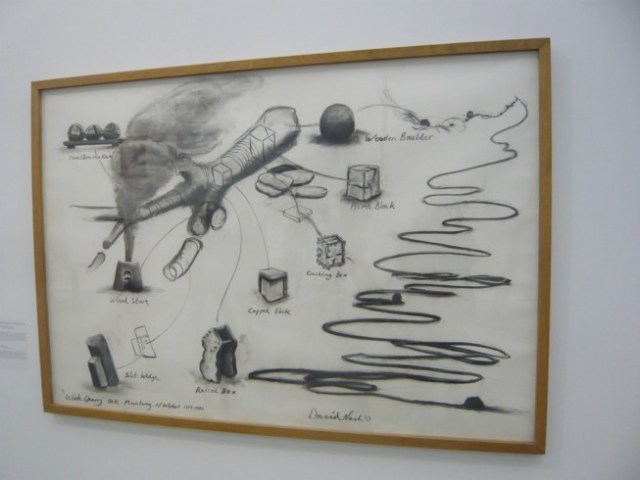
‘Boulder’ is one such project. One of the first large-scale pieces Nash made was to cut a boulder-shaped chunk from a tree (illustrated at the top of Nash’s charcoal drawing above) in 1978. This was then transported to a stream near to where he lives and works, in the Welsh hills, and rolled into the water. Since then, it has slowly made its way downstream until it reached the estuaries and inlets of the sea, where it finally disappeared in 2015. Nash documented its travels in a series of photographs and films made regularly all the while, and presented in the exhibition as a film.

006a


003a


003b

Nash’s sketch of a Larch trunk

It feels as though there is something of this meeting of art and the natural world in old ruins overrun with scrub and grass. They frequently seem to have a sculptural quality that complements the landscape around them, in a way that more pristine buildings do not.

And I like the sense that an artwork, like a ruined building, is not permanent and that eventually the natural world will absorb it back into itself. That it will reclaim it. Perhaps the artist and the environmentalist in me merge here.

My own sculptures are in wood, and some of them are set out in our garden where they gradually degrade over the years through the action of sun and rain, until they appear strangely like some weird plants that have sprouted unexpectedly there.

How To Solve The Climate Crisis

What we need are machines that remove the carbon dioxide from the atmosphere, cost nothing to produce, are made entirely from natural products available worldwide, produce no harmful waste materials, fit into the landscape harmoniously and also provide countless other benefits to us, wildlife and the environment.

030a

We already have them.

They are called trees.

We need to plant them in their millions and to stop cutting down those we already have.

The Wood Wide Web and a Bill of Rights

012a

Today, the Guardian’s Review section carries a piece by Robert Macfarlane about a growing movement to grant rights to parts of the landscape, seen by some as one way to protect and preserve them. It opens by describing how in December 2018 the Ohio city of Toledo passed a ‘Bill of Rights’ for Lake Erie, which for years had been heavily polluted and reached a crisis point in 2014 when for three days, during the hottest part of the year, it had been impossible to extract drinkable water from the lake.

The piece goes on to discuss the pros and cons of these laws, especially the potential problems of recognising, say, a river or a forest as a ‘person’ in law, and how that might play out in legal disputes.

At the heart of the Extinction Crisis we are currently suffering, in what is now recognised as the Anthropocene – the period during which human activity has been the dominant influence on climate and the environment. – is the way that we, as a society, view the world we live in and those we share it with. And this has powerful consequences at a time when we are directly causing the extinction of so many plant and animal species, and thence the wholesale destruction of ecosystems and the consequent changes to the climate this triggers.

I have always thought of the Earth as consisting of two distinct layers; a rocky planet – a core – wrapped in a mantle of life, a mantle whole and made up of countless billions of organisms all influencing and influenced by each other; a true web of life that we are all part of, but no longer seem to recognise. And by the same token when we think of somewhere as a ‘place’, we commonly imagine it in isolation, as though it existed somehow despite its myriad neighbours. For example, if I ask you to imagine ‘London’ you may have an image of Central London with its familiar landmarks, filled with hurrying people and buses and cars. Or it might be the Docklands area, the West End – any one of thousands of parts of the city. But would you have an image of a city connected to the counties around it by roads, by streams and rivers, by areas of woodland and fields, the flight paths of birds, the daily migration of commuters or the dominant weather patterns, and then this greater area connected even further to the rest of the country, and then this country connected by seas filled with life to other countries and continents?

And this same lack of imagination frequently makes us see everything around us with the blinkered eyes of our own vested interests. Some will view a landscape as something to be exploited purely for financial gain, be it to extract oil, perhaps, or to maximise the yield of farmland by destroying woodland and hedgerow, infilling ponds and killing wildlife. Some may feel it imperative to build more and bigger roads, covering dozens more square kilometres with concrete and asphalt, as though it were so necessary that we should always be able to travel faster than we do already.

It is still quite controversial, but botanists are just beginning to understand the extent to which trees communicate with each other and the remarkable way their roots are all connected through networks of fungal threads – the Wood Wide Web, as it is sometimes called. It is supposed that trees communicate to each other through these threads about things such as insect attacks, which may trigger defence mechanisms in individuals before they are actually under attack. In that way alone, it is appropriate to think of a forest as a single living entity.

To return to the laws that might protect the natural world, what we really need are laws that recognise the importance of this mantle, and how every part of it relates to every other. And this includes our own part in this relationship, since we are very much part of it, and in the end we depend upon it for our own lives.

Suffer the Little Children…


011a

The other night there was a piece on the TV news in which a child psychologist bemoaned the fact that children were being frightened by news about the Climate Emergency, suggesting that we should tone it down and perhaps not mention it in schools – I don’t remember the precise details – to which I said ‘Good! Children need to be frightened by it!’

That didn’t go down too well with my wife, who naturally felt that children shouldn’t be frightened.

And usually I would agree with that, but as unfeeling as it might sound I think it is right that they should be frightened by what is happening. It is their future which is inevitably going to be impacted by the actions we do or do not take in the next few years. Their future which our inaction will damage or destroy. And at the moment, that future looks none too promising.

If they are frightened they are likely to raise the issue with their parents, and the resulting conversation may result in more adults learning how imperative it is we take action, and perhaps beginning to add their voices to the demands for action.

And they will be far more frightened if their homes and schools are flooded, or their neighbourhood catches fire, or armed conflict breaks out, all of which look increasingly likely unless we really DO SOMETHING!

It is the actions taken by concerned and frightened children which have become school strikes, and which have led to the formation of Extinction Rebellion, and which may ultimately lead to a people-led drive to finally take meaningful action to try to prevent catastrophe.

So, sad as it seems, they need to be frightened.

We all need to be frightened.

The Great Disconnect

There is a huge disconnect between the human race and the natural world. This is nothing new, of course, it is something that has gradually been developing ever since man first discovered farming and began to live in settled communities rather than living a nomadic existence. But it has accelerated rapidly since the onset of the Industrial Revolution, until we passed the point where for the first time there were more people living in urban areas than in rural ones. That may seem an obvious fact to many in the Western World, but that statistic is a worldwide one. 55% of the population today is urban, but the spread is very uneven. In North America, for example, 82% of the population today are urban, whereas across Africa as a whole it is only 43%.

This creeping urbanisation has had many obvious consequences, such as the growth of villages into towns, and thence into cities and finally into super-sized metropolises covering hundreds of square kilometres with hardly a tree or a bird to be found in some parts. Such as whole villages being abandoned as the population move to towns to find work, partly due to the growing mechanisation of farming and the demise of traditional rural industries. Such as a rapidly shrinking amount of land that can be thought of as wilderness. Even those areas that are not now covered with an urban sprawl may well be covered with farmlands or plantations, or large areas devoted to leisure activities such as golf courses which as far as wildlife and plant diversity are concerned, are little better than deserts.

And such as a growing and deepening disconnect between humans and the natural world.

037a

In small part, this is natural and necessary; it is a process that is inevitable as we evolve from a species indistinguishable from the other great apes in behaviour and purpose, into a species able to pursue activities unrelated to simple survival.

Of course, we have also become a species capable of wiping out our species and all other species, too.

But this trend seems to have accelerated at an alarming rate over the last thirty to fifty years. Of course, urbanisation continues to be a growing trend, the growth of technology continues to feed into areas such as farming, where we now have huge farms that can be operated by a couple of people alone, which might have required a labour force of maybe a hundred once, and we have social media and computers and gaming and thousands of on-demand TV stations.

050a

This last phenomenon I think is mainly the cause of what appears to be an especially severe disconnect between the natural world and the younger generations.

Now before everyone rushes to tell me of wonderful younger folk who love the natural world and who actively fight to protect it citing, perhaps, the incredible people who make up Extinction Rebellion, obviously there are many exceptions to this. But it is a trend. Before I retired, my job was teaching outdoor activities such as climbing or navigating, and I worked with many children and young adults. The environment in which I worked, of course, was the natural world. And although many of the youngsters who came along lived in towns or cities, there were also many who lived nearby, in a more rural environment. And what shocked me, was that so many of them had no better understanding of that environment than those that lived in inner cities.

034a

I met country children that couldn’t recognise an oak tree or knew what an acorn was. Country children who couldn’t recognise a kestrel. Country children who had no idea what wild garlic was.

As a kid, I lived on the edge of London. I don’t think I was in any way exceptional, but I would spend as much time as I could playing with friends in the woods and fields I could walk to or get to on my bike. We splashed around in streams and climbed trees, learned what different butterflies looked like, 037bfound stag beetles and slow-worms, caught minnows and sticklebacks, and absorbed a lot of knowledge about trees and birds and insects and mammals from books and TV programs and just being out in the country.

I assumed it was what all kids did.

But this seems to be no longer the case. I have already written about The Lost Words (here), the book written by Robert Macfarlane and Jackie Morris as a response to learning that supposedly common words such as conkerlost words and kingfisher and acorn are words that the majority of children today are unfamiliar with – something that would once have been unthinkable. And this disconnect seems to me the saddest thing. So much of our very rich heritage has a rural background, be it music or literature, architecture, leisure activities, or traditional crafts. And the same is naturally true for most countries and societies.

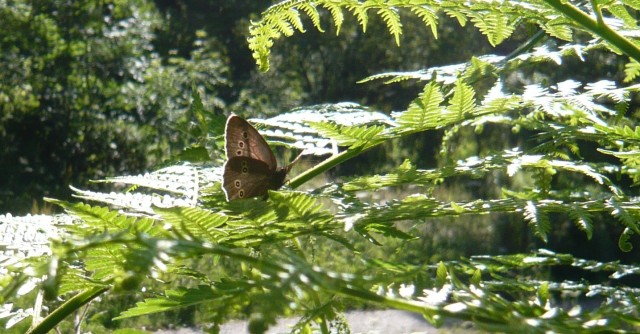
But to return to the reasons for this, I feel the rise of social media and on-demand electronic entertainment has been the largest single influence on the younger generation, especially, to the point where to the majority of them, pretty well all their leisure time is taken up with these things and there is no desire to explore the natural world at all.

Sometimes I think the electronic world is more real to many of them than the real world is, anyway.

057

Sigh. I’m off to check the vegetable garden.

The Joy of Unknowing (1)

We have just returned from a few days away in Shropshire, which is one reason you haven’t heard from me recently.

We were incredibly lucky with the weather, and spent the time walking and reading and mooching around towns and villages. And finding time for the occasional meal and cold beer, of course.

Yes, we did some lovely walks. And I find it a natural thing to be constantly identifying and photographing whatever I see when out for a walk. I have always been interested in all aspects of the environment, be it the plants and animals, the geography and geology, the weather, or the historical impact of people on the environment in forms such as old trackways, deserted buildings, or ancient boundaries.

006a

And we have spent several fantastic days surrounded by an environment rich in all these things, as we have walked through woods, fields, and open hillsides, seen ancient settlements, butterflies, birds, and many wildflowers, and all this in an area of some of the most complex geology in the UK.

But sometimes I feel myself tiring of the constant need to identify and record everything; it is really a way of trying to own them.

And when you post on social media too, it can feel at times a little like a competition to put up the best pictures of this or that wildflower or bird or mountain, which naturally need to be identified and named. Especially on Twatter, whose format seems to encourage this.

017a

So, on our first morning away, as we walk up a track heading into the hills above Church Stretton, under early morning blue skies with the air crystal clear and beautifully cool, I decide that for now I am just going to exist in the moment.

Because by doing this, I am relieved of the constant necessity of deciding whether this bird is a rook or a crow, or whether that flower is greater stitchwort or lesser stitchwort.

018a

Because it doesn’t really matter.

And for now, instead of having to always know whether it is this or that bird singing, I can allow myself to simply think there is singing. There is birdsong.

Or, even better, there is a sound I find melodic, and it pleases me.

By doing this, I can relax and centre myself, which is something I feel has been badly lacking in my life recently. I have struggled with social media in any case, feeling a huge pressure to post new material and to read the many I follow, even when I don’t feel up to it.

It feels like a return to a much simpler time in my life. I can enjoy the views of the hills, the sounds of the streams and birds, and just concentrate on being.

This must have been part of the pleasure I felt as a child on every occasion when I could roam outdoors. Certainly, I was curious about what I saw, but since I knew so little about them, there was always an openness to the experience and the excitement of discovery. I would see butterflies I had not seen before, and I would just get the thrill of seeing them without having to know anything more about them. I would see wildflowers I didn’t recognise and just enjoy the shapes and colours.

Naturally, you cannot really unknow things in that way, just as you cannot really return to that point in your childhood, but it is possible, even if for only a short while, to let go of the need to identify and quantify (and therefore own) everything, and simply exist in the here and now.

The (Shy And) Retiring Type…

A few days ago, I made the decision to retire from my present job.

It is something I have been brooding over for some while, and having a little time and space to think while I walked on Dartmoor last week enabled me to finally accept a decision I had really come to some time before.

013a

For a long time I have instructed groups in an outdoor environment, in activities such as climbing, canoeing, navigation and team building. As I have got older, though, I have naturally found these activities both physically and mentally more demanding. After all, when you are responsible for people’s safety as well as teaching them skills, there is an added pressure on everything you do.

A number of other stresses in my life over the last year or so have not helped, especially as they are still ongoing.

004a

So as well as a sense of regret, there is certainly a great feeling of relief. Regret, because I have had a huge amount of both pleasure and satisfaction from this work, which has carried me through those times when I felt it was becoming all too much, but relief that now it is time to call it a day, as I have reached the point where I know I cannot carry on for much longer.

I love being in an outdoor environment. It is why I choose to go to hills and woods and mountains rather than towns and cities, and this was instrumental in my deciding to teach these activities in the first place. But the obverse of that coin is that so often I am unable to really enjoy being there, since I am entirely focused on my group and the activities – which is how it should be, of course.

029a

One thing I shall look forward to, then, is being able to enjoy that environment every time I am there, without constantly having to check everyone is safe, or ensuring the activities are taking place as they should be.

While I intend to bring a greater focus to my writing, and also to my painting, I will also have to find something to bring in a little money for the next couple of years until I reach the state retirement age. I’ve no idea what that will be, yet.

126a

Essentially, I just feel burnt out. It is a very intensive job, in the way that care work, for example, can be, and I know it is the right time to go. Otherwise, there is the risk I will begin to run sessions that no one will want to take part in.

And that’s not the way I want it to finish. Far better that people should ask why I am going, than they should ask why I have not gone before now.

Bob on Holiday

Just in case you were wondering where he was, Bob has been on holiday. He’s back now, though.

And actually, he’s rather cross.

Now, lot’s of people return from holiday having had a wonderful time and feeling a bit tetchy that they have to come back to the daily grind, but it’s not like that.

No, Bob thinks we’ve all been lied to.

He went away to a holiday enclave in a West African country – or so he says. Bob’s sense of geography being what it is, I wouldn’t be too certain of the destination without checking his passport stamps first. And I wouldn’t do that. So I’ll take his word for it for now.

‘Now, I’m no fool,’ he said, looking at me.

‘No, of course not, Bob,’ I replied. ‘Absolutely not. Anything but. In fact, anyone who says…’ My words died away as I heard Bob’s wife, Gina, laughing somewhere behind me. ‘Go on,’ I ended, lamely.

‘Well, we read all the time that this is one of the poorest countries in the world,’ he continued, ‘yet I’ve never been to a nicer place! The hotel was really luxurious! Food was brilliant. All the staff were wonderful – they were smartly dressed and they couldn’t do enough for you! There were masses of security men all around the perimeter, mind you, but I don’t know what they were there for. And the beach was fantastic!’

IMG

‘Was it just you on the beach?’

‘No, there were dozens of us.’

‘Any local people?’

‘No, they don’t go there, apparently. They don’t like sitting around on the beach like we do.

‘Did you go outside the hotel grounds at all, Bob?’

‘Yeah, we went to a village to see local artists at work. I loved the village. It’s such a minimalist lifestyle. They don’t waste time or money on all those pointless things that we think are so essential in the west.’

‘Like what?’

‘All that rubbish we don’t need!’ he said, heatedly. ‘They live a simple, healthy, lifestyle, and what matters to them are the things that are really important.’

‘Like what?’ I repeated.

‘Well, simple food, for example. It’s much healthier, you know. You don’t come across any of the locals there who are overweight.’

‘What is this diet, then? Do you know?’

‘Well, mostly they make a sort of porridge out of some local grain, apparently.’

‘Is that it?’

‘Oh, no. Of course not! They usually have it with, er beans. And onions.’

‘It doesn’t sound very exciting.’

‘Food doesn’t need to be exciting! It’s there to keep you alive!

It was a side of Bob I’d never seen before, and, to be honest, it was a bit scary. I never realised he could be so evangelical. At least, not about things like that. I’m used to him banging on about how wonderful a new beer is that he has discovered, or about his favourite pizza topping (which I’m not going to talk about here, but…pineapple on pizza…how could you?), but now he had all the fervour of a fresh convert to some extreme religion.

‘And then there are the houses they live in,’ he continued.

‘The houses?’

‘Yes. Gloriously simple and uncomplicated!’

‘As in small and built of odd pieces of driftwood and plastic sheeting?’

‘Exactly!’ He smiled warmly. ‘I love the way they make use of what’s locally available to build with. It keeps the costs down, and reduces the environmental impact of transporting thinks like bricks from far away. Simple.’

‘But would you want to live in one of those?’

‘I wouldn’t mind. I mean, what else do you need? Just some sort of bed in there and, oh, a table, I suppose. And a couple of chairs.’

‘But you just told me how luxurious the hotel was, and how much you enjoyed it.’

‘Well, I wasn’t going to turn it down, was I? But apparently it’s because us Westerners are all just so soft and pampered. The native people don’t live like that at all.’

‘So you say. Does this mean you’re going to change how you live, then, Bob?’

‘Well, I don’t think it’s particularly practical in the West.

‘I suppose not. Tell me about the artists you went to visit, then.’

‘Ah, yes. Mainly carvers. Lovely wood; mainly animals and masks. I bought a couple. Look, that’s one of them.’ He pointed to a beautifully carved and polished elephant in black wood, standing on the mantelpiece. ‘It cost the equivalent of about two pounds in our money.’

‘That seems very cheap.’

‘I know, but it’s a lot to them. And it’s putting money into the local economy.’

‘Who did you give the money to? The chap who carved it?’

‘No, there was a bloke who showed us round. Nice guy in a suit. Looked very smart. We paid him.’

‘I don’t suppose the carver was in a suit.’

‘Of course not! You wouldn’t wear one of those while you were working, would you?’

‘Describe him, then.’

‘Well, he was wearing a pair of shorts.’

‘What else?’

‘Nothing else. That was it. they could have done with a wash, though, I must admit.’ He put his head to one side and stared into the distance. ‘And a bit of sewing.’ He rubbed his chin thoughtfully. ‘Really, he could have done with a new pair of shorts. They were pretty ghastly.’

‘Maybe the nice man in the suit will buy him a pair.’ Bob smiled happily.

‘I’m sure he will!’

Going Green

On the morning of the 26th August, 2019, every single person on earth woke up to find that their skin had turned green.

For a few hours, there were an awful lot of people trying to find a way to change it back again, to try to dye it, rub the colour off, swallow lots of strange potions, try magic spells, see doctors, priests, scientists, mystics, druids, and all sorts of other experts and so-called experts, all of whom claimed they could cure the problem.

But all of whom had green skin as well, so they didn’t come across as very convincing.

Finally, someone thought to bellow up to God ‘Oi, God! What on earth have you done?’

There was a rumble of ethereal chuckling, and then God replied: ‘I am just so totally pissed off, like, with your saying how some of you are better than the others, like, just because of the colour of the skin I gave you. It’s all pretty random, after all. So now you’re all the same, and you might as well just stop it.’

‘Yeah…but…green?’

‘Yes, green. If I make you all white, then the ones that were already white will make out that was because they were superior in the first place. Same with all the other skin colours. So…green. None of you were green before.’

‘But…’

‘Plus,’ and here God gave a little Godly snigger, ‘you all equate green skin with aliens. So now you’re all aliens. And, even if I say so myself, that’s a good one.’

002a

Nothing’s ever simple, though, is it? Within a couple of weeks, once everyone had realised there was no mileage in everyone claiming to be a Green Supremacist, all the major religions started working overtime to fire up extra feuds and wars and to persecute anyone within reach who thought differently to the ways they did, anyone they considered heretical, those who some thought might be a slightly different shade of green, or cut their sandwiches in a non-prescribed way.

And then the sound of the loudest ever irritated sigh filled the skies and echoed around every valley and mountain and city on earth. It rumbled across the plains and seas and everyone stopped what they were doing and muttered ‘Oh, crikey. Now what?’

And God roared out ‘I thought I was angry before, but now I’m really pissed off! What on earth makes you think you can speak for me? This is all, quite frankly, rather insulting! I made this lovely planet, and put you on it so you could enjoy it and look after it and be nice to each other! How dare you presume to say that I hate people who you disagree with? How dare you say you have authority to kill in my name? And, while you’re at it, you can stop all the servile bowing and scraping, too. I mean, what sort of an image do you have of me?

‘Oh, and I almost forgot (‘cos I’ve got a lot of gripes with you lot!). Men are not superior to women in any way whatsoever. So you men can stop paying them less, treating them differently, forcing them to hide themselves, denying them education, declaring them inferior or evil, or discriminating against them in any other way at all, or else I’m jolly well going to visit a few plagues on you that will really make your blood run cold!

‘Now, start to look after my bloody planet, treat women with respect, and stop trying to find more cowardly ways to exterminate anyone you think different to yourselves!’

Blimey. Better do as She says.