Spain 1

I’ve been to Spain a dozen or so times, although I’ve never posted about it before.

I’ve been there as a tourist / traveller – the words are interchangeable, and where one stops and the other begins is very much a matter of personal taste. Some travellers would be highly offended if you referred to them as tourists, yet the Oxford dictionary defines a tourist as a person who makes a tour, a traveller, esp. for recreation. It is a snob thing, really. Many travellers like to think of themselves as being too serious to be a mere tourist. Perhaps it has a lot to do with that word tour, with the inference it is an organised thing, probably by a travel company, and probably full of holiday-makers who need to be guided around these awkward foreign places and told what to see and do. A Package Tour, perhaps. And so also that word recreation.

And I can be as guilty of that snobbish attitude as the next traveller. I can think of a number of times when I’ve been travelling and said ‘I’m just going to be a tourist, today‘, when I’ve felt like a day just wandering around a place and taking photographs and sitting in cafes.

Mea culpa.

I’ve also had the pleasure of going to Spain numerous times as an instructor with a group, and spending a week taking people canoeing, walking and climbing. So, all that and getting paid for it, too. Pretty fortunate, actually.

If you have ever read the book As I walked out one midsummer morning by Laurie Lee, which is the follow-up book to Cider with Rosie, you will know it is the record of his journey on foot through Spain in the 1930’s, just before the outbreak of the Spanish Civil War. It is a truly marvellous book, and well worth anyone’s time reading it, but I mention it only because I wanted to do something like that, and so my second visit to Spain was to spend a couple of weeks walking in the hills and mountains in the South of the country.

I flew into Malaga, I walked out of Malaga.

Heading north, the walker quickly gets into the foothills of the Sierra Nevada, the mountain chain that extends for a couple of hundred miles parallel to the south coast of Spain. And for the best part of the next two weeks I worked my way first Eastwards, and then Westwards back to Malaga, avoiding roads wherever possible. I slept each night on a hillside, or in the corner of a field, or anywhere else convenient where I could lay out my sleeping bag away from town or village.

img20190318_12020089

img20190318_12030670

As a journey, it was not without its difficulties – finding water was frequently a problem. Passing through villages there would inevitably be a tap somewhere I could fill up my bottles (and myself; I rapidly learned the thing to do was to drink as much as I possibly could when I found a water supply!), but away from any habitation it was a lot harder. Many water courses had dried up and I had to take every opportunity to fill up.

img20190318_12103098

img20190318_12092043

But as a way of seeing the Spain that few casual visitors see, it was unrivalled.
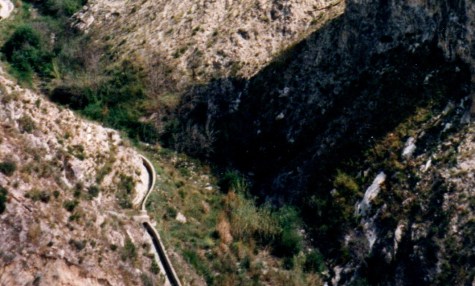
img20190318_12045312

When the Arabs conquered part of Spain in the early part of the eighth century, they created water courses known as Falaj (which can still be seen in use in many countries such as Oman and Iran) to channel water over long distances. This one is still in use now in the Sierra Nevada.

img20190318_12075705

Morning View…

img20190318_12111452

…and a dusk photo at one of my wild camps. 

Those Old Paths

We seem to be in the middle of a spell of warm, sunny weather. It seems Spring really has arrived, although things could always change quickly, of course. But it’s the sort of weather that tempts me out to go walking as much as I can. We are extremely fortunate in the UK to have such a wonderful network of footpaths, open to the public.

042a

Dartmoor footpath

Many of the ancient tracks are still just that; just trackways that have never been turned into roads over the years. Often, this is due to their locations in the landscapes they traverse. Neolithic or Bronze Age man lived in a landscape that frequently comprised dense, almost impenetrable, forest, with networks of streams meandering through marshy lowlands, and wherever possible they would utilise the higher ground to move around, and hence we have long-distance footpaths today still following these same routes such as the Ridgeway, while modern roads tend to utilise the lower, flatter land where possible. Walking these Old Ways (and it is impossible to even mention them without referencing Robert Macfarlane’s wonderful book, The Old Ways!) always gives me goosebumps, as I feel I’m following in the steps of these prehistoric travellers.

And yes, we are lucky. Not only do we have so many of these paths, but we have the right to walk them whenever we please. But this has not always been the case. Up until comparatively recently, huge areas of the British countryside were owned by the landed gentry who denied the public any access. In 1932, the first mass trespass by five hundred men and women at Kinder Scout, in the Peak District, led to the imprisonment of five of the trespassers but this led to a second, three weeks later at nearby Castleton, involving ten thousand trespassers.

This growing movement, demanding the right to roam, led eventually to the creation of the first of the national parks in 1951, and to the Countryside Right Of Way act in 2000. So today it is possible to walk plentiful footpaths pretty well anywhere in the country, thanks to this incredibly successful movement of direct action.

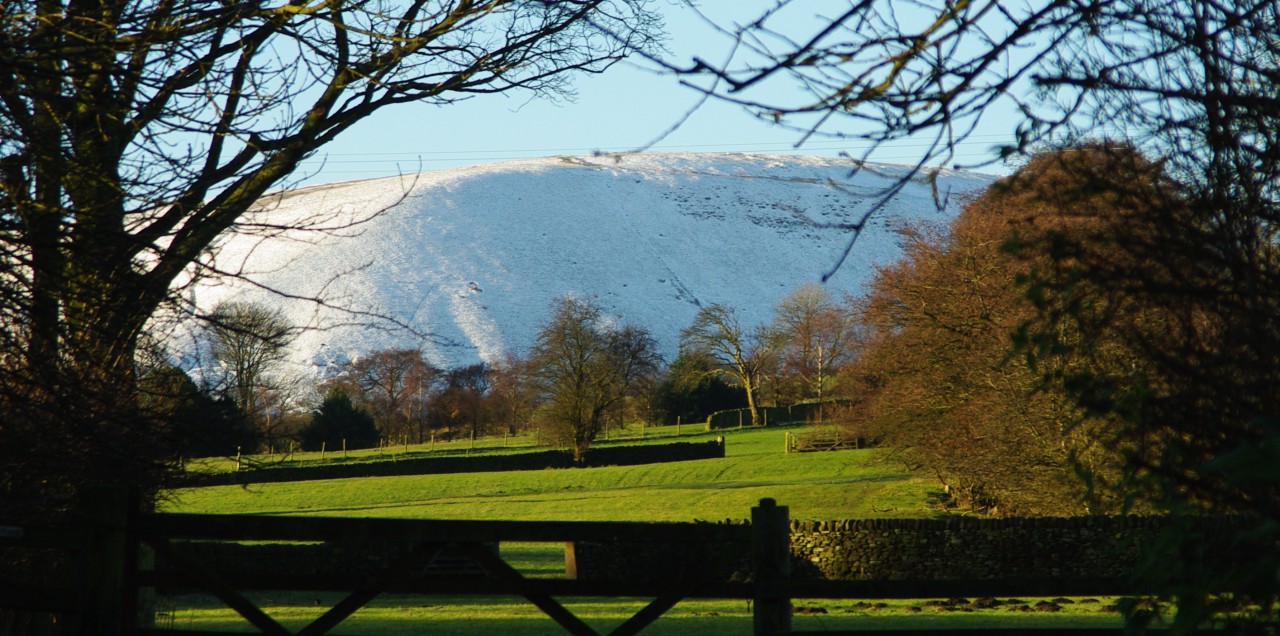
My header picture at the very top of the page, incidentally, is a view of the Peak District looking towards Kinder Scout.

And it’s another gorgeous day today, so we’re off for a walk to make the most of it. I’ll catch up with everyone later.

On A Home Visit

On A Home Visit

038a

It has been a long time.


But when I used to live here

Did I notice how neatly

The trees seem to fit

Between earth and sky?


Did I realise

How right it all was?


The just-ness of the hills

Rising to the east,

And the is-ness

Of fields and streams.


My world of changeless certainty.


A Walk And Other Things

It was bitterly cold but sunny first thing yesterday morning, but after a couple of hours the air had warmed up enough to tempt me out. I was due a walk anyway, having not even left the house the previous day.

Every year there is a point somewhere around the middle of February when I feel the warmth of the sun for the first time that year, but yesterday morning there was already a hint of that.

It wasn’t cold enough to freeze the ground, except in a few particularly exposed places, and so it was very muddy underfoot. Therefore it was a delight to occasionally walk through drifts of last years leaves.

And there was so much birdsong. So much so that it became a background noise that was easy to filter out after a while, except when a particularly loud or unusual song caught my attention. Not that I do that deliberately, since birdsong is one of the delights of the countryside. At some point or another when I’m out, I can usually hear the rooks, but maybe because of the sun and the noise from the other birds they seemed to be silent. I’ve always associated them with cloudy skies for some reason, perhaps because I’m so used to hearing them on moorland and in the hills and mountains.

But I’m sure they like a sunny day every bit as much as the next bird.

This morning is cloudy again and the rooks are back. Outside I hear crark crark crark, and the occasional cronk. There is rain and sleet forecast for later, so I go into town in the morning. By the time I get home, the sky is already full of dark clouds and threatening to drop some weather soon.

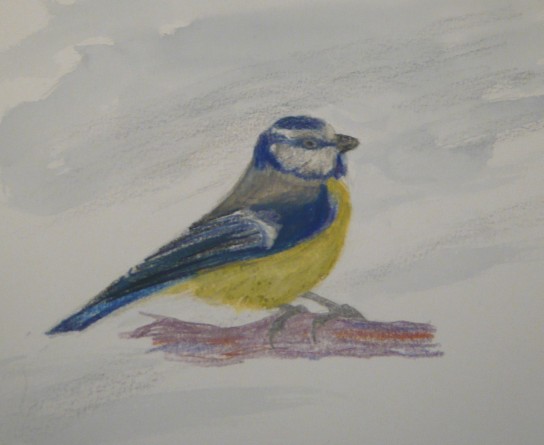
The afternoon, then. I partly spent painting this little fellow:

035

The blue tit is one of the few British birds whose population seems to be increasing slightly at the moment, in contrast to most whose populations have fallen – sometimes dramatically – over the last few years. We seem to be losing lots of the birds I took for granted as a child, which is such a sad thing. As a race, we seem to be so damned good at exterminating other creatures.

The (Shy And) Retiring Type…

A few days ago, I made the decision to retire from my present job.

It is something I have been brooding over for some while, and having a little time and space to think while I walked on Dartmoor last week enabled me to finally accept a decision I had really come to some time before.

013a

For a long time I have instructed groups in an outdoor environment, in activities such as climbing, canoeing, navigation and team building. As I have got older, though, I have naturally found these activities both physically and mentally more demanding. After all, when you are responsible for people’s safety as well as teaching them skills, there is an added pressure on everything you do.

A number of other stresses in my life over the last year or so have not helped, especially as they are still ongoing.

004a

So as well as a sense of regret, there is certainly a great feeling of relief. Regret, because I have had a huge amount of both pleasure and satisfaction from this work, which has carried me through those times when I felt it was becoming all too much, but relief that now it is time to call it a day, as I have reached the point where I know I cannot carry on for much longer.

I love being in an outdoor environment. It is why I choose to go to hills and woods and mountains rather than towns and cities, and this was instrumental in my deciding to teach these activities in the first place. But the obverse of that coin is that so often I am unable to really enjoy being there, since I am entirely focused on my group and the activities – which is how it should be, of course.

029a

One thing I shall look forward to, then, is being able to enjoy that environment every time I am there, without constantly having to check everyone is safe, or ensuring the activities are taking place as they should be.

While I intend to bring a greater focus to my writing, and also to my painting, I will also have to find something to bring in a little money for the next couple of years until I reach the state retirement age. I’ve no idea what that will be, yet.

126a

Essentially, I just feel burnt out. It is a very intensive job, in the way that care work, for example, can be, and I know it is the right time to go. Otherwise, there is the risk I will begin to run sessions that no one will want to take part in.

And that’s not the way I want it to finish. Far better that people should ask why I am going, than they should ask why I have not gone before now.

All Hail The Conquering Hero!

I’ve never wanted to ‘conquer’ mountains.

img_0010

Or any other parts of the world, really.

I’ve always felt this was the wrong way to think of a journey. It was ridiculous to think I could impose my will upon a mountain, or on a desert, or indeed upon any part of my route. That I could, perhaps, somehow bend it to my will.

I feel it is more a case of preparing as best as possible, including mentally, and then perhaps said mountain will tolerate my presence; will allow me passage.

‘Conquering’ also carries the implication of invasion, of fighting, of strife. That is not the sort of relationship I want with mountains, or with any other place I choose to travel.

Certainly, in the past I have travelled at least partly with that mindset at times.

IMG_0005

Some of you may recall I wrote about an extremely foolish journey I took in Oman when I lived there almost 30 years ago (Mr. Stupid Goes For a Walk). Although I was running low on water, I pushed myself to the limit to reach the final ridge of hills on the route I had decided I was going to achieve one day, nearly killing my stupid self in the process. And although I achieved my aim, I didn’t feel victorious.

Only a bit stupid.

I prefer instead to think of myself as a visitor. And as a visitor, I need to have some manners. You do not expect to find the visitors pushing through your house and demanding to see this or to be given that, so I don’t.

I am not out to break records, nor to prove how tough I am.

This does not imply a lack of ambition, nor a lack of determination. Indeed, I have both – it’s just that the mindset is a little different. In particular, I give myself different priorities. I want to reach my goal, but if I don’t it does not matter. I think I’m more attuned to my own safety, and perhaps that of others. I hope I can be receptive to the feelings of others, too.

A good example in the climbing world is that of the mountains in Nepal that climbers are forbidden to reach the summit of, due to the belief that they are the abode of gods. Theoretically, a climber will stop some 10 meters or so short of the summit. Opinion is naturally divided over whether a climber would, or wouldn’t, in the absence of any witnesses, respect that ban.

I would respect it every time.

The mountains, of course, are inanimate. They do not wish me harm or otherwise. Neither do deserts or oceans. Even the most inhospitable of landscapes is neutral. It does not care whether I succeed in my aim to reach or traverse a particular part of it, and it will not hinder or help me in the attempt.

154

My feelings about a landscape are just my reactions to it, and if I should choose to give this landscape a kindly or vindictive character, I am only projecting my own feelings onto it.

This may give me comfort, or otherwise, but will make no material difference.

Maybe I am simply suggesting it’s good to travel with humility.

I have touched upon that before!

Mr. Stupid Goes For a Walk

I have been posting a bit about walking, recently, what with my frustration at being unable to do a great deal of it after my foot operation.

Foolishly, I made reference to the following episode in a reply to someone on one of the ‘walking’ posts, and admitted I might write about it sometime. Well, take this as a Warning From Someone Who Learned The Hard Way.

Thirty years ago I lived and worked in Oman. I was a seismologist, working on seismic data for an oil exploration company – but before you all shout at me, my conscience is clear. I don’t think I was particularly good at it, and I don’t think my efforts contributed to anyone finding any oil.

*phew!*

I do worry that as a result of this post, though, someone will now contact me and say ‘Hello, Mick. I was a geophysicist in Muscat when you were there, and I remember that one of the projects you worked on found absolutely stonking amounts of oil!’ But I doubt it.

Anyway, let me set the scene.

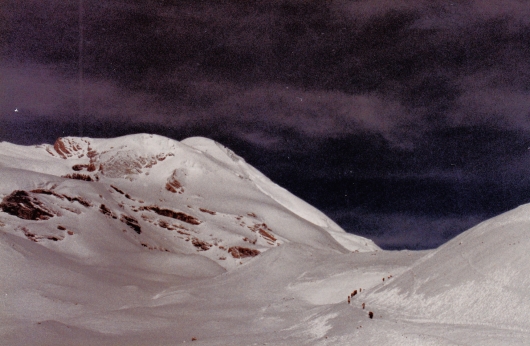
I lived near Muscat, the capital, which lies on the north coast of Oman. Behind me, towards the interior, ran a line of high hills

It is a massive simplification, but just at this point the hills run east to west, parallel with the coast, and consist of a series of ridges (jebels) and valleys (wadis). So to cross them from north to south (or in the opposite direction) the traveller has to continually climb up and down for the entire journey.

IMG_0005

I bet you can already see where this is going.

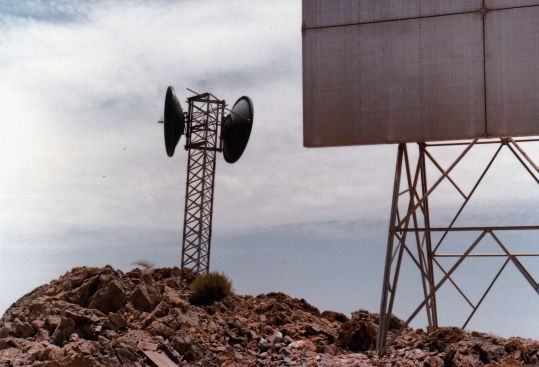
When I had a few free hours, I would often walk out of my house, and up into the hills to just wander around and explore. As a result of this, I knew the first couple of wadis and jebels pretty well. There was a high, prominent jebel to the south, though, which was the final ridge before the land fell away to a wide stony plain, and I had never gone that far on foot up till then. This ridge was easy to spot, however, as there was a large microwave (radio) transmitter on top, and I knew it was the final ridge as we would often drive past it on the south side.

I had a day off.

I don’t know exactly what time of year it was, but it must have been in the ‘cooler’ season, because even I wouldn’t have been stupid enough to try when it was really hot.

Surely?

I didn’t even have a proper rucksack, I had a small roll-bag, which I slung uncomfortably over my shoulder. Inside, I had a single bottle of water, and a dozen small packaged juice drinks. I had a compass, but no map. I had a hat, I had a camera.

So, well-equipped and well-prepared, I set off.

The first couple of hours went well. I crossed two or three ridges and felt fine. I guess I should say at this point, that I was pretty fit. The project probably wasn’t an unreasonable one, by any means.

Certainly not for someone with the right equipment and supplies.

IMG_0008

I was probably just beginning to feel a bit hot and tired when I crested what I thought would be the penultimate ridge, only to find I was looking down on another two smaller ridges that I still had to cross before reaching the final large one.

And the large one was looking very large indeed!

I can be ridiculously, unreasonably, stubborn, at times. I remember that on the final ascent I had to force my legs to bend and stretch, to take each step, but the top was getting nearer and nearer and I wasn’t going to give in.

I made it.

IMG_0007

I enjoyed the view and the moment. It was, admittedly, very impressive and I knew I’d done pretty well to get there.

And really, all I needed to do then was to carry on down the south side of the ridge, walk another kilometre or two to the road I mentioned earlier, and hitch a lift back to Muscat.

IMG_0006

Have I mentioned I can be unreasonably stubborn?

I turned around and started heading down the north side towards home.

I could draw this out into a long dramatic story of my walk, but I’ll give you the abbreviated version.

I found I was in difficulty as soon as I had to go up the next hill. especially as I had finished all my drinks by then.

It took me several hours and more energy than I realised I had at one point, just to get to the final ridge. But at that point, I knew I no longer had the energy or strength for that last climb. I could not do it. Fortunately for me, I knew I could follow the valley for a mile or two east, where it would come out to the coast plain. So I turned and stumbled that way. By now, I was desperate to find some sort of shade, just for a moment, but there was nothing.

But I staggered along, and as the hills either side dropped down, I came to a cluster of buildings. I don’t know what exactly they were, but I staggered in through a doorway and an Indian working there took one look at me, sat me down and brought me water.

‘Slowly!’ I remember him saying, as I poured it down my throat. ‘Not good to drink too quick!’

I didn’t care. I drank it like a camel on steroids given twenty seconds to fill up. I got through an awful lot of water, but he made me sit and rest for a while before I went off again. I think he offered me food, which I refused, and I think he offered to find someone to drive me, but I don’t really remember too much from that point on. I did walk home eventually, though. I just hope I thanked him sufficiently.

It was not one of my more intelligent adventures.

By Train in Sri Lanka

I’m stuck at home still with a foot in bandages, only now I’ve been told that I won’t be back on my feet properly until the middle of August. So, nothing for it but to indulge myself with a bit of a train journey.

006.jpg

On Colombo station – the madding crowd at a typically busy time.


200a

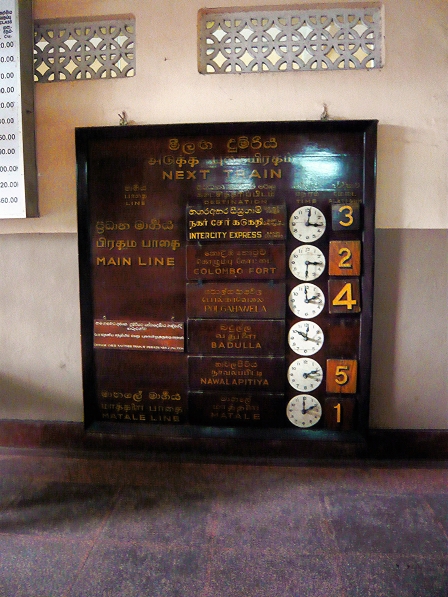
At Kandy station, the departures board is refreshingly low-tech!


158a

At Kandy station.


167

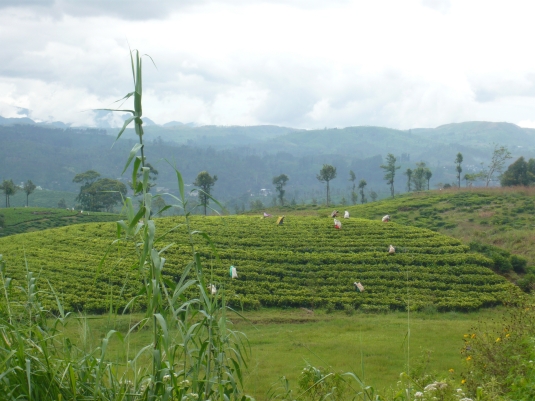
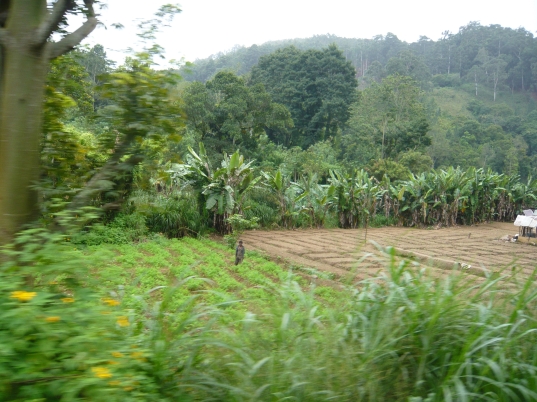
Leaving Kandy and travelling up into the hills, the traveller passes tea gardens…


170

…and small farms carved out of the jungle…


172

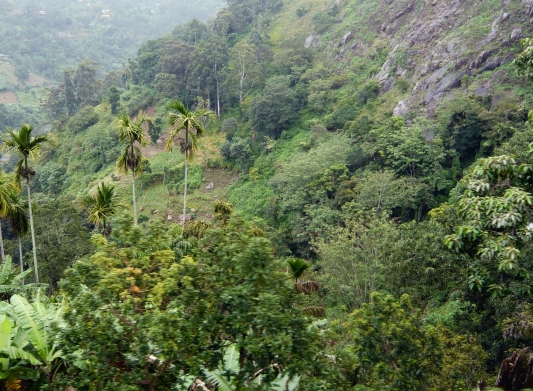
…and plenty of jungle.


184

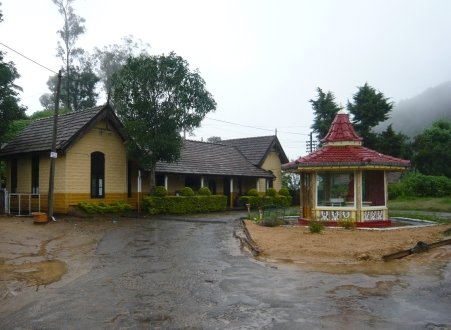
Ella station, our destination. far from the madding crowd, indeed!


The Travel Bug bit me – part 1

Travelling! My first inclination to travel to remote regions came from my Grandmother, when I was probably six or seven years old, despite the fact that she had never travelled very far at all in her whole life. In fact, I don’t think that she ever left England.

But she would tell me stories of China, inducing images of Emperors and pig-tailed mandarins, peasants and bandits, and this was coupled with a children’s book; an encyclopaedia I presume, with grainy, black and white pictures of strange scenery. It was extremely evocative, although at the time I did not understand that. I was just excited by the mysterious, the strange and the unknown.  I was hooked, and wanted to go there! Ever since then, the places where I’ve most wanted to travel, other than Britain and Europe, have almost all been in Asia.

The list of places that I have at the moment that I would like to visit, are almost exclusively Asian.

Yes, she has a lot to answer for, that sweet old lady.

hill station 2

When I was a teenager, I began to use maps, although in rather an ad hoc, hit and miss manner.

They were there for me when I was really stuck, or I just wanted to know in which general direction something lay. It would be a very long time before I began to use them in a skillful way, able to predict the exact lie of the land, navigate in the fog or the dark, or find my way through complicated landscapes with the map and compass. And, do you know, since I’ve learned to do that, I often feel as though I’ve actually lost something rather magical, although I don’t suppose that I can blame it all on that. The maps that I was using as a teenager would tend to be the Bartholomew’s Touring Maps, small scale with little detail. I would feel, as I headed along a Cornish footpath, that I only knew roughly where I was going. It always felt like an adventure; an exploration.

Now, I need to be more and more remote before I can get that feeling, and even then it does not always work. Some ten years ago, I spent a couple of weeks in Ladakh, in the Himalaya in the far north of India, and I was surprised at just how easy all of my walking was. Setting off with map and compass, I always knew exactly where I was, only confused at times by the multiplicity of tracks criss-crossing the landscape. Even then, reference to mountains and villages with map and compass would invariably allow me to set my position.

That doesn’t mean that I wanted to get lost, just that there was a small part of me that said ‘even this is all tame!’ Equally, I can be put off, when using a map, by the knowledge that over the interesting looking ridge that I am heading for, there lies a motorway or building estate, and so I then spend ages trying to plot a route that I try to get perfect, rather than simply heading off in the direction that I want to go and exploring as I go, correcting my course as I travel.

Nothing can tempt me more than a track leading tantalisingly into the distance, perhaps meandering through Mediterranean scrub towards a notch in the skyline, perhaps leading through a glowing archway of trees. Even now, when using map and compass to navigate, I often have to resist the temptation to ignore the map and head off to follow an interesting looking track. I think that this must be a part of my ‘I wonder what’s over the other side of the hill?’ nature. It’s another reason why I’ve never been able to lie on a beach – apart from the fact that this seems a particularly pointless pastime in any case. Any time that I’ve tried it, it never seems to be more than a couple of minutes before I begin to think ‘What’s round that cliff, I wonder?’ or ‘If I head back up the river, I think I might find a way through those hills.’ And then I just have to go to find out.

There are plenty of other things that can destroy a sense of adventure in travelling, other than over-familiarity with maps, of course. I remember the shock and the sense of let-down I received in Germany about 35 years ago, when I spent the best part of a morning struggling up an ill-defined track through thick woodland to the top of a berg in the Black Forest (I was using a tiny touring map at the time, which showed main roads at best). My elation at arriving at the top and surveying the panorama of hills and mountains around me was completely destroyed within a minute, as a coach roared up the other side of the hill, came to a halt a few feet away from me, and then disgorged about 30 Japanese tourists. They spent about two minutes firing off photographs of everything in sight, including myself, before leaping back on board the coach, roaring off down the hill and leaving me gob-smacked in the sudden silence and slowly settling dust.