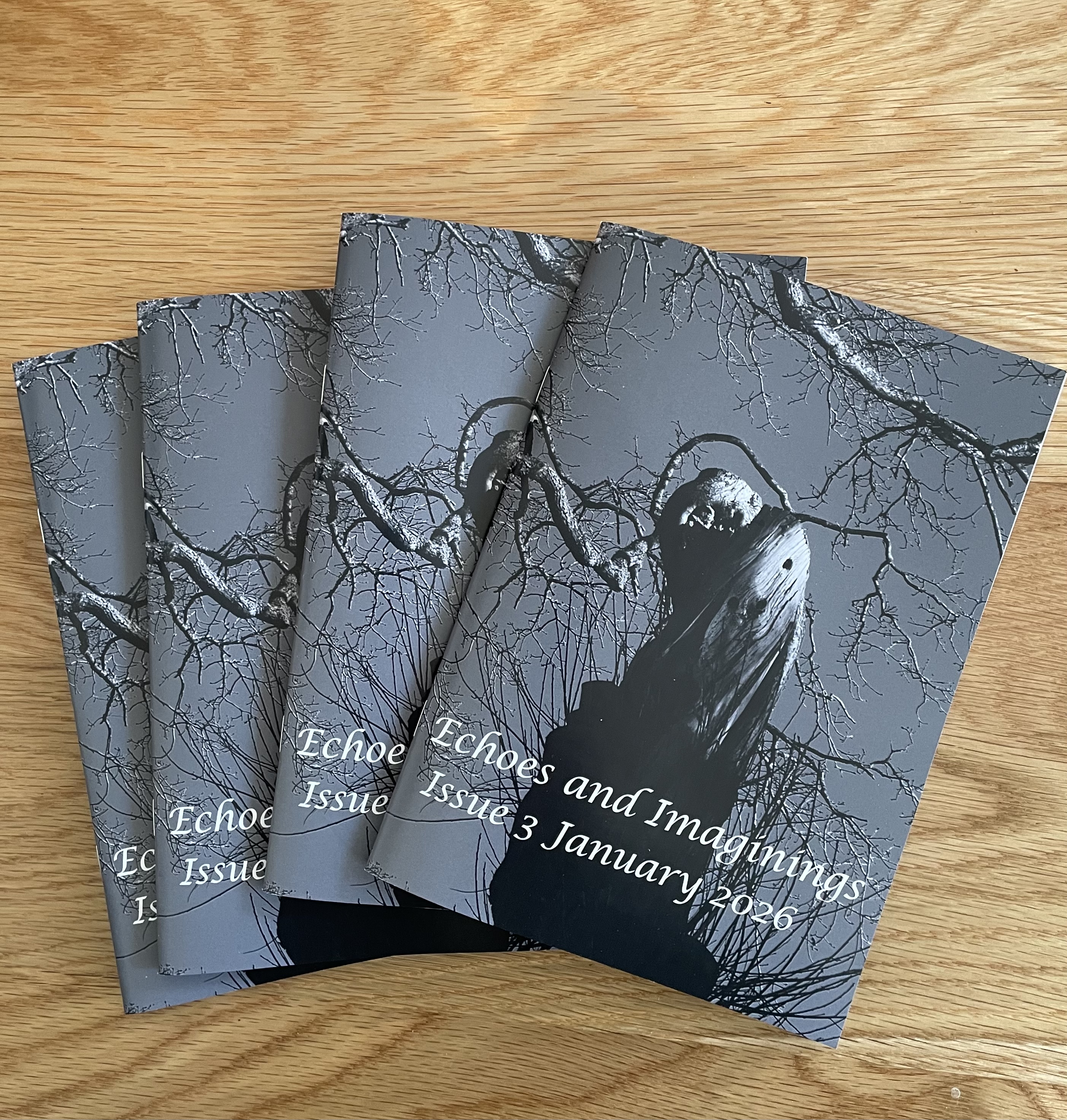
Echoes and Imaginings – Issue #3

…is now in my Etsy shop.

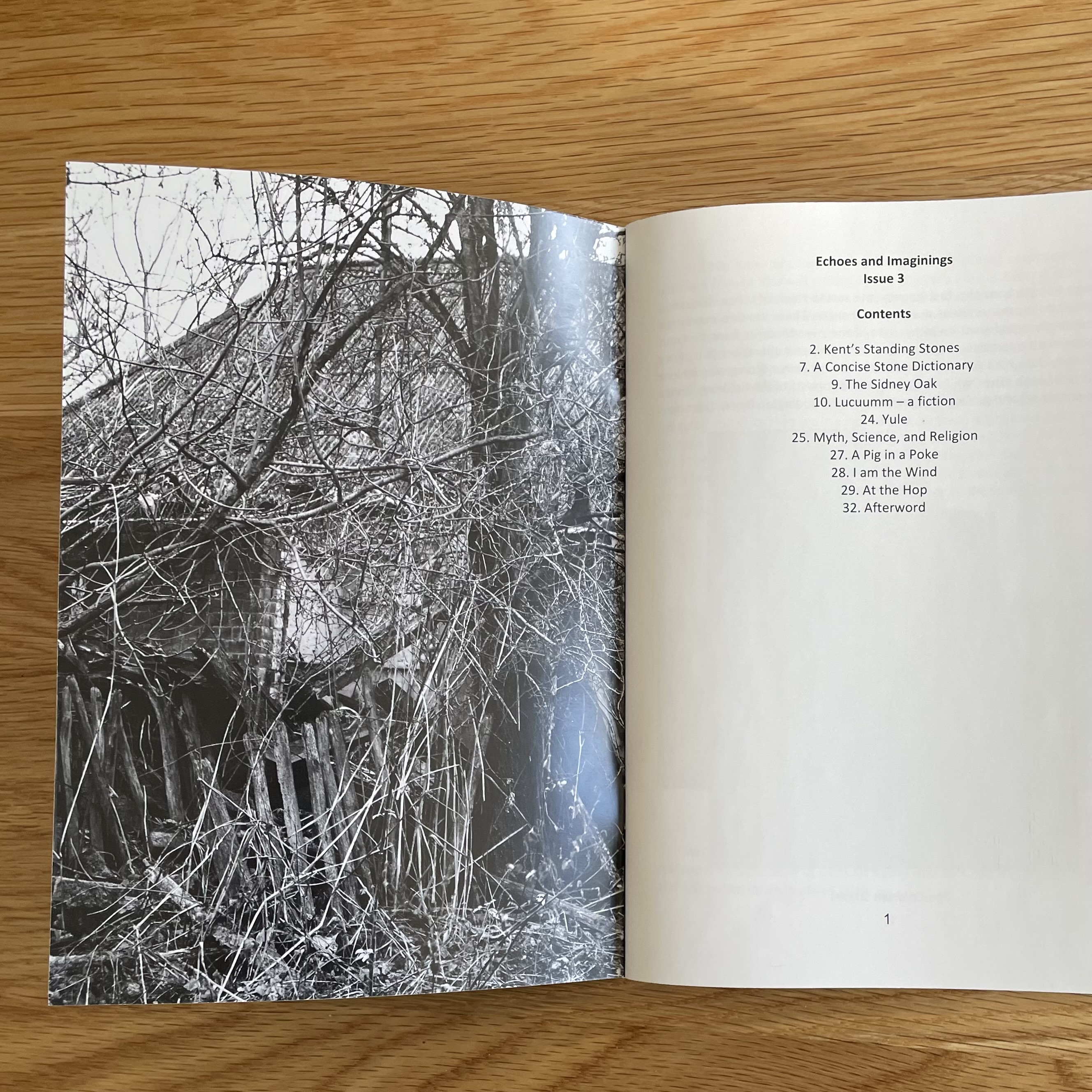
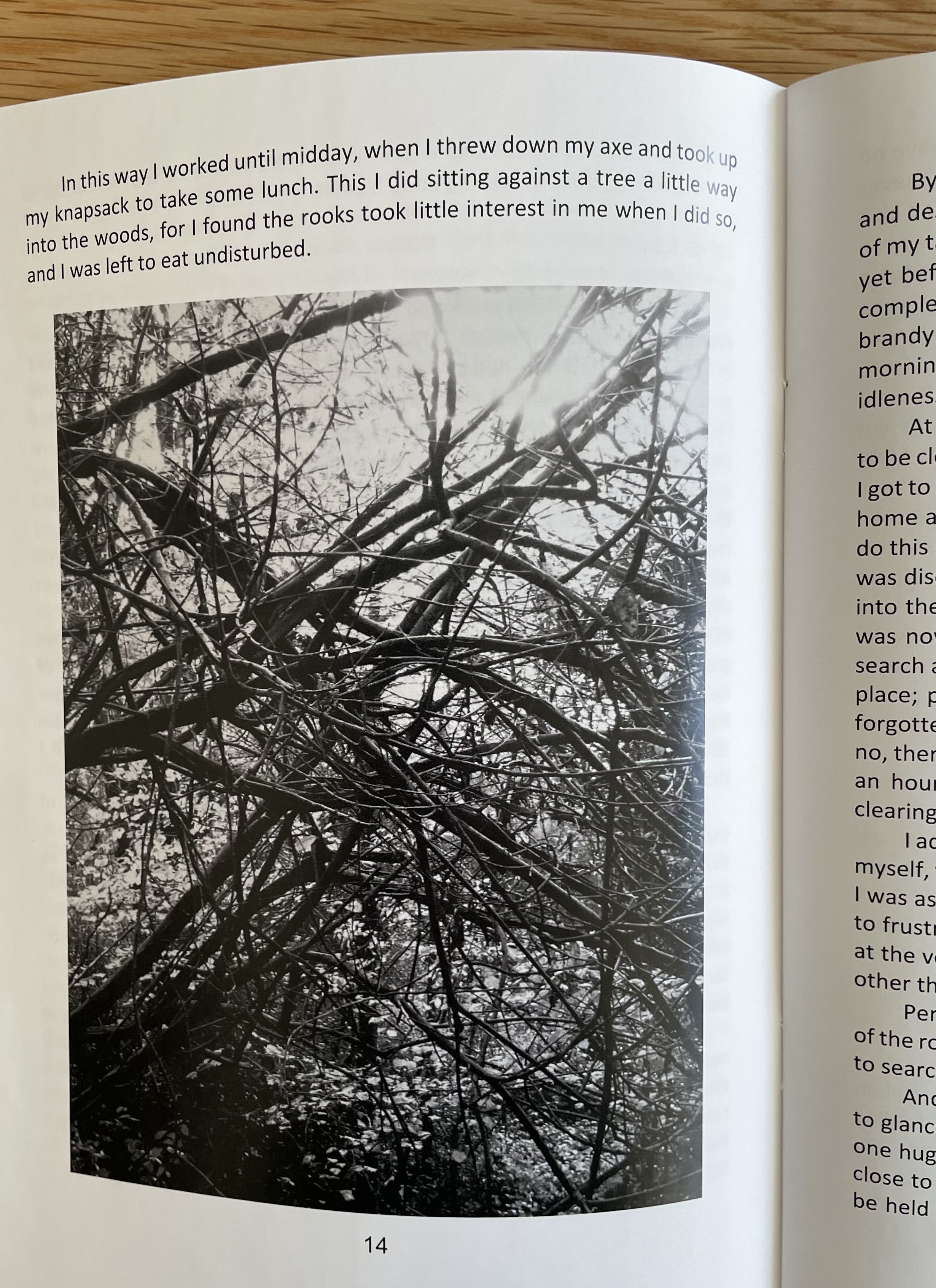
It follows the same pattern as the first two issues, more or less, although there is a bit of a change in the contents – nothing drastic, but in this issue, for the first time, I’ve included a fiction piece. Against that, there are only two poems. I want it to keep the same vibe, but I also want it to change and grow. There is one piece of my artwork included, and I think I might use more of this in future editions. But that vibe is still folklore, psychogeography, speculation…

And my timing is atrocious. All three issues so far have been compiled just before Christmas, so by the time they’ve been printed up we’re into January. If I had any commercial acumen, they’d have been up for sale around the end of November just in time for Christmas.

But I haven’t. Put it down to the anti-capitalist in me.

Initially, I had thought I would limit the zine to four issues, but I think now it might go on for a little longer than that.

We’ll see.

And I also have a zine on a completely different subject almost ready to go to print. Watch this space!

6th November 2025

When I began this blog, some ten years ago, it was for the express purpose of both promoting my writing and discussing writing in general. Since then, although I have certainly used it for that purpose, promoting my books and zines, posting the occasional poem, writing the occasional review of other books, and posting discussion topics on the subject, the blog has almost inevitably drifted into other waters. Since I enjoy travel so much, I began to post photographs and memories of those travels. I put up pictures of my artwork, since this seemed an obvious (and free!) place to promote them. Articles on the British countryside, mythology and folklore, and customs. Like most people, I have wide interests and this is a good format to record them in.

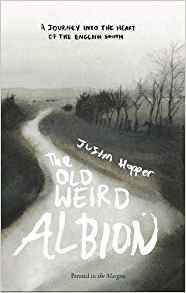
The Old Weird Albion, by Justin Hopper. Reviewed in 2019

One of my great pleasures has been the meeting of minds. We follow each other, read posts and comment, foment discussions. And it is a safe place! Unlike social media, it is very rare for strangers to barge in and attack other users. And on the very rare occasions this happens, it is easy to just block them. This makes it a much more enjoyable place to spend time. And there are no algorithms pushing contentious posts at the reader.

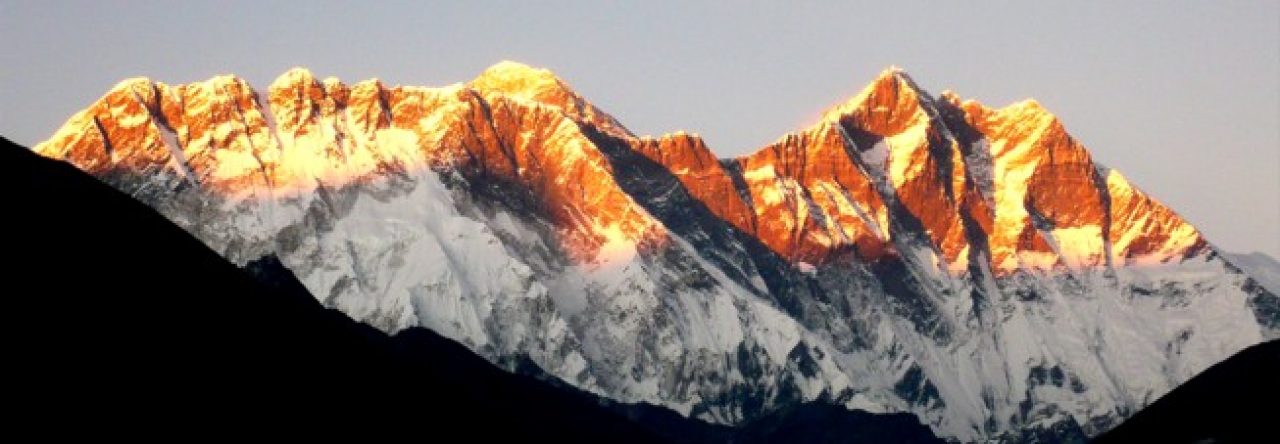
Mount Everest, photographed from Tengboche in Nepal from a post in 2021

But for the last couple of years I have been rather tardy in both posting and reading other’s blogs. Part of the reason for this is that since being retired, for some reason I seem to have less free time than I did before. I’m not really sure why that is. But I’m still here. And to get myself back into the swing of things, as well as writing some new posts, I’ll probably re-post a few of the posts I put up a long while back, which many of my current followers won’t have seen.

Recycling is good, after all.

A piece of my artwork.

Writer’s Notebooks (2) – The Purge

I’ve been doing some clearing out.

I must have had around twenty notebooks on my shelves. However, once they’re filled up, they are almost never opened again. Once finished, they’re put in a drawer, or on a shelf, and then pretty well forgotten.

Taking up space.

Occasionally I might be writing something and vaguely remember noting down something that might be relevant, but I’d never be able to find it again, so I usually didn’t bother. Anything worthwhile I might have written down while out for a walk or on a journey someplace, never seen again.

Yet when I actually come to sit down and read through them again, there tends to be nothing I want to use. Nothing that seems relevant. Either superseded by other ideas, or simply not any good.

Then there are the notebooks I used to develop novels, short stories, etc. No longer needed when the work is finished. Why hang onto those?

So they’ve all gone. It feels very cathartic.

The Footpath Book

Once, I thought I’d write a footpath book, a guidebook for an area I walked frequently and knew well. As well as the practicalities of walking the paths – pointing out turnings that were easy to miss, alternative routes, the geography of the paths – I would also discuss the history and geology of the area, the wildlife and architecture, the folklore…

I’m sure you’ve seen plenty of examples of these books.

But that, naturally, would require me to walk each path carefully noting every point at which I would need to remark on these details. But I know me. I would be coming up to a point where I knew I needed to take note of the vagaries of the route, or points of special interest, and then a mile or two later I’d realise I’d been working on a poem in my head and had forgotten all about the task in hand….I would just find it impossible to keep my focus on the technicalities while walking. And I don’t really do technicalities very well, anyway.

And to have to do this for every step of every part of these routes, well, it’s not what I do. While walking, I’m inclined to drift along, my mind wandering, my focus flitting from one thing to another – whatever catches my eye at the time.

It will just have to go down as another of my discarded projects. The footpath book is for someone else to write.

Found – One Muse

‘Oh, you’re back.’

‘Well, not really. I’ve been here all the time. I just didn’t have anything to say to you, that’s all.’

‘Why on earth not?’

‘For a start, you don’t listen to me. You keep fannying around with that novel that your heart’s not in, anyway. What is it that you actually want to write? Not that one, at least at the moment.’

‘I’d love to finish it, actually, just get it out of the way.’

‘It’ll still be there when you’re ready to finish it – if you ever are. And if you’re not, it doesn’t matter. Surely you’ve got other stuff you’d rather be working on?’

‘I…’

‘Like, your poetry’s pretty crap, but you enjoy writing it.’

‘Hey! I…’

‘Then there’s the other novel, the one you’ve been faffing around with for years.’

‘Yes…’

‘So work on that one, since you actually do like it, and do a few paintings, for God’s sake. You’ve been saying you’re going to, well get on with it.’

‘I thought a muse was meant to be an inspiration, not a nag.’

‘A muse,’ she replied tersely, ‘will say whatever she thinks necessary to get her author off his lazy butt! Now, what about this pamphlet or brochure you’re meant to be doing at the moment?’

‘The zine?’

She visibly cringed.

‘Yes…that. As far as I can see you’ve been tinkering with it for months but you’ve nothing to show for it.’

‘I…’

‘You seem to have decided on a few of the poems you want to put in it, and a short story, but you haven’t rewritten the essays you wanted to use, haven’t sorted out the photographs and done nothing towards the artwork. You’ve not even decided on a title for the thing yet!’

‘I’ve…’

‘Yes, and that’s another thing. You keep jumping from one thing to another, and never completing anything.’

‘I’ve always thought it’s good to have a couple of projects on the go. When I get stuck on one I can go and work on another.’

‘Yeeessss….a couple you say. Exactly how many have you got on the go at the moment?’

‘Ah, er, I’m not sure…’

‘No? Well roughly how many?’

‘Er…’

‘Very roughly? You don’t actually know, do you? Just finish something! What about the short poem’ -*cringe* – ‘zine you’ve got in bits? As far as I can tell it’s nearer completion than the other one.’

‘Um, I suppose I could…’

‘And I’m not some lifestyle guru, but get out and go for more walks. And listen to more music and read some more books. You’re not reading very much at the moment, are you? And read something you want to read and listen to something you want to listen to. Not because you think you ‘ought’ to, whatever the hell that means. And stay off fricking social media, too. It’s poisonous.’

‘That’s certainly true.’

‘So just see that you do, or I really will be off. I’ll be checking up on you more regularly, now. I can see it’s the only way.’

She’s a tough, unforgiving, so-and-so, my muse.
Panicking Pigeons and Floundering Pheasants

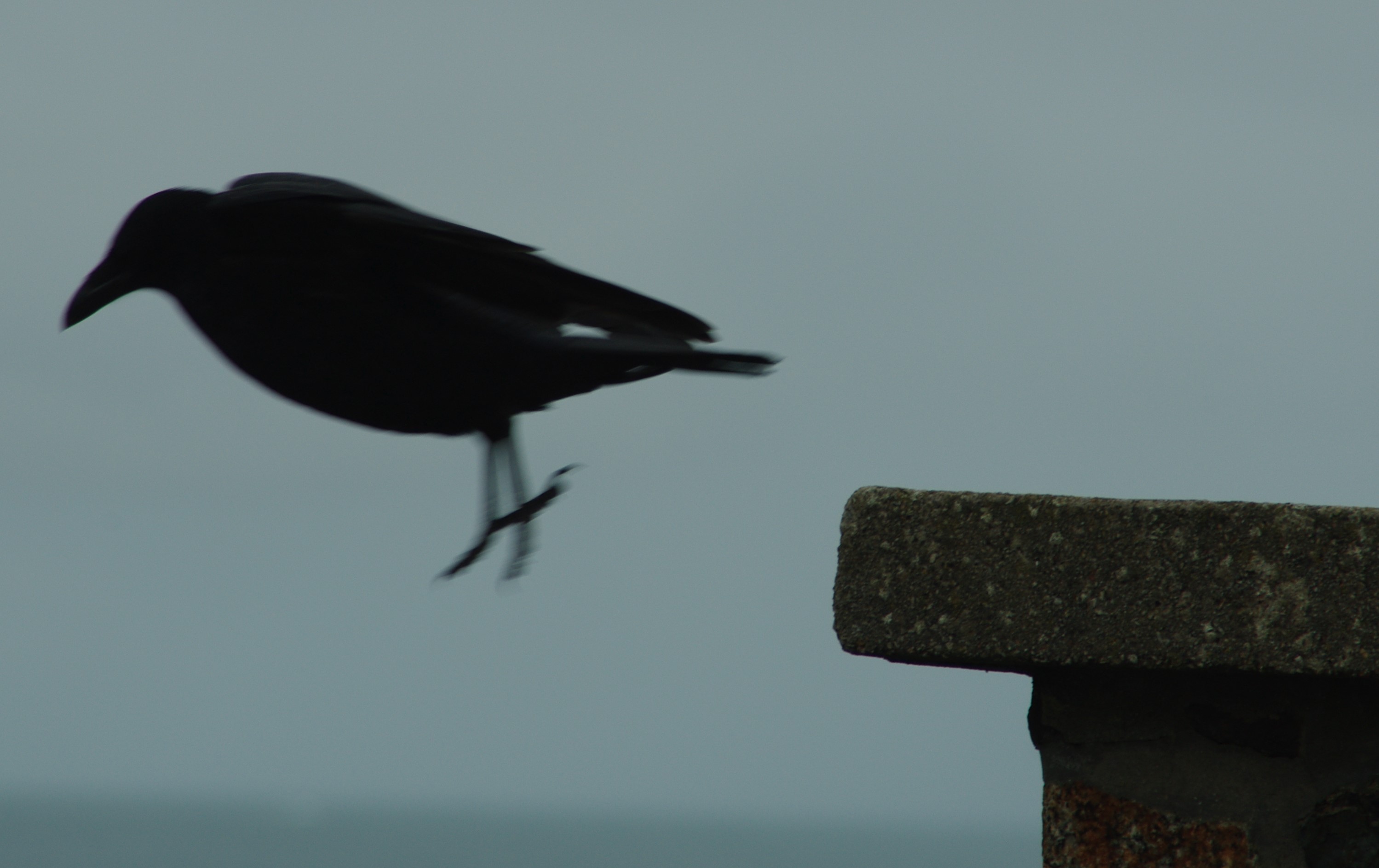
Some birds look particularly elegant and graceful when they fly…

And some don’t…

Panicking pigeons are pitiful things,

Flapping and slapping and clapping their wings,

Each one has only one thing on its brain,

And that’s searching for insects, for seeds, and for grain.

.

Walk-bobbing-walking like chickens on speed,

Or speeded up clockwork or on some doped seed,

Cooing down chimneys and shitting on folks,

A ridiculous call like a ghost being choked.

.

A floundering pheasant’s a physical freak,

With a whirring of wings and a creak from its beak,

You would think they would hide up and shut up all day,

But a clattering rusty noise gives them away.

.

There are plenty of elegant fowl in the sky,

The swift and the swallow, the eagle and kite,

With a breath-taking swoop or a beautiful song,

At times, though, evolution just got it plain wrong.

.

And on the subject of birds, I couldn’t let you go without letting you listen to the blackbird in our garden who I mentioned in the previous post, who has been singing his little heart out every day:

Sigh

Poem number five in my Poem-A-Day-For-A-Week-Or-So series. Snow outside, test cricket on the TV, beer in the cupboard. That’s my day sorted, then.

The sea sighs for you tonight.

It sucks at the shingle

And smears your footprints

Like a wet thumb rubbed across writing.

Where once you walked and left your

Prints, it gently wipes the land clean.

Lovingly it lays its cheek to the ground

And nuzzles your memory.

.

We are more than specks

In the infinity of time and space

Yet somehow we need to

Make sense of our lives.

Rock endures

But so does the wind and the rain.

More so, in fact, since in the end

Mountains are levelled

And the wind and rain remain.

.

In the end the passage of many feet

May be more durable than

Dwellings of stone.

Wandering

I’m posting this poem again, as it rather illustrates what I’ve personally found particularly frustrating during the recent lockdown. We can go for longer walks now, it is true, but that’s still not the same.

015a

If I could just wave a wand,

I would wander the world.

With my notebook in hand,

And a bag on my back.


I would sleep under hedges,

In hotels and haylofts.

Drink beers under trees,

And eat cheese on the moor.


I’d watch clouds over hilltops,

And boats on the ocean.

Shapes and shadows at sunset,

A moon with a view.


And I’d write trivial poems

Of snowfall and sunlight,

Birds singing at dawn

And the sounds of a stream.


There’s the lure of a skyline,

And skylarks above me,

Wine and woodsmoke my welcome,

At the end of the day.


To travel, to journey,

There’s magic in wandering

Over moorland and downland,

Through woods and through fields.


The world’s full of wonders

All waiting for wanderers.

Let me follow these paths

For as long as I can.

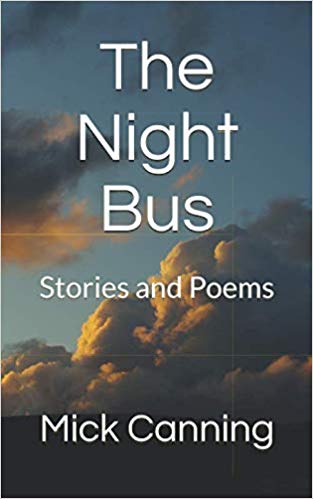
The poem can be found in my collection The Night Bus, which is available here. should your interest have been piqued by this…

Vikings

Allow me to introduce a new joint venture, a magazine (or zine, as I’m informed we hip youngsters now say):

img_20200601_202436_133d

The final poem in my recent collection, The Night Bus, is a poem called Vikings, and it is reproduced in this here zine with a series of super illustrations.

41XAtkb6ssL._SX311_BO1,204,203,200_

This is a collaboration between myself and my talented friend Mark Prestage. As already indicated the poem is mine, while Mark designed, cut and printed the linocuts.

img_20200601_202436_133c

Mark also did the hard work of putting the zine together, while I just sat around and drank beer. The zine is printed on 16 pages of high quality paper, in a preliminary edition of 40 numbered copies.

img_20200601_202436_133b

In the UK the price is £4.50 including postage and packaging, and it can be ordered from my Etsy site: here, or directly from me (just email me) using Paypal. Unfortunately the cost of postage overseas makes it impractical to offer outside of the UK (typically doubling the cost of the zine, or even more).

If people make lots of approving noises, we have ideas for similar projects in the future.

Mark also blogs here: drifting in lower case and twits: twit and is well worth a visit.

Lost and Found in Translation

Untitled-Grayscale-02

I have read many novels, short stories and poems translated into English from other languages, but I wonder how much of what I read is true to the original intentions of the authors?

The Argentinian writer Jorge Luis Borges wrote many short stories and poems, all of them in his native Spanish. Although I did buy one collection in Spanish, my own knowledge of that language has always been too poor for me to do anything other than read it slowly and laboriously and, undoubtedly, to miss many of the nuances in the writing. So for that reason, I’ve had to read them in translation.

And in any case, even if I spoke Spanish well I could do little more than read it as translation in my head. Unless I spoke it like a native speaker, I would still likely miss much that the author intended to convey.

And so I buy translations.

Zima Junction by the Russian poet Yevgeny Yevtushenko is a long poem that tells of the poet’s visit to his home town in Siberia, having left some years before to go to live and work in a city. It is a beautiful depiction of rural life in Russia at the time, seen afresh after a gap of several years away, and describes the poets now ambiguous relationship with it.

Long poems can be good vehicles for describing journeys; my own poem The Night Bus does just that, and was written because in that instance I could not find any other medium that worked as well to convey what I wanted to say.

Another favourite of mine is Dart by Alice Oswald, which describes a journey from the source to the sea along the River Dart in Devon, England. She gives voices to the various people encountered along this journey, and to the animals living there…Since it is written in English, I am not left with any worry I am missing things the poet wanted to say, other than perhaps my own occasional inability to understand her.

I have a book of poems from North East India. It is an anthology that I bought in India, with contributions from a huge number of poets. A few of them wrote in English, but the majority of them wrote in other languages – some in Bengali, but the majority in one or other of the plethora of languages to be found in the North East States. And, sadly, most of the translations appear to have been done as a straightforward translation word for word, with no thought given to the feeling of the poem. Any rhythm the poems may originally have had seems to have been lost. The sentences are often clunky and uncomfortable to read. Their meanings have become lost in translation.

But Zima Junction has a natural and comfortable rhythm

The translator of a poem has, to my mind, a task that is more difficult than the translator of prose. Yet, paradoxically, they also have more freedom. More difficult, because they have to get across to the reader ideas or meanings that may be partly concealed in idiomatic language used by the author that perhaps we have no parallel for in English, and hence they may have to completely alter the structure of that part. This will affect a line of poetry far more than it would a line of prose. Immediately, the rhythm of the poem is disrupted, the word count of the line changed.

Yet the reader of a poem has a right to expect a poem. And so, strangely, the translator has the freedom to re-write the poem. In the need for the end result of their translation to be a poem, they may have to completely alter much of the structure to enable the translated words to reassemble themselves as a poem. And so the translators of poems must, by essence, be poets themselves.

So to return to Borges and Yevtushenko, when I read the poems I do wonder whether I am actually reading their poems, or someone else’s?