The Thick Month

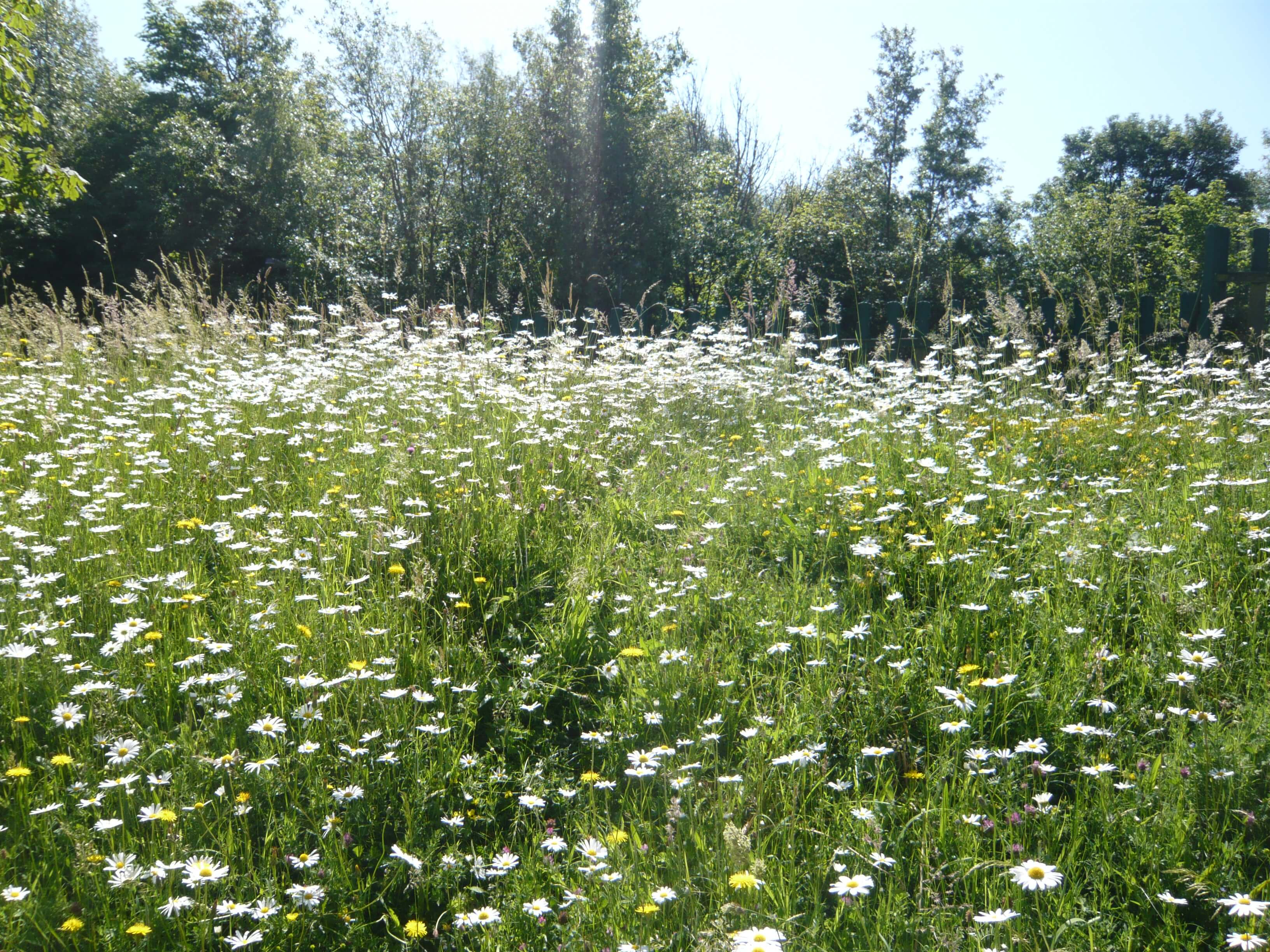
June is the Thick Month. Trees and bushes and stands of wildflowers have acquired a lush density by now, branches and stems encased in full-sized leaves, rich and vividly green. Leaves massed and packed in swaying light-blocking swathes. Nothing has yet faded, although there is a gradual falling away of birdsong now mating is over and broods are being raised, although this is compensated for by what seems to be an increase in insect noise, especially bee hum – certainly in our garden. The flowers are beset by mason, carder and bumblebees, and large numbers of solitary bees which provide a delightful oxymoron for this recorder, at least.

Going out and about through the woods a mile from my home, I feel I could almost be walking indoors, such is the density of the tree canopy above me, and when it begins to rain I do indeed remain dry, other than from the occasional drip finding its way through. But it is muddy underfoot in places, the sheltering swathes also keeping the sun from drying out the ground. The thick wet dark humus-rich soil smells sweet and clean, reminding me of a ‘plum-pudding smell,’ as Kenneth Grahame described the river-bank in The Wind in the Willows.

The fields, too, are thick with wildflowers and grass, as are roadside borders where councils have refrained from scalping them. As much as I rejoice to find the occasional rarer species amongst them, I think my greatest pleasure is just to see masses of the commoner species; buttercups or ox eye daisies, vetches or speedwells.

I generally see nothing rare when I am walking my patch, but I could never think of any of this as ‘ordinary’.

Rain of a Completely Different Water

About an hour after I wrote my previous post, we finally had some serious rain. Real, well-intentioned rain. Rain that took its responsibilities seriously. It even managed a little bit of thunder thrown in every now and again, although nothing too strenuous. So as soon as I published that post, really, it had been overtaken by events. Because the trouble with writing about rain, especially in Britain, is that by the time you’re done, it’s doing something quite different and making you look a bit foolish.

And this morning we have a light, steady rain again, but this time it feels very different to that of yesterday. Perhaps it’s just because the last twelve hours have been wet, and this weather has now established itself as a new, if temporary, normal. The day is bright and grey and, I have to admit, I love it. At this time of year the greens of the countless new leaves on all the trees and bushes and smaller plants glow with a wonderful brightness, even under the grey and the gloom. It is a day to put on boots and a light waterproof (it’s still very warm) and go out for a long wander.

So that is what I think I’ll do.

The Weariness of Rain

It is raining, and after what feels like weeks of steadily increasing sultry heat, it has now been raining for almost an hour. But there is no relief in this rain, at least not yet. It is a light rain, light and disinterested, as if its heart really isn’t in what it has to do. It sounds as though it is tired. It is a dutiful rain, rather than a rain with a purpose. We have been promised thunder, and torrential rain, but so far we have had rain that merely congeals the dust; rain to lightly refresh anyone abroad this evening without threatening to soak them through.

The windows of the house are open, front and back, in an attempt to create a through draught, but the air is still. Clammy. Hot. The only relief from the heat inside is psychological, rather than physical. The pattering of raindrops outside. A slight increase in birdsong, despite the lateness of the hour.

I am afraid the rain does not think it is really worth all the effort and will soon pack up and leave again. Maybe it will never return.

Sigh

Poem number five in my Poem-A-Day-For-A-Week-Or-So series. Snow outside, test cricket on the TV, beer in the cupboard. That’s my day sorted, then.

The sea sighs for you tonight.

It sucks at the shingle

And smears your footprints

Like a wet thumb rubbed across writing.

Where once you walked and left your

Prints, it gently wipes the land clean.

Lovingly it lays its cheek to the ground

And nuzzles your memory.

.

We are more than specks

In the infinity of time and space

Yet somehow we need to

Make sense of our lives.

Rock endures

But so does the wind and the rain.

More so, in fact, since in the end

Mountains are levelled

And the wind and rain remain.

.

In the end the passage of many feet

May be more durable than

Dwellings of stone.

I Made A Vow

Day four of the Poem-A-Day-For-A-Week-Or-So project and a bit of a rush, today, as I’ve been assembling a shed (as you do). Another one, therefore, which will benefit from a revision when I have more time.

In Tripoli I made a vow to travel light, my eyes wide open,

Travel all the time I could, to take my chances when they happened,

Planned to seek out strange new places, take some risks see new horizons,

One thing alone I wanted now, the promise of the unexplored.

.

And I remember where I was, the time of day, the type of weather,

Early morning, early March, this was a time of change for me,

A time for taking big decisions, time to turn my life around,

Time to leave things in the past, the time to turn another page.

.

At the time I made that vow, I yearned to go along the Silk Road,

Travelling any way I could, and though that sadly never happened,

Other projects came and went, journeys all filled with adventure,

Baking deserts, frozen mountains, close to home and far away.

.

I knew the world would not be kind, it would not make my journeys easy,

Whatever it might offer me, I’d leave myself completely open,

Embrace the rain, embrace the wind, embrace the temple and the hillside.

This was my private pact with life and to this day I’ve not yet finished.

Mud

The second of my ‘Poem a Day’ poems. Just getting this far is a bit of an achievement, I suppose, although I’m not particularly happy with either the meter or the rhythm. It feels as sloppy as the day itself was. But I think it has potential if I do a bit of work on it sometime later.

Mud

Today, the sun has been sent into exile,

Leaving just a weary daylight.

It has gone, and we shall never see its like again.

.

In the steady rain,

Climbing this hill is an act of defiance

A far more daunting prospect than usual.

It is like a resistance.

One step forwards and two steps back

I slide and slither upon the track,

Barely keeping my footing at times.

.

In places, mist curls beneath the trees

Where the birds voice their own defiance

Loud and clear.

.

Beneath the endless grey,

Still lower clouds like smoke from gunfire,

From shell bursts or industrial disaster

The earth torn up and churned

From countless toiling feet.

But other than the birds,

I have the world to myself.

Winter – 2

Nature dies down in winter. Certainly, at those latitudes where the days become much shorter and the temperatures plummet. Both wind and rain seem to become more frequent. Snow. It is a period of rest and renewal after autumn has put on a final glorious display of colour. Animals adapt to this in one of three ways: some will eat and eat of the autumn bounty of, especially, fruit, putting on large fat reserves and surviving the winter in a state of hibernation, their heart-rates dropping to a scarcely believable one or two beats a minute, their bodies slowly using these fat reserves for the little energy required to maintain a flickering life through those months. Some migrate, seeking a warmer climate until spring returns. These animals are, due to the obvious logistics required to travel hundreds of miles to reach those more hospitable climes, the larger animals and many of the birds. Travel over those kinds of distances would be out of the question for the smaller ones. Others stay put and, in the case of the plant eaters, scratch out a meagre living on whatever leaves and grasses survive through the winter. The carnivores, of course, stay and try to catch them.

Our Neolithic ancestors’ life cycles would be attuned to this pattern too. Autumn must have been lived fast and furiously. In the same way our medieval ancestors worked long hours to bring in the harvests, Neolithic man and woman must have used all the dwindling daylight to bring in as much food and fuel and dry bedding as possible before the winter period. Then by the end of autumn gathering would have largely ceased and they would have moved into a winter rhythm of life.

But how did they get through winter? What of the food they had gathered? Presumably, they had no way of storing fruit – could any of it be dried? Was it fermented for drink? Or was it all eaten as soon as it was gathered, as though they were all so many dormice seeking to build up their reserves? And could this, in fact, have been a part of their strategy to get through those months? To eat and eat until the perishable foods were all gone, and then to stop all but the most essential activities. To expend as little energy as possible and stay as warm as they could. Spending as much time as possible asleep.

And yet, they would still need to eat, and so with dwindling food reserves they would slaughter any beasts kept for that purpose, possibly smoking the meat to enable it to keep for as long as possible. Hunting would continue and might, in some ways, become a little easier. With less vegetation around, there would be less cover for their prey, and in snow there would be clear tracks to follow. But presumably this prey would still need to be pursued, and this would use precious energy, unless they relied more upon pits and snares.

R. I. P. Winter

It’s beginning to feel both as though autumn has been with us forever, and that it is especially reluctant to leave us, this year.

This year has been a mast year; the trees and bushes have been laden with prodigious quantities of nuts and berries. The hawthorns, especially, seem to be weighed down with berries, and we have gathered large quantities of nuts from the hazel in our garden. There are so many acorns beneath the oaks nearby that there is a thick, continuous, crunchy, carpet of them underfoot. Traditionally, this has been said to indicate a harsh winter ahead, although how the trees and bushes are meant to work this out when we have no idea what the weather will be then, heaven only knows.

What it really indicates, of course, is that the climatic conditions have been such throughout the year that these trees and bushes have successfully produced their large crops. Nothing to do with what will come along later.

On the other hand, the leaves have held onto their greens for longer than usual and only turned late, and still seem most reluctant to fall. It has taken the determined efforts of a few strong winds just to remove about half of them. Certainly, around my part of Britain, anyway.

It is not cold. There are no signs of a proper winter chill approaching, with the long-range weather forecast contenting itself with predictions of the occasional cold spell in the next month, which takes us through to mid-December. In the garden the grass and many of our other plants are still engaged in that crazy autumn growth spurt.

Of course, it was never unusual for November to be wet and mild, and we may yet have a biting cold winter, although I wouldn’t bet on it. It is a long, long time since we have had a winter like that in these parts. In my lifetime, only the winters of 1963 and 1978/79 really stand out as being extremely harsh, although a few others have had shorter periods of cold and snow. The expectation for winter around here now is that it will just be chilly and wet. I think only once in the last six or seven years have we had more than just the odd flurry of snow; that was from the so-called ‘Beast from the East’ a couple of years ago, and even that only lasted a few days.

We seem to have lost winter somewhere along the way, which sounds very careless of us.

In fact, that is quite a good way of describing it.

You don’t need me to tell you we have been careless in the way we have interacted with nature, the result being our world is heating up dangerously. And in our part of the world, this has led to hotter, drier, summers and milder, wetter, winters. There has been a notable increase in destructive flooding events. Downpours are frequently very heavy and long-lasting. Rather than being spread out through the month, we may get an entire month’s worth of rain in less than a day. Summers, conversely, have become very dry.

This is absolutely nothing to the extreme climate conditions suffered by millions of others in other parts of the world, but it helps to bring it home to us that the Climate Emergency is real, and it is happening. With everything else happening in the world at the moment, this seems to have been conveniently ignored by the mainstream media for the last six months.

R. I. P. Winter.

An Andalusian Adventure (2)

Part 1 can be found here: Part 1

It was a long way to Colmenar. I was walking up into the Malaga Mountains, with no map and no directions other than a road sign at the edge of Malaga suggesting that by following this road I would eventually reach my destination.

I suspect I have undertaken other journeys where I have been better prepared.

But the day was perfect for walking, with high drifting clouds and a light breeze to keep me cool, and having done little for several days other than eat, drink and wander around Malaga, I was feeling fit, fresh, and eager to get going.

As the hours went by and I slowly gained height, the clouds began to build up, and the temperature gradually dropped. About an hour from my destination, it finally began to rain. Immediately the temperature plummeted, and I rapidly went from merely chilled to decidedly cold.

Usually, we approach rain all wrong. Buddhists would say unskilfully. If it begins to rain, we hunch ourselves up, both physically and mentally. We fear becoming cold and wet. We need to let go of this fear. It’s a good lesson to learn. Stop. Take several long, slow, deep, breaths, and let go of this feeling. Let go of this need. We act as though hunching ourselves up will keep us dry and make us warmer. It doesn’t. Unless one can find shelter, it is better to accept the rain and finish the journey.

It is a cliché to speak of heightened awareness, yet that is also a by-product of this letting go. We remove our focus from the rain and instead allow it to go elsewhere, where it is really needed. We should throw back our heads and embrace the rain, enjoy the freshness of the rain on our faces. Listen to the sound of the rain on the ground and the leaves around us.

Back then, I hadn’t learned that lesson. I hurried towards the town as fast as I could.

One of the first buildings I came to was an inn. I went into the bar and asked for a room. The room I was given was reached by leaving the bar again and walking around the side of the building. The door to my room had a gap at the bottom of an inch or two, but otherwise fitted the door frame well enough. It was locked and unlocked by the type of huge key frequently described as a jailor’s key. The room was furnished only with a bed, a chair, and a small chest of drawers. There was a mirror above the chest of drawers and a crucifix above the head of the bed, but other than those the whitewashed walls were bare. There was a small window which was shuttered. The floor was of flagstones, with no carpet or mat. To use toilet or bathroom it was necessary to leave the room again and continue still further around the building to reach a very basic room. But again, it was clean. And there was a toilet that worked, and a sink with a cold tap. There was also a shower set into the ceiling I could have braved, but it felt much too cold for that.

Later, I would occupy rooms like this in many other places, in many other countries. Simple, perfectly clean, and usually very cheap. I am not sure whether it is because they appeal to the minimalist in me, but in many ways I prefer them to more comfortable accommodation.

Whenever I have stayed in one, I have always felt I was carrying too much baggage with me. I have been beset with the feeling I should be throwing out some of the items I have in my bag – do I need all those clothes? All those other items? It has been a recurring regret of mine that I have never managed to live a simpler lifestyle than I have. I have never enjoyed the frenetic hurry and clamour of modern urban life, and I hate how easily my life can become complex and filled with what feels like unnecessary fuss.

Here, even the spartan contents of my rucksack seemed too much. Perhaps I had too many books with me…

But now I was here, I changed out of my wet clothes and opened the shutters so I could look out at the low cloud and misty horizon. The rain drummed comfortingly on the roof and I settled down to read a book for an hour or so. I was content, and that’s a good place to be.

I cannot remember what I had for supper that night, but I do remember I drank a bottle of cheap red wine with it. Perhaps that is the reason.

I rather think I slept well, too.

And as in all good stories, the morning dawned bright and clear, the sun shining low in a clear blue sky. Before I left the town, I passed a couple of shops and bought a few items for my lunch: bread, a huge tomato, a hunk of cheese, a couple of apples, a bottle of cheap wine.

img20190318_12103098

With the improved weather, and the fact I had more downhill stretches that day than uphill ones, I allowed myself the luxury of returning to Malaga slowly, including a stop for lunch of about an hour. Compared to the UK, Spain is a large country and the rural population is comparatively small. Although I was not far from the city, I saw almost no one else on my walk and I meandered along slowly through a mixture of low trees and bushes, many of them in flower – the distinctive Mediterranean maquis vegetation – rocky outcrops and clumps of flowers, and the occasional lone farmhouse. The ground was dry and dusty, as though the rain of the previous day had never happened, and the sun was hot. With my lunch consisting of about half a bottle of wine as well as the food, I was feeling extremely weary and footsore when I reached Malaga again. I found the hotel I’d stayed in before and got a room on the same floor. After showering, I finished the bread and cheese and decided all I wanted to do was read my book for a while and then have an early night.

There was a knock at the door and when I opened it Matthias was standing there grinning.

‘I saw you arrive earlier. We go for beer, now!’
Sketch n’ Haiku Day

We’ve had all sorts in the last week.

We’ve had cold, bright, sunny days. We’ve had cold snowy sleety days. And today we have lashing rain and wind. It’s milder than it was, but as miserable as sin and the wind still cuts through you!

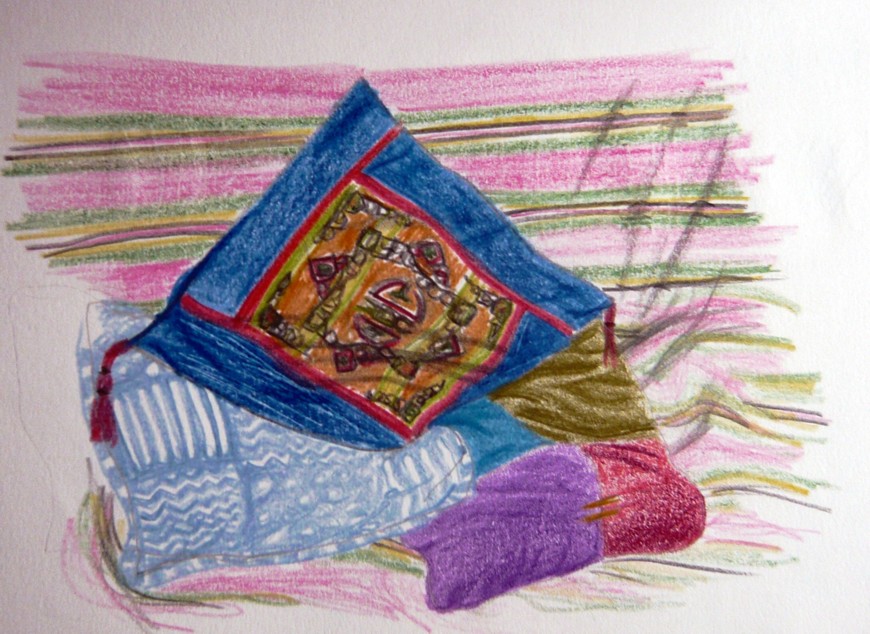
So here is a sketch for the day – cushions on the sofa to remind me of Nepal, since the top one came from there:

002

And here is a haiku for the day, to remind me of summer:

Amidst the traffic,

In the still airs above me,

A lark dripping down.

And a thought for the day? Another haiku, to remind me to slow down sometimes:

Obsession with time

Is climbing trees in autumn

To get down the leaves.

And today I begin the first edit for A Good Place – initially reading it through and thinking about the voice, the narration, to see if it works for me. Next, another read to look for flaws in the plot, redundancies, things to add and take out. Finally, try to knock the grammar into shape. If I’m happy with that, then it’s on to the beta readers.

Hope you all have a good day.