Published!

Well, blimey, Making Friends with the Crocodile is now published on Kindle and is up on Amazon as we speak!

Making Friends with the -Crocodile

About a week ago, I reached the point where I felt that the editing was finally complete, or, at least, if it wasn’t, then I might just pick at it for ages without really making any further difference, and so it was time to get the process finished.

What a relief.

It feels as though I have been under pressure for weeks. I’ve felt tired, I’ve felt tense.

Ooh, I’ve been irritable!

All this pressure, of course, is of my own making. A lot of it, I suspect, being due to this being my first foray into publishing.

I knew that I needed to format my text for Kindle, and heard that Scrivener was a useful tool for that. And so I downloaded Scrivener, and spent a couple of hours working through the tutorial until I decided that it just wasn’t going to happen for me.

I’m sure it is very useful, but I was getting to the point where I felt like chucking the laptop at the wall.

So I went and looked in detail at the instructions for publishing on Kindle, and found that you could just save your file in the correct format and then upload that.

Bye, bye Scrivener.

I looked at a few Kindle books and then wrote the stuff at the front and back of the book – about copyrights and stuff like that.

I inserted my table of contents.

I already had my book cover ready.

I wrote the blurb:

‘Siddiqa was only just into her teens when she was forced to leave her home to live with her new husband and his family in another village. The years have passed, and now Siddiqa has three children of her own. Her grown up son has brought his new wife, Naira, to live with them, so Siddiqa is no longer the lowliest in the household, for she has a daughter-in-law.

Life in rural India is particularly harsh for women. This novel explores themes of female oppression and tradition and asks whether the next generation will find life any easier.’

Working out how to upload to Kindle, and to complete all of the forms and tick boxes proved a little long winded, but reasonably straightforward.

So then, suddenly, there it was. Sitting on Amazon, available for pre-order, with a launch date of 4th June. Although for some reason, unfortunately, pre-order is not available in India.

And now it feels much like stepping off of a crowded and noisy street into summer sunshine; the sounds of the shouting and the traffic disappearing and being replaced by birdsong.

IMGP2282

Woo-hoo!

And what a buzz to go and look at my own author page on Amazon, with my own book there!

Woo-hoo again!

For the moment, as I say, it is only available for pre-order, and will be released on 4th June. But if anyone does feel inclined to buy it, pre-orders will help boost the ratings when it actually launches.

I am going to look again at Print on Demand, in a day or so. Initially, I had ruled it out, mainly because the one site that I looked at required the customer (i.e. me) to order and pay for a set number in advance, and I assumed that would always be the case, but now I think that is possibly not so. Certainly, the Amazon tool, CreateSpace, looks as though it might work more the way that Kindle does.

It will be great if it does, since I really prefer to have a physical copy of a book, and I know there are still a few other people out there who still feel that way.

So…now to get my head around promotion…

Ooh, it’s nearly finished!

I’m getting excited, now.

My novel, ‘Making Friends with the Crocodile’ is hopefully ready for its final edit.

This part of the journey seems to be taking a great deal of time, but this might be because it is my first foray into publishing. I know that there is still much to do – formatting, advertising, proof-reading, the publishing itself, amongst a plethora of smaller but no less important tasks – but I am finally beginning to feel that I am getting there.

Curiously, after what I wrote in my last post, I never found any of the characters threatening to hijack the plot in any way. Although I never planned it out in any detail, I had a rough plan in my head, which, remarkably, I kept to. Perhaps it is because the subject matter is strong. I don’t know.

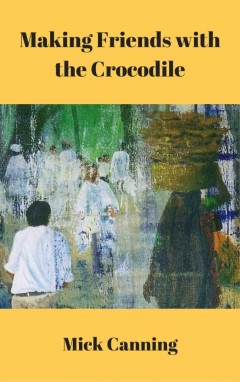
And I think that I have settled upon the cover (the artwork is my own).

Making Friends With The Crocodile cover 1

I may play around with the wording, slightly, for example I might take out the words ‘A Novel’.

For some background; the story is set in a village in Northern India, some fifteen odd years ago. It is about the deteriorating relationship between two women in a family: the mother and her daughter in law. Like this relationship frequently is, it is a strained, fractious one, not helped by that society’s attitudes towards women and their roles in general. And when one of them gets caught up in events beyond her control, these attitudes become dreadfully destructive.

As always, your thoughts would be very much appreciated.

Pitfalls for Writers – 4) Language; a bit of a follow-up

Back somewhere deep in the mists of time, I published ‘Pitfalls for Writers 1’. In this, I discussed some of the potential problems of language in a novel.

If I am to write a story of medieval Persia, for example, I will write it in English. No one who reads it is going to be fooled into thinking that my characters were really speaking in English. But this on its own is not enough. There must be something in the language I use that reminds the reader that the story setting really is medieval Persia.

P1050055

And so I suggested using a flavour of the speech. I might sprinkle the conversation with words such as ‘dirham’ (a unit of currency), or ‘djinns’ (genies). The characters might smoke a ‘qalyan’, which is how they would have referred to what we generally call a hookah. A greeting might be ‘Salām ʿalaykom’.

In the comment stream that followed, I concluded that I might employ a glossary, but certainly not footnotes.

This has now become most relevant to me.

About a month ago, I finished reading Anuradha Roy’s ‘The Folded Earth’. It is a novel that is set in India, written by an Indian writer, yet it uses a glossary, although she is presumably writing in the first instance for an Indian audience. This glossary explains a few words and phrases that many western readers would be unfamiliar with, although I would expect the majority of Indian readers to know them all.

My own novel is being read now by generous beta readers, and some of the discussion is over the use of the appropriate Hindi / Urdu words in the text.

And so, with ‘The Folded Earth’ as an example, I shall definitely use a glossary.

Next, it is important to employ the correct voice.

Speech:

Clearly, if the protagonists of a story are sitting down to a meal, they might complain about the amount of fat on the meat, but they would be most unlikely to refer to it as ‘adipose tissue’. Unless one or both were, for example, surgeons.

Very few people would be likely to refer to two items as being ‘in casual juxtaposition’. They would be far more likely to say something along the lines of ‘oh, they look a bit odd next to each other.’ As tempting as it might be for the author to show off their vocabulary, it is something that should be used most carefully.

Narrator:

If the story actually has a narrator, then this becomes even more important. The country bumpkin relating an everyday tale of rustic shenanigans should not be employing sophisticated and subtle wordplay. He or she should only be employing language that they would naturally use.

Author’s voice:

Even if there is no actual narrator, it remains important to use only language that would be natural to the situation. For example, it sounds plain wrong to describe a group of Vikings ‘computing’ an answer to a problem, even if it is only the author describing it that way.

Generally, of course, and I know that some will disagree with this, it is usually better to avoid all flowery and showy language in novels, and use simple language well.

Finally, a jarring note found in a few modern novels set in older times, is that the characters often think like modern folk. Reading these books as against books written, perhaps, 150 years ago, it is not just the style and language of the writing that are different, but also the prejudices. The hero of a novel set in 1840 is going to have casual prejudices against, perhaps, people of another race, women, etc etc. We tend to be reluctant to set these down in print, nowadays, perhaps as if by doing so we are almost admitting to having these prejudices ourselves.

However, if we want to depict our characters realistically, we need to do so ‘warts and all’. And if the writer is going to depict them otherwise, then he or she needs to have a good reason why they do.


The Problem of Historical Truth

In my previous post about the pitfalls of online research, I began by alluding to the unreliability of newspaper reports. If you were to read reports on an important item of news in a number of different newspapers, you frequently might be forgiven for thinking that they were actually talking about completely different events. There will be political bias, of course, and the prejudices and agendas of reporters and editors alike. Are the individuals in an armed insurgency terrorists or freedom fighters? It is a point of view. Are strikers in an industry greedy mischief-making saboteurs, or victimised and mistreated victims of greedy corporations? Again, it is a point of view.

It can be very hard today to see through the fog of opinions and misinformation on any topic. How much more so when we delve back into time?

History is written by the victors. For example, what we know about Caesar’s campaigns in Gaul and Britain were written largely by the Roman conquerors, especially Caesar himself. Most of what we know of the reign of Ashoka, in India, comes from the edicts that he caused to be inscribed upon the remarkable number of rocks and pillars that are still in existence.

023 (2)

Even tales written by the vanquished are likely to be inaccurate, of course. The cruelty of the victors, their barbarity; all of their actions will be exaggerated.

The historian understands that information comes largely from primary and secondary sources. A primary source might be, for example, an account written at the time (Caesar, above) or Parish registers of births, marriages and deaths. These sources are considered to be most likely to be accurate, being compiled at the time of the events described, but clearly they might all be deliberately or accidently falsified. Secondary sources might be newspapers, which are largely made up of analysis and opinion, and therefore considered to be an interpretation of information that has been derived from another (hopefully primary!) source.

A primary source is also referred to as evidence, yet I wonder whether a better distinction would be made if ‘evidence’ referred only to unwritten sources; archaeological remains, buildings, pottery, jewellery and coins and their like, which, whilst needing interpretation, are unlikely to be prey to the kind of distortions that written sources might be. Caesar, after all, might have claimed to take ten thousand prisoners when he only took five hundred, yet pottery of a particular type that is found at a particular spot, tells a story that needs to be interpreted, yet is unlikely to be a falsehood.

We need to be careful, though, when it is interpreted in light of contemporary writing, to avoid the temptation of unconsciously corroborating those writings.

Having written the above, we do have to take a certain amount on trust, because it is not practical to question everything in the world that we come across.

Yet, just because we discover that Troy really does exist, does not mean that all of the stories of the Iliad are now, somehow, all true. That would be like an author writing an incredibly impossible fantasy tale, in which the city of Vienna still exists and features, yet claiming it must be true because Vienna is a real place.

During the first year of World War One, a fictional short story ‘The Bowmen’ was published in the London Evening News by Arthur Machen. In this tale, he describes a battle between English and German soldiers at Mons, in France, in which the beleaguered British were aided by the sudden appearance of phantom archers who intervened to keep the British safe. Although this was fiction, the story quickly ‘went viral’, as we might put it today, and was readily believed by many in Britain. Of course, there was a feeling then that the British were good and the Germans evil, and so it was natural that God might intervene to help and protect them. A far stronger belief in God, in those days, also contributed to the feeling that it was natural to find that a miracle had occurred.

Although Machen republished the tale in a book with a long introduction explaining that it was fiction, and examining reasons the public thought it was true, not only did the belief persist, but further reports of angels on the battlefield began to appear. As a child in the 1960’s, I remember reading an account of this in a comic, with it presented as the truth. In 2001, the Sunday Times reported that photographic evidence to support the story had been discovered, although this was proved to be a hoax.

The Sunday Times also published exerts from Hitler’s Diaries in 1983, until these, too, were proved to have been forged.

Memories are notoriously unreliable. I was reading just a few days ago of an experiment where a group of people were encouraged to discuss childhood memories, with selected members of the group feeding in deliberately false information. After an initial hesitation, it seemed that all of them accepted these false memories as real, even to the extent of agreeing that they had taken part in a balloon ride, when they had not, and describing what they had seen from the balloon, and their feelings during the ride. The point being that they came to believe these were their own, real, memories.

How reliable are our own memories, then? And what can we trust? Clearly, there must be a lot of historical narrative that has been honestly recorded, that is simply not true, and we are unlikely to ever know what it is.

The Slow Book Movement

The original slow book manifesto (November 2009) declared that the movement:

aims to inspire a reawakening to the act of reading. As we enter an era with more and more people “reading” books on digital screens, getting news headlines online, escaping through the flat screen at home, the time is ripe for people to be reminded, or introduced for the first time, to the joys of reading. 

Then in March 2012, Maura Kelly also called for a slow book movement, arguing that In our leisure moments, whenever we have down time, we should turn to literature—to works that took some time to write and will take some time to read, but will also stay with us longer than anything else. They’ll help us unwind better than any electronic device—and they’ll pleasurably sharpen our minds and identities, too.

And then added: Slow Books will have standards about what kinds of reading materials count towards your daily quota. Blog posts won’t, of course, but neither will newspaper pieces or even magazine articles.

Also excluded: non-literary books.

Why the emphasis on literature? By playing with language, plot structure, and images, it challenges us cognitively even as it entertains. It invites us to see the world in a different way, demands that we interpret unusual descriptions, and pushes our memories to recall characters and plot details. In fact, as Annie Murphy Paul noted in a March 17 New York Times op-ed, neuroscientists have found plenty of proof that reading fiction stimulates all sorts of cognitive areas—not just language regions but also those responsible for coordinating movement and interpreting smells. Because literary books are so mentally invigorating, and require such engagement, they make us smarter than other kinds of reading material, as a 2009 University of Santa Barbara indicated.

Phew!

Then the splendid Writers’ Village Blog discussed the subject at length earlier this year http://www.writers-village.org/writing-award-blog/how-to-fall-in-love-again

An article in the Guardian newspaper in July 2010: http://www.theguardian.com/books/2010/jul/15/slow-reading Suggested that the problem was that with our modern, frenetic, habits, we are losing the ability to concentrate for long enough to read books. Actually, it says a lot more than that; I paraphrase.

I think that we have now come to a sort of consensus on the subject, in that when we refer to something called the Slow Book Movement, we are referring to the idea of reading writing that is leisurely, rich and intelligent. Writing that doesn’t attempt to hustle you, but takes as much time as it needs to adequately describe what it wants to describe. We used to do it all the time, of course. For example:

In the broad old-fashioned window-seat—as capacious as many modern sofas, and cushioned to serve the purpose of a luxurious settee—in the broad old-fashioned window-seat of a roomy chamber, Mr Chester lounged, very much at his ease, over a well-furnished breakfast-table. He had exchanged his riding-coat for a handsome morning-gown, his boots for slippers; had been at great pains to atone for the having been obliged to make his toilet when he rose without the aid of dressing-case and tiring equipage; and, having gradually forgotten through these means the discomforts of an indifferent night and an early ride, was in a state of perfect complacency, indolence, and satisfaction.

From ‘Barnaby Rudge’ by Charles Dickens.

Of course, we weren’t all being driven to distraction by texts and emails and phone calls and all the other demands for our attention that we have to put up with now. And there are still plenty of writers who can write this way:

‘During the hot afternoon the air shimmered with heat, the long white-walled house and the straight ranks of trees swam in an hallucinatory mirage, their wavering images quivering in rainbow-hued waves across which suddenly a parakeet darted. In one of the inner rooms of the house, Sathiah lay asleep on a mat. Outside, in the grove, the palmyrah palms enclosed the restless shadow of the child in his endless games. The house constantly projected itself before his consciousness, his black, leaping shadow imprinted on the white wall as he reared up suddenly against it, an elongated blind shade, as blind as the shadows of close-growing, dark trees.’

From ‘Peacocks and Dreams’ by Jean Arasanayagam, the Sri Lankan writer.

It is a three course meal with carefully chosen wines, brought to the table and served at leisure, rather than burger and fries on the run, which fills but rarely satisfies. It is a string quartet in an intimate space, rather than a strident ringtone next to you on a crowded train. It is a test match rather than a T20 fixture (any one from a non-cricket playing nation, please feel free to request an explanation).

Because a story is far more than its ending. Every author will attempt to pace their story appropriately, and even in a fast-paced thriller they need those slower segments for the reader to draw breath, and to build the tension. And surely in any story the construction of the world of the story is integral, so that the reader can visualise where the drama is taking place.

Writers now are frequently advised to cut out any word, phrase, sentence, paragraph or even chapter which their work can do without. To cut and pare down to the bare minimum. There should be nothing superfluous, otherwise our readers will get bored and put down the book, never to pick it up again. But, when I first read The Lord of the Rings, a lot of the attraction of the book for me was the colourful, and leisurely, descriptions of the journey, as much as the action. I am also an avid reader of travel books, and imagine a travel book where we are not told enough to be able to visualise the journey. Would that work? It seems most unlikely.

All of this is why the majority of my short stories are not, in fact, very short.

What do you think? Do you agree? Please let me know your thoughts.