Today is the shortest day of the year. Where I live, we will get approximately half the daylight hours that we will get during the Summer Solstice. Actually, slightly less. We get up in the dark and it is dark again long before supper time. The weather is cold and predominantly miserable.
But from today the daylight hours lengthen – at first imperceptibly, but gradually it becomes noticeable the hours of daylight are increasing. Finally, there is an end to the relentless lengthening of darkness, and within a few weeks it will become obvious that the world is, indeed, moving towards a time of warmth again.
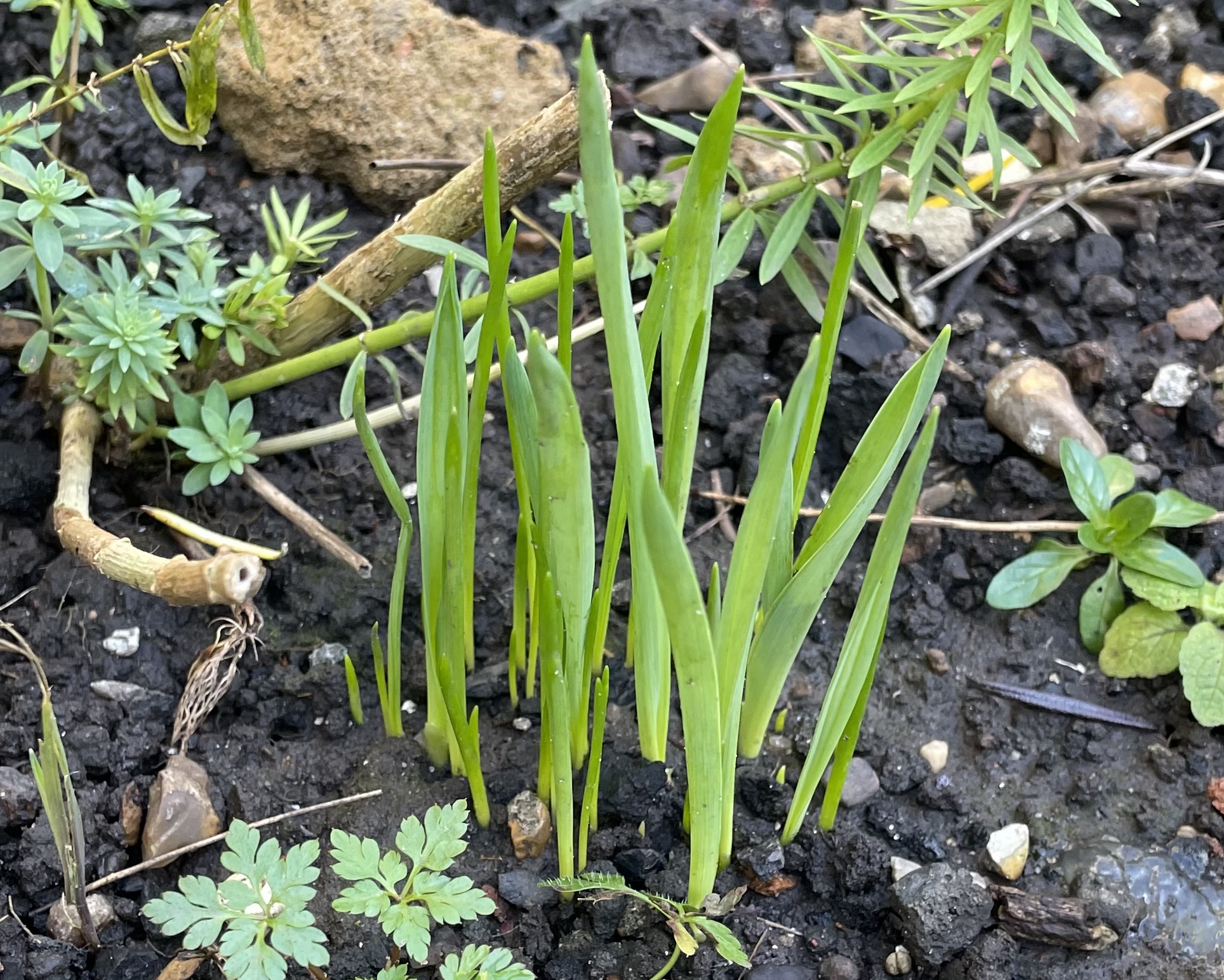
Yet there are already new plants coming up; new growth that has been prompted by…what? When they broke the surface of the ground a few weeks ago the days were still getting shorter and certainly no warmer. Nature is strong and determined. Winter is never a lifeless time of death and decay. There is dormancy and rest, but also a lot of growth if one takes the trouble to look for it.
I’m thinking longingly of Spring, of renewal and growth. In a couple of hours I’m off to see a mumming play – perhaps I’ll leave you to Google that one – down on the Kent coast. Beer will be involved, of course, in line with the best folk traditions. Old – possibly ancient – celebrations of the turning of the year and the approach of Spring.
That’s why you haven’t heard from me for a while. Here’re a few pictures.
We began walking from Amberley this time, and on the first day the weather was pretty meh. It was either raining or starting to rain or just deciding when to rain. But, as always, the Downs looked fantastic. This view reminded me of a Roland Hilder painting:
But it got steadily wetter throughout the day. We took a very welcome break in the Frankland Arms in Washington and if I was writing a pub review it would get five stars – especially as it served Harvey’s Old Ale. But I only allowed myself one of those, as we still had some serious mileage to do. And it was, as noted, getting wetter. We approached Chanctonbury Ring:
And as we began the descent from the top, the saddest part of the journey. We walked among a large number of ash trees, all of which were dead or dying from Ash Dieback disease. It looked like a picture of the Somme.
The next day was dull, but at least it was dry. We walked past the Devil’s Dyke which I never seem to be able to get a good picture of, no matter which angle I take it at. The Devil’s Dyke is so-called because for some reason the Devil wanted to destroy Sussex, and got talking to Saint Dunstan and asked him the best way to do it. Why he did that I can’t imagine. Never ask a saint for advice if you’re the Devil. It won’t end well. Anyway, Saint D suggested he dig a channel through the South Downs and flood it. Right, thought Old Nick, and set to work. Saint D let him toil away for a few hours and then caused all the cocks in Sussex to crow. Thinking it was morning, Old Nick threw down his shovel, twirled his moustaches and hissed ‘Curses, foiled again!’
Alternatively, it might have been caused by melt-water during the ice age, but why spoil a good legend?
And the best weather? During our rest day in Lewes. And, oh look! There’s the Harvey’s Brewery! What a good rest day.
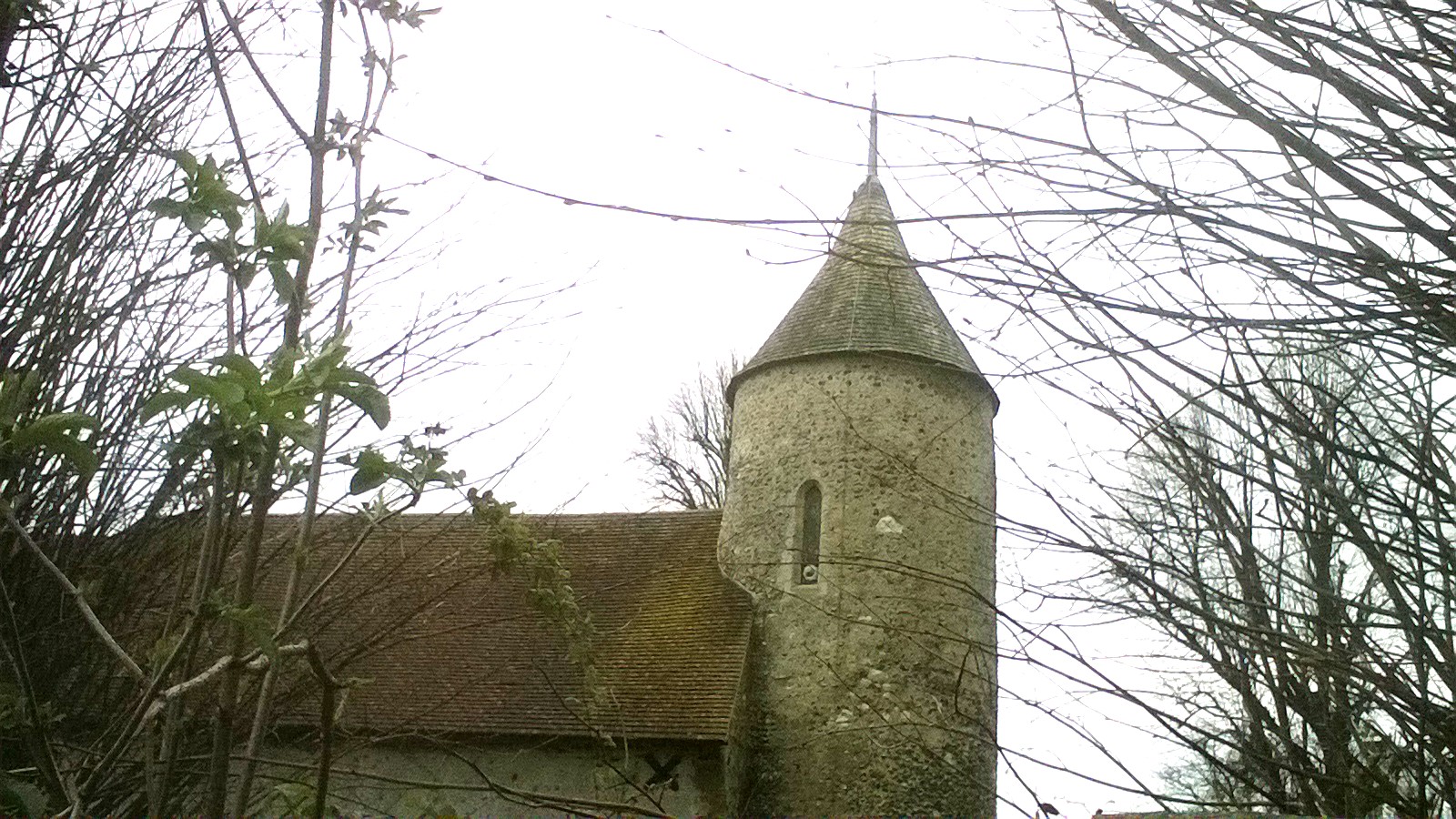
The following day was dull again as we left Lewes, and by now quite a sharp wind was blowing – into our faces too, unfortunately. But we had a pretty decent day and passed this church in Southease, one of only two (I think) in England with a round tower outside of Norfolk. The other is in nearby Lewes.
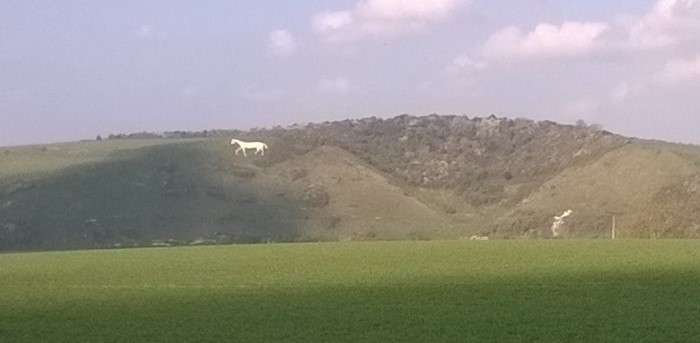
The final day began sunny but again with a sharp and unkind wind. We left Alfriston with its church on the edge of the village by the river and headed towards the coast. On the South Downs away to our right we passed a white horse carved into the chalk.
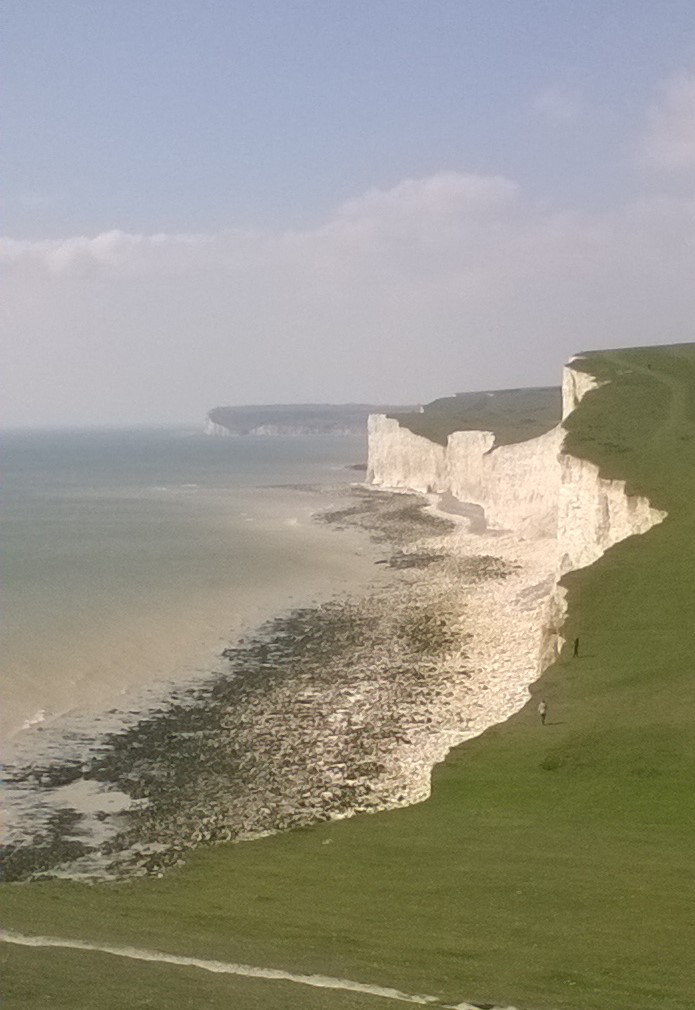
Soon we were up onto the Downs again, for the final walk into Eastbourne over the Seven Sisters and Beachy Head. I tend to forget how tiring this leg can be, going continually uphill then downhill for the best part of six miles. For some reason, although we could see the Belle Tout lighthouse in the distance, it never seemed to get any nearer. Once I could do this leg of the walk easily, but…getting a little older…
An always fantastic view, though. Here we’re looking back across the Seven Sisters towards Seaford Head.
Hermits have long gone out of fashion, which is rather a shame. At one time I think I might have viewed it as a good career choice. It had its perks; accommodation was provided, usually in the form of a rude hut (that’s rude as in rudimentary, of course, not because there were obscene drawings on the walls. Although heaven knows what the hut’s occupant might have been driven to in the long winter months…) or a romantically ruined building, food was generally provided, although I suspect that within the job description for a hermit it would have been set out that nourishment came in the form of gruel and acorns rather than an a la carte menu, and people generally left you alone to get on with hermitty things. The downside, though, was what those hermitty things consisted of. There would have been long hours of prayer and contemplation, and I think even if the weather was crap, the hermit would be expected to be out in it praying and contemplating – probably contemplating a hot meal, a hot bath and a warm bed. The estate’s owners and guests would expect to view you hermitting, which you’d have to put up with whenever that might occur – probably every time you felt least like hermitting. The rude hut probably leaked and had an earth floor and nowhere to light a fire and you’d probably have to dig a hole in the woods every time you needed a crap and if the estate servants were late bringing the gruel or even forgot about it altogether, I doubt you’d be welcome going up to the Big House to complain.
I’ve no idea whether the terms and conditions of employment were ever open to negotiation, but if the position still existed today, I’m sure they would be. Hopefully, the profession would have been unionised and today’s hermit could look forward to comfortable lodgings with regular meals, well out of the way of the noise and hubbub of society.
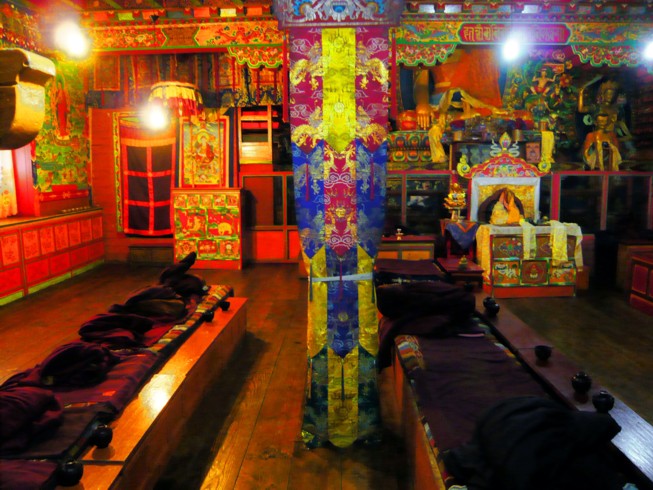
But I didn’t intend to talk about hermits, it just kind of happened. We’ve finally got some decent weather here, and yesterday I was walking through a village in the sunshine and idly thinking there are two situations in which I reckon I could renounce the world. One is in somewhere like Kathmandu in the Buddhist temples there. I’ve always had such a profound feeling of peace and stillness in these places. Buddhism is the only set of beliefs I’ve ever really been attracted to, although more as a philosophy of life than as a religion. I can’t do religion. The world is beautiful and amazing enough without throwing imaginary beings into the mix. But Buddhism is more about being a better person and looking after the world and everyone and everything in it. I could melt into that environment without too much difficulty. At least for a while.
The other situation, especially on an English summer’s afternoon in the countryside, is to retreat to somewhere remote and live a simple life away from the world as much as is practical. I’ve probably told you that before. That’s where the hermit thoughts came in.
But sadly, as already mentioned, hermits aren’t a thing anymore. Not in this country, at least. There are openings available in various other countries, but I don’t think I’m ready to explore those options. Perhaps I’ll just go for another walk.
Often, it still feels like summer at this time of year, but I feel autumn has truly arrived now. This morning I walked a path I haven’t walked for a week or more to find the sun was that much lower than it had been and I was constantly having to shade my eyes. It’s all about colours, now. Colours and the cooling of the world. Russet. Browns. Fading drab greens. Yellows and orange. Autumn can be beautiful, although it can also be dull and dreary and occasionally fierce. But mornings often arrive with an added sparkle, with heavy dews on cobwebs and leaves glinting in the low sun, hedgerows of thistledown, rosehips, and hawthorn. There is usually a freshness in the air, especially in the mornings, which has been absent for most of the summer, that invariably lifts my spirits.
I like summer, of course I do, but the arrival of autumn reminds me in some ways of the arrival of spring. In spring we have the stirring of life after a long period of hibernation, whereas the beginning of autumn always feels to me like the start of a new, second, outburst of life. Many plants have a sudden growth spurt, fruits and nuts and berries swell and glow and are plundered by birds and beasts. It is still warm, warm enough to bask in the sun and to feel hot walking up even quite gentle hills.
The Equinox occurs on Friday (at 2.03am in the UK, to be precise) and after this the hours of darkness outnumber the hours of daylight until the end of next March (counting dusk and pre-dawn as night time). After this, the year always feels to me quite different, even if the weather from the one day to the next is much the same. I can already feel myself slipping into a different place; the logs for the burner have arrived and have been stacked ready for use. The apples have been picked, shortly to be wrapped and stored away. Much in the garden is in the process of being cut back for winter. When the days are short and the nights are long, there will be many books to read, lots of music to listen to, a few beers to drink, and many long conversations to be had.
But also many long walks as well, I hope. I love winter too.
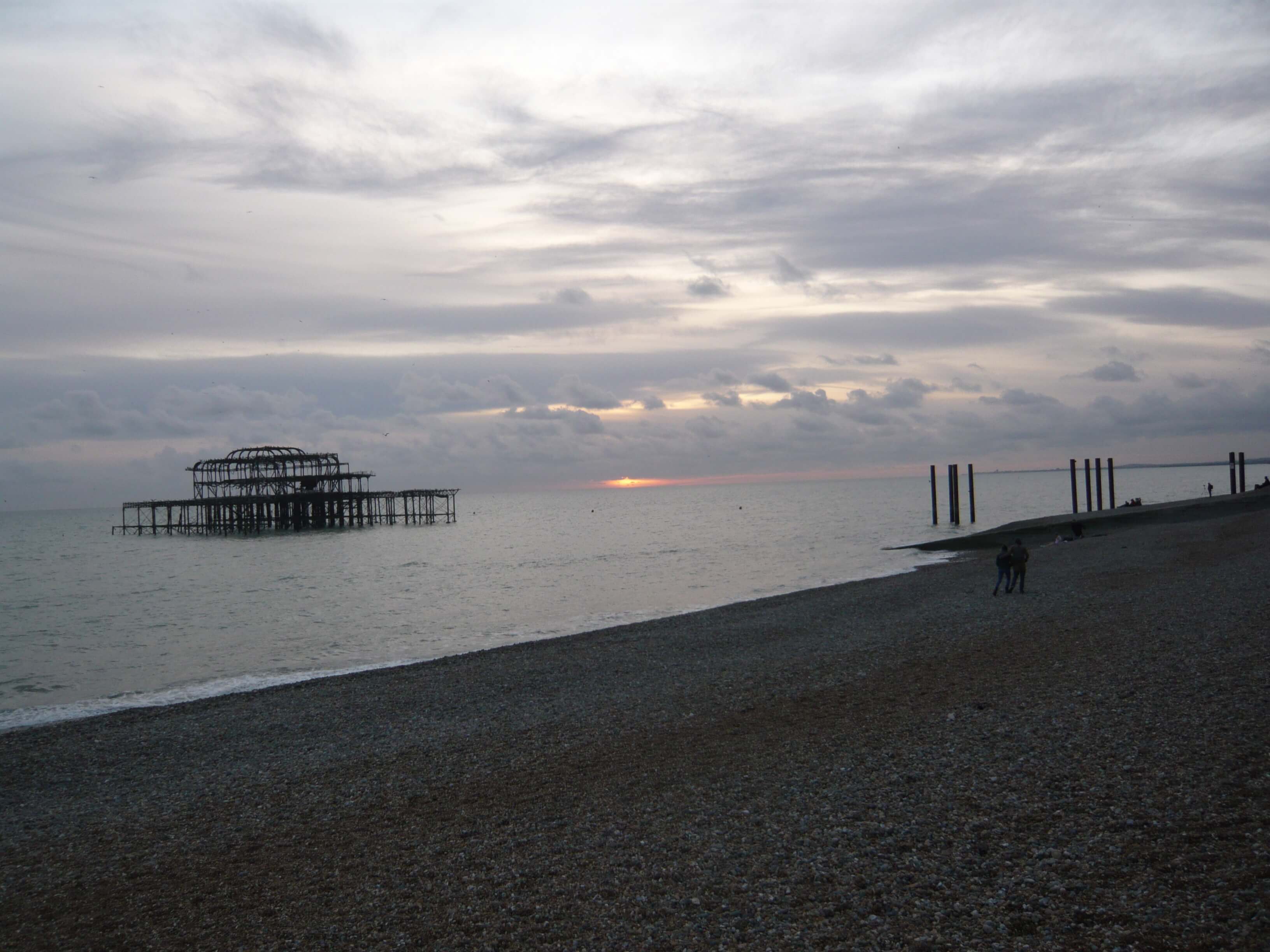
We went down to Brighton for the weekend. Staying two nights there gave us a chance to watch the starling murmurations that regularly put on amazing displays around the old pier. It also gave us the chance to get up onto the South Downs for a good walk.
On the first evening we walked down to the seafront to await the starlings. It was a lovely sky, but with an extremely keen wind blowing in off the sea. After about half an hour our wait was rewarded with a brief but great display as the starlings whirled and dipped and soared in formation around the Old Pier. But guess who’s camera decided to stop working because of the cold? So, no murmuration photos, I’m afraid.
Next morning we caught the bus up to Ditchling Beacon. We were to walk from there to Devil’s Dyke, then catch another bus back down to Brighton. It was very cold and windy in Brighton, and all the way up gusts of wind buffeted the bus. Not a good omen. Anyway, the bus arrived at the top of the Downs and stopped. We got off the bus.
My God, it was bloody cold!
It was extremely tempting to turn around and get straight back on the bus again, but we (just) resisted it.
‘No, really, it’s lovely. Quite refreshing. Why do you ask?’
When we last passed this dew pond four or five years ago, the weather was deteriorating and a few wavelets wrinkled the surface, while the sky was largely blue but with a few clouds rolling in. Today the sky was greyer and waves were careering wildly across the water. Does it look cold? It was bloody cold! I may have mentioned that already.
After an hour or so, we dropped down to the village of Pyecombe and had a quick look around the lovely old church. Then the long, slow walk back up onto the Downs on the other side of the valley. At this point on our previous walk the rain had been pouring down and the clouds getting lower and lower. This time, despite the cold (I have mentioned that, haven’t I?) it was clear and sunny. And by this time, thankfully, we had warmed up somewhat.
Our route took us down a lovely sheltered holloway to another valley, where we began the final walk up to Devil’s Dyke.
By now it was sunny and despite the wind it was lovely. We felt we could have stood there and just looked at it all day. However, we had a pub with hot soup and cold beer to get to before our bus trip back down to Brighton, so we hurried on.
My coach got into Inverness at 8.10pm after almost twelve hours on the road, and I was more than ready to begin walking. With over two hours of daylight left, I aimed to get well clear of the city and find a good spot to camp for the night. I grabbed a bag of chips from a chippy, then followed the Caledonian Canal southwest for about four miles, left it and climbed a little more to the west to find somewhere to sleep. I filled my water bottle from a stream, then wandered into a little wood and got out my bivvi tent and settled down for the night, black clouds heading slowly towards me as I did so.
Altourie – rain clouds coming in from the west. Torr Mor in Foreground
19th June 1994
This morning is dry and bright, but quite windy. I boiled some water for coffee and set off as soon as I could, intending to make the most of the good weather. Today I intend to cover quite a few miles on side roads which I hope will be carrying very little traffic and so get a substantial fraction of the journey under my belt before the weather gets any worse. This is Scotland, after all. I‘m expecting rain. It should also break me in gently, being easier ground than much I expect to have to walk. So, I’m aiming for Urquhart Castle, which overlooks Loch Ness and will be a slight diversion from my route but I just fancy having a look at it, and from there I can leave the road and follow the river southwest through Glen Coiltie before turning further towards the west.
As soon as I set off, I was walking straight into the teeth of a strong wind. Long distance footpaths are usually walked from west to east, at least in Britain, and there is a strong argument for that; we get the majority of our weather from the west, so by doing that we have the wind (and whatever it brings with it) at our backs. I’m walking it in the opposite direction not just because I am naturally perverse – or not only for that reason, anyway – but because the more interesting and exciting scenery will be on the west side of the country, and hence my destination. Walking from west to east I feel I would arrive at my destination with a certain amount of disappointment, with all due respect to Inverness which is a delightful city, but I’m after the spectacular wilderness.
So, into the teeth of a strong wind. It is not long, though, before I am walking through Abriachen Forest and I stop for a rest sheltered from the wind.
Abriachen Forest
I rather think Abriachen Forest has changed a little since I passed through there in 1994. I remember it as a dark wood of densely planted conifers, typical of the conifer woodlands planted in the middle to late twentieth century with the intention of producing the maximum possible yield of wood. The trees allow so little light through that other than the trees themselves – Douglas Fir and Sitka Spruce, typically – these plantations (forest is the wrong word) house very little life. But in 1998 the community of Abriachen (a small village) purchased 540 hectares of the woodland and since then have been improving it – thinning the trees, reintroducing native species and creating footpaths and trails.
But on the edge of the forest, and beside the road, there are a multitude of flowers: vetches, Ladies smock, and violets, particularly catch my eye. I draw away from the forest and I am back amongst a more natural landscape, with banks of pepperminty smelling gorse, occasional rowan trees in blossom and heather beginning to flower.
In places, the ground is bright with cotton grass
Now, for the first time, as I leave the road and walk uphill along a track towards the farm of Achpopuli, I get my first good view of large snow-covered mountains to he west. Once past the farm, I am on a supposed footpath heading up towards a saddle between two hill crests but the ground is extremely boggy and proves to be a taste of much of the rest of the route. My feet sink about six inches into either water or soft moss and heather, slowing my progress significantly. But then I m over, and down to a small loch where I stop to refill my water bottle and have a wash. I am surprised by how warm the water is, and I brave a quick dip as well as a shave.
Loch Glanaidh
On, then, to Urquhart Castle and then a little further out of my way to visit Divach falls, a waterfall with a drop of about a hundred feet. And near the bottom, primroses were still out.
Urquhart Castle and Loch Ness
Following a track up Glen Coiltie looking for a suitable spot to make my camp and cook supper I am walking through old forest, such a contrast to the plantation I walked through earlier. The trees are so covered in mosses and lichen it seems at times almost a wonder they are still alive. The path winds up and down and left and right and feels at times like a high mountain trail. Far below I hear the roar of the river, and for almost the first time that day feel I am absolutely in my element.
Eventually I make camp in a small hollow just below Carn a Bhainne. There is a low ridge towards the west which should shelter me from the worst of the wind. After I have eaten, I sit with a mug of tea looking across the river towards a snow pocket that is probably a couple of hundred meters higher than where I am.
Winter would have brought a period of enforced leisure for our ancestors. Their days would have become shorter with the increasing hours of darkness, until in midwinter the daylight hours would make up only one third of the time.
All outdoor activities would effectively cease in the darkness, and even during the day the worsening weather would limit what could be achieved outdoors. But other than those tasks that could be carried out, what did they do in these times? how did they pass those long hours?
At times, no doubt, there would have been feasting and merry-making because they would have required some cheer and a sense of well-being to help them get through the winter. But they must also have been mindful of husbanding scarce food resources through those long barren months.
it may be that they played games. Although archaeology hasn’t furnished us with evidence of board games or dice or variations on these, it is still possible they would scratch, perhaps, some form of grid into the beaten soil of the floor and play games of skill or chance. It is not beyond possibility that some flat rocks with strange scorings and lines on them were used for that purpose.
With no TVs or books or computers, it might seem to us that time would have weighed heavily on their hands. But you are used to what you are used to, and they would have seen things differently. They may have looked forward to a period of relative inactivity; long hours of no talk, sitting or lying down, the mind slowing down until hours were passed in no thought. Did they then also pass unusually long hours in sleep? A kind of semi-hibernation as a way of conserving energy?
But long hours also, of talking. They must have talked: of daily life and plans and past disasters and glories, of gossip, and told stories both new and handed down from previous generations. These stories would have been incredibly powerful tools for the preservation of the tribe. With no written word, the spoken word becomes the only way knowledge is transmitted. And thus it has to be memorised, both for use and also to transmit in the future. As aids to memorising, powerful tools are repetition, rhyme and rhythm. We cannot know exactly how this was utilised, but it cannot have been long before poetry and song evolved.
It can be no coincidence, but in all the early societies we know of who had no written records, those of which we know about through records left by others – such as the Romans writing of the Britons – it is clear that poetry and song were important, and the bard a highly valued member of that society. Indeed, the writings left by Romans, who tended to denigrate anyone not Roman as barbarian and primitive, violent, and uncultured, still make it clear these ‘barbarian’ tribes valued poetry and song highly. Partly, this must have been for educational purposes, but they seem also to have been valued for themselves, for their beauty. It is taking things too far to suggest this proves the same would have applied in Neolithic times, but it is certainly possible. At some point, there would have been music. I imagine this developed out of ritual, perhaps through repetitive chanting and the beat of drums…
And so, I can imagine this at first being perhaps the preserve of the shaman, until becoming a specialised ‘post’ – that of the bard – and acquiring the value of entertainment, as well as instruction.
Nature dies down in winter. Certainly, at those latitudes where the days become much shorter and the temperatures plummet. Both wind and rain seem to become more frequent. Snow. It is a period of rest and renewal after autumn has put on a final glorious display of colour. Animals adapt to this in one of three ways: some will eat and eat of the autumn bounty of, especially, fruit, putting on large fat reserves and surviving the winter in a state of hibernation, their heart-rates dropping to a scarcely believable one or two beats a minute, their bodies slowly using these fat reserves for the little energy required to maintain a flickering life through those months. Some migrate, seeking a warmer climate until spring returns. These animals are, due to the obvious logistics required to travel hundreds of miles to reach those more hospitable climes, the larger animals and many of the birds. Travel over those kinds of distances would be out of the question for the smaller ones. Others stay put and, in the case of the plant eaters, scratch out a meagre living on whatever leaves and grasses survive through the winter. The carnivores, of course, stay and try to catch them.
Our Neolithic ancestors’ life cycles would be attuned to this pattern too. Autumn must have been lived fast and furiously. In the same way our medieval ancestors worked long hours to bring in the harvests, Neolithic man and woman must have used all the dwindling daylight to bring in as much food and fuel and dry bedding as possible before the winter period. Then by the end of autumn gathering would have largely ceased and they would have moved into a winter rhythm of life.
But how did they get through winter? What of the food they had gathered? Presumably, they had no way of storing fruit – could any of it be dried? Was it fermented for drink? Or was it all eaten as soon as it was gathered, as though they were all so many dormice seeking to build up their reserves? And could this, in fact, have been a part of their strategy to get through those months? To eat and eat until the perishable foods were all gone, and then to stop all but the most essential activities. To expend as little energy as possible and stay as warm as they could. Spending as much time as possible asleep.
And yet, they would still need to eat, and so with dwindling food reserves they would slaughter any beasts kept for that purpose, possibly smoking the meat to enable it to keep for as long as possible. Hunting would continue and might, in some ways, become a little easier. With less vegetation around, there would be less cover for their prey, and in snow there would be clear tracks to follow. But presumably this prey would still need to be pursued, and this would use precious energy, unless they relied more upon pits and snares.
The long-range weather forecast is predicting generally mild, wet weather in the run-up to Christmas. So still no sign of ‘winter’ yet.
Although there is a lot to be said for mild weather, we need the cold of winter to help to break up the soil for the following year and kill off many pests. But our climate is changing.
There are some swallows still around, apparently. Presumably because there are still plenty of insects for them to eat. They should have left ages ago. What does this mean for them in the coming months? If the weather remains mild and the insects persist, will they be able to survive the winter here? And will they still be able to successfully migrate if the expected colder weather kills off these insects, or will they have left it too late? I suspect it will not end well for them.
There have always been a few of these days at the turn of the seasons, although probably nowhere near as many as now, and I wonder how our ancestors would deal with these days; the days I am sometimes tempted to call the Nothing Days. Those days which are grey and cold, but not severely so. The leaves are continuing to fall but seem in no hurry to complete the job. Nothing seems to be contributing to the change of the seasons. If any plants or animals are responding to anything, it can only be to the shortening of the daylight hours. There are still plenty of nuts and berries for the wildlife to forage – the birds are largely ignoring our bird feeders at the moment – although little for the human forager; the blackberries have finished, the chestnuts and hazelnuts all gone.
I suspect our ancestors would have moved into their own winter routines anyway, and got on with the jobs in hand, largely mending and making. With the onset of rains and wind and snow, rooves and walls would be repaired and strengthened, leaks caulked, trenches dug out to drain water away from dwellings. Tools and weapons would be fashioned and repaired. Measures taken for comfort and warmth – perhaps grasses and rushes and bracken collected and heaped up inside, likewise firewood, and fodder for animals.
Although I’m only guessing, but a fire in the middle of a hut filled with heaps of dried grasses might have required a Neolithic risk assessment following a visit by a fire and safety officer.










 Mick Canning