Winter – 3

Winter would have brought a period of enforced leisure for our ancestors. Their days would have become shorter with the increasing hours of darkness, until in midwinter the daylight hours would make up only one third of the time.

All outdoor activities would effectively cease in the darkness, and even during the day the worsening weather would limit what could be achieved outdoors. But other than those tasks that could be carried out, what did they do in these times? how did they pass those long hours?

At times, no doubt, there would have been feasting and merry-making because they would have required some cheer and a sense of well-being to help them get through the winter. But they must also have been mindful of husbanding scarce food resources through those long barren months.

it may be that they played games. Although archaeology hasn’t furnished us with evidence of board games or dice or variations on these, it is still possible they would scratch, perhaps, some form of grid into the beaten soil of the floor and play games of skill or chance. It is not beyond possibility that some flat rocks with strange scorings and lines on them were used for that purpose.

With no TVs or books or computers, it might seem to us that time would have weighed heavily on their hands. But you are used to what you are used to, and they would have seen things differently. They may have looked forward to a period of relative inactivity; long hours of no talk, sitting or lying down, the mind slowing down until hours were passed in no thought. Did they then also pass unusually long hours in sleep? A kind of semi-hibernation as a way of conserving energy?

But long hours also, of talking. They must have talked: of daily life and plans and past disasters and glories, of gossip, and told stories both new and handed down from previous generations. These stories would have been incredibly powerful tools for the preservation of the tribe. With no written word, the spoken word becomes the only way knowledge is transmitted. And thus it has to be memorised, both for use and also to transmit in the future. As aids to memorising, powerful tools are repetition, rhyme and rhythm. We cannot know exactly how this was utilised, but it cannot have been long before poetry and song evolved.

It can be no coincidence, but in all the early societies we know of who had no written records, those of which we know about through records left by others – such as the Romans writing of the Britons – it is clear that poetry and song were important, and the bard a highly valued member of that society. Indeed, the writings left by Romans, who tended to denigrate anyone not Roman as barbarian and primitive, violent, and uncultured, still make it clear these ‘barbarian’ tribes valued poetry and song highly. Partly, this must have been for educational purposes, but they seem also to have been valued for themselves, for their beauty. It is taking things too far to suggest this proves the same would have applied in Neolithic times, but it is certainly possible. At some point, there would have been music. I imagine this developed out of ritual, perhaps through repetitive chanting and the beat of drums…

And so, I can imagine this at first being perhaps the preserve of the shaman, until becoming a specialised ‘post’ – that of the bard – and acquiring the value of entertainment, as well as instruction.

Winter – 2

Nature dies down in winter. Certainly, at those latitudes where the days become much shorter and the temperatures plummet. Both wind and rain seem to become more frequent. Snow. It is a period of rest and renewal after autumn has put on a final glorious display of colour. Animals adapt to this in one of three ways: some will eat and eat of the autumn bounty of, especially, fruit, putting on large fat reserves and surviving the winter in a state of hibernation, their heart-rates dropping to a scarcely believable one or two beats a minute, their bodies slowly using these fat reserves for the little energy required to maintain a flickering life through those months. Some migrate, seeking a warmer climate until spring returns. These animals are, due to the obvious logistics required to travel hundreds of miles to reach those more hospitable climes, the larger animals and many of the birds. Travel over those kinds of distances would be out of the question for the smaller ones. Others stay put and, in the case of the plant eaters, scratch out a meagre living on whatever leaves and grasses survive through the winter. The carnivores, of course, stay and try to catch them.

Our Neolithic ancestors’ life cycles would be attuned to this pattern too. Autumn must have been lived fast and furiously. In the same way our medieval ancestors worked long hours to bring in the harvests, Neolithic man and woman must have used all the dwindling daylight to bring in as much food and fuel and dry bedding as possible before the winter period. Then by the end of autumn gathering would have largely ceased and they would have moved into a winter rhythm of life.

But how did they get through winter? What of the food they had gathered? Presumably, they had no way of storing fruit – could any of it be dried? Was it fermented for drink? Or was it all eaten as soon as it was gathered, as though they were all so many dormice seeking to build up their reserves? And could this, in fact, have been a part of their strategy to get through those months? To eat and eat until the perishable foods were all gone, and then to stop all but the most essential activities. To expend as little energy as possible and stay as warm as they could. Spending as much time as possible asleep.

And yet, they would still need to eat, and so with dwindling food reserves they would slaughter any beasts kept for that purpose, possibly smoking the meat to enable it to keep for as long as possible. Hunting would continue and might, in some ways, become a little easier. With less vegetation around, there would be less cover for their prey, and in snow there would be clear tracks to follow. But presumably this prey would still need to be pursued, and this would use precious energy, unless they relied more upon pits and snares.

Winter – 1

The long-range weather forecast is predicting generally mild, wet weather in the run-up to Christmas. So still no sign of ‘winter’ yet.

Although there is a lot to be said for mild weather, we need the cold of winter to help to break up the soil for the following year and kill off many pests. But our climate is changing.

There are some swallows still around, apparently. Presumably because there are still plenty of insects for them to eat. They should have left ages ago. What does this mean for them in the coming months? If the weather remains mild and the insects persist, will they be able to survive the winter here? And will they still be able to successfully migrate if the expected colder weather kills off these insects, or will they have left it too late? I suspect it will not end well for them.

There have always been a few of these days at the turn of the seasons, although probably nowhere near as many as now, and I wonder how our ancestors would deal with these days; the days I am sometimes tempted to call the Nothing Days. Those days which are grey and cold, but not severely so. The leaves are continuing to fall but seem in no hurry to complete the job. Nothing seems to be contributing to the change of the seasons. If any plants or animals are responding to anything, it can only be to the shortening of the daylight hours. There are still plenty of nuts and berries for the wildlife to forage – the birds are largely ignoring our bird feeders at the moment – although little for the human forager; the blackberries have finished, the chestnuts and hazelnuts all gone.

I suspect our ancestors would have moved into their own winter routines anyway, and got on with the jobs in hand, largely mending and making. With the onset of rains and wind and snow, rooves and walls would be repaired and strengthened, leaks caulked, trenches dug out to drain water away from dwellings. Tools and weapons would be fashioned and repaired. Measures taken for comfort and warmth – perhaps grasses and rushes and bracken collected and heaped up inside, likewise firewood, and fodder for animals.

Although I’m only guessing, but a fire in the middle of a hut filled with heaps of dried grasses might have required a Neolithic risk assessment following a visit by a fire and safety officer.

R. I. P. Winter

It’s beginning to feel both as though autumn has been with us forever, and that it is especially reluctant to leave us, this year.

This year has been a mast year; the trees and bushes have been laden with prodigious quantities of nuts and berries. The hawthorns, especially, seem to be weighed down with berries, and we have gathered large quantities of nuts from the hazel in our garden. There are so many acorns beneath the oaks nearby that there is a thick, continuous, crunchy, carpet of them underfoot. Traditionally, this has been said to indicate a harsh winter ahead, although how the trees and bushes are meant to work this out when we have no idea what the weather will be then, heaven only knows.

What it really indicates, of course, is that the climatic conditions have been such throughout the year that these trees and bushes have successfully produced their large crops. Nothing to do with what will come along later.

On the other hand, the leaves have held onto their greens for longer than usual and only turned late, and still seem most reluctant to fall. It has taken the determined efforts of a few strong winds just to remove about half of them. Certainly, around my part of Britain, anyway.

It is not cold. There are no signs of a proper winter chill approaching, with the long-range weather forecast contenting itself with predictions of the occasional cold spell in the next month, which takes us through to mid-December. In the garden the grass and many of our other plants are still engaged in that crazy autumn growth spurt.

Of course, it was never unusual for November to be wet and mild, and we may yet have a biting cold winter, although I wouldn’t bet on it. It is a long, long time since we have had a winter like that in these parts. In my lifetime, only the winters of 1963 and 1978/79 really stand out as being extremely harsh, although a few others have had shorter periods of cold and snow. The expectation for winter around here now is that it will just be chilly and wet. I think only once in the last six or seven years have we had more than just the odd flurry of snow; that was from the so-called ‘Beast from the East’ a couple of years ago, and even that only lasted a few days.

We seem to have lost winter somewhere along the way, which sounds very careless of us.

In fact, that is quite a good way of describing it.

You don’t need me to tell you we have been careless in the way we have interacted with nature, the result being our world is heating up dangerously. And in our part of the world, this has led to hotter, drier, summers and milder, wetter, winters. There has been a notable increase in destructive flooding events. Downpours are frequently very heavy and long-lasting. Rather than being spread out through the month, we may get an entire month’s worth of rain in less than a day. Summers, conversely, have become very dry.

This is absolutely nothing to the extreme climate conditions suffered by millions of others in other parts of the world, but it helps to bring it home to us that the Climate Emergency is real, and it is happening. With everything else happening in the world at the moment, this seems to have been conveniently ignored by the mainstream media for the last six months.

R. I. P. Winter.

Green Christmas

Yesterday was beautiful.

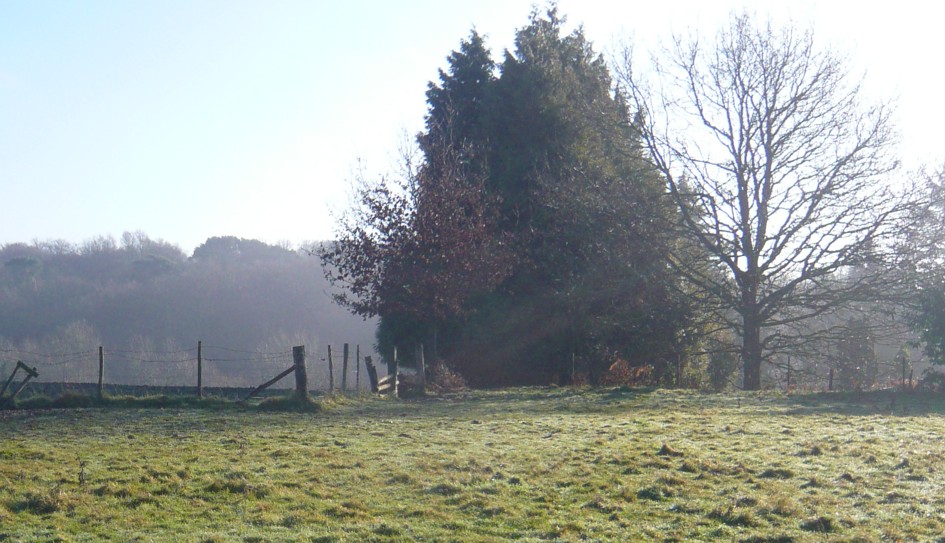
I went out for a walk in the morning as the overnight mist was lifting, and the air was cool but not cold, under a sunny, clear sky filled with birdsong. I felt a powerful sense of renewal in the world.

001a

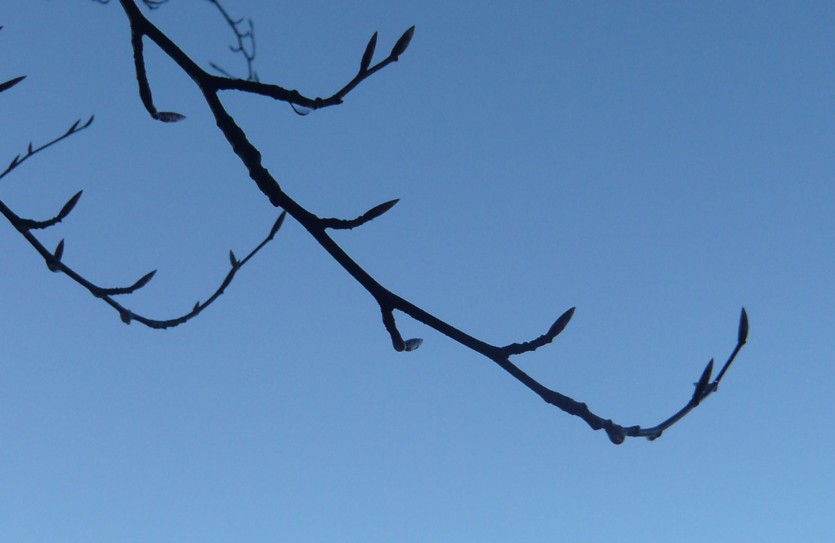
There is little new growth yet, but the trees were covered in buds. Although we are not long past the shortest day of the year, the ridiculously mild temperature and the sun which felt warm on my face, reminded me that there is one more minute of daylight today than there was yesterday, and tomorrow there will be one more than that. And it will not be long before each day gains an extra two minutes, then three, then four…

009a

The air smelt clearer and cleaner than it had for months, and I felt like beginning a long journey. I yearned to be walking on the Downs, or heading through fields and woods with my destination nothing more elaborate than a bed in a basic bunkhouse or hostel, and somewhere to get a meal, preferably in a tiny village surrounded by hills and streams and woods. This is a feeling I get every Spring, that it is a time to explore more of the world.

Everything seems to be fresh. I need to do something new, something positive. To plant some trees, perhaps (always a good idea).

007a

I thought of Christmas. This year, we had a string of lights in one room, with handfuls of greenery as the only other decorations. This, for me, is a way to make sense of the season. It has nothing to do with religion, unless it be the ancient religions that worshipped the sun and the moon and celebrated the turn of the year at the Winter Solstice when the seasons begin their long, slow journey back towards the promise of Spring and the harvests of Autumn. A simple wisdom, in tune with the natural world.

I do not, I cannot – I will not – associate it with any other form of mythical gods. For me, it is all about the natural cycle of the seasons, simple and uncomplicated.

And I particularly like the period when Christmas is definitely over, and we’re only just getting into the new year. Everything seems to have this feeling of renewal, which was the whole point of the Yule festival. A time to look forward and plan for the coming year. This will be where the tradition of New Year Resolutions comes from, no doubt.

This year, I shall resolve to try and simplify my life further, and to live more in tune with the natural world.

Myth, Science and Religion

Religion begins as science, as an attempt to make sense of the world. The birth of religion marked the dawn of humans as rational, analytical beings. This was humans moving beyond the worries of simply surviving from day to day, and reaching that point in evolution where they looked with wonder upon the world around them and asked: How did this come into existence? What is it that controls the weather and other variables? By observing the natural world around them, the cycles of day and night, the seasons, the migrations of the animals, they would have concluded that these patterns suggested a grand design and order.

003a

An assumption would probably be made that all this was controlled by benevolent beings, but beings who might need propitiating occasionally to keep them sweet; the odd ritual here, perhaps a sacrifice of some sort there.

And if that was so, perhaps they could be propitiated in a somewhat greater way, to grant other boons?

It would not be long before someone claimed a channel to the gods to relay their desires and instructions, and so the priestly class would be born. Self-interest? Quite likely. After all, we see that in most religions today, so why not?

Religions then, over the years, spawned new religions, the spark being reinterpretation rather than inspiration.

We think we see echoes of old religions in myths. Myths are the fragments of history we know, combined with assumptions about how our ancestors acted and thought, frequently combined with scarce written evidence, which may or may not be biased or wholly inaccurate. When our written sources include stories of monsters and miracles, we should probably be advised to treat them cautiously.

Myth-makers frequently come with an agenda, although depending upon your point of view that is not necessarily a bad thing. If you are looking for a scientific analysis of the lives of our ancestors, it’s probably best to give myth a wide berth. Or at least to be very, very, careful what you take from it. But in a way, it does provide an alternative world view that many find preferable to both the stark realities of day to day life, as well as the cold dead hand of religion. After all, if you’re using your imagination, it’s easy to plan your myth-world much the way you’d like it.

And perhaps myth does offer us a way of getting inside the heads of those people, at least superficially.

One assumption we can make is that there would be similarities in the thought processes of those people, with the thought processes of us today. It is perfectly reasonable to assume they would react in similar ways to us, to pain and fear, to pleasure, warmth and cold. Our reaction to the unknown tends to be to populate it with characters or situations based on our experiences, and they probably did the same.

Stonehenge is aligned with the solar calendar. This we know. It’s science. And we know a considerable amount about the geography of the area around Stonehenge at the time it was built, through archaeology and science.

What we don’t know is how it was used. Just because it was aligned with the rising sun at summer solstice and the setting sun at winter solstice, does not mean we know what took place at those times. We assume our ancestors worshipped or venerated the sun there, especially at the time of the solstices, but we do not know that. Were there sacrifices? Did they hold special ceremonies connected with fertility or birth or death? Was it perhaps just like a club where they turned up now and again and got drunk and held orgies? It could be, since there is no hard evidence for anything.

Believers in ley lines also claim it is at the centre of an intricate system of lines connecting natural (‘holy’) locations with important (‘holy’) sites such as churches, wells and crossroads. Pseudoscience? Coincidence?

Our assumptions, though, lead us to think that because of the immense effort required to build the structure, it must have been an incredibly important site, and we are surely justified in concluding important ceremonies were enacted there.

Whatever they were.

Do It Tomorrow

IMGP2317

We have all been encouraged to think

That our time is so important.

Yet it is only when we become old,

And we have so much less of it left,

That we realise this is not the case.


We’ve been told we must save time,

Instead of using it and moving on.

How precious time is,

As if it were a commodity we might hoard

And use when we need it most.


Instead of squandering it on what makes us happy,

And filling it with unimportant things.


But I say, let what you’re doing fill your time.

If you’re washing up,

Then let your plates be the cleanest.

And if you’re looking at the winter sun on frosty leaves,

Well, let that be the best experience you have ever had.


Sometimes I have these flashes,

When I think I’ve understood something deep and profound.

And usually it means an evening drinking wine,

Or half an hour sitting on a sunlit hillside.

But I do wonder what we’re all so busy chasing.


And if you think this lesson worth remembering,

There’s no better time than now.


Winter – a Tanka

I was writing a haiku yesterday, and decided to go the extra mile with it. Traditionally in Japan these poems were sometimes written in the form of tanka, which are essentially poems of five lines rather than three, with a syllable count of 5/7/5/7/7.

They could also be written as linked verse, with one or two poets writing haiku, and others supplying the two remaining lines between each haiku.

I’ve gone down the linked verse route, and also given myself the remit that each verse (of two or three lines) must contain a word or sentiment linking it to those either side – something that was also commonly done.

Yesterday was cold and miserable, hence the results.

It’s my first attempt – please don’t be too harsh!

029

The flowers have gone.

Crumbling stems standing askew,

In waterlogged soil.


Outlined against the grey sky,

Old willows by the stream.


Ten thousand leaves are

All that remain of autumn.

Wistful nostalgia.


Memories of warmer days,

Are all but forgotten now.


Wrapped up warm and snug,

Watching the grey willows weep.

Hands in my pockets.


Leaves fall slowly through the air,

Onto silent black waters.


Now a gust of wind

Swirls leaves around and around.

Racing each other.


Shifting clouds race overhead,

Sudden drizzle on the breeze.


Spiteful winter day,

Grasses shiver in the wind.

Low sunlight dazzles.


Walking in meditation,

Clouds unexpectedly clear.


Sudden bright sunshine

Reminds me the cold Winter,

Will change into Spring.

010a

The Beastie From The Eastie

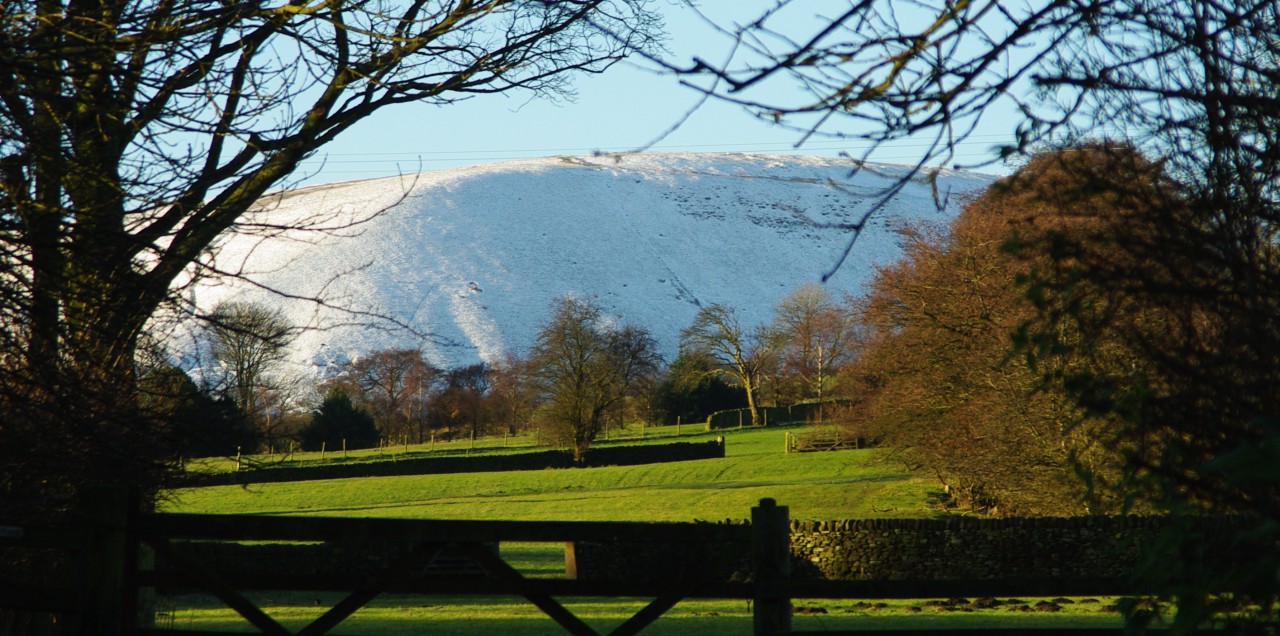
Yes, we’ve had some snow.

And oddly, despite this being the UK, lots of things are still working.

Although, to glance at the newspapers you could be forgiven for thinking the End Of The World was here.

But the sun was out this morning, so I wandered out for a bit of a bimble in the countryside.

view

Fresh snow always feels magical.

I suppose this is because it is a pure white, because it sparkles in the sun and even in the night time it appears to glow.

It covers things up, but sits lightly upon them.

There is a purity to fresh snow that causes the landscape to feel cleaner and purer, too.

While the snow is falling, sound seems to be muffled and absorbed, so that one exists in a silent wonderland.

Shadows

It transforms a dull winter landscape into something bright and very special.

some paths are still clear

Some of the paths are still easy to find,

Some paths are less obvious

While others have become less obvious.

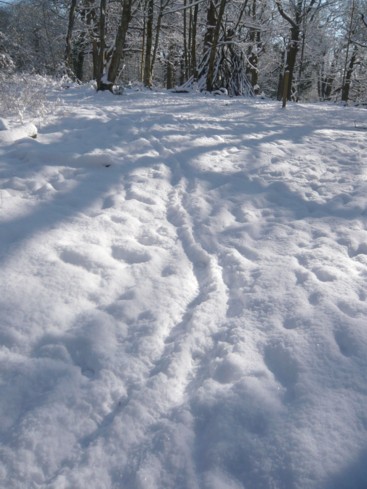
tracks

The animals have their own paths, that we are often unable to tread.

view 2

But there is a silence over everything, and every now and again a breath of wind sends a thousand sparkling snow diamonds drifting down through the branches of the trees.

some things are hidden

The snow hides much…

Footprints

But it reveals where we have been.

Some shapes become more mysterious

And it makes some shapes more mysterious.

New Year’s Essay, 2018

I rarely, if ever, make New Year’s resolutions. I feel that if there is something in my life that needs changing, then it should be addressed straight away, rather than leaving it until an arbitrary date in the future. Of course, for many people it acts as a focus or some other incentive to change old habits, although witness the number of gym memberships that never get used beyond, say, the end of January, and it becomes obvious that what many people need to change most is their resolve.

010a

Possibly jumping the gun a little with this photo…

As an introvert, I am very curious to know whether much of my behaviour is conditioned by my being that, or whether it is my behaviour that causes my introversion in the first place. It’s probably a ‘chicken and egg’ situation, of course, with both applying equally. My introversion is surely driven by those elements of anxiety, my inferiority complex and the depression I’ve always lived with, and, in turn, those things will be reinforced by my chosen introverted lifestyle.

But we are complex creatures. Like Harry Haller in Hermann Hesse’s excellent novel Steppenwolf, each one of us consists of many different personalities. Our characters will be made up of a mixture of the cultivated soul, the wild, untamed soul (the ‘wolf of the steppes’ in Hesse’s book), the dancer, the monk, the shopaholic, the miser…all those elements will be there to a greater or lesser degree. And alongside the Introvert exists also the Extrovert, even if this personality is rather repressed in my case. It is all a matter of balance.

It seems much worse in the winter, too. I am certain I am affected by SAD; it seems entirely logical that I should feel low when the weather is cold and grey and bleak, and perk up when the sun comes out. Perhaps we all do.

Yesterday, the weather was the pits. Cold, grey, and bleak, with added showers of freezing cold rain and a wind that cut through me like a knife. I really felt like crap. But today, I walked out under a clear blue sky, a bright sun glinting off the puddles and the grass rippling in a mild, gentle breeze. These are the moments I need to seize; to wrestle my soul back from the darkness. The moments I need to shake off the black dog and point myself towards the little things I can do to lift myself.

I remind myself that I have a published book that people have been nice about, therefore not all my writing is meaningless drivel. I have sold many paintings, and a lot of people have enthused over them. I can paint, and I don’t need to destroy them all. Family and friends do matter, and they do care about me. There will be warm, sunny days and expeditions.  There will be walks and bottles of wine shared. There will be wonderful books to read and interesting places to visit.

And so, I resolve to fight that bastard black dog for another year.