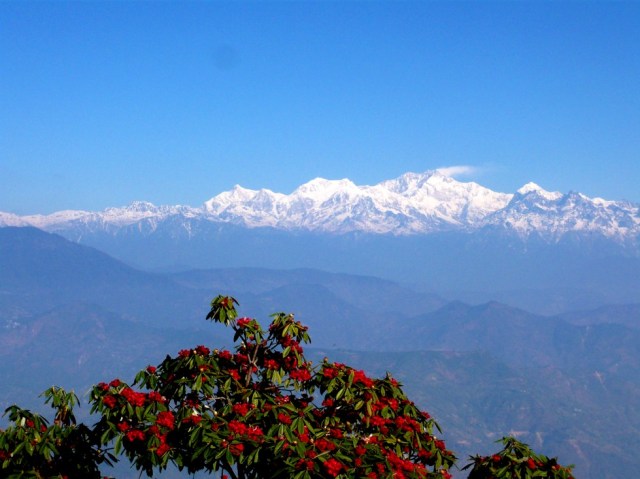
Kanchenjunga, the third highest peak in the Himalaya (and the world) taken from Observatory Hill, Darjeeling. It is the peak right of centre, with the spindrift blowing from the summit.
Have a great Thursday.
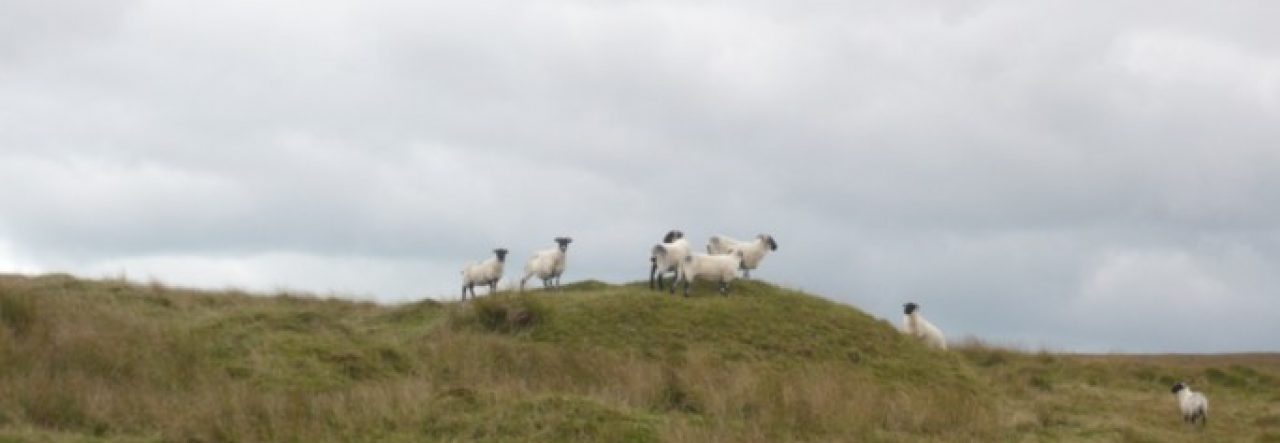
Kanchenjunga, the third highest peak in the Himalaya (and the world) taken from Observatory Hill, Darjeeling. It is the peak right of centre, with the spindrift blowing from the summit.
Have a great Thursday.
I happened on a notebook of poems I’d written some twenty to twenty five years ago.

My style has changed somewhat in the intervening years, and most of them seem rather poor now. One or two of them I still like, though, and I think I’ll put them up here now and again.
This one is just called Rain.
I hurried down the road before the storm
– this must be six or seven years ago –
Still silhouettes for trees within the mist,
Around ahead behind me dull and grey.
The air was chilled
And in the hills the thunder growled,
A tiger prowled,
In the high forests of the Weald.
A hundred miles away my cottage refuge,
A forlorn hope now far beyond the deluge.
Sharp blue electric yellow split the air,
A crack like washing harried by the wind.
Then came swollen lazy drops of water,
Beachballs of rain exploding all around.
Dull chattering
The pattering of rain on tiles
After the miles
I’d run through forests of the Weald.
The sound of distant gunfire possibly,
I closed my eyes to see where I might be.
This is another standalone poem from my linked series, a work in progress, ‘Breeze’.
So much work in progress! One day, I’ll finish one of these projects, but for now I hope you’ll be satisfied with a few extracts. Unfortunately, I just don’t seem to have a great deal of time at the moment…

It is like a small dog,
The wind is.
Nosing into corners, and
Snuffling around piles of leaves.
Making them leap up in surprise,
And slowly come back down again.
All a-flutter.
Suspicious of the wind,
They cannot keep still,
But are continually on the move.
Looking this way and that,
And glancing over their shoulders,
Whispering…
Whispering ‘Did you see that?
‘Did you see it?’
Whispering…
Last night I was lucky enough to attend a great evening of performance poetry at The Java Bean cafe in Tunbridge Wells, for the launch of the new pamphlet by Louisa Campbell, a member of my local writing group.
Supported by published poets Ira Lightman and John McCullough, both of whom gave great performances, Louisa’s was easily the standout set for me.
A natural performer, she read a selection of poems from The Happy Bus, Published by Picaroon Poetry, which is a collection she describes as ‘charting the journey through anxiety and depression and on to peace and joy’.

This is not to suggest that her poetry is all dark, for that is certainly not the case. Each one bristles with hope and determination, and frequently humour – for Louisa does humour very well – and had the audience frequently chortling (we chortle a lot in Tunbridge Wells. We also chunter about stuff, but there was none of that last night).
And, let’s face it, how often do you get to see a poet declaiming a couple of their poems in a wolf onesie?, or getting an audience in Tunbridge Wells to yell out a chorus of ‘Bugger!’?
Below, an extract from the pamphlet:

To get your copy, click on either of the links below.
Two weeks ago I wrote of the idea so many people have that somewhere in the past there was a ‘Golden Age’ when everything was so much better than today.
I am now going to post what might seem a bit of a contradiction to what I wrote then.

More and more, we are losing our connection with the natural world.
Everyone would have a different opinion on what is meant by the phrase ‘quality of life’, but for me if I am surrounded by concrete structures, with a lack of trees and flowers and birds, animals and insects, if the building I am in consists of electronic devices, plastic, steel, and artificial floor coverings, if my engagement with the day to day tasks of this building consists of pressing buttons, then I feel my own quality of life is much diminished.
A common post appearing on Facebook is of a picture of a cabin or cottage in the wilderness somewhere, with the caption ‘Could you live here for a month without TV or phone signal or internet for $25,000?’
Could I do it? I’d bite your hand off for the chance to do it. And I wouldn’t even need the money as an incentive.
No press-the-button entertainment. Setting and lighting a log fire instead of switching on the heating. No dishwasher. No constant barrage of emails, texts and phone calls. No street lights – or streets.
I’d bite yer hand off.
Whether I am at home, working, or walking in the country, always there seems to be the sound of aircraft passing overhead. Day and night. Constantly.
And unless you’re in the middle of a national park, there always seems to be traffic noise. Even when I’m walking in the midst of woodland, or through fields, it’s always present as a background noise.
And anywhere near a road or street, it is just constant. And I find that extremely stressful.
This is one reason why I love being amongst mountains. Usually, they are remote enough that the traffic noise is finally silenced. Frequently, they are away from air routes. And, of course, there are far fewer people around. And those that are there don’t usually seem to be glued to mobile phones or playing music.
And I’m nostalgic. Well, I’m in my sixties now, I’m allowed to be. And that brings us back to the post about a supposed golden age. Nostalgia is a yearning for the past, with the inference that it was better than the present day. There are, of course, many things about today that are much less than perfect – I’ve called out a few of the things I don’t like earlier in this post – but only a fool would deny that huge medical advances have improved all our lives for the better, social security has largely alleviated the horrors of abject poverty and, at least in the affluent west, our lives are not subject to the whims of despots.
But although I can expect to live to a greater age than my forebears – at least in theory – I would be willing to trade some of that for a time when life was less complicated, a life where I didn’t feel constantly bombarded by social media and advertising. A life that was lived more slowly.
Not a Golden Age, certainly, but one I would happily live in.

Cindy says
Cindy says she’s staying in tonight,
The lipstick lies unopened on the side.
Her dancing dress is hanging in the dark,
And Cindy sits still staring into space.
Cindy says she’s staying in tonight,
Mere men are not enough to tempt her out.
And alcohol alone begins to pall,
So Cindy sets the table just for one.
Cindy says she’s staying in tonight,
Of patronising princes, she’ll have none.
And dirty dancing makes her far too nervous,
Since Cindy’s slippers slip around like glass.
Cindy says she’s staying in tonight,
Shoos Roland Rat’s green taxi from her door.
Her Godmother’s grand schemes come to naught,
As Cindy slings her sling-backs on the floor.
Cindy says she’s staying in tonight,
In crumpled clothes and uncombed, unwashed hair.
Dumb DVDs her only entertainment,
And Cindy sheds a tear alone tonight.
Cindy says she’s staying in tonight,
Her fickle fling now fancies young Snow White.
Walked out on her a week ago last Wednesday.
Sad Cindy sleeps alone again tonight.
Finally, I have got around to updating the ‘My Writing‘ page of this site (link at the top of the page). It was about time!

The first time she ever set eyes on the sea,
She was forty seven.
It was a long road there.
She set off with little enough,
And arrived with much less.
She had a home, once.
A house,
In a well-to-do area of the city.
Life was good.
But fear came,
In the form of bullets, shells and bombs.
Once, gas.
Her house is rubble, now.
Memories and possessions buried,
Alongside her husband.
Alongside her daughter.
Alongside her middle son.
Her hands are scarred from the digging.
For weeks,
Her palms were raw and bloody,
from blocks of masonry,
Too large to move.
Dust and tears.
The pain came later.
It was bad enough to lose her home,
But when you’re caught in the cross-fire,
And the food runs out,
What else can you do?
Her eldest son paid for the crossing,
With borrowed money.
Somewhere,
He is ‘paying off’ the loan.
A bonded labourer.
A slave.
Her youngest son was washed away.
The dinghy was too small,
The passengers too many.
Fear.
You could smell it,
Alongside the despair.
The panic.
There were fewer of them when the sun rose.
There is shelter here,
Of a sort.
But when the wind blows she shivers,
Drawing near the oil drum blaze.
There is food,
Once a day.
Of a sort.
There was a welcome.
She soon learns what sort.
Now, she walks down to the sea.
She wonders whether she should,
Whether she should just,
Just, slip under,
The waves.
It seems that huge numbers of people have an impression that there was a ‘Golden Age’ at some previous point of their, or some other, society.
They may not define it in those words, or even acknowledge it as such, but it seems to be very common for people to yearn for another time. Sometimes, this is nostalgia – for the days of their youth – but frequently it is for some far-off time that they feel to be somehow better than the time they live in.
Fantasy books frequently encourage this sort of thinking. Regardless of the actual storyline, the heroes and villains and cast of other odd characters tend to run around and fight and go on quests and sit around in quaint thatched inns quaffing head-splitting alcoholic drinks and everyone is jolly and no one ever dies of dysentery or bubonic plague in misery and agony and squalor.
The Lord of the Rings is a fine example of this. It is a favourite of mine, but it is very noticeable how no one dies of disease, but mostly lives to an exceedingly old age unless chopped into pieces by Orcs.
Hollywood, too, plays its part in this. To take a film at (almost) random, an old version of ‘Robin Hood’ (set in medieval England, remember) depicts a group of merry men dressed in very strange attire living in the depths of a forest and merrily ambushing the Bad King’s men, merrily dining at long tables out beneath the spreading branches of merry oak trees under starry skies and everyone looks clean and clean shaven and everyone is merry, and it never rains.
Pah!
This is meant to be medieval England. Life expectancy at the time was around 30 years. Huge numbers of people died of dysentery, mainly because there was no concept of hygiene. Occasional plagues carried off massive numbers of people, emptying entire towns and villages. There were no antibiotics or anaesthetics. Disease was sent by God and the only way to cure it was considered to be prayer. Or witchcraft. Women routinely died in childbirth, in great pain. The majority of children never reached their teens. Every peasant in every village was effectively a slave under the command of the local lord, who held the power of life and death over them, and might exercise this on a whim at any moment. The threat of famine was ever present.
Pain and misery was a given.
The majority of people lived, too, in a very real terror of the Devil and the threat of eternal damnation.
The list of horrors is almost endless. The phrase ‘life was nasty, brutish and short’ is an apt description of those times. Certainly, I would not wish to live under those conditions.
There are plenty of other ‘Golden Ages’, of course. Almost any time in history can exercise a fascination on us, if certain aspects of it appeal to us and there are things we dislike about the society we live in. And it is natural to yearn for something better; something more than we have.
And this is not to suggest that every age was a living hell for everyone in that society, but that life in most of these times was reasonably decent for the very few on top of the pile, and pretty miserable for the rest. In fact, the measure of how ‘Golden’ an age was, tends to be the conditions of the upper echelons of that society, and perhaps those of a middle class, if such existed.
There is much wrong with our world today. But the huge advances seen over the last hundred years or so, especially in medicine, have meant that our lives have been improved out of all recognition. No longer does surgery equate to filling the patient with a quart of whisky and then sawing off a leg or an arm. No longer do those patients routinely die of infections after surgery, thanks to antibiotics. High blood pressure is controlled, rather than routinely killing. Children usually survive all the diseases of childhood, rather than being most likely to die. Women rarely die in childbirth, and the pain can be somewhat controlled.
Women and children are no longer the legal chattels of men.
Work conditions are hugely improved. Children do not go down mines or work at dangerous looms 14 hours a day. Instead, most receive a proper education. Adults, too, work fewer hours and under far better conditions than previously. When they are too old or frail to work, the state provides a certain amount of dignified support. People do not as a rule die these days of starvation. We do not execute children for stealing sixpence, or poaching rabbits on the Lord’s estate.
In most cases, for most people, today is the Golden Age.
Ouch! Probably my worst title yet!
I can’t help it…I’ve not been well…
…well, only a cold, but you know what we men are like.
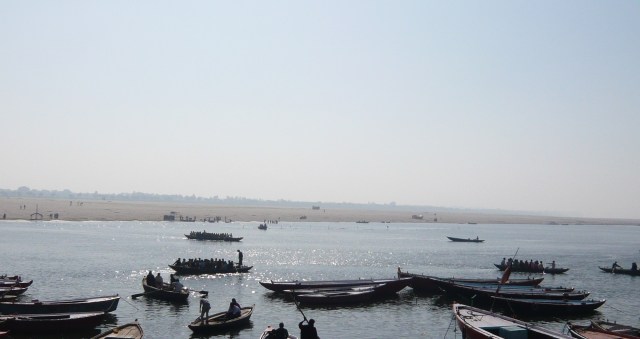
In another attempt to feel instantly better, I’ve nipped across to North India (only in my imagination, unfortunately), to picture Kedar Ghat, on the banks of the Ganges, in Varanasi.

Ghats, a Hindi word, are sets of steps leading down to a river (and also mountain ranges or passes – The eastern and Western Ghats in Central India). It has also come to mean a level place at the edge of a river where Hindus cremate their dead.
In Varanasi, there are between 84 and 87 ghats, depending upon who you get this information from,. The Manikarnika Ghat, or Ghats (possibly this is the origin of the confusion over the number) is the ‘burning ghat’, where cremations are carried out 24 hours a day, all through the year. The source fire there has supposedly been burning for thousands of years, but photography is actively discouraged, hence my only shot is one taken from a distance.

Of course, the ghats are also used for bathing. Hindus bathe en masse there, as a dip in the Ganges is meant to wash away sins. Important pujas (ceremonies) take place at sunrise and sunset. Boat trips to view the ghats are very popular, and finally much of the city’s laundry gets done at the dhobi ghats (dhobi meaning laundry).
Namaste!
It’s been a busy week again. I don’t seem to have managed to write anything, take any photographs, or even think about drawing or painting.
The news? I try to avoid it.
And to top it all, I have a cold and I feel bleurgh.
It’s at times like this I usually travel somewhere exotic in my head.
So, a few more photographs from Southern India, then.

Ganesh Temple, Kodaikanal. Ganesh, the elephant-headed god of prosperity, is one of the most popular gods in the Hindu pantheon and worshipped widely throughout India. This shrine is by the lake in Kodaikanal, a hill-station in the Palani Hills northwest of Madurai.
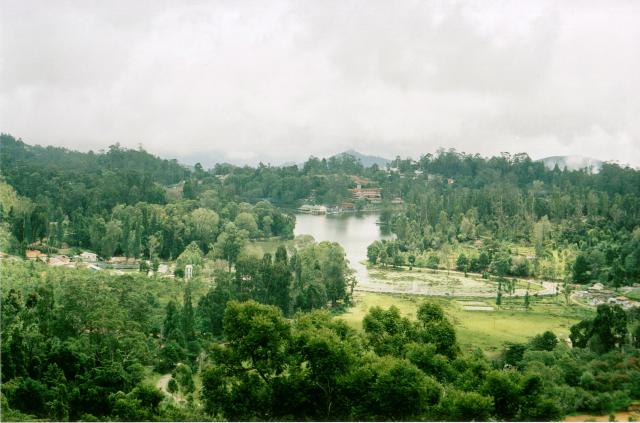
View of the lake at Kodaikanal. Besides the better known hill stations of Northern India, there are quite a number further south, of which Kodaikanal is just one example, although unique in having been originally started by American missionaries in the 1840’s.

Raj-era bungalows in Kodaikanal. These are on a ‘prime-site’ location overlooking the lake.

Madurai skyline. The Sri Meenakshi Temple complex, dedicated to Shiva and his wife, Sati, dominates the skyline of the old city. Often called ‘The Heart of Tamil Country’, Madurai attracts up to 10,000 pildrims and tourists on any one day. This picture was taken from the Rooftop Restaurant Terrace at the Hotel Supreme, where we sat with a beer and watched a long procession of tourists wander across the roof to take the same shot.

Entrance to the Sri Meenakshi Temple complex, Madurai. 12 huge gopuram towers, each between 45 and 50 metres in height, are carved in highly elaborate designs featuring gods, people, animals and mythical creatures which are then brightly painted. The whole effect is more like an enormous and eccentricly iced cake, or at least plaster-work. The whole of the temple seethes with pilgrims, tourists, trinket sellers and guides. And touts, who basically cover the last two categories.

Carved statue of Nataraja, Madurai Temple complex. I am unfamiliar with this particular god, but I like the carving!
 Mick Canning