Trapped!

It’s snowing here, and I fear we are completely cut off from civilisation.

002

Well, this is the UK; we don’t exaggerate a great deal, but our experience of bad weather, especially here in our little corner of the country, is not quite as extreme as in some other places, so cut us some slack, will you?

Now, if it was raining hard, we wouldn’t bat an eyelid. Or eyelids…there could be a grammatical issue here, but I’m not going to pursue it right now. This is the UK, so we do rain. We may not get a monsoon, but, hell, we get more than enough of the stuff. We get floods and high tides and days and days of it pouring out of leaden skies onto us. We get so much of it that if we ever get a period of more than a week without rain, we officially declare it a drought and order everyone not to use hosepipes and make it compulsory to take baths with a friend, and ration it so severely that all we have to drink is beer.

Actually, we should declare a drought most weeks, I reckon.

But back to the present. I had been planning to walk to the nearest large supermarket to do our regular shop for large items, but now this doesn’t look nearly so attractive. And, quite frankly, nor does the thought of the return trip with a rucksack full of catfood and soya milk and other heavy bulkies.

And what is worse, we are running low on essential supplies; eggs, bread, beer…you know, essentials.

Of course, we can get some of these round the corner at the little shops in our own little high street, but because of the severe arctic conditions prevailing outside, we have been reduced to glowering at each other and using psychological warfare;

‘I thought you wanted a newspaper.’

‘I do. I thought you might go and get it.’

‘I’ve got a blog post to write and, anyway, I’m not worried whether we get a newspaper or not.’

‘We’ve got no eggs. Don’t you want an omelette this morning?’

‘I’ve had cereal.’

‘You always have an omelette on Saturdays.’

‘Not always. We need milk soon, too. I only put a splash in my tea, you use much more than me.’

‘Grrr’

‘Snarl’

But you can get everything delivered, now. Perhaps we could get our eggs delivered by Amazon drone, since this is the coming thing. And Amazon sell everything in the world now, or will do soon.

‘That doesn’t sound a good idea,’ says my wife (we’re talking again, although we still haven’t gone to the shops) ‘perhaps they will just put a chicken on the drone, instead, and when it reaches the customer’s house the drone could automatically give it a hormone injection to stimulate egg laying, then return to base afterwards.’

Of course, the calculations would be quite complicated; they would have to take into account the weight and body mass of the chicken, the number of eggs required…heaven knows what else. But I like the idea of parachuting in emergency chickens.

I’m a little worried about the larger items, though. Crates of wine or sacks of rice might pose an altogether different and somewhat stiffer test. How big are the drones? It’s all very well in theory, but none of want drones the size of a 747 landing in our streets with a new refrigerator and a week’s worth of potatoes for the neighbours.

Oh, it’s stopped snowing, now.

Wow, What a Book #3, #4, #whatever

Well, Saturday already. Seems only yesterday it was Friday *sigh* I suppose I’d better get on with it.

I don’t think I’ll do ten of these after all, because I rather run the risk of listing books just because I like them, rather than because they have had a real and measurable influence on me. So today I present the final three.

1. Silent Spring, by Rachel Carson.

Image result for silent spring

I read this book when I was in my mid twenties, and it really did open my eyes to what we as a species were doing to the planet. Up until that point, I had not really understood the impact that we were having on the environment. Shocked, I became interested in learning more, and then even more shocked as I learned what food and drink manufacturers put in their products for us to consume. At that time, one of them was the nasty compound dropped by the Americans on Vietnam during the Vietnamese War; a defoliant that was known to be carcinogenic.

It was used as orange food colouring.

I got hold of a list of all the ‘E’ numbers that were permitted additives, and which the industry certainly didn’t want us to know about. Certain ones were very nasty indeed. It was at this point that I became very keen on reading the labels on food and drink packaging.

I became involved with various pressure groups, such as Greenpeace.

That book changed my life.

2. The Razor’s Edge by W Somerset Maugham.

download

In some ways, this could lay claim to be the book that has had the greatest influence on my adult life, but in a different way to Silent Spring.

I’d always tried to be a reasonably decent human being, but reading this made me rethink the way that I wanted my life to be. It is the story of a man who returns from the first world war and begins to question his place in society. He finds the trappings of modern western life, and its values, empty and meaningless – its focus on making money, selfishness and greed. He then searches for something meaningful in his own life, through education, religion and travel, and explores his relationships to others.

The message in this book immediately resonated with me; that there is much more to life than the pursuit of money, essential though some of it it might be to my survival. Other people mattered. Helping others was important. What is called the spiritual life, whether or not you believe in a god or not, was an important part of us all.

5. The War of the Worlds by H G Wells.

hgg

Are you serious? you ask. How could this book be an influence on your life? One of the first science fiction books, and admirable for that, but an influence?

Well, it is easily told, and the answer will probably surprise you. This book provided the initial impetus for me to become a vegetarian.

Yes, a vegetarian. There is a passage in the book where the narrator recoils with disgust as the Martians take the blood from still-living humans for their nutrition, but then comments that it was probably the same reaction as an intelligent rabbit would feel observing our own eating habits. That made me consider whether it was necessary for me to eat meat, and I came to the conclusion that no, it was not.

Wow, What a book #2

To continue with the 10 books that have most influenced my life.

My second choice is The Lord of the Rings, by J R R Tolkien.

Image result for the lord of the rings book cover

I suspect that very few readers are unaware of the story of The Lord of the Rings, having either read the book, seen the film, or both. And at this point, it might be a good idea to just make it clear that I am talking about the book here, and not the Peter Jackson films, or even the ill-fated attempt at animating the entire book in 1978, an attempt that got as far as the first book, and was, to be honest, rather dreadful. Let me content myself by just saying it was a bit ‘Disney’. I’m not that mad on the Peter Jackson films either, to be honest, but back to the book.

So, I’m not going into any great detail about the story, but, in a nutshell, it involves a quest to destroy a ring that gives great power to the wearer, but inevitably corrupts and destroys them. It’s maker, Sauron, is attempting to find it, and the free peoples of the world must not only keep it from him, for if he recovers it it he will then have power to enslave the entire world, but also take it to the fiery mountain, Mount Doom, where it had been forged, to cast it into the flames and destroy it.

Mount Doom is, inconveniently, inside Sauron’s heavily fortified and guarded kingdom.

Elves, dwarves, men, wizards, hobbits, orcs…you all know it, don’t you?

As readers, we are all different. Some of us like a plot that gallops along so fast that we can barely keep up, with writing that limits itself to the action and no more than the minimum descriptions necessary.

Others, like me, enjoy the scenery and the atmosphere of the described world almost as much as the plot itself – join the Slow Book Movement now! Just send a completed application form to…sorry, wrong place. Where was I? Oh yes, most readers like a mixture of the two, of course.

But as one of these Slow Readers, there is a massive amount in this book that appeals to me. When I read descriptions of the hobbits setting off to walk through woods and fields as the sun comes up through early autumn mists, I might have been reading a description of a morning when I had done just that whilst wild camping in the countryside in my part of England. I have always loved walking on footpaths and through fields and woods, and disliked roads and towns.

The countryside Tolkien described around the Shire – the home of the hobbits – might have been my countryside. there were chalk downs and woods and streams, even one or two names (for example Michel Delving) that could have been local.

There were other woodlands in the book, and if they were described as magical, then that was little more than I naturally felt about woodlands anyway. Aren’t they all magical?

And, on top of all that, there were mountains. Today, I love mountains! But I had never seen one at this point, and suddenly I wanted to go and climb one. There were inns and beer, adventure and song, friendship and dangers. What was not to like?

The whole book is really made up of three books, and the first book, which has always been my favourite, is the one which is mainly set in this land that I could almost identify. This was not the first fantasy book that I had read, but it was, and still is, the one whose descriptions have the greatest power to draw me in. It is the one that, to me, seems the most real.

All of this, with the themes of courage and friendship, self sacrifice and loyalty, and the message that good will eventually triumph over evil, come together in a mixture that is in just the right proportions to appeal to me.

But how has it actually influenced me?

For a start, when I began to write, everything that I wrote seemed to be influenced by that book. This was not actually a good thing, because other than The Lord of the Rings, I don’t really enjoy fantasy! But I wrote that way for a long while.

Today, though, what remains is the descriptive writing. I wonder whether I might otherwise have been a very different reader and writer, since before I read LOTR, I read mainly detective stories and adventure novels.

And I explored a lot of the Middle English literature that influenced Tolkien, from Beowulf to Sir Gawain and the Green Knight, which I suppose not too many people do today.

I visited mountains because of that book.

And a measure of how strong this appeal was (and remains) is that I have probably read the book about twenty times. The last but one time, though, was around twenty years ago. When I decided to re-read it last year, I did wonder whether I would be disappointed. I strongly suspected that I might have ‘grown out of it’.

I needn’t have worried.

I enjoyed it just as much as I ever had; I noticed one or two details I had either forgotten or never really noticed in the first place, and I found myself drawn in every bit as strongly as I had been before.

I loved it.

Wow, What a Book! #1

I thought that I would pick out what might be the 10 books that have most influenced my life. Well, I say 10 books, but I may tire of this long before I reach 10, so let’s just see what happens.

You see, these are not really reviews, although it is necessary to give some idea of the plot of each book, it is more about how they have influenced me, and I may decide after a while that I’m just giving away too much about myself.

Or that I’m just going over and over the same ground.

Okay, then. Let’s get on with it. The rules:

Firstly, I must have read the book more than 5 years ago. I know this is an arbitrary figure, but any book that I have read recently is likely to be clearer in my mind, and so appear a little more important to me than it really is. It needs time to settle.

Secondly, I need to be able to demonstrate to myself exactly how it is that the book has influenced me. Just to say ‘it was important to me’ will not be enough. That would be little better than just saying ‘I like it’. Perfectly valid, but hardly the stuff of a blog post. This is another reason to impose the 5 year rule – there must have been enough time elapsed to see the influence.

So I’ll start today with Steppenwolf by Hermann Hesse.

Image result for steppenwolf Hesse

Sometimes, you get the feeling that some people have just been born into the wrong century. Not that they would prefer dressing in cravats or crinolines, although they might anyway, or that they have a hankering after a little piracy or bubonic plague, but rather you can see that they don’t fit in with the pace of modern life, or much like the ethos of the times.

There must be quite a few people like that, which must partly explain the immense popularity of Steppenwolf both when it was released, and then especially in the 1960’s and 1970’s.

It was the second book by Hesse that I had read, after cutting my teeth on ‘The Journey to the East’ as a teenager, and I was a little unprepared for its message.

Whereas ‘The Journey to the East’ felt like a bit of drug-induced fantasy, although a very clever and readable one, without any obvious message beyond ‘free yourself from the conventions of society, man’, Steppenwolf clearly had a more serious message to convey.

It begins with the protagonist, Harry, contemplating taking his own life, because he sees himself as a serious writer both at odds with the world that he lives in (Germany, post WWI), whose values, especially the bourgeois ones, he despises, but also with his inner alter ego, the very opposite of the sophisticated artist that he sees himself, which he calls the Steppenwolf – or the wolf of the steppes. He hates and fears this alter ego, who he feels he cannot control, and who sneers at everything that Harry holds dear.

It is whilst Harry is contemplating suicide, that he comes across a booklet entitled ‘Treatise on the Steppenwolf’ and as he reads it, he discovers that it is about himself. the booklet talks about Harry and his alter ego, but also explains that there are many, many more of these other sides to his character.

Through the rest of the book, Harry learns how to reconcile these many sides of himself and, more importantly, how he can manage to live in this world that up until then, he sees no value in.

When I read the part of the book that consisted of the treatise on the various different natures that made up the protagonist of the novel, it was the first indication to me that we really do have these different sides to our characters; sides that do not need to be in conflict with each other, but can coexist quite peaceably. As a typical young man, I knew that there were parts of me that yearned for safety, parts that simply wanted to rebel. Parts that enjoyed home life and parts that wanted nothing more than to wander the world with my possessions in a rucksack. There was the aesthete and there was the lover. The artist and the fighter.

Until then, the rebel in me had sneered at the home lover, and the artist seemed to be in perpetual conflict with the fighter. I had felt embarrassed by parts of my character and, just as did the hero of Steppenwolf, rather tried to repress them.

What this book did was to show me that it was natural to feel like that, and that the secret was to accept all of these sides of me, and allow them to all have their moments of dominance, and their moments of passivity. They did not need to be in conflict.

It completely changed my outlook on life.

The Travel Bug Bit Me – part 3

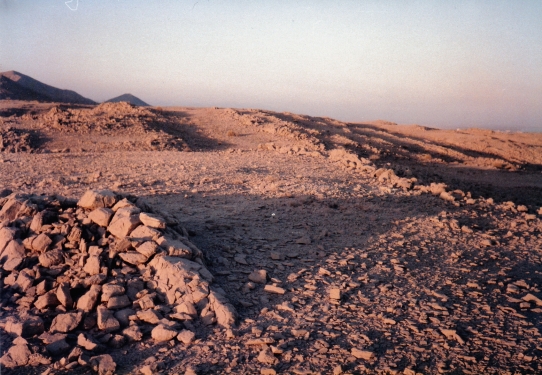
When I lived in Oman, the land around where I lived and worked was all stone desert; hills and valleys of razor sharp broken boulders, water worn stones at the bottom of dry valleys, with occasional villages and settlements and old, crumbling, mud brick forts dating from the time that the Portuguese were there. Almost invisible tracks used by goats and nomads wound their way through this wonderful landscape, or simply followed the routes of the wadis, the dry river valleys. I had a very small scale map of the country, as well as a few very large scale maps that I had pinched from the office where I worked (I did return them when I left). These would consist largely of huge areas of blank paper, with the occasional ‘tree’ or ‘large boulder’ helpfully marked, although they did show the main wadi courses and mountain ridges.

I was very tempted to write ‘here be dragons’ on them occasionally.

img_0001

Never before had I quite understood what silence was. And it was the first place (to be followed by the Himalaya) that I was to truly see a night sky. I was periodically astonished by the desert’s outbursts – blasts of hot wind like an opened oven door; flash floods that appeared from a blue sky in minutes, to ferociously drench the unfortunate climbers on the top of a previously baking jebel (hill); and tiny earthquakes and landslides – I was no doubt fortunate never to witness a serious one. I would overnight in the desert with friends and we would lie on our backs to watch the unbelievable night sky with its thousands of stars, satellites and shooting stars, before ascending a 10,000ft mountain in the morning, or exploring a stretch of uninhabited coastline.

I spent almost every spare hour that I had out in that desert, either trying to find my way across trackless ridges in my jeep, or just walking; walking everywhere within walking distance and discovering just how much there is actually to see in a desert. I was supremely happy in that environment, and some 20 years later when I had to change aircraft in Muscat, I found myself looking out at the purple tinted hazy mountain lines with something very close to homesickness.

Today, even waiting on the station to get a train to go to the next stop, a coffee in hand, a bag over my shoulder with a book in it, I am on a journey. And that journey feels clearly related to the longest journeys that I have ever taken. There can still be the same sense of travelling, of departing and arriving. The search for food and shelter… I think that it shows just how much a journey largely exists in the mind. Often our perceptions of a journey seem to differ from that journey’s reality (as many things do, I suppose). A long, difficult journey can seem to be over quicker than a short, easy one.

Just packing a rucksack, even an overnight bag when I used to have to occasionally stay over where I once worked – a wash bag and towel, sleeping bag and clothes – I feel as though I’m off on a journey. There is a certain amount of excitement…

And I know, too, how smell is such a strong, evocative, sense. Just with the kitchen window open, at 10pm on a slightly rainy October evening, I suddenly catch a scent of something – something cooking nearby, or a hint of smoke, perhaps – and I am instantly transported to Nepal, high in the mountains, remembering an evening with sherpas and villagers beside a river where we ate and then sat around talking and drinking and listening to those sherpas and villagers singing.

Okay, I’m ready to go and pack, now…

The Travel Bug Bit Me – part 2

There never seems to be a better time to set off on a journey, especially a walk, than first thing on an early autumn’s morning. It is late enough in the year to have a proper sparkling dew, usually covering cobwebs draped across bushes, and ideally there will be some bright sunshine, a hint of sharpness and the colours of leaves beginning to turn, berries in the hedgerows, and still an abundance of flowers. This is another hark back to my teenage years, I’m sure. It all seemed quite magical then, and it still does today.

023

I suppose, at the time, it could be said that I had a head full of hobbits. Of my contemporaries at the time, those with itchy feet tended to be either those who read and re-read Kerouac’s ‘On the Road’, and those who did the same with ‘The Lord of the Rings’. I fell squarely into the second camp, never really discovering the appeal of Kerouac. I guess they were largely the crowd who enjoyed ‘Easy Rider’ and wanted to travel Route 66. Later, I read Laurie Lee’s ‘As I walked out one midsummer’s morning’ and found the same atmosphere there. I walked from the London suburbs, where I lived at the time, with a friend down to Hastings. On the way we stopped at a couple of youth hostels, and had a couple of nights wild camping in woods. And everything did seem magical, although apart from the distance in time, I do not know why this should have been. All of the fields and woods, hills and hedgerows, seemed somehow to fill my head and assume a greater importance than anything else in my life at that time. Otherwise I would hitch hike down to the coast, or the West Country, and this would satisfy my sense of adventure, never knowing where I would end up and forever feeling as though I was travelling through an undiscovered land.

I don’t think, as a teenager, that I was ever happier than when I was off for a long walk with friends, or even on my own. I still get that same sense of pleasure when I arrive at my destination after a day’s walking, whether it be the spot that I’ve chosen for my wild camp on a mountain side somewhere, or a bunkhouse or hostel on the edge of a village where I know I can stroll to a nearby pub for a meal and a few pints in the evening. My chosen destinations then tended to be youth hostels, and I remember an awful lot of them fondly, still today. I think that my favourite, then, must have been Land’s End. I wonder how many people now remember the awesome murals that they had over most of the walls, inspired, of course, by Tolkien! The days were spent, whilst strolling through lanes and along footpaths, learning to recognise wild flowers and trees, butterflies, but not so much the birds. Even in those days my eyesight was too poor for that!

‘Rambling’ is used extensively as an insult by many of the climbing fraternity, yet it means no more than long distance walking, at a fairly relaxed rate. My dictionary defines it as walking for pleasure, with or without a definite route. This would seem a fair definition, and includes hill walking, trail walking, any type of walking, in fact. I think that the intended barb is that it is ‘soft’, yet people who would think of themselves as ramblers include very elderly people whom I have observed galloping over the fells at a rate to put roughtie-toughtie young climbers to shame. Its popularity, at least in Britain, stems from the last century when it was taken up by factory and mill workers in the north of England, in particular, as a healthy and cheap form of sport and entertainment. There is a point, in fact, where it merges into climbing, having passed through the scrambling and mountaineering stages.

Is it a coincidence that it seems that most of the best trips that I’ve read about in books have been done by solo travellers? If they have not been strictly alone, then they are using porters or guides who have been employed specifically to help the explorer along his chosen route, rather than suddenly say ‘Ooh, no. I don’t fancy that anymore. Let’s go back now.’

 Most of my own distance walking has been done in my own company. This always has the advantage that I can decide when and where I travel, when to stop for a break, when to go off on a diversion to see a particularly interesting (to me) village or hill or something. I do often miss the company of others when I walk or travel, and enjoy it when I do get it. I find it good to travel with somebody for a while, and then to move on again by myself when we begin to disagree over the route, or want to move at a different rate (or politics or religion intervenes, of course!). I suppose that this is also not entirely disconnected with my love of solitude. When hill walking, especially, I almost resent meeting other people. Especially large groups. Amongst the list of things that I positively hate coming across in any wilderness area, such as discarded lunch wrappers, people bellowing into mobile phones (‘Yes, I’m on the summit, now!’ – do some people have these damn things surgically attached to their heads?), music, for God’s sake – why would anyone want to hike out somewhere remote, where the predominant sounds are bird calls and the wind in the grass, listening to a bloody i-pod? – comes the large group of walkers.

There is no logical reason why I should, and it is certainly not due to a feeling that they have no right to be there. I just crave solitude in those situations. If I was asked to name my favourite day out walking in the hills of Britain, I think that I would unhesitatingly mention a November’s day some years ago, when I walked the Carnedd Horseshoe in North Wales. This particular circular route starts at the village of Bethesda and heads up a gently rising valley onto a ridge until it reaches the mountain of Carnedd Dafydd, where you then amble up to the summit. From there, there is a ridge walk to Carnedd Llewelyn, a shorter ridge to Yr Elen, then gently back down to Bethesda. The day was unusually warm for November, with sunshine and a beautiful clear sky throughout. And although Carnedd Dafydd is the second highest mountain in Wales, after Snowdon, it sees far less traffic of human feet than most other parts of North Wales. Consequently, I had a day’s walking in one of the most beautiful parts of the world, in fantastic weather conditions, without meeting another soul. Perfect.

img

I always used to do this with photos to make up panoramas – it’s a lot easier today!

Some people, although they would prefer to travel in company, choose ‘alone’ because they become good at doing ‘alone’.

I’ve heard it said, and frequently read it, that there is nowhere left on the planet to explore, anymore. I suppose that if what is meant by that is that there are no longer maps of whole countries or continents published that have ‘unexplored’ or ‘here be dragons’ printed over large, blank areas, then, yes, that is so. But if I go anywhere that I have not been to before, especially if I have read little or nothing about it, then I am exploring. I may not be contributing anything towards the sum total of human knowledge, but I am making discoveries for myself.

Thank heaven, though, that there are still areas of the Earth that are wildly beautiful and lawless, where outsiders, especially westerners, fear to tread, and life is cheap but the landscape is breathtaking.

Oh heavens, why on earth did I follow that blog?

Untitled-TrueColor-02

Every now and again I get unfollowed. And every now and again I unfollow a blog. Is it a big deal? Should it be a big deal?

At first, it can seem hurtful to find that someone has unfollowed you on any sort of social media, but really it shouldn’t be. Somehow, I find that I now follow a huge number of blogs, most of which I love, and I do wish I had more time available to read them more fully and comment on them, but I don’t. This means that every now and again I sacrifice one for the common good.

But, never without good reason.

First up, one thing that does irritate me, is when I visit and read a blog, leave a response – sometimes a quite lengthy one – and never receive any sort of reply. One blog that I initially followed was like this, and when I had left several comments that were never even acknowledged, I went through their comments strings and found that they could not be bothered to reply to anyone.

Instant unfollow. I dislike rudeness.

What other reasons?

Okay, so maybe I was attracted to your blog initially by the posts about cuddly kittens and home baking, but now the focus of your posts has shifted to motor vehicle maintenance and origami, and I feel my interest is waning. It’s time to move on. Don’t take it badly – what we had was good, but we all grow and develop and change over the years, and what was once right for both of us now leaves at least one of us empty. I wish you well, but I’m leaving you for another.

A little like the above, perhaps I found your blog through a particular post that interested me, but since then it seems that every post is on subjects that don’t. I’m sorry, I gave it a few months, I gave it a good try, but it’s just not doing it for me. Bye bye.

I unfollowed one blog because every post was a long moan about other people. Sorry, there was no pleasure to be had in reading that one.

Perhaps I notice that where your blog was originally full of carefully argued points and good language, it has become home now to foul-mouthed polemics and crude language in general. Hmm, perhaps you should take this one personally. I won’t be the only one to leave.

So, every now and again I see that my own number of followers has fallen, and that I’ve been unfollowed. My reaction? I do wonder whether I have written something boring or offensive, and occasionally re-read a few of my posts in that light. That’s okay, it’s constructive and encourages me to think about what I’m doing.

Perhaps we should all hope to get unfollowed every now and again, just to make us focus constructively on our posts.


The Travel Bug bit me – part 1

Travelling! My first inclination to travel to remote regions came from my Grandmother, when I was probably six or seven years old, despite the fact that she had never travelled very far at all in her whole life. In fact, I don’t think that she ever left England.

But she would tell me stories of China, inducing images of Emperors and pig-tailed mandarins, peasants and bandits, and this was coupled with a children’s book; an encyclopaedia I presume, with grainy, black and white pictures of strange scenery. It was extremely evocative, although at the time I did not understand that. I was just excited by the mysterious, the strange and the unknown.  I was hooked, and wanted to go there! Ever since then, the places where I’ve most wanted to travel, other than Britain and Europe, have almost all been in Asia.

The list of places that I have at the moment that I would like to visit, are almost exclusively Asian.

Yes, she has a lot to answer for, that sweet old lady.

hill station 2

When I was a teenager, I began to use maps, although in rather an ad hoc, hit and miss manner.

They were there for me when I was really stuck, or I just wanted to know in which general direction something lay. It would be a very long time before I began to use them in a skillful way, able to predict the exact lie of the land, navigate in the fog or the dark, or find my way through complicated landscapes with the map and compass. And, do you know, since I’ve learned to do that, I often feel as though I’ve actually lost something rather magical, although I don’t suppose that I can blame it all on that. The maps that I was using as a teenager would tend to be the Bartholomew’s Touring Maps, small scale with little detail. I would feel, as I headed along a Cornish footpath, that I only knew roughly where I was going. It always felt like an adventure; an exploration.

Now, I need to be more and more remote before I can get that feeling, and even then it does not always work. Some ten years ago, I spent a couple of weeks in Ladakh, in the Himalaya in the far north of India, and I was surprised at just how easy all of my walking was. Setting off with map and compass, I always knew exactly where I was, only confused at times by the multiplicity of tracks criss-crossing the landscape. Even then, reference to mountains and villages with map and compass would invariably allow me to set my position.

That doesn’t mean that I wanted to get lost, just that there was a small part of me that said ‘even this is all tame!’ Equally, I can be put off, when using a map, by the knowledge that over the interesting looking ridge that I am heading for, there lies a motorway or building estate, and so I then spend ages trying to plot a route that I try to get perfect, rather than simply heading off in the direction that I want to go and exploring as I go, correcting my course as I travel.

Nothing can tempt me more than a track leading tantalisingly into the distance, perhaps meandering through Mediterranean scrub towards a notch in the skyline, perhaps leading through a glowing archway of trees. Even now, when using map and compass to navigate, I often have to resist the temptation to ignore the map and head off to follow an interesting looking track. I think that this must be a part of my ‘I wonder what’s over the other side of the hill?’ nature. It’s another reason why I’ve never been able to lie on a beach – apart from the fact that this seems a particularly pointless pastime in any case. Any time that I’ve tried it, it never seems to be more than a couple of minutes before I begin to think ‘What’s round that cliff, I wonder?’ or ‘If I head back up the river, I think I might find a way through those hills.’ And then I just have to go to find out.

There are plenty of other things that can destroy a sense of adventure in travelling, other than over-familiarity with maps, of course. I remember the shock and the sense of let-down I received in Germany about 35 years ago, when I spent the best part of a morning struggling up an ill-defined track through thick woodland to the top of a berg in the Black Forest (I was using a tiny touring map at the time, which showed main roads at best). My elation at arriving at the top and surveying the panorama of hills and mountains around me was completely destroyed within a minute, as a coach roared up the other side of the hill, came to a halt a few feet away from me, and then disgorged about 30 Japanese tourists. They spent about two minutes firing off photographs of everything in sight, including myself, before leaping back on board the coach, roaring off down the hill and leaving me gob-smacked in the sudden silence and slowly settling dust.


Coffee; my drug of choice!

At least, the first thing in the morning, it is.

061a

I just don’t understand why it is that having a perfectly average 7 or 8 hours of sleep each night should turn me from a (relatively) normal and functioning human being, into an extra from ‘Return of the Neanderthal’ – and a non-speaking extra at that, other than the occasional ‘ug’ or snarl.

Of course, if I get less than 7 or 8 hours, then I resemble something that hasn’t even made it as far up the evolutionary ladder as the Neanderthals; some sort of fairly large and irritable beast with too many pointed teeth and a lamentable lack of patience, perhaps.

Just left to my own devices, this would not auger well for my marriage, my blood pressure, or even for the local society and environment.

But if modern medicine can work wonders in curing all sorts of previously fatal diseases, then caffeine of just the right dose seems to be the medicinal panacea for morning.

And being just a layman when it comes to the world of caffeine, I have a childlike wonder at its effects.

I am especially impressed by the strength of the espresso that you get served in cafes in Spain or France, and hence at its effectiveness. The customer crawls in and somehow climbs up onto a bar stool, using their final reserves of energy, croaks out a request for ‘espresso!’, then uses the last of their strength to lift the tiny cup to their lips…they drink…and Bingo! They leap suddenly into the air as if energised by a bolt of electricity, and then rush out of the cafe, singing lustily, to do a 16 hour day’s work.

And proper Turkish coffee, an extremely effective if much tastier substitute for asphalt, just has me in awe. Are there really people who are able to drink this each day? Every day?

Superhuman.

I doff my cap to them.

I take mine a little weaker than that, I admit, but I do like it relatively strong, and without milk or sugar – exactly the way that nature intended it.

Naturally, instant coffee just does not cut it, although I do admit than it can be effective at combating fatigue; many years ago when I worked in the Middle East, I noticed that one or two of the men who worked shifts at our company would eat the occasional mouthful of instant coffee powder when they were tired, presumably to help them get through the following few hours.

But despite that, I just have not found an instant coffee that seems drinkable. Nothing can match the real thing, for me.

And lest you fear that I am doing myself irreparable damage by flooding my system with strong coffee throughout the day, let me just say here that for me it is an early morning ritual only, and after that I drink tea (a good Darjeeling, naturally!).

But now it is lunchtime. I have got through another morning.

Thank you, coffee. Thank you.

Where’s that damned kettle?

Plastic Bottles of Water

Plastic bottles of water.

We buy plastic bottles of water.

Why the bloody hell, at least in the west, do we buy plastic bottles of water?

And, hang on a minute, before we even start wondering why we pay stupid amounts of money for a commodity that is virtually free, we even pay for those silly little contraptions on the tops of the bottles that you grip with your teeth, pull, and then, if it works, and doesn’t just break off, enables you to squirt the water through this nozzle into your mouth.

All of this just to save you unscrewing the cap and taking it off.

The dreadful labour of having to unscrew the cap.

And taking it off.

Perhaps that is why we buy the bottled water – to save us the bother of turning a tap and holding a glass beneath it to catch the water.

Really?

So why do we do it?

P1050104

It costs…well, tap water is all but free. For example, in California tap water costs one tenth of a cent per gallon.

In the UK my local water company charges £1.248 per cubic meter, which is 220 gallons, for water. This makes it just over half a penny a gallon.

Bottled water? On sale in my local supermarket for £1.50 for 3 litres. On special offer. There are approximately 4.5 litres in a gallon, so this costs out at £2.75 per gallon, which is approximately 550 times more expensive than tap water. Or, if you like, you are paying under half a penny for the water, and almost the entire £2.75 for the plastic bottles.

Feel good about that?

Me neither.

Perhaps the bottled water is far superior to the tap water?

Nope. Sorry about that, it’s not.

First of all, approximately half of it comes from the tap in any case. Yup, that’s right. The company that flogs it to you gets it from out of the tap.

And as for the rest, tap water is subject to more stringent quality and health standards than bottled water is, in any case. In tests on water in the USA last year, tap water came out better.

So are the huge, multinational soft drinks companies who manufacture these things doing it for our benefit?

You bet they’re not. They’re doing it because they can see an easy and gigantic profit.

We could do worse than talk to our old friend, Mr Satan Moneyglutton, the anonymous CEO of a major soft drinks company, at this point.

‘I honestly don’t know what you’re whingeing about. You want convenience, don’t you? What could be more convenient than pouring all of your money into our coffers?

‘Tap water is so yesterday. It’s inconvenient. We have declared war on tap water. When we’re done, tap water will be relegated to irrigation and washing dishes.

‘And we are working hard to persuade restaurants not to give tap water to diners, but force them instead to purchase our bottled drinks.

‘It is helpful, of course, that most towns and cities seem to have stopped building and maintaining public water fountains, thereby forcing the thirsty citizen to purchase a canned or bottled drink.

‘Furthermore, with the spread of those nasty windfarms and tidal power generators, the future for oil as a source of power is, sadly, looking a wee bit unhealthy.

‘Clearly, there’s no point in leaving the oil in the ground where it’s of no use to anyone, so it makes sense to step up the manufacture of plastics which, incidentally, will make me even richer.’

So, there you go.

‘Nice bottle of water, sir? Only £1. And would you like a plastic bag full of air with that? Only £1.50.’

Don’t laugh – it’ll happen soon, I’m certain.