The Joy of Unknowing (1)

We have just returned from a few days away in Shropshire, which is one reason you haven’t heard from me recently.

We were incredibly lucky with the weather, and spent the time walking and reading and mooching around towns and villages. And finding time for the occasional meal and cold beer, of course.

Yes, we did some lovely walks. And I find it a natural thing to be constantly identifying and photographing whatever I see when out for a walk. I have always been interested in all aspects of the environment, be it the plants and animals, the geography and geology, the weather, or the historical impact of people on the environment in forms such as old trackways, deserted buildings, or ancient boundaries.

006a

And we have spent several fantastic days surrounded by an environment rich in all these things, as we have walked through woods, fields, and open hillsides, seen ancient settlements, butterflies, birds, and many wildflowers, and all this in an area of some of the most complex geology in the UK.

But sometimes I feel myself tiring of the constant need to identify and record everything; it is really a way of trying to own them.

And when you post on social media too, it can feel at times a little like a competition to put up the best pictures of this or that wildflower or bird or mountain, which naturally need to be identified and named. Especially on Twatter, whose format seems to encourage this.

017a

So, on our first morning away, as we walk up a track heading into the hills above Church Stretton, under early morning blue skies with the air crystal clear and beautifully cool, I decide that for now I am just going to exist in the moment.

Because by doing this, I am relieved of the constant necessity of deciding whether this bird is a rook or a crow, or whether that flower is greater stitchwort or lesser stitchwort.

018a

Because it doesn’t really matter.

And for now, instead of having to always know whether it is this or that bird singing, I can allow myself to simply think there is singing. There is birdsong.

Or, even better, there is a sound I find melodic, and it pleases me.

By doing this, I can relax and centre myself, which is something I feel has been badly lacking in my life recently. I have struggled with social media in any case, feeling a huge pressure to post new material and to read the many I follow, even when I don’t feel up to it.

It feels like a return to a much simpler time in my life. I can enjoy the views of the hills, the sounds of the streams and birds, and just concentrate on being.

This must have been part of the pleasure I felt as a child on every occasion when I could roam outdoors. Certainly, I was curious about what I saw, but since I knew so little about them, there was always an openness to the experience and the excitement of discovery. I would see butterflies I had not seen before, and I would just get the thrill of seeing them without having to know anything more about them. I would see wildflowers I didn’t recognise and just enjoy the shapes and colours.

Naturally, you cannot really unknow things in that way, just as you cannot really return to that point in your childhood, but it is possible, even if for only a short while, to let go of the need to identify and quantify (and therefore own) everything, and simply exist in the here and now.

Strolling in Sussex (1)

Yesterday, I went for a bit of a walk. The oppressive humidity of the previous day had lessened, fortunately, and it was an overcast morning with a cool breeze.

Just the way I like it.

I decided to take the train a few stops down the line, where I could get out at one of those stations that bears the name of a village a mile or so away but stands on its own in the middle of the countryside. The nearest building (other than the station itself) is a farm. Hopefully I could have a day’s gentle walking with nothing more demanding around me than birds, insects, trees and wildflowers.

I really, really, needed to do that.

It seemed a good start at the station. A good omen. While waiting for my train to draw in, my eye was drawn to a single large, white, bindweed flower in the tangle of brambles and vines and bushes, trees and garden plants escaped and gone native that serves as a barrier behind the platform.

Most gardeners hate bindweed. I suppose we do, really. Once it gets into the garden it grows at a ridiculously rapid rate and strangles any other plants in its way. And even pulling it up doesn’t get rid of it. It just regenerates. I tell you, come the end of days it will just be scorpions, cockroaches and bindweed left.

But this flower looked lovely. The largest, pure white, bindweed flowers often remind me of the calla lily, only a calla lily that is not so…let’s say…excited. One of my favourite artists is Georgia O’Keeffe. I’ve probably told you that before. But O’Keeffe was particularly known for painting large flower paintings, many of them more than a little ‘suggestive’. And the calla lily was one of her favourites. I’d show you one of hers but, you know, copyright and all that. I’ll leave you to look it up if you wish to.

040a

So, here’s the bindweed flower.

Anyway, I got on my train and later I got off at the correct station and began walking along the footpath and got shouted at by some sheep.

Really, there’s no other way to describe it. On one side of the footpath were a couple of dozen sheep in a field where the grass had been cropped very short and there seemed to be very little left for them to eat. As soon as they saw me, they came rushing over to the fence bleating loudly. Obviously demanding to be re-housed in the field on the other side of the footpath.

In that field, thick lush grass was being munched by a couple of dozen quite contented sheep. I didn’t hear a (Bo) peep out of them.

‘Really sorry,’ I told them. ‘I can’t help you.’ I walked on feeling oddly guilty.

But I got over it.


023a

For the rest of the morning I walked slowly through fields and along lanes, stopping frequently to look at flowers and insects and, really, just enjoying being where I was.

021a

011a

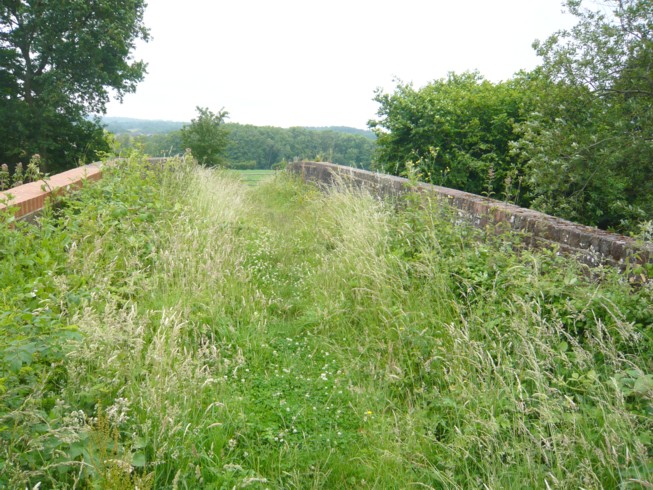
Bridge over the railway

016a

024a

010a

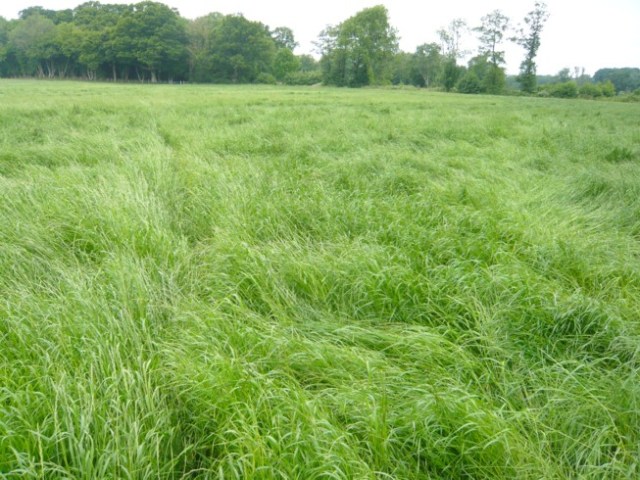
I was just beginning to think it must be lunchtime when my path took me through a field of long grass.

This field lay between a stream I had just crossed, and a wood where I was heading. The wood stood a little higher than the surrounding fields, and the long grass of the field I was to cross was thick and green. The breeze caught the top of the grass, so it waved like the sea or a large lake and as I began to wade through it, it really did feel as though I waded through water.

027a

And there was the drag of the grass against my legs, and the top of the grass sparkled a little in the breeze, just as wavelets would. And there was also the sense that I was not quite sure what I might suddenly step upon. Just to complete the illusion, there were also some lovely blue damselflies darting around.

Then I finally stepped ashore at the edge of the wood, walked up a slight sandy slope that might have been a beach, and sat down to eat my sandwich.

Now, I have to tell you that this was the best sandwich in the world, and I won’t brook any disagreement. Thick wholemeal bread, cheese, several large slices of raw onion, and several thick slices of tomato. Perhaps it was my mood, and the setting, but it was damned good.

And then it was time to explore the wood.

A Thought

Without Compassion I am Nothing

001a

Without compassion I am nothing.

For pity is not compassion,

It is no more than a patronising aloofness

That demeans the recipient.

But compassion encourages action.


Without compassion I am nothing, yet

Without anger I have one hand tied behind my back.

I must not lose my sense of indignation

At injustice, for without anger,

Nothing will be changed.


Without compassion I am nothing,

Yet without wisdom my anger will be directionless,

Blindly striking out to hurt both enemy and friend.

And doing more damage than any original wound.


Without compassion,

I am nothing.


Fritillaries

022

The Snake’s Head Fritillary – also known as the Frog Cup, the Guinea Hen Flower, the Chess Flower, due to the remarkable patterns on its petals:

022a

The name Fritillary, in fact, derives from the Latin fritillus, meaning dice box (which were formerly chequered). Also known as the Chequered Daffodil, the Chequered Lily, and the Leper Lily, since the flower shape resembles the bell once carried by lepers.

We saw and photographed these beautiful but scarce wild flowers exactly five years ago today at Iffley Meadows in Oxford, which is a well-known spot for viewing them.

Review of Devil in the Wind by Frank Prem

44440062

Like Frank’s previous book, Small Town Kid, this collection of poems tells a story of rural and small town Australia. But the similarities between the two books end there.

Whereas the previous collection was a celebration of boyhood in Frank’s hometown, this is an account of the dreadful bushfires of February 2009 that swept through parts of Southern Australia, the area that is home to the author, killing 173 people and leaving a huge area a fire-blackened moonscape.

The poems are a mixture of first-hand accounts, from those who ran desperately from the flames, saving what they could and suddenly terrified at the unbelievable size of the fire and the terrible speed the flames moved at, from firefighters who fought the flames like small companies of soldiers attempting to halt the progress of an overwhelmingly large army, until they literally dropped from exhaustion, from the fire-spotters, and from the frightened friends and relatives trying to raise loved ones down unresponsive phonelines.

In many ways, this is a very difficult book to read, although it is important to do so, especially for those of us fortunate enough to have never had to live through events as terrifying as those described in its poems. It is full of raw emotion and naked detail, traumatised victims and quiet heroes.

At times, I found it essential to look away and take a breather, much as the firefighters had to do, as the emotion became just too much for me.

Poetry is an immensely personal art form. Even when the subject is neither the poet nor the reader, intense emotions come through. Presented in this form, these accounts are shocking. I cannot tell whether they would have felt as shocking had they been prose, but the sparse brevity of the language confronts you almost aggressively, defying you to ignore what they say. Each one seems to scream ‘Listen to me! Don’t you dare turn away until I have finished!’

It is extremely rarely that I would suggest a book should be required reading, but I genuinely think Devil in the Wind should be and is unquestionably a five star read.

Aggie

Aggie sits smile-chuckling at nothing much on TV today.

She’s made her shopping list,

And tidied her room.

She cried a little when Patrick called her stupid,

But she seems to forget him when children’s TV comes on.


It’s on the television screen that life makes sense to her.


Aggie, did you put that food in the waste?

No! Aggie is a good girl! Large-eyed-scared.

I smile easily. Soothingly. Of course you are, Aggie.

The same ritual every evening. But I wonder

Just what happened in that huge, rambling institution

She called home.


It’s then I think, for the hundredth time,

Of the pages in her file, the report from the hospital,

By the doctors and the clinicians,

With their tests and scans and

‘I can find no evidence…’


By all accounts a normal child,

Who, just after the war


Got into trouble.

She was sent away for her own good!


A cousin, sharp-spiteful,

But who refuses to say any more.

None of my business, or of yours!


‘There is evidence of a number of fractures,

The upper left radius, several ribs,

The right fibula, particularly poorly healed…’


Have you seen my baby? Asks Aggie, suddenly.

What baby’s that, Aggie?

Distracted-distant.

I have to do the medication, right now.

I’ll talk to you later.


‘There appears to be no reason for her disability,

No birth trauma, no accident,

No diagnosis…’


It’s Aggie’s seventieth birthday, tomorrow.

What would you like to do, Aggie?

Do you want to go somewhere?


Aggie nods.

There is something she’d like to do,

But the words won’t come and the more she tries,

The harder it seems to get, and so

She gets distressed, and cries and runs off

Slipper-slapping to her room.

The door slams.


‘Aggie spends a lot of time crying…’


The New Viking

Untitled-TrueColor-01

Long, long ago, (although not in a galaxy far, far away) I posted a poem about Vikings which was called, astonishingly, Vikings. (It can be found here should you wish to re-visit it.

This is a rather tongue-in-cheek follow up.

The New Viking, a Reformed man


He brought death and terror to these Saxon lands,

Taking iron and fire to fearful hamlets,

But he was defeated by a woman,

A yellow-haired woman, soft and pliant.

And now the screams of battle are the

Bloodcurdling cries of infants.


He beats his sword into a ploughshare,

And grows rows of turnips and cabbages.

His axe cleaves firewood.

Maybe he’ll name his house ‘Dunplundering’.


He no longer lives within sight of his beloved sea,

But he watches trees ripple in the wind;

An ocean of billows topped with brilliant green spume.


Casting long shadows in warm sunlight,

These immobile giants roaring and sighing,

Desperately attempting to free themselves

Of their earthen shackles

Feel uncomfortably close to home.


Those northern winters still call him.

The fire, the mead, the fighting,

The tales of monsters and warriors.


Hamstrung by instinct

He shifts uneasily, guiltily, on his chair by the hearth.

His sword fingers twitch and tap and he

Looks for reasons to pick arguments

With his neighbours.


Anything would do.

Restless Wind

107b

Some people need the familiar,

Finding in it safety and comfort.

But some see it as a constraint,

Suffocating them like the walls of a prison.


And the same wind that blows

Through both their houses

Causes one man to close his door,

While the other throws his wide open.

The Weald of Kent and Sussex

South East England is my area. It is where I was raised and, other than a few years spent abroad, it is where I have lived my whole life. In particular, the Weald and the Downs. Not so much the coastline, which has never particularly attracted me, but the hills and valleys, the woodlands and rabbits, the hidden crags and open downland, the land of streams and foxes and badgers, birds and villages and butterflies.

039a

On the Sussex Downs

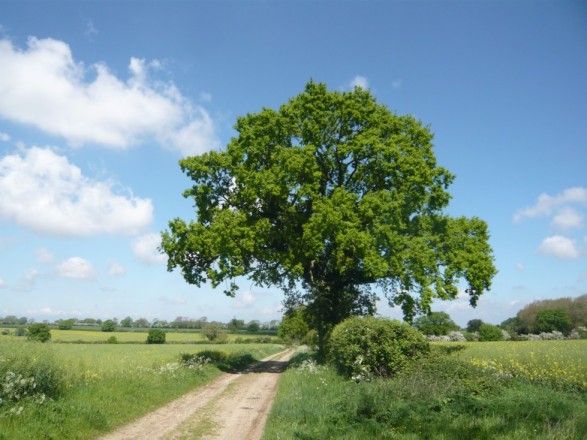
There is a curious fact about the wooded areas of South east England, which is that there is more woodland, covering a greater area now, than was the case four hundred years ago.

032a

Back then, South East England was the industrial heartland of Britain. This was before the discovery of the coal seams of the North and the Midlands, and the various factors which would eventually lead to the greatest impact of the Industrial revolution being in those areas.  Instead, the modest iron deposits of the Weald were mined and worked into firedogs and nails, cannon and cooking pans, as the wealth of words such as hammer and forge in place names still bear witness.


037b

Huge numbers of trees were cut down to feed the fires of these forges, and huge numbers also for charcoal burning, for building, and near the coast the great Kent and Sussex oaks were in huge demand to build the large number of ships the navy demanded. But then from the mid eighteenth century onwards, industry began to shift northwards.

Despite the pressures on the land for building and for farming in this crowded corner of our crowded island, there is actually more woodland now than there was during the fifteenth and sixteenth centuries. And that is not something that can be said of many parts of Britain or, I suspect, many parts of the world at all.

010a

The Weald is an area whose underlying rocks are sandstone and clay, which means that the unimproved soils are inevitably either light and sandy or thick and claggy. In some parts there are old sunken tracks known as ‘Summer Roads’, so-called because they became impassable in the winter months, when they might have had a foot or more of thick, wet, muddy, clay on their surface. When these were in use, journeys between villages that might take an hour or two in summer, could became almost impossibly long during the winter.

037x

At the moment, all everything in the news seems depressing and unpleasant and so, this post is an indulgence. Just a smattering of information, and a few photos of places I love, largely to improve my mood.

Spain 2

It was after posting my series of poems ‘The Old Way‘, last week, and also mentioning that I’d almost completed a very long poem on a very long bus journey, that made me think of travel again. Not that that is unusual, of course. I’d nip off on another journey at the drop of a hat if I had the chance, but for the time being we can’t afford to do that.

But, I am planning to publish those poems and a whole lot more, plus a few short stories, in a book some time later this year, as well as the Indian novel I’m currently editing – A Good Place. Two book in one year! We’ll see how that pans out…

But…Spain. Mallorca, this time, to be precise. Mallorca is the largest of the Balearic islands and lies in the Mediterranean Sea about a hundred miles east of the Spanish city of Valencia.

If you were to do a Google search for Mallorca (Go on, now I’ve mentioned it you can’t resist, can you?), you would be forgiven, looking at the results, for thinking there was nothing on the island other than the city of Palma, beaches, swimming pools, hotels and night clubs.

And you would be very wrong.

Certainly, there’s plenty of that if you want it, but there is also the rest of the island, which measures approximately fifty miles by forty miles, and contains some surprisingly big hills and mountains, small villages and towns, orchards, fields and woodlands, hiking trails and Roman and Moorish remains.

img20190320_11402114

I’ve only had one visit there, and after flying into Palma I took the train up into the Tramuntana, the range of mountains on the north west of the island, to the little town of Soller. From there I walked up into the mountains themselves and spent the next couple of days just wandering around and exploring, sleeping overnight in a stone refuge.

img20190320_11394102

Luxury holiday accommodation at about 2000ft.

But there was a lot of rain arriving, and I retreated back to Soller for the remainder of my week, finding a room in a cheap backstreet hotel and spending the days exploring the lower hills and villages, and some of the coast nearby.

img20190320_11335509.jpg

Lots of rain arriving.

img20190320_11421944

View from the window of my other luxury holiday accommodation in Soller. Lots of rain still arriving.

img20190320_11302033

But it wasn’t all rain. There were lots of little villages to explore…

img20190320_11410230

Farms, and hills to wander around in…

img20190320_11311220

img20190320_11332135

img20190320_11414759

Village church

…and lots of bread and cheese and fruit and wine to enjoy. Not that you need to see a picture of that.