Blogging vs Other Social Media

It’s a fight to the death!

085

Well, okay, not quite that, but bear with me for a bit longer.

The other week I gave a short talk to my writing group on reasons a writer should be on social media and, more importantly, why they needed a blog. I’m not going to go into this in any detail now, but I promised I’d summarise what I said in bullet points, and then thought it might be worth putting up here to see if anyone felt like adding anything to it.

So…

Why?

  • As a writer, you need to have a social media presence to sell books, to get known. Even if you are a published author.
  • On a social media platform, you are aiming to get shares for your posts. The more shares, the more people will see them.
  • It’s all about engaging with customers, fans and critics.
  • There are a huge number of platforms, but just a few examples that I have experience of:
  • Facebook is the biggest, and the most active, with a high rate of engagement. Having an Author Page is a good way to engage through backstories, questions, surveys and daily updates (yours or your work), ‘Behind the scenes’ articles.
  • Linkedin has many users, but a low rate of engagement. A business page can be useful.
  • Twitter is short and succinct. A sort of ‘Marketing Lite’. Posts appear fleetingly and then are essentially gone, though, unless they generate lots of likes and retweets.
  • Goodreads is like ‘background’ media – people need to seek you out to find you.
  • But the number one way to be found is through blog posts.
  • Like all good social media, blogs encourage visitors to return. Unlike ordinary websites, they are updated regularly and the reader can be alerted to each new post.
  • There are many other reasons to blog, viz:
  1. Teaches you to write more professionally – you have an audience
  2. Discipline
  3. Practice
  4. Feedback from people outside your usual circle
  5. Networking with others
  6. You can upload links to other social media
  7. There is space to write more in-depth than on other social media
  8. To review work for other writers
  9. To explore ideas and get feedback on these
  • A blog is simply a website with posts being regularly replaced, although the old ones are still on the website to read.
  • There are many blogging platforms, but I use WordPress.
  • One advantage of WP is the ease by which readers can see you have a new post.
  • Whichever platform you choose, it should have clear instructions and / or tutorials to help you set up.
  • It should also allow you to block spammers, remove adverts (by upgrading), monetise your site, and change the layout. In other words, have as much control as possible over its appearance.
  • It can be really helpful if the platform provides diagnostics on data such as page views, visitors, likes, comments, and links to and from your site. This helps you plan and refine how you run it.

How?

  • Purchase your own address! It is not very expensive, but it makes your blog more personal, more professional, and the address more memorable. And the host cannot arbitrarily close it down, which might happen with a free site.
  • Start by going and looking at other blogs, to find what you like and might work for you. then use your Site Builder Tool to create your site.
  • Once you begin writing your first post make sure you are using a clear font that stands out.
  • Keep the post around 500 words, certainly under 1000. When you have a decent following, you may get away with more, but new readers will be put off by longer ones. (As a guide, this post has 945 words).
  • Add a picture or two to help it stand out and look less daunting, but not too many. And not just dozens of selfies, unless you are an established celebrity. It’s a real turn off.
  • Make the post interesting! Put some good stuff in first, to get the readers’ attention. And don’t save all the good stuff until the end, as readers might not otherwise get there.
  • Use categories and tabs on each post to help new readers find them.

Issues

  • Don’t feel under pressure to post to a fixed schedule.
  • Don’t be afraid to change the subjects you post about – it’s all under your control and there are no rules on it. Let it develop organically.
  • Don’t be afraid to take a break if you need to. It’s very easy to get into a mindset where you think you need to do all these things to a rigid schedule.
  • Don’t obsess about the number of followers you have or likes / comments you get. Chasing them is counter-productive.
  • Find some blogs YOU like, and follow them, commenting when you have something to say. That way you will begin to get visits in return and then, hopefully, follows back. It is pointless following a blog that doesn’t interest you, just hoping to get a follow back. You want followers who will be interested in what you have to offer.
  • And on that subject, if a new follower has a site that doesn’t interest you, there is no obligation for you to follow them back.
  • And don’t feel obliged to comment on / like / or even read every post on blogs you follow.
  • Do remember that copyright law applies exactly the same on the internet as it does in the real world. If you copy a photo or article from the internet without permission and post it on your blog be prepared for possible legal unpleasantness. I always use my own, just to be safe. I think it looks better, too.

World Book Day

World Book Day, celebrated today, 7th March, has the declared aim: Our mission is to give every child and young person a book of their own.

It is celebrated in the UK, although I have no idea whether this is an idea that has been taken up elsewhere, and would be interested to find out.

Schools, in particular, seem to have embraced the idea, with children encouraged to attend classes dressed as their favourite book or literary character. Thus hundreds of Harry Potters and Willy Wonkas and Very Hungry Caterpillars march into schools across the country once each year.

A splendid thought!

Which brings me to a marvellous project aimed at schools across the country.

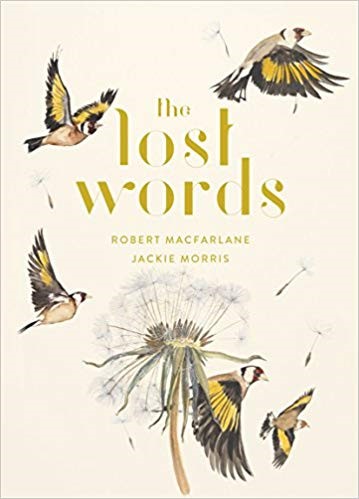
Growing, in a way, out of Robert Macfarlane’s brilliant book Landmarks is The Lost Words, a collaboration between Robert Macfarlane and artist Jackie Morris. I can do no better than to quote Jackie Morris on the reasons: It had come to the attention of some who work in the world of words that certain words were slipping out of common usage. As a result when it came to amend the junior dictionary for a new edition these words were gone… These words included bluebell, conker, heron, acorn and perhaps the one that cut the deepest for me, kingfisher.

lost words

So The Lost Words is aimed towards children, to encourage them, through the words and paintings of the book, to discover the natural world that so many of them know nothing of.

So many grow up today without any meaningful contact with the natural world, and this book aims to encourage them to know and to love and protect it.

And the project – the campaign, really, in a very ad hoc way, is to raise money where necessary to place a copy of the book in every school in Britain. It has already been achieved in Scotland, I understand, and hopefully, it will soon be achieved in every other school in Britain.

Review of Masks and Other Stories From Colombia by Richard Crosfield

In Masks and Other Stories From Colombia, Richard Crosfield brings us twenty five tales set in Colombia, the majority of them viewed through the privileged eyes of Printer, a British expatriate.

mask

Printer, we are told, has a good ear for a story, and is much in demand by hosts and hostesses at parties to recount these tales. He also has more empathy and sympathy for the Colombians who surround him than do most of the other cossetted expats. Naturally, this acts as a good device to introduce several of the stories.

Some of the stories are little more than vignettes, bringing the reader into the lives led by the mixture of the very poor, the well-to-do middle class, and the extremely well-off and powerful of Colombian society, as well as the expats among whom Printer lives and works. These appear to do little more than illustrate what the lives of these people are like, yet at the end of each story something has changed; there has been resolution of some kind.

Of the others, some demonstrate that you don’t always require an earth-shattering event to create a satisfactory ending, but just a quiet re-drawing of the landscape. Something has shifted, perhaps so subtly that not all the protagonists have even noticed. But we, the readers, see it clearly.

Yet it is easy for the reader to become lulled into a false sense of security by this, so that we are caught out – shocked, perhaps – when we come to one of the stories that has a more powerful and emotional conclusion.

The temptation when placing stories in a setting that is very different from the writer’s own setting, even when that writer has spent a good deal of time there – perhaps especially when that writer has spent a good deal of time there – is to either set all of them in the almost artificial world inhabited by the expat, or to try to set them in the wider community, a community that perhaps they may not completely understand. Richard has managed successfully to do both, something that demonstrates an easy familiarity with both these worlds.

Throughout the book, we can see that the author’s sympathies lie very much with the underdogs of Colombian society, although the stories never become clichés of the noble poor versus the evil rich. They are told with too much intelligence and enough humour to escape that, and, perhaps above all, the writing itself is easy and a joy to read.

Expect to encounter amateur cricketers and murderous bandits, whores and priests, street kids and artists. And a whole host of others.

This is most certainly a five star read.

My disclaimer – I received a copy of this book having beta read one of the stories for the author, although I was not asked to write a review. But my admiration for the stories and my pleasure reading them is entirely genuine.

Seven Cities of Delhi by Rajiv Chopra


001

On my first visit to Delhi, almost thirty years ago, I was overwhelmed by the huge numbers of monuments there, such as the Red Fort and Purana Qila. I found the area around Paharganj to be chaotic and exciting and everything an inquisitive Westerner could wish for – a mixture of smells of food and incense and, yes, sewage. A mixture of ugly concrete buildings and beautiful dilapidated buildings left over from the British Raj and often much earlier. Milling crowds of people and cows and rickshaws and bicycles and autos, and history, history, history.

Chadni Chowk was incredibly crowded, the Lodi Gardens completely deserted. The Jama Masjid crowded by tourists and worshippers alike, the Janta Manta often almost empty.

There is so much history everywhere you turn in Delhi.

Other Westerners I met tended to be highly disparaging of Delhi, which was something I couldn’t completely understand since many of these same Westerners seemed to praise Mumbai and Kolkata for the very reasons they hated Delhi.

Yet Delhi is, I think, one of the most exciting and interesting cities I have ever visited. From a historical viewpoint alone, it has over ten thousand listed monuments.

Ten thousand!

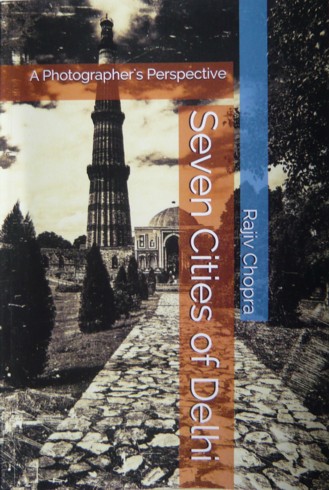
Rajiv Chopra is a Delhi based photographer with a passion for recording both the historical Delhi and the street life he comes across from day to day. In this book, he has combined his photographs with a little of the history of the seven historical cities that constitute Delhi, and also a perspective of the differing processes that photography has passed through from its invention up to the present day.

To illustrate all these factors, his book is split into seven sections – one for each of the historical periods – and in each section he has outlined one of these photographic processes so that, for example, in the section covering the first city, Mehrauli, he speaks of daguerrotypes. And then his own photographs he processes through Photoshop to simulate the effects of these processes.

This is not a long book, but it does not pretend to do more than act as an introduction to the history of Delhi. And in this it certainly whets the appetite for more, and then for anyone with even a passing interest in photography it gives a concise and potted description of these photographic processes. Finally the photographs themselves complement the text perfectly.

I unhesitatingly recommend this book for anyone who wants to know a little of the history of Delhi, and who enjoys photographs that give a real flavour of the history of that magnificent city.

Five stars out of five.

You can find Rajiv’s website and blog here

Review – The Name of the Rose by Umberto Eco


002

Late in the year 1327 Brother William of Baskerville, a Franciscan monk, and Adso, a Benedictine novice, arrive at a monastery in Northern Italy. Winter is rapidly approaching, and so is both a legation led by a notorious inquisitor and another that contains that inquisitor’s implacable enemies. William is to speak in intercession between them.

But once they arrive at the monastery, a series of brutal murders begins, and, at the request of the Abbot, William and Adso are drawn into the investigation.

Every detective story needs a detective, and in The Name of the Rose it is William of Baskerville, who indeed uses logic and observation to make deductions, much like a medieval Sherlock Holmes.

Untitled-Grayscale-01

As the plot develops, there are long theological debates centred around both the poverty of Christ and the question of whether Christ laughed. Questions I have little knowledge of, but which read as authentic to me. But these debates are central to the plot. On the interpretation of Christ’s poverty alone, men and women are accused of heresy and burnt at the stake.

But everything is centred upon the monastery’s library. This library is the greatest library of its time in Europe, containing innumerable rare, important and beautiful volumes. At the centre of the story lies a mysterious and forbidden book, and this book lies at the centre of the labyrinthine library where only the Librarian and his assistant are permitted. But are the murders being committed to get hold of this book or is there another reason? Could they, in fact, be connected with the predictions in the Book of Revelations?

Untitled-Grayscale-02

This is such a well-known book that I found I forgot it was a translation from the original I was reading. Much like the Bible, of course, which point is salient to the monks, and certainly in medieval times this interpretation was a matter of life or death to thousands.

But the translation of  prose does not pose the same problems as the translation of verse, and I don’t suppose the English translation is any different from the Italian original. But the potentials made me smile

As a long book, it provides a canvas for long descriptions, both of the abbey and the associated buildings – essentially a castle – and of the long debates between the monks and the other players. At times there is undoubtedly a temptation to skip some of these, but the reader is adequately rewarded for persevering in that the descriptions paint a powerful picture of the place and time, while the debates tell much about the importance of religion and the ridiculous interpretations of every word of the Bible that quite literally governed the lives and deaths of everyone at that time.

A word about the pace of the book, though. Some readers may find it a little slow (although if those readers skip the debates and longer descriptions it is as fast-paced as any other), but remember it is not just a detective story, it is also a historical novel and moves at the pace one would expect of a book of that genre.

I read this a very long time ago, and although I remember it as having been a very good book, I had forgotten just how good. I will unhesitatingly give it five stars.

And the meaning behind the title? Well, you need to wait until the end to find out, and then you need to understand Latin…

Starless and Bible-Black – Under Milk Wood by Dylan Thomas

009

After my previous post, it seems entirely apt to post a review, today.

Writers rely upon reviews to sell books. To spread the word. And I am conscious how bad I am at leaving reviews – mainly because I’m not very good at writing them. But I Shall Try To Do Better!

To start with, this is the review I left on Goodreads some time ago for a book that is already very well-known.

This book begins, then, full of rich, playful language as it sets the scene and gradually introduces the players.

To begin at the beginning:

It is spring, moonless night in the small town, starless and bible-black, the cobblestreets silent and the hunched, courters’ -and -rabbits’ wood limping invisible down to the sloeblack, slow, black, crowblack, fishingboat-bobbing sea. The houses are blind as moles (though moles see fine to-night in the snouting, velvet dingles) or blind as Captain Cat there in the muffled middle by the pump and the town clock, the shops in mourning, the Welfare Hall in widows’ weeds. And all the people of the lulled and dumbfounded town are sleeping now.

I have heard poems by Dylan Thomas read by Richard Burton – the actor, not the nineteenth century explorer – and his warm, mesmeric, lilting tone suits the poetry like no other voice I could imagine. Now, I cannot read any Dylan Thomas without hearing it read in his voice.

(I want my work read like that. There is a man I know with a wonderful voice; mellifluous and rich and deep, like Burgundy and dark chocolate. Not Welsh, but very English, who I shall attempt to trick into reading one of my poems or short stories out loud, one day.)

So, to the poem, or play, if you will, for it is a play, first and foremost, told as a prose poem. The play is full of wonderful voices, the voices of a plethora of small-town characters; all of them realistically drawn with their dreams and vices and foibles, and depicted with great humour, but also with sadness. Sadness, for there is resolution for most of the characters, and for some their dreams come true, but others are disappointed.

All of these characters love and hate and desire each other, they reminisce, they have ambitions. In this play, they all have their day. In this place, each one gets to tell their story, or have it told for them.

From the very beginning, the language is rich like double cream and brandy butter; too rich, perhaps, for certainly by the time I had begun to near the end it had become too much. I found myself yearning for more plain, simple language. I wanted a few bread and water phrases.

But the words invite you to savour them slowly – in fact, they demand it. Perhaps the secret, then, is to read this little and often; to dip into it and immerse yourself in the language.

I really wanted to give this masterpiece four and half stars out of five, but without that option, I give it five, although with the caveat above.

Self Publishing – a Blessing or a Curse?

That depends on who you talk to, of course.

pothi edition

The self publishing boom has given rise to the publication of millions of new books, the majority of which would never have been published traditionally because they would be either deemed to be of insufficient interest to return a profit to the publishers or because they were, frankly, just too terrible to see the light of day.

How good a book is can be very subjective in many ways, but certain rules must apply.

If you buy a traditionally published book, you may be reasonably certain that it has been edited and proof-read to a high standard, the printing and layout of the book is of good quality, and the actual contents – plot, dialogue, character development et al – are sufficiently well written as to repay your reading time.

There are no such guarantees with a self published book.

As a member of several Goodreads groups, I receive regular emails which consist largely of other members promoting their books. These promotions frequently consist of a synopsis of the book, extracts, and links. All well and good, but the number of extracts that are poorly written, unedited (it would seem), with poor print layout, and the number of synopses that are equally poor, is very high indeed. Probably the majority, unfortunately. And should I follow the link to the ebook sales site and read a longer extract, frequently this, too, is filled with more of the same errors.

As far as the plot and dialogue and all that goes with that is concerned, I admit that may be partly down to taste. I have no doubt that some poorly written and poorly plotted books still give great pleasure to many readers, and good luck to them. There are certainly examples of the same amongst traditionally published books. And styles go in and out of fashion, anyway.

What I do take issue with, though, is poor, sloppy editing.

Most people cannot afford to pay for professional editing – I certainly can’t. I understand that. It means doing the job yourself, but taking infinite time and care over it. Check it over and over again until it is the best you can do. The odd mistake will slip through, but that happens even in a professionally edited work. Persuade others to act as beta readers for you. They may not be professionals, but they will spot things you don’t. You are too close to the work, anyway.

If you can’t do that, don’t publish the book.

Let’s take layout first. It only takes a careful look at half a dozen professionally published books to get a good idea of what that layout should look like. And you can buy books that supply more detail. If you are serious about your book, you should do that.

Spellcheck is a useful tool, but only if it is used properly. It recognises a correctly spelled word in its database, but has nothing to say about the suitability of its use. I do find it particularly irritating to come across passages where the completely wrong word has been used, no doubt because Spellcheck flagged it up as the correct spelling. Common examples are groyne / groin, sheer / shear, alter / altar etc. etc. etc.

Grammar is the biggest minefield, though. We all get that wrong at times, even the best of us. But at least avoid the biggest howlers – the so-called grocer’s apostrophe, for example. Put the manuscript through a program such as Grammarly, which is free to download, to pick up the majority of the errors.

Another phenomenon I have seen recently is a 4,000 word story published on Amazon as a ‘Novella’. I suppose there’s nothing wrong with selling a story that length, but anything that comes in at 4,000 words is a short story. And quite a short one at that. To describe it as a novella, no matter what price it is being sold at is, quite frankly, a bit of a bloody cheek.

Please don’t do that.

And I’m sure many other readers have their own pet peeves.


No Going Back

In a somewhat pensive mood, today.

Untitled-Scanned-05


We all try to do it in our own way.

Me, I walk the woods and hills, trying to recapture

That half-remembered birdsong from my childhood.

Looking for the clear nascent sunlight,

And the cool morning breath of a magical wild rose.


Others revisit old haunts,

Tread half-forgotten streets and peer in shop windows,

Leaf through foxed and fragile pages

Of Peter and Jane, hold china dolls,

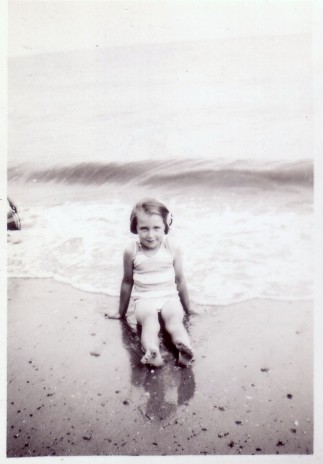
And gaze wistfully at black and white seasides.


It’s more than elusive,

But what they have in common,

Is leaving today behind.

Maybe, what I’m really searching for,

Is a different me,

Although I wouldn’t want to be a teenager again.


And if you haven’t tried it,

If you haven’t caught the sound of yesterday,

Or smelt the stale cooking and damp mothballs

Of a long-dead indulgent aunt,

Then perhaps you’re still too young.

Supermarket Gripes

P1040982b

I haven’t had a good rant for a while, so best I put that right.

I had cause to go into a large store of a well-known supermarket a while ago.

Make that a very large store.

An extremely large store. Obscenely large.

It was like a medium sized city inside.

Or possibly a large cathedral, which would feel more appropriate, since these things are the glorification of the worship of money. How so? This store, like most others of its hateful ilk, does not simply sell food, any more.

Oh no.

It sells clothes. It sells white goods. DVDs and CDs. Computers and accessories. Mobile phones. Books, stationery, and greetings cards. Items of furniture. Garden items. DIY stuff. It has started its own bank and offers everything from insurance policies to bank accounts. The list seems endless. If I had wanted a lighthouse or a wolf they would probably have got me one from out the back.

There seems to be very little that it does not yet sell, although I have no doubt that it will only be a matter of time before those few gaps are filled.

Its business plan is simple – put every single other type of shop out of business, and corner the market in everything.

I had the strangest feeling – the feeling that I was somehow diminished, just by being in there.

And the food items? The reason I went in there in the first place?

Apparently it is essential that we are able to choose from well over a hundred types of cheese which particular one we need – strong, very strong, beat your brains in, mild, sliced, grated, chopped in cubes, turned into string, low fat, no fat, cows’ milk, sheeps’ milk, antelopes’ milk, crocodiles’ milk, virtual cheese, and all produced by four or five different companies.

And that’s just the cheddar.

Its website tells me that it sells 343 different cheese products. I’m all for choice, but, good grief!

Interestingly, looking at a website for a rival big multinational, I find they sell 344 of these products. Perhaps I should go there, instead? I wouldn’t want to miss out on a shopping opportunity. They might be able to offer me a better ‘shopping experience.’ For my ‘shopping solutions.’

Why do advertising agencies have to come up with that drivel?

And that brings me to another interesting thought.

There is the push to encourage all shoppers to use the ‘self’ check-outs, but at least they seem to have reined back a little on the verbal persuasions. I was standing in line at my ‘local’ small branch last year, when I was approached by a member of staff who suggested I use a ‘self’ check-out.

‘No thanks.’ I said.

‘It’s okay,’ he told me, ‘I’ll show you what to do.’

I can see perfectly well what to do. I don’t intend to use it.’

‘Why not, sir?’

‘Because it’s sole purpose is to take away your jobs.’

‘That’s not so…’

‘I suggest you look at their website, then. Because I have. It clearly states that is one of the advantages of buying one.’

Damn the lot of them.

Virtually at Everest – part 1

I’ve not commented much on anyone’s blogs, recently, as I’ve rather gone into my shell for a bit. I do this at times, I’m afraid…engagement feels difficult…

And I’m fed up with having to sit around all the time with my foot in plaster and bandages. Even reading and writing is becoming a bit boring. Probably those two things are connected.

For my previous post, I revived my spirits somewhat by taking a virtual train journey in Sri lanka, so perhaps I should try something a little more adventurous this time, and put my virtually healed foot to a bit of a virtual test.

What about a trek up to Everest base Camp, then? That’d certainly test it out. And since I’ve got all of this virtual time at my disposal, perhaps I’ll do it the hard way.

But to start with, I’ll have a few days in Kathmandu; I always feel better for that. Just walking around Thamel and browsing in the shops there, stopping occasionally for tea or a snack or a beer at the Rum Doodle, ending up with armfuls of books I didn’t really intend to buy, handmade paper to paint on, handmade notebooks with beautiful cloth covers, some wood carvings…

105a

Luckily, this is a virtual journey, so I don’t have to carry them around with me. I’ll send them back home in a virtual package. But before I do that, I’ll just nip into this inviting looking restaurant for some lunch.

Oh, hell’s bells! Here’s Bob! ‘What on earth are you doing here, Bob?’

‘I heard you were a bit bored, so I thought I’d come along to cheer you up.’

‘Oh, that’s most, er, kind of you, Bob. Where are you staying?’

‘Kathmandu Guest House, Mick. Same place as you. In fact, I got the room next to yours.’

‘Ah. How…nice. Um, have you eaten, yet?’

‘I was just going to order. Oh, they don’t seem to have pizza here.’

‘No, they don’t. there’s a restaurant nearby where you can get one, though. Would you like me to show you where it is?’

‘No, that’s okay. Tell you what, I’ll try whatever you’re having. I’ll have the same.’

‘Really?’ Bob is probably the last person I’d describe as adventurous. I’ve never known him try anything new, and I just can’t believe he’s actually come to Nepal. I’ll ask him why once we’ve ordered some lunch. ‘I’m having the thugpa*, Bob. And a lemon and ginger tea.’

‘Sounds good.’

I order, still slightly shocked, then turn back to Bob.

‘What on earth brought you to Nepal, Bob?’ He looks down at the tablecloth, and seems a little embarrassed by my question.

‘Ah, there was a little, um, confusion, there.’ I wait, but he seems reluctant to continue.

‘And?’

‘I was planning to go to Naples. I think the travel agent must have misheard me.’ He looks up. ‘But it was great to bump into you. We’re going to have a brilliant time!’

‘So it was nothing to do with me being bored, then.’ He looks hurt.

‘Oh, it was! I just thought you’d gone to Naples, too. That’s where your wife told me you’d gone.’ My wife is, indeed, under strict instructions not to tell Bob where I am, and Naples must have been the first place she thought of.

Such is life, though. We chat a little, and the food arrives. Bob looks down at his with an expression best described as ‘disappointed’.

‘They’ve brought us soup.’

‘It’s thugpa, Bob. What we ordered.’

‘But I…’

‘You said you’d have what I’m having,’ I say, firmly. ‘I’m having thugpa.’

‘Oh, okay.’ He watches me eat for a few moments, then asks ‘Can I have bread with it?’

‘You can ask.’

He asks. The waiter shakes his head. Bob argues. He doesn’t want rolls. He doesn’t want brown bread. The waiter disappears, and moments later a boy dashes out of the kitchen and out of the front door of the cafe. A few minutes later he is back with a small package wrapped in newspaper. He runs into the kitchen. After another minute the waiter is out again with a plate, holding two slices of white bread, a knife, and a small mountain of oily butter, which he places down in front of Bob. Then he gives Bob a look that I can only describe as ‘withering’ and returns to the kitchen.

‘See, I knew they’d have it,’ Bob says, triumphantly.

Afterwards, he suggests we go sightseeing. ‘Let’s go to Swayambunath,’ I say, ‘You’ll find that interesting, I’m sure.’

‘Oh, what’s that, is it a castle?’

‘They don’t have any castles here, Bob.’

‘None?’ Sightseeing for Bob means castles. Or gardens. ‘I’ve got my phone with me. Let me take a look.’

‘Oh, I was rather hoping you’d have left that at home.’

‘No fear! I don’t want to get lost in a strange place! Now, what was that name again?’

‘Don’t worry about that, Bob. We’ll get a taxi.’

‘Oh, great!’ His eyes seemed to light up at the thought. ‘I know all about that! You have to haggle, right? For everything. I’ll do that, Mick. leave it to me!’

Well, although I seem to be saddled with a virtual Bob, I’m not going to let that put me off. Although I am painfully aware of the potential for him to offend people left, right, and centre, and possibly cause an international incident.

I suppose we’d better find a taxi.

*thugpa is a Tibetan dish, usually a clear soup of noodles and vegetables