Wednesday December 27th

It is windy this morning and the forecast is for rain and high winds later in the day. Consequently, I go out for a walk straight after breakfast, heading for the woods beside the common where I know I will be sheltered from the worst of it, should the winds get up soon. Above, the clouds are thick and dark and what light does make it through the mirk is thin and silvery, glittering coldly on leaves and puddles, the latter wrinkled with tiny wavelets scurrying in bursts across their surfaces.

A couple of rooks are calling irritably overhead, buffeted by the breeze, as I reach the edge of the wood. A few paces in, I pass along the edge of a shallow, long-disused sandstone quarry, its banks perforated with badger holes, and with other entrances deeper into the woods. The whole of the sett appears to occupy upwards of a fifth of an acre, although there may well be entrances I have not yet found.

Moving on, I find I am walking to the rhythm of a tune in my head, something that happens to me frequently. This time, it is a track from an album by Stick in the Wheel, a kind of punk-folk group, the track being the Abbots Bromley Horn Dance. Stick in the Wheel are a group I have only recently discovered, and the only album I have of theirs (so far!) gets played rather a lot. This particular tune has a very pronounced beat and I wonder, as I often do, whether the tune has come into my head as the beat matches my pace, or whether I have unconsciously altered my pace to fit the tune.

I also decide it doesn’t matter which it is.

It is still early enough in the day for there to be very few other people about. In about an hour’s time the air will be filled with barking and shouting as the regular dog walkers invade, but for now I have the place almost to myself.
I have just begun to re-read Robert MacFarlane’s The Old Ways, and in this he tells us that at the time of writing (2012) he reckoned he had walked perhaps 7,000 or 8,000 miles along footpaths in his lifetime. Does this mean each mile is a unique mile, in that he means he has walked this distance all along different routes, or does it include the day to day walks along local routes, routes such as the one I repeat day after day? He doesn’t make that clear, and I would guess it includes all repetitions. He then goes on to quote De Quincy saying that Wordsworth walked a total of 175,000 – 180,000 miles in his lifetime (although how did he know?), which would clearly include his repeated local walks, if true. I wonder how many I have done and make a vague stab at guessing a figure. At various times I have worked out I tend to walk an average of 20 miles a week, allowing for good and bad periods of walking, of which probably one half would be on footpaths. There were times when I did much less, and times when I did much more, but it seems a reasonable estimate. That would give me a figure of between 25,000 and 27,000 miles in my adult life so far, which is probably wildly out but is quite similar to Robert Macfarlane’s.

I’ve no idea what to conclude from that.

But I know I would probably walk quite a bit further if I didn’t tend to stop so frequently just to stand and stare at my surroundings. I do it often enough to sometimes irritate those I walk with, although they’re usually kind enough to say nothing about it. But there are also those who just get their heads down and walk, walk, walk, seemingly on some mission to cover as many miles as possible in the shortest possible time, barely able to glance around them as they go. What is that about, unless it’s some sort of charity event and they’re raising money by the mile? Where is the pleasure?

The Welsh poet W H Davies wrote ‘What is this life if, full of care, we have no time to stand and stare?’

What indeed?

I’ve been doing it quite a lot again this morning. It seems so important. Surely everyone must do it to a degree?
Wind And Wandering

We went down to Brighton for the weekend. Staying two nights there gave us a chance to watch the starling murmurations that regularly put on amazing displays around the old pier. It also gave us the chance to get up onto the South Downs for a good walk.

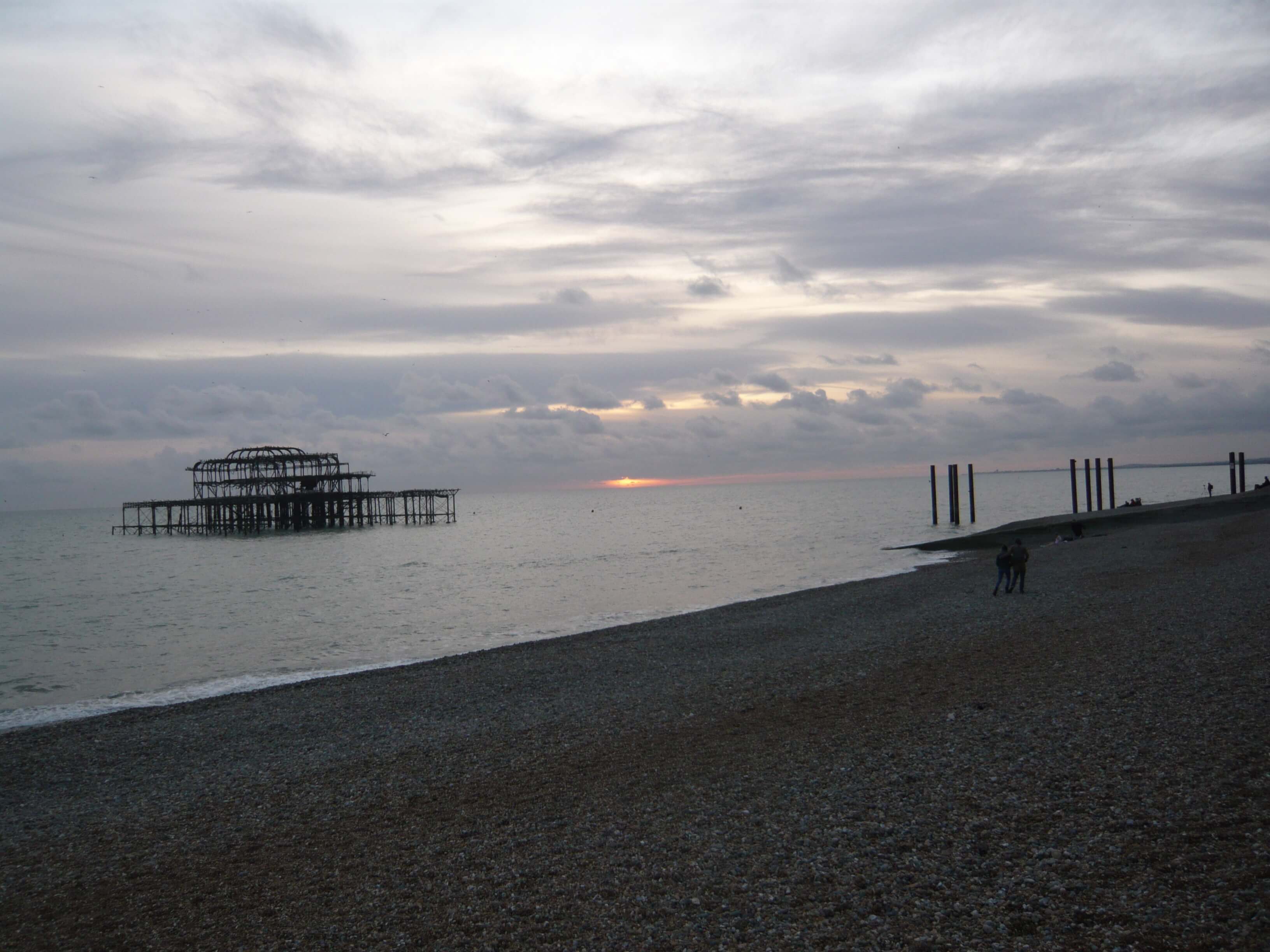
On the first evening we walked down to the seafront to await the starlings. It was a lovely sky, but with an extremely keen wind blowing in off the sea. After about half an hour our wait was rewarded with a brief but great display as the starlings whirled and dipped and soared in formation around the Old Pier. But guess who’s camera decided to stop working because of the cold? So, no murmuration photos, I’m afraid.

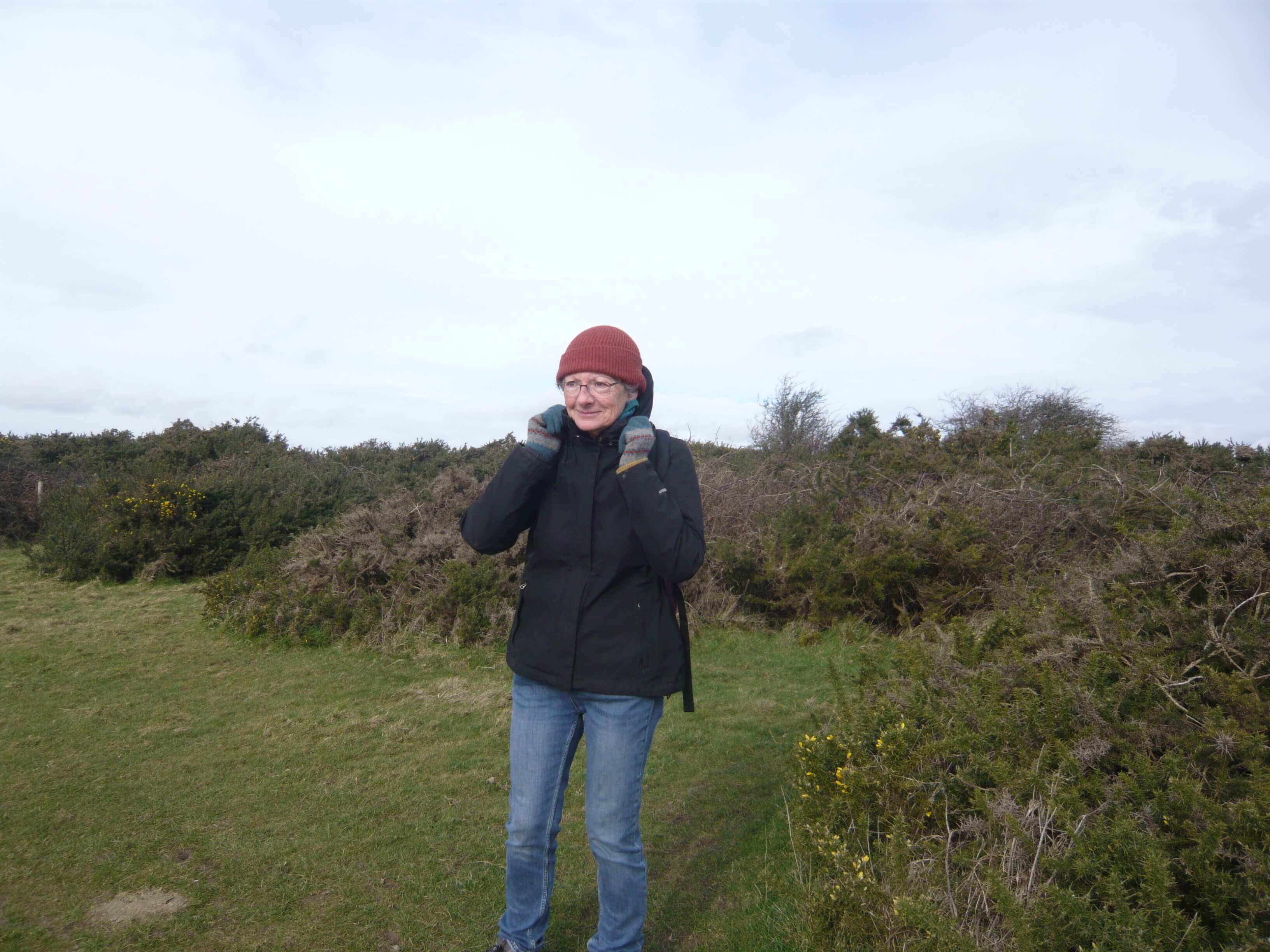
Next morning we caught the bus up to Ditchling Beacon. We were to walk from there to Devil’s Dyke, then catch another bus back down to Brighton. It was very cold and windy in Brighton, and all the way up gusts of wind buffeted the bus. Not a good omen. Anyway, the bus arrived at the top of the Downs and stopped. We got off the bus.

My God, it was bloody cold!

It was extremely tempting to turn around and get straight back on the bus again, but we (just) resisted it.

No, really, it’s lovely. Quite refreshing. Why do you ask?’

When we last passed this dew pond four or five years ago, the weather was deteriorating and a few wavelets wrinkled the surface, while the sky was largely blue but with a few clouds rolling in. Today the sky was greyer and waves were careering wildly across the water. Does it look cold? It was bloody cold! I may have mentioned that already.

After an hour or so, we dropped down to the village of Pyecombe and had a quick look around the lovely old church. Then the long, slow walk back up onto the Downs on the other side of the valley. At this point on our previous walk the rain had been pouring down and the clouds getting lower and lower. This time, despite the cold (I have mentioned that, haven’t I?) it was clear and sunny. And by this time, thankfully, we had warmed up somewhat.

Our route took us down a lovely sheltered holloway to another valley, where we began the final walk up to Devil’s Dyke.

By now it was sunny and despite the wind it was lovely. We felt we could have stood there and just looked at it all day. However, we had a pub with hot soup and cold beer to get to before our bus trip back down to Brighton, so we hurried on.

A Scottish Coast to Coast Walk (3)

22nd April 1994

Today the intention is to take it as easy as possible.

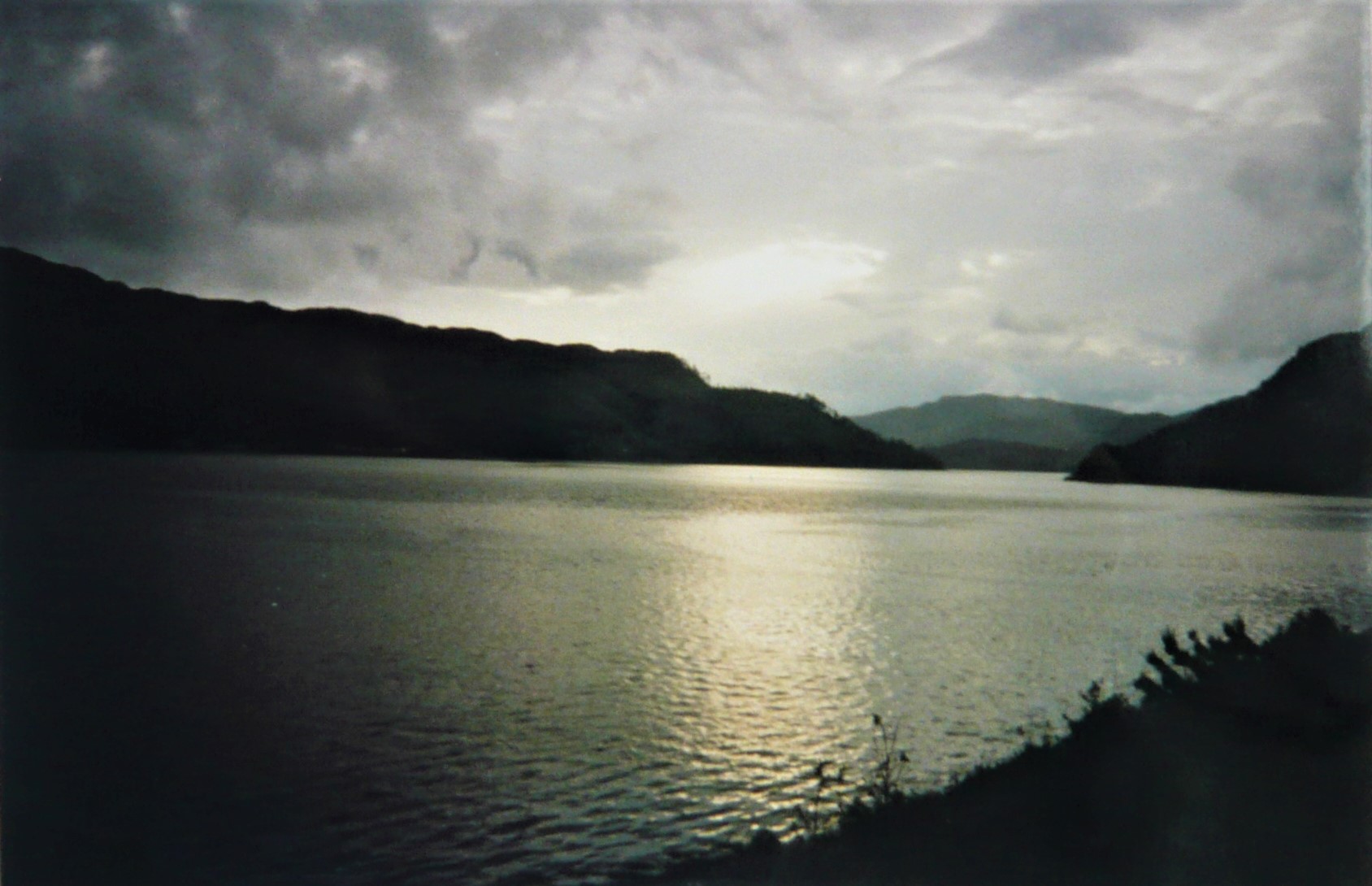
Loch Duich

Last night, after a fruitless search for treats I cooked myself some supper and then decided to walk on for another half a dozen miles or so with a view to just leaving a token walk into Kyle of Lochalsh. But I’d already done a good twenty miles already, and it was a really stupid move. Eventually I bivvied just off the side of the road, with the weather closing in rapidly. Clouds were rolling down the mountainsides and coming up the loch. By the time I was in my sleeping bag all hell broke loose. I don’t think I’ve ever heard anything like it. The wind howled and shrieked and at times it screamed. And the rain that accompanied it absolutely hammered down. It seemed to go on for most of the night and I lay there unable to sleep for the noise.

Castle Eilean Donnan

But by six the rain had stopped and the wind dropped, although it was still having a good old blow. I got up, packed up, then walked a mile or so back up the road to get a photo of Castle Eilean Donnan which I’d passed in semi-darkness the previous evening.

Through the rest of the morning I walked along the side of the loch through alternate rain and sun and constant gusting winds. Or perhaps ‘limped’ would be a better description, since I was now extremely footsore, and perhaps that contributed to a slight sense of let down when I got to Kyle. Still, that was my target and I’ve achieved it in around three and a half days. I will have covered around eighty to eighty five miles and since a lot of it was over steep hills and bog, I’m quite pleased with that.

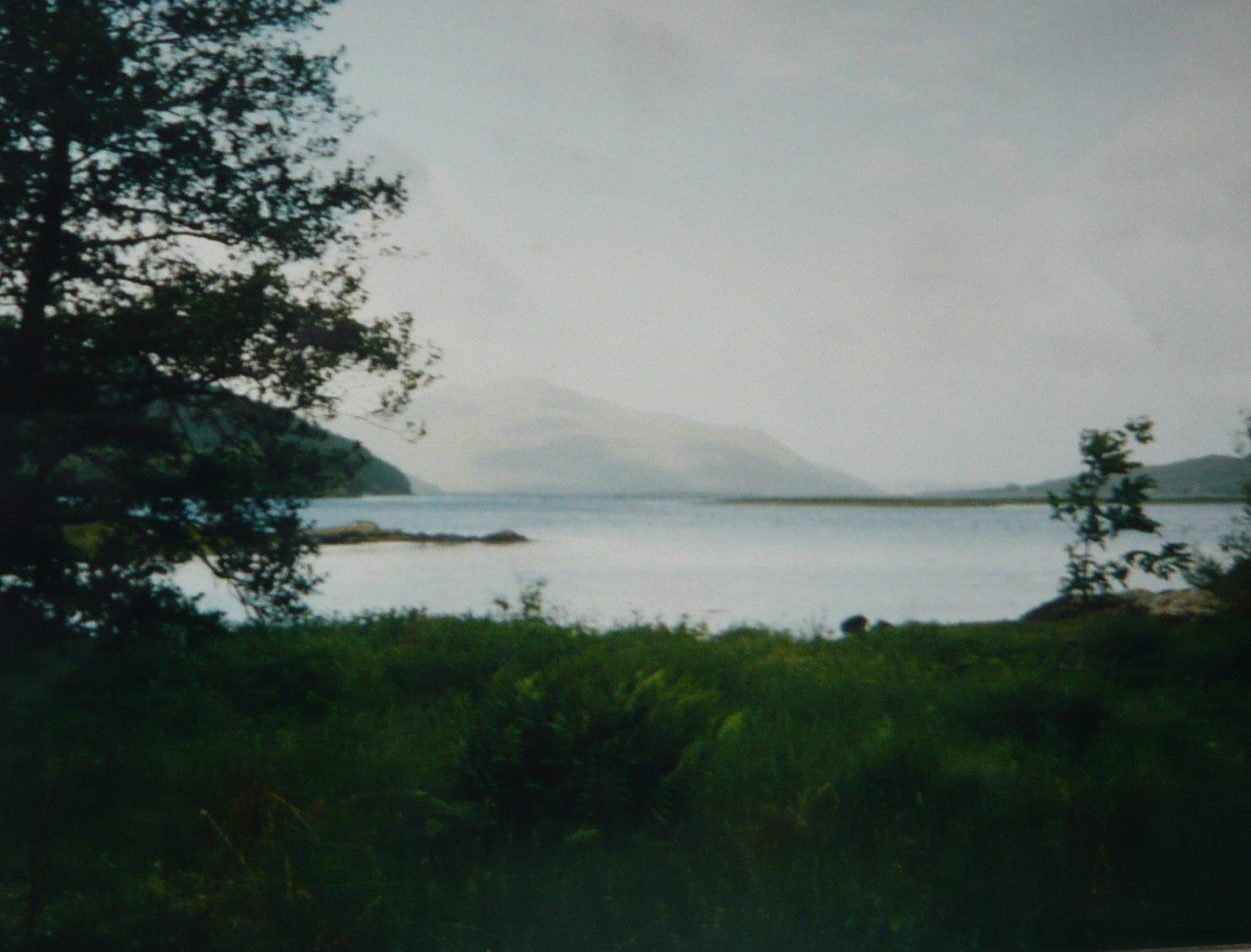
Looking down Loch Aish towards the Isle of Skye

I think it’s important to state here that even if I still enjoyed the same levels of fitness and stamina I enjoyed almost thirty years ago, and was able to repeat this walk, I would not do it this way.

I’ve no wish to set records and, really, I did not wish to do so then, but there is a sort of perverse pride that says ‘Look, I can walk thirty miles a day’, although that is not the only reason I covered so much ground each day. It was the middle of summer in Scotland, with very long daylight hours. The temptation to use them to do ‘just another couple of miles’ was too much at times.

Skye from Kyle of Lochalsh

And now I’m in a cheap guest house and about to have a shower and go out to find a café. Or maybe even a pub.

I suspect I’ll sleep well tonight.

A Scottish Coast to Coast Walk (2)

20th June 1994

It rained during the night, but when I emerge from my bivvi in the morning it has eased to an occasional drizzle. Down the valley to the east, the sun is glittering on the trees, while the hilltops are shrouded in cloud. Cotton grass and heather dance around me in the breeze, and it is warm.

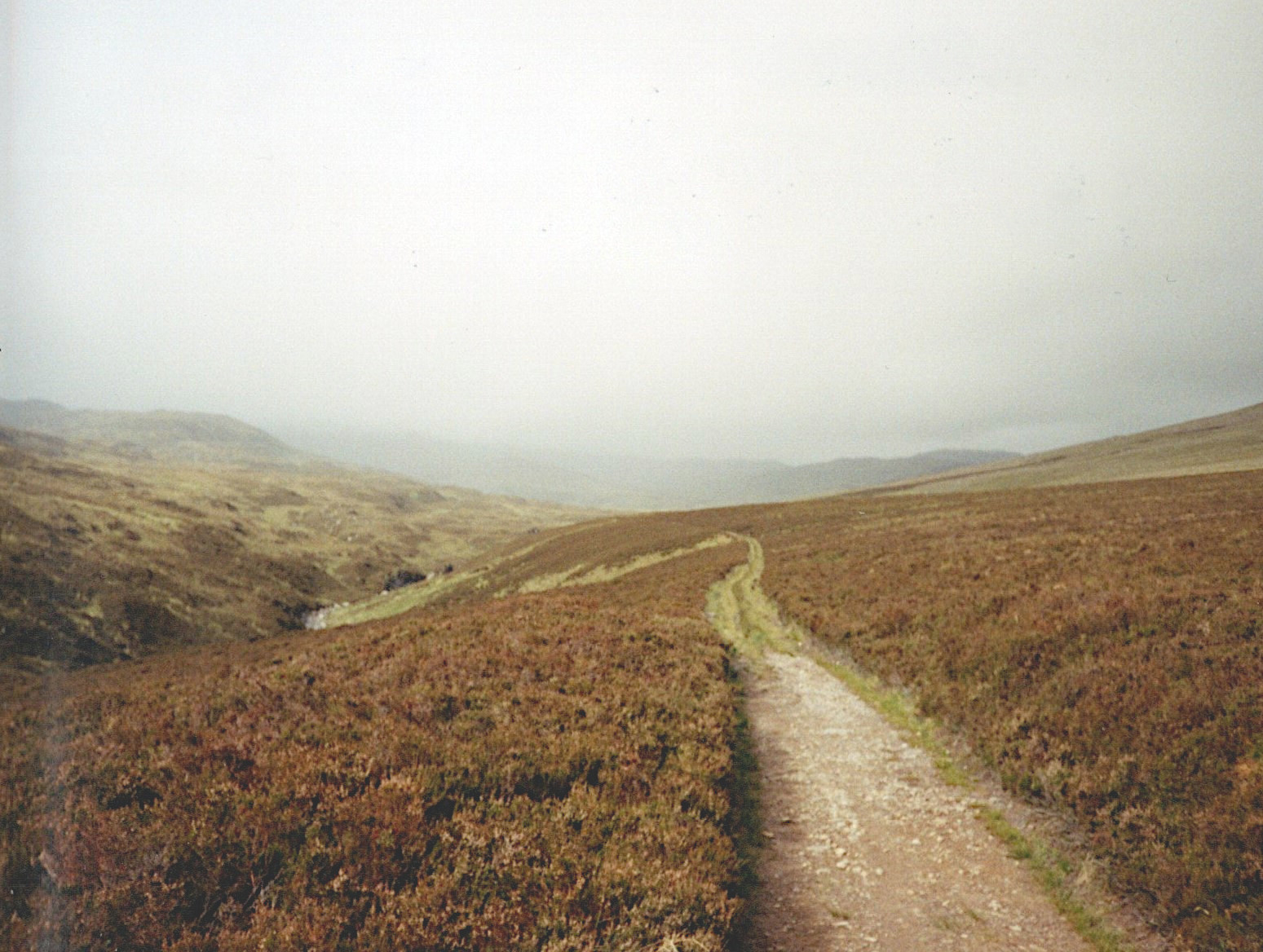
Glen Coiltie, looking west.

Through the morning, I work my way further west up Glen Coiltie, the wind slowly increasing in strength and the drizzle turning gradually to heavy rain. When I top a final ridge and begin to head down towards Loch Aslaich the wind positively howls. I plod along and gradually up onto a plateau where the path simply disappears. With the low cloud drifting across at ground level this becomes a good test of my navigational skills.

The weather worsens again. At times I stop just to retreat further into my waterproofs rather like a turtle withdrawing its head into its shell. It is a lovely landscape, desolate and wild, but just too wet and windy to enjoy, never mind even to think of taking any photos.

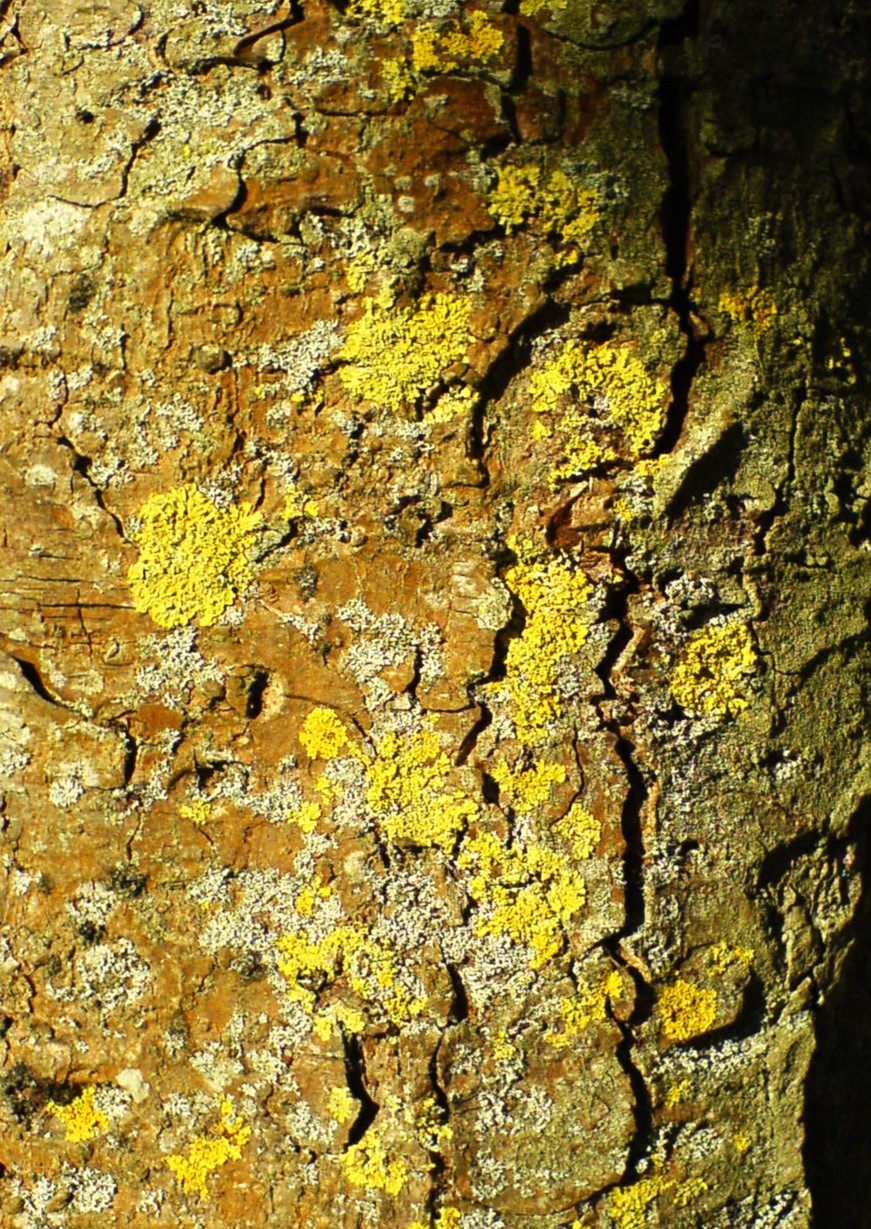
By the evening I am alongside Loch Beinn a Mheadhoin, after a long, wet, day. For a couple of miles I had been looking for somewhere to camp, but the path was through old pine forest and the ground was several feet deep in fallen logs and branches, all covered in moss and lichen. Eventually I find a spot near a waterfall amongst a few birches at one edge of the lake. It is a lovely spot, but I know what will await me in the morning.

21st April 1994

I unzip my bivvi and immediately a huge cloud of midges descends upon me. I forego breakfast for the moment and pack up as quickly as I can, flapping my arms around ineffectively and swearing my very bestest swears.

Not the best place to camp, beside open water with lots of tree cover

Soon enough, though, I am away from the water and ahead of me snowy peaks rear up above the trees. The thrill is upon me again! As I walk through the morning, the clouds are lowering and thickening again, but for now the rain holds off, for which I am thankful. It had been so wet the previous day the rain had managed to soak everything inside my rucksack. During the night I had gradually brought maps and clothes into my sleeping bag for my body heat to dry out. By the morning probably about half of it was dry.

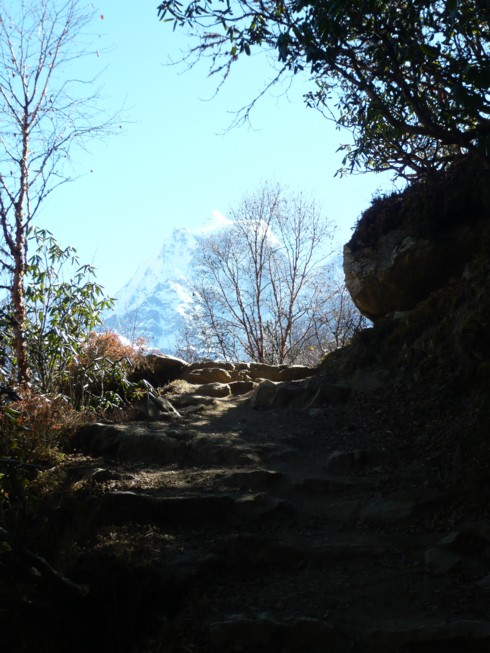
It is colder than yesterday. The snowline looks to be lower here; I am at about three hundred meters and there are pockets of snow level with me on the mountains nearby. But with the improved weather as well as the scenery, my mood is much better and I am enjoying just being part of the environment. It reminds me of other walks and treks I have done – I keep thinking of Nepal! – and in this mood the miles seem to melt away as I walk. The previous day, at one point I had managed less than five miles in three hours up on the plateau in the atrocious weather, so this day is a huge improvement.

The Five Sisters in the distance and Creag a Chaorainn on the right,

I follow a river for a while, and where the water is moving slowly I can really appreciate how beautifully crystal clear it is, even though it has a deep brown hue from the peat. There are tiny orchids in the grass, although I don’t know their name, but few other flowers just here.

An Tudair on the left and Sgurr na Lapaich on the right

And now I pass a couple of walkers and we stop for a brief chat. These are the first people I have seen since leaving Inverness and although yesterday the weather was so bad that only idiots would have been out in it (or one idiot, anyway), in a world of five and a half billion people, to spend a whole day travelling without seeing another soul from dawn to dusk is an increasing rarity.

River Affric near Athnamulloch. The sheep track is so worn it has almost become a tunnel.

I stop for an early lunch and then soon after I set off again I find the path disappears in a particularly boggy area and, predictably, it begins to rain. I take a compass bearing and step forward cautiously. Half a kilometre later I find the path again and the rain stops. Now I go uphill again, over the Eionngleann (lots of these names sound as though they come from Lord of the Rings), down into a long valley where the weather comes in again, and down to the village of Carn-gorm. The village sits at the head of Loch Duich, which joins Loch Aish and this opens up to the Atlantic Ocean. I’m definitely in Western Scotland now. Now to see if there’s anywhere in the village to get a pizza or something more interesting than what’s left in my rucksack.

Eionngleann
Looking North West down Gleann Lichd, my route down to Carn-gorm

Mud

The second of my ‘Poem a Day’ poems. Just getting this far is a bit of an achievement, I suppose, although I’m not particularly happy with either the meter or the rhythm. It feels as sloppy as the day itself was. But I think it has potential if I do a bit of work on it sometime later.

Mud

Today, the sun has been sent into exile,

Leaving just a weary daylight.

It has gone, and we shall never see its like again.

.

In the steady rain,

Climbing this hill is an act of defiance

A far more daunting prospect than usual.

It is like a resistance.

One step forwards and two steps back

I slide and slither upon the track,

Barely keeping my footing at times.

.

In places, mist curls beneath the trees

Where the birds voice their own defiance

Loud and clear.

.

Beneath the endless grey,

Still lower clouds like smoke from gunfire,

From shell bursts or industrial disaster

The earth torn up and churned

From countless toiling feet.

But other than the birds,

I have the world to myself.

Wandering

I’m posting this poem again, as it rather illustrates what I’ve personally found particularly frustrating during the recent lockdown. We can go for longer walks now, it is true, but that’s still not the same.

015a

If I could just wave a wand,

I would wander the world.

With my notebook in hand,

And a bag on my back.


I would sleep under hedges,

In hotels and haylofts.

Drink beers under trees,

And eat cheese on the moor.


I’d watch clouds over hilltops,

And boats on the ocean.

Shapes and shadows at sunset,

A moon with a view.


And I’d write trivial poems

Of snowfall and sunlight,

Birds singing at dawn

And the sounds of a stream.


There’s the lure of a skyline,

And skylarks above me,

Wine and woodsmoke my welcome,

At the end of the day.


To travel, to journey,

There’s magic in wandering

Over moorland and downland,

Through woods and through fields.


The world’s full of wonders

All waiting for wanderers.

Let me follow these paths

For as long as I can.

The poem can be found in my collection The Night Bus, which is available here. should your interest have been piqued by this…

I Am The Wind

Untitled-Grayscale-01

I clatter dry leaves along dusty footpaths

And bear burdens far greater

Than mere birds and clouds.


On high, cold, moors I blow

In the hollow eyes of sheep, inert and prone,

And ruffle the hissing grass over barrows

Of long-dead chieftains.


From the fading fires of the sick and the dying

I blow prayers in the smarting eyes

Of disinterested and uncaring gods.


I steal your thoughts.

Winter – a Tanka

I was writing a haiku yesterday, and decided to go the extra mile with it. Traditionally in Japan these poems were sometimes written in the form of tanka, which are essentially poems of five lines rather than three, with a syllable count of 5/7/5/7/7.

They could also be written as linked verse, with one or two poets writing haiku, and others supplying the two remaining lines between each haiku.

I’ve gone down the linked verse route, and also given myself the remit that each verse (of two or three lines) must contain a word or sentiment linking it to those either side – something that was also commonly done.

Yesterday was cold and miserable, hence the results.

It’s my first attempt – please don’t be too harsh!

029

The flowers have gone.

Crumbling stems standing askew,

In waterlogged soil.


Outlined against the grey sky,

Old willows by the stream.


Ten thousand leaves are

All that remain of autumn.

Wistful nostalgia.


Memories of warmer days,

Are all but forgotten now.


Wrapped up warm and snug,

Watching the grey willows weep.

Hands in my pockets.


Leaves fall slowly through the air,

Onto silent black waters.


Now a gust of wind

Swirls leaves around and around.

Racing each other.


Shifting clouds race overhead,

Sudden drizzle on the breeze.


Spiteful winter day,

Grasses shiver in the wind.

Low sunlight dazzles.


Walking in meditation,

Clouds unexpectedly clear.


Sudden bright sunshine

Reminds me the cold Winter,

Will change into Spring.

010a

If I Could Just Wave A Wand…

337a

Pandering to my Inner Vagabond, here…

If I could just wave a wand,

I would wander the world.

With my notebook in hand,

And a bag on my back.


I would sleep under hedges,

In hotels and haylofts.

Drink beers under trees,

And eat cheese on the moor.


I’d watch clouds over hilltops,

And boats on the ocean.

Shapes and shadows at sunset,

A moon with a view.


And I’d write trivial poems

Of snowfall and sunlight,

Birds singing at dawn

And the sounds of a stream.


There’s the lure of a skyline,

And skylarks above me,

Wine and wood smoke my welcome

At the end of the day.


To travel, to journey,

There’s magic in wandering

Over moorland and downland,

Through woods and through fields.


The world’s full of wonders

All waiting for wanderers.

Let me follow these paths

For as long as I can.


Keep Watch at the Window

It’s October.

021a

That must mean it’s autumn. It certainly feels like it, now. So here’s a little poem for when the days are drawing in and it’s becoming colder and darker outside.

Keep watch at the window in the Westering light,

On the distant hill in the approaching night,

Under darkling clouds, over dew-touched heath,

Where the flowers of summer are now touched by death,

I’ll be coming home in the fading light.


Keep watch at the window in the fading light,

You’ll see me walking when the moon is bright,

My shadow before me coming down the hill,

My breath opaque in the air now chill,

I’ll be coming home in the last of the light.


Keep watch at the window in the last of the light,

When I’m weary you’ll see me come into sight,

Drawn by the firelight and the thought of wine,

By the thought of you; so glad you’re mine!

I’m home now, let’s shut out the night.