May Day Mayhem

The May Day festival, Beltane, is a survival, or revival, from the Iron Age, celebrated in Celtic communities – Scotland and Ireland particularly – and revived as a full festival in Scotland in the 1980’s by the Beltane Fire Society. Beltane was a fire festival, although nothing of that remains in the festivities carried out in England. Beltane was first mentioned by name in Irish writings from the late 800’s / early 900’s.

The English version of this festival involves cutting flowers and greenery and dancing around a maypole, which things are also carried out during Beltane, celebrating the beginning of Summer which begins on May 1st. When I was a child, dancing around the maypole was the chief, possibly only, activity carried out on May Day. I have a photograph of my brother, my cousin, and myself, dressed up for the May Day Fair at which there was maypole dancing, but no obvious indication of surplus greenery. Past generations in England celebrated May Day with a day of celebrations which while including maypole dancing as an important manifestation of encouraging the fertility of the soil (and the festival-goers!) would also have included plenty of food and drink and general gaiety.

Mayhem, if you like.

This year, I managed two May Day days out.

On Saturday, two days before May Day, I visited Kingston near Lewes, in Sussex, for the Caught by the River Mayday event. Caught by the River describe themselves as an arts/nature/culture clash and you can read all about them here. I have followed them now for several years, and this seems as good a time as any to mention that their coverage of arts, nature, and culture are second to none and if you’re not yet following them, well, you should be.

There was mask-making to begin with, especially to involve the children, the makers encouraged to incorporate flowers and greenery into their masks, and almost inevitably a certain amount of folk-horror found its way into some of these.

Nice, Richard.

This was followed by a promenade around the maypole, after which the activity moved indoors.
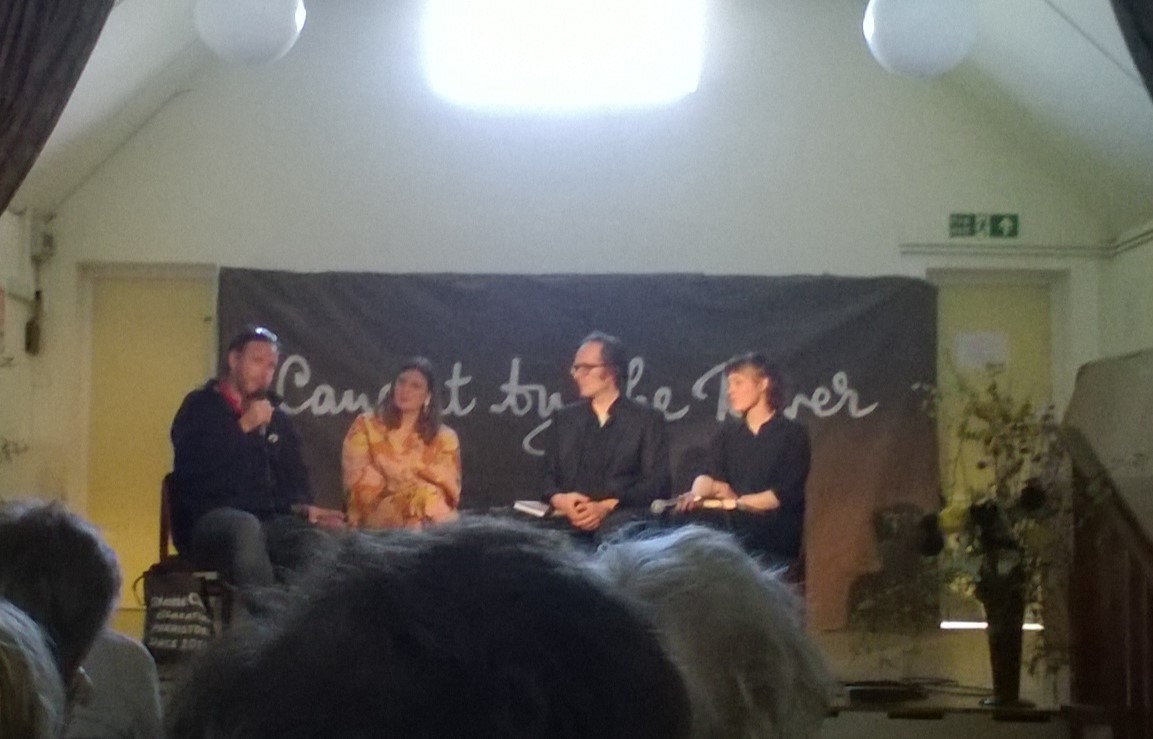
There were films, talks, and discussions, subjects including rivers, village life in the early eighteenth century, art, standing stones and the like, and the environment. After which, in the late afternoon, we all promenaded up the hillside to the Gurdy Stone.

This is the Gurdy Stone, a modern standing stone on a hillside overlooking Kingston. Here, Local Psycho (Jem Finer and Jimmy Cauty), held a gathering to encode the music of their Hurdy Gurdy song into the stone “To mark the 50,000 year return of the Green Comet and release of The Hurdy-Gurdy song on Heavenly Recordings.”

Throughout the day, naturally, we all had access to the pub.

And then on Monday, which was May Day, we went down to Hastings. It rather felt as though everyone in South East England must be in the town, either at the Jack in the Green festivities or watching blokes on motorbikes roaring up and down the seafront for no discernible reason. I don’t much like crowds, and some of this was very difficult. But away from the huge horsepower and testosterone nonsense, amongst the Jack in the Green celebrations the atmosphere was brilliant and the large numbers of people perfectly acceptable. Jack in the Green is a manifestation of the spirit of spring, related to the Green Man, a dancing figure covered in greenery.

The festival in Hastings has grown over the years into a large event involving musicians, dancers, Morris sides, huge figures in addition to Jack in the Green such as the Queen of the May, a witch, and others, plus any number of people joining in the procession around the town, all decorated with as much, or as little, greenery and/or flowers as they feel suitable.
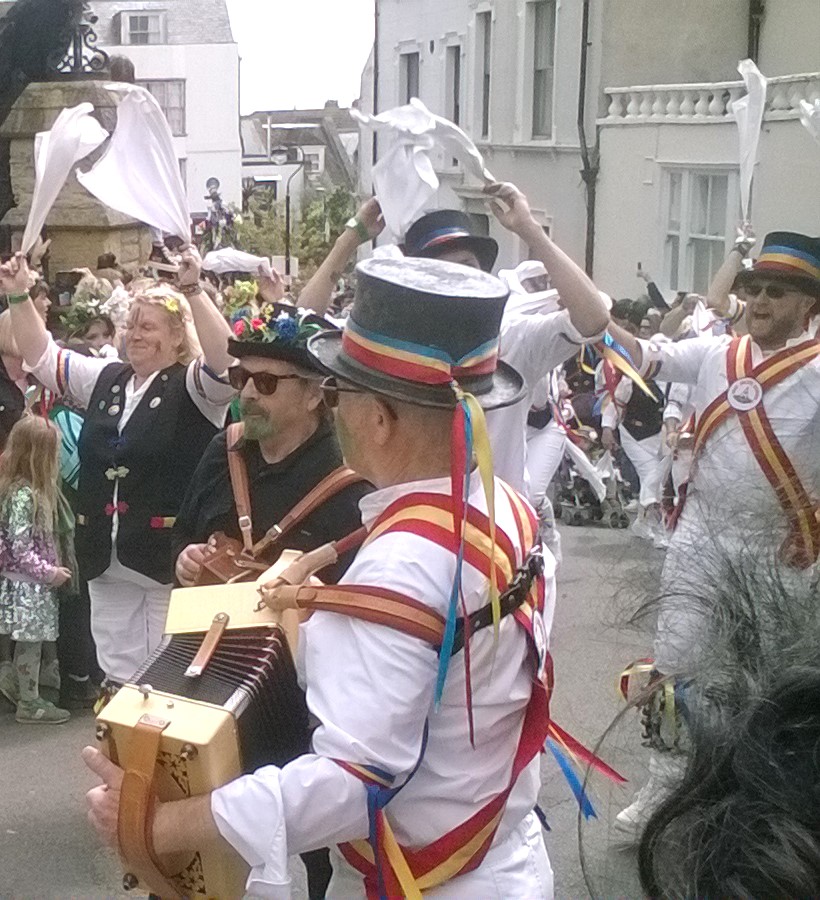
There you go, a Morris side.

Followed by a large witch with a cat. Why the witch? I’ve no idea. Why not? I suppose.
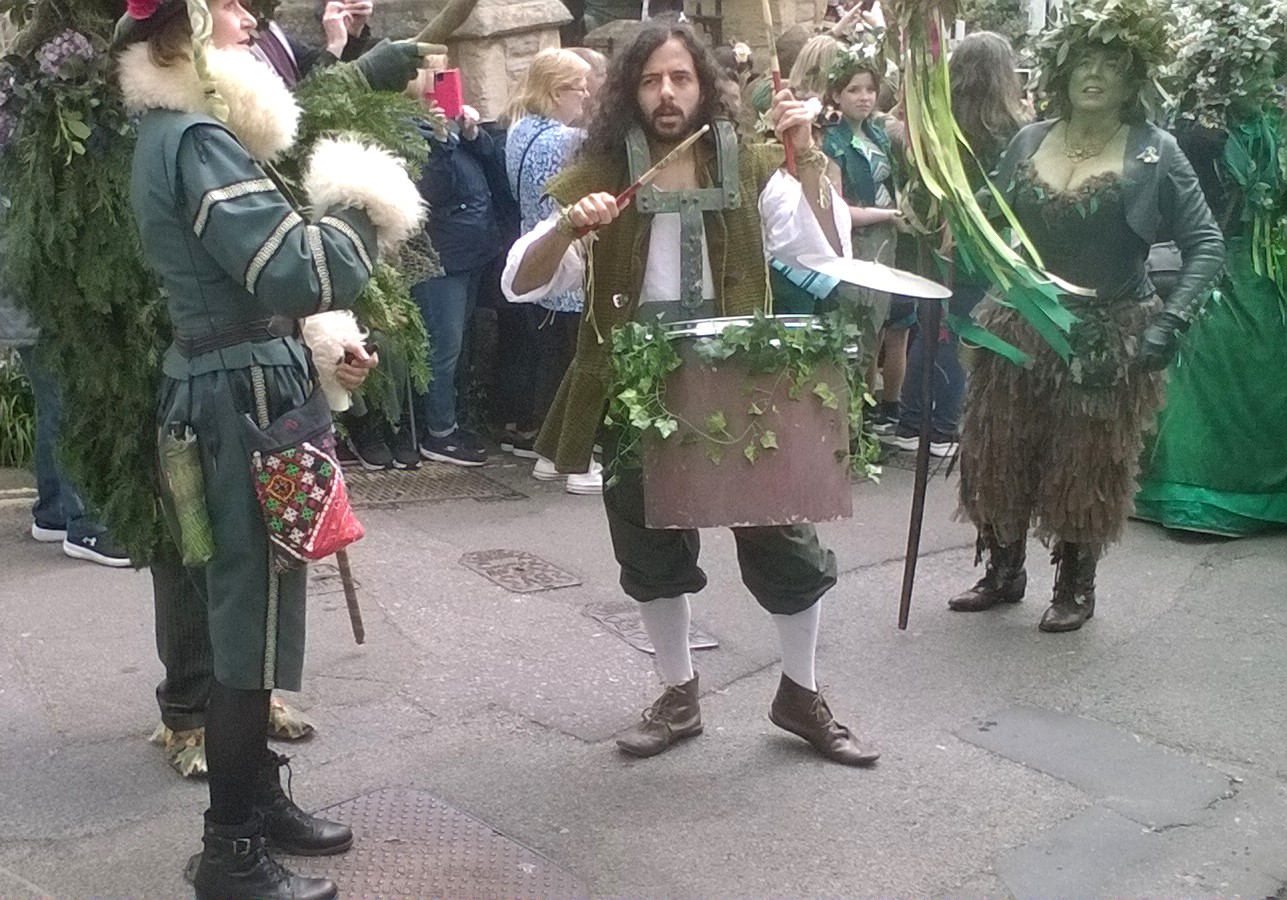
And there you have it. Music. Drumming. Greenery. Crowd involvement. Summer is icumen in and winter’s gone away-o.

And there was beer again, of course.
Review of An Atlas of Impossible Longing

An Atlas of Impossible Longing

A year ago I read The Folded Earth, Anuradha Roy’s second novel, and decided it was so good I would have to read all of the others. And so recently I finished her first book, An Atlas of Impossible Longing. In this, Anuradha Roy tells the story of three generations of a family who have moved from Calcutta to live in a huge, rambling mansion in Songarh, a small town in the hills of Bengal.

Amulya’s wife, Kananbala, hates the isolation of the town, with its lack of fashionable shops and social life, and longs to return to Calcutta. Their oldest son, Kamal, longs for children, and his youngest, Nirmal, is widowed and longs for his unmarried cousin.

Everyone appears to long for something that proves unattainable, and at the centre of the story are two children, thrown together by chance circumstance and then separated by the cultural fears of adults, but who have formed an unbreakable bond that endures through years of separation.

Mukunda is an orphan of unknown caste adopted by the family, and his only companion is Bakul, daughter of Nirmal. They pass their time playing in the grounds of their home or in the woods and fields around the town.

As Bakul and Mukunda grow towards adulthood, their friendship slowly begins to become something more, and Mukunda is sent away to Calcutta by the family, suddenly fearful of the consequences of this.

As the years pass, Mukunda graduates from college and becomes prosperous, even through the years of Partition, without ever returning to see the family who raised him, although he thinks frequently of Bakul. But then chance sends him to Songarh, and he realises he must find out what has happened to her.

The pace of this book is deceptively languid, but this enables Roy to paint the characters and settings in exquisite detail, and for the plot to unfold at an easily assimilable rate.

I feel you always gain more from re-reading a book, and I am longing to do this, to immerse myself again in the rich landscape and characters Roy has created.

Most definitely a five star read.

Responsible Travelling – Part 1

In a way, this could be titled ethical travelling, but I would like it to cover cultural issues as well as environmental and other ethical concerns. I don’t particularly like proselytising, but I think that we all need to be responsible for our actions: it makes for a happier world for all concerned.

156

So, in no particular order…

Trekking

First of all, when arranging a trek, please try and have a look at the ethical policy of your chosen company. Nowadays, many have a policy of ensuring that porters are properly paid and treated, food is sourced wisely and money makes its way back into the local community. The guides / cooks / sherpas or what-have-yous should be trained to ensure that the environment is treated with respect during the trek. Personally, I feel that from a selfish point of view it makes sense to choose a company that follows these guidelines, because I feel that I will be treated better by them, too. It should not be much more expensive, either.

Secondly, it is not all up to them. One of the most important things we can all do is avoid littering villages and countryside as we trek. Apart from the unpleasantness of spectacular scenery ruined by plastic bags and used loo paper, we can hardly criticise local laxness in this area if we are guilty of the same ourselves.

Deforestation is a major problem in the mountains now, which can only get worse with the effects of global warming. Consequently, anything that we can do to minimise the burning of wood is important, so please do not insist on unnecessary fires to sit around or warm up. You should have brought sufficient clothing on the trek for that. And it seems a minor thing, but if a group of trekkers turn up at a tea house and insist on lots of different dishes, then that will involve a lot of extra firewood to cook them. Try and have the same dish, if possible.

Shopping

Ah, yes. Such an important part of our visit, really. The ultra-cheap clothes, the amazing antique statues, the cheap religious paintings…unbelievable bargains, compared to what we would pay in the west…

…and rather a minefield, unfortunately. Those cheap imitation brand names, as we should all know by now, are usually produced in sweatshop conditions, conditions that would often justify being described as ‘slavery’. As well as being, usually, rather inferior quality. Difficult to avoid them all; after all, who is to say we shouldn’t be buying those attractively embroidered ‘I did the Everest Trail 2017’ or suchlike t-shirts for the equivalent of a couple of dollars?

Well, there is a world of difference between the genuine sweatshop (if I can use such a phrase) and the family sitting around their sewing machines under a tarpaulin beside the stall producing their goods. The latter may be working hard for a poor return, but may be infinitely better off than those with no work and certainly better off than the sweatshop labourer who will earn far less, in conditions far worse. Even today, unfortunately, some of them are bonded labourers.

The antiques…if you go to the Kathmandu valley, you will in many places find the remains of religious statues that have been stolen from their sites beside roads or outside temples. These statues usually find their way to the west to ‘collectors’, or may be sold off to tourists who know no better. In many countries you will need an export licence from the authorities to take antiques over 100 years old out of the country simply to attempt to prevent this sort of desecration. Invariably it is possible to buy modern copies of these items – handcrafted and as beautiful as the originals. It is better for everybody if the traveller contents themselves with these, not least because the smuggler can be hit with a hefty fine or prison sentence. It is also worth mentioning that many of the ‘antiques’ are fakes, in any case.

And the religious paintings. Again, in Kathmandu, Thankas, the paintings that hang in temples, are frequently offered for sale. And again, if genuine, should not be sold. They have probably been stolen. Wherever they are offered for sale, however, there will be bright new paintings for sale – equally beautiful, well made and far cheaper. Spend your rupees on them and support the craftsmen that make a living that way.

BIG or small?

Staying with the shop theme, it seems fairly obvious that by buying from the little shop rather than the supermarket you will be far more likely to be putting money back into the local community. All well and good. Inevitably, though, it is never quite as straightforward as that. Moving south across the border to India, we may find that in the market that we are searching for souvenirs, as well as local traders there may be traders from Tibet or Nepal, Kashmiris and dealers from the city. How you wish to spend your money may pose a dilemma that I cannot solve for you. But at least give it some thought!

The same situation can arise with hotels and trekking companies. I feel that in that situation, the small company or hotel is likely to get my rupees, since, unless I know otherwise, they are more likely to put money back into the local community.

Water, water everywhere…

…but most of it comes in plastic bottles which end up littering the environment, or refilled by unscrupulous rascals with what could be contaminated water, to be sold on again. Avoid this if you can (not always possible, I admit) by taking water purifying tablets and using the local water – read the instructions carefully to see exactly what is required – or using the boiled and filtered water available in some places (See info in places such as Lonely Planet guide books). If you buy plastic bottles, scrunch them up before disposal to prevent their re-use.

In some places, such as Ladakh, you can find environmentally minded laundry shops, where the soapy water is disposed of properly, rather than just poured into local streams. May they prosper and multiply!


How India Changed an Englishman

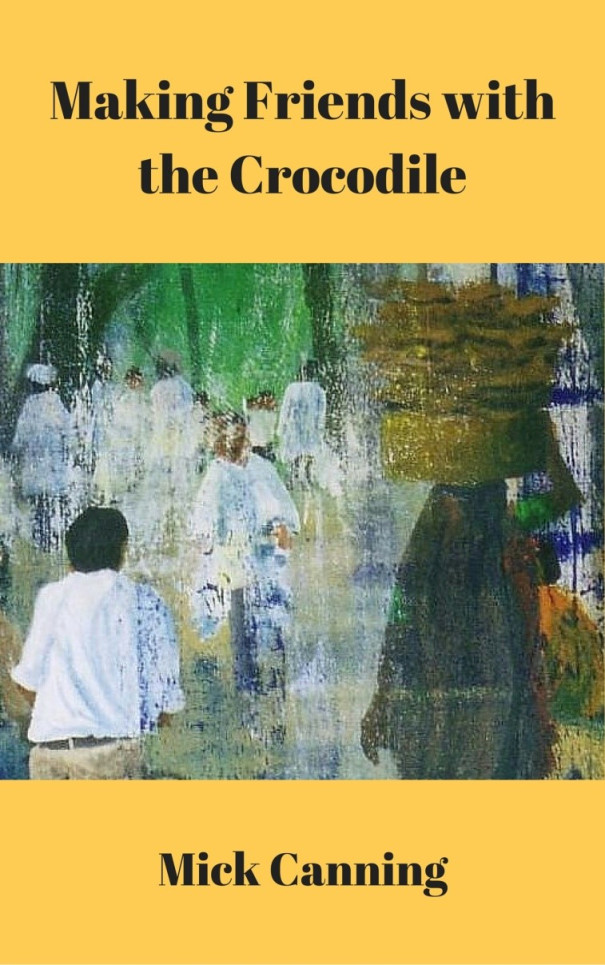
I wrote a piece for The Good Men Project, about my time in India and how I came to write Making friends with the Crocodile’. Sushi Menon kindly edited it to make it readable, and gave it a title, and you can find it here:

How India Changed An Englishman

Making Friends with the Crocodile cover

An Alien Culture?

More people travel for leisure purposes today than have ever done so in the past. And many work abroad on short- or long-term contracts, often with a certain amount of leisure time available to experience the culture that surrounds them there.

And this will result in these travellers meeting the people that make up the indigenous society where, for a while, they find themselves. Will there then be a meeting of minds?

Having lived in an ex-pat society, as I have referred to on here before, I am familiar with the laager mentality that often pervades it. I won’t go into all the permutations, but there is frequently a combination of arrogance and fear that leads to a strong feeling of ‘us and them’.

Many travel with the firm conviction that their own society is superior to any other, and are unwilling to see any good at all in any others. Some who go away to work resent being uprooted, and arrive with that resentment packed in their baggage. Some find the experience to be fearful, if they do not understand the language being spoken around them or assume that this alien society has values that somehow threaten them.

And they can either lock themselves away and peer over the barricades, or they can embrace the experience and learn from it.

137 (2)

Travel broadens the mind, it is said, but sometimes it seems to just cement prejudices more firmly in place.

And how easy it is to travel around just looking for things to justify prejudices!

One of the more infuriating things that I come across occasionally is a bigoted and ignorant letter or article in a local newspaper (it often tends to be the local ones) where someone’s idiot views are justified by the phrase ‘I know; I was there’. I imagine them living their entire time in a foreign country in a compound that they rarely leave, yet thinking that they now know exactly how the society functions beyond their walls.

I’ve met one or two of them, over the years.

I spent three years in Oman, working, and I’ve travelled fairly extensively in India, but I do not imagine or pretend that I really have much more than a superficial experience of these places. I knew little of the local culture in Oman beyond what I could see in the streets and villages and markets that I visited. I didn’t know anyone well enough to spend time at their homes or in their social circles. I went with groups of other westerners to places of interest. I did spend a lot of time exploring the desert and the nearby towns on my own, but I was effectively still inside my own little bubble. It is a huge regret that I never got deeper under the surface.

I have, perhaps, managed to learn a little more about the real India, especially through spending time on a project in a village, although I cannot pretend, even to myself, that I really have any idea of what it is like to actually live in an Indian village.

During the later days of the British Raj, the rulers took the approach that their civilisation was naturally superior, and that there was nothing in Indian civilisation worthy of their consideration. The irony of this is that around the end of the eighteenth century, and the first years of the nineteenth, many of the British in India had taken a keen interest in Indian history and culture, themselves doing a tremendous amount to unearth much of the history that had been lost and forgotten. For that comparatively brief period, it would seem that many of the British treated Indians and their culture with a deep respect.

The reasons that this changed are probably deeper than my understanding, but two things stand out. Firstly, that from the beginning of the nineteenth century, many British women came to India in search of husbands, bringing with them what we tend to think of as Victorian attitudes, and secondly, there was an upsurge of evangelism in Britain, which translated itself in India as a movement to convert the ‘heathens’ to Christianity. These combined as a new feeling of superiority, and contempt for a society that was now seen as inferior, especially when much of it resisted their overtures.

With this, the British as a whole seemed to become more intolerant and arrogant, and less respectful of sensibilities. This culminated in the horrors of 1857, which could be said to be caused directly by these attitudes.

To return to the present day, it seems that many travellers have attitudes no better than their Victorian predecessors’. I wrote a post a few months back that mentioned a number of westerners I came across in a Himalayan hill resort, https://mickcanning.co/2015/10/25/the-mad-woman-of-the-hill-station/  should you wish to view it, whose behaviour and attitudes were just downright arrogant and disrespectful. They were doing no more than confirming their prejudices as they travelled, and at the same time I daresay they were confirming many people’s views of western travellers.

Yet there are many people who travel with open ears, open eyes and an open mind, and their rewards are far greater than those of the blinkered traveller. They have the wonderful opportunity to experience and learn about different cultures at first hand, speak to people who hold different beliefs and ideals to them, and perhaps learn a little of what drives them. In return, they have an opportunity to enlighten others, perhaps, to things in their own society that might not be understood by those others. In a small way, each and every one of them can choose to contribute either to different societies coming to understand and become more tolerant, or to the further spread of tensions, mistrust, and misunderstandings.

And all of these little interactions, added together, are as important and influential as the contacts between politicians and diplomats.