On Windover Hill and The Oddness of Time

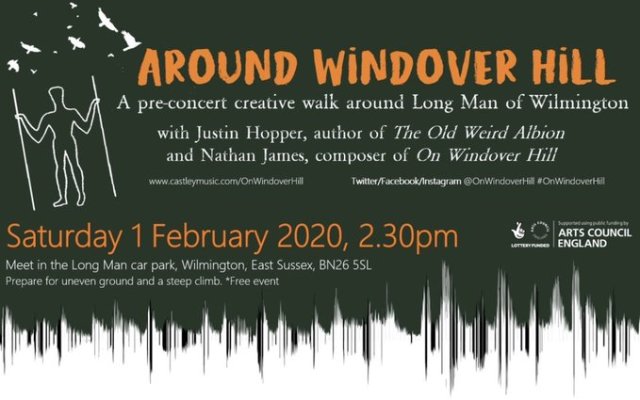
Yesterday, we joined a walk to the Long Man of Wilmington, on the South Downs in Sussex. The walk was led by composer Nathan James, and Justin Hopper, the author of The Old Weird Albion.

EPrcQenWoAQWbeb

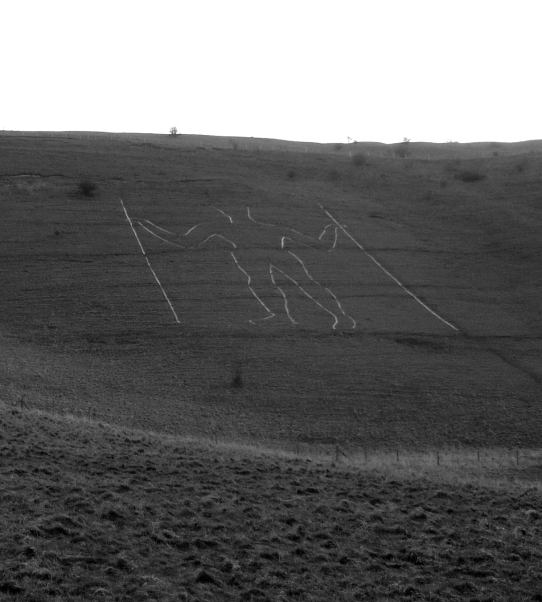
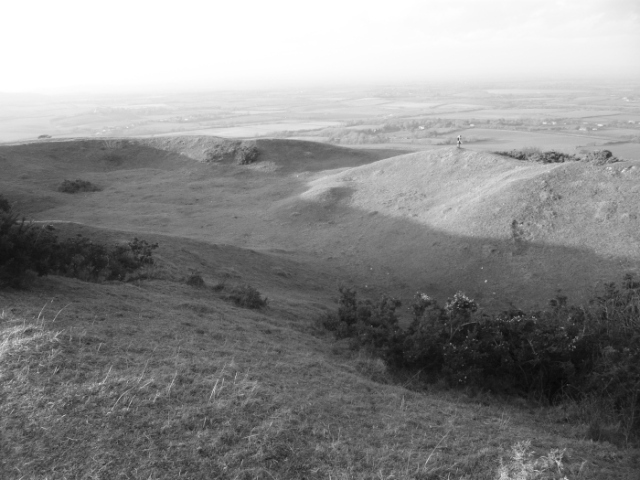
The Long Man is a chalk figure etched through the grass into the hillside, below the summit of Windover Hill, revealing the chalk that lies beneath. When and why it was first cut is the subject of myth and speculation – and that brings us neatly to Nathan’s new composition.

P1060405a

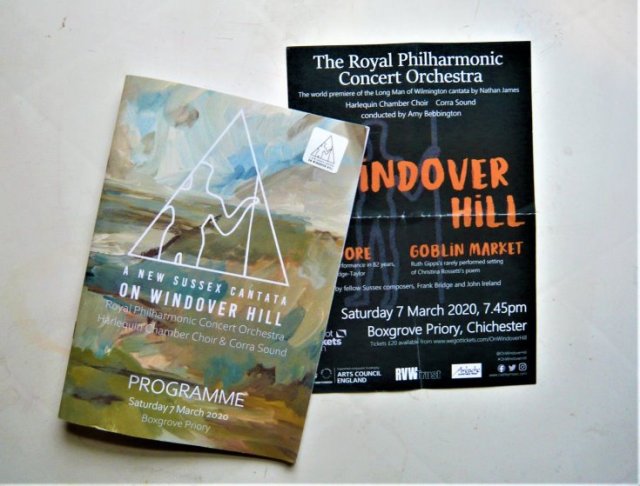
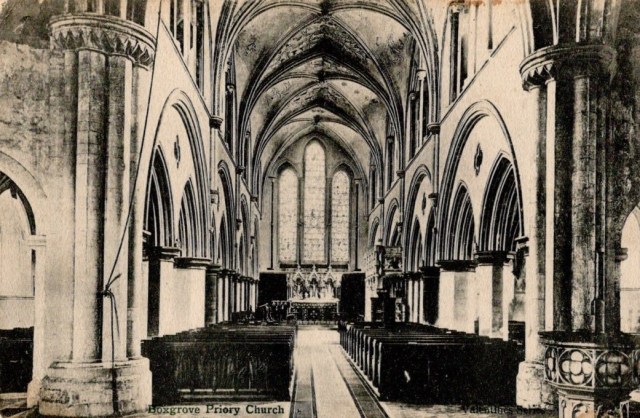
On 7th March, Nathan will premier his fantastic new choral work On Windover Hill at Boxgrove Priory, Chichester, Sussex. This has been inspired by the Long Man, its mythology, and the art that has arisen around it, as well as the written history and the geography of the surrounding land. It has a very English feel to it, in the tradition of Vaughan Williams or Holst.

Full details of the work and the performance can be found here. Tickets can also be bought by clicking ‘The Premier’ link in the sidebar there. We have ours, and it would be great to see it sold out!

This walk was by way of a taster for the concert, with a mixture of history and mythology imparted along the way, a poem from Peter Martin, read by himself, and extracts from stories read out by Justin, all of which referenced the Long Man. Also  Anna Tabbush sang two folk songs, one of which was the only song known about the Long Man, appropriately enough called The Long Man and written by the late Maria Cunningham.

P1060395a

I’m not sure How many people I expected to see, but we were around forty, with a surprisingly large number being artists of one sort or another.

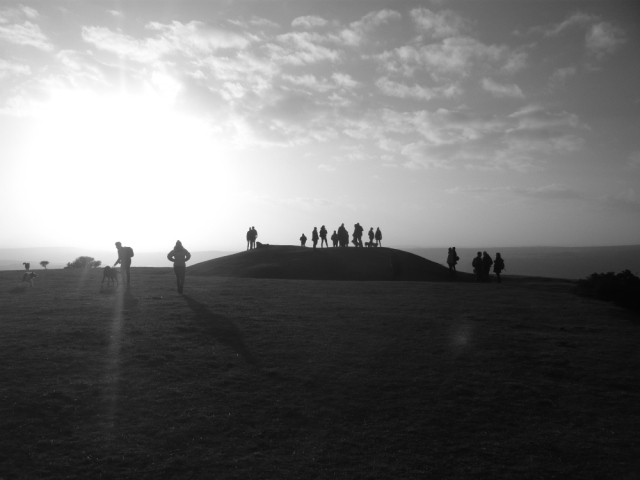
The weather was so much better than we had a right to expect – the forecast had been for clouds and rain, but the clouds cleared during the morning, and we had plenty of sunshine as we ascended, although it rather lived up to its name at the top, with more than enough wind for everyone.

P1060404a

Here, the remains of prehistoric burial mounds sit overlooking the Long Man, and the rest of the surrounding countryside.

P1060403a

Some landscapes seem to muck around with your perception of time, and Downland seems especially prone to this. I’m not entirely sure why this should be, but suspect it is a combination of factors.

It is a very open landscape, and other than the contours of the land and a few trees, frequently the only features that stand out are prehistoric ones, such as barrows and chalk figures. Due to the uncertainty around their origins, these have a timelessness about them, a fluidity when it comes to grasping their history. We see the long view, which perhaps works on our sense of time as well as space. The more recent additions to the landscape are usually in the form of fences, which can easily seem invisible as we look around for something less ephemeral than the open sky to fix our eyes on.

The Downs are an ancient landscape, in any case. When human beings recolonised what is now Britain after the last Ice Age, at first they kept to the higher ground which gave less impediment to travel and settlement than the marshy and thickly wooded lowlands. Most standing stones and burial mounds from the Neolithic or earlier are found on these higher areas.

I do not get these feelings in more recent landscapes. At a medieval castle or manor house, it is easy to imagine the inhabitants baking bread or sweeping corridors; activities as natural to us today as they were then. I feel a comfortable mixture of the old and the new, a recognisable timeline connecting the past with me.

But barrows, standing stones and hillside figures have a purpose alien and unknown to us. Step on the ground near these remains and you can feel the presence of the unknown. No wonder the belief in the past in faeries and elves who inhabited the underground, and who lived essentially out of time.

They offend our carefully erected sense of order and belonging and, perhaps, still pose a barely acknowledged threat to us today.

I might be imagining it, of course, but listening to the extracts from On Windover Hill on the website, I think I recognise that feeling in places, an unexpected musical response to my own feelings. And then Nathan’s description of his creative process on the website echoes some of this too.

I’m hooked!

Review of The Old Weird Albion

The Old Weird Albion, by Justin Hopper.

download

The viewer sees a painting that appears to be composed of watercolour and charcoal, of a winding road or track, possibly even a river, leading towards a line of downland hills, the whole created entirely in black and shades of grey, with the title and author scrawled into the picture in brilliant white, as though it were a prehistoric figure etched into the Downs themselves.

And that’s just the cover.

This is a book quite unlike any I have read before, in that it is a book about the south of England, especially the South Downs of Sussex, but it is far more than geography and the associated disciplines such as geology and biology, rural history and architecture, and folklore. Psycho-geography was not a term I had come across before, but there is an aptness to it that becomes apparent as you read.

The book opens at Beachy Head, a beautiful piece of Sussex with a dark reputation for suicide, as a woman throws herself off the edge. Quickly, we learn that this woman was the first wife of the grandfather of the author, Justin Hopper. And we learn that this book is in part a chronicle of his efforts to discover this person and learn something of her life and, consequently, her motives for such an act.

In so doing, he needs to revisit parts of his earlier time in Sussex and examine his own relationship to the area as well as the relationship of other players, not just his grandfather and other members of their family.

He has a gift for sifting and selecting the weird in these relationships, not just at sites that might be naturally expected to encourage the weird, such as Chanctonbury Ring, high on the Downs above Steyning or in old ruined buildings, but also in humdrum blocks of flats in modern developments. He references modern phenomena like crop circles and throughout there is the presence of ‘magic’, in the sense of a natural force. Many of the people he meets are an eccentric mix of the weird, too, although I choose this description carefully, largely in the old, original meaning of the word of ‘fate’ or ‘destiny’.

A strength of this book is its intensity, and I feel impelled to look at the pictures it references and read the books it quotes. So much so that upon finishing the book, I spent some time tracking down an old copy of one of those books, which I am now reading, and which holds my interest in just the way Justin implied it would.

On a personal level, this book came just at the right time for me, in that I am reacquainting myself with the geography and history, and the plants and animals, of the South of England, where I grew up and which formed my love of the natural world, and the book has encouraged me to look at this in a new way.

It is most certainly a five star book for me.

Myth, Science and Religion

Religion begins as science, as an attempt to make sense of the world. The birth of religion marked the dawn of humans as rational, analytical beings. This was humans moving beyond the worries of simply surviving from day to day, and reaching that point in evolution where they looked with wonder upon the world around them and asked: How did this come into existence? What is it that controls the weather and other variables? By observing the natural world around them, the cycles of day and night, the seasons, the migrations of the animals, they would have concluded that these patterns suggested a grand design and order.

003a

An assumption would probably be made that all this was controlled by benevolent beings, but beings who might need propitiating occasionally to keep them sweet; the odd ritual here, perhaps a sacrifice of some sort there.

And if that was so, perhaps they could be propitiated in a somewhat greater way, to grant other boons?

It would not be long before someone claimed a channel to the gods to relay their desires and instructions, and so the priestly class would be born. Self-interest? Quite likely. After all, we see that in most religions today, so why not?

Religions then, over the years, spawned new religions, the spark being reinterpretation rather than inspiration.

We think we see echoes of old religions in myths. Myths are the fragments of history we know, combined with assumptions about how our ancestors acted and thought, frequently combined with scarce written evidence, which may or may not be biased or wholly inaccurate. When our written sources include stories of monsters and miracles, we should probably be advised to treat them cautiously.

Myth-makers frequently come with an agenda, although depending upon your point of view that is not necessarily a bad thing. If you are looking for a scientific analysis of the lives of our ancestors, it’s probably best to give myth a wide berth. Or at least to be very, very, careful what you take from it. But in a way, it does provide an alternative world view that many find preferable to both the stark realities of day to day life, as well as the cold dead hand of religion. After all, if you’re using your imagination, it’s easy to plan your myth-world much the way you’d like it.

And perhaps myth does offer us a way of getting inside the heads of those people, at least superficially.

One assumption we can make is that there would be similarities in the thought processes of those people, with the thought processes of us today. It is perfectly reasonable to assume they would react in similar ways to us, to pain and fear, to pleasure, warmth and cold. Our reaction to the unknown tends to be to populate it with characters or situations based on our experiences, and they probably did the same.

Stonehenge is aligned with the solar calendar. This we know. It’s science. And we know a considerable amount about the geography of the area around Stonehenge at the time it was built, through archaeology and science.

What we don’t know is how it was used. Just because it was aligned with the rising sun at summer solstice and the setting sun at winter solstice, does not mean we know what took place at those times. We assume our ancestors worshipped or venerated the sun there, especially at the time of the solstices, but we do not know that. Were there sacrifices? Did they hold special ceremonies connected with fertility or birth or death? Was it perhaps just like a club where they turned up now and again and got drunk and held orgies? It could be, since there is no hard evidence for anything.

Believers in ley lines also claim it is at the centre of an intricate system of lines connecting natural (‘holy’) locations with important (‘holy’) sites such as churches, wells and crossroads. Pseudoscience? Coincidence?

Our assumptions, though, lead us to think that because of the immense effort required to build the structure, it must have been an incredibly important site, and we are surely justified in concluding important ceremonies were enacted there.

Whatever they were.

The Weald of Kent and Sussex

South East England is my area. It is where I was raised and, other than a few years spent abroad, it is where I have lived my whole life. In particular, the Weald and the Downs. Not so much the coastline, which has never particularly attracted me, but the hills and valleys, the woodlands and rabbits, the hidden crags and open downland, the land of streams and foxes and badgers, birds and villages and butterflies.

039a

On the Sussex Downs

There is a curious fact about the wooded areas of South east England, which is that there is more woodland, covering a greater area now, than was the case four hundred years ago.

032a

Back then, South East England was the industrial heartland of Britain. This was before the discovery of the coal seams of the North and the Midlands, and the various factors which would eventually lead to the greatest impact of the Industrial revolution being in those areas.  Instead, the modest iron deposits of the Weald were mined and worked into firedogs and nails, cannon and cooking pans, as the wealth of words such as hammer and forge in place names still bear witness.


037b

Huge numbers of trees were cut down to feed the fires of these forges, and huge numbers also for charcoal burning, for building, and near the coast the great Kent and Sussex oaks were in huge demand to build the large number of ships the navy demanded. But then from the mid eighteenth century onwards, industry began to shift northwards.

Despite the pressures on the land for building and for farming in this crowded corner of our crowded island, there is actually more woodland now than there was during the fifteenth and sixteenth centuries. And that is not something that can be said of many parts of Britain or, I suspect, many parts of the world at all.

010a

The Weald is an area whose underlying rocks are sandstone and clay, which means that the unimproved soils are inevitably either light and sandy or thick and claggy. In some parts there are old sunken tracks known as ‘Summer Roads’, so-called because they became impassable in the winter months, when they might have had a foot or more of thick, wet, muddy, clay on their surface. When these were in use, journeys between villages that might take an hour or two in summer, could became almost impossibly long during the winter.

037x

At the moment, all everything in the news seems depressing and unpleasant and so, this post is an indulgence. Just a smattering of information, and a few photos of places I love, largely to improve my mood.

Seven Cities of Delhi by Rajiv Chopra


001

On my first visit to Delhi, almost thirty years ago, I was overwhelmed by the huge numbers of monuments there, such as the Red Fort and Purana Qila. I found the area around Paharganj to be chaotic and exciting and everything an inquisitive Westerner could wish for – a mixture of smells of food and incense and, yes, sewage. A mixture of ugly concrete buildings and beautiful dilapidated buildings left over from the British Raj and often much earlier. Milling crowds of people and cows and rickshaws and bicycles and autos, and history, history, history.

Chadni Chowk was incredibly crowded, the Lodi Gardens completely deserted. The Jama Masjid crowded by tourists and worshippers alike, the Janta Manta often almost empty.

There is so much history everywhere you turn in Delhi.

Other Westerners I met tended to be highly disparaging of Delhi, which was something I couldn’t completely understand since many of these same Westerners seemed to praise Mumbai and Kolkata for the very reasons they hated Delhi.

Yet Delhi is, I think, one of the most exciting and interesting cities I have ever visited. From a historical viewpoint alone, it has over ten thousand listed monuments.

Ten thousand!

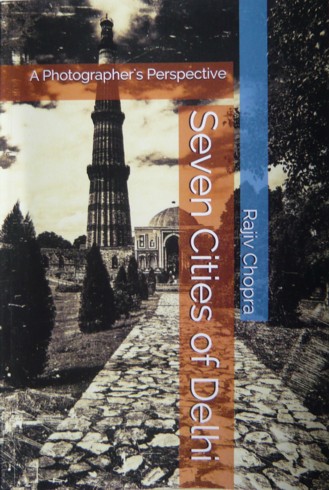
Rajiv Chopra is a Delhi based photographer with a passion for recording both the historical Delhi and the street life he comes across from day to day. In this book, he has combined his photographs with a little of the history of the seven historical cities that constitute Delhi, and also a perspective of the differing processes that photography has passed through from its invention up to the present day.

To illustrate all these factors, his book is split into seven sections – one for each of the historical periods – and in each section he has outlined one of these photographic processes so that, for example, in the section covering the first city, Mehrauli, he speaks of daguerrotypes. And then his own photographs he processes through Photoshop to simulate the effects of these processes.

This is not a long book, but it does not pretend to do more than act as an introduction to the history of Delhi. And in this it certainly whets the appetite for more, and then for anyone with even a passing interest in photography it gives a concise and potted description of these photographic processes. Finally the photographs themselves complement the text perfectly.

I unhesitatingly recommend this book for anyone who wants to know a little of the history of Delhi, and who enjoys photographs that give a real flavour of the history of that magnificent city.

Five stars out of five.

You can find Rajiv’s website and blog here

The Enduring Lie of A Golden Age

It seems that huge numbers of people have an impression that there was a ‘Golden Age’ at some previous point of their, or some other, society.

They may not define it in those words, or even acknowledge it as such, but it seems to be very common for people to yearn for another time. Sometimes, this is nostalgia – for the days of their youth – but frequently it is for some far-off time that they feel to be somehow better than the time they live in.

Untitled-Grayscale-01

Fantasy books frequently encourage this sort of thinking. Regardless of the actual storyline, the heroes and villains and cast of other odd characters tend to run around and fight and go on quests and sit around in quaint thatched inns quaffing head-splitting alcoholic drinks and everyone is jolly and no one ever dies of dysentery or bubonic plague in misery and agony and squalor.

The Lord of the Rings is a fine example of this. It is a favourite of mine, but it is very noticeable how no one dies of disease, but mostly lives to an exceedingly old age unless chopped into pieces by Orcs.

Hollywood, too, plays its part in this. To take a film at (almost) random, an old version of ‘Robin Hood’ (set in medieval England, remember) depicts a group of merry men dressed in very strange attire living in the depths of a forest and merrily ambushing the Bad King’s men, merrily dining at long tables out beneath the spreading branches of merry oak trees under starry skies and everyone looks clean and clean shaven and everyone is merry, and it never rains.

Pah!

This is meant to be medieval England. Life expectancy at the time was around 30 years. Huge numbers of people died of dysentery, mainly because there was no concept of hygiene. Occasional plagues carried off massive numbers of people, emptying entire towns and villages. There were no antibiotics or anaesthetics. Disease was sent by God and the only way to cure it was considered to be prayer. Or witchcraft. Women routinely died in childbirth, in great pain. The majority of children never reached their teens. Every peasant in every village was effectively a slave under the command of the local lord, who held the power of life and death over them, and might exercise this on a whim at any moment. The threat of famine was ever present.

Pain and misery was a given.

The majority of people lived, too, in a very real terror of the Devil and the threat of eternal damnation.

The list of horrors is almost endless. The phrase ‘life was nasty, brutish and short’ is an apt description of those times. Certainly, I would not wish to live under those conditions.

There are plenty of other ‘Golden Ages’, of course. Almost any time in history can exercise a fascination on us, if certain aspects of it appeal to us and there are things we dislike about the society we live in. And it is natural to yearn for something better; something more than we have.

And this is not to suggest that every age was a living hell for everyone in that society, but that life in most of these times was reasonably decent for the very few on top of the pile, and pretty miserable for the rest. In fact, the measure of how ‘Golden’ an age was, tends to be the conditions of the upper echelons of that society, and perhaps those of a middle class, if such existed.

There is much wrong with our world today. But the huge advances seen over the last hundred years or so, especially in medicine, have meant that our lives have been improved out of all recognition. No longer does surgery equate to filling the patient with a quart of whisky and then sawing off a leg or an arm. No longer do those patients routinely die of infections after surgery, thanks to antibiotics. High blood pressure is controlled, rather than routinely killing. Children usually survive all the diseases of childhood, rather than being most likely to die. Women rarely die in childbirth, and the pain can be somewhat controlled.

Women and children are no longer the legal chattels of men.

Work conditions are hugely improved. Children do not go down mines or work at dangerous looms 14 hours a day. Instead, most receive a proper education. Adults, too, work fewer hours and under far better conditions than previously. When they are too old or frail to work, the state provides a certain amount of dignified support. People do not as a rule die these days of starvation. We do not execute children for stealing sixpence, or poaching rabbits on the Lord’s estate.

In most cases, for most people, today is the Golden Age.

Visit to Kashmir

I fell in love with Kashmir.

It was 1989, and I had come to India to have a closer look. A year before, I had flown to Delhi and the same day taken the bus to Kathmandu to go trekking in Nepal.

This meant that I had a lot of hours sitting and watching Northern India go past the windows of the bus, and this had piqued my interest and convinced me I should go and have a proper look.

So I arrived and, a couple of days later, took the bus up to Srinagar, a journey of 24 hours. In those days, I never kept a travel journal, which is something I regret now. It makes it difficult to piece together the details and leaves me, at best, with impressions and, of course, a number of photographs.

The photos, though, were taken on a cheap camera, and I did not take many.

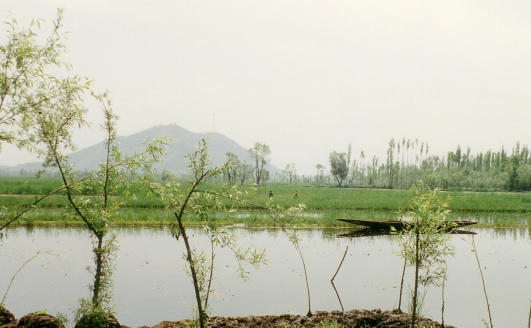
But I had a week in Srinagar and although I did not venture far afield from there, I loved what I saw of the valley with its gardens, Lake Dal with its confusion of meandering paths through fields and grass, naturally, the houseboats on the lake and also the shakiras, the sampan-like boats used by the fishermen and the traders on the lake.

shakirab

Shakira on Lake Dal

I found a houseboat when I arrived, managing to resist ending up in a hotel in town that was being pressed on me by a fellow on the bus. I seem to remember I found my houseboat by going to the lake, hiring a shakira and asking the boatman to take me to the first of a long line of moored houseboats, where I asked if there was a room. I think at the second or third I struck lucky.

I keep trying to remember the name of my houseboat.

Occasionally, during their waking day, a dreamer will catch a glimpse, a snapshot – no, not even that; perhaps no more than a hint, a flavour of a previous night’s dream. Something akin to catching a scent on the breeze that is gone before it is even realised that it was there. That is the best way I can describe the teasing hint I may get of the name of that boat. I think ‘Ah, yes, it began with ‘S’…no, wait, it didn’t, but there was definitely an ‘S’ in it somewhere. Perhaps…’ then it has gone.

But it was my own floating palace for a week. A marvel of beautifully carved wood, a magnificent bedroom and living room all to myself, and a fellow who lived on board (not the owner, I gathered) who cooked my meals. When I wasn’t ashore exploring, I sat on the deck and read.

I remember the Shalimar Gardens, and that there were at least one or two more; masses of flowers, large lawns, trees…I wandered around there with the high mountains towering above us.

And, there was the beginning of the agitation. At that point, I knew next to nothing of India’s history or politics, and although I could detect the tensions, I was unaware of what they comprised. Once or twice, there were isolated gunshots in the distance, especially at night. ‘Bandits’, said my fellow on board, rather too casually. I came across a mass demonstration outside a mosque in town, with either the police or the army, I’ve no idea which, a very heavy presence. There was a lot of shouting, and the atmosphere was hostile enough for me to make myself scarce fairly quickly.

But I personally encountered nothing but politeness and good humour, and other than the underlying tensions, despite getting ripped off now and again in shops (it was Kashmir, and I was a tourist!), I felt comfortable and happy there. When I left the valley to return to Delhi and thence further afield, it was with the thought I would return again one day.

Regrettably, though, each time I have returned, it has not been considered a safe destination.

Perhaps, though…perhaps…one day…

Older Pictures – Nainital

I have to begin this post with a caveat; it is quite possible that one or more of these photographs are not actually of Nainital, but perhaps of somewhere else. They are certainly of India, but there is nothing written on the back of the photographs. The majority were my father’s, taken by him on leave during the 1940’s, and since he died a long time ago I can no longer question him.

Nainital means the ‘eye lake’, and refers to the goddess Parvati. According to legend, her eye fell into the lake when Lord Shiva, her husband, carried her body back to their home on Mount Kailash.

naini tal

This first one is a postcard I bought on my visit to Nainital in 2005. Normally, you expect a postcard today to be a picture of as good a quality as possible, so I was delighted to find this one. I have no idea how old the original would have been, but I would guess that it dates from the inter-war period.

hill station 4

This one was taken by my father (or so I assume – another caveat, I suppose!) since it was amongst the ones I inherited from him.

hill station 2

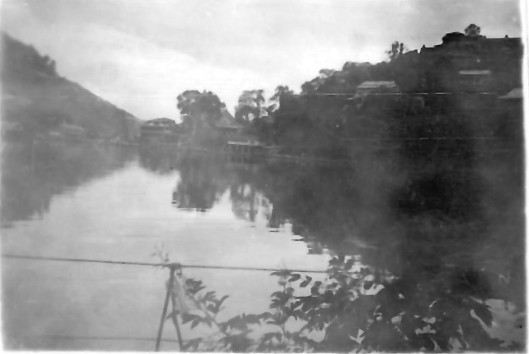
This one I believe is of Nainital, although I cannot work out any details of either the direction it was shot, or the buildings down the hillside. Someone who knows Nainital (Rajiv?) might be able to help me with this one.

IMG_0003

Snow View, Nainital. The back of the postcard is blank, and so again I have no idea how old it would be. Google is no help, either. I found two other copies of the postcard, but neither told me anything about the picture.

hill station 1a

A view across the lake.

IMG

And a view of some pretty serious recreational boating.

dad 1

My father indulging in some of this recreational boating.

IMG_0001

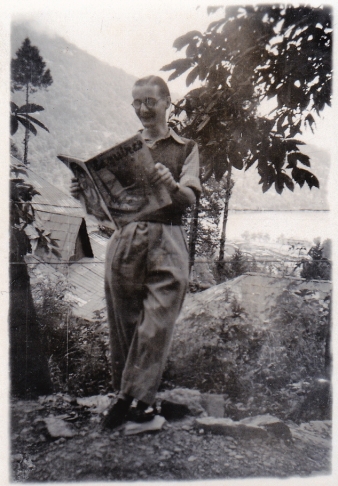
Finally, a photograph of one of his army mates. Although I have no idea who the subject is, I really like the photograph.

The Past is a Foreign Country; We Did Remarkably Similar Things There

Or, following in my father’s footsteps, or something like that.

Putting up some old postcards of Darjeeling earlier this week set me to thinking. And, let’s face it, anything that can achieve that is a good thing!

I have posted before that my father spent time in India, both during the Second World War and in the days leading up to Partition. If you would like to re-read it, the link is here: My Father In India

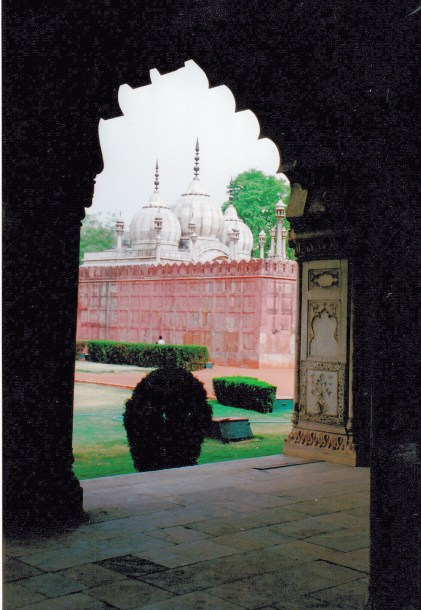
In this post, I mentioned that when I first visited India in 1989, at least, my first proper visit rather than simply passing through on the way to Nepal, I visited the Red Fort in Delhi, taking plenty of photographs, of course.

Some while later, at home, I was going through some of my father’s photographs, and discovered that I had taken a photograph of a view of the mosque in the Red Fort that was almost identical to one that he had.

img

Above: the one my father had. And, below: the one I took.

img_0001

Looking at the minaret in front of the dome closest to the viewer, it seems I took my photograph from the archway to the left of the one my father’s photograph is taken from, but otherwise we must have been standing in the same spot. My father would have been quite a bit younger at that time than I was when I visited the Red Fort, and the circumstances very different. But I’m sure that he felt the same sense of awe that I did.

Now there are mature trees behind the mosque, a couple of low hedges in front, and the creepers on the wall have gone.

Otherwise, the view is the same.

And because my father is no longer here, there is an extra poignancy to this; although our footsteps crossed and merged at this place, thousands of miles away, and we both must have lingered in this same spot and, who knows, possibly thought similar thoughts, the passage of time means in reality we might as well have been tens of millions of miles apart.

And this led me to look more closely at his other photographs.

There are not many, perhaps thirty or forty of them, but it is strange that when he was on leave in India, one time, he went with a few chums up to Nainital, and again there appear to be photos taken from spots where I have stood. The images are not the same, this time, but again our footsteps must have crossed.

I think the greatest regret I have about this, other than the obvious one that he is no longer alive, is that I cannot talk about these places with him. But just sharing them is good, even if it does make me feel sad.

Historic Darjeeling

Digging into my (admittedly rather small) old postcard collection, I came across a few picturing Darjeeling.

imga

On this first one, other than the title, there is no information on the card. It is unused (as are the other two here), so I do not even have a postmark to help me guess what date the picture was taken. I would guess, however, that although the postcard was probably printed in the 1930’s, the photo could be ten or twenty years older than that. It looks as though the road on the right is The Mall, and the one running from left to right a little way below the skyline could be Hill Cart Road. Looking through a magnifying glass, it is possible to see that there are plenty of pedestrians, but I cannot make out a single vehicle. The photo would have been taken from a high spot on Dr Zakir Hussein Rd, near where the TV tower now stands.

img_0001

The second one is simply labelled ‘Native Village, Darjeeling’, and is the representation of a hand-tinted black and white photo. ‘Darjeeling’ is much more than the town, of course, and covers a large area all around it. Other than that, I could not hazzard more than a guess where this village lies. Searching through a few internet sites, however, I found another copy of this with a date of 1910.

img_0002

Finally, ‘The Railway Loop above Tindharia, Darjeeling’. Also hand coloured, this particular picture appears to be a copy of a photograph taken in 1880 by Bourne and Shepherd. Also known as ‘Agony Point’, this was built to enable trains to tackle the steep gradients by spiralling around instead of going straight up or down. It is renowned for being an incredibly tight loop.

Perhaps this is also a good place to slip in a link to my previous blog post:

My First Long Trip to India (5) in which I wrote about my impressions of Colonial era India when I visited Darjeeling for the first time.