Pilgrimage

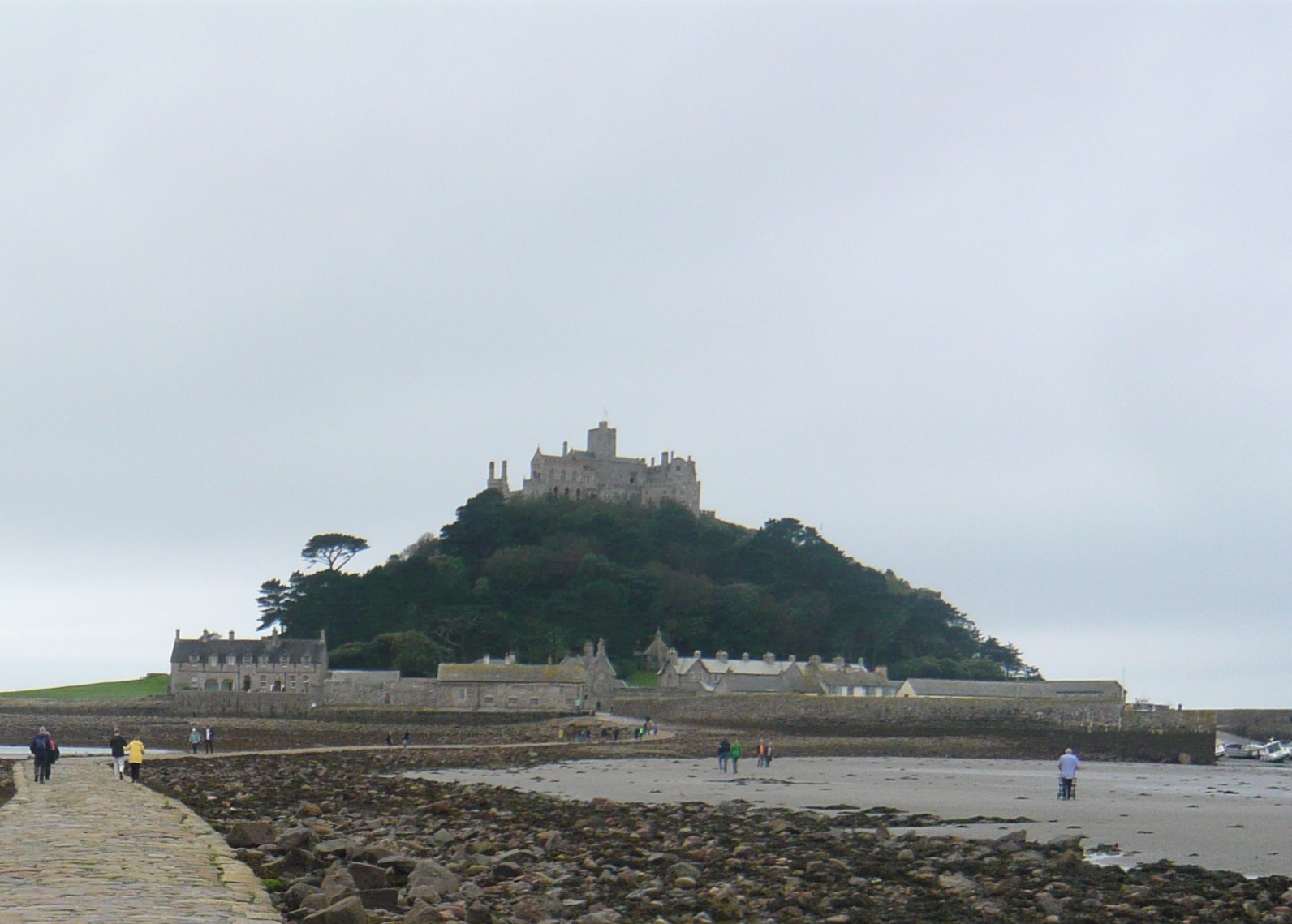
We recently returned from a week in Cornwall, and where we stayed was close to the end of a pilgrim route, St Michael’s Way. This is a short twelve and a half mile walk from the North Cornish coast to St Michael’s Mount, in Mount’s Bay on the South coast. Although the route is such a short one – a day’s walk for most people – it still apparently qualifies for a pilgrim ‘stamp’ on the official pilgrim passport for the very much longer long-distance Camino pilgrimage, since in the Middle Ages many pilgrims walked this route to the Benedictine monastery on the island, then took a boat to France to continue on towards Santiago de Compostela.
I am interested in learning – as far as it is possible for the staunchly non-religious person to learn – what the religious get out of pilgrimages. In the past, they were generally viewed as a way of gaining merit, of putting a few points in the bank when it came to whether you were headed for heaven or hell in the afterlife. Frequently, they were also undertaken in the hope of cures from diseases; various remnants of saints such as bones or clothing were held to have miraculous properties, and the touch of these might cure whichever disease ailed you.

Personally, I view pilgrimage as a spiritual thing, rather than a religious one. Something that puts the pilgrim in touch with their ‘finer’ feelings – a way of understanding what is important in life; relationships, simplicity, art maybe, minimal possessions – we will all have a different interpretation of this. In the past I have considered attempting one of the Camino routes – through France and Northern Spain to Santiago de Compostela. These are long, serious, routes, hundreds of miles long. Had I done so, I would have walked these for pleasure, as well as a personal challenge, rather than as a pilgrimage. Now, though, I am curious to see how much of the ‘religious’ experience I might have.

Whether visiting a church or a standing stone, a ‘holy’ well or a Sufi shrine, all are invested with spirituality. All are invested with meaning to many people and although I know I will never be able to experience the feelings of, say, a Christian at a site they consider holy, I might experience something akin to it. I’m not suggesting I might feel awe at the shrine of a saint, more that I might get an impression of the feelings of the visitors who do. And because I cannot quite find the words to express what I might hope to find, I reckon that’s an indication it’s an experiment worth making.

In Another Lifetime I could Have Been…(2)

…a monk.

Yes, you heard me correctly. a monk. Regular readers of this indulgence will know I pour scorn on organised religion, but also that I have a hankering for the simple life and for solitude. I would love to be disciplined enough to do without fripperies, but I never quite seem to get there. Obviously social media would also have to go if I was a monk. In fact, even if I didn’t become a monk, I think perhaps social media should go. That would be good for me.

But not books, of course. They’re Important.

In another time, a time when belief in the predominant religion was a given, I would have had no problem in becoming a monk. But since I don’t have that belief, it sounds like a contradiction to say that to me the spiritual side of life is extremely important, but the spiritual is, to me, separate from religion. I view the spiritual side of me as being that part that yearns for simplicity, for art, for the minimum possessions required for life, and to be surrounded by nature. Incidentally, I also understand that monks are given a daily ration of beer or wine.

That also sounds good.

And because I was fortunate to have been born in an age of scientific enquiry when most people no longer blindly accept religious dogma, but are generally prepared to question it, I am free to make choices based on my own conscience and on what I consider important.

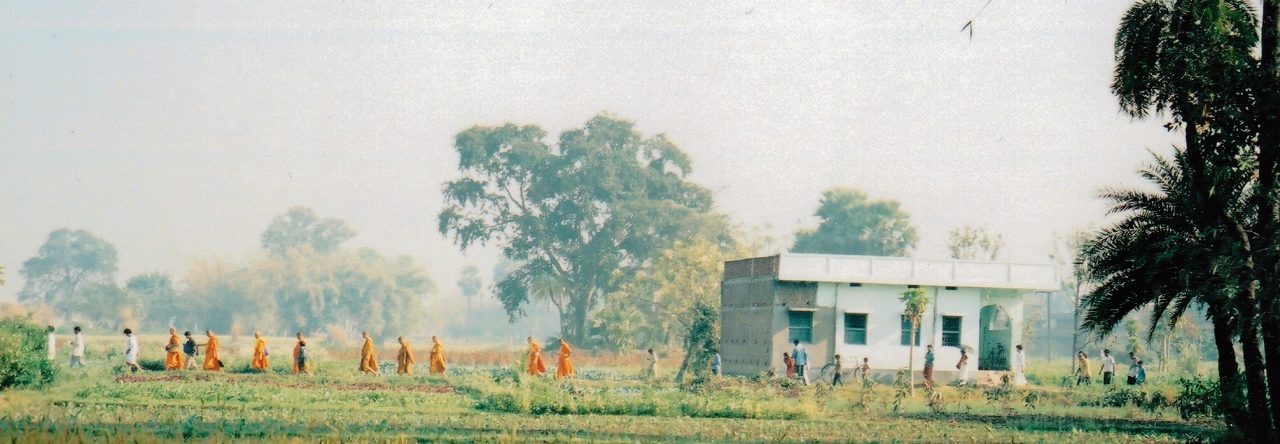
But I could almost, under certain circumstances, become a Buddhist monk, even in this life. I have said before how I am attracted to Buddhism, although as a philosophy rather than as a religion. I like the way the emphasis is on yourself to make your best life. Gods don’t have to be involved.

I have twice spent a week in that sort of environment – one time a week of Zen meditation, which was very hard work but left me with a great feeling of clear-headed calm, and once on a retreat at a Benedictine monastery where I made a point of attending a simple morning service each day and spending the rest of the day in thought and writing and painting and gently wandering around the extensive grounds. As a panacea for the stresses of modern life it was difficult to beat. I could, as I said, see myself in another life settling into the routine there on a permanent basis. But not in this life.

Return To Tengboche…

…but not literally, unfortunately. I did say I would re-post another travel post from some while back, so here it is.

Four years ago I wrote four short posts about Tengboche. Here I’ve combined them into a single post and added some extra pictures and text to give a little more information about this lovely place.

Tengboche is a monastery complex and a couple of trekking lodges at 3860m on the route up to Everest Base Camp from Lukla, in Nepal. It sits high above the waters of the Dudh Khosi, the rapidly flowing river than runs alongside much of the Everest Trail.

The monastery complex. On arrival in the afternoon, the clouds are low. This seems to be the pattern most days – clear mornings and then the clouds coming in early afternoon. In a general sense, weather patterns in the Himalaya – certainly in some parts, and probably at certain times of the year – can be quite predictable. When I trekked the Annapurna Circuit, for example, we were told one evening that around ten o’clock the next morning there would be strong winds blowing in the valley we were to follow, because that was what happened every day. And blow they did. At ten o’clock.

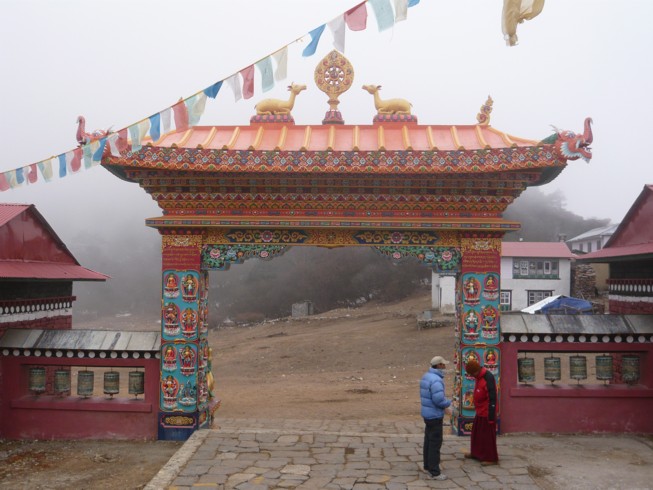
From inside the monastery grounds. The monastery is a Tibetan Buddhist complex, liberally decorated with the pictures, statues, and symbols to be found in every such place.

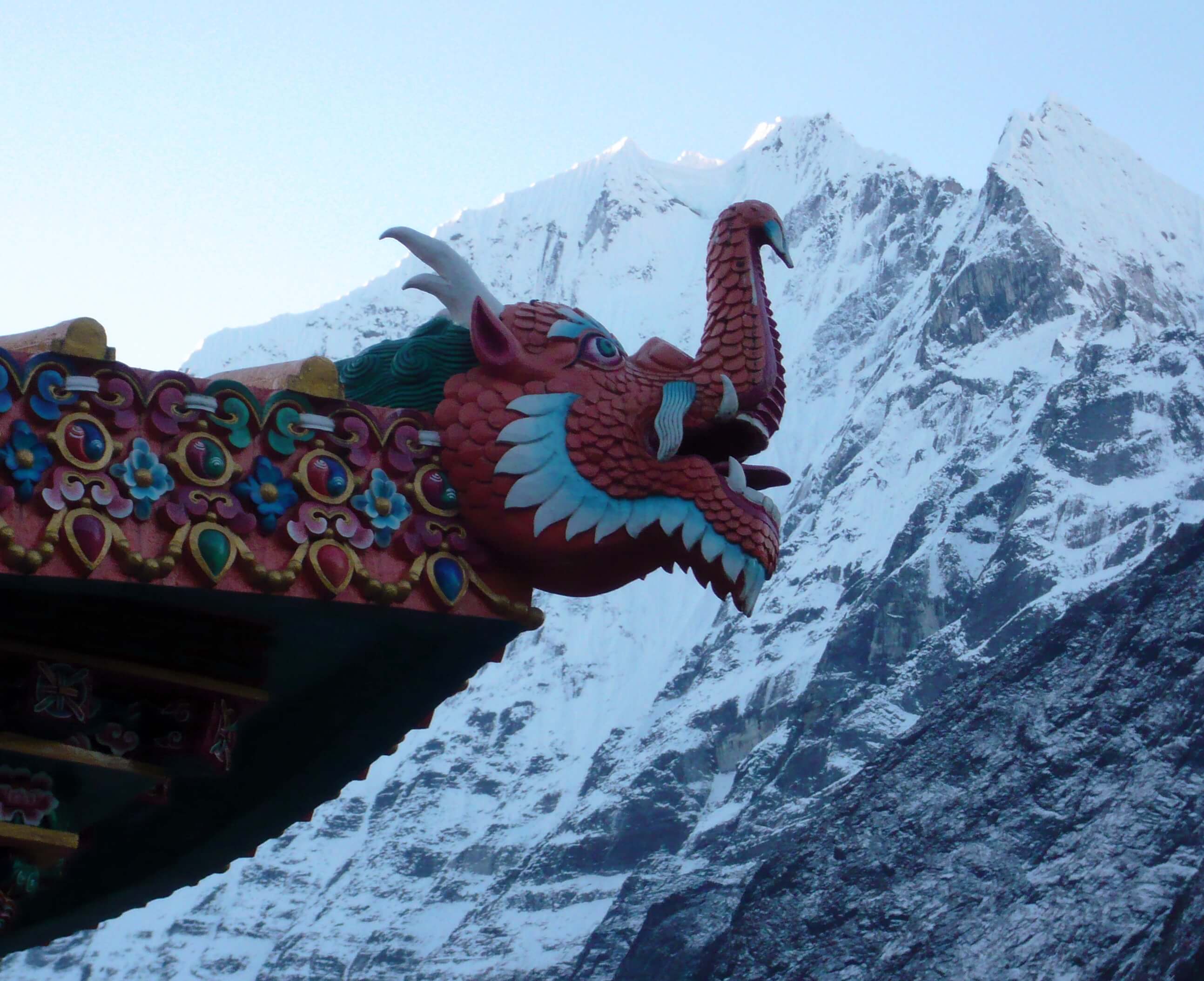
Roof decoration
145a

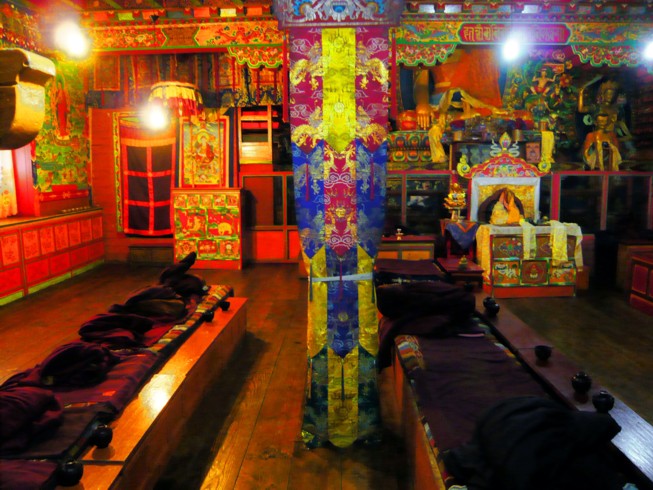
Inside Tengboche monastery following a puja (ceremony).

Rightly or wrongly, I don’t like taking photographs of pujas in monasteries. It feels intrusive and bad mannered. I would feel the same in a church, mosque or temple. This has nothing to do with any beliefs of my own, but is born of simple respect.

I noted in my diary: We have just sat in on a chanting puja, but my meditation failed dismally. I was completely unable to concentrate on my breath as all that I could think of were my freezing feet!

It was blooming cold!

198a

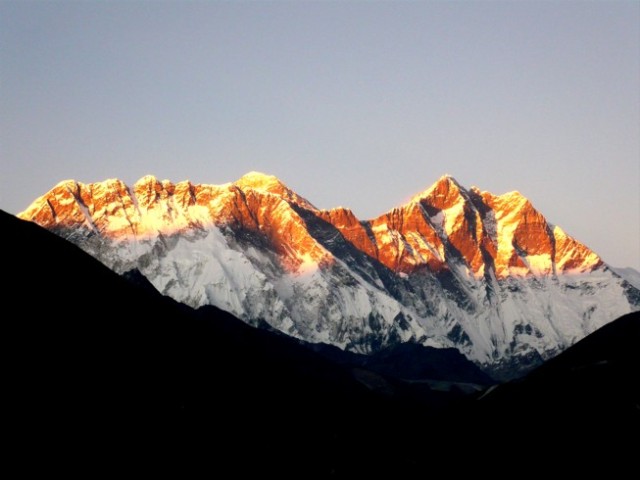
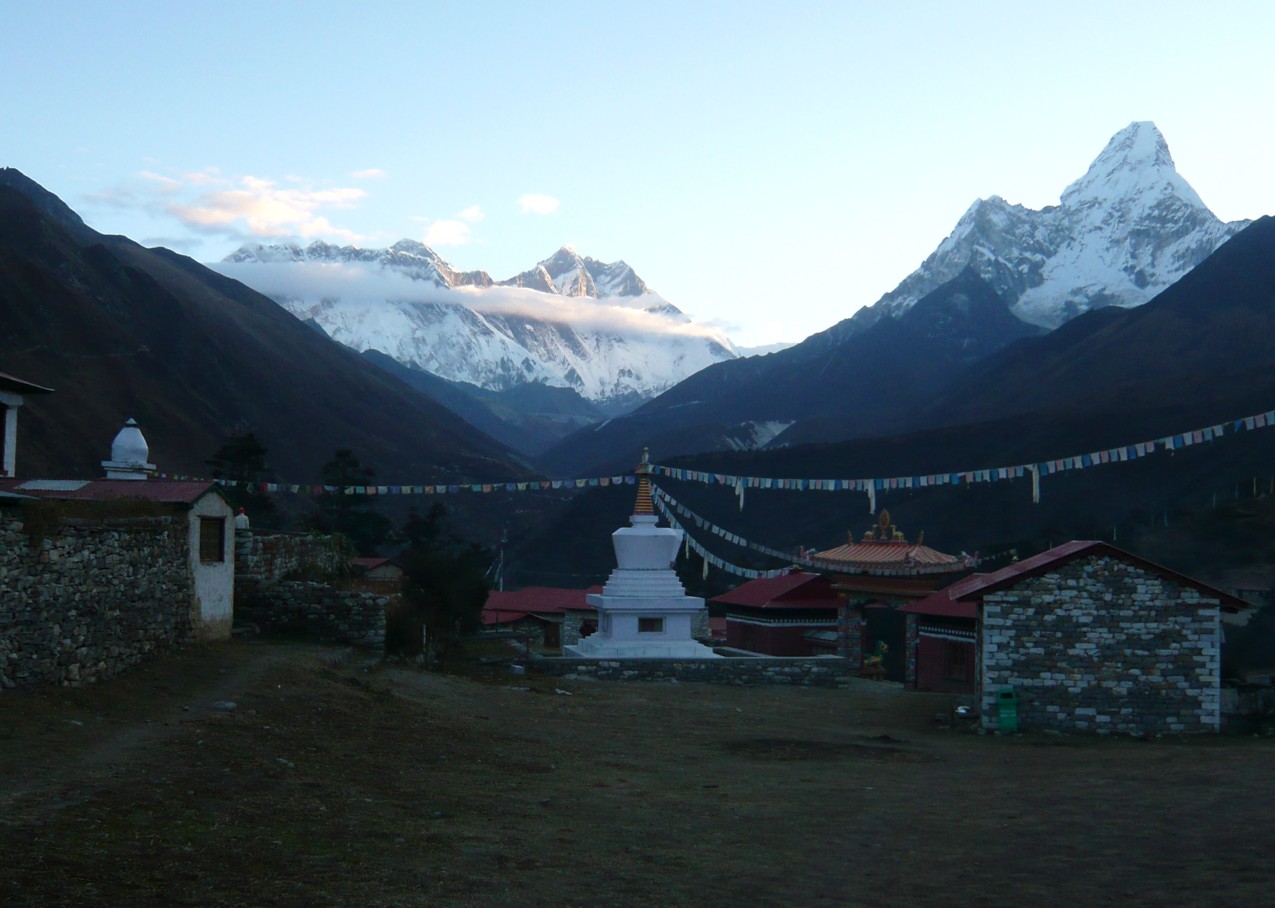
This view must have been photographed so many times, but how fantastic is it? Sunset on Everest (left) and Nuptse (right), photographed from Tengboche. This was taken on my third visit; the other two times the clouds failed to clear in the evening, so this was an unexpected treat.

212a

And this is the same view in the morning – but with the addition of Ama Dablam on the right of the picture. Ama Dablam is possibly my favourite mountain; the classic ‘mountain-shaped’ mountain, similar to the Matterhorn.

Close-up of window showing the dawn chorus orchestra.

We were awoken in the mornings by the harsh notes of conch shells and the clashing of symbols. This was part of the morning puja, rather than a summons for coffee and porridge. It does make for an excellent alarm call, though.

Review – The Name of the Rose by Umberto Eco


002

Late in the year 1327 Brother William of Baskerville, a Franciscan monk, and Adso, a Benedictine novice, arrive at a monastery in Northern Italy. Winter is rapidly approaching, and so is both a legation led by a notorious inquisitor and another that contains that inquisitor’s implacable enemies. William is to speak in intercession between them.

But once they arrive at the monastery, a series of brutal murders begins, and, at the request of the Abbot, William and Adso are drawn into the investigation.

Every detective story needs a detective, and in The Name of the Rose it is William of Baskerville, who indeed uses logic and observation to make deductions, much like a medieval Sherlock Holmes.

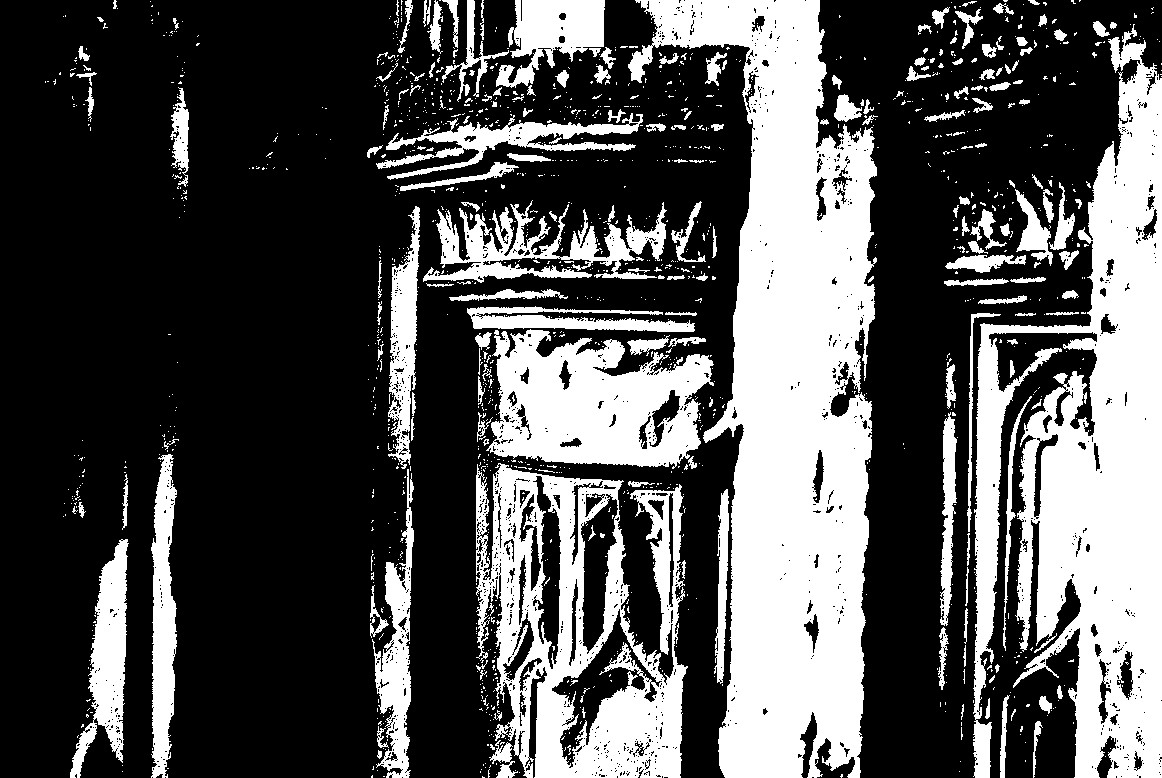
Untitled-Grayscale-01

As the plot develops, there are long theological debates centred around both the poverty of Christ and the question of whether Christ laughed. Questions I have little knowledge of, but which read as authentic to me. But these debates are central to the plot. On the interpretation of Christ’s poverty alone, men and women are accused of heresy and burnt at the stake.

But everything is centred upon the monastery’s library. This library is the greatest library of its time in Europe, containing innumerable rare, important and beautiful volumes. At the centre of the story lies a mysterious and forbidden book, and this book lies at the centre of the labyrinthine library where only the Librarian and his assistant are permitted. But are the murders being committed to get hold of this book or is there another reason? Could they, in fact, be connected with the predictions in the Book of Revelations?

Untitled-Grayscale-02

This is such a well-known book that I found I forgot it was a translation from the original I was reading. Much like the Bible, of course, which point is salient to the monks, and certainly in medieval times this interpretation was a matter of life or death to thousands.

But the translation of  prose does not pose the same problems as the translation of verse, and I don’t suppose the English translation is any different from the Italian original. But the potentials made me smile

As a long book, it provides a canvas for long descriptions, both of the abbey and the associated buildings – essentially a castle – and of the long debates between the monks and the other players. At times there is undoubtedly a temptation to skip some of these, but the reader is adequately rewarded for persevering in that the descriptions paint a powerful picture of the place and time, while the debates tell much about the importance of religion and the ridiculous interpretations of every word of the Bible that quite literally governed the lives and deaths of everyone at that time.

A word about the pace of the book, though. Some readers may find it a little slow (although if those readers skip the debates and longer descriptions it is as fast-paced as any other), but remember it is not just a detective story, it is also a historical novel and moves at the pace one would expect of a book of that genre.

I read this a very long time ago, and although I remember it as having been a very good book, I had forgotten just how good. I will unhesitatingly give it five stars.

And the meaning behind the title? Well, you need to wait until the end to find out, and then you need to understand Latin…

Prayer Flags

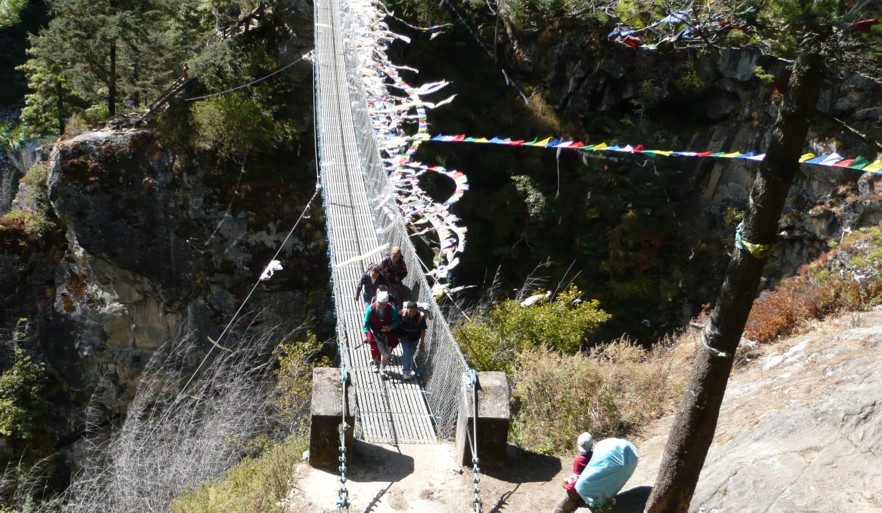
Prayer flags are found wherever Tibetan Buddhism is found. As they flutter in the breeze, they use this wind to send blessings out into the world. Through many parts of the Himalaya they adorn monasteries and humble homes, chortens and bamboo flagpoles. They are tied in their hundreds and thousands to bridges, above mountain peaks, and in the courtyards of every conceivable building.

Elsewhere, they are to be found wherever exiled Tibetans live, and wherever their school of Buddhism flourishes.

The makers of the flags intend the prayers and blessings that adorn them not for their own benefit, but for the benefit of all beings.

eleven

Prayer flags in the Yumtang Valley, Sikkim, India.

prayer flags

Prayer flags, Observatory Hill, Darjeeling, India.

IMG_0005

Prayer flags outside a monastery in Sikkim, India.

106a

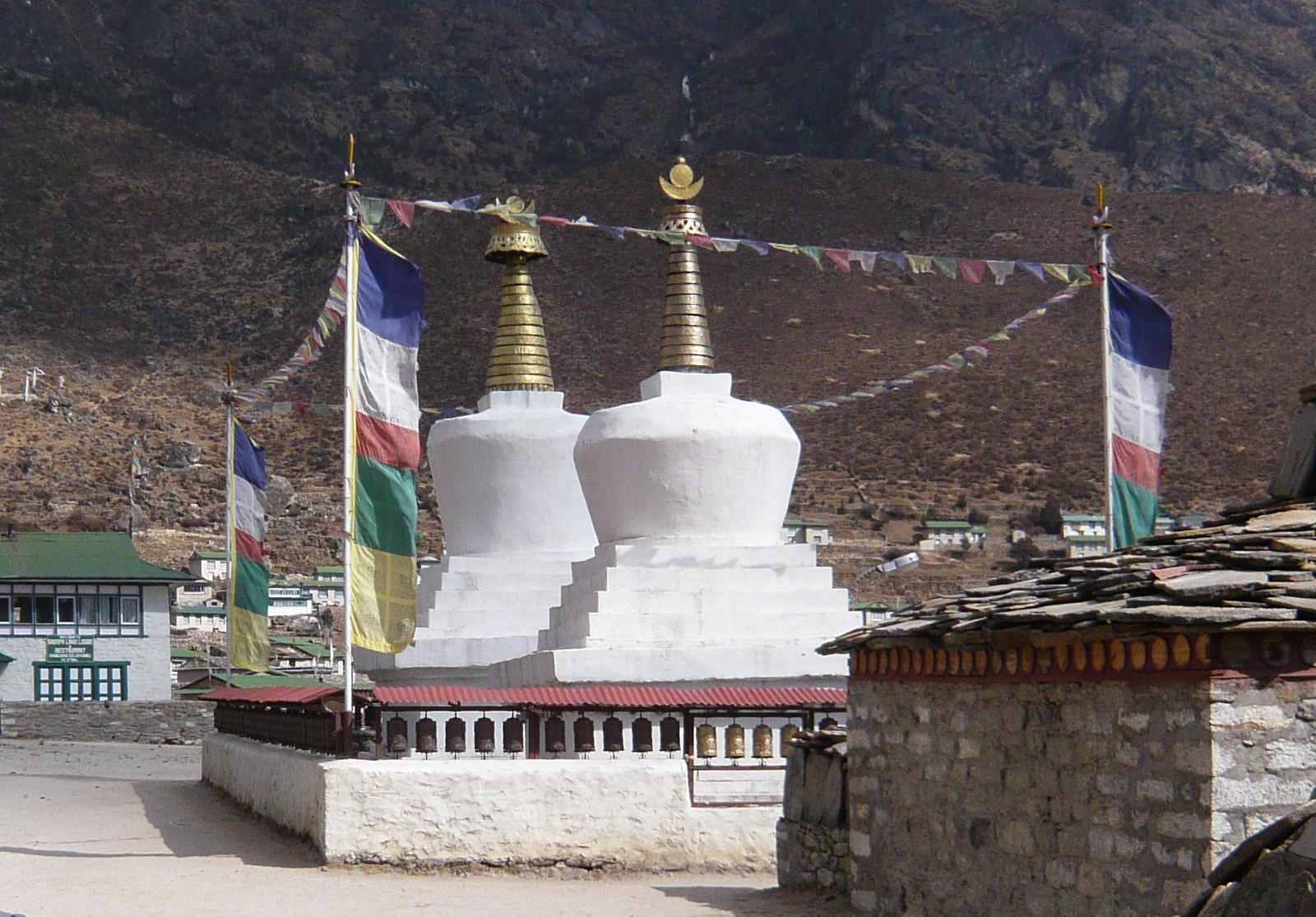
Prayer flags adorn a pair of chortens and walls of prayer wheels in Khumjung, Nepal.

139a

Prayer flags at Tengboche, Nepal.

141a

And adorning a bridge of the Dudh Khosi, again in Nepal.

Tengboche – 4

146a

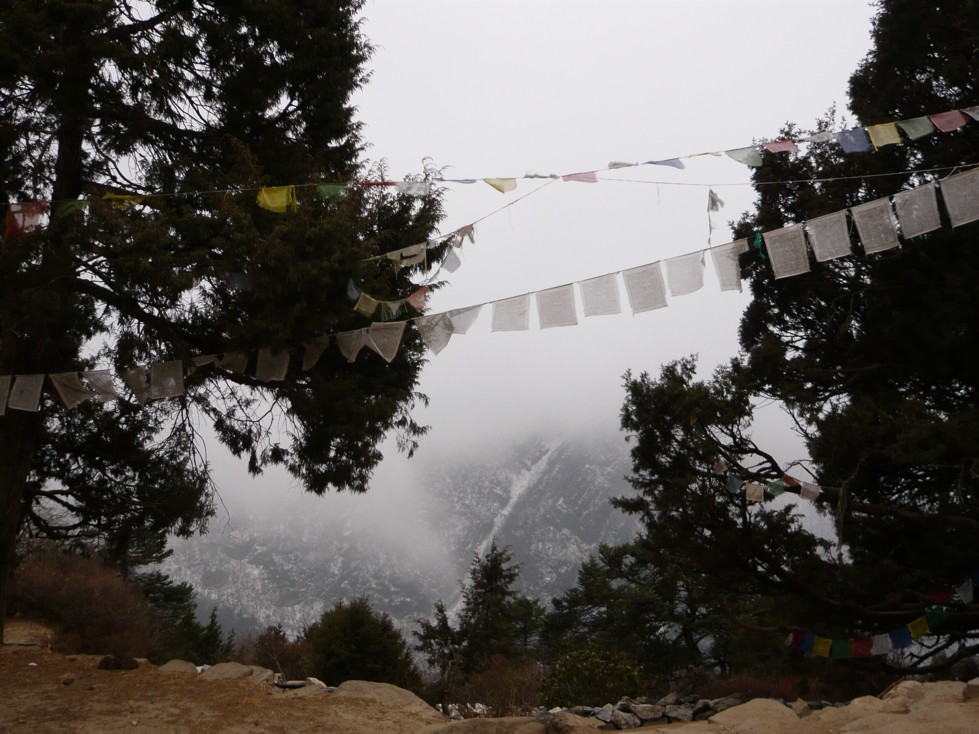
Commonly, late in the afternoon mists form and the temperature plummets. But even in the enveloping grey, Tengboche is colourful and beautiful.

Tengboche – 3

212a

To compare with the photo in the previous post, this is the same view in the morning – but with the addition of Ama Dablam on the right of the picture. This is possibly my favourite mountain; the classic ‘mountain-shaped’ mountain, similar to the Matterhorn.

Tengboche – 1

Tengboche is a monastery complex and a couple of trekking lodges on the route up to Everest Base Camp from Lukla, in Nepal. It sits high above the waters of the Dudh Khosi.

145a

Inside Tengboche monastery following a puja (ceremony).

Rightly or wrongly, I don’t like taking photographs of pujas in monasteries. It feels intrusive and bad mannered. I would feel the same in a church, mosque or temple. This has nothing to do with any beliefs of my own, but is born of simple respect.

I noted in my diary: We have just sat in on a chanting puja, but my meditation failed dismally. I was completely unable to concentrate on my breath as all that I could think of were my freezing feet!

It was blooming cold!