Prayer Flags

Prayer flags are found wherever Tibetan Buddhism is found. As they flutter in the breeze, they use this wind to send blessings out into the world. Through many parts of the Himalaya they adorn monasteries and humble homes, chortens and bamboo flagpoles. They are tied in their hundreds and thousands to bridges, above mountain peaks, and in the courtyards of every conceivable building.

Elsewhere, they are to be found wherever exiled Tibetans live, and wherever their school of Buddhism flourishes.

The makers of the flags intend the prayers and blessings that adorn them not for their own benefit, but for the benefit of all beings.

eleven

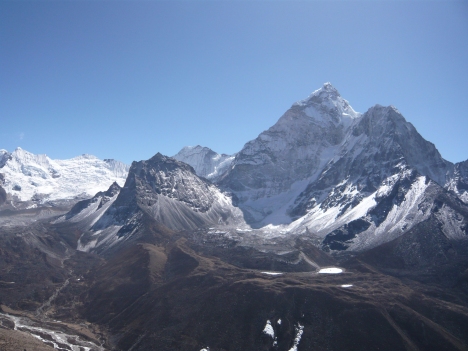
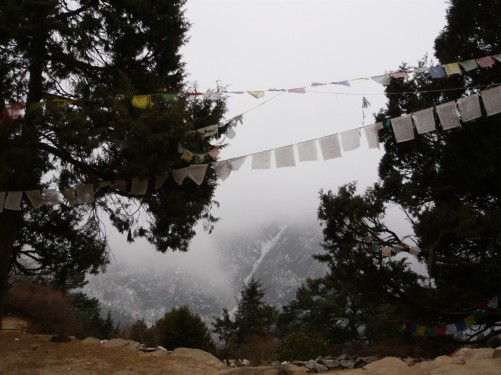
Prayer flags in the Yumtang Valley, Sikkim, India.

prayer flags

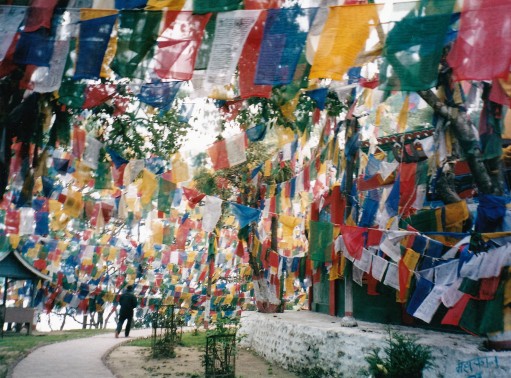
Prayer flags, Observatory Hill, Darjeeling, India.

IMG_0005

Prayer flags outside a monastery in Sikkim, India.

106a

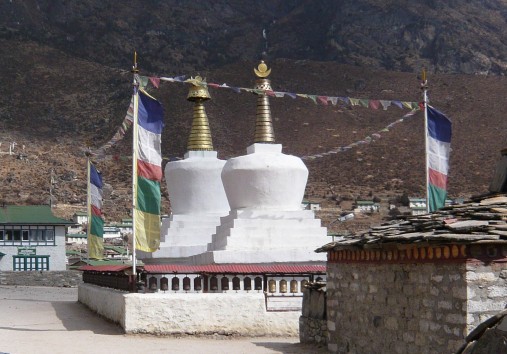
Prayer flags adorn a pair of chortens and walls of prayer wheels in Khumjung, Nepal.

139a

Prayer flags at Tengboche, Nepal.

141a

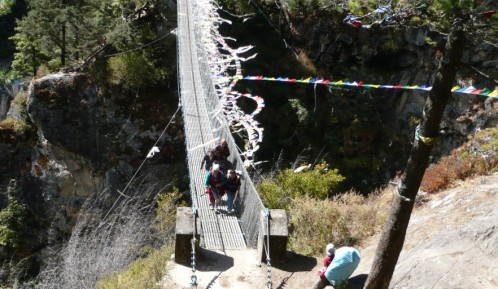
And adorning a bridge of the Dudh Khosi, again in Nepal.

Southern India (2)

trichy skyline 2

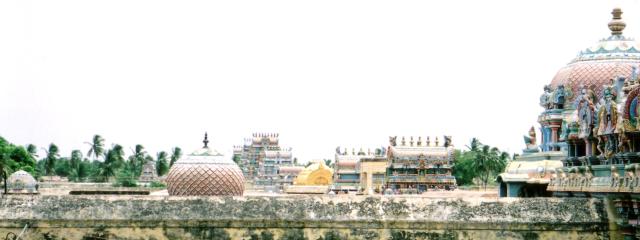
Another shot of the skyline of Sri Ranganathaswamy Temple in Trichy.

trichy temple door

Decorated door in the Sri Ranganathaswamy Temple.The scorch marks at the foot of the door are from candles and incense sticks, which have been lit and offered to the god in pujas.

shore temple

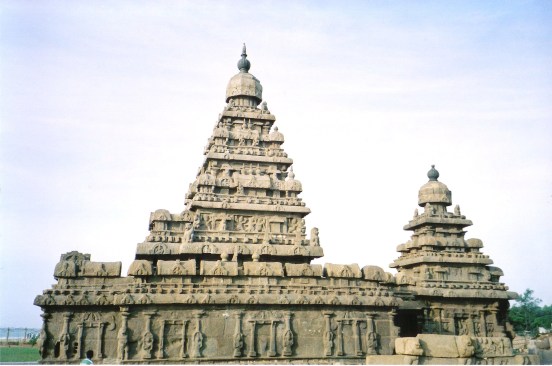
Shore Temple, Mamallapuram. Mamallapuram is a short way South of Chennai (Madras) and is a large village which is home to hundreds of stone sculptors. The village itself has a wealth of old temples and sculptures in the form of friezes and ‘Rathas’ – literally chariots, carved out of solid rock. The Shore Temple shown here has been extensively weathered by wind and sea, but has a remarkable amount of detail still preserved.

5 rathas elephant

Carved Elephant at the 5 Rathas, Mamallapuram. An incredible complex of rock-cut temples from the Pallavan Period, 300m from the shore. They were buried under the sand until rediscovered and excavated by the British some 200 years ago.

side street

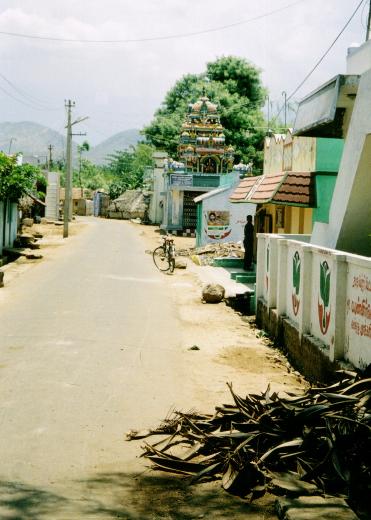
Sometimes it seems that there is a temple down every side-street. This one is in a village near the town of Dindigul, Tamil Nadu.

roof shrine

This roof shrine is nearby.

salt-workers

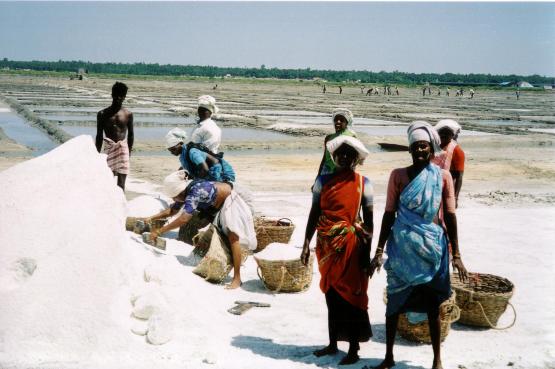
Salt workers pose for a photograph at the salt pans near Marakkanam, just north of Pondicherry (now renamed Puducherry, its original name before the French arrived). The sea is allowed to flow into ‘pans’ (not unlike paddy fields!) and then evaporates over several days under the hot sun, leaving behind a layer of salt which is gathered by hand. Salt has been gathered this way in India from time immemorial, but when the British in India imposed a salt tax, this eventually led to the ‘Salt March’ led by Gandhi, where he symbolically gathered salt at the coast after a 200km march, an action that contributed to the loosening of the hold that the British Raj held on India.

Virtually at Everest – part 3

Our guide was waiting for us on the edge of the airfield, with a porter who would load our bags into a large basket on his back.

‘Let’s go to our hotel and settle in,’ said Bob. ‘Then we can go and look at some sights, maybe after lunch.’

‘I’m afraid not, Bob. We’re not staying here. Tonight we’re staying in a little place about six or seven miles up the trail.’

‘Oh, alright.’ He looked a little miffed, but then brightened as a thought seemed to strike him. ‘We could have a second breakfast when we get there.’

‘We won’t be there until mid afternoon.’

‘Huh? Why on earth not?’

‘The paths are pretty steep in places, it makes for a long walk.’

‘Walk?!!?!’

‘Yes, walk. We’re trekking, Bob, remember?’

‘Yes…but…I…’

071

Walking up the path with Bob was a pleasure I can only compare to dancing in a deep sea diving suit. Every few steps I took I would hear a plaintive ‘Mick…wait for me…’ from behind.

By lunchtime we had covered approximately half a mile and could still see the buildings of Lukla. Our guide, the impassive Pasang, calmly directed us to a nearby teahouse, and then left us as we ordered.

Bob wasn’t terribly impressed with the menu, though.

‘Do they have pizza?’

‘Is it on the menu?’

‘I can’t see it.’

‘Then, no.’

‘What are momos?’

‘Tibetan dumplings.’

‘Yuk. Dahl baht?’

‘Rice and lentils.’

‘Oh, God!’

We had fried vegetables. At first, I thought Bob wouldn’t eat his, from the face he made when it arrived, but walking half a mile that morning had clearly given him an appetite, and he managed to force it down.

As we ate, Pasang reappeared with another Nepali. They stood in the doorway for a while, looking at us and talking in low voices. The other man seemed a little upset and kept shaking his head, then they both left again. After about ten minutes, Pasang was back, this time with a much larger man. Again, they talked in low voices, with a lot of head shaking from the stranger, but they eventually shook hands, although neither looked particularly happy, and went back outside.

After we had finished lunch, Pasang took us outside where our porter was waiting, as was the large stranger, who also had one of those huge baskets on his back.

‘You will sit in his basket,’ he said to Bob.

‘What? No fear!’ He looked horrified. Pasang was clearly struggling to keep up his ‘impassive’ image.

‘If you do not,’ he said, sharply, it will be midnight before we reach the guest house. And,’ he looked at Bob meaningfully, ‘you will miss supper.’

Reluctantly, Bob did as he was told. I may have mentioned this already, but Bob is not a slightly built chap. His love of pizza and his fear of exercise combine to produce a body guaranteed to strike fear into the heart of any fitness instructor.

I looked at the stranger with a deep respect.
226

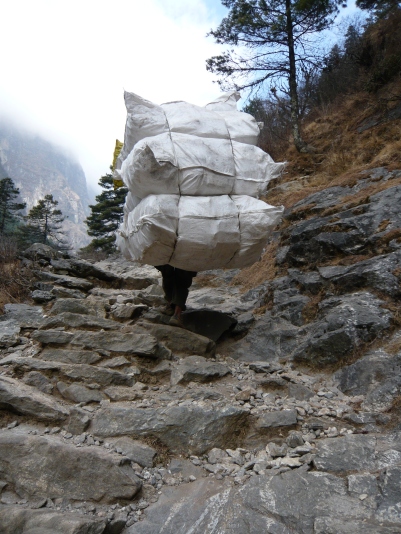
They carry large loads, although not usually as large as Bob.

We set off. Pasang led, the two porters walked just behind him, with Bob peering unhappily over the top of the basket, and reminding me strangely of a cat in a basket going to the vets.

Which led to a few unkind thoughts, I’m afraid.

However, two hours later we were at the tea house where we were to spend the night, with no further mishaps. The afternoon had been lovely, and I had wandered along happily at the back of our little group, taking a few photographs but mainly just enjoying being there.

065a

Bob clambered out of his basket and looked around. Then he whipped his phone out of his pocket. ‘We’ve done really well, haven’t we? Let’s take a couple of selfies!’

The following morning we were woken at six o’clock for an early start, but Bob wasn’t feeling well.

‘I think I’ve caught pneumonia,’ he moaned hoarsely.

‘Oh, it doesn’t look that bad,’ I replied, brightly. ‘Probably just a bit of a sore throat due to the altitude. Let’s see how you are after breakfast.’ He dragged himself out of bed and shuffled wearily to the dining room, where he managed a light breakfast of porridge and banana, omelette, bread, toast, jam and coffee.

‘What do you think?’ I asked Pasang.

‘It is definitely best he stays here until we return,’said Pasang firmly. ‘We should not take the risk of him getting any worse.’ I was about to say that it was only a slight cold, but I saw the wisdom in what he was saying, and so I agreed.

So, it was a shame, but we had to do the rest of the trek without Bob.

Silver linings and all that…
250


154


169


177


189


210

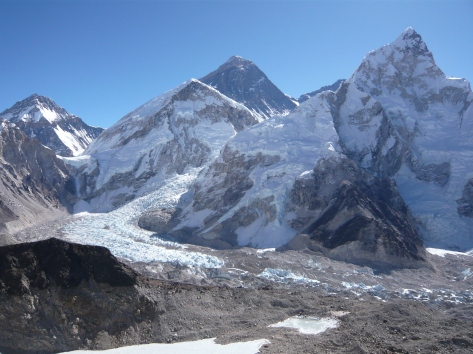
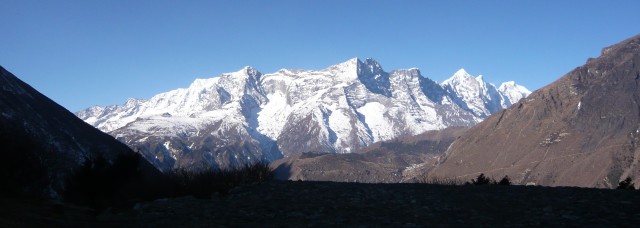
Everest is the one in the middle!
Monsoon

monsoon

Monsoon – 18ins x 24ins , Acrylic on board.

I painted this a long time ago.

Although I have been caught up in a few very heavy downpours in India, I have never been there during the monsoon. And I was reminded of that a day or two ago while having an online conversation with another blogger.

It is something that I would like to experience, sometime. In India, it is an exciting, a very welcome time – after the temperature has been steadily climbing for months, and everywhere is dry and parched, the rains finally arrive to cool the air, and the earth bursts into life.

Everyone rejoices!

But westerners avoid it. Why go to India during the monsoon, just to get wet? is the general feeling.

Yet I have a yearning to witness it, and to use it in my writing, too. To write…take photos…paint…

And just to experience it!

Hiatus – along the Peddars Way

Home again, after a few days away. We walked the Peddars Way in East Anglia over four days, a distance of some fifty odd miles. Not exactly a long long distance footpath, so to speak (Gabe – you might have something to say on this!), but a pleasant enough walk and surprisingly remote from habitation in places.

Perhaps it’s a short distance footpath. And why not?

003a

That should mean I have time to catch up with blogs and posts and writing and God knows what else, but I now have a very busy week ahead of me, so I just have time to bustle in and do a little housekeeping, as it were, only to then bustle out again until the weekend.

034a

Hence a random selection of photographs from the walk.

038a

And an extremely random selection of thoughts:

‘Why on earth is the only pub we pass on the first day – which is a long walk – closed at lunchtime? Other walkers bemoan this fact. They must miss out on a whole load of trade.’

‘Are we all honorary Peddars this week?’

‘I don’t really like staying in bed and breakfast places – it feels too much like borrowing someone else’s room for the night, and I feel I’m imposing on them, even though we are paying to stay there. I’d rather stay in an impersonal hotel.’

‘In all of the huge number of pig farms we pass, the fields are full of little metal houses for the pigs, with straight roads criss-crossing them. Do the pigs give these roads names, or simply number them on a grid system, as in New York?’

‘And do the teenage pigs have to make their own entertainment, or do they expect it to be provided?’

‘Why do large pub chains make their pubs so incredibly unappealing?’

023a

Now I must rush off and attempt to organise myself for the week ahead.

Speak soon!

Ciao!


Older Pictures – Nainital

I have to begin this post with a caveat; it is quite possible that one or more of these photographs are not actually of Nainital, but perhaps of somewhere else. They are certainly of India, but there is nothing written on the back of the photographs. The majority were my father’s, taken by him on leave during the 1940’s, and since he died a long time ago I can no longer question him.

Nainital means the ‘eye lake’, and refers to the goddess Parvati. According to legend, her eye fell into the lake when Lord Shiva, her husband, carried her body back to their home on Mount Kailash.

naini tal

This first one is a postcard I bought on my visit to Nainital in 2005. Normally, you expect a postcard today to be a picture of as good a quality as possible, so I was delighted to find this one. I have no idea how old the original would have been, but I would guess that it dates from the inter-war period.

hill station 4

This one was taken by my father (or so I assume – another caveat, I suppose!) since it was amongst the ones I inherited from him.

hill station 2

This one I believe is of Nainital, although I cannot work out any details of either the direction it was shot, or the buildings down the hillside. Someone who knows Nainital (Rajiv?) might be able to help me with this one.

IMG_0003

Snow View, Nainital. The back of the postcard is blank, and so again I have no idea how old it would be. Google is no help, either. I found two other copies of the postcard, but neither told me anything about the picture.

hill station 1a

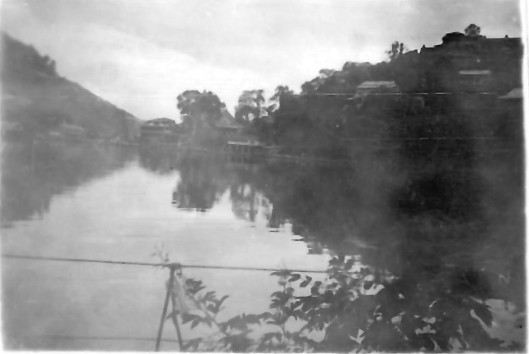
A view across the lake.

IMG

And a view of some pretty serious recreational boating.

dad 1

My father indulging in some of this recreational boating.

IMG_0001

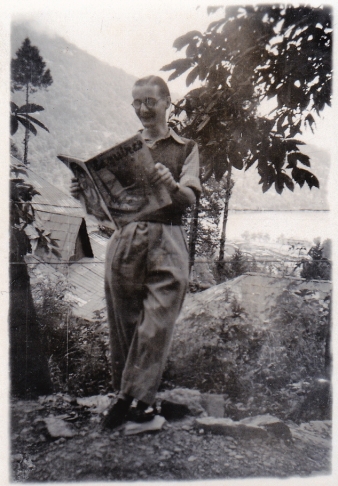
Finally, a photograph of one of his army mates. Although I have no idea who the subject is, I really like the photograph.

The Past is a Foreign Country; We Did Remarkably Similar Things There

Or, following in my father’s footsteps, or something like that.

Putting up some old postcards of Darjeeling earlier this week set me to thinking. And, let’s face it, anything that can achieve that is a good thing!

I have posted before that my father spent time in India, both during the Second World War and in the days leading up to Partition. If you would like to re-read it, the link is here: My Father In India

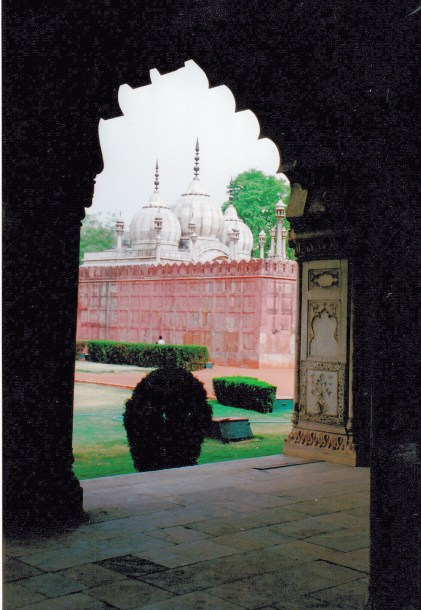
In this post, I mentioned that when I first visited India in 1989, at least, my first proper visit rather than simply passing through on the way to Nepal, I visited the Red Fort in Delhi, taking plenty of photographs, of course.

Some while later, at home, I was going through some of my father’s photographs, and discovered that I had taken a photograph of a view of the mosque in the Red Fort that was almost identical to one that he had.

img

Above: the one my father had. And, below: the one I took.

img_0001

Looking at the minaret in front of the dome closest to the viewer, it seems I took my photograph from the archway to the left of the one my father’s photograph is taken from, but otherwise we must have been standing in the same spot. My father would have been quite a bit younger at that time than I was when I visited the Red Fort, and the circumstances very different. But I’m sure that he felt the same sense of awe that I did.

Now there are mature trees behind the mosque, a couple of low hedges in front, and the creepers on the wall have gone.

Otherwise, the view is the same.

And because my father is no longer here, there is an extra poignancy to this; although our footsteps crossed and merged at this place, thousands of miles away, and we both must have lingered in this same spot and, who knows, possibly thought similar thoughts, the passage of time means in reality we might as well have been tens of millions of miles apart.

And this led me to look more closely at his other photographs.

There are not many, perhaps thirty or forty of them, but it is strange that when he was on leave in India, one time, he went with a few chums up to Nainital, and again there appear to be photos taken from spots where I have stood. The images are not the same, this time, but again our footsteps must have crossed.

I think the greatest regret I have about this, other than the obvious one that he is no longer alive, is that I cannot talk about these places with him. But just sharing them is good, even if it does make me feel sad.

Historic Darjeeling

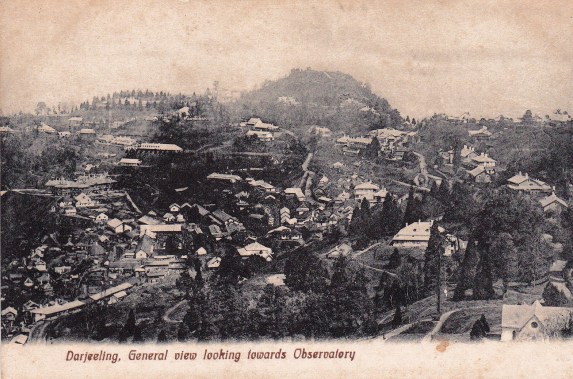
Digging into my (admittedly rather small) old postcard collection, I came across a few picturing Darjeeling.

imga

On this first one, other than the title, there is no information on the card. It is unused (as are the other two here), so I do not even have a postmark to help me guess what date the picture was taken. I would guess, however, that although the postcard was probably printed in the 1930’s, the photo could be ten or twenty years older than that. It looks as though the road on the right is The Mall, and the one running from left to right a little way below the skyline could be Hill Cart Road. Looking through a magnifying glass, it is possible to see that there are plenty of pedestrians, but I cannot make out a single vehicle. The photo would have been taken from a high spot on Dr Zakir Hussein Rd, near where the TV tower now stands.

img_0001

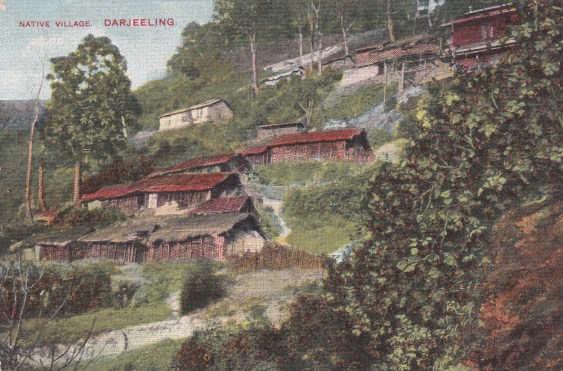
The second one is simply labelled ‘Native Village, Darjeeling’, and is the representation of a hand-tinted black and white photo. ‘Darjeeling’ is much more than the town, of course, and covers a large area all around it. Other than that, I could not hazzard more than a guess where this village lies. Searching through a few internet sites, however, I found another copy of this with a date of 1910.

img_0002

Finally, ‘The Railway Loop above Tindharia, Darjeeling’. Also hand coloured, this particular picture appears to be a copy of a photograph taken in 1880 by Bourne and Shepherd. Also known as ‘Agony Point’, this was built to enable trains to tackle the steep gradients by spiralling around instead of going straight up or down. It is renowned for being an incredibly tight loop.

Perhaps this is also a good place to slip in a link to my previous blog post:

My First Long Trip to India (5) in which I wrote about my impressions of Colonial era India when I visited Darjeeling for the first time.

Venice…a bit…

Call me arty. Call me something, anyway.

I’m in the middle of a ridiculously busy couple of weeks, so in place of one of my usual ‘witty’ and ‘well-argued’ posts, here are a small selection of pictures that I recently put up on my Picfair site.

I still don’t even have time to catch up with anyone else, but I will in a week or so. Honest!

041

Marionettes, masks and puppets in a shop window display.

185

Arches and columns reflected in floodwaters.

059

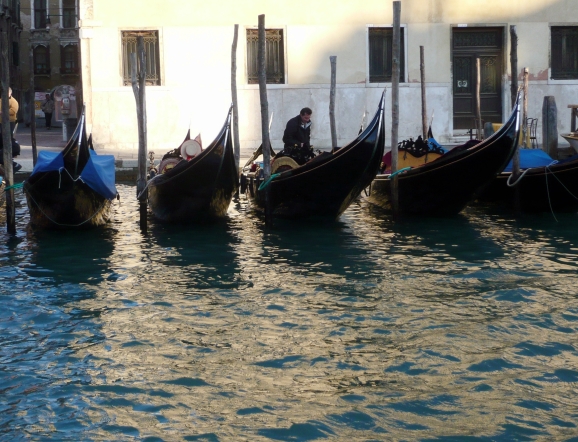
Gondolas. It’s Venice, there have to be gondolas.

154

Umbrellas. It’s raining. You get umbrellas.

166

Chairs in a rainy St Mark’s Square.

081

The Venetian version of a backstreet. Or backwater. Whatever.


Bodhgaya (2) – A Special Place

About six months ago, I put up a post on Bodhgaya (which you can find here if you wish to read it again), and promised I would find a few more photos to post another time.

This is another time.

img_0018

My first picture is of the entrance to the Mahabodhi Temple, which is built on the site where the Buddha achieved enlightenment. The first temple was built by Emperor Ashoka, in the third century BC, and the present one was erected in the fifth or sixth century AD. Visitors remove their shoes (or face a one hundred rupee fine) and descend the steps from the garden that surrounds the temple.

img_0020

Just before reaching the entrance itself, they will pass this small chorten – one of dozens surrounding the temple – garlanded with marigolds.

img_0019

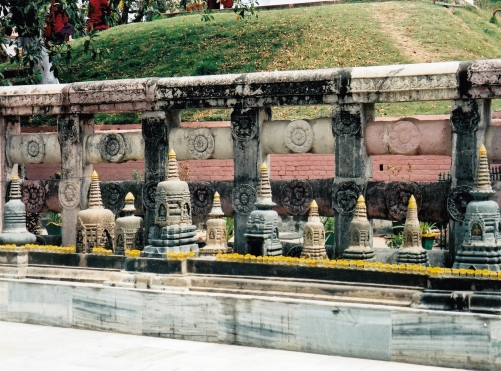
Many more chortens surround the temple and can be found around the gardens themselves, these ones beside a carved sandstone balustrade.

img_0024

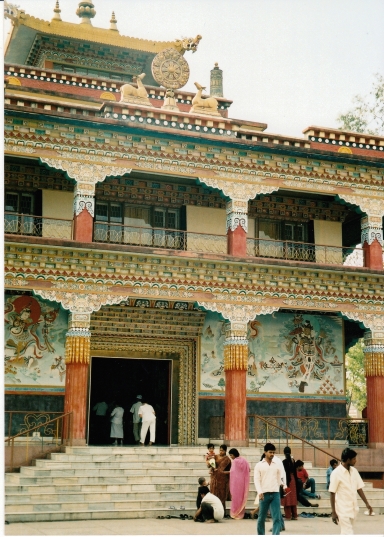
But the Mahabodhi Temple is by no means the only Buddhist temple in Bodhgaya. As the place where the Buddha attained enlightenment, it has naturally been the focus for many Buddhists from around the world, and there are many other temples built by those from the various different branches of Buddhism. This one is one of two Tibetan temples.

img_0017

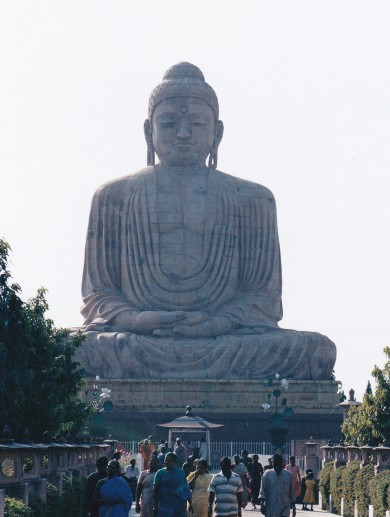
On the edge of Bodhgaya, this twenty five metre tall statue of the Buddha was erected in the grounds of the Japanese Daijokyo temple in 1989.

But Bodhgaya, naturally, is more than simply its temples. Although it is quite naturally a major tourist attraction, it is also home to many people, and daily life is not much different from other towns in Northern India.

img_0023

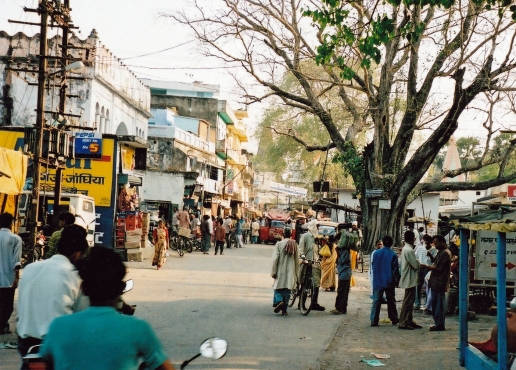
As you approach the temple areas from the northern side of the town, this is a fairly typical scene. In the distance, the share auto that plies between Bodhgaya and Gaya is filling up with passengers, and men and women shop for essentials.

img_0021

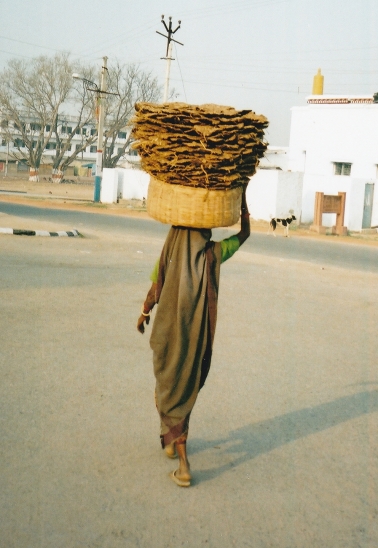
A woman carries a basket of dried cattle dung, which will be used to fuel the cooking fire.

img_0022

And on the edge of the town, the scene quickly becomes rural once again.

From Thursday I shall be away for a few days, but will catch up with comments and other blog posts once I am back.