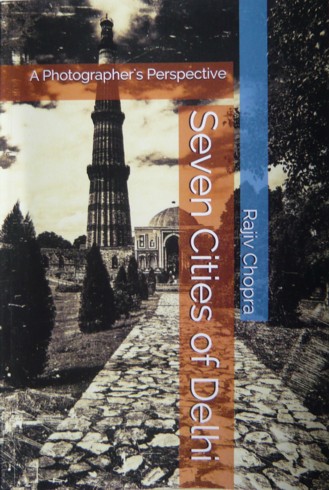
Seven Cities of Delhi by Rajiv Chopra


001

On my first visit to Delhi, almost thirty years ago, I was overwhelmed by the huge numbers of monuments there, such as the Red Fort and Purana Qila. I found the area around Paharganj to be chaotic and exciting and everything an inquisitive Westerner could wish for – a mixture of smells of food and incense and, yes, sewage. A mixture of ugly concrete buildings and beautiful dilapidated buildings left over from the British Raj and often much earlier. Milling crowds of people and cows and rickshaws and bicycles and autos, and history, history, history.

Chadni Chowk was incredibly crowded, the Lodi Gardens completely deserted. The Jama Masjid crowded by tourists and worshippers alike, the Janta Manta often almost empty.

There is so much history everywhere you turn in Delhi.

Other Westerners I met tended to be highly disparaging of Delhi, which was something I couldn’t completely understand since many of these same Westerners seemed to praise Mumbai and Kolkata for the very reasons they hated Delhi.

Yet Delhi is, I think, one of the most exciting and interesting cities I have ever visited. From a historical viewpoint alone, it has over ten thousand listed monuments.

Ten thousand!

Rajiv Chopra is a Delhi based photographer with a passion for recording both the historical Delhi and the street life he comes across from day to day. In this book, he has combined his photographs with a little of the history of the seven historical cities that constitute Delhi, and also a perspective of the differing processes that photography has passed through from its invention up to the present day.

To illustrate all these factors, his book is split into seven sections – one for each of the historical periods – and in each section he has outlined one of these photographic processes so that, for example, in the section covering the first city, Mehrauli, he speaks of daguerrotypes. And then his own photographs he processes through Photoshop to simulate the effects of these processes.

This is not a long book, but it does not pretend to do more than act as an introduction to the history of Delhi. And in this it certainly whets the appetite for more, and then for anyone with even a passing interest in photography it gives a concise and potted description of these photographic processes. Finally the photographs themselves complement the text perfectly.

I unhesitatingly recommend this book for anyone who wants to know a little of the history of Delhi, and who enjoys photographs that give a real flavour of the history of that magnificent city.

Five stars out of five.

You can find Rajiv’s website and blog here
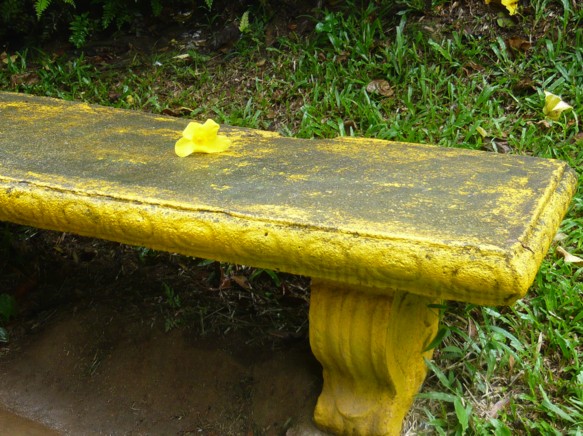
Very Random Sri Lanka!

Finally, it’s warm and sunny here! Hooray!

So here are a few random pictures I took in Sri Lanka some while ago. So what relevance is there in that? None, really…
108

I just like the randomness of them.

150

Lurking Kingfisher…

206

That, incidentally, is a Cannon Ball Tree.

206a

And that’s why.

210

And I have no idea what that tree is called, but the strange roots are little more than a hand-breadth wide, and as tall as I am.

Just Playing…

Take one photograph, play around with it a little, create 3 new ones, all different.

Add some autumn haiku, since it’s almost spring.

That was fun.

001b

Yellow maple leaves

Rattling wildly in the wind –

Autumn’s prayer flags


001c

Obsession with time

Is climbing trees in autumn

To get down the leaves.


001d

The last yellow leaf

Hovers above the brambles

Waiting for the wind.

Prayer Flags

Prayer flags are found wherever Tibetan Buddhism is found. As they flutter in the breeze, they use this wind to send blessings out into the world. Through many parts of the Himalaya they adorn monasteries and humble homes, chortens and bamboo flagpoles. They are tied in their hundreds and thousands to bridges, above mountain peaks, and in the courtyards of every conceivable building.

Elsewhere, they are to be found wherever exiled Tibetans live, and wherever their school of Buddhism flourishes.

The makers of the flags intend the prayers and blessings that adorn them not for their own benefit, but for the benefit of all beings.

eleven

Prayer flags in the Yumtang Valley, Sikkim, India.

prayer flags

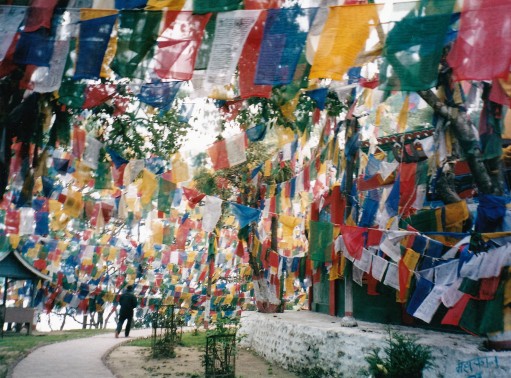
Prayer flags, Observatory Hill, Darjeeling, India.

IMG_0005

Prayer flags outside a monastery in Sikkim, India.

106a

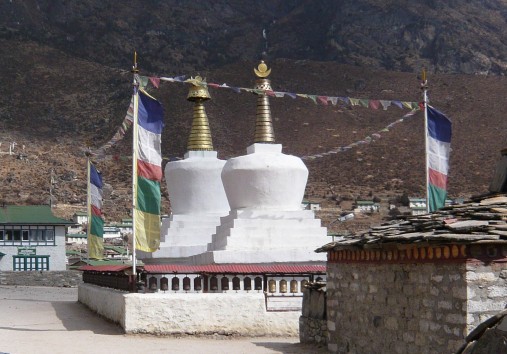
Prayer flags adorn a pair of chortens and walls of prayer wheels in Khumjung, Nepal.

139a

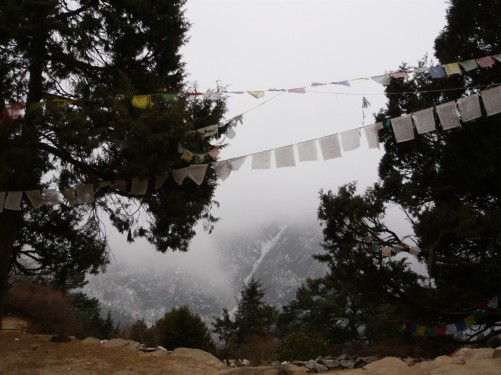
Prayer flags at Tengboche, Nepal.

141a

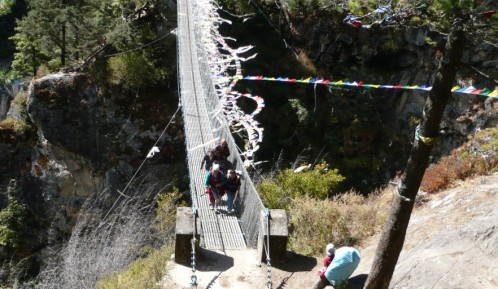
And adorning a bridge of the Dudh Khosi, again in Nepal.

Tengboche – 4

146a

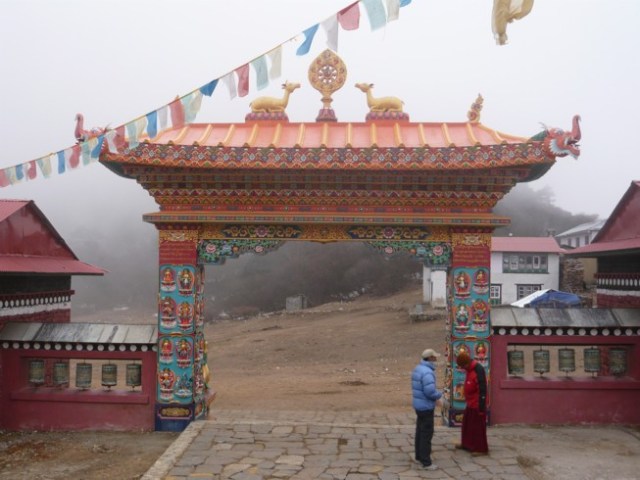
Commonly, late in the afternoon mists form and the temperature plummets. But even in the enveloping grey, Tengboche is colourful and beautiful.

Tengboche – 2


198a

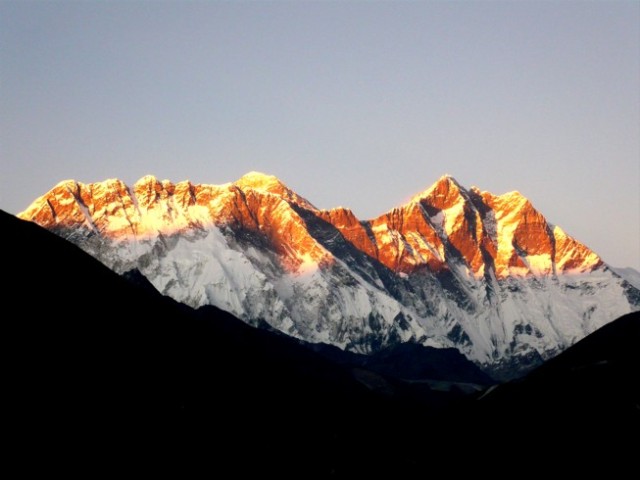
This view must have been photographed so many times, but how fantastic is it?

Sunset on Everest (left) and Nuptse (right), photographed from Tengboche.

Tengboche – 1

Tengboche is a monastery complex and a couple of trekking lodges on the route up to Everest Base Camp from Lukla, in Nepal. It sits high above the waters of the Dudh Khosi.

145a

Inside Tengboche monastery following a puja (ceremony).

Rightly or wrongly, I don’t like taking photographs of pujas in monasteries. It feels intrusive and bad mannered. I would feel the same in a church, mosque or temple. This has nothing to do with any beliefs of my own, but is born of simple respect.

I noted in my diary: We have just sat in on a chanting puja, but my meditation failed dismally. I was completely unable to concentrate on my breath as all that I could think of were my freezing feet!

It was blooming cold!

Just Look at Ghat!

Ouch! Probably my worst title yet!

I can’t help it…I’ve not been well…

…well, only a cold, but you know what we men are like.

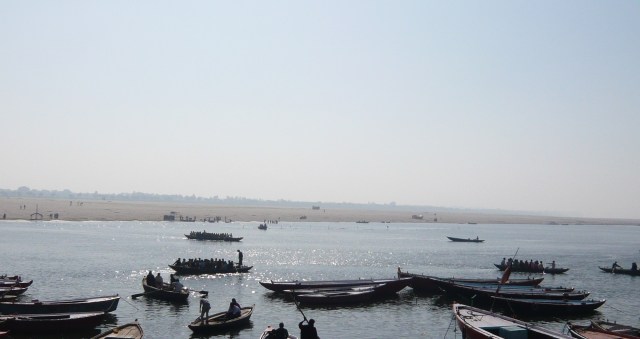
In another attempt to feel instantly better, I’ve nipped across to North India (only in my imagination, unfortunately), to picture Kedar Ghat, on the banks of the Ganges, in Varanasi.

056a

Ghats, a Hindi word, are sets of steps leading down to a river (and also mountain ranges or passes – The eastern and Western Ghats in Central India). It has also come to mean a level place at the edge of a river where Hindus cremate their dead.

In Varanasi, there are between 84 and 87 ghats, depending upon who you get this information from,. The Manikarnika Ghat, or Ghats (possibly this is the origin of the confusion over the number) is the ‘burning ghat’, where cremations are carried out 24 hours a day, all through the year. The source fire there has supposedly been burning for thousands of years, but photography is actively discouraged, hence my only shot is one taken from a distance.

046a

Of course, the ghats are also used for bathing. Hindus bathe en masse there, as a dip in the Ganges is meant to wash away sins. Important pujas (ceremonies) take place at sunrise and sunset. Boat trips to view the ghats are very popular, and finally much of the city’s laundry gets done at the dhobi ghats (dhobi meaning laundry).

040a

Namaste!

Southern India (1)

Southern India differs from the north in several respects. The first difference that the visitor tends to notice, once they have got away from the typical Indian maelstrom of airport, traffic, city centre, etc, is that with the less densely concentrated population comes a somewhat more laid-back atmosphere and attitude than in the north. The hassles and pressures, the touts, are still there, but seem somehow less intense.

The second real difference is in the culture. Southern India was never really assimilated into the Mogul empire, and only ever partly conquered, so there is a huge wealth of Hindu architecture and a proportional lack of Islamic, with next to no Buddhist remains and no continuing tradition of Buddhism at all. At times, it seems as though the visitor has entered a different country, but India has a way of reasserting itself on the senses…

trichy stall

Stall outside Sri Ranganathaswamy Temple, Tiruchirappalli (Trichy), Tamil Nadu State. All over India, amongst the heat, dust and drabness that pervades the majority of the population’s day to day life, one finds colour.

trichy garland seller

Garland seller outside Rock Fort Temple complex, Trichy. The garlands will be used to decorate statues of gods during pujas (ceremonies) conducted in the Temples.

rock fort temple

Rock Fort temple, Trichy.  A view of the main temple from the pathway that leads to the tiny temple at the top of the rock. Non Hindus are not allowed into the main temple, dedicated to Shiva, or the temple at the top dedicated to Ganesh…although for a small donation, the priest is willing to waive this rule…

From my journal:

‘The trip is not particularly uncomfortable. It is a typical five hour trip through India – dust, buffaloes, half a dozen schoolchildren stuffed into an autorickshaw, wait-till-the-other-guy-blinks over-taking, temples large, medium and small, huge dry river beds, The Cauvery full of water, trees, strange crops, broken down trucks, train lines stretching arrow-straight into the distance, rows and rows of stalls with neat piles of fruit and vegetables, rows of hanging water bottles from the roof, biscuits, samozas, cigarettes and crisps, a child squatting in the dirt, mum feeding the family beneath the tree, Tiffin Ready signs, smart petrol stations, mud huts, cement buildings, palm shacks, huge residences surrounded by high walls – all concrete, police traffic blocks (ignored), it all blurs into one.’

trichy temple 2

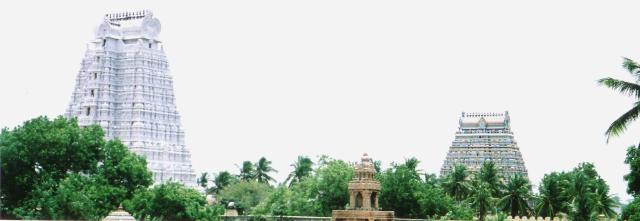
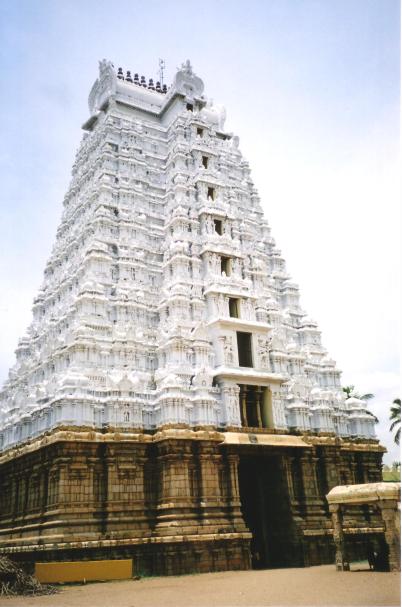
Part of Sri Ranganathaswamy Temple complex. This is the largest of all temple complexes in India, covering a staggering 60 hectares, and is dedicated to Vishnu. The Gopuram (tower) on the left is painted white, as a symbol of purity, and is one of the buildings that non-hindus are not permitted to enter.

white goporam trichy

The White gopuram, in all its glory.

trichy puja 2

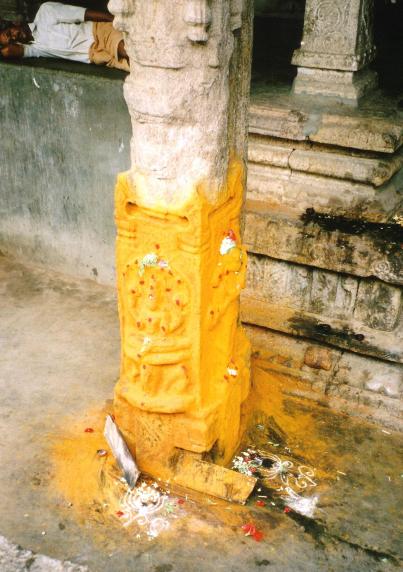
Pillar in Sri Ranganathaswamy Temple, liberally decorated with coloured powders and with offerings of incense, rice and flowers. Devotees of the god concerned will conduct their own personal pujas to ensure health and prosperity, or perhaps for some more specific purpose, such as to request the birth of a son or success in a particular undertaking. Although this temple is dedicated to Vishnu, other gods are represented there and prayed to.

trichy puja 1

Another, nearby, pillar in the same temple. Although in the same temple and close to the pillar in the previous picture, this shrine will be to another, different, god. Its use, however, will be the same.

Ladakh (2)

Long ago in the misty depths of time – that’s last year, actually, I posted a piece about Ladakh (you can find it here if you’d like to read it.)

This, then, is another mixture of photographs and entries from my journal of my 2005 trip to India, which included a couple of weeks spent in Ladakh. I went comparatively early in the year, when the nights are still extremely cold and very few visitors have made their way up from the plains.

 Just the way I like it!

Ladakh is high. If you fly in from Delhi (the only way to enter Ladakh for 8 months of the year), you travel from around sea level to 3500m in no time at all. Ladakh means ‘The Land of High Passes’, and is aptly named. Leh, the capital, at 3500m, is one of the lower areas of Ladakh. It’s all uphill from there. Winters are incredibly harsh and the summer growing season brief, yet the Ladakhis traditionally are self-sufficient in everything they need – food, clothing and shelter – and have only recently collided with the western consumer society. In contrast with most of the rest of India, the religion and culture of the majority of the people there is Tibetan Buddhism.

IMG_0007

The Roof of the World – View across the Indus valley at 3500m, Thikse, Ladakh.

 Friday 8th April 2005

I’m in Ladakh and, hey, wow!

At the airport for 4.30am, to find the flight postponed until 8am, due to weather conditions. It all looked ominous, but just after 7am we were told to check in and after numerous baggage checks, body checks, baggage identifications, etc, we were away at 8.30.

I’ve heard the flight described as one of the most spectacular in the world. I’ve also heard it described as jaw-dropping. I can imagine that it could be bowel-dropping. As we approached the Himalaya, clouds steadily built up and we flew through with tantalising glimpses of great snow-covered ranges below, through the occasional gaps in the cloud. After a while the turbulence built up and we were buffeted quite considerably. Then as we began to near Leh, we slowly lost height, the turbulence increased and we got more views of peaks at under-carriage height. Once we had dropped out of the clouds and the whole valley lay spread into the distance surrounded by snow-swept mountains, it was indeed jaw-dropping.

Then into land after three slow circles around the airstrip. The outside temperature was 2C, we were told, but it certainly didn’t seem that cold.

Once we’d gone through the formalities of registration and baggage reclaim with the refreshingly friendly ground staff, I walked out into the front of the airport and found a taxi. Yousef charged me RS 100/- to go to my choice of guesthouse (The Ti-Sei) and left me his mobile number. He also gave me all the usual (sensible) advice about taking it easy for a day or so.

I’m now sitting in a splendid light and airy room, looking out across the vegetable garden (covered in this morning’s snowstorm) to lines of bare poplars, traditional houses and some splendid mountains, also covered in snow.

 IMG_0025

Cairn at top of mountain north of Leh.

After a Ladakhi lunch of apricots, apple juice and water, headed north past the Shanti Stupa towards the first line of hills. Reached there at 1.15pm and stopped there for a breather. Silence. Apart from the pounding of the blood in my head. Absolute silence. After a few minutes the call of the muezzin drifts up from Leh, from the Jama Masjid. Then a few bird calls from the crags. Perfect peace. A perfect desert landscape, with pockets of snow. I’m sitting on a boulder, warmed by the sun, my feet in patches of fresh snow.

 IMG_0004

Gompa just below Leh Palace, Leh, ladakh.

leh street

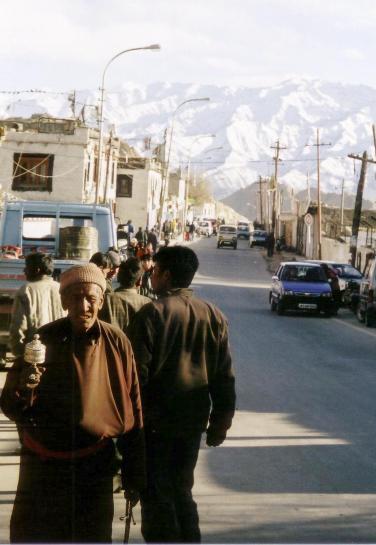
Man spinning prayer wheel, Leh. To Ladakhis, their religion is not somehow separate from their daily life, but an essential part of it.

 IMG_0001

Leh Palace. Very similar to the Potala in Lhasa, although smaller, this was the home of Ladakh’s royal family from the 17th century, when it was built, until the mid 19th century when they moved to the palace at Stok, on the other side of the Indus Valley, as a result of an invasion by Kashmiri forces.

IMG_0005

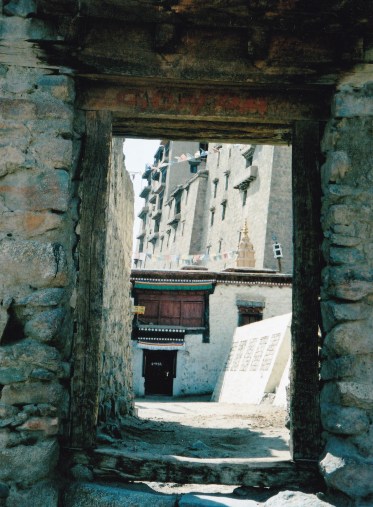
Gateway to Gompa at Leh Palace.

IMG_0024a

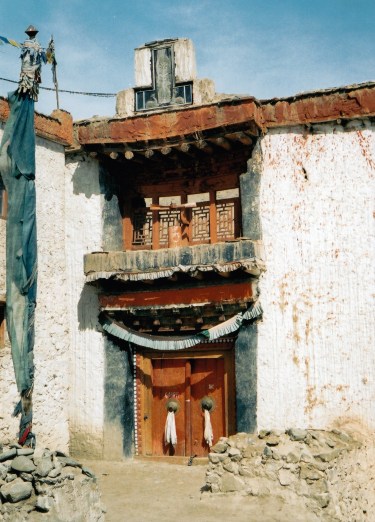
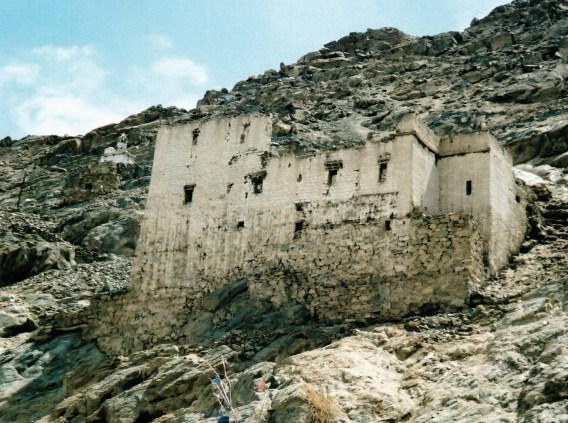
Old buildings on the outskirts of Leh, ladakh. Traditional Ladakhi buildings closely resemble those of Tibet. In fact, there are so many similarities between the two areas, that Ladakh is often referred to as ‘Little Tibet’.

                                                              Untitled-TrueColor-03

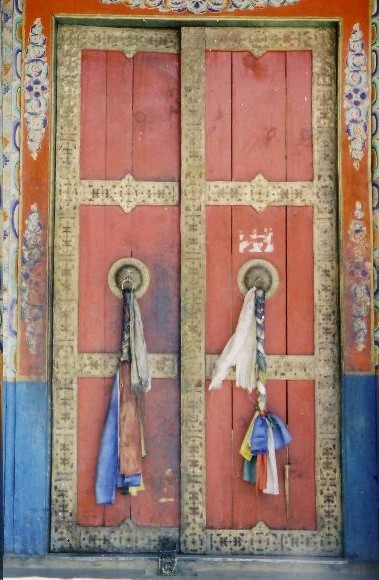
Temple Door at the Monastery at Thikse, Ladakh.


IMG_0008

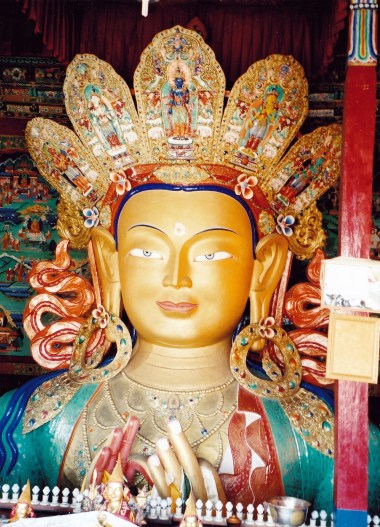
Statue of Maitreya, the Future Buddha, at Thikse Gompa. This statue, 2 stories high (15 metres) in it’s own temple was completed in 1981.