The Footpath Book

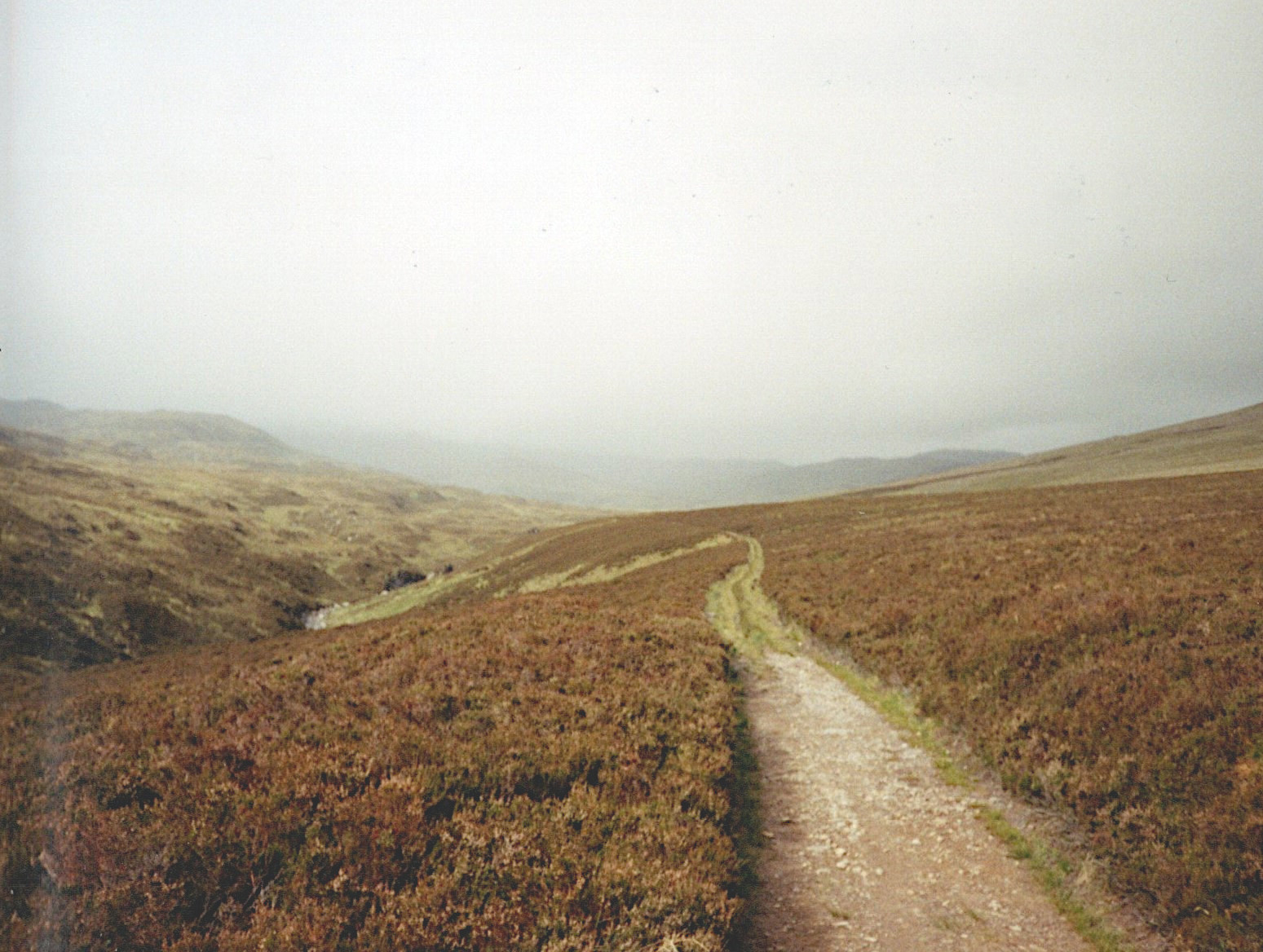
Once, I thought I’d write a footpath book, a guidebook for an area I walked frequently and knew well. As well as the practicalities of walking the paths – pointing out turnings that were easy to miss, alternative routes, the geography of the paths – I would also discuss the history and geology of the area, the wildlife and architecture, the folklore…

I’m sure you’ve seen plenty of examples of these books.

But that, naturally, would require me to walk each path carefully noting every point at which I would need to remark on these details. But I know me. I would be coming up to a point where I knew I needed to take note of the vagaries of the route, or points of special interest, and then a mile or two later I’d realise I’d been working on a poem in my head and had forgotten all about the task in hand….I would just find it impossible to keep my focus on the technicalities while walking. And I don’t really do technicalities very well, anyway.

And to have to do this for every step of every part of these routes, well, it’s not what I do. While walking, I’m inclined to drift along, my mind wandering, my focus flitting from one thing to another – whatever catches my eye at the time.

It will just have to go down as another of my discarded projects. The footpath book is for someone else to write.

Found – One Muse

‘Oh, you’re back.’

‘Well, not really. I’ve been here all the time. I just didn’t have anything to say to you, that’s all.’

‘Why on earth not?’

‘For a start, you don’t listen to me. You keep fannying around with that novel that your heart’s not in, anyway. What is it that you actually want to write? Not that one, at least at the moment.’

‘I’d love to finish it, actually, just get it out of the way.’

‘It’ll still be there when you’re ready to finish it – if you ever are. And if you’re not, it doesn’t matter. Surely you’ve got other stuff you’d rather be working on?’

‘I…’

‘Like, your poetry’s pretty crap, but you enjoy writing it.’

‘Hey! I…’

‘Then there’s the other novel, the one you’ve been faffing around with for years.’

‘Yes…’

‘So work on that one, since you actually do like it, and do a few paintings, for God’s sake. You’ve been saying you’re going to, well get on with it.’

‘I thought a muse was meant to be an inspiration, not a nag.’

‘A muse,’ she replied tersely, ‘will say whatever she thinks necessary to get her author off his lazy butt! Now, what about this pamphlet or brochure you’re meant to be doing at the moment?’

‘The zine?’

She visibly cringed.

‘Yes…that. As far as I can see you’ve been tinkering with it for months but you’ve nothing to show for it.’

‘I…’

‘You seem to have decided on a few of the poems you want to put in it, and a short story, but you haven’t rewritten the essays you wanted to use, haven’t sorted out the photographs and done nothing towards the artwork. You’ve not even decided on a title for the thing yet!’

‘I’ve…’

‘Yes, and that’s another thing. You keep jumping from one thing to another, and never completing anything.’

‘I’ve always thought it’s good to have a couple of projects on the go. When I get stuck on one I can go and work on another.’

‘Yeeessss….a couple you say. Exactly how many have you got on the go at the moment?’

‘Ah, er, I’m not sure…’

‘No? Well roughly how many?’

‘Er…’

‘Very roughly? You don’t actually know, do you? Just finish something! What about the short poem’ -*cringe* – ‘zine you’ve got in bits? As far as I can tell it’s nearer completion than the other one.’

‘Um, I suppose I could…’

‘And I’m not some lifestyle guru, but get out and go for more walks. And listen to more music and read some more books. You’re not reading very much at the moment, are you? And read something you want to read and listen to something you want to listen to. Not because you think you ‘ought’ to, whatever the hell that means. And stay off fricking social media, too. It’s poisonous.’

‘That’s certainly true.’

‘So just see that you do, or I really will be off. I’ll be checking up on you more regularly, now. I can see it’s the only way.’

She’s a tough, unforgiving, so-and-so, my muse.

At Tunbridge Wells Literary Festival

Tunbridge Wells now boasts a literary festival. Over four days this year it hosts talks from well-known writers such as Michael Rosen, Michael Parkinson and Sheila Hancock. But not just the big names.

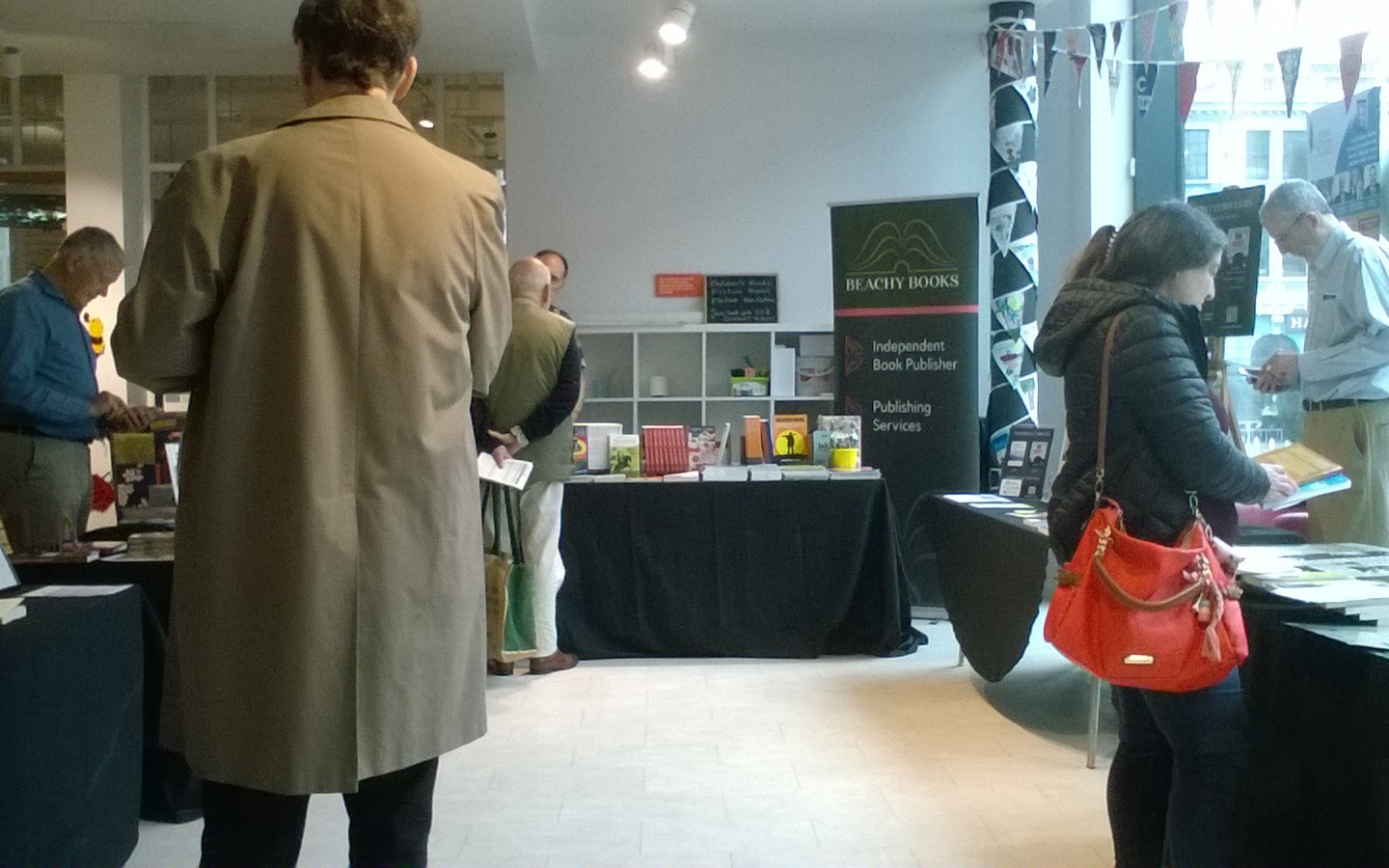
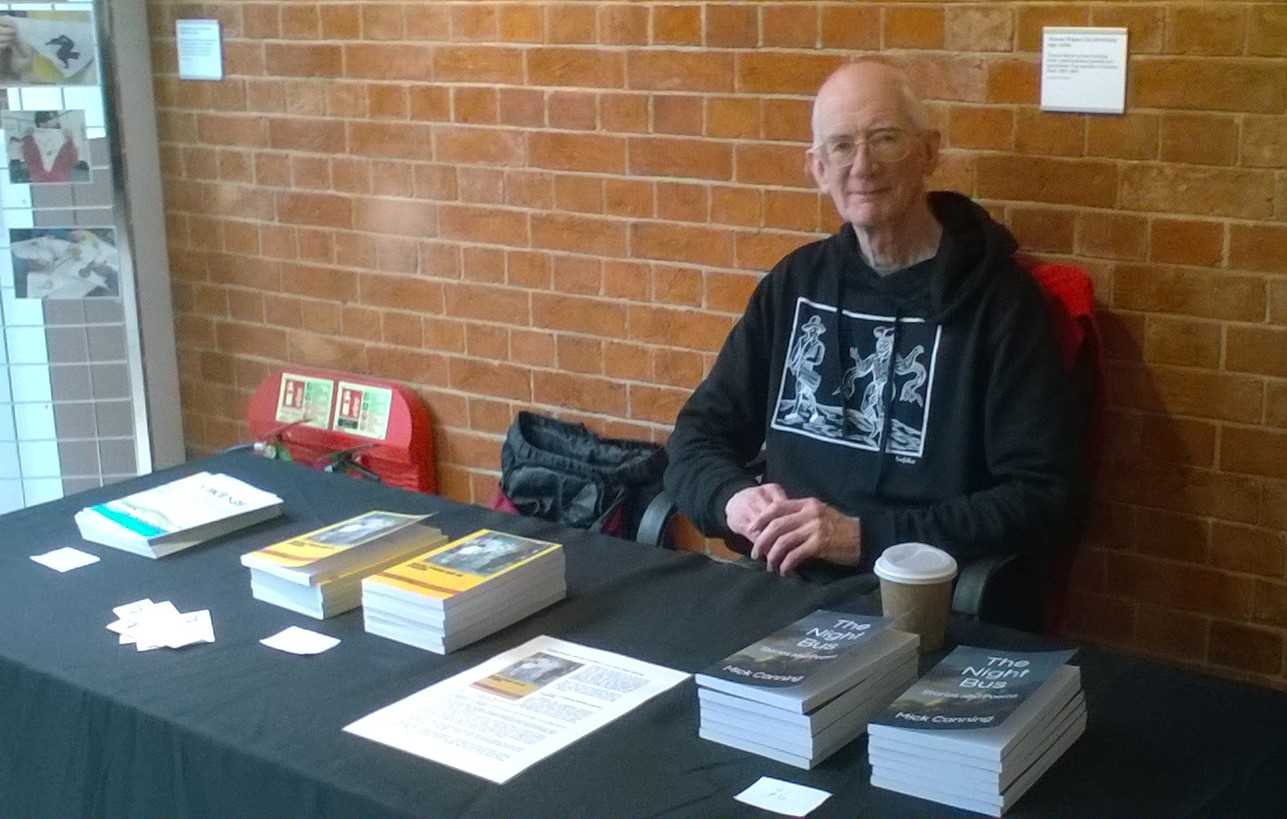
Yesterday was the day local writers could book a table and hawk their wares. It’s been some time since I’ve taken part in one of these, in fact, I’ve only done it once before, I think. When I used to regularly have paintings in exhibitions, I spent a lot of time essentially doing the same thing – chatting to other painters, talking to members of the public who might buy a painting and generally ‘networking’ (I still find that a slightly silly word). Although talking about Making Friends with the Crocodile did have another effect – it reminded me again that I’m beginning to feel I ought to take one final trip to India, sometime.

Anyway, I think I should probably do one of these more often. Did I sell armfuls of books? No, but I sold a few. I had some good conversations with members of the public and other writers, It also seems to have the effect of energising my commitment to writing, which is something that happened to my painting at exhibitions, too. Talking about my books and projects encourages me to focus afresh on them and, basically, get my finger out and get on with it, which can’t be a bad thing.

So, I’d better get on with it.

January. A New Year, a New Project. Well…projects…

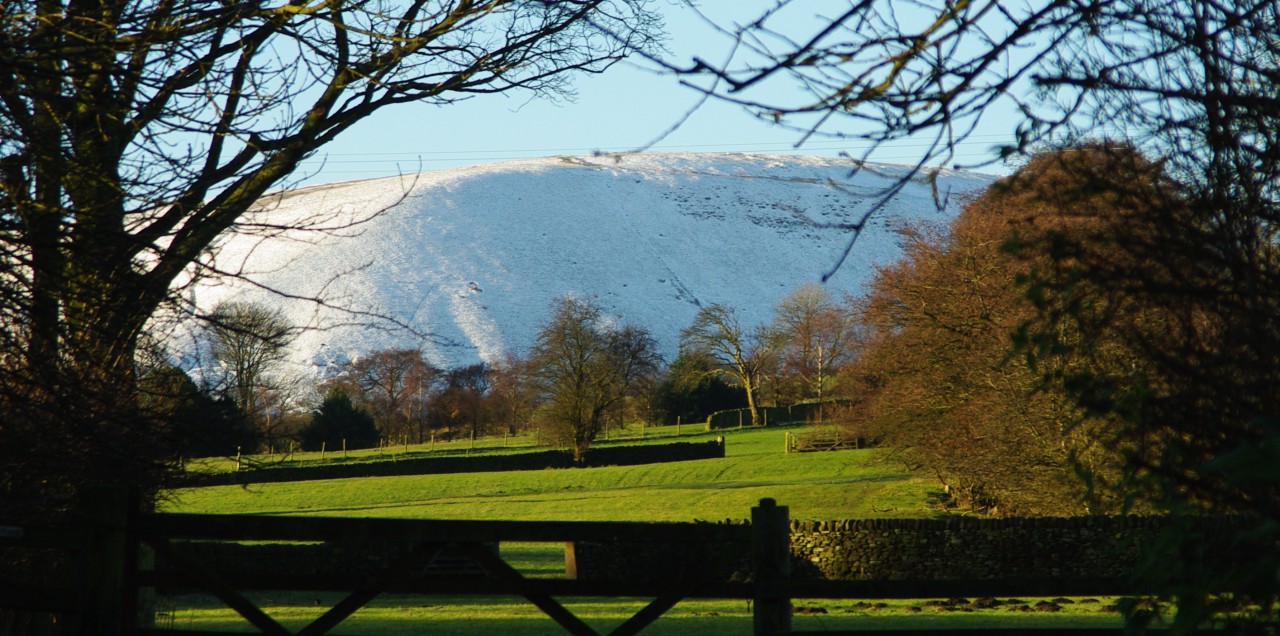
Well, here we are again. A New Year. At least we’ve had a few sunny days, recently:

On Rye Harbour Nature Reserve, Sussex.

Heading up on to the South Downs from Clayton, Sussex.

‘Jill’ windmill, near Clayton, South Downs.

‘Jack’ windmill – no longer working, and now a private dwelling.

And another shot of ‘Jill’ – restored and now working

I don’t miss 2021 at all, although I’m sure I’m not alone in that. But I got off much easier than many people, of course. I’m still here, for a start. But I had a few health issues that I’m now stuck with, and these have slowed me down a bit and have forced me to alter my lifestyle in small (but annoying) ways. And I feel old. I am old. If you’re under twenty one, then I’m incredibly old!

And for various reasons I had a very unproductive year in that I found writing really difficult and just couldn’t get my head around any art. Although I don’t make New Year Resolutions as such, I’m tackling the uninspired non-productivity by setting myself, well, not exactly goals, but projects for each month of the year.

I have been researching my family tree, and instead of nice neat charts and tables, I have reams of scrap paper with partly legible duplicated notes (and a few charts and tables). For January, then, I am sorting all of those out and making those nice neat charts and tables, and trying to fill in some of the many gaps I’m discovering as I do so. It’s only halfway through the month and it’s going well, so that’s a success so far. But the rest of the year will comprise creative projects. For the next one – February – I intend to fill all the gaps left in my work in progress, A Good Place (the novel I’ve been working on for four or five years). I won’t get around to editing it, but I intend to complete what I am determined will be the final draft.

And then for March, I shall…well, I’ll tell you that in February.

Sunday Supplement – 4

I’ve been playing this album for much of the last week. the first I had heard of Sharron Kraus was on Chanctonbury Ring, the album she worked on with Justin Hopper, based on Justin’s book The Old Weird Albion. Joy’s Reflection is Sorrow is filled with beautiful haunting songs in the folk tradition, with more than a touch of otherworldliness about them.

My world is full of paths that are too well trodden at the moment. I suppose everyone’s is, really. All the paths nearby on the common and through the woods are overflowing with dog walkers and families out for exercise and relaxation, and without going further afield it is difficult to find anywhere to walk in solitude. So a longer walk is demanded this week, out to fields and woods and rivers where I know I shall meet hardly a soul.

I think I shall resist posting progress reports on my writing in future, since I jump from project to project and no sooner do I say I’m doing a final edit of x, than I am working on y and have shelved x for the foreseeable future. I have, for example, found great difficulty in finishing A Good Place, revising the plot and the ending for the third time now…

It’s downright embarrassing, really.

I’m finding writing very difficult at present, though, which is one reason I’m not posting on here very often. Like everyone else, I just need to hang in there.

And I’m reading An Indifference of Birds by Robert Smyth.

This is another book about birds, but in this case it looks at how birds see us and how we affect them. And by extension, it looks at how we affect the whole of the natural world, and the enormous damage we are doing to it. But if that sounds horribly gloomy, the book is a delight to read – beautifully written, and filled with observation and information. Do buy it.

And look after yourselves.

David Nash and Impermanence

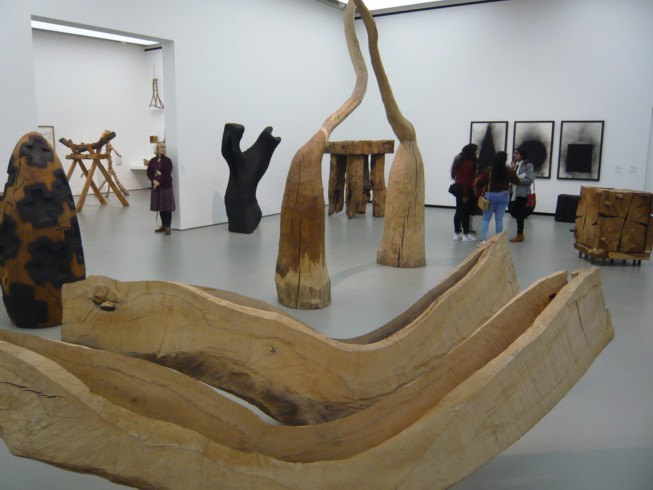
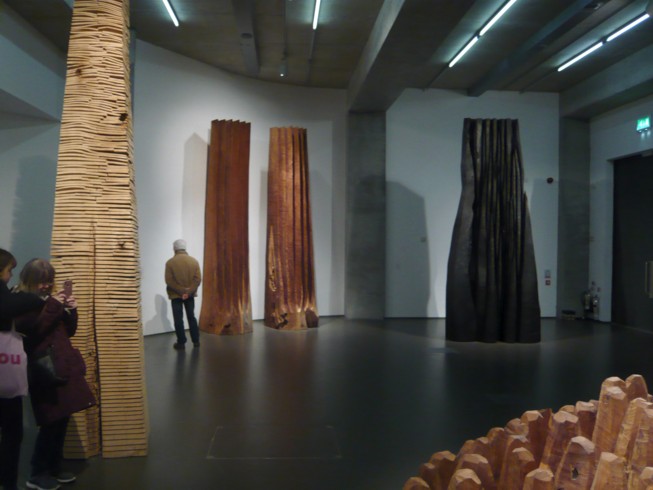
A few days ago we went to the Towner Gallery in Eastbourne, Sussex, specifically to see the Eric Ravilious paintings and prints on permanent exhibition there. There was also a large exhibition by the sculptor David Nash, who works with wood on a large scale. The fact that the whole exhibition, which also included a gallery of paintings, prints and a couple of small installations, and was intended to highlight the effects of the Climate Crisis, was the first one ever curated by Caroline Lucas M.P. of the Green Party was an added bonus for me.

007a


002a

As much as I enjoyed the Ravilious, I was blown away by Nash’s sculptures. To see wooden sculptures on that scale is unusual in itself – usually that would be the preserve of stone or metal – but that very scale plays tricks with the mind and the eye. Boxes and bowls many times larger than one would expect meet the eye as you walk around the galleries, and many of the pieces also deceive where perhaps one looks to be made from several separate pieces of wood, but on closer inspection are carved from a single block like the boat shapes in the top picture, or the ‘stack’ in the one below that.

Much of the work is left rough-hewn, but even this can be deceptive. Some pieces have been carefully finished to give that appearance.

Sculpture is the art form that seems to exist to interact with the natural world. A number of the works here are based on natural forms, but there are also stories of projects Nash has undertaken where his sculpture is either living, in the form of carefully planted and managed groves of trees, or interact in other ways.

004a

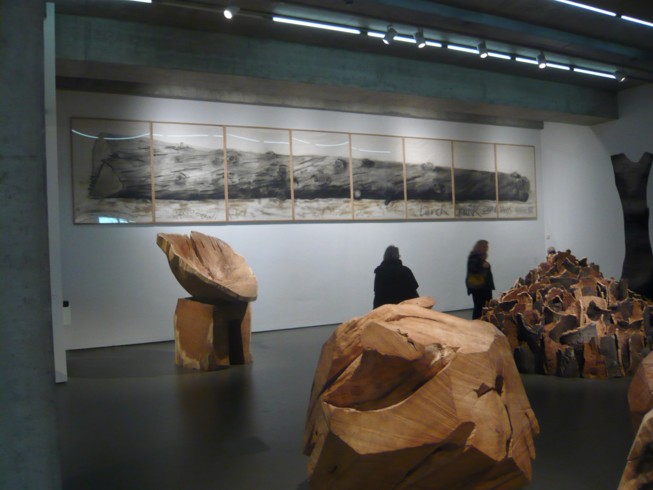
‘Boulder’ is one such project. One of the first large-scale pieces Nash made was to cut a boulder-shaped chunk from a tree (illustrated at the top of Nash’s charcoal drawing above) in 1978. This was then transported to a stream near to where he lives and works, in the Welsh hills, and rolled into the water. Since then, it has slowly made its way downstream until it reached the estuaries and inlets of the sea, where it finally disappeared in 2015. Nash documented its travels in a series of photographs and films made regularly all the while, and presented in the exhibition as a film.

006a


003a


003b

Nash’s sketch of a Larch trunk

It feels as though there is something of this meeting of art and the natural world in old ruins overrun with scrub and grass. They frequently seem to have a sculptural quality that complements the landscape around them, in a way that more pristine buildings do not.

And I like the sense that an artwork, like a ruined building, is not permanent and that eventually the natural world will absorb it back into itself. That it will reclaim it. Perhaps the artist and the environmentalist in me merge here.

My own sculptures are in wood, and some of them are set out in our garden where they gradually degrade over the years through the action of sun and rain, until they appear strangely like some weird plants that have sprouted unexpectedly there.

Responsible Travelling – Part 2

Volunteering

Many travellers who are spending some time away from home end up volunteering their services at a project that claims to be a Good Cause, or offering to help to sponsor it. And many are, although a goodly number turn out to be money-making scams, some set up very elaborately indeed.

I have seen many sides of charity work – I have worked as a volunteer in UK and in India, worked as a paid employee of a charity and I have been both a trustee and a committee member of charities. I have also watched one go to bad, with various warning signs unheeded and a number of heads buried in the sand.

dawn panorama

So how do you tell a good project from a bad one? There are no hard and fast rules, mainly because projects differ so much. Some are huge, multi-million dollar constructs involving hundreds of volunteers and paid staff whilst others run on a shoestring with one or two staff. Some are run entirely by local people, others may be foreign led or almost entirely staffed by foreigners. They set up and run schools, leprosy or aids centres, save donkeys, teach alternative ways to cook and heat to reduce deforestation, rescue fallen women and street children, restore old temples, and so on and so on. And it is often very difficult to tell a scam from a genuine project.

Firstly, please do not just leap in and offer money. There are several good ways to get a feel for the project. Local knowledge is often a good start – talk to people. If you are spending a while in a place, you will get to know people and you can chat about your chosen project to them. If it is dodgy, someone is very likely to warn you. Or spend a while there as a volunteer before offering any money. Watching how it is run at first hand should give you a feel for it. Other than that, look at its website, if it has one. The project should have a board of trustees, or a committee, to oversee it. Contact them. Ask to see how the money is used and accounted for. This should all be open and in the public domain. Don’t be afraid to ask questions. If the people concerned are reluctant to give answers, or resent your asking, be suspicious. Look for obvious signs and use common sense. A large, flashy building with a few children inside and a big new landcruiser parked out in front, in the midst of a squalid village is going to be locally devisive and should also set your alarm bells ringing. If the trustees and committee all live in Europe or US, then it may be very difficult for them to carry out their duties effectively and again you should be wary.

Naturally, all this is unnecessary if you volunteer through a well-known and reputable agency such as Oxfam or VSO – you can be sure that all has been checked out thoroughly. If you can arrange a placement before you travel, using a reputable charity, you are unlikely to encounter problems. Do a little research.

Photography

Just a bit of common sense here, really. Be aware that in some societies taking photos, especially of people or religious objects and buildings, may not be accepted as easily as it is in the west. Often it is best to ask first. Be aware of people’s sensitivities. Years ago as I waited at Dubai airport, an elderly local gentleman in local costume sat drinking coffee in a cafe. He was approached by a western couple; he taking a number of photos of said local gentleman from intrusively close range, whilst she posed beside him. After a while she virtually sat on his knee as her partner continued to snap. The local gentleman sat impassive and stony faced through this whilst I (and I am sure almost everyone else in the room) cringed and wanted to creep away (or hit them!). I hope that just the thought of it makes you cringe, too! I have virtually stopped taking candid shots in places like markets, largely because I feel quite uncomfortable doing so. I feel as though I am both being intrusive, and treating people insensitively. I have found, though, that I have been rewarded with a lot of great photographs by simply asking people if they minded me photographing them. Very few refuse, and quite a few will pose proudly.

twenty one

Should you take photos of people and offer to send them copies, please make sure that you honour this. Many people that you meet will want their photo taken – in India I have been frequently approached when taking photos by people who wanted me to photograph them. In more remote areas, you may come across people who have never seen their photograph before.

You should also be aware that in many countries airports, bridges, hydro-electric power stations and many other buildings are regarded as military installations and the authorities take a dim view of attempts to photograph them. It is possible to end up facing years in prison for taking that innocent photograph of a nice-looking bridge! Find out before you travel whether this applies to the country you are visiting.

To go or not to go –

The ethics of visiting an oppressed country.

For visiting – to see it as it really is (you probably won’t. The Army/State/Police will ensure that you don’t get to particularly sensitive areas.), to support the local people (you may or may not be. You can choose to spend your money in little stalls or shops but you may have little choice when it comes to hotels. You may be forced to stay in State-run set-ups. You certainly won’t be allowed to show any political support.).

Against visiting – You would be tacitly supporting the State. You would invariably be financially supporting the state. If the State encourages foreign tourism, it is because it wants the tourists’ dollars. Again, this is another dilemma that you will have to solve for yourself. There are several things that you can do, however, if you want to support the people of an oppressed country.

Campaigning – groups such as Amnesty International (www.amnesty.org.uk) or Avaaz (www.avaaz.org) campaign actively in support of prisoners of conscience or oppressed groups or minorities. Join them, sign their petitions, give money, write letters to governments. Add your voice to those demanding change.

Boycotts – Boycotting the goods of an oppressive regime denies them foreign cash.

There and back again

You might want to think about offsetting your carbon emissions when you travel to and from your holiday (and do not forget about any internal flights that you might take). There are a few companies that use carbon offset payments to either plant trees, or work in the area of low carbon technology with the aim of reducing the effects of global warming – for example developing cheap and easy to produce but highly efficient cooking stoves for use in areas such as Nepal where erosion has become a huge problem due to deforestation for cooking fires.

Climate Care are the company I have contributed to, who do a lot of work in this field. Obviously it is better if you take alternative public transport, but not always possible or convenient. There is a limit to how many 30 hour bus rides in ramshackle vehicles it is possible to put up with! It is not possible to be precise, but usually trains are the least polluting option. When island hopping, ferries rather than planes.

It is far more interesting to travel slowly and be part of the environment than to get into a hermetically sealed container and just emerge at the other end. Surely, that is what travel is all about.


My First Long Trip to India (4)

What did I do whilst I was in Bodhgaya?

On my first day at the project, I left my guest house at 6.30 and walked over the bridge that crosses the wide, dry and sandy riverbed, into the village. At that time of morning, the air is still cool and the light is beautiful.

dawn panorama

When I arrived school was well under way, with over two hundred children and five teachers sitting or standing under the trees, looking at blackboards, writing in exercise books, and reciting out loud. The school day ran from around six thirty until nine or nine thirty, and involved the children who lived there, plus another couple of hundred from the village and surrounding area. At nine-ish the couple of hundred went home – for many of them it was the only schooling that they received; and they were only able to attend because the Project provided it for free. The Project kids then ate quickly, washed and changed into uniforms, then went off to another school, which the Project paid for – partly in rupees, and partly by the manager doing some regular work for them.

Two other volunteers and myself made ourselves useful by preparing and washing vegetables, making chapattis, cleaning plates and bowls and manning the pump (there was a well, so at least there was a good supply of fresh, clean water). I found the cleaning process fascinating. Ash from the kitchen fire is always saved and pots, pans and bowls are all cleaned using a handful of ash as a scourer, and then rinsed. It helps that all of the utensils are stainless steel – cheap, light and hard-wearing. They come up a treat.

At the end of the morning, I went off to town for lunch, and also to buy a bottle of Indian rum from the Foreign Liquor Store; you have to go to a locked grille and pay for your purchase, where it is then placed in a brown paper bag and passed out through the grille. It all seems most furtive. I had been sleeping badly, and someone suggested that it might help, so I was happy to try it!

Then to the drug store and Ayurvedic (traditional medicine) shop to buy medical supplies for the Foundation, and then finally a water heater, cups, spoon, coffee etc. for myself.

I was gradually making myself at home.

Whilst I was in Bodhgaya, it was decided that I would act as a sort of secretary, which would take a lot of pressure off of the manager (who took about an hour to compose a short email, in any case). There was another volunteer arriving in about six weeks, who could then take this over, so that would give some continuity. I would also do a little English and maths teaching to some of the children.

IMG

The Muslim festival of Muharram was one event that happened during my stay. One afternoon, another volunteer and I found ourselves watching a mock sword-fight, held at a Muslim tomb, where at the culmination some ashes were symbolically buried, representing Imam Hussain, the Prophet’s grandson. All of the village were there, and a jolly time was had by all. Or at least a noisy one, which probably amounts to the same thing.

Once this was over, we wandered back to the Project in the half light, trying to keep an eye on all of the children (who knew their way back far better than us), where we were treated to yet another meal. We all sat around the courtyard on a tarpaulin, sharing plates of vegetables, rice, chapatti and, for the meat eaters, goat, since it is a special occasion (certainly for the goat, it is!). Lit by the light of a single hurricane lamp, surrounded by shadows, we stuffed our faces – adults first, and then the children.

We then meandered back quietly through the fields in the moonlight, listening to distant fireworks and drums from the town and nearby villages; although, other than the soft scuff of our feet in the dry, dusty soil, we seemed to be walking in an oasis of silence. Above, the night sky was a deep, vibrant, velvet blue and the Mahabodhi temple glowed in the distance, lit up by the dozens of lights surrounding it. We agreed that we were privileged to be able to experience all of this, and expressed astonishment that there are people who will pay thousands of pounds to go to India to spend their time sitting on beaches and living in plush hotels on the seafront.

To each their own, I guess.

One final snapshot from Bodhgaya:

The temperature and the humidity had been gradually rising, and I had reached the point where I was finding it difficult to cope and was desperate to get away. Eventually, I made up my mind to go to Darjeeling at the first opportunity and, suddenly, everything was different:

‘I investigate flights and trains, and start deciding on days. Strangely, I now start finding reasons for postponing my travel date, rather than bringing it forwards, as though the decision has given me permission to enjoy the place. Bodhgaya has become so familiar to me, that I start getting those ‘leaving home’ feelings.

‘After I have eaten, I head back in the night along the road that runs around past the site of the Tibetan market, now empty since the Tibetans have long-gone by now, largely by the end of February, most in January. It’s far too hot for them now.

‘To my left, in the darkness, I can feel the open, flat market area, sense the emptiness by the sudden silence and the moving airs; it is now merely hot, the sun long gone down and the breeze gives almost a feeling of coolness. I walk around the corner and know to a metre when I shall see the soaring Mahabodhi temple, floodlit, through the trees behind the darkened stalls; filled by families already settling for the night. On the other side of the road the familiar pattern of lights on the low hillside. I walk on, to the sound of the frightened cries of chickens in small cages on the corner by the clinic. I know where I am by sounds alone.

Down, then, to join the Gaya road and a maelstrom of traffic. Dust lies thick beside the pot-holed road and I kick it up with my footsteps to join the thick cloud hanging heavily in the air and churned about by the traffic, so thick that the few cars or buses with lights merely illuminate the confusion. The dust settles on your head, your clothes, in your mouth, in your nostrils, your eyes. The glow of headlights merely hurts eyes already smarting.

In the darkened area beside the police compound (they have to keep them somewhere), I await the point where I am suddenly assailed by the strong scent of flowers, heady and unexpected from some low, unobtrusive and nondescript blooms that give off a sweet, pungent odour remarkably powerful for their size.

Almost immediately I pass the Burmese monastery, where rickshaw wallahs pounce, then home.’

I left about a week later.