When I began this blog, some ten years ago, it was for the express purpose of both promoting my writing and discussing writing in general. Since then, although I have certainly used it for that purpose, promoting my books and zines, posting the occasional poem, writing the occasional review of other books, and posting discussion topics on the subject, the blog has almost inevitably drifted into other waters. Since I enjoy travel so much, I began to post photographs and memories of those travels. I put up pictures of my artwork, since this seemed an obvious (and free!) place to promote them. Articles on the British countryside, mythology and folklore, and customs. Like most people, I have wide interests and this is a good format to record them in.
One of my great pleasures has been the meeting of minds. We follow each other, read posts and comment, foment discussions. And it is a safe place! Unlike social media, it is very rare for strangers to barge in and attack other users. And on the very rare occasions this happens, it is easy to just block them. This makes it a much more enjoyable place to spend time. And there are no algorithms pushing contentious posts at the reader.
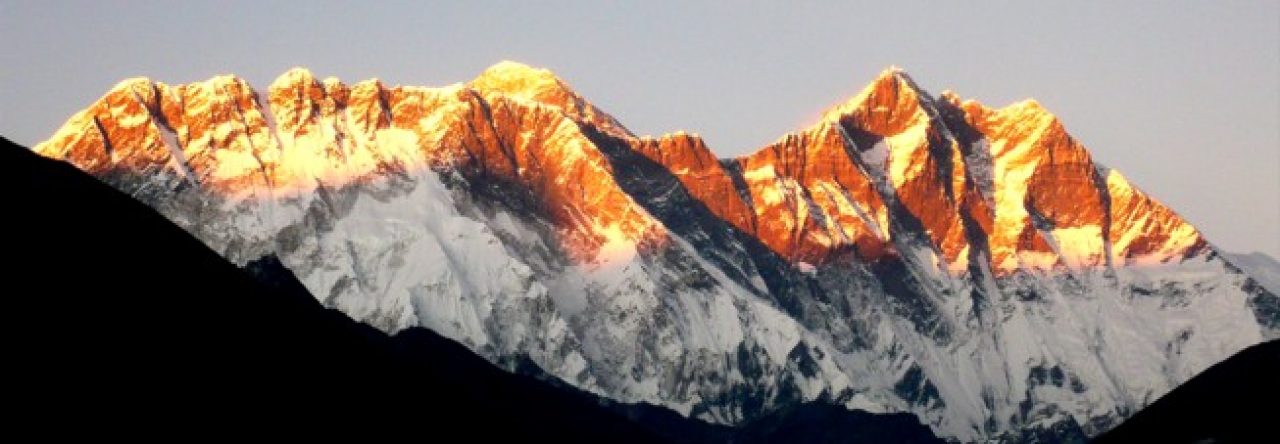
Mount Everest, photographed from Tengboche in Nepal from a post in 2021
But for the last couple of years I have been rather tardy in both posting and reading other’s blogs. Part of the reason for this is that since being retired, for some reason I seem to have less free time than I did before. I’m not really sure why that is. But I’m still here. And to get myself back into the swing of things, as well as writing some new posts, I’ll probably re-post a few of the posts I put up a long while back, which many of my current followers won’t have seen.
Well, my favourite twelve, anyway. One a month, if you like, although that wasn’t how I read them. Or perhaps the twelve book reviews of Christmas – oops, no. Missed that one. Anyway…these are some of the books I read in 2022, not books that were first published this year. But I seem to have read so many good books in 2022, it’s difficult to make a choice and this has ended up being a little arbitrary.
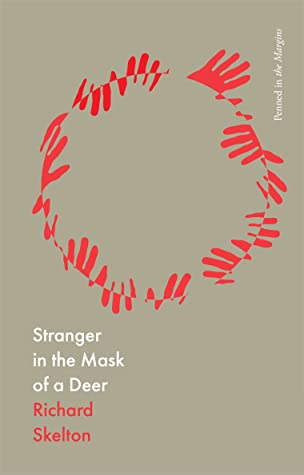
Stranger in the Mask of a Deer by Richard Skelton. It has been a long time since I last read something new and immediately put it into my top ten reads, but this remarkable work is straight in there. A few weeks later I had to re-read it, captivated by its dream-like quality.
It is essentially a poetic narrative ranging between the present day and Palaeolithic Britain, told by humans both ancient and modern, and by non-human voices. Its essence is life and ritual, the connection between humans and animals, between humans and the land they occupy, and the elements surrounding them.
The remains of deer skulls complete with antlers, but with eye holes punched into the skull so they might be worn as masks, have been found at Star Carr in Yorkshire, dating to approximately eleven thousand years ago. It is presumed these masks would have been used in rituals…
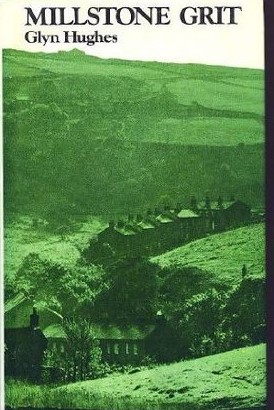
Millstone Grit by Glyn Hughes. This very readable book was originally published in 1975, describing a fifty mile walk the author took through East Lancashire and the West Riding of Yorkshire; an exploration of the moorlands and villages alongside the industrial towns, all of them suffering in their own ways from the effects of the loss of traditional industries in that area. It is about Hughes’ attachment to this area he came to live in, the clash between human and non-human landscapes, and about working class history in these places, but above all else about some most remarkable people he meets along the way.
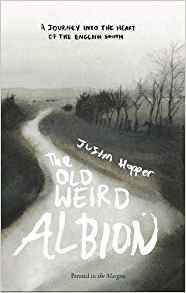
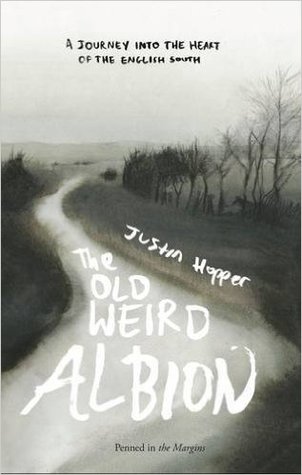
I re-read The Old Weird Albion by Justin Hopper. This is a book about tracing a mystery in his family’s past, beginning with a woman preparing to throw herself off Beachy Head, a notorious spot for suicides, but also about the effects the landscape of the South Downs has had upon people.
This is a book I reviewed on this blog when I first read it three years ago – the link is here – and I’ll just put an extract of that review here: ‘He has a gift for sifting and selecting the weird in these relationships, not just at sites that might be naturally expected to encourage the weird, such as Chanctonbury Ring, high on the Downs above Steyning or in old ruined buildings, but also in humdrum blocks of flats in modern developments. He references modern phenomena like crop circles and throughout there is the presence of ‘magic’, in the sense of a natural force. Many of the people he meets are an eccentric mix of the weird, too, although I choose this description carefully, largely in the old, original meaning of the word of ‘fate’ or ‘destiny’.’
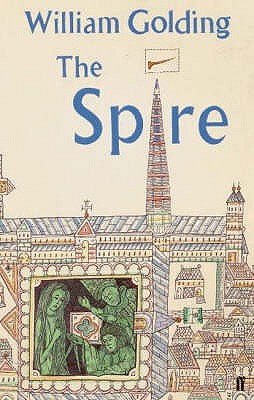
Another re-read, this time of a book I first read some forty years ago. The Spire by William Golding is a novel set in medieval England, in an unspecified city somewhere in the south. It is a story essentially about pride and hubris, about the Dean of a church determined to have built a great spire on his church, despite warnings that the foundations will not be able to support such a colossal structure. The ending seems predictable and yet that is not really where the story is going, being more concerned with the characters inhabiting that space.
The setting is the church and environs, and it evokes the feel of the ecclesiastic medieval as successfully as The Name of the Rose does. One test of how good a novel set in historical times is, is whether it transports the reader easily to that setting. I certainly found it did.
I bought Hemisphere by Pete Green at an event where poets read excerpts from their work. It is effectively a poetic journey around the northern hemisphere, beginning in Scotland, the journey approximating to the latitude of the arctic circle. The writing conveys a tremendous sense of place and feels very right for the cold edgelands described.
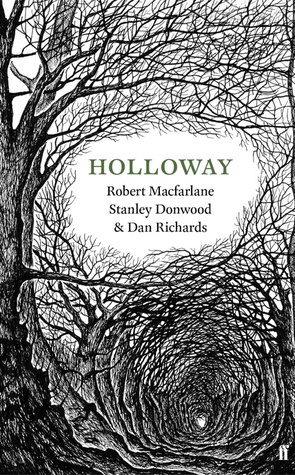
Holloway by Robert MacFarlane and Dan Richards, with illustrations by Stanley Donwood is a short book, describing a journey MacFarlane, Donwood, and Richards made in Dorset, essentially a revisit of a trip MacFarlane made previously with Roger Deakin for an earlier book, exploring holloways. Holloways, often known as sunken tracks or paths, are old – frequently very old – paths made over the centuries by the passage of feet, both human and animal, and perhaps by the wheels of wagons and carts. It is a short journey – perhaps ‘experience’ would be a better word – describing wild camps and walking, cycling and visiting old buildings; in some ways, perhaps it is really no more than a short camping trip, undertaken by a group of men acting out a boyhood adventure. The writing, though, by both MacFarlane and Richards is exquisitely poetic and Donwood’s illustrations never less than beautiful.
Notes on the Sonnets by Luke Kennard.
‘Luke Kennard recasts Shakespeare’s 154 sonnets as a series of anarchic prose poems set in the same joyless house party.
A physicist explains dark matter in the kitchen. A crying man is consoled by a Sigmund Freud action figure. An out-of-hours doctor sells phials of dark red liquid from a briefcase. Someone takes out a guitar.
Wry, insolent and self-eviscerating, Notes on the Sonnets riddles the Bard with the anxieties of the modern age, bringing Kennard’s affectionate critique to subjects as various as love, marriage, God, metaphysics and a sad horse.’
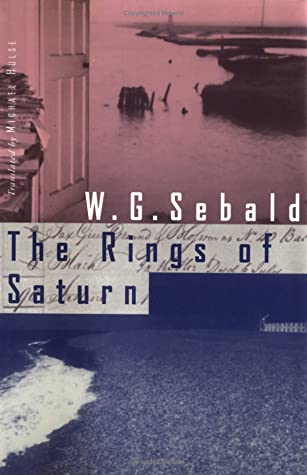
The Rings of Saturn by W. G. Sebald had been on my ‘to-read’ list for a long time, but I finally got around to picking up a copy this year. On one level, this is a walking journey taken by the author along the Suffolk coast in the early 1990’s, describing both places and people he comes across, but really, it is much deeper than that and is a psychogeographical work par excellence. Throughout the journey, we are never quite certain whether events are happening to the author, or have happened in the past, or perhaps to someone else at some other time. He goes off in unexpected directions, literary, historical, and physical, exploring a wide and eclectic range of subjects yet throughout there is a cohesion to the narrative.
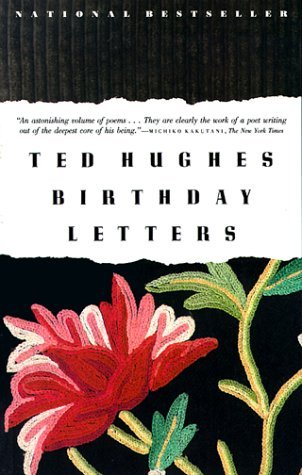
The Birthday Letters are a not-quite-series of poems Ted Hughes wrote to his wife the American poet Sylvia Plath after her death. Personally, I find them to be probably his most accessible poems and wonder whether that says something about me, although this isn’t the time to go into that. Theirs was a difficult relationship, and her suicide (as well as that of a later lover of his) frequently colours people’s opinions of Hughes. Inevitably, these are often extremely personal poems, so much so that at times I feel a slight discomfort reading them, as if I’d opened someone’s private correspondence by accident, but Hughes wrote them as an attempt to restore her to him, and published them almost for the public to read as his own account of her life and death.
Sadly, Roger Deakin only wrote three books, of which Notes From Walnut Tree Farm is compiled from diary entries he kept during the last six years of his life. In these notes, he recorded his day to day life on the farm, walks on nearby Mellis Common, the yearly cycle of the natural world all around him, and his thoughts on literature, the importance of nature, and musings on the past.
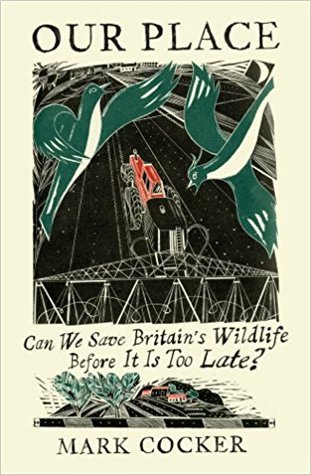
Our Place by Mark Cocker is an exploration of the history of environmental thought and politics in Great Britain and, especially, the way forward. It asks pertinent questions like who owns the land and why? And who benefits from green policies? Not afraid to be radical in its suggestions, it asks why there is such a disconnect between the British public’s sympathy for and championing of the countryside and the reality of its current condition.
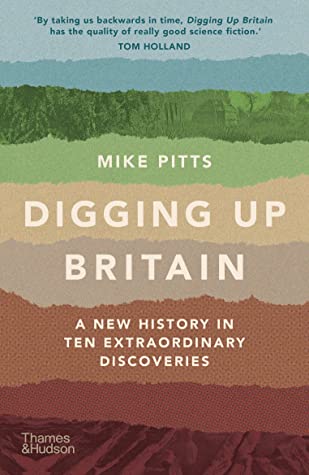
Digging up Britain by Mike Pitts tells the story of Britain’s history and prehistory in ten astonishing excavations. As someone who has always had an interest in history and pre-history, I found this book a timely reminder of the huge strides taken forward in our understanding of the past over the last ten years or so, due to such important tools as DNA analysis as well as the painstaking work of those who excavate and interpret these sites. There are some remarkable tales in this book.
For anyone who loves the English South Downs – and whodunnits – this book makes an interesting read.
On the one hand, it is a fairly average 1930’s detective murder mystery, although I have certainly read much worse, but on the other it provides some marvellous insights into the South Downs in the area specifically around Chanctonbury Ring in that time, which is really what took my interest.
Personally, I prefer murder mysteries involving ‘normal’ people, rather than the typical country house full of assorted Colonels and ladies and royalty and such-like, so popular at the time – other than the thought of bumping off the Upper Classes, of course! But this book delivers in that it is set on a downland farm, where the farmer goes missing, believed murdered. It even has, as a cover, an adaptation of one of the fabulous Leslie Carr railway posters of the 1930’s – what’s not to like?
The introduction mentions its ‘sense of place’, and the writing seems to me especially good at conveying an accurate feel of the landscape. One thing that comes over very strongly is the emptiness of the countryside at that time. The Downs have been sparsely inhabited since Roman times; before then, much of the population chose to live on the higher, drier, lands of the chalklands of South and South East England, away from the forested and frequently marshy lower areas where travel was difficult and clearance very hard work. After the arrival of the Romans, however, all this changed, and since then the chalklands have been left largely to a small population living mainly by farming sheep.
We now have many people visiting for leisure purposes and on fine days popular routes such as the walk to Birling Gap from Eastbourne (or from convenient car parks much closer!) may easily see hundreds of visitors striding along the footpaths and hanging off the edge of the cliffs taking selfies (other stupid ways to kill oneself are available). On the same day, though, nearby footpaths may see no visitors at all. It is still a sparsely populated area.
John Bude evokes this sense of emptiness well. His descriptions of the roads and paths on and around the area really allow the reader to feel this. His characters walk the lanes and roads of the downs frequently without meeting anyone else on their journeys. Farms and houses are ‘isolated’, and even at a time when most people would travel by public transport to cover any distance, the population is so small that when questioned by the detective on the case, a bus conductor can remember who was on his bus several weeks before.
There are four lime kilns near Washington, on the edge of the area described in the story, which I suspect were the inspiration for the lime kiln featured on the farm in the book. No spoilers, but you might well guess their relevance to a murder mystery.
But it is the descriptions of the roads and paths that particularly take my interest, roads and paths virtually empty of footfall or traffic even during the day, emphasising how lightly populated the area was, and still is today, to a degree. Other than popular footpaths such as the long distance South Downs Way, and those footpaths running between popular tourist spots, it is still easy to find solitude in this quiet area of the otherwise heavily populated South East England.
The viewer sees a painting that appears to be composed of watercolour and charcoal, of a winding road or track, possibly even a river, leading towards a line of downland hills, the whole created entirely in black and shades of grey, with the title and author scrawled into the picture in brilliant white, as though it were a prehistoric figure etched into the Downs themselves.
And that’s just the cover.
This is a book quite unlike any I have read before, in that it is a book about the south of England, especially the South Downs of Sussex, but it is far more than geography and the associated disciplines such as geology and biology, rural history and architecture, and folklore. Psycho-geography was not a term I had come across before, but there is an aptness to it that becomes apparent as you read.
The book opens at Beachy Head, a beautiful piece of Sussex with a dark reputation for suicide, as a woman throws herself off the edge. Quickly, we learn that this woman was the first wife of the grandfather of the author, Justin Hopper. And we learn that this book is in part a chronicle of his efforts to discover this person and learn something of her life and, consequently, her motives for such an act.
In so doing, he needs to revisit parts of his earlier time in Sussex and examine his own relationship to the area as well as the relationship of other players, not just his grandfather and other members of their family.
He has a gift for sifting and selecting the weird in these relationships, not just at sites that might be naturally expected to encourage the weird, such as Chanctonbury Ring, high on the Downs above Steyning or in old ruined buildings, but also in humdrum blocks of flats in modern developments. He references modern phenomena like crop circles and throughout there is the presence of ‘magic’, in the sense of a natural force. Many of the people he meets are an eccentric mix of the weird, too, although I choose this description carefully, largely in the old, original meaning of the word of ‘fate’ or ‘destiny’.
A strength of this book is its intensity, and I feel impelled to look at the pictures it references and read the books it quotes. So much so that upon finishing the book, I spent some time tracking down an old copy of one of those books, which I am now reading, and which holds my interest in just the way Justin implied it would.
On a personal level, this book came just at the right time for me, in that I am reacquainting myself with the geography and history, and the plants and animals, of the South of England, where I grew up and which formed my love of the natural world, and the book has encouraged me to look at this in a new way.
Well, okay, not quite that, but bear with me for a bit longer.
The other week I gave a short talk to my writing group on reasons a writer should be on social media and, more importantly, why they needed a blog. I’m not going to go into this in any detail now, but I promised I’d summarise what I said in bullet points, and then thought it might be worth putting up here to see if anyone felt like adding anything to it.
So…
Why?
As a writer, you need to have a social media presence to sell books, to get known. Even if you are a published author.
On a social media platform, you are aiming to get shares for your posts. The more shares, the more people will see them.
It’s all about engaging with customers, fans and critics.
There are a huge number of platforms, but just a few examples that I have experience of:
Facebook is the biggest, and the most active, with a high rate of engagement. Having an Author Page is a good way to engage through backstories, questions, surveys and daily updates (yours or your work), ‘Behind the scenes’ articles.
Linkedin has many users, but a low rate of engagement. A business page can be useful.
Twitter is short and succinct. A sort of ‘Marketing Lite’. Posts appear fleetingly and then are essentially gone, though, unless they generate lots of likes and retweets.
Goodreads is like ‘background’ media – people need to seek you out to find you.
But the number one way to be found is through blog posts.
Like all good social media, blogs encourage visitors to return. Unlike ordinary websites, they are updated regularly and the reader can be alerted to each new post.
There are many other reasons to blog, viz:
Teaches you to write more professionally – you have an audience
Discipline
Practice
Feedback from people outside your usual circle
Networking with others
You can upload links to other social media
There is space to write more in-depth than on other social media
To review work for other writers
To explore ideas and get feedback on these
A blog is simply a website with posts being regularly replaced, although the old ones are still on the website to read.
There are many blogging platforms, but I use WordPress.
One advantage of WP is the ease by which readers can see you have a new post.
Whichever platform you choose, it should have clear instructions and / or tutorials to help you set up.
It should also allow you to block spammers, remove adverts (by upgrading), monetise your site, and change the layout. In other words, have as much control as possible over its appearance.
It can be really helpful if the platform provides diagnostics on data such as page views, visitors, likes, comments, and links to and from your site. This helps you plan and refine how you run it.
How?
Purchase your own address! It is not very expensive, but it makes your blog more personal, more professional, and the address more memorable. And the host cannot arbitrarily close it down, which might happen with a free site.
Start by going and looking at other blogs, to find what you like and might work for you. then use your Site Builder Tool to create your site.
Once you begin writing your first post make sure you are using a clear font that stands out.
Keep the post around 500 words, certainly under 1000. When you have a decent following, you may get away with more, but new readers will be put off by longer ones. (As a guide, this post has 945 words).
Add a picture or two to help it stand out and look less daunting, but not too many. And not just dozens of selfies, unless you are an established celebrity. It’s a real turn off.
Make the post interesting! Put some good stuff in first, to get the readers’ attention. And don’t save all the good stuff until the end, as readers might not otherwise get there.
Use categories and tabs on each post to help new readers find them.
Issues
Don’t feel under pressure to post to a fixed schedule.
Don’t be afraid to change the subjects you post about – it’s all under your control and there are no rules on it. Let it develop organically.
Don’t be afraid to take a break if you need to. It’s very easy to get into a mindset where you think you need to do all these things to a rigid schedule.
Don’t obsess about the number of followers you have or likes / comments you get. Chasing them is counter-productive.
Find some blogs YOU like, and follow them, commenting when you have something to say. That way you will begin to get visits in return and then, hopefully, follows back. It is pointless following a blog that doesn’t interest you, just hoping to get a follow back. You want followers who will be interested in what you have to offer.
And on that subject, if a new follower has a site that doesn’t interest you, there is no obligation for you to follow them back.
And don’t feel obliged to comment on / like / or even read every post on blogs you follow.
Do remember that copyright law applies exactly the same on the internet as it does in the real world. If you copy a photo or article from the internet without permission and post it on your blog be prepared for possible legal unpleasantness. I always use my own, just to be safe. I think it looks better, too.
In Masks and Other Stories From Colombia, Richard Crosfield brings us twenty five tales set in Colombia, the majority of them viewed through the privileged eyes of Printer, a British expatriate.
Printer, we are told, has a good ear for a story, and is much in demand by hosts and hostesses at parties to recount these tales. He also has more empathy and sympathy for the Colombians who surround him than do most of the other cossetted expats. Naturally, this acts as a good device to introduce several of the stories.
Some of the stories are little more than vignettes, bringing the reader into the lives led by the mixture of the very poor, the well-to-do middle class, and the extremely well-off and powerful of Colombian society, as well as the expats among whom Printer lives and works. These appear to do little more than illustrate what the lives of these people are like, yet at the end of each story something has changed; there has been resolution of some kind.
Of the others, some demonstrate that you don’t always require an earth-shattering event to create a satisfactory ending, but just a quiet re-drawing of the landscape. Something has shifted, perhaps so subtly that not all the protagonists have even noticed. But we, the readers, see it clearly.
Yet it is easy for the reader to become lulled into a false sense of security by this, so that we are caught out – shocked, perhaps – when we come to one of the stories that has a more powerful and emotional conclusion.
The temptation when placing stories in a setting that is very different from the writer’s own setting, even when that writer has spent a good deal of time there – perhaps especially when that writer has spent a good deal of time there – is to either set all of them in the almost artificial world inhabited by the expat, or to try to set them in the wider community, a community that perhaps they may not completely understand. Richard has managed successfully to do both, something that demonstrates an easy familiarity with both these worlds.
Throughout the book, we can see that the author’s sympathies lie very much with the underdogs of Colombian society, although the stories never become clichés of the noble poor versus the evil rich. They are told with too much intelligence and enough humour to escape that, and, perhaps above all, the writing itself is easy and a joy to read.
Expect to encounter amateur cricketers and murderous bandits, whores and priests, street kids and artists. And a whole host of others.
This is most certainly a five star read.
My disclaimer – I received a copy of this book having beta read one of the stories for the author, although I was not asked to write a review. But my admiration for the stories and my pleasure reading them is entirely genuine.
After my previous post, it seems entirely apt to post a review, today.
Writers rely upon reviews to sell books. To spread the word. And I am conscious how bad I am at leaving reviews – mainly because I’m not very good at writing them. But I Shall Try To Do Better!
To start with, this is the review I left on Goodreads some time ago for a book that is already very well-known.
This book begins, then, full of rich, playful language as it sets the scene and gradually introduces the players.
To begin at the beginning:
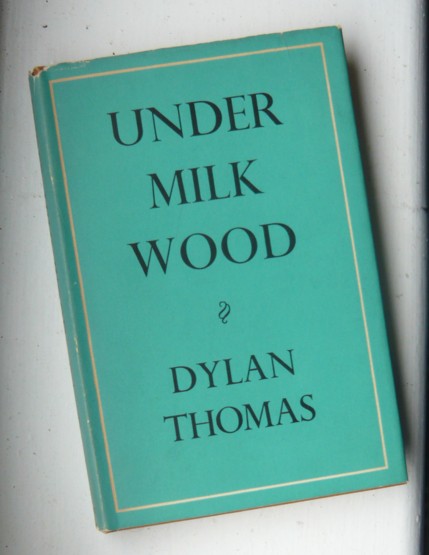
It is spring, moonless night in the small town, starless and bible-black, the cobblestreets silent and the hunched, courters’ -and -rabbits’ wood limping invisible down to the sloeblack, slow, black, crowblack, fishingboat-bobbing sea. The houses are blind as moles (though moles see fine to-night in the snouting, velvet dingles) or blind as Captain Cat there in the muffled middle by the pump and the town clock, the shops in mourning, the Welfare Hall in widows’ weeds. And all the people of the lulled and dumbfounded town are sleeping now.
I have heard poems by Dylan Thomas read by Richard Burton – the actor, not the nineteenth century explorer – and his warm, mesmeric, lilting tone suits the poetry like no other voice I could imagine. Now, I cannot read any Dylan Thomas without hearing it read in his voice.
(I want my work read like that. There is a man I know with a wonderful voice; mellifluous and rich and deep, like Burgundy and dark chocolate. Not Welsh, but very English, who I shall attempt to trick into reading one of my poems or short stories out loud, one day.)
So, to the poem, or play, if you will, for it is a play, first and foremost, told as a prose poem. The play is full of wonderful voices, the voices of a plethora of small-town characters; all of them realistically drawn with their dreams and vices and foibles, and depicted with great humour, but also with sadness. Sadness, for there is resolution for most of the characters, and for some their dreams come true, but others are disappointed.
All of these characters love and hate and desire each other, they reminisce, they have ambitions. In this play, they all have their day. In this place, each one gets to tell their story, or have it told for them.
From the very beginning, the language is rich like double cream and brandy butter; too rich, perhaps, for certainly by the time I had begun to near the end it had become too much. I found myself yearning for more plain, simple language. I wanted a few bread and water phrases.
But the words invite you to savour them slowly – in fact, they demand it. Perhaps the secret, then, is to read this little and often; to dip into it and immerse yourself in the language.
I really wanted to give this masterpiece four and half stars out of five, but without that option, I give it five, although with the caveat above.
No, I didn’t go away, unfortunately, although a holiday was what I both have been and am still craving. I made a rash promise some weeks ago to put up a Facebook Author page, to do a minor relaunch of my novel, and to serialise a bawdy Elizabethan detective story. Really, I should know myself better than that.
I think it was the short story that finally broke me.
Writing, for me, is a pleasure, comparable to painting. It is all about crafting the finished product, taking my time and eventually producing the best I can. When all goes well, the process is immensely satisfying from beginning to end.
Within that process, of course, there are times of writer’s block, false starts and finishes, wrong turnings, and many other things to go wrong. And the editing can be an infuriating process. But overall, there needs to be a flow.
Making Friends with the Crocodile worked for me at the length it was (45,000 words), since I wrote it almost as a stream of consciousness as the story unfolded in my mind. It came out in a rush partly because of its importance to me, and partly because I found I could visualise the characters, the story and the setting clearly. Once I had reached the end, I knew that was the end.
Obviously, many stories take a lot more coaxing to get down on paper. I’ve struggled with ones that need to be forced, certainly in places, partly because at that point they are not ‘me’ at the heart of them; I have lost that flow. But sometimes because of the length.
One reason I stopped entering short story competitions is I write a lot of long short stories. I am perfectly aware of the dictum that whatever you write can be edited down to the required length and that, indeed, they should be edited down.
But I also strongly believe that when a story presents itself to be written, that story has an internal length that needs to be respected, even after editing. Some require a few hundred words, some a lot more. But to attempt to turn Making Friends with the Crocodile into a 120,000 word novel or a 5.000 word short story, I am sure would have meant a lesser read. It would have been padded out for the sake of it, or stripped down to bare bones that would have meant that the characters could not have been drawn as strongly as I wanted them to be, and therefore encouraged less empathy from the reader.
Where is all this leading?
I began the short story / serial. It was working quite well, and I had a good few chuckles to myself as I was writing it and then, suddenly, it was almost 10,000 words long and nowhere near finished.
Oh dear.
So I attempted to cram and trim and edit and get it down to a suitable length for serialisation, but I was not happy with the result. Oh no. And I had one of my minor panic-I-can’t-cope-stress attacks and decided the only way to deal with it was to hide.
So, I’m not going to serialise it after all. I will finish it, but the attempt to condense it into a few instalments simply wasn’t working, and what I ended up with felt completely wrong. I will return to it at some point in the future, and finish it as the novella that it clearly is.
There is another strand to all this:
I made the Facebook Author page. That was the easy bit, and I’ll show you where it is next time. And I put together the re-launch promotion piece by the simple expedient of gathering together extracts from lots of the kind reviews the book has had.
But I am in a state of recurring panic, once again, over this huge need to self-promote to sell books. Of course, we all want to, but we are forever urged to use this or that platform, accept this or that offer, etc. Now, we are told that we ‘must’ have a YouTube channel. Really? And a presence on all sorts of social media. Are we not ‘serious’ writers if we are not prepared to move heaven and earth to sell a couple of extra books? That we should ‘invest’ a hundred or five hundred dollars here and there to advertise ourselves?
I have sold a few, and what is really important to me is the tremendous feedback that I’ve had.
Blowing my own trumpet is anathema to me, as I have written in the past. I just can’t do the selling and marketing the way that seems to be presented as essential. It’s an aspect of life that I hate, and a reason I have never gone into ‘business’. Everything around the promotion and marketing just seems relentless and is something that I cannot cope with.
Fortunately, I am not interested in fame. The idea frightens me.
And I really struggle with social media. I have had two goes at being on Facebook, and cope with it at the moment by not going on it very much. I spent ages trying to see the use of Linkedin, and have solved that one by closing my account last week. I really see no use for it.
And I am not doing Twatter.
So here I am back on WordPress, which is a platform I do enjoy. I’ll dip in and out of it a bit over the next few weeks or months, I suspect, since I still feel a bit panicky, but I will be there.
Well, it’s taken me long enough, as I’m sure everyone will agree, but I have finally managed to publish Making Friends with the Crocodile as a Print on demand paperback in India! Hurrah!
It is published by Pothi, and is available on their site, here, and on Amazon.in and Flipkart.
It is still available as a Kindle e-book from Amazon, and is also available as an e-book from Kobo, worldwide, for those who do not favour Kindle.
I have been told plenty of times that I need to be more proactive promoting the book, but I’m not terribly good at that. However, this is me having another pathetic stab at it:
Buy it now! It’s great! Please…pretty please…
Oh well, I’m working on it.
Should you be kind enough to buy it, or, indeed, if you have already done so, please consider leaving a review. Reviews encourage others to buy the book, and, on Amazon, once a book has garnered a certain number, then Amazon list it a little more prominently – which is a tremendous help to the author!
And I have been lucky enough to garner some very complimentary and generous reviews, so far. A few excerpts:
‘This beautifully written story, set in a village in Bihar, draws you in from its first page.’
‘Making Friends with the Crocodile is a very fine book. And it takes us into the harsh reality of the life of women in rural India, much more effectively than any official report.’
‘The characters are depicted with obvious respect for a culture that is both beautiful and at times shocking. By the novels finale, though tragic, we are left with a very thought provoking and memorable story.’
‘This is a novel with depth and real emotional involvement. Told simply and with an honesty that defies disbelief at events and attitudes, it packs some serious punches. It’s a story that will live with me for a long time, and one that has materially altered my opinions about certain cultural norms. Researched in real depth and related in language that fits the narrator so well, it’s a very good read.’
‘Mick has delved into the mind of a middle- aged woman living in rural Bihar and has beautifully sketched the love – hate relationship she shares with her daughter in law. The book gives a lot of perspective on the mind-set and predispositions that prevail in the rural north Indian society (which apply, at large to many other parts as well).’
The blurb: ‘Siddiqa was only just into her teens when she was forced to leave her home to live with her new husband and his family in another village. The years have passed, and now Siddiqa has three children of her own. Her grown up son has brought his new wife, Naira, to live with them, so Siddiqa is no longer the lowliest in the household, for she has a daughter-in-law.
Life in rural India is particularly harsh for women. This novel explores themes of female oppression and tradition and asks whether the next generation will find life any easier.‘
I suppose that at least when I publish my next book, I should have a much better idea of how to go about it.
I thought that I would pick out what might be the 10 books that have most influenced my life. Well, I say 10 books, but I may tire of this long before I reach 10, so let’s just see what happens.
You see, these are not really reviews, although it is necessary to give some idea of the plot of each book, it is more about how they have influenced me, and I may decide after a while that I’m just giving away too much about myself.
Or that I’m just going over and over the same ground.
Okay, then. Let’s get on with it. The rules:
Firstly, I must have read the book more than 5 years ago. I know this is an arbitrary figure, but any book that I have read recently is likely to be clearer in my mind, and so appear a little more important to me than it really is. It needs time to settle.
Secondly, I need to be able to demonstrate to myself exactly how it is that the book has influenced me. Just to say ‘it was important to me’ will not be enough. That would be little better than just saying ‘I like it’. Perfectly valid, but hardly the stuff of a blog post. This is another reason to impose the 5 year rule – there must have been enough time elapsed to see the influence.
So I’ll start today with Steppenwolf by Hermann Hesse.
Sometimes, you get the feeling that some people have just been born into the wrong century. Not that they would prefer dressing in cravats or crinolines, although they might anyway, or that they have a hankering after a little piracy or bubonic plague, but rather you can see that they don’t fit in with the pace of modern life, or much like the ethos of the times.
There must be quite a few people like that, which must partly explain the immense popularity of Steppenwolf both when it was released, and then especially in the 1960’s and 1970’s.
It was the second book by Hesse that I had read, after cutting my teeth on ‘The Journey to the East’ as a teenager, and I was a little unprepared for its message.
Whereas ‘The Journey to the East’ felt like a bit of drug-induced fantasy, although a very clever and readable one, without any obvious message beyond ‘free yourself from the conventions of society, man’, Steppenwolf clearly had a more serious message to convey.
It begins with the protagonist, Harry, contemplating taking his own life, because he sees himself as a serious writer both at odds with the world that he lives in (Germany, post WWI), whose values, especially the bourgeois ones, he despises, but also with his inner alter ego, the very opposite of the sophisticated artist that he sees himself, which he calls the Steppenwolf – or the wolf of the steppes. He hates and fears this alter ego, who he feels he cannot control, and who sneers at everything that Harry holds dear.
It is whilst Harry is contemplating suicide, that he comes across a booklet entitled ‘Treatise on the Steppenwolf’ and as he reads it, he discovers that it is about himself. the booklet talks about Harry and his alter ego, but also explains that there are many, many more of these other sides to his character.
Through the rest of the book, Harry learns how to reconcile these many sides of himself and, more importantly, how he can manage to live in this world that up until then, he sees no value in.
When I read the part of the book that consisted of the treatise on the various different natures that made up the protagonist of the novel, it was the first indication to me that we really do have these different sides to our characters; sides that do not need to be in conflict with each other, but can coexist quite peaceably. As a typical young man, I knew that there were parts of me that yearned for safety, parts that simply wanted to rebel. Parts that enjoyed home life and parts that wanted nothing more than to wander the world with my possessions in a rucksack. There was the aesthete and there was the lover. The artist and the fighter.
Until then, the rebel in me had sneered at the home lover, and the artist seemed to be in perpetual conflict with the fighter. I had felt embarrassed by parts of my character and, just as did the hero of Steppenwolf, rather tried to repress them.
What this book did was to show me that it was natural to feel like that, and that the secret was to accept all of these sides of me, and allow them to all have their moments of dominance, and their moments of passivity. They did not need to be in conflict.






 Mick Canning