A Quiet Place

Hermits have long gone out of fashion, which is rather a shame. At one time I think I might have viewed it as a good career choice. It had its perks; accommodation was provided, usually in the form of a rude hut (that’s rude as in rudimentary, of course, not because there were obscene drawings on the walls. Although heaven knows what the hut’s occupant might have been driven to in the long winter months…) or a romantically ruined building, food was generally provided, although I suspect that within the job description for a hermit it would have been set out that nourishment came in the form of gruel and acorns rather than an a la carte menu, and people generally left you alone to get on with hermitty things. The downside, though, was what those hermitty things consisted of. There would have been long hours of prayer and contemplation, and I think even if the weather was crap, the hermit would be expected to be out in it praying and contemplating – probably contemplating a hot meal, a hot bath and a warm bed. The estate’s owners and guests would expect to view you hermitting, which you’d have to put up with whenever that might occur – probably every time you felt least like hermitting. The rude hut probably leaked and had an earth floor and nowhere to light a fire and you’d probably have to dig a hole in the woods every time you needed a crap and if the estate servants were late bringing the gruel or even forgot about it altogether, I doubt you’d be welcome going up to the Big House to complain.

I’ve no idea whether the terms and conditions of employment were ever open to negotiation, but if the position still existed today, I’m sure they would be. Hopefully, the profession would have been unionised and today’s hermit could look forward to comfortable lodgings with regular meals, well out of the way of the noise and hubbub of society.

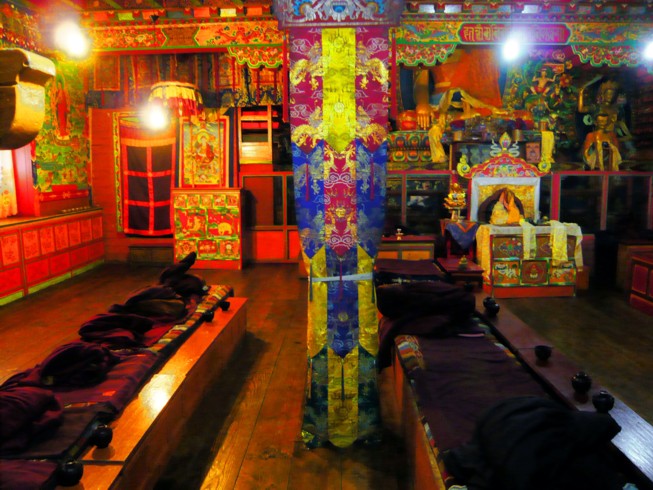
But I didn’t intend to talk about hermits, it just kind of happened. We’ve finally got some decent weather here, and yesterday I was walking through a village in the sunshine and idly thinking there are two situations in which I reckon I could renounce the world. One is in somewhere like Kathmandu in the Buddhist temples there. I’ve always had such a profound feeling of peace and stillness in these places. Buddhism is the only set of beliefs I’ve ever really been attracted to, although more as a philosophy of life than as a religion. I can’t do religion. The world is beautiful and amazing enough without throwing imaginary beings into the mix. But Buddhism is more about being a better person and looking after the world and everyone and everything in it. I could melt into that environment without too much difficulty. At least for a while.
The other situation, especially on an English summer’s afternoon in the countryside, is to retreat to somewhere remote and live a simple life away from the world as much as is practical. I’ve probably told you that before. That’s where the hermit thoughts came in.

But sadly, as already mentioned, hermits aren’t a thing anymore. Not in this country, at least. There are openings available in various other countries, but I don’t think I’m ready to explore those options. Perhaps I’ll just go for another walk.

Winter – 3

Winter would have brought a period of enforced leisure for our ancestors. Their days would have become shorter with the increasing hours of darkness, until in midwinter the daylight hours would make up only one third of the time.

All outdoor activities would effectively cease in the darkness, and even during the day the worsening weather would limit what could be achieved outdoors. But other than those tasks that could be carried out, what did they do in these times? how did they pass those long hours?

At times, no doubt, there would have been feasting and merry-making because they would have required some cheer and a sense of well-being to help them get through the winter. But they must also have been mindful of husbanding scarce food resources through those long barren months.

it may be that they played games. Although archaeology hasn’t furnished us with evidence of board games or dice or variations on these, it is still possible they would scratch, perhaps, some form of grid into the beaten soil of the floor and play games of skill or chance. It is not beyond possibility that some flat rocks with strange scorings and lines on them were used for that purpose.

With no TVs or books or computers, it might seem to us that time would have weighed heavily on their hands. But you are used to what you are used to, and they would have seen things differently. They may have looked forward to a period of relative inactivity; long hours of no talk, sitting or lying down, the mind slowing down until hours were passed in no thought. Did they then also pass unusually long hours in sleep? A kind of semi-hibernation as a way of conserving energy?

But long hours also, of talking. They must have talked: of daily life and plans and past disasters and glories, of gossip, and told stories both new and handed down from previous generations. These stories would have been incredibly powerful tools for the preservation of the tribe. With no written word, the spoken word becomes the only way knowledge is transmitted. And thus it has to be memorised, both for use and also to transmit in the future. As aids to memorising, powerful tools are repetition, rhyme and rhythm. We cannot know exactly how this was utilised, but it cannot have been long before poetry and song evolved.

It can be no coincidence, but in all the early societies we know of who had no written records, those of which we know about through records left by others – such as the Romans writing of the Britons – it is clear that poetry and song were important, and the bard a highly valued member of that society. Indeed, the writings left by Romans, who tended to denigrate anyone not Roman as barbarian and primitive, violent, and uncultured, still make it clear these ‘barbarian’ tribes valued poetry and song highly. Partly, this must have been for educational purposes, but they seem also to have been valued for themselves, for their beauty. It is taking things too far to suggest this proves the same would have applied in Neolithic times, but it is certainly possible. At some point, there would have been music. I imagine this developed out of ritual, perhaps through repetitive chanting and the beat of drums…

And so, I can imagine this at first being perhaps the preserve of the shaman, until becoming a specialised ‘post’ – that of the bard – and acquiring the value of entertainment, as well as instruction.

Review of Masks and Other Stories From Colombia by Richard Crosfield

In Masks and Other Stories From Colombia, Richard Crosfield brings us twenty five tales set in Colombia, the majority of them viewed through the privileged eyes of Printer, a British expatriate.

mask

Printer, we are told, has a good ear for a story, and is much in demand by hosts and hostesses at parties to recount these tales. He also has more empathy and sympathy for the Colombians who surround him than do most of the other cossetted expats. Naturally, this acts as a good device to introduce several of the stories.

Some of the stories are little more than vignettes, bringing the reader into the lives led by the mixture of the very poor, the well-to-do middle class, and the extremely well-off and powerful of Colombian society, as well as the expats among whom Printer lives and works. These appear to do little more than illustrate what the lives of these people are like, yet at the end of each story something has changed; there has been resolution of some kind.

Of the others, some demonstrate that you don’t always require an earth-shattering event to create a satisfactory ending, but just a quiet re-drawing of the landscape. Something has shifted, perhaps so subtly that not all the protagonists have even noticed. But we, the readers, see it clearly.

Yet it is easy for the reader to become lulled into a false sense of security by this, so that we are caught out – shocked, perhaps – when we come to one of the stories that has a more powerful and emotional conclusion.

The temptation when placing stories in a setting that is very different from the writer’s own setting, even when that writer has spent a good deal of time there – perhaps especially when that writer has spent a good deal of time there – is to either set all of them in the almost artificial world inhabited by the expat, or to try to set them in the wider community, a community that perhaps they may not completely understand. Richard has managed successfully to do both, something that demonstrates an easy familiarity with both these worlds.

Throughout the book, we can see that the author’s sympathies lie very much with the underdogs of Colombian society, although the stories never become clichés of the noble poor versus the evil rich. They are told with too much intelligence and enough humour to escape that, and, perhaps above all, the writing itself is easy and a joy to read.

Expect to encounter amateur cricketers and murderous bandits, whores and priests, street kids and artists. And a whole host of others.

This is most certainly a five star read.

My disclaimer – I received a copy of this book having beta read one of the stories for the author, although I was not asked to write a review. But my admiration for the stories and my pleasure reading them is entirely genuine.

The Enduring Lie of A Golden Age

It seems that huge numbers of people have an impression that there was a ‘Golden Age’ at some previous point of their, or some other, society.

They may not define it in those words, or even acknowledge it as such, but it seems to be very common for people to yearn for another time. Sometimes, this is nostalgia – for the days of their youth – but frequently it is for some far-off time that they feel to be somehow better than the time they live in.

Untitled-Grayscale-01

Fantasy books frequently encourage this sort of thinking. Regardless of the actual storyline, the heroes and villains and cast of other odd characters tend to run around and fight and go on quests and sit around in quaint thatched inns quaffing head-splitting alcoholic drinks and everyone is jolly and no one ever dies of dysentery or bubonic plague in misery and agony and squalor.

The Lord of the Rings is a fine example of this. It is a favourite of mine, but it is very noticeable how no one dies of disease, but mostly lives to an exceedingly old age unless chopped into pieces by Orcs.

Hollywood, too, plays its part in this. To take a film at (almost) random, an old version of ‘Robin Hood’ (set in medieval England, remember) depicts a group of merry men dressed in very strange attire living in the depths of a forest and merrily ambushing the Bad King’s men, merrily dining at long tables out beneath the spreading branches of merry oak trees under starry skies and everyone looks clean and clean shaven and everyone is merry, and it never rains.

Pah!

This is meant to be medieval England. Life expectancy at the time was around 30 years. Huge numbers of people died of dysentery, mainly because there was no concept of hygiene. Occasional plagues carried off massive numbers of people, emptying entire towns and villages. There were no antibiotics or anaesthetics. Disease was sent by God and the only way to cure it was considered to be prayer. Or witchcraft. Women routinely died in childbirth, in great pain. The majority of children never reached their teens. Every peasant in every village was effectively a slave under the command of the local lord, who held the power of life and death over them, and might exercise this on a whim at any moment. The threat of famine was ever present.

Pain and misery was a given.

The majority of people lived, too, in a very real terror of the Devil and the threat of eternal damnation.

The list of horrors is almost endless. The phrase ‘life was nasty, brutish and short’ is an apt description of those times. Certainly, I would not wish to live under those conditions.

There are plenty of other ‘Golden Ages’, of course. Almost any time in history can exercise a fascination on us, if certain aspects of it appeal to us and there are things we dislike about the society we live in. And it is natural to yearn for something better; something more than we have.

And this is not to suggest that every age was a living hell for everyone in that society, but that life in most of these times was reasonably decent for the very few on top of the pile, and pretty miserable for the rest. In fact, the measure of how ‘Golden’ an age was, tends to be the conditions of the upper echelons of that society, and perhaps those of a middle class, if such existed.

There is much wrong with our world today. But the huge advances seen over the last hundred years or so, especially in medicine, have meant that our lives have been improved out of all recognition. No longer does surgery equate to filling the patient with a quart of whisky and then sawing off a leg or an arm. No longer do those patients routinely die of infections after surgery, thanks to antibiotics. High blood pressure is controlled, rather than routinely killing. Children usually survive all the diseases of childhood, rather than being most likely to die. Women rarely die in childbirth, and the pain can be somewhat controlled.

Women and children are no longer the legal chattels of men.

Work conditions are hugely improved. Children do not go down mines or work at dangerous looms 14 hours a day. Instead, most receive a proper education. Adults, too, work fewer hours and under far better conditions than previously. When they are too old or frail to work, the state provides a certain amount of dignified support. People do not as a rule die these days of starvation. We do not execute children for stealing sixpence, or poaching rabbits on the Lord’s estate.

In most cases, for most people, today is the Golden Age.

Ooh, it’s nearly finished!

I’m getting excited, now.

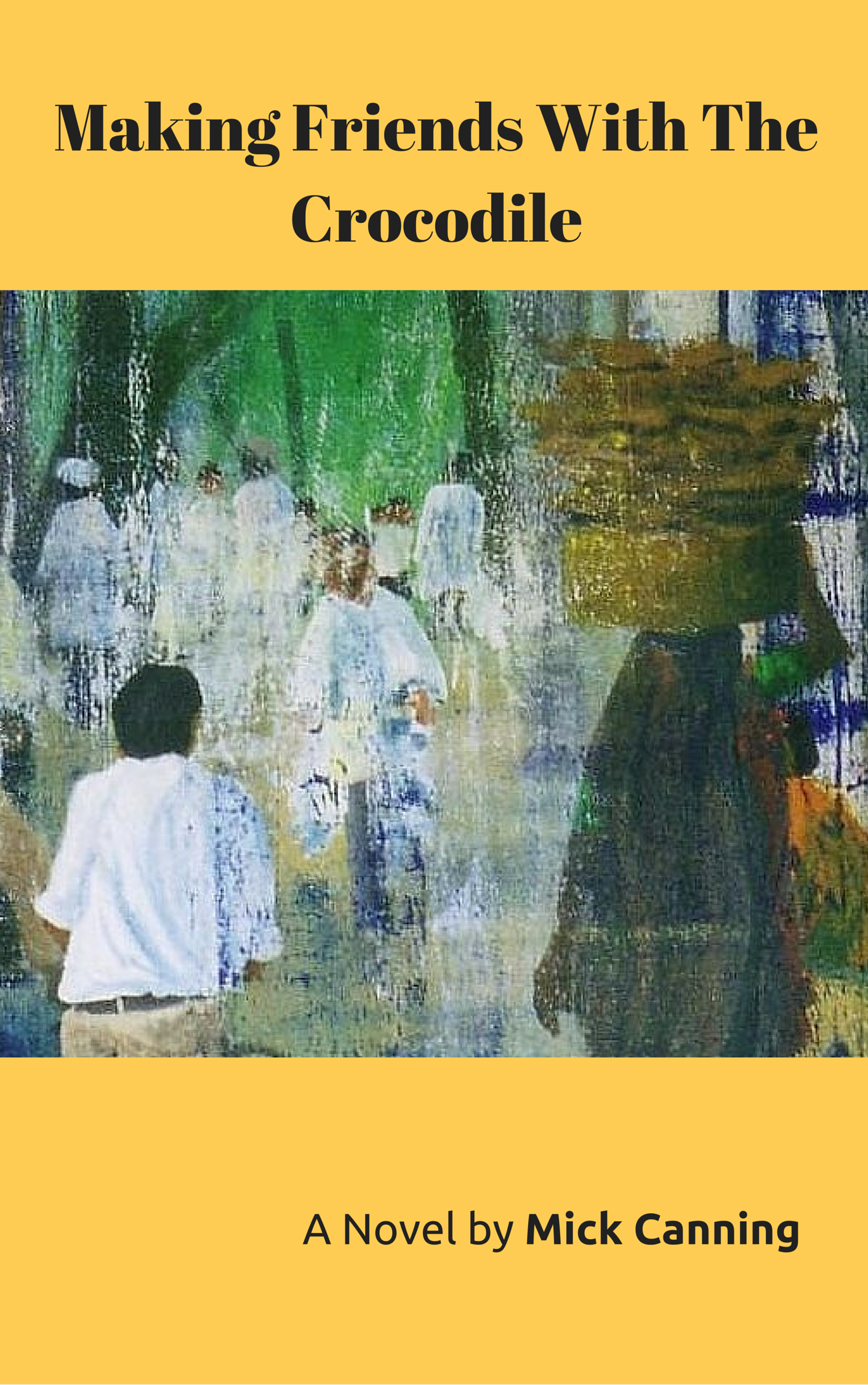
My novel, ‘Making Friends with the Crocodile’ is hopefully ready for its final edit.

This part of the journey seems to be taking a great deal of time, but this might be because it is my first foray into publishing. I know that there is still much to do – formatting, advertising, proof-reading, the publishing itself, amongst a plethora of smaller but no less important tasks – but I am finally beginning to feel that I am getting there.

Curiously, after what I wrote in my last post, I never found any of the characters threatening to hijack the plot in any way. Although I never planned it out in any detail, I had a rough plan in my head, which, remarkably, I kept to. Perhaps it is because the subject matter is strong. I don’t know.

And I think that I have settled upon the cover (the artwork is my own).

Making Friends With The Crocodile cover 1

I may play around with the wording, slightly, for example I might take out the words ‘A Novel’.

For some background; the story is set in a village in Northern India, some fifteen odd years ago. It is about the deteriorating relationship between two women in a family: the mother and her daughter in law. Like this relationship frequently is, it is a strained, fractious one, not helped by that society’s attitudes towards women and their roles in general. And when one of them gets caught up in events beyond her control, these attitudes become dreadfully destructive.

As always, your thoughts would be very much appreciated.

An Alien Culture?

More people travel for leisure purposes today than have ever done so in the past. And many work abroad on short- or long-term contracts, often with a certain amount of leisure time available to experience the culture that surrounds them there.

And this will result in these travellers meeting the people that make up the indigenous society where, for a while, they find themselves. Will there then be a meeting of minds?

Having lived in an ex-pat society, as I have referred to on here before, I am familiar with the laager mentality that often pervades it. I won’t go into all the permutations, but there is frequently a combination of arrogance and fear that leads to a strong feeling of ‘us and them’.

Many travel with the firm conviction that their own society is superior to any other, and are unwilling to see any good at all in any others. Some who go away to work resent being uprooted, and arrive with that resentment packed in their baggage. Some find the experience to be fearful, if they do not understand the language being spoken around them or assume that this alien society has values that somehow threaten them.

And they can either lock themselves away and peer over the barricades, or they can embrace the experience and learn from it.

137 (2)

Travel broadens the mind, it is said, but sometimes it seems to just cement prejudices more firmly in place.

And how easy it is to travel around just looking for things to justify prejudices!

One of the more infuriating things that I come across occasionally is a bigoted and ignorant letter or article in a local newspaper (it often tends to be the local ones) where someone’s idiot views are justified by the phrase ‘I know; I was there’. I imagine them living their entire time in a foreign country in a compound that they rarely leave, yet thinking that they now know exactly how the society functions beyond their walls.

I’ve met one or two of them, over the years.

I spent three years in Oman, working, and I’ve travelled fairly extensively in India, but I do not imagine or pretend that I really have much more than a superficial experience of these places. I knew little of the local culture in Oman beyond what I could see in the streets and villages and markets that I visited. I didn’t know anyone well enough to spend time at their homes or in their social circles. I went with groups of other westerners to places of interest. I did spend a lot of time exploring the desert and the nearby towns on my own, but I was effectively still inside my own little bubble. It is a huge regret that I never got deeper under the surface.

I have, perhaps, managed to learn a little more about the real India, especially through spending time on a project in a village, although I cannot pretend, even to myself, that I really have any idea of what it is like to actually live in an Indian village.

During the later days of the British Raj, the rulers took the approach that their civilisation was naturally superior, and that there was nothing in Indian civilisation worthy of their consideration. The irony of this is that around the end of the eighteenth century, and the first years of the nineteenth, many of the British in India had taken a keen interest in Indian history and culture, themselves doing a tremendous amount to unearth much of the history that had been lost and forgotten. For that comparatively brief period, it would seem that many of the British treated Indians and their culture with a deep respect.

The reasons that this changed are probably deeper than my understanding, but two things stand out. Firstly, that from the beginning of the nineteenth century, many British women came to India in search of husbands, bringing with them what we tend to think of as Victorian attitudes, and secondly, there was an upsurge of evangelism in Britain, which translated itself in India as a movement to convert the ‘heathens’ to Christianity. These combined as a new feeling of superiority, and contempt for a society that was now seen as inferior, especially when much of it resisted their overtures.

With this, the British as a whole seemed to become more intolerant and arrogant, and less respectful of sensibilities. This culminated in the horrors of 1857, which could be said to be caused directly by these attitudes.

To return to the present day, it seems that many travellers have attitudes no better than their Victorian predecessors’. I wrote a post a few months back that mentioned a number of westerners I came across in a Himalayan hill resort, https://mickcanning.co/2015/10/25/the-mad-woman-of-the-hill-station/  should you wish to view it, whose behaviour and attitudes were just downright arrogant and disrespectful. They were doing no more than confirming their prejudices as they travelled, and at the same time I daresay they were confirming many people’s views of western travellers.

Yet there are many people who travel with open ears, open eyes and an open mind, and their rewards are far greater than those of the blinkered traveller. They have the wonderful opportunity to experience and learn about different cultures at first hand, speak to people who hold different beliefs and ideals to them, and perhaps learn a little of what drives them. In return, they have an opportunity to enlighten others, perhaps, to things in their own society that might not be understood by those others. In a small way, each and every one of them can choose to contribute either to different societies coming to understand and become more tolerant, or to the further spread of tensions, mistrust, and misunderstandings.

And all of these little interactions, added together, are as important and influential as the contacts between politicians and diplomats.

Once Upon a Time

046

Are you sitting comfortably? Then I’ll begin.

It is a cliché that causes us to smile, yet variations of that phrase will have been used countless times in the distant past, when our ancestors gathered around the storyteller of the tribe to hear whatever tale he (or she) was about to tell.

And research http://rsos.royalsocietypublishing.org/content/3/1/150645  that was published this week, now tells us that the history of fairy tales turns out to be even longer than anyone suspected, going back to the times of prehistoric tribes. Not that this theory is entirely uncontested, of course.

But I would be surprised if it were untrue.

There have always been storytellers, who performed an important role, especially before the invention of writing. In those days, when all knowledge had to be memorised if it was to be of any use, then the skills of the storyteller in the tribe, someone who was used to organising their thoughts so that they could remember what was important and then recount it to the rest of the tribe, would have been vital for far more than simply entertainment; they would have been essential for the tribe’s survival.

They would have told stories about wild animals; either cautionary tales, or how to hunt them. Stories of skirmishes with other tribes; praising the bravery of their own warriors, and recounting how the other tribe was put to flight, but warning, still, of the danger these other tribes posed.

They must have always speculated on the origins of their world, and come up with the various creation myths. It would be important that all the tribe understood the appropriate rituals they would need to follow to appease the gods and ensure their own welfare.

So these stories would have been a way of sharing information with all the members of the tribe.

Much later, after the invention of writing, these tales began to perform a different function. They would still be used as cautionary tales, but now perhaps aimed more towards children (watch out for cross-dressing wolves and the like), or purely for entertainment.

But in a society where the majority were unable to read, they would remain important.

Throughout history, there has always been a borrowing and reinvention of stories; the myth of a flood that wipes out most of mankind, for example, is found virtually all over the world.

But the difference between a ‘myth’ and a ‘fairy story’ seems a little vague. I suppose the term ‘myth’ does seem to have a little more gravitas.

Many of these stories concern blacksmiths, which might be due to an early awe of those peoples who discovered how to work stronger metal, specifically iron, and fears that they might be using magical or supernatural means to do so. I’ll return to that shortly.

Now let’s take one well-known example of a fairy tale; the story of Snow White plays out both as a royal power struggle, something that has occurred time and again all over the world, and also the classic tale of the wicked stepmother, highlighting the insecurity a child may feel when a parent dies and is replaced by a stranger.

She flees an assassination attempt to find refuge with another people. The fact that they are depicted as dwarves (in the well-known European version) serves to emphasize the fact that they are not her own people.

There are further attempts on her life, but she is finally rescued by a passing prince and lives happily ever after.

Variations of this story crop up across Europe, Turkey, Africa, Asia and America. Whether these tales were passed from tribe to tribe and spread across the world that way, or were invented spontaneously in different parts of the world, it is unlikely we will ever know. It was probably a combination of the two. What is certain, is that they tend to be reinvented regularly.

Stories of mortals striking deals with supernatural beings (i.e. the devil) occur world-wide. What they all have in common is that either the human making it reneges on the deal, and usually finds a way to cheat the supernatural being, or, of course, the devil comes to collect his soul.

It is still a well-used device in literature. There is Goethe’s Faust, and since then many other popular novels on the subject, and we are still happily reinventing this story, as well as all of the other fairy tales, into new stories today.

In Britain, there are numerous folk-tales on this subject, usually concerning blacksmiths who either make pacts with the devil, or who are visited by him in disguise and realise who he really is (the comely maiden with the cloven hooves is often a bit of a giveaway). It usually ends with the devil being grabbed by the nose with red hot pincers and running off screaming. But again, these tales surface from all parts of the British Isles, and are set in times that are contemporary to the story teller. So the fellow telling the tale in an ale-house in a sixteenth century village would mention the blacksmith in a village twenty or so miles away – close enough to be particularly exciting to the listeners, but probably far enough away for there to be no one in his audience who might confidently denounce it as false.

And then, of course, they all lived happily ever after.